



Abstract
This article presents a novel information criterion based optimal model parameter selection algorithm for behavioral modeling of Radio Frequency Power Amplifiers (RF PAs). The proposed approach uses Particle Swarm Optimization (PSO) along with the Information Criterion (IC) based cost functions for determining the most parsimonious model from all the available combinatorial models. The proposed technique thereby helps in deriving complexity reduced models without compromising modeling accuracy. The validation of the proposed approach was carried out by modeling a GaAs based PA driven by a 20-MHz generic random input signal. It was shown that, the model performance was maintained while its complexity in terms of number of coefficients was reduced by around 35% in the considered cases. In addition, the proposed PSO based approach helps in deriving the most parsimonious PA model in a very short amount of time compared to the conventional sweep technique.
Keywords
Introduction
The Radio Frequency Power Amplifier (RF PA) is one of the major component in the transmitter of any modern wireless communication system. However, they are inherently non-linear and exhibit memory effects when excited by wideband or multi carrier signals such as Code Division Multiple Access (CDMA) and Orthogonal Frequency Division Multiplexing (OFDM). These unwanted characteristics of RF PAs distort the modulated signal, causing degradation in the performance of bit error rate (BER) in the in-band region and spectral regrowth in the adjacent side bands. Therefore, accurate behavioral modeling of RF PAs is essential for evaluating the impact of the signal distortions caused due to their adverse characteristics on the overall performance of wireless systems. Moreover, inverse behavioral modeling of PAs finds application in digital pre-distortion (DPD) [1] techniques which compensate the impairments caused due to non-linear PAs.
Numerous PA models based on Volterra series [2], Artificial Neural Network (ANN) [3, 4], Wiener [5, 6] and Hammerstein [7–9] models are available in the literature. Although the Volterra model is efficient in capturing the behavior of PA more accurately, deriving its kernels is computationally intensive and also consume lot of resources. Hence, simplified versions of Volterra such as Memory Polynomial (MP) [10] and Generalized Memory Polynomial (GMP) [11] models are widely used. The Volterra and its truncated versions (MP and GMP models) are parametric in nature and these parameters depends on the non linear order and memory length of the PA. Hence, identifying the required parameters for accurate PA modeling is a challenging task.
Nowadays, certain applications require RF integrated circuits with multiple PAs which together support multiple frequency bands. The chip may also support multiple protocols such as WLAN, Bluetooth, Zigbee or proprietary schemes. Depending on the characteristics of PA, various aspects of transmission (for example, in WLAN, the bandwidth/FFT size which effects the Peak-to-Average-Power-Ratio (PAPR) and/or the MCS (modulation and coding selection)) are chosen. Hence, it may serve well to save a model of the PA on chip. And a single model even for a single PA for all frequency bands or even powers may not suffice. Instead multiple models of the PA are required. In order to save this information, precious memory is used. By reducing the parameters of the PA behavioral model without significant degradation in modeling accuracy, a substantial reduction in the memory to save this information is possible. Hence, there is a need to derive PA models with reduced model dimension [12–14].
The conventional method of identifying the accurate PA model structures, for instance [11], is based on sweeping the parameters over an initialized range, then quantify the accuracy of each model. Finally the model parameters corresponding to the highest accuracy (minimum modeling error) are selected. However, this requires enormous amount of computation time. Hence, several optimization algorithms like genetic (GA) [15], hill-climbing (HC) [16] and particle swarm optimization (PSO) [17–19] are proposed. All these methods perform a guided deterministic or random search to identify the best model and hence reduce the model estimation time. In addition, applying Information criteria (IC) [20] which considers both model performance and complexity can help in identifying the PA model with reduced dimension without compromising the model performance [18]. In this work, we propose a modified PSO along with the Maximum Entropy (ME) based Information Criteria [24] to identify the most parsimonious PA model. Compared to the conventional PSO [18], our proposed approach assigns specific range for the individual parameters of the considered PA model and hence helps in reducing the search space for the PSO algorithm. This in-turn helps in deriving accurate PA models with substantial reduction in CPU time compared to the conventional sweep based method.
This paper is organized as follows: Section 2 discusses the state of the art PA behavioral models, Section 3 discusses the algorithms used for model parameter identification with different search criteria (conventional and the proposed information criteria based), Section 4 presents the simulation results and Section 5 marks the conclusion.
Behavioral Modeling of RF Power Amplifiers
Some of the widely used models for predicting the behavior of PA are: Volterra Series, Memory Polynomial (MP) Model and Generalized Memory Polynomial (GMP) model.
Volterra Series
Volterra series is the most popular mathematical tool used to model the output of RF PAs that are characterized by non linear systems with memory. The discrete baseband equivalent form of Volterra consists of a sum of multi dimensional convolutions and can be written as [2],
From Eq. 2, it can be inferred that, the Volterra model is highly complex and its practical usage is limited due to the large kernel size and estimation time. Hence, the applications of Volterra based models are limited to weakly non linear systems with less memory effects.
A simplified version of the Volterra series that consists of only its diagonal terms is the memory polynomial model. The MP modeled output [10], for any complex baseband input x (n) is given by:
The GMP model is an enhanced version of the MP model and it consists of both the diagonal and cross terms (leading and lagging envelope terms) from the expanded Volterra series. The GMP model performs better than the MP model and the improvement in performance comes at the cost of higher order model dimensions. The GMP based model [11] output for any baseband sampled input data x (n) can be given as:
Sweep method is one of the widely used approach for model parameter selection where the range of all parameters are swept from a minimum to a maximum value and the model which gives minimum Normalized Mean Square Error (NMSE, a model error metric) is chosen as the best model. However, due to the enormous time that it takes to determine the best model, sweep technique is not a preferred choice for large parametric models such as GMP model. Hence there is a need to apply optimization techniques to determine the best model in a short amount of time. Literature presents various optimization procedures including GA, HC and PSO. PSO is a kind of stochastic optimization method inspired by the social behavior of animals or birds and can search the best solution from a large search space. Although there are several alternatives with in the domain of stochastic optimization, the PSO has special features like faster rate of convergence and higher success rate compared to other optimization algorithms. Hence, it is widely used in Global optimization problems. Every model order selection algorithm requires a range of initial values to be defined for the model parameters first and then the algorithm chooses the best model based on some predefined criterion, which is defined in terms of its cost function. In PA behavioral modeling, the parameter range for any model is governed by several parameters including modulation scheme, PAPR, operating power and bandwidth of the input signal.
Sweep Method
In this approach, an exhaustive search is performed over the initialized model parameter range according to the defined cost function to determine the best model. The algorithm performs the model validation step for all the possible parameter combinations within the defined range and then selects the model with minimum cost function as the best. The sequence of steps involved in the sweep method are given by the pseudo code shown in Table 1.
Pseudo code for sweep algorithm
Pseudo code for sweep algorithm
Unlike the full-scale search procedure used in sweep method, PSO performs a guided random search to select the parameters of the best model. The conventional PSO considers a swarm of particles with certain position and velocity, which are d-dimensional vectors. The variable d represents the number of model parameters in our case (like d=2 for MP model and d=8 for GMP model). The position of each particle represents a potential solution in the provided search space and particle velocity control the convergence speed of the algorithm. The conventional PSO used for PA modeling [18] assigns the same range for all the parameters of the PA model. This makes the search mechanism highly complex and also consumes lot of resources and time to determine the best model. Our proposed approach overcomes this drawback by introducing a variant of PSO, where different ranges are assigned for each individual parameters of the considered PA model and thereby reduces the search space. The range of each parameters are defined based on the input signal parameters like, modulation scheme, PAPR, operating power and bandwidth of the baseband signal used for PA modeling. In the proposed approach, each potential solution is represented by a particle and each particle has d-different positions (xi,j, j = 1, 2 . . . d) and velocities (vi,j, j = 1, 2 . . . d), where i and j represents the index of the particle and dimension respectively and d is the number of model parameters. The positions and velocities of the particles are updated at each iteration according to Eqs. 7 and 8. The optimization goal is to find the parameter set (x*) that minimizes the required cost function. At t + 1
th
iteration, the updated individual velocity of the particle is:
The flow of steps involved in the proposed variant of PSO are illustrated in the pseudo code given in Table 2. The algorithm returns x*, the optimal model order set and the best cost (minimum cost function), where x* = [K a , Q a ] for the MP model and x* = [K a , Q a , K b , Q b , L b , K c , Q c , L c ] for the GMP model respectively.
Pseudo code for the modified PSO based algorithm
The Cost Function defines the search criteria for the parameter identification algorithms of RF PA models. The algorithms should work to optimize (either minimize or maximize) the cost function to get the best validated model structures. Following are the different cost functions considered in this work:
Normalized Mean Square Error (NMSE)
The metric NMSE measures the error between the modeled output (y
modeled
) and the actual measured output (y
actual
) of the PA and it can be given as:
Information Criterion is widely used for model order selection in statistics and linear regressions, as it considers both the model error and complexity (size) [20]. In general, the Information Criterion as given by [21] can be represented as:
Two other criteria are introduced in [24], using Maximum Entropy (ME) method and information criteria. In these criteria, a tolerance factor is introduced in a way that it controls the model accuracy by fixing the penalty function and is described as below. Maximum Entropy-Akaike Information Criterion (ME-AIC) It is derived from AIC and Maximum Entropy theory. For a given model, the ME-AIC is given by:
Maximum Entropy-Bayesian Information Criterion (ME-BIC) This is derived from BIC and Maximum Entropy theory and is given by:
The validation of the proposed work was carried out by modeling a GaAs based PA driven by a single carrier 20-MHz generic random input signal having an average power of 10 dBm, simulated using Keysight ADS tool. The conventional sweep method and the proposed information criteria based sweep and PSO algorithms are applied on the MP and GMP models to determine the most parsimonious model. The model extraction was done on an Intel CORE i7-4790 processor running at 3.60 GHz. Sampled complex baseband waveforms of the input and output of the PA are used for deriving the PA model. A set of 12,000 data samples are taken for model estimation and another set of 12,000 samples are used for model validation. The model extraction step was repeated for 50 times when PSO is used, to ensure consistency. To find the best population size for the PSO, swarms of various sizes (like 50,100,150,200 and 250) were tested with a fixed iteration order of 10 using AIC as the cost function, as shown in Figure 1. From Figure 1, it can be inferred that increasing the swarm size beyond 200 particles does not help in increasing the model performance and involves huge estimation time, hence 200 is taken as the best swarm size. The search space for the model order selection algorithms is defined by initializing a predefined range for each of the parameters in the MP and GMP models as shown in Table 3. Similarly the parameters chosen for the PSO algorithm are listed in Table 4.
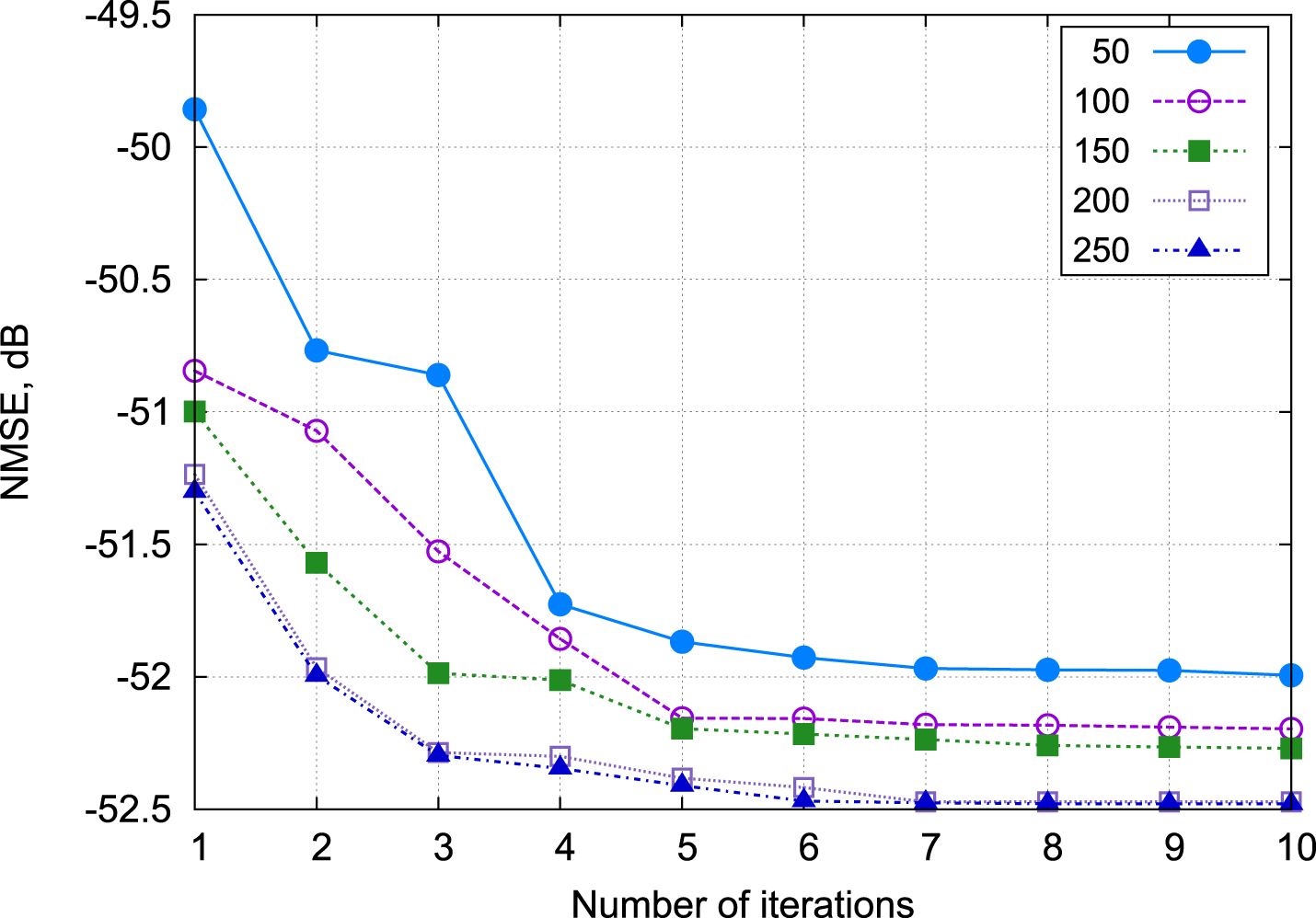
Study of PSO Convergence with Different Population Sizes.
Parameter Range Initialization for MP and GMP models
Parameter Initialization for PSO based Algorithm
The sweep based algorithm is initially applied to derive the optimal PA model based on MP and GMP models with different cost functions and the results are tabulated in Table 5 and Table 6 respectively. These results illustrate that, compared to the NMSE, AIC and BIC based cost functions, the maximum entropy based information criteria such as ME-AIC and ME-BIC significantly reduces the model complexity without compromising the performance. For MP model, the best model is having an NMSE of -47.6974 with a size of 45, whereas the most parsimonious model has an equivalent performance of -47.2136 with 30 coefficients. Similarly for the GMP model, a model with -52.5613 NMSE and size of 75 is the best and the most parsimonious model has an NMSE of -52.3244 with only 49 coefficients are determined with ME based criteria. Hence, for both the MP and GMP models the complexity is reduced around 35% using the proposed ME based IC. Figure 2 and Figure 3 illustrates the variation of model performance (NMSE) with the constant criterion (C) of ME-AIC and ME-BIC for the sweep based MP and GMP models respectively. From Figure 2 and Figure 3, it can be observed that, the NMSE initially reduces and then becomes almost constant after a certain value of C. Based on that, for MP model the value of C for which the algorithm will give the most parsimonious model is chosen as 60 and 160 for the ME-AIC and ME-BIC cost functions respectively. Similarly for the GMP model, the C values are chosen as 60 and 180 for ME-AIC and ME-BIC respectively.
Comparison Between Conventional Sweep Method and Information Criterion Based Sweep Method for MP Model
Comparison Between Conventional Sweep Method and Information Criterion Based Sweep Method for GMP Model
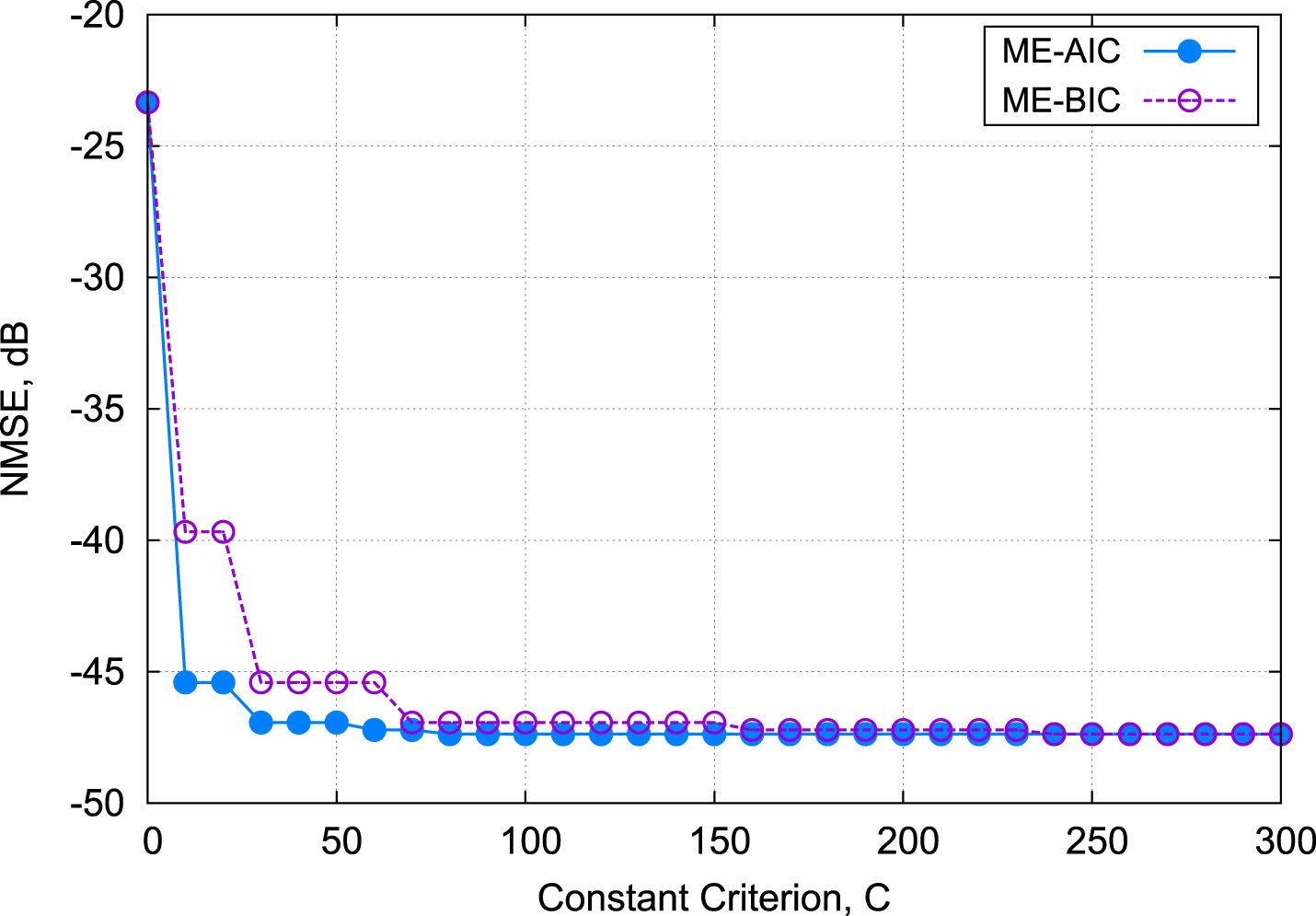
Variation of NMSE with constant criteria (C) for ME-AIC and ME-BIC with sweep based MP model.
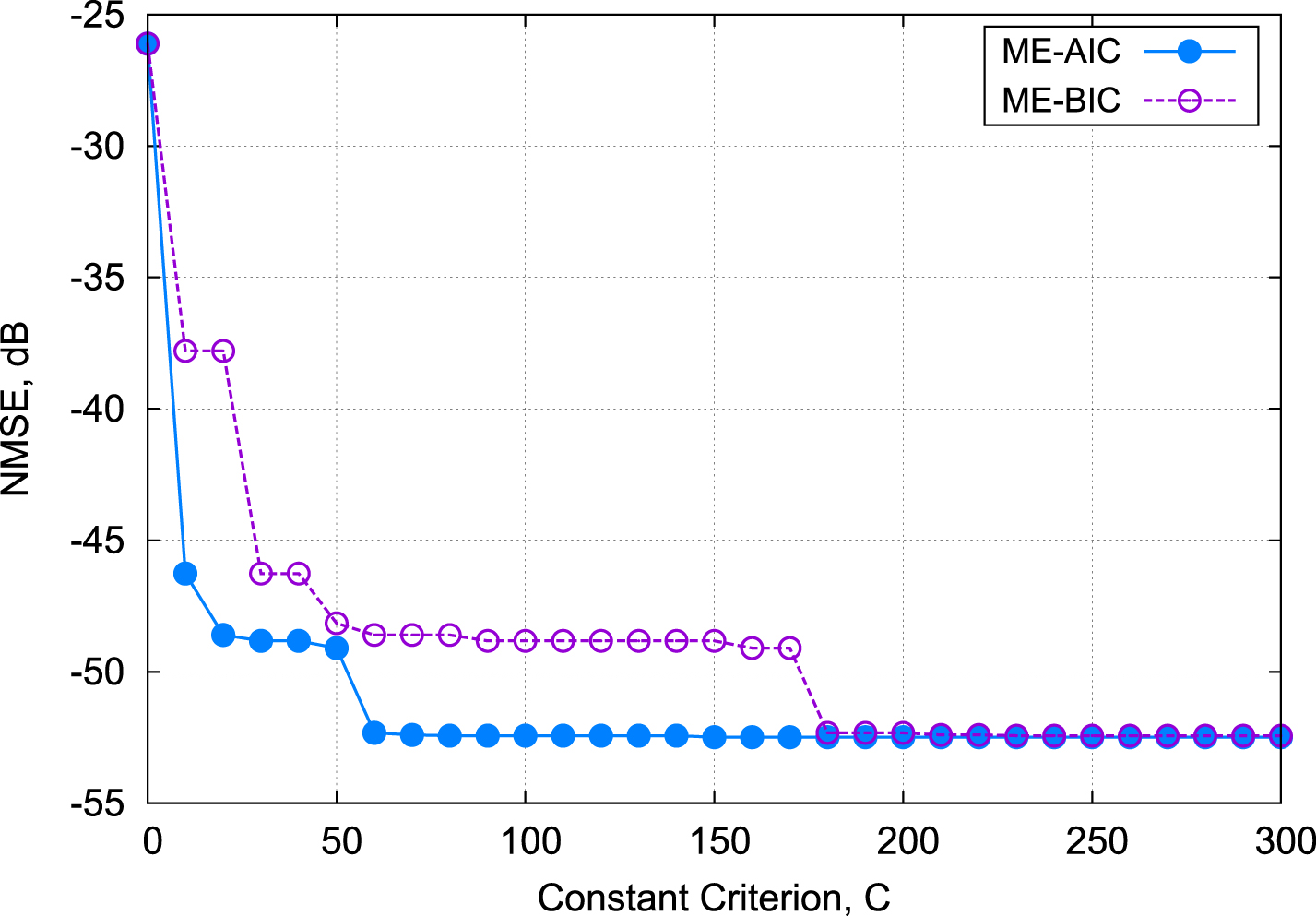
Variation of NMSE with constant criteria (C) for ME-AIC and ME-BIC with sweep based GMP model.
The sweep based approach determines the best solution with the required cost function, since it performs a full-scale search over the provided search space. However, this method takes enormous amount of time to determine the best solution. The CPU time required for estimating the MP model parameters is small, since its optimal structure is determined by only two parameters. On the other hand, the GMP model size is determined by eight different integer parameters and hence it consumes lot of estimation time as shown in Table 6. Hence, to reduce the time for estimating the GMP model parameters, the PSO algorithm is used. The PSO performs a guided random search over 2000 parameter combinations to find the best solution. For the GMP model, the PSO algorithm along with all the introduced cost functions are used to determine the best model and the results are summarized in Table 7. Since the PSO algorithm performs a random search, the solution provided by it is not same all the time. Hence, to ensure consistency the experiment was repeated for 50 times and the results are averaged. Table 7 illustrates that, with PSO based approach there is a significant reduction in time required to determine the best solution compared to the sweep based method. In addition, the information criterion based cost functions helps in substantially reducing the model complexity. It is to be noted that, the minor loss in performance of less than 1 dB comes with a significant reduction in the model size.
Comparison of PSO performance with different Cost Functions
Figure 4 shows the normalized power spectral density (PSD) of the actual input, output and the GMP modeled output waveforms of the PA based on the conventional sweep-NMSE and PSO-ME BIC methods. From Figure 4 it can be observed that, even though ME-BIC based PSO (48) requires only two third of the coefficients compared to the conventional approach (75), there is no significant difference between the modeled waveforms using the two approaches. This clearly illustrates that, applying information criterion based cost function to determine the PA model coefficients helps in deriving complexity reduced PA models without compromising the modeling accuracy.
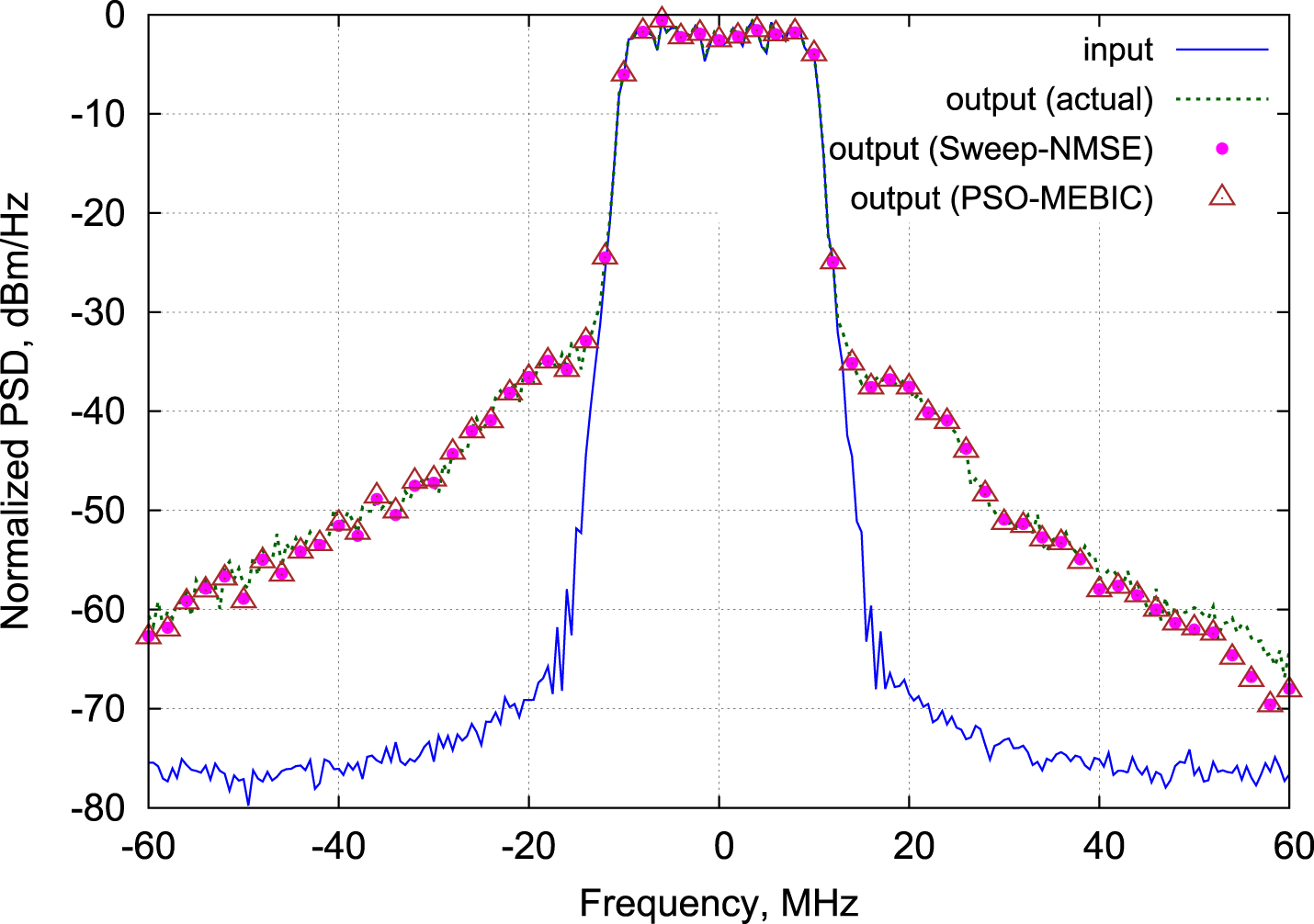
Normalized PSD for GMP based model.
In this paper, different information criterion based cost functions are used in model parameter selection algorithms to derive complexity reduced PA models without significant degradation in model performance. The results clearly indicate the superior performance of the introduced maximum entropy based approaches compared to the traditional approaches in deriving the most parsimonious model. It was found that, information criterion based sweep method reduces the model complexity by 35% without significant degradation in its performance. In addition, the proposed variant of PSO helps in reducing the execution time by almost 1/100 to determine the optimal model parameters. Hence, the proposed approach helps in deriving complexity reduced models at faster time.