



Abstract
Automatic identification systems represent a wide classification of devices used primarily in commercial settings for inventory/logistics control. Familiar examples of such devices are bar codes, magnetic strips, smart cards, RFID (Radio-frequency identification) and biometric and voice recognition. Security is especially lax in low powered radio frequency systems communicating through an unsecured radio wave channel. Security represents a critical component for enabling the large scale adoption of automatic identification systems. Providing an effective security solution for low powered systems is a major area of concern; it directs research towards ‘power consumption aware’ computations in security solutions. This paper proposes a lightweight inter-zonal authentication Protocol for moving objects in low powered radio frequency systems. Formal validation and a thorough analysis of the protocol in SPAN security tool reveal its effectiveness and resiliency to attacks – eavesdropping, reader and tag impersonation, replay and desynchronization.
Introduction
Though identification systems may employ smart cards, magnetic strips, RFID (Radio Frequency IDentification), biometrics and voice recognition, they are currently predominantly barcode systems. Technological advancements impose the necessity for real-time data acquisition, compelling systems to become assertive in terms of tracking and monitoring [1]. In recent times, there has been an increased deployment of low powered RF systems for tracking and monitoring of different objects like assets, humans, vehicles etc. Low powered RF devices provide considerable advantages over barcodes- data can be read automatically without the object being in the line of sight of a reader or system authenticator. Moreover, data can be sent at a rate of hundreds of data units per second, and from a distance of several meters (depending on the area of coverage of the RFsystem).
Open wireless communication channels in RF systems are similar to wireless mobile communications. As a result, the system air interface is susceptible to security threats and attacks similar to those in wireless mobile communications. Security issue becomes a key concern and the systems are designed to provide effective security. Reliable security solutions for RF applications demand security requirements with respect to authentication, integrity, privacy, anonymity, session freshness, synchronization. Interesting threads of research in this direction have been the focus of [6, 28–31]. As RF systems are chiefly low-powered, It is important that the security solutions take into consideration computing overheads. Lightweight schemes become the focus of securing RF systems [4, 18].
A survey in [5–21] examines and bring out several aspects related to low powered RF system security. Security threats to RF systems can be put into several classes [22–24]. Any form of unauthorized access to the objects falls under the category of eavesdropping/sniffing. A rogue authenticator may read confidential data, record it and use it to breach authentication data exchanges. The highest level of security risk to a low powered RF systems network is sniffing/eavesdropping attack [22]. Spoofing attacks involve rogue entities not only secretly scanning and recording data transmissions from a legitimate object but also copying the object’s ID and making itself appear to be valid. Replay attack involves using an object’s response to an authenticator’s challenge to impersonate the object [25]. It can be countered by providing privacy and authentication [1–4, 6].
RF systems use low-cost tag/label for identifying objects and obviously are restricted in terms of storage capacity and computational power. Low powered RF systems need to benefit from lightweight solutions to security. Use of simple operations and limited cryptographic functionalities permit minimum levels of computations and energy consumptions, while at the same time supporting cryptographic goals of security. Security solutions for RF systems can be classified by the weight of cryptographic primitives used- Middle-weight, light-weight and ultra-lightweight solutions. Middleweight solutions [8, 9] for higher security applications (finance, military) use symmetric/asymmetric encryption. Lightweight solutions use cyclic redundancy code (CRC) operator, message authentication code (MAC) and hash function. While research has focused on lightweight solutions for RF systems security, the studies from [13–15] suggest the use of bitwise logical operations, shift operations and pseudo-random number generator (PRNG) which support the least computationally demanding class, the ultra-lightweight.
A lightweight mutual authentication and ownership management schemes are proposed by using limited cryptographic functionality [1]. Rahman et al. [4] presents a lightweight mutual authentication protocol to achieve basic security goals, i.e. confidentiality, integrity and authentication using a unique choice of pseudorandom numbers. Authentication process in [6] introduces timestamps to protect tag privacy and prevent tracking. On the other hand, [2] Osaka et al. propose a lightweight security method that achieves the security requirements using hash functions, symmetric cryptography, and the XOR operation. It achieves distinguishability, forward security, security against the replay attack, and security against the tag killing. The proposed method is reasonably efficient, but vulnerable to tracking and DoS attacks brought out by [16]. Moreover, as brought out in [17], an attacker can add noise to the final message exchange of [2] resulting in the tag holding incorrect secret information, due to which any subsequent authentication wouldfail.
While [1, 2] have not considered mobile RF systems, [3] implements a lightweight authentication for mobile RF system with grouped tags to identify objects. The authentication for tags is based on PRNG. The protocol provides security against reader impersonation/ impersonation attack and tracking. The RF system in Weis et al. [19] hides the object’s identification using random numbers in the object’s responses to avoid its reuse. It is vulnerable to impersonation attacks. Yu et al.’s [20] protocol use a 128-bit key set that is dynamically updated by the server. It uses the LSB 30 bits of the tag ID for authentication. However, this results in the possibility of compromising the security of the system as a whole.
This paper proposes a Light-weight Inter-zonal Authentication Protocol for moving objects in low powered RF systems. The protocol is designed for ‘power consumption aware’ computations in security solutions. The work presented in this paper is divided into 3 phases: System registration phase, zonal authentication phase and a mutual authentication phase. In phase 1, the object must register itself to the system authenticator (SA). The RFID network is partitioned into various zones based on the coverage of the authenticator of the RF system in a particular area. In phase 2 and phase 3, several events of handshakes are performed between both the object and ZA, object and IZA to mutually authenticate each other and start communicating. This protocol can be adopted by object monitoring and tracking systems for providing secure and reliable data exchanges. The protocol has been verified against security attacks which include eavesdropping, spoofing, authenticator and object impersonation, replay and desynchronization by using the SPAN security tool for formal validation of the protocol.
The contributions of the work are: (i) A multi-zonal authentication schema resilient to eavesdrop, replay, authenticator and impersonation and desynchronization (ii) An inter-zonal authentication protocol that mutually verifies the tracked object and the authenticator / reader (iii) A light-weight authentication schema performing PRNG, XOR, and XTEA with very less computation overhead.
The work presented in this paper contributes to ‘power consumption aware’ computations in security solutions. A lightweight inter-zonal authentication protocol for moving objects in low powered RF systems is proposed. The protocol uses ultra-lightweight XOR and PRNG functions for passing and decoding random numbers. Time stamps are used in interactive sessions between an object and an authenticator to keep the freshness of the challenge-response information in each communication round. Two or more handshakes between the communicating devices are defined as an event. Logical Clock (LC) value presents in the communicating devices increments simultaneously on verification of every event. Each communicating device maintains its own LC value. A mismatch in LC value between communicating devices terminates the communication between them. XTEA (Extended Tiny Encryption Algorithm) is used for both encryption and decryption. Wheeler and Needham in [27] made an extension to TEA algorithm (XTEA) which is a lightweight blockcipher.
The rest of the paper is organized as the proposed work, a 3-phase Light-weight Inter-zonal Authentication scheme is discussed in length in section 2. Analysis of the proposed protocol in terms of resiliency to security attacks and performance is presented in sections 3. Formal validation of the protocol using the SPAN security tool is presented in section 3.5. The conclusion is in Section 4.
Research method
RF system architecture
RF systems largely consist of authenticator and objects; both of which are responsible for verifying the identity of each other invariably ensuring communication with only the intended parties. This paper proposes a Light-weight Inter-zonal Authentication Protocol for moving objects in low powered RF systems. The protocol uses a ticket based authentication approach using cryptographic operations-XOR, PRNG (Pseudo Random Number Generation) and XTEA (Extended Tiny Encryption Algorithm).
The multizonal architecture of the proposed protocol is shown in Fig. 1. The architecture includes one SA (System Authenticator) for the entire system. On the onset, the SA registers all the objects to be identified to the system – 1 as shown in Fig. 1. It is structured to encompass many zones, where each zone defines a geographical region of authentication. The system is partitioned into multiple zones, each employing a ZA (Zonal Authenticator) to authenticate inbound registered objects - 2. Each zone allows communication between objects and inter-zonal authenticator (IZA) only after mutual authentication - 3 as shown in Fig. 1. The proposed mutual authentication protocol is organized to operate in three phases System Registration phase, Zonal Authentication and Mutual Authentication phase. System registration of an object with the SA generates an encrypted system ticket and sets the identification of the source zone (IDZONE-S), identification of tag (IDOBJECT) and LC value for the object. The Zonal Authentication of an object with the ZA verifies the system ticket and generates an encrypted zonal ticket. The zonal ticket is used for further authentication of the object by an inter-zonal authenticator. The entities and their roles of the multizonal RF system are explicated in Table 1.
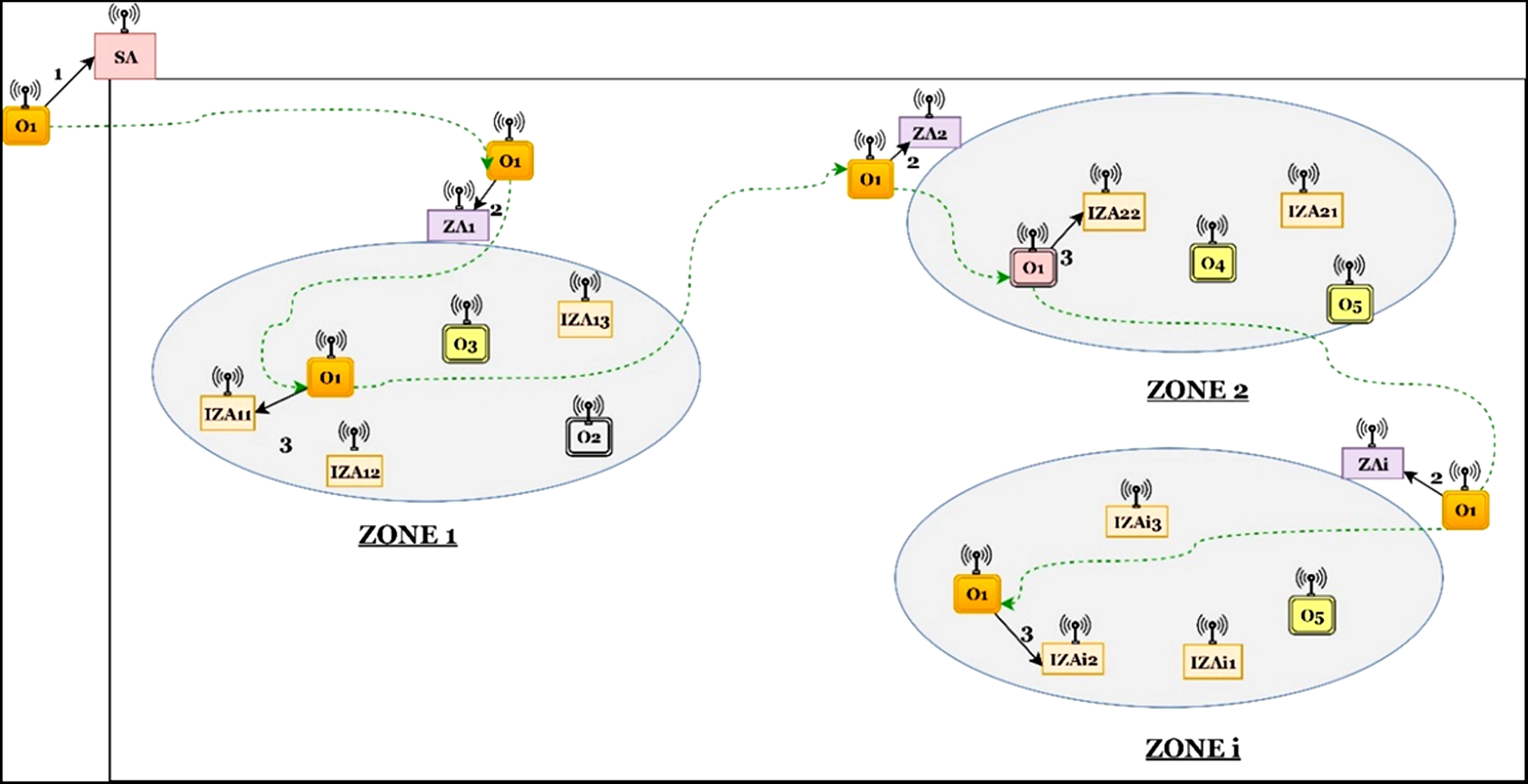
Multizonal Architecture.
Entities and roles
The assumptions made in designing the protocol are: All entities in the RF system namely, object and authenticators trust the System Authenticator (SA) and Zonal authenticator (ZA). The Authenticators (SA and ZA) maintains the list of ticket keys of all the inter-zonal authenticators in the setup. Only the Authenticators (SA and ZA) can access the memory contents of the object to be identified.
The proposed protocol is a three-phase mutual authentication protocol. The first phase is the System Registration Phase that registers an object with the RF networked System, generating a System Ticket. The subsequent phase is the Zonal Authentication phase. It authenticates a registered object when it is inbound into a zone, generating a Zonal Ticket. The last phase of the protocol is the Mutual Authentication phase. It mutually authenticates the object in a zone and the inter-zonal authenticator before any application processing is performed by the reader. Notations and terms used in the proposed protocol are given in Table 2.
Notation and terms
Notation and terms
This phase writes significant data in the memory of the object for authentication to be performed by ZA and IZA. The SA writes IDZONE-s - Identificationnumber of start zone, IDOBJECT- Identification number of object and LC – Logical clock (16-bit integer value, initially zero) into the object’s memory. The SA then sends the system ticket to the object thus registering it in the RF networked system. A registered tag contains the following after the system registration phase: IDZONE-S Identification number of the start zone IDOBJECT- Identification number of object LC – Logical clock (16-bit integer value, initially zero) TicketSYSTEM - (IDOBJECT, IDZONE T0, Tmax, Timestamp, R + S)KZA-IZA
A ticket in the proposed protocol is encrypted using the shared secret key KZA-IZA, between ZA and IZR of a Zone.
The encryption with KZA-IZA is performed to prevent alteration of the contents by any unauthorized entity. IDOBJECT and IDZONE allow verification of the object and zone. The values T0, Tmax and Timestamp permit verification of ticket validity. A ticket is valid only if (Current timestamp – Timestamp in the ticket)< (Tmax - T0). The value (R + S) are 16-bit random numbers generated by ZA. (R + S) serves as one of the components for mutual authentication and is available to IZA via the ticket. LC is a logical clock that keeps track of the number of times handshakes have been performed for an object in a zone.
Phase II: Zonal authentication phase
The RF networked system is partitioned into a number of zones based on the coverage of the RF authenticators, each zone defining a geographical region of authentication. A zone consists of one ZA and multiple IZA’s as illustrated in Fig. 1. Zonal authentication refers to the authentication of inbound registered objects into any one of the zones in RF networked system.
The ZA of a zone accesses an inbound object by accessing its memory and checks for IDZone written in the object at registration or any previous zonal authentication. If the IDZone in the object does not match the current zone, then the ZA sets the appropriate IDZone, issues a zonal ticket for that zone and resets LC for the registered object. If the IDZone matches the current zone, then ZA stores a 16-bit random number S and stores it in the object’s memory. It then queries the object for a ticket; this may be a system ticket or a zonal ticket. ZA checks for the ticket’s validity and authenticates the object. In case a ticket’s validity has expired (invalid ticket), the ticket is renewed at the ZA. After the Zonal Registration Phase, the registered object contains the following: IDZONE - Identification number of the zone. IDOBJECT- Identification number of the object. LC – Logical clock (16-bit integer value). TicketZONE - (IDOBJECT, IDZONE, T0, Tmax, Timestamp, R + S) kZA-IZA
S R ∧ S
As depicted in Fig. 2, a zonal ticket is issued by ZA along with R ∧ S, the XOR of 16-bit random numbers R and S. XOR operation is commutative and associative in nature. An important property of the XOR operation is as follows,

Phase II – Zonal authentication phase.
ZA generates S and stores it in the object’s memory. It generates R and sends R ∧ S to the object. The value of R can be obtained from R ∧ S only if the value of S is known and vice versa. As a result, the object can obtain the value of R from R ∧ S using the value of S stored in it. Using R and S, the object computes (R + S), which serves as one of the components for mutual authentication. It is not possible for an unauthorized entity to obtain R or S from R ∧ S. This property prevents unauthorized/illegal entities from obtaining R and S in order to successfully impersonate as system registered object/authenticator.
XOR and PRNG (Pseudo Random Number Generator) are the main cryptographic operations used in the proposed protocol. The contribution of XOR operation towards securing the proposed authentication scheme has been highlighted in Phase II discussion. PRNG () function generates a random number using a seed. An important property of PRNG () function is that it is a one-way function – the seed cannot be obtained from the random number. This process is detailed in Fig. 3.
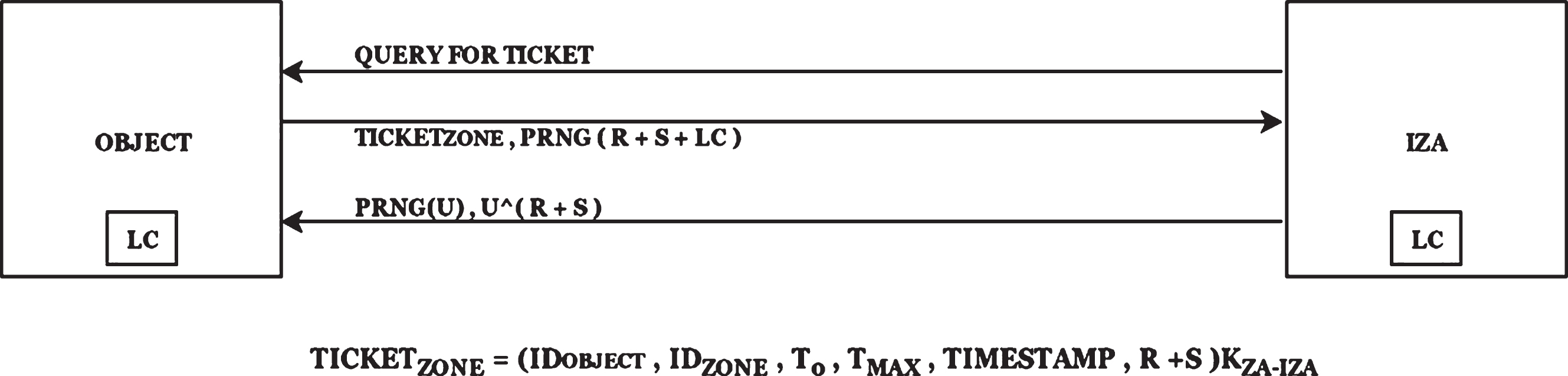
Phase III – Mutual Authentication phase.
It is not possible for an illegal/unauthorized authenticator to obtain the seed (U) and authenticate itself as a legal IZA of the zone. The properties of both XOR and PRNG are exploited to provide a secure authentication protocol that is resilient to eavesdropping attack, authenticator and object impersonation attack, replay attack and desynchronization attack.
The resiliency of the proposed protocol with respect to different types of attacks is analyzed in this section.
Eavesdropping attack
Eavesdropping attack is an unauthorised real-time interception of the communication between an object and an authenticator. An adversary A may acquire R ∧ S, PRNG (R + S + LC) ticket, PRNG (U) and (U ∧ (R + S)) from the communication (Phase II and Phase III) between an authenticator and an object. A successful attack can be performed on the RF networked system if A can perform the following from the intercepted contents: Decrypt the encrypted system/zonal ticket to obtain its contents. Obtain 16-bit random numbers R, S and U. Obtain LC and compute R+S+LC.
The proposed protocol is secure against eavesdropping: The ticket is encrypted using KZA-IZA– The eavesdropper cannot gain any valuable information from a ticket without knowing the shared secret key (KZA-IZR) It is not possible for an eavesdropper to obtain R or S from R ∧ S or U from (U ∧ (R + S)) due to the XOR property in (Equation 1). PRNG () function is a one-way function, as a result of this property, the eavesdropper cannot obtain the values of (R + S + LC), U from PRNG (R + S + LC) and PRNG (U)
Authenticator/object impersonation attack
Authenticator-impersonation refers to a process in which an adversary-authenticator A deceives a registered object to authenticate it as a valid authenticator. Whereas, object-impersonation is the process in which an adversary - object A, deceives a genuine authenticator to authenticate it as a valid object. For authenticator/object-impersonation attacks to be successful, A performs the following: Access memory contents of an object. Obtain contents of system/zonal ticket.
The proposed protocol is secure against authenticator/object-impersonation: Only the SA and ZA can access the memory contents of the objects as assumed in the protocol. Therefore an adversary A cannot access the memory contents of the object. Tickets in the proposed protocol are encrypted using the secret key (KZA-IZA), shared between the zonal authenticator and inter-zonal authenticators in a zone. An impersonating authenticator A has to obtain (KZA-IZA), in order to decrypt the ticket and extract the data needed for authentication.
Replay attack
A replay attack is performed when an adversary (object or authenticator) A, attempts to reuse the authentication component used in a handshake. A captures the authentication component PRNG (R + S + LC) in Phase III and attempts to replay it (later on) in another authentication session with an authenticator. Logical Clock LC is incrementing software counter maintained in each process by which the happened-before ordering can be captured numerically [26]. LC is used in the protocol to resist replay attacks. LC values are updated for each authentication by both the object and IZA. For replay attack to be successful, A must have the correct LC value of a particular authentication session. This is not possible as the LC value is updated after every handshake in phase III. In Fig. 4, LC is updated to LC’ by both the object and IZA after handshake in phase III. It illustrates a replay attack, where A replays TICKETZONE, PRNG (R + S + LC) captured from the session #n during session # (n + i) Since LC ≠ LC, the authentication fails.
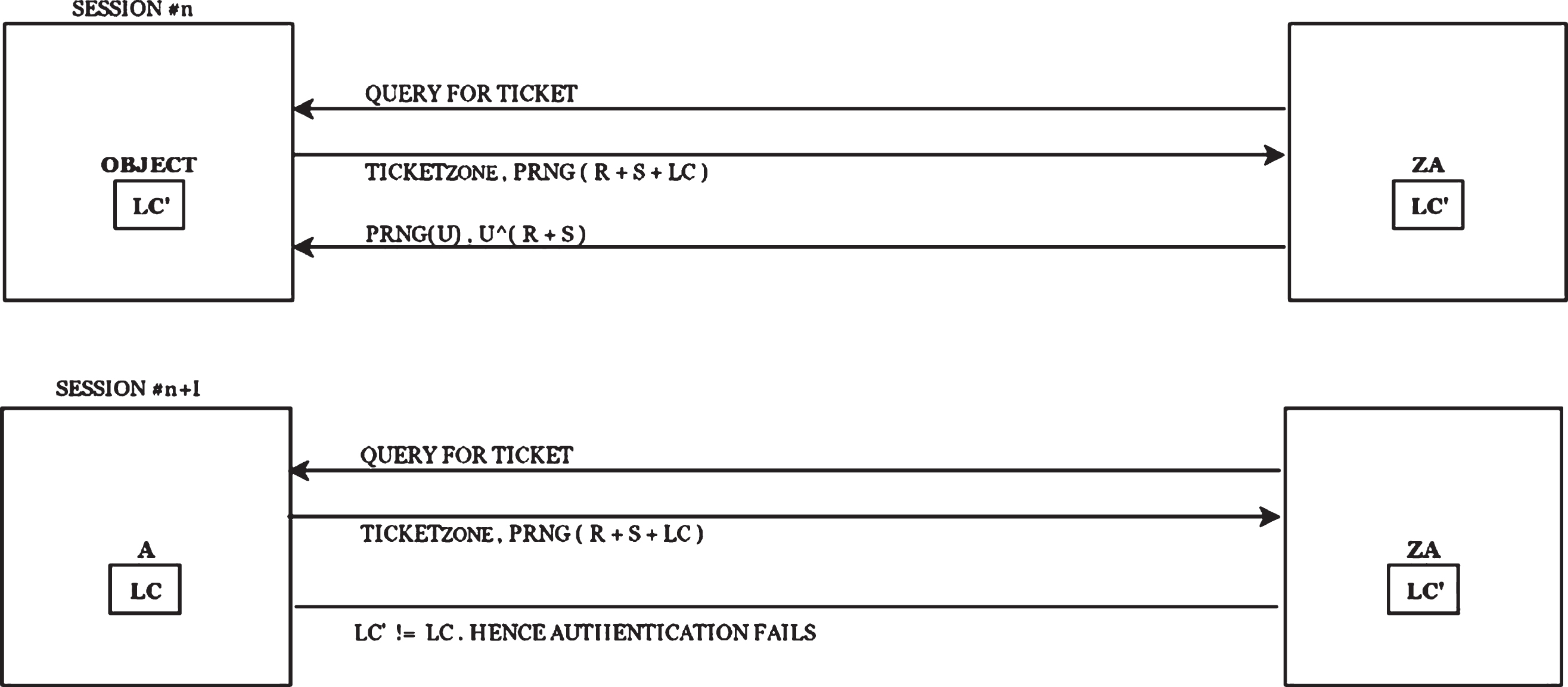
Replay Attack.
An adversary A performs a desynchronization attack with intent to disrupt the authenticationprocess.
A desynchronization attack on the RF system forces the object and authenticator to update their common values to different values. In the proposed protocol, LC is a logical clock that keeps track of the number of times handshakes have been performed for an object in a zone. The LC values are updated by the object and the IZA only after a successful handshake in Phase III. A desynchronization attack can be successful if the LC updation is desynchronized; LC in the proposed protocol is not updated if the handshake in Phase III is unsuccessful. As a result, the adversary cannot perform a desynchronization attack to disrupt the authentication process of the proposed protocol.
Performance analysis
The man-in-the-middle attack is possible when an intruder tries to monitor and turns the trusted packet into the malicious one in the communication medium. In the proposed scheme, the communication is secured by encrypting the message with the help of the recipient’s public key and applying cryptographic hashing. The packet can be decrypted using the recipient’s private key which is kept a secret among anyone in the network (see step 6 and 8). Thus, the man-in-the-middle attack is impossible between the communicants mentioned in the proposed scheme.
An analysis of the proposed protocol in terms of resiliency requirements against eavesdropping, impersonation, replay, and desynchronization is illustrated in Table 3.
Comparison of related protocols
Comparison of related protocols
The performance of the proposed protocol is analyzed for the time complexity of the operations (TXOR - time complexity of the XOR operation, TRNG - time complexity of the random number generation operation, TPRNG - time complexity of pseudorandom number function, TEDC - time complexity of the encryption/decryption cryptosystem) used in mutual authentication. Table 4 projects the total time complexity at an object and anauthenticator.
Analysis of the proposed protocol
The proposed protocol performs 2 XOR operations at the object in Phase II and III, 2 XOR operations at the authenticator in phase II and III. Accounting for a total of 4 XOR operations performed by the object and authenticator at the end of phase II and phase III. The total of 2 PRNG operations is performed by the object in phase III, 2 PRNG operations at the authenticator in phase III. Accounting for a total of 4 PRNG operations performed by the object and authenticator at the end of phase II and phase III. Two random number generation operations are performed at the authenticator in phase II. Only one encryption/decryption operation is performed at the authenticator in phase II and phase III. Therefore, a successful mutual authentication in a zone requires a time complexity of 2TXOR + 2TPRNG at the object and 2TXOR + 2TPRNG + 1TEDC + 2TRNG at the authenticator. Object’s data/information may be required to be processed by more than one authenticator in a zone, accounting for multiple authentications. The number of times (x) an object is authenticated in a zone accounts for a total of x * (4TXOR + 4TPRNG + 1TEDC + 2TRNG).
The performance Analysis of MKT phase (mutual authentication, key update and ticket computation) in [1] is analysed.for the time complexity of the operations (TXOR - time complexity of the XOR operation, TRNG - time complexity of the random number generation operation, TPRNG - time complexity of pseudo-random number function, TPER - time complexity of permutation operation, TMOD - time complexity of modulus operation) used in mutual authentication.
Table 5 shows the total time complexity at a tag identifying the object and a reader (authenticator). The protocol in [1] performs 75 XOR operations at the tag in MKT phase, 63 XOR operations at the Reader in MKT phase. Accounting for a total of 138 XOR operations performed by the tag and reader at the end of MKT phase. The total of 72 PRNG operations is performed by the tag in MKT phase, 36 PRNG operations at the Reader in MKT phase. Accounting for a total of 36 PRNG operations performed by the tag and reader at the end of MKT phase. 12 permutation operations, 2 Random number generation operations are performed at the reader in the mutual authentication phase. 6 modulus operations are performed at the tag in the mutual authentication phase. Therefore, a successful mutual authentication requires a time complexity of 75TXOR + 36TPRNG + 12TPER + 6TMOD at the tag and 63TXOR + 2TRNG + 36TPRNG at the reader. The performance analysis in Tables 4 and 5 infers that the proposed protocol in this paper functions with a lesser time complexity compared to the MKT phase of the protocol proposed in [1].
Analysis - mutual authentication, key update and ticket computation in [1]
SPAN is a security protocol animator for HLPSL and CAS+ specifications that are similar AVISPA (Automated Validation of Internet Security Protocols and Applications). It facilitates the analysis of large-scale Internet security-sensitive protocols and applications. SPAN implements an active intruder that allows interactively finding and building attacks over protocols. SPAN automatically builds an attack message sequence chart on HLPSL and CAS+ specification of the protocol using the AVISPA verification tools. CL-AtSe is one such AVISPA verification tool. It is an efficient versatile automatic analyzer for the security of the cryptographic protocols. State-based security property like secrecy, authentication and fairness can be modeled using the CL-AtSe tool and the algebraic properties of operators like XOR or exponentiation are taken into account with fewer limitations compared to other tools, thanks to a modular unification algorithm.
The intruder simulation of the proposed protocol is done using SPAN. The protocol was found to safe from intruder attacks. In addition to the intruder simulation, CL-AtSe tool verification for the proposed protocol was performed. The proposed protocol was found to be secure against attacks simulated by CL-AtSe tool.
Conclusion
In this paper, a light-weight inter-zonal authentication Protocol for moving objects in low powered RF systems. This was done by employing the ultra-lightweight the PRNG function and XOR operation. Such use of a simple operation adds a minimal level of computation and energy consumption for low-powered RF systems while, at the same time, supports the cryptographic goals of the protocol. The proposed protocol was verified for security attacks and was formally validated using the SPAN security tool. Analysis of the proposed protocol and comparison with previous works in Section 5 and 6 indicate the following: (i) no disclosure of secret information (ii) no dependency on previously used secret data/information (ii) resiliency against sniffing/eavesdropping, and replay attacks is guaranteed (iv) the protocol is free from desynchronization issues (v) lower computational complexity (vi) lower time complexity.