



Abstract
The natural activities and human thinking forms the basis for fuzzy logic which presents based on different application perspectives. The performance of various energy storage systems life time can be improved by utilizing fuzzy logic controllers and back up in a hybrid power system especiallywhile usingrenewable sources. The Load Frequency Controllers (LFC) using classical control techniques are tuned based on trial and error methods.Also, when system complexity increases controller gives slow response, by considering the fuzzy intelligent control these system performances are improved. A soft computing fuzzy technique is employed to maximize the efficiency from solar panel to give maximumpower output.The various applications in power systems relating to energy storage system performance for energy management, controller for controlling the load-frequency in multi-area power system and for solar systems by considering the tracking efficiency which are utilized for synchronization into the grid.The fuzzy logic provides better improvement and efficiency when compared to conventional controllers. These controllers do not have any specific or particular procedure to implement in various applications. A brief review to fuzzy logic controllers (FLC) for energy storage systems LFC and PV solar MPPT is presented.
Keywords
Introduction
Fuzzy is a soft computing technique formed with a set of linguistic rules, tells about the operator control algorithm which is used in many real industrial applications. The fuzzy control started as the most predominant in various applications for research by fuzzy sets [1]. The difficult defined processes which can be controlled by a human operator who is skilled led a way for using fuzzy control effectively. The fuzzy control based on logic is fuzzy logic, when compared to logical systems operation traditionally these are very close to natural language and human thinking. FLC (Fuzzy Logic Controller) is a linguistic approach which can present a real-world application effectively when compared to crisp set control strategies [2]. Compared to conventional control algorithms FLC gives better response for a complex system. The processes implemented using FLC seemed to be useful but are difficult for study when processes alone are considered with the help of traditional techniques.
FLC has no procedure for implementing, the systematic way of calculation is indefinite during utilization of fuzzy sets which provide the basis. Figure 1 shows the basic structure of FLC consisting the main blocks. The knowledge base helps as a main resource or input during fuzzy. The two different interfaces, fuzzification and defuzzification interfaces mainly depends on knowledge base which helps the decision-making logic to build a path between fuzzification and defuzzification interfaces. These all four together forms a basic structure for an FLC. The controlled system with the help of defuzzification interface build the process (or) the output state for fuzzification. Fuzzification is the quantity measured is transformed subject to valuation to a value which can be defined to map from an input space, which is observed through fuzzy sets by using specific input. It transforms the crisp value into fuzzy with in a specific universal set [3]. The random noise disturbs the observed data, the fuzzification operates must help output in the form of fuzzy numbers which should be converted from probabilistic data, the calculated efficiency is modified as fuzzy numbers are easier to control when compared with random variables. The idea of hybrid operation of numbers is used during fuzzification strategy which comprises randomness and uncertainty. Knowledge base the fuzzy control rule and data base together form a knowledge base for an FLC [4]. The fuzzy data calculation and fuzzy control rules in FLC are the basic concepts linked with the data base. The correct option for membership function of term sets a vital role in application. Each process for a state should be able to conclude a proper control in fuzzy control algorithm which is called completeness. This leads to rule base, data base or both for an FLC. Rule base strategy is based on the FLC rules whereas data base on primary fuzzy sets [5]. The optimal control rules by limiting system response to an instructional fuzzy band was specified with the help of fuzzy rules by an instructive algorithm proposed by Mamdani, he also proposed another method of rule base called scale mapping for justification of rules.
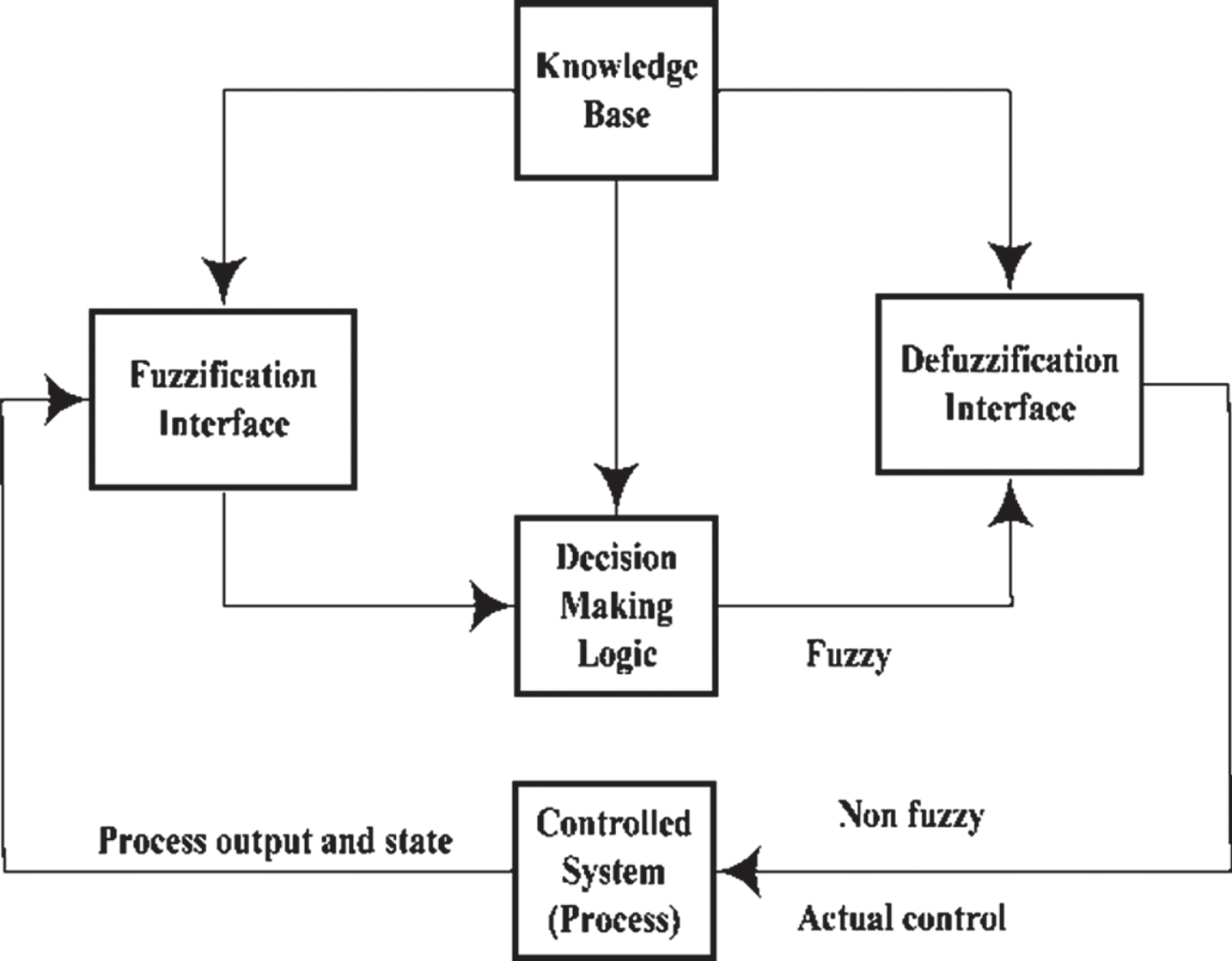
Structure of FLC.
The various fuzzy logic-based approaches are being discussed in further sections briefly. The different energy storage systems utilized for energy management with the help of FLC are discussed in Section 2. The FLC based LFC for better improvement of stability of the system by reducing the settling time and peak over shoot in Section 3. In Section 4, the optimal tracking of power and improvement of efficiency for solar with FLC is discussed.
The dynamic stability of the power system is enhanced with an energy storage unit Super Conducting Magnetic Energy Storage System (SMES) [6]. A controller utilizing fuzzy logic is considered to produce a signal for SMES unit to flow the power from or to it. The rules are adopted continuously as per the system performance. The derivative and speed deviation are minimalized for forming the cost function. The effectiveness of faults in the controller is verified which are created in a transmission line at different positions. A power system with single machine infinity bus connected to a load through parallel lines a SMES unit is connected at the generator bus bar to improvise the system stability. As shown in Table 1 after fault clearance the dynamics of system is improved with the help of adaptive fuzzy logic control. The SMES unit performance along with adaptive fuzzy logic controller at the center of the transmission line for the same disturbance. A significant improvement is attained in both double and single line operations. The energy requirement for SMES is less when associatedwith the PI controller. The saved SMES energy which is in large amounts with Adaptive Fuzzy Controller (AFC) parallelly to maintain response same as from the PI controller with less settling time.
Comparison of Adaptive fuzzy control and PI control SMES unit after fault
Comparison of Adaptive fuzzy control and PI control SMES unit after fault
The energy system comprising of Photo Voltaic (PV), fuel cell and wind is prevised for carrying energy at best efficiency. The controller employed is fuzzy control based which is emphasized to reach maximum power to track for wind and PV energies for delivering peak power to fixed voltage at the DC bus [7]. The load is being supplied by the bus having fixed voltage, but the more power produced is fed to the electrolyzer for generating hydrogen to supply fuel cells. The flow of power within the system components for satisfying load requirements during day of operation is designed for the management system. The generated power from PV and wind systems is studied, hydrogen generated is utilized, stored and also the produced power by fuel cells for supplying the deficit in the load demand. The fuzzy controllers proved the accuracy with the help of simulation results.
The uncertainty of solar led to development of fuzzy logic controller for transferring power to critical loads during which the batter also helps to supply these critical loads rather than normal loads [8]. The controller used for dispatch economically provides better charging of the battery to supply critical loads at a maximum extent. The controller is also optimized for better energy transfer utilizing Particle Swarm Optimization (PSO) algorithm. As shown in tables the performances of different control techniques to encounter the critical load, non-critical load and battery charging average percentage are shown. In the Figs. 2–4 a case study for three areas are considered where the critical loads are met more percentage by using optimal fuzzy controller. The life span of the battery can be increased where the total battery discharges is less for FLC where the FLC is optimized in addition which is found by other researchers too. The battery average percentage of charge is also increased using fuzzy optimization which in turn decrease the average depth of charge which improves the battery life time expectancy.
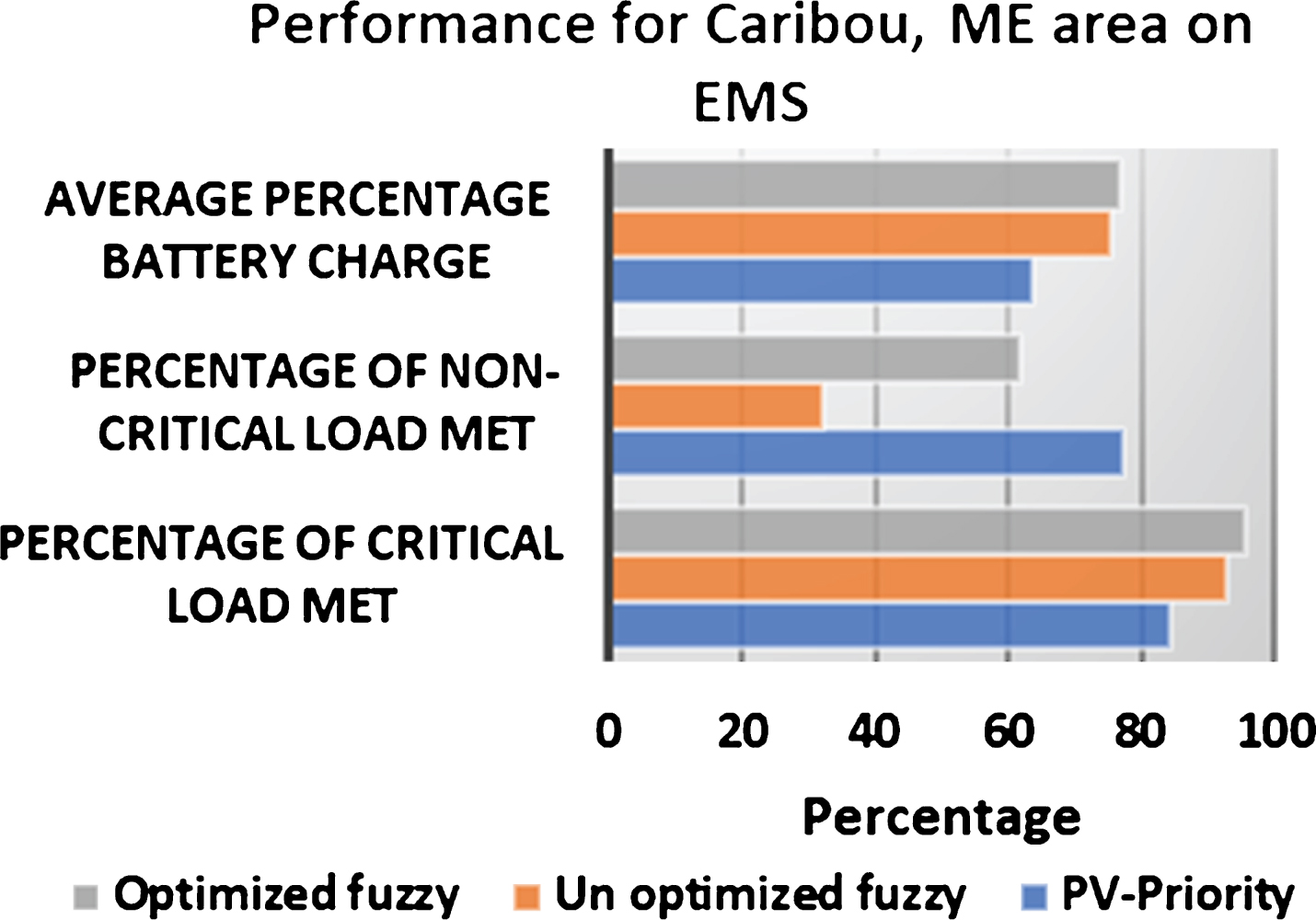
Summary of control performance for Caribou, ME area.

Summary of control performance for Omaha, NE area.
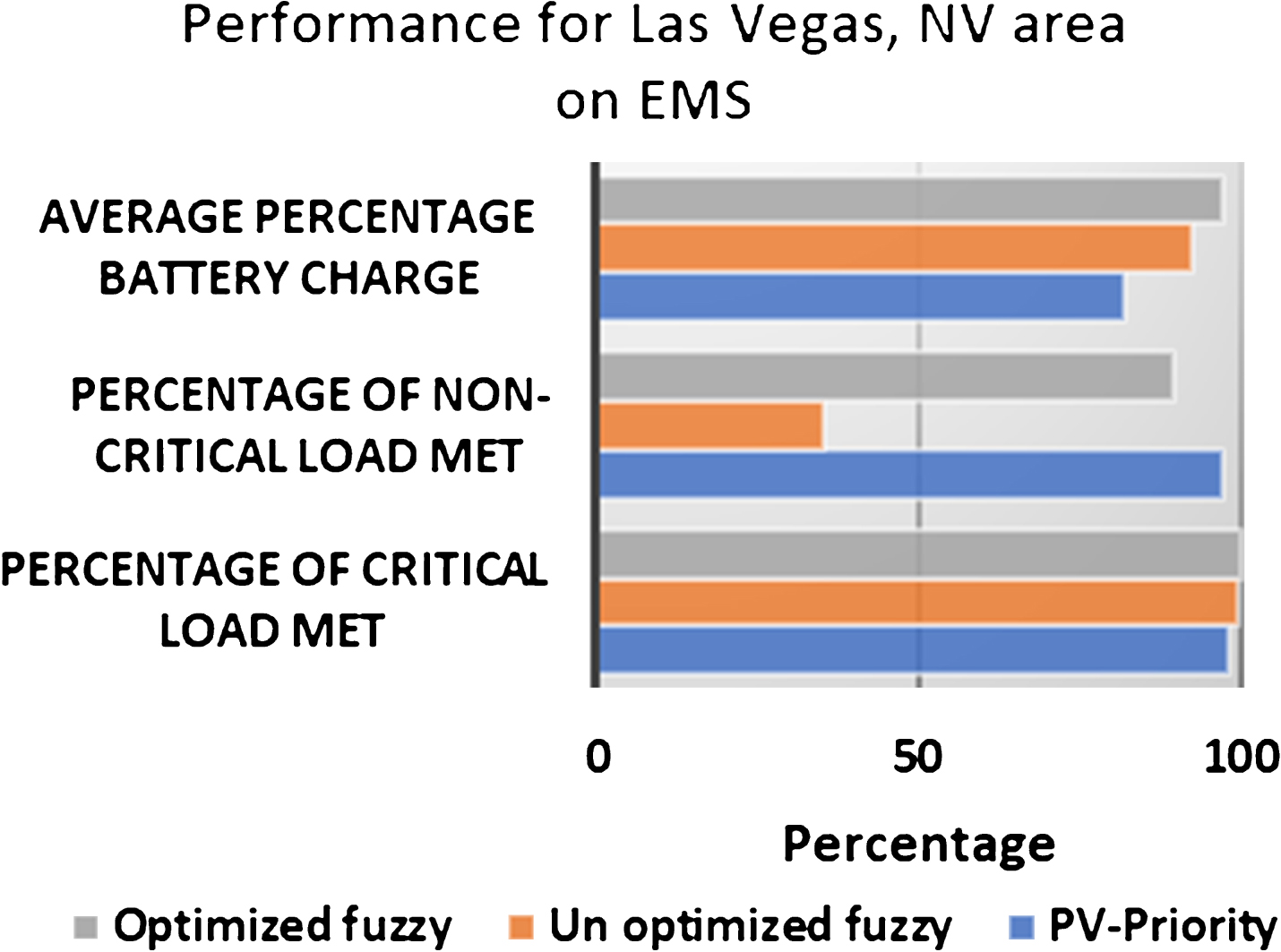
Summary of control performance for Las Vegas, NV area.
The controller utilized for diesel wind hybrid system is proposed which is based on linguistic borders and hybrid algorithms comprising genetic and simulated annealing. The concept is dual mode based incorporated with the projected controller [9] as it could improvise the system performance. The proportional plus integral along with controller using fuzzy logic are compared with their results with the simulated system. The robustness and sensitivity analysis of controller was tested and results proved proposed controller effectiveness.
The operational cost of hybrid renewable energy system is optimized by using a fuzzy logic controller [10]. The hybrid system comprises of wind, PV and two energy storage units where one is battery unit and other unit is fuel cell. The excess amount of energy generated after meeting the load demand from the dc bus is being utilized for charging of hydrogen electrolyzer. According to the generation and load variation and state of charge the FLC controller will generate a signal to manage the power in such a way to lessen the system cost.
A fuzzy control, to control the power generation from Battery Energy Storage System (BESS) in a micro grid consisting of diesel generator and renewable sources along with energy storage system and fuzzy PI controller is utilized to control the diesel as well as BESS power output to control the load frequency control in island mode of microgrid is tested [11]. A fuzzy PI control for energy storage system is shown in Fig. 5. A PWM converter is controlled by generating pulses bade on the grid reference real and reactive powers. A reference power is compared with grid values and the error value is given to PI control and difference with derivate error is given to FLC and then it generates a pulse to PWM technique.

Fuzzy PI control for BESS.
An energy management system for a residential application using classical logic control switches to ON/OFF one source at a time. The advantage of this control is its simplicity, the disadvantage with this control is power failure due to variation of load and overflow due to loss of energy. This drawback suggests fuzzy logic controller which provides various ways of connecting the energy produced from sources and energy storage [12]. FLC is modelled for 9 output combinations to the given 4 input combinations where inputs are LOAD, PV, WIND and battery powers as shown in the Fig. 6 A 81 set of rules are considered for optimum operation of smart controller.
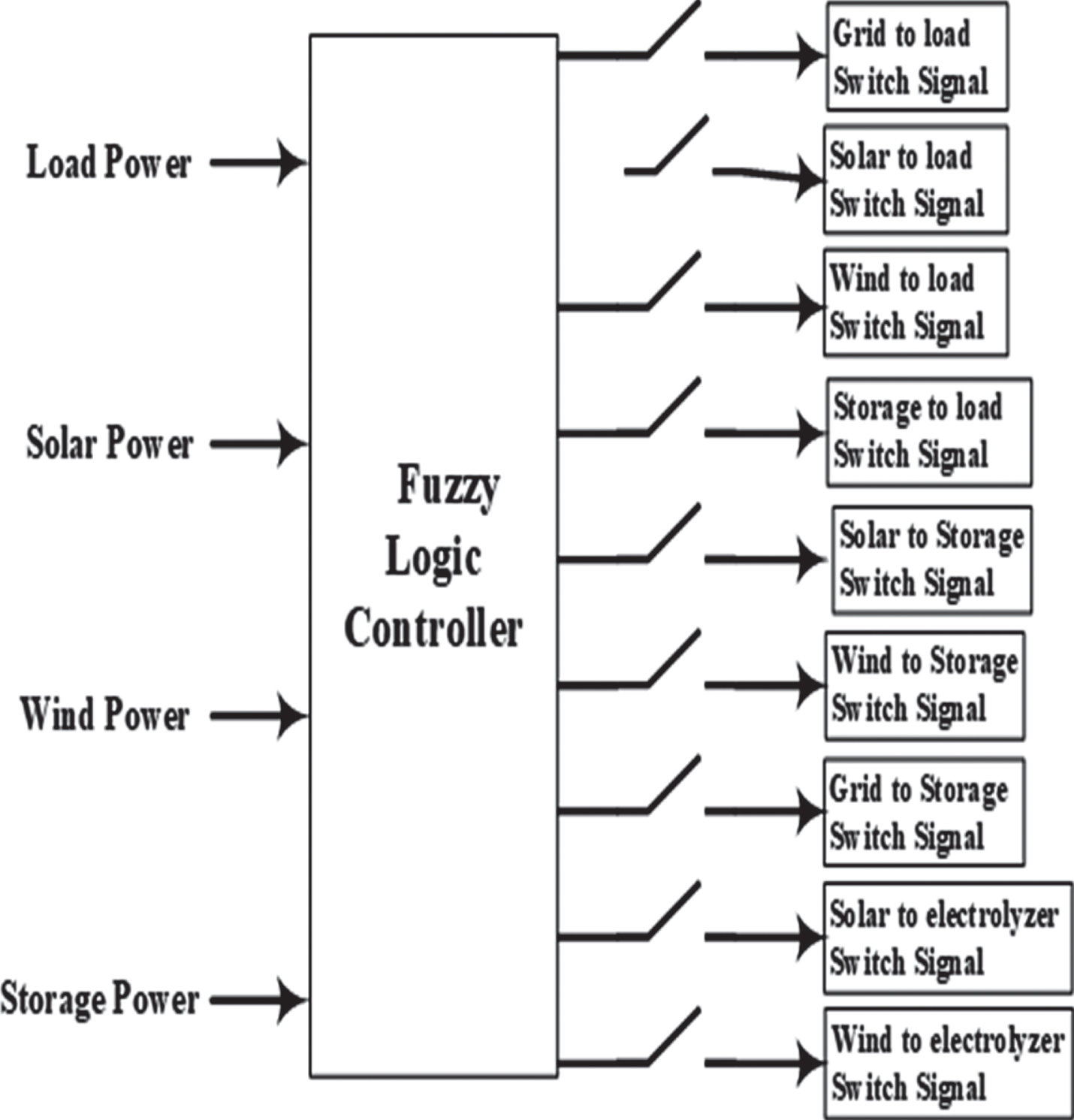
Swathing strategies from FLC.
The solar and wind energies are primary sources for meeting the load demand. The battery and grid finally feed the load only when solar or wind couldn’t meet the load demand. The storage power comes into action due to the uncertainty of solar and wind power. In this situation the grid as well as storage power fetches or meets the load demand but in the presence of solar or wind when they are meeting load demand, the grid supplies power to energy storage for charging. The solar and wind fed to hydrogen system only when there is excess of production of power.
A power management is made for a hybrid energy power system along with a battery storage system with an intelligent logic control using fuzzy, it enables the power sharing firstly according to generation as well as load demand, in the next stage it controls the state of charge of battery to control the blackouts [13]. FLC will give signals to each generating station according to weather and load demand it will switch on the generation and supply to bus.
An energy management system for battery and SMES is considered using FLC. In this hybrid storage system, the charging current and discharging current of battery is controlled with respect to State of Charge (SOC) of SMES [14]. Compared to low frequency filtering method fuzzy will give more constant battery current due to which life time of battery will increase.
The energy management strategy is used in hybrid system for a standalone application which comprises of a PV, fuel cell and storage system with battery and super capacitor bank. The DC bus voltage is maintained to be constant using nonlinear differential flatness based fuzzy logic control [15]. The combination of super capacitor high power and battery having high energy content seems to be effective due to low specific energy in the batterie. the double layered charging helps in providing more energy due to high specific energy in super capacitor.
The energy management of the grid connected hybrid system is evaluated using ANFIS. The ANFIS based supervisory control is used for management of energy in the hybrid system where battery and hydrogen storage combinely supplies the demanded power by the grid after wind and PV are taken into consideration for generation of power [16]. The controller working based on ANFIS is used for transfer of power by controlling the reactive and active power variables and is compared with the classical PI controller to show the usefulness of the energy management system.
The energy management levels of a PV based storage system with combination of supercapacitors and batteries using fuzzy logic controller is presented [17]. The motive is to uphold voltage constant of the DC bus and supply the required power to load by maintain the SOC of both the devices and reliability of the supply is met with an optimal power flow within the two storage systems.
A hybrid microgrid with both AC and DC grids are connected with a bidirectional converter to transfer the power between the two grids [18]. In ac microgrid wind generation and diesel generator with ac loads are considered and a PV with dc loads are considered in both the microgrids energy storage system of battery banks. A supervisory control of fuzzy logic control is considered to utilize the maximum power from renewable sources by meeting the load demand in both the grids as well as maintaining the SOC of battery banks without any interruption of power supply. the fuzzy controller helps in managing the soc of battery to extend the lifecycle of the battery. The fuzzy controllers are used for optimized energy management as well as for air supply control in the fuel cell [19]. The imbedded fuel cell is used for energy management.
The lithium ion batteries connected in series are controlled by fuzzy logic with the help of battery equalization scheme which is a bi-directional converter used for energy transferring [20]. The input current battery distortion is improved by using a converter which is ripple free. the membership functions are framed to describe equalizing behavior of the cells by fuzzy logic-controlled method with in specified equaling region to rapidly balance the cell voltage.
In a islanded hybrid power system the energy management between three energy sources are controlled in three steps, in the first step a neural network feed forward technique is utilized to acquire maximum power from different PV panels, in the second step a fuzzy control is used to manage the power in the system in such way that charging and discharging of cells, in the third step a controller locally is used to improvise the battery/cell performance by limiting them to their set points [21]. The proposed control strategy gives better control compared to conventional techniques and it can be used in a smart house to get better optimizing performance.
A distributed generation with PV, fuel cell and a super capacitor is considered for high power application with a parallel converter from PV, fuel cell and super capacitor respectively [22]. Solar PV is the primary generation FC is a backup for solar and a axillary source to supply the deficient energy. fuzzy logic control is utilized to control the DC grid voltage regulation to supply reliable and power supply.
The hybrid energy storage system for a navel application is controlled using fuzzy logic control in which high power converter to change the power flow from storage or from source to particular common point [23]. The fuzzy logic control using software simulation is validated by maintaining stable voltage and energy management as power electronic devices are highly transient in nature.
The energy management in an energy storage system to supply a peak demand in a shipboard with a medium voltage system is considered, the battery and a super capacitor is connected to load with a DC–DC bidirectional converter along with dual active bridge [24]. Whenever a change in voltage or power in the system fuzzy logic control provides an immediate response in charging and discharging of energy storage devices through the dual active bridge converter. the whole system is modeled in the sim power system and the results were compared with the PI controller of energy management system.
The battery bank is used in island wind energy conversion system for maintain DC bus voltage constant. As wind and load in the system are dynamically changes, the wind generated output is converted to DC and DC link is connected to battery bank to provide constant dc voltage [25]. The charge and discharge of battery is controlled using fuzzy control and PD controllers and compared with each other a fuzzy control will give better soc compared to PD control.
A method using Emotional Learning based Intelligent technique for a two-area interconnected power system with GRC is used [26]. A neuro-fuzzy controller with a power change error as an input to it is taken which also uses a fuzzy critic along with ELI to tune the fuzzy controller to give better response for the system and these responses are compared with the PI, fuzzy and hybrid neuro- fuzzy controllers.
An optimal rule base fuzzy by means of c-means clustering algorithms method for LFC [27]. The rule-base for the fuzzy controller is obtained by inputs of phase plane plot in the linguistic form. It is applied to two area power system consisting GRC system with uncertain parameters and at various disturbances and finally, it is related with PI and original fuzzy controller.A type -2 fuzzy controller for a two-area power system with SMES units of a two-area reheated thermal system [28] which also considers boiler dynamics, SMES and GRC. The benefit of this controller is having more sensitivity to large disturbances. The operation of the type-2 fuzzy controller is validated with fuzzy PI controller and optimal PID controller with considering GRC, BD and SMES. The settling time and peak overshoot of the different areastie line power in p.u. and change in frequency is shown in Figs. 7 and 8. respectively. Simulation analysis shows the high robustness of the planned SMES controller with less power availability against various changes and system disturbances in related with SMES in last research.
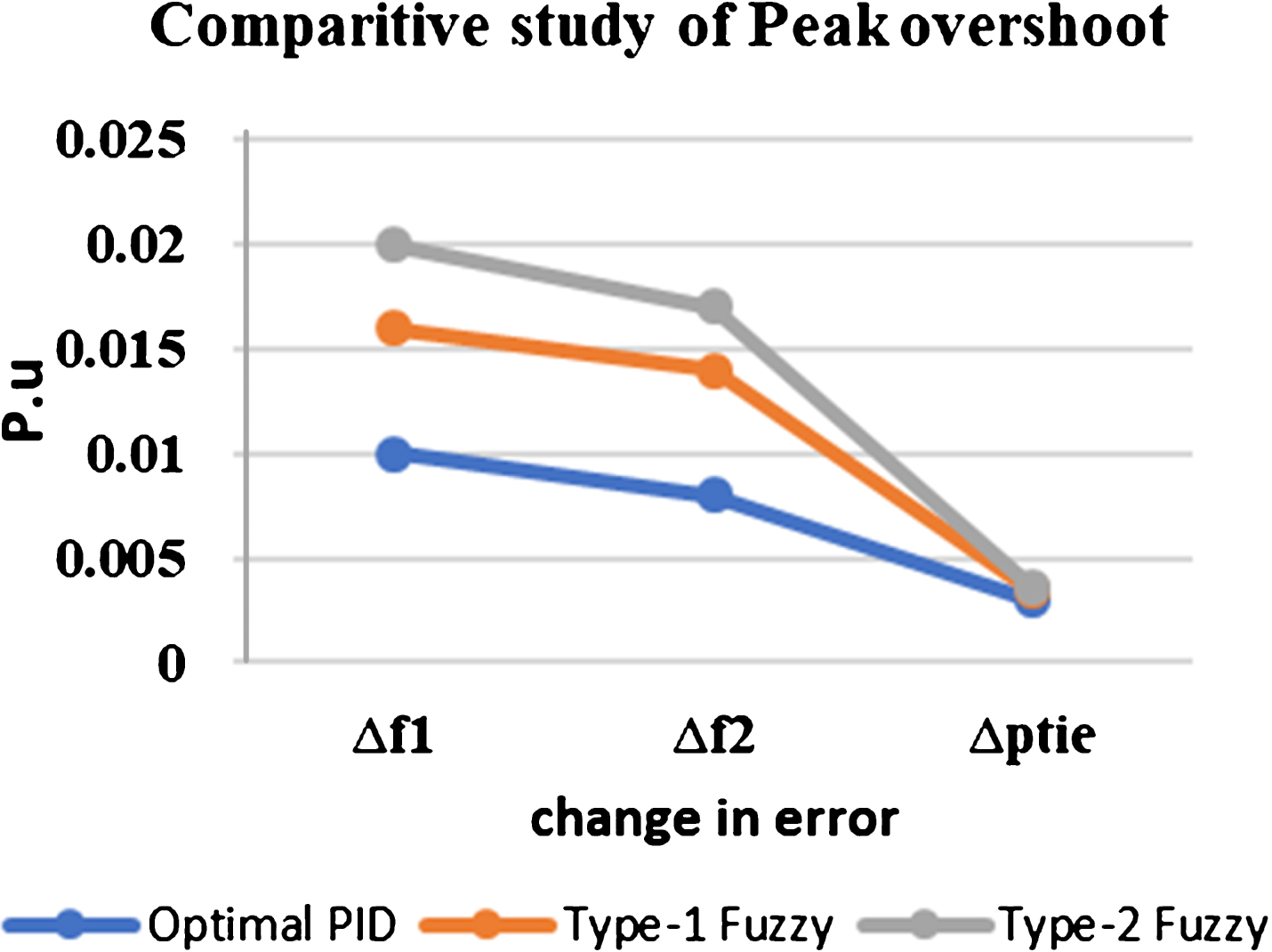
Comparative study of peak overshoot for different control techniques.
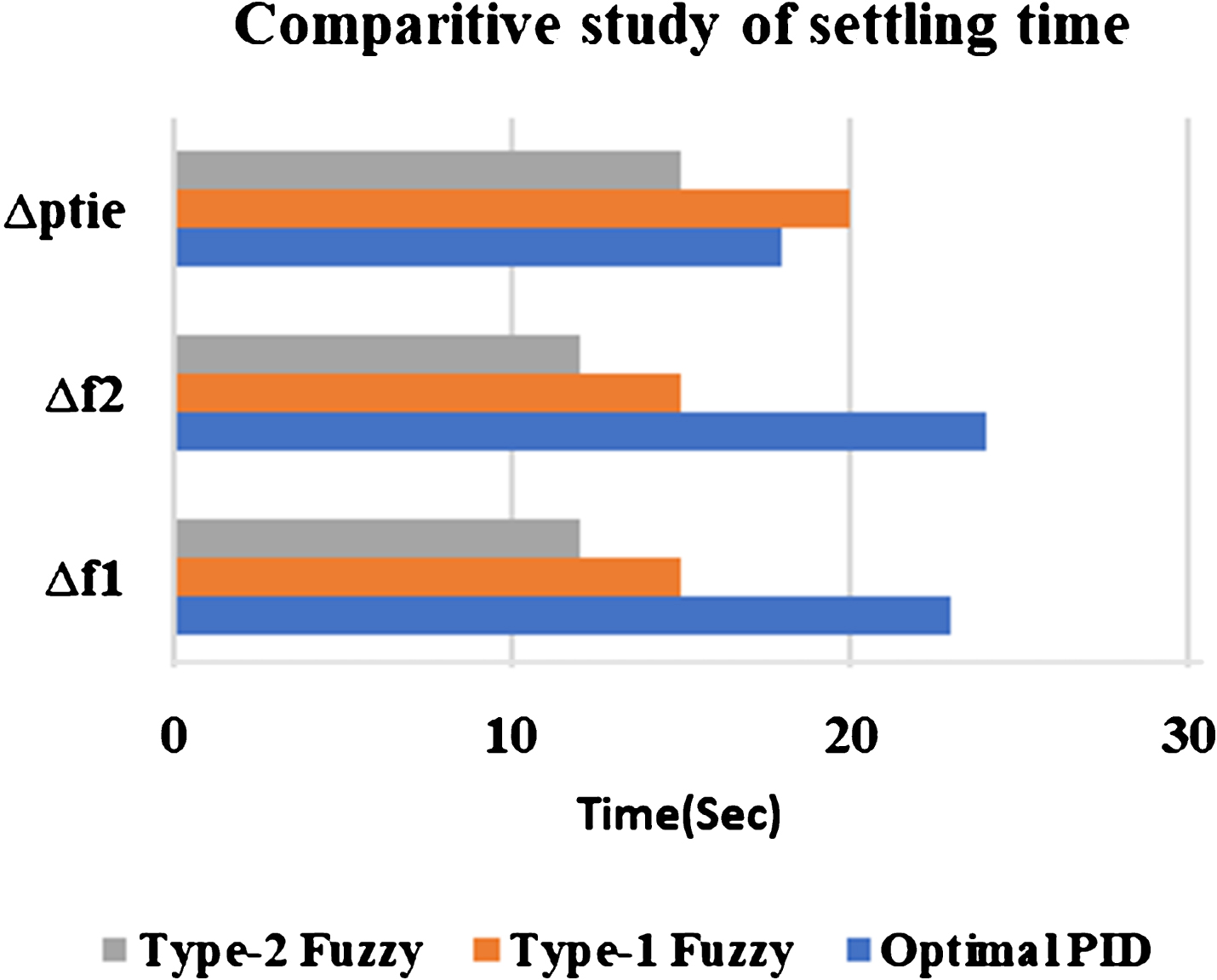
Comparative study of settling time for different control techniques.
A fuzzy gain schedule for PI controller is used to control the load frequency for a multi-source multi area power systems [29]. In general PI controller is used due to its various benefits, in recent trends various tuning methods are used like Ziglar Nicholus method, genetic algorithm is used for PI gains, but these gain values are fixed to system conditions, but by using Fuzzy Gain Scheduling (FGS) which can tune for different system conditions. The LFC is analyzed for Z-N, GA, FGS, which gives better performance compared to all the control techniques.
An Indirect Adaptive Fuzzy Logic control for an interconnected multi area power system with unknown parameters like wear and tear of equipment and unknown parameters of interconnected like variations in synchronous power are used [30]. The control parameters of the controller are obtained from formulating the appropriate control law adaptively and updating the procedures. The fuzzy controller will ensure the limits of each and every variable and tracking error in a closed loop system. It is an auxiliary signal given to reduce the fuzzy estimate error and to reduce the external trouble on following performance.
A operational intelligent strategy to control interconnected area frequency control using SAMBA and Fuzzy PI controller is used for optimal tune parameters [31]. A continuous Modified bat algorithm-based fuzzy tuning PI controller is used for parameters of input and target membership functions for the coefficients of fuzzy controllers which are instantaneously optimized by SAMBA. Presentation of the projected controller is assessed on a test case of power system having four areas where the areas are interconnected to each other. The simulation results validate the advantage of the given controller related to optimized fuzzy PID and PID controllers. LFC for multi area power system utilizing PSO PID controller and fuzzy PID is used for various disturbances and these responses are related with the PID controllerutilized conventionally [32].
A type-2 fuzzy controller using learning method with feedback error for LFC which consists of intelligent feedforward controller like ANN along with conventional feedback control to advance the presentation of the FEL strategy, the type-2 fuzzy logic system is assumed in the place of ANN in INFC due to the capability as the model worries, which might exist measured data of sensor and in the rules more efficiently [33]. This approach is related with type-1 fuzzy controller based on FEL and PID controller. The objective is to reduce the error signal to controller that is change between the reference r and output y. The controlled output u fb and a feed forward output of φ(w), both these are combinedly input to the plant. The FEL block structure is shown in the Fig. 9 where u fb is the training error which will be driven to zero.
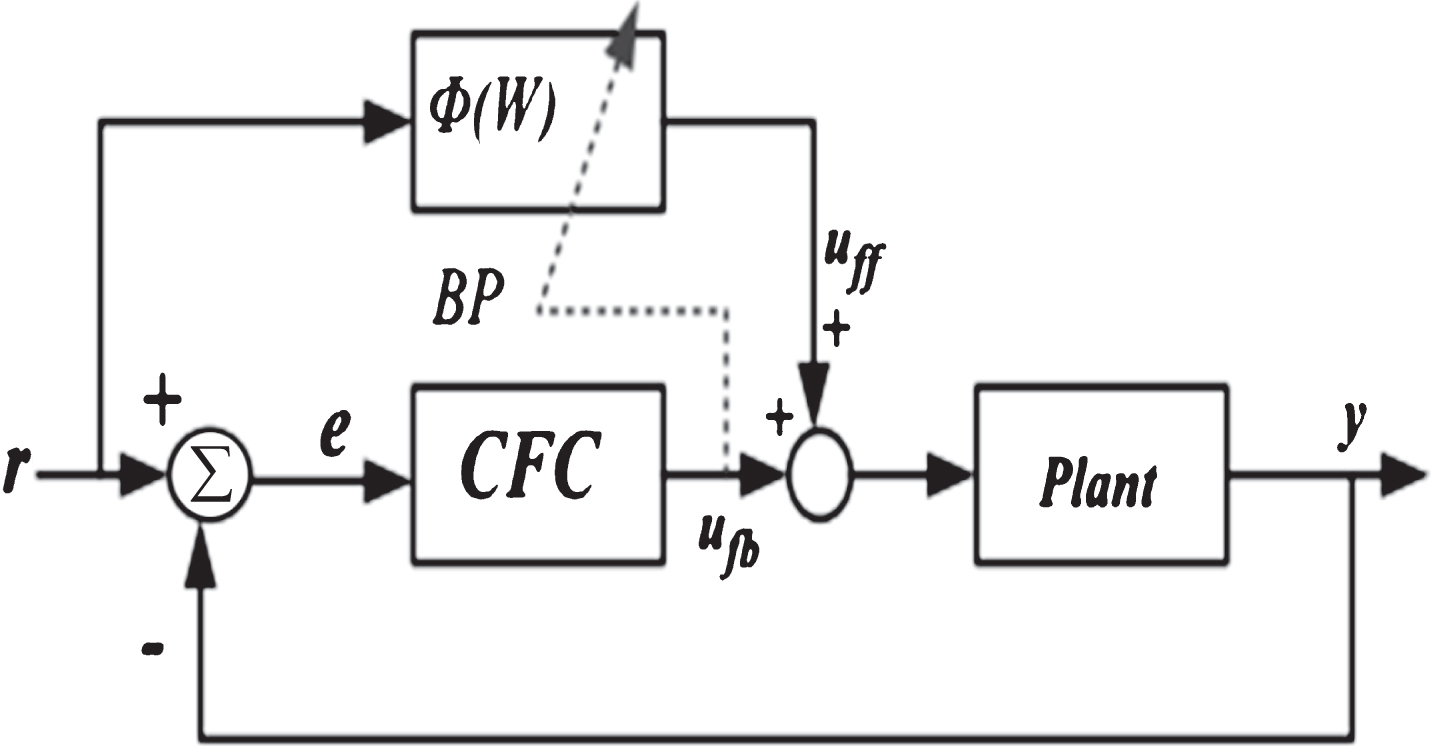
Feedback error learning controller.
A neuro-fuzzy control for multi area thermal power system for automatic load frequency control [34] related with the fuzzy, ANN, traditional PI and PID controllers is proposed. The performance estimation based on Fuzzy, ANN and ANFIS controlling technique for multi area interconnected hydro thermal power plant is planned. The controller efficiency over the other methods is shown which is also applied to same power system and response of controller is verified using the simulation analysis, it shows that the above technique gives better responses and also reduce the peak variation of frequencies, time error and tie-line power. The analysis and comparison of all the control techniques of different areas overshoot and settling times are given in the Figs. 10 and 11 respectively. It can be determined that ANFIS controller with gain sliding gives good settling time when compared with fuzzy, ANN, conventional PID and PI.

Comparative study of peak overshoot for different control techniques.
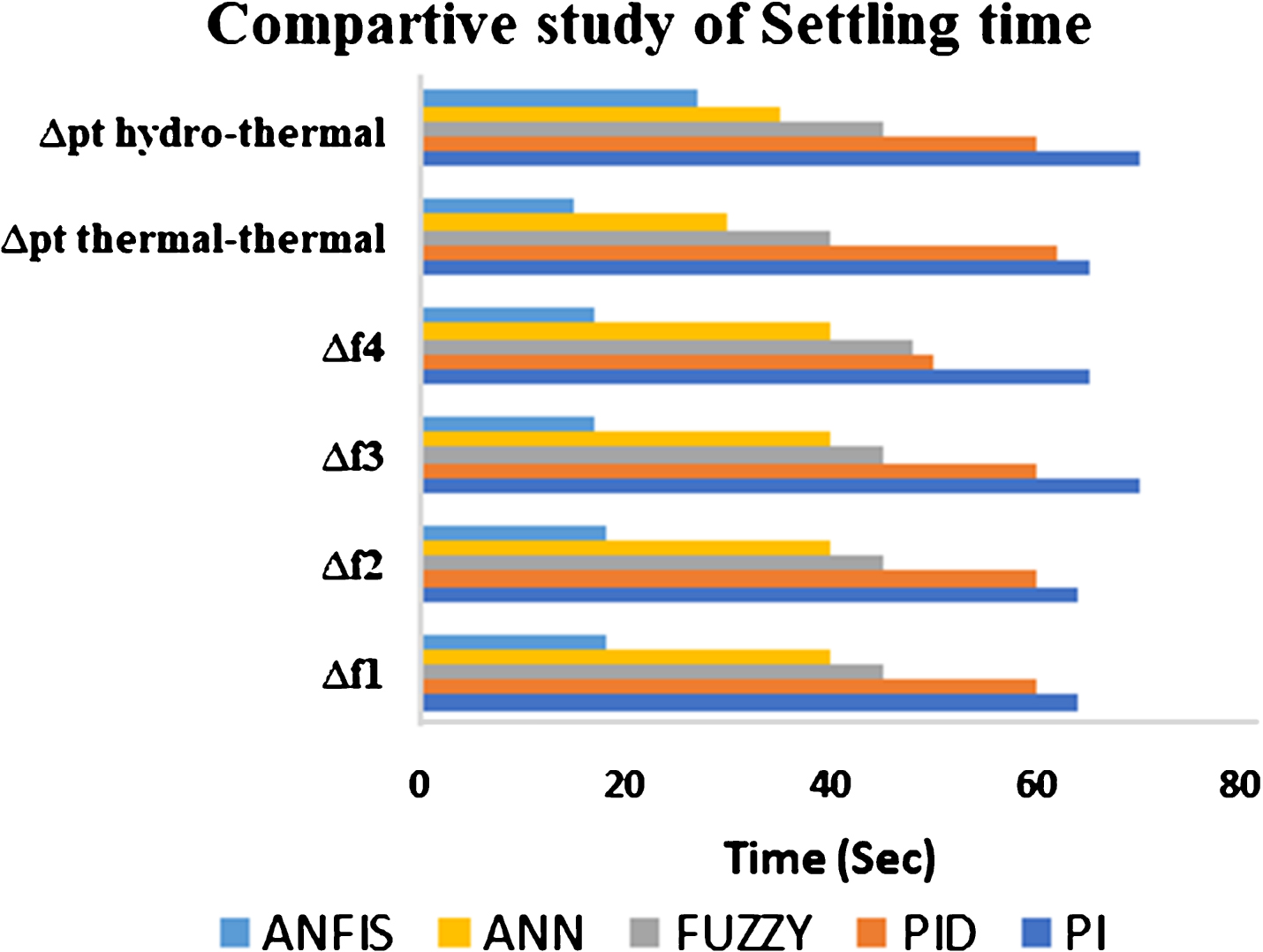
Comparative study of settling time for different control techniques.
The power generated by wind turbine is intermittent will cause a serious power and frequency variation problem in an isolated hybrid power system [35]. Wind energy is uncertainty in nature depending on day and seasonal continuous supply is affected. To overcome this a Hybrid power system is considered for reliable and stable frequency and power supply. Author as considered both conventional and intelligent controller to have high robust control over the system. A hybrid controller of scaling factor fuzzy logic controller-PID is utilized to control the WTG and DES mechanism through pitch angle and governor control respectively. QOHS optimization method is used for tuning the gains of classical control, scaling factor of FLC and energy storage parameters. Energy storage system balances the power and then reduces the frequency deviation in less time.
A fuzzy PID controller with two-levels for a two-area power system as a additional controller for LFC, fuzzy PID controller of two level is tested for small disturbance in load which controlled successfully without any deviations peak overshoots and oscillations and a small raising time is seen [36]. this study is proved that two level fuzzy PID is good for tuning the gains of PID and it can be applicable in real time applications.
The fuzzy logic with SMES application is utilized to control the frequency damping of two-area power systems which are interconnected [37]. The frequency oscillations in the system occur due to disturbances. The frequency oscillations of the system can be stabilized. The active power via SMES can be controlled. The area control error utilized as input signals to controller to the proposed FLC. The proposed FLC controlled SMES superiority are compared with results of the conventional PI controlled SMES in the two-area power system to reach frequency deviation quickly to zero.
A high wind energy penetration into power system is to maintain the frequency of the system in a specified limit. By literature wind turbines generators can support frequency control in two ways one is by inertia control and other one is by primary frequency control [38]. In inertia method rotation of turbine directly effects the frequency where as in primary frequency control real power injection will affect the frequency response, this real power generation can be controlled by controlling pitch angle and speed of turbine. An optimized fuzzy controller is used to determine the optimizing de loading condition and operate the turbine below the rated speed such that it can inject specific amount of active power to support system frequency.
Islanded hybrid power system with wind and diesel generation are considered and an energy storage device is utilized to improve the frequency and power variation forms of the hybrid island system [39]. A metaheuristic algorithm is used for best frequency and power variations. Two fuzzy controllers are employed to control the wind and diesel power generations by taking the two inputs change in frequency or change in power and their derivatives respectively, these two controllers are planed with quasi oppositional search algorithm are performed.
The power output for a set of constraints of a PV can be maximized by using MPPT which plays a important role in PV system to improve efficiency of a array fuzzy logic concept for PV has been proposed and compared with P&O algorithm [40]. The simulation with MPPT and a DC/DC CUK converter fed to load is attained.
The auto scaling variable step size (ASVSS) MPPT for PV system using fuzzy logic controller is applied which has a good performance during tracking [41]. The auto convergence characteristics has been applied as a inputs to fuzzy logic system, but the MPPT system could meet the advantages of good capability for tracking. the merits of FLC & ASVSS are combined so that solar system performance can be improved further.it has good performance in tracking but the output power needed to be enhanced.
A PV-Battery energy system is used to drive a Asynchronous motor with the help of Fuzzy sliding mode control [42]. Electrical machine uses a sliding mode control which has a drawback of chattering effect which is due to fast switching in the control, leads to damage the actuator as well waste of energy, to overcome this problem a sliding mode fuzzy controller is used, A sliding mode is used to determine best parameter values in fuzzy rules.
Author proposed asymmetrical FLC algorithm for solar photovoltaic system connected to a grid is shown in the Fig. 12. When connected to grid inverter control is very essential to synchronize the system. The performance of the inverter is depending on the algorithm used for generating pulses to PV inverter [43]. The uncertainty of photo energy and load as well as randomity in nature leads to the proposed membership function which is asymmetrical due to the solar PV system parameters. The stability and controllability provided is better due to the coarse and fine tuning of asymmetrical fuzzy membership functions. The classy fuzzy rules and input membership functions of FLC can improve and control the dynamics of the system. The solar irradiation and consumer loads are always dynamically varying to utilize efferently the solar panel using MPPT optimizing technique, a symmetrical FLC algorithm is used for synchronizing the system with grid and is tested in MATLAB environment.
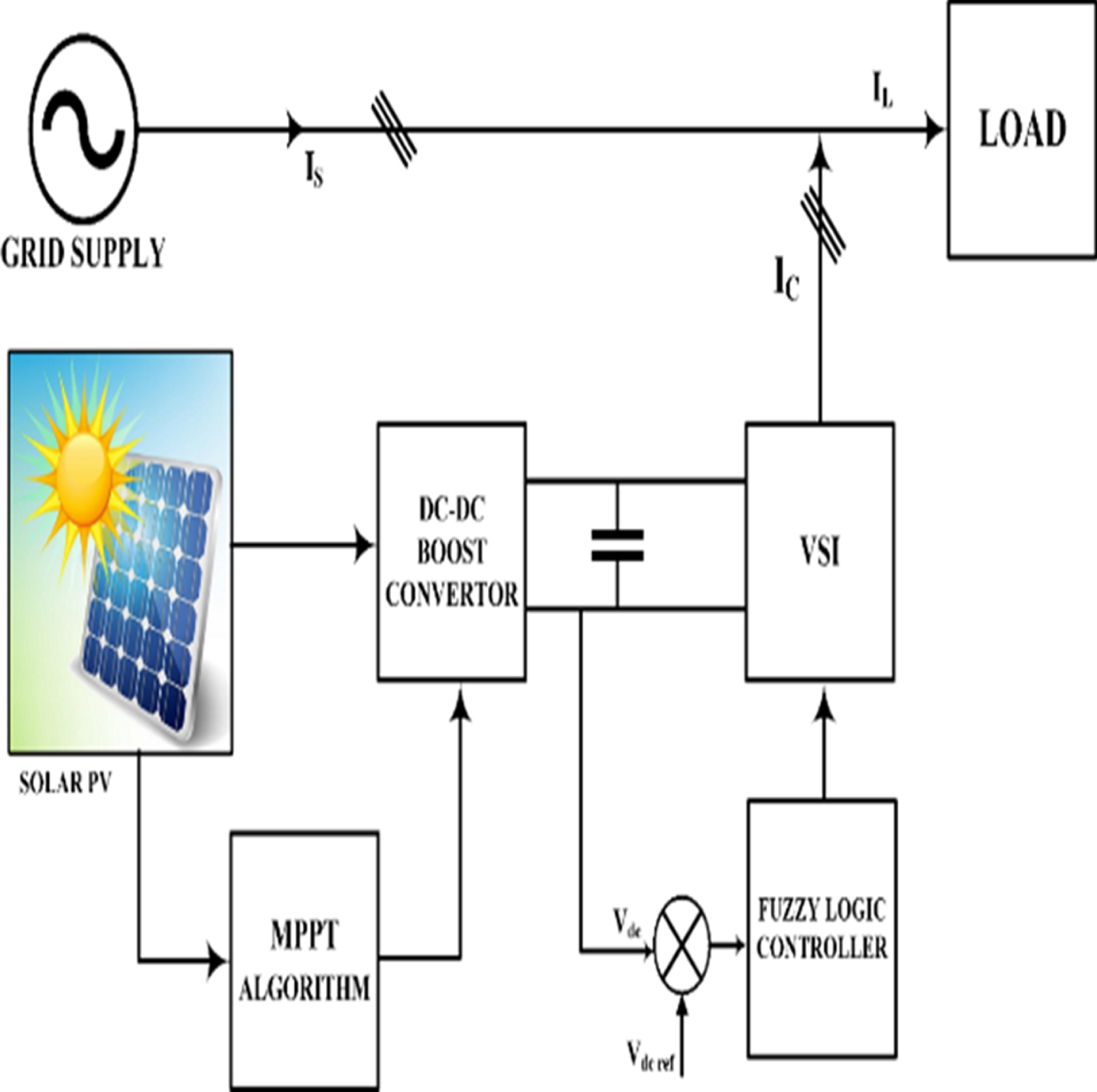
A solar PV connected to grid.
A solar PV system with a buck-boost converter is designed for charging a battery is designed and it is controlled by a fuzzy logic control. A micro control is used to monitor the SOC, when the solar panel output voltage is less than the battery charging voltage set point, then it computes an error signals and based on fuzzy algorithm duty cycle is generated converter is operated buck or boost mode [44]. The analysis is made on a PV system it observed that converter not able to operate boost the voltage when input current is small. The fuzzy logic control works on the basis of system voltage and battery charging set point, these voltages are sensed by voltage sensors and data is transferred to microcontroller based on fuzzy algorithm depending on the duty cycle to enable buck/boost mode to charge the battery is shown in the Fig. 13.

A solar PV based battery charging.
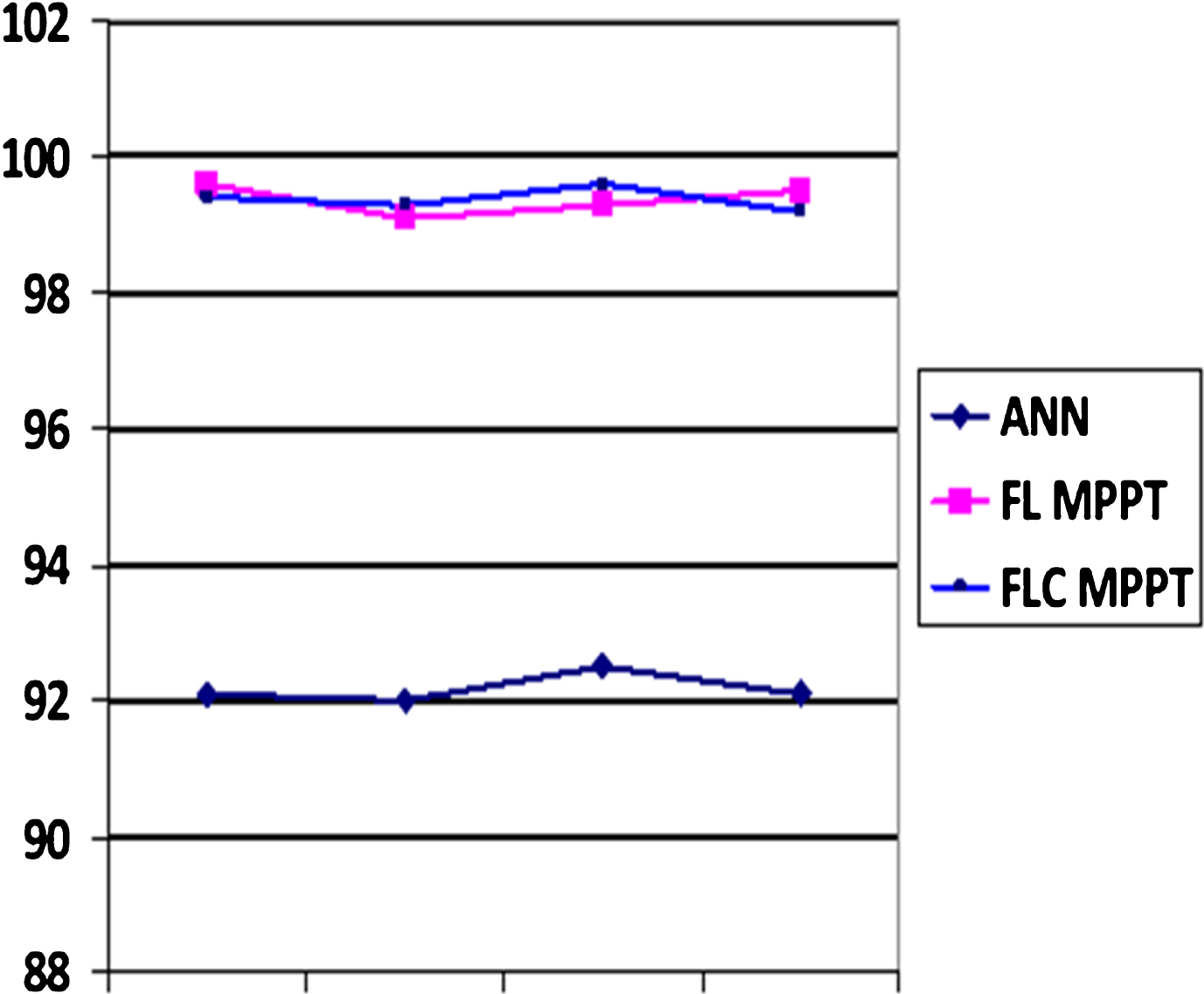
Efficiency comparison graph for different MPPT methods.
The various faults occurring in PV could be detected using proposed algorithm. The short-circuited PV is considered as one of the modules for fault detection [45]. The proposed algorithm has proved the effectiveness of detecting the fault in a PV system.
Author projected a new algorithm for finding fault in PV system which consists of both fuzzy logic system and ANN interface [46]. Faults like partial shading, module defect, two module defects are detected by the algorithm. Depending on the power and voltage of a PV module variation, the inputs are given to proposed controller. 92.1% of accuracy rate is obtained using 4 various ANN networks has been tested with 2 inputs and 9 outputs of ANN. the same is tested on fuzzy logic control which is giving almost the same response.
To maximize the efficiency and decrease the cost of system various methods are proposed to operate system at maximum power point [47]. Here author as proposed a novel technique FPGA based FLC for MPPT of PV system. Fuzzy logic controller is designed in MATLAB and then implemented in VHDL, it has the advantage of faster response and high flexibility. the proposed method is implemented in real time digital hardware.
A new technique fuzzy logic MPPT is employed for PV for maximizing the power generation especially when connected to grid [48]. As all the conventional control techniques face a major problems like lower converging speed, more oscillations near MPP and drift problem of charging, P&O is one of the mostly used technique for MPPT due to simple and low cost in implementation but it also faces the above problems, to overcome this a soft computing FL-MPPT AI technique is proposed, fuzzy rules for this technique is created from modified P&O algorithm and it is suitable for slow change of irradiance using this technique an efficiency 0f 99.6% is obtained when connected to grid under EN5030 standard test.
The controller developed based on Elman Neural Network (ENN)is proposed to Trak the best operational point of PV generating source [49]. Additionally,Takagi-Sugeno-Kang based gain trainer working on fuzzy is utilized for PI parameters adjustment of fuel cell and Battery enable storage Systems with the help of virtual flux-oriented control scheme on the basis of gain tunes working on neuro-fuzzy.The fast change in environment and unaffected in the change of circuit parameters lead to FLC MPPT. The exactness of FLC MPPT increased to 99.4% from 94.8% [50]. The control utilized is PI control which is not only simple but also easy to implement to provide constantly. The main was to improve the efficiency, cost reduction and provide voltage and current for battery charging there by increasing the battery lifecycle. The various MPPT techniques with their advantages and disadvantages are listed out in Table 2 where fuzzy logic plays an important role which is more advantageous than the conventional control techniques.
Various MPPT techniques advantages and disadvantages
Comparison of various parameters of MPPT techniques
Note: SM-sampling method, INC-indirect control, MM-modulation method, I-current, V-voltage.
The traditional controller requires physical properties of the system which is difficult as most of the systems are complex and usually limited. The FLC does not need detail knowledge of the system, it only requires linguistic rules to perform certain control operation. In this paper, three different power system applications are considered where one is on energy storage performance improvement in energy management, LFC for a multi area power system and solar PV systems for increasing the tracking efficiency and also it is used for synchronization of the system when connected to grid. The complexity of the system with the utilization of FLC for larger power system network could help in controlling the network in each and every constraint effectively when compared to the conventional controllers.