



Abstract
The trustworthiness of consumer evaluation is an important prerequisite for reference to make a decision. Hence, a trust evaluator must recognize biased information (referred to as false recommendation), and do so dynamically. Drawing on the sociological concept of trust fusion, a new trust evaluating model is proposed, one built upon (i) Bayesian updating of the trust evaluation with each transaction, and (ii) the identification and correction of purposefully misleading evaluations according to improved evidence theory. Simulations show that the algorithm’s trust value increases slowly with successful transactions, but drops rapidly with a failed transaction, capturing the notion that trust is hard to establish, yet easy to destroy. Further simulations demonstrate the model has good robustness and error tolerance of trust evaluation against false recommendations at varying levels of deception. The algorithm effectively and robustly compensates for deception.
Introduction
Trust plays a key role in all interactions [35, 36], and is an important prerequisite for the success of both traditional transactions in physical social networks and modern e-business in virtual internet environments, especially as an intellectual core of the information systems discipline [4, 46]. Trust should be substantially based on evidence, as consumers form trust directly from past transactions or indirectly from consumer evaluations or recommendations [21]. However, due to information asymmetry, evaluations are very heterogeneous creating a high level of uncertainty, especially in virtual environments. Moreover, market participants may act out of pure self-interest or may engage in collusion for the sake of their own goals [29], on aspects of fraud in ratings, online reviews variance [2]. If the information that potential buyers use to form a decision is biased or noisy due to heterogeneity, asymmetry, and deception, the transactions are more likely to fail [17]. Therefore, how to update trust in real time and diminish the influence of vicious evaluation on trust is an urgent issue to be solved.
Prior research has extensively examined trust primarily by two approaches. One is on the applied layer as marketing and consumer behavior based on psychological and behavioral factors, such as how companies influence the perceived trustworthiness of market actors and even how trust judgments can be made online [3], trust in e-commerce research includes but is not limited to social presence and website design, branding, system quality, culture, shared values, interaction, credibility, relationships, justice, and customer reviewers [9, 33]. The other focuses on arithmetic layer by setting up reliable trust models, which propose to compute a trust value for a source provider [16, 30]. For example, many studies calculate the credibility/trust of transaction objects by constructing a trust model simply accumulating trust or equalizing trust [13, 47]. However, these models lack the ability to discriminate false recommendations. In order to improve the information discriminability and model effectiveness, researchers have pursued dynamic trust evaluation models using D-S evidence theory [10, 20], but these models remain inept at handling deceptive evaluations, such as they do not identify false recommendations in advance, which limits effectively shielding against the impact of fraud evaluation information on trust model. Likewise, the term uncertainty is described but without any foundation [28]. Noticeably, the above question mathematically manifests as the solution on dynamic and robustness of trust model. Dynamics requests the update mechanism based on prior knowledge which generated by individuals that interact directly. Robustness requests to shield against malicious evaluation, decrease its weigh value, so as to make the synthetic overall-trust consistent with the real value.
Accordingly, this research examines how to identify and shield against deceptive evaluations in the dynamic trust update scheme. Drawing on the sociological notion of trust [27], the Bayesian rule and D-S evidence theory in the artificial intelligence research field [5, 15], trust is defined trust as an integrated evaluation of behaviors and capacities of a peer from the viewpoint of another peer [25, 44]. This article develops an effective trust evaluation mechanism, considering the trust decision as multi-source group decision from direct and indirect sources, finally obtains the real trust value of interaction individual.
In this paper, a concept of integrated trust fused from direct trust and multi-source recommendation trust is proposed. Recommendations are from the objectives who had transaction history with the evaluated target. Both direct trust and recommendation trust are fused by improved D-S theory. In particular, the fusion rule of evidence theory is improved based on similarity measure for computing trust values. Under rational expectation, the definition of trust can be directly measured by previous transaction results instead of opinion surveys (see, for example, [12]). Second, the quantification method is updated, employing vector tuples with different assignment formula. This quantification facilitates the trust update in real-time. Third, the extant model, similar-DS model are improved, which indicates stronger robustness and error tolerance.
The rest of the paper is organized as follows. The next section describes the representation online service trust in the marketplace via evidence theory. Section 3 presents our trust model based on, and Section 4 reports a numerical simulation. Finally, section 5 summarizes the conclusion, and discussions of the implications to theory and practice, as well as the limitations and future research.
Materials and methods
The evidence theory representation of online service trust
Due to the complexity, dynamics and uncertainty of the network structure in an online platform, recommendation information from network participants have unfavorable characteristics, such as incompleteness, inaccuracy and non-reliability [31, 39] The D-S theory is a mathematical theory of evidence that rests on the belief function to quantify [19]. Unlike the Bayesian Theory, Evidence Theory is more flexible, it does not need prior knowledge about probability assignment, and it is able to assign probability values to sets of possibilities rather than to single events only [10]. It can thereby address the problems of uncertainty and incomplete information better. In addition, it enables the representation of evidence with very little signal and resolves the fusion question of dynamic multi-source recommendation trust. Next section begins with an overview of Evidence Theory followed by previous study and then introduces the evidence theory representation of trust.
Evidence theory
Evidence theory builds on the non-empty set Θ, which is composed by the mutually exclusive and finite elements, enumerates all the possible results
1
of the evaluation [5, 15]. Let Θ be the Frame of Discernment (FOD), and denotes its power set as 2
θ
. Mass is called Basic Probability Assignment (BPA) function, which stands for a belief mapping from 2
θ
to the interval between 0 and 1. Mass can be assigned to sets or intervals. Let A be the possible evaluation subset and a subset of Θ. m (A) is the support of evaluation A. Obeying:
Mass functions m1, m2, . . . , m n from multiple information sources are combined via Dempster’s fusion rule [32]. Also known as the evidence combination formula, for every outcome A, Dempster combinational rule about functions m1, m2, . . . , m n in the framework is:
In this study, trust is defined from a perspective of intellectual system. Many researchers have addressed uncertainty issue in Mobile Ad Hoc Networks (MANETs) and explored relationship between trust and uncertainty [22, 45]. In comparison, trust is explicitly modeled as an integration of direct trust and indirect trust, and introduce the uncertainty factor into the model. This highlights the importance of uncertainty but also makes a better reflection of reality through a binding rate of evaluation. Direct trust is calculated by the probability assignment function method, using Bayes’ rule to initialize and design the dynamic update formula. Indirect trust originates in the fusion of multi-source recommendation trust, and then individuals recommend direct trust to others as recommendation trust. The uncertainty factor is introduced into the model., as show in Fig. 1. Finally, total trust can be obtained by fusing multi-source evidence based on a D-S evidence theory combination method with similarity.
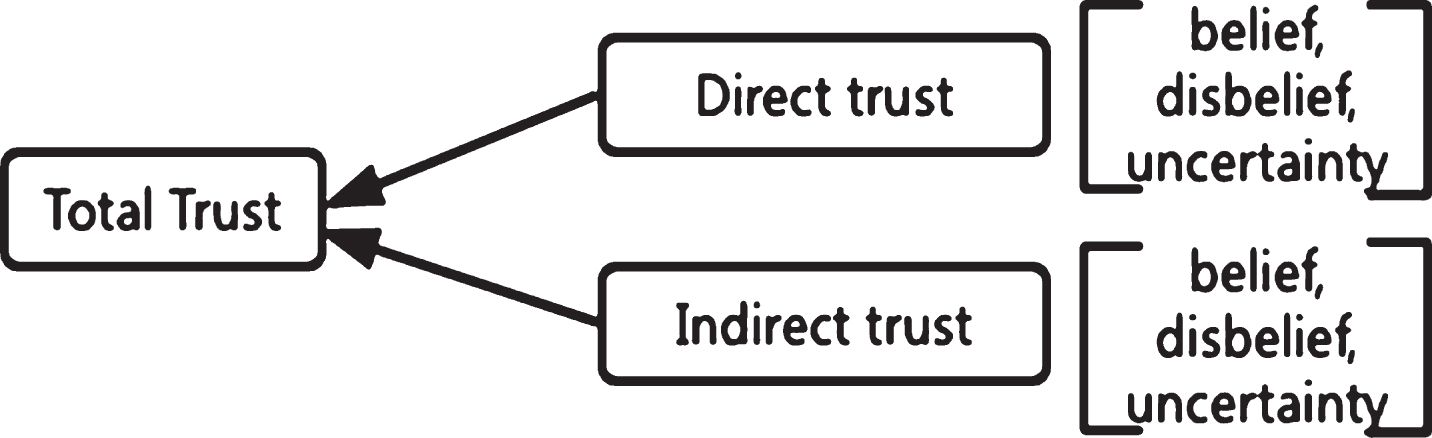
Trust Representation with Uncertainty Incorporated at the Base Level.
Let the frame of discernment regarding trust be θ = {T (TRUST) , - T (DISTRUST)}, which means T represents trust, and – T represents distrust, therefore, θ ’s power set 2 θ is { {φ} , {T} , {- T} , {T , - T }} where m (φ) =0, so trust value between individuals in the model is defined as the form (m (T) , m (T, - T) , m (- T)),in which m (- T) denotes blief derived from the evaluation on sellers and m (- T) denotes disbelief derived from the evaluation on sellers.
B el (T) = m (T), p l (T) = m (T) + m (T, - T), the neutral evidence interval width of [B el , p l ] is m (T, - T), represents as fuzzy degree of evidence to individual trust evaluation. m (T, - T), reflects the uncertainty degree of evidence to individual trust or distrust, the greater the length, the greater the fuzziness.
Calculation of Trust
The initialization and dynamic update formula of (m (T) , m (T, - T) , m (- T)) is constructed as trust between individuals. For m (T) without any priori information, the ‘equal ignorance’ rule of Bayesian is adopted to assume priori as the uniform distribution μ (0, 1) over the interval (0, 1). According to Bayesian rule formula, the probability distribution is:
Then analytical calculation is conducted and the result shows that the posterior obeys the Beta distribution, with parameters α = s + 1, β = n + 2,
Indirectly derived trust, also known as recommendation trust, is rooted in recommendations from third parties about the evaluated object [38], the source of recommendation trust are from other sellers and buyers. Traditional evidence theory would get counter-intuitive result when the evidences have a high degree of difference [10]. Therefore, it’s necessary to improve the algorithm to make it have a good robustness when meet this situation.
The recommendation trust is fused by the method of improved evidence theory, and the algorithm is as follows.
Assuming m
i
, m
j
are two BPA (Basic Probability Assignment Function) of the recognition framework, then the Jousselme distance between m
i
and m
j
is:
The other calculation of di,j is:
In the formula, ∥m i ∥ ′2 = < m i , m j >, where <m i , m j > is a scalar value, its definition is given as:
If all the focal elements are single, then <m i , m j > can be the inner product of vectors.
Assuming the number of evidences that the system received is n,formula (6) can be applied to get the pairwise distance matrix d of n evidences.
The similarity measurement s
ij
between evidence m
i
and m
j
is defined as:
Then the pairwise similarity matrix s of n evidences is:
The support degree of evidence m
i
is:
and the relative weight ω
i
is:
Finally, the evidence source is corrected based on the ω
i
,the corrected formula is
The proposed approach would moderate the evidences to get a new group evidence with lower degree of difference which will make the proposed approach get a higher robustness.
The model of online service trust is constructed based on evidence theory in this section, separately computing the direct trust and indirect trust. In order to test the performance of the model, a simulation test is conducted to investigate direct trust evaluation and recommendation evaluation trust for the dynamic and error tolerance.
Simulations are performed to test the dynamic performance of the model and, separately, its error tolerance to malicious node. The numerical experimental setup used for analysis of the trust model is inspired from Xia et al. [18]. All experiments are conducted on a machine having Intel Core i3 (3.2 GHz) processor, 3 GB RAM and Microsoft Windows 7 operating system. MATLAB 2010a is used to evaluate the performance of direct trust and indirect trust based routing protocols in different test conditions. Then dynamic test and robust test are conducted, one is to check the dynamic evolutionary process of trust value in the interaction activity over time, the other is to check anti-attack ability of the model with simulating the severe, moderate and slight mode
Dynamic test
The experiment is designed for numbers of transactions of online service. A corresponding evaluation will be generated after each transaction, with a timely updating of the assignment function of trust value. The result is shown as Fig. 2.

Direct trust updating.
As shown in Fig. 2, the rising slope of the curve m (T) decreases with the increase of transaction, indicating that the trust value can be added less with each successful transaction. While the trading result is fuzzy or distrust, the decreasing slope of the curve m (T) becomes large, and the trust value would decrease heavily after each failed transaction. These findings reveal that trust has the characteristics of “hard to establish, easy to destroy”. When unusual trade occurs, the values of m (T, - T) and m (- T) rises rapidly, indicating that the model is sensitive to test malicious evidence, so as to it has good dynamic performance and can effectively shield the attack of malicious behavior.
Test Criterion
The similarity coefficient NC (Normalized Correlation) is used to measure the similarity degree between interference signal with the original one. Let w represents the original information, represents the signal after being attacked, so
Where, M1, M2 are the length and width of information matrix, respectively.
Formula (16) considers the original trust value without malicious node as source signal, and the attacked trust value as signal with disruption. Then the similarity degree of the two values is calculated, where a high degree of similarity indicates good robustness.
Assuming three recommendation paths (one is the malicious evidence to test the robustness of the model), all the trust evidence are combined with additional direct trust. Suppose direct trust is DT(0.1, 0.2, 0.7), recommendation trust values through three paths are UT1(0.15, 0.15, 0.7), UT2(0.1, 0.1, 0.8) and UT3(0.94, 0.05, 0.01), respectively. Obviously UT3 is the malicious one. According to the Evidence Theory, the combination result is (0.0484, 0.0103, 0.9413), and the remaining three trust evidence sources are (0.0005, 0.0022, 0.9973) after removing the malicious node. The result shows the recommendation of malicious node affects the fusion effects, reduces the assignment function m (T) of trust, and increases the value of m (- T). The degree of similarity matrix through Evidence Theory based on weight is as follows:
Additional, simulations are carried out which including slander and exaggeration conditions, each were assessed on a severe, moderate and slight levels. also tests robustness of the model in different attack degree. In the moderate slander case, the UT3 are (0.5, 0.05, 0.45) and (0.2, 0.05, 0.75).
Slander and exaggeration are essentially the same in mathematics, so only numerical simulation is conducted on the model robustness with slander attack r i represents the standard value, ri1 represents the combined trust value of original evidence theory, ri2 represents the combined trust value of improved evidence theory, then similarity degree of the two combined trust values and standard trust values are calculated. The result is shown as Table 1.
Similarity Test of Combination Trust
Similarity Test of Combination Trust
The result reveals that the similarity degree of the integrated trust value and standard trust value in terms of original Evidence Theory with the condition of severe slander attack is 0.9987, indicating that the integrated trust value occurs distortion in the large extent. While the similarity degree of the integrated trust value and standard trust value in terms of improved Evidence Theory is 1.0000, indicating that the trust computing model based on improved Evidence Theory effectively shields the impact of the distortion due to conflict evidence, the evaluation information of trust is retained well. In the condition of moderate attack and slight attack, the similarity degree of combined results based on original Evidence Theory and improved Evidence Theory is identical 1.0000, indicating that the conflict of evidence source can be considered as normal distance, and the conflict evidence source also can be considered as normal evidence source.
Simulation results show that the trust model based on improved Evidence Theory has strong robustness, which can effectively shield the impact of conflict evidence source on integrated trust distortion. In the severe, moderate and slight mode, the similarity degrees of combined result and standard trust value are both 1.0000, to achieve a very good result of fidelity.
Conclusion
Online trust will continue to be an important aspect of e-commerce even as both e-commerce and the Internet itself have evolved rapidly over time. Given the various levels of referable consumer evaluations in online transactions, this article proposes a trust evaluation model based on improved evidence theory, especially, evidence quantifying and dynamic updating, transmitting and fusing of trust in the online service are studied respectively. The evidence theory is applied to qualify and update trust, which plays an important role in updating timely and effectively testing deceptive even malicious behavior. Meanwhile, the trust is combined based on improved evidence theory, which has strong robustness and dynamics that can effectively decrease the impact of false evaluation. Simulation results show that the model can provide real-time, accurate decision support for online service and decision basis for potential consumers.
Discussion
Our constructs are grounded in the literature in terms of the more often used types of trust, as well as the reality context. It can be noted that trust changed quickly because it was based directly on evaluations, whereas too hard to establish. So understanding the reliability of trust evaluation and decision making relevance is no less important than the trust value per se.
A significant amount of research has been conducted on trust, even the evidential approaches [42]. It must be emphasized that this study did not consider the type of virtual organization, the temporary system, long-term system or a combination of these two. Previous study proposed that a wide fuzzy set for a trust value represents a high degree of uncertainty, whereas a narrow fuzzy set implies a reliable value. The trust is modeled through fuzzy sets, but did not consider it based on how the value has been calculated. However, the proposed approach will make sense only when there are few attack nodes. The more attack nodes emerging in the system, the results will be more counter-intuitive.
Future research should incorporate more experiments, new types of data, longitudinal approaches, and more robust measurement. This work can be further extended to real systems as to evaluate the performance, to establish more integrative and appropriate model for a virtual transaction society. A possible extension may evaluate trust in an e-commerce system, and regulate behaviors of participants effectively.
Footnotes
Or in the language of Boudraa et al., 2004; propositions.
Acknowledgment
Funding for this research was provided by the National Natural Science Foundation of China (71672195, 71662024, 71872184); We thank Feixiang Gong for valuable thoughts and comments.