



Abstract
This paper presents a new evolutionary approach for reconfiguration of radial systems. The framework applied for optimization is Symbiotic Organism Search Algorithm (SOSA). The algorithm is impressed by the interactive behavior opted by the living organisms for surviving and to propagate in the ecosystem. This concept aims for optimal survivability in the ecosystem involving the harm and benefits received from other organisms. The aim is to find optimal reconfiguration and to reduce the real power loss in the distribution side. This approach is examined on 16-bus and 33-bus systems. The results show a significant reduction of real power loss. The time required for execution is less when compared to other approaches. Based on the results calculated with distribution load flow algorithm the SOSA gives better results in terms of real power loss reduction and it is best suitable for digital automation systems.
Introduction
The growth of demand for electricity is becoming a challenge for the society. This needs an optimization in the production, distribution and the utilization of electricity [1]. The installation of new distribution power network is very difficult and not economical. So it becomes necessary to optimize the power economically for consumer satisfaction [2]. Several methods are there to optimize the distribution system, the main technique is reconfiguration. It is defined as adjusting the structure of the feeder with the two commonly used switches in the distribution system [3]. The sectional switches (closed) which is connected on the same feeder while the tie switches (open) which are connected between two feeders are used to change the framework of the feeder [4]. This reconfiguration reduces the real power loss in a significant way. For the reconfiguration to be carried out, many different algorithms have been used till now for optimization of distribution system [5]. The reconfiguration is done without disturbing the radial structure of the feeder [6, 7].
In the year 1975 Merlin and Back insisted on the reconfiguration concept for minimization of real power loss [8]. The optimal algorithm is an approach which involves less number of steps and less complexity [9, 11]. The real life application demands simultaneous optimization for the complicated multiple objective functions [12]. Therefore solution provided by a specific multi objective approaches may suit the applications but cannot be treated as a universal problem solution [13, 26]. Thus there is always a requirement before the researchers to come up with new algorithms which can handle the challenging task for the real life problems [14, 25]. It is important to notice that the naturally inspired multi objective approaches are generally unconstrained in nature and it also require additional techniques to solve constrained problems [24, 32].
This paper proposes a method for minimization of losses using symbiotic organism search algorithm (SOSA) for optimization of the power distribution system. This algorithm is based on the relationship between several organisms which live together and survives in the ecosystem [15, 18]. The goodness about SOSA is the algorithm is parameter free. It does not require any adjustment in any of the parameter and the only step is to initialize the population and number of generation [16, 23]. This method is tested with two standard systems 16 and 33 buses. The power loss results, comparison tables and convergence graph are displayed in chapter 5. Load flow values are calculated using modified Newton Raphson method and these values are substituted in SOSA algorithm for 16 and 33 bust test systems and the reduced real power loss values have been calculated with radial new reconfiguration.
The paper is organized as follows. Section 2 begins with the problem identification and related works on constrained multi-objective optimization [19–21].
The proposed multi-objective SOSA are outlined in Section 3. Implementation of SOSA is outlined in Section 4 with detailed steps the simulation environment, performance evaluation methods and standard algorithms used for comparison are described in Section 5. The applications of the proposed algorithm to structural truss design problem robustness are given in Section 6. The concluding remarks are narrated in Section 7.
Problem identification
The net power loss is expressed as
Where, PT, Loss = Total power loss Nbr = Number of branches Ri = Resistance of branch i Pi = Real power flow through branch i Qi = Reactive power through branch i Vi = Voltage magnitude at bus i n = total number of line switches K = kth number of bus
Subjected to the following constraints The voltages limits of the bus should not cross the permissible limits Vmin≤Vi≤Vmax where Vmin and Vmax are the lower and higher potentials. The bus current must lie within the rated values. Radiality of the network is secured always. All feeders need to be served.
In the year 2014, Cheng and Prayogo developed this algorithm. This algorithm was impressed by interaction of natural organisms living together in an ecosystem [27]. Organisms rarely lives in isolation since it depends mostly on other organisms for their living. So, it develops symbiotic relationship for adaptation to the changes in their environment [28].
The three symbiotic relationships are Mutualism - relationship among two different species which benefit mutually from that relation. The interaction between two different species provides advantage to both of them. the relationship between flower and pollinator is mutualism [27]. Commensalism - relationship among two different species in which one benefits and the other is unaffected or neutral. The relationship between Remora fish and Shark is commensalism. The small Remora fish attach itself behind the huge body of Shark and consumes its leftover food thus get benefited from the interaction. The activity of huge Shark does not get affected by the activities of the small fish [28]. Parasitism - relationship among two different species in which one benefits and the other is actively harmed. The interaction between the mosquito and human is a phenomenon of parasitism. Once the mosquito bite the human, the process create parasite in the human body. The germs present in the human body reproduce themselves and the human usually gets affected by the disease and possibly die. But if the human body has better immunity power then they can protect and the parasite gets eliminated from the body [29]. The above process is shown in Fig. 3.1.
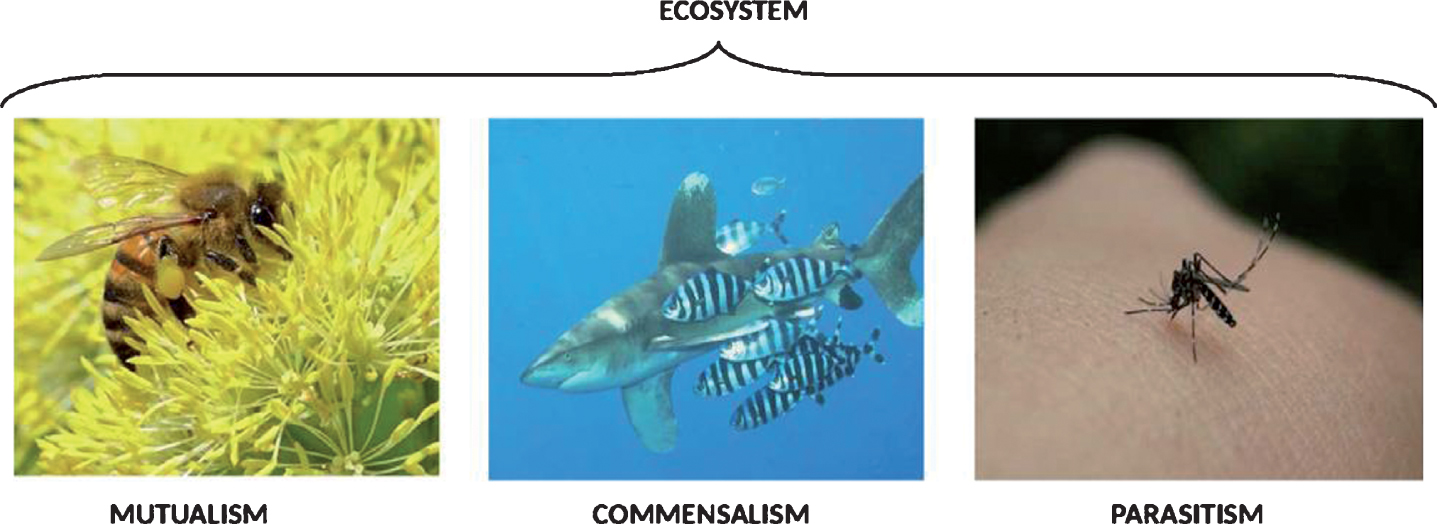
Symbiotic process in Eco- System.
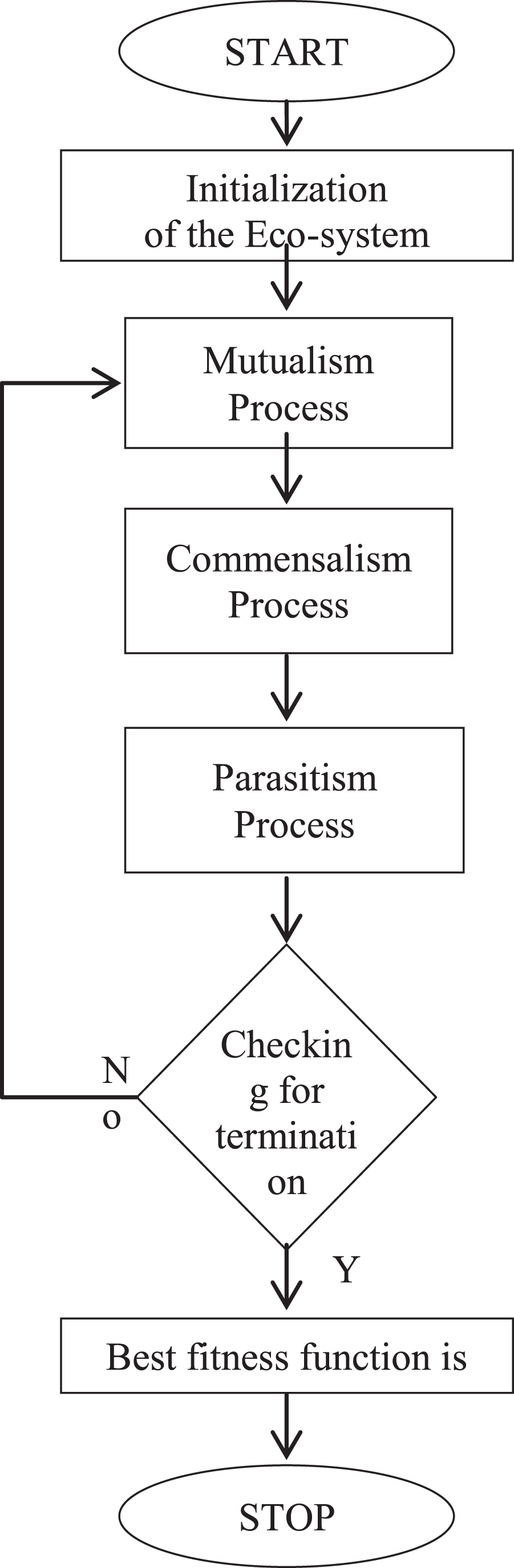
General flowchart for SOSA.
The steps followed in this algorithm are:
Radiality and voltage constraints are incorporated in this both the algorithms to avoid over loading, voltage reversal problems. This will also maintain the stability of a system.
Results and discussion
The Symbiotic Optimization Search (SOS) is an evolutionary approach where the organisms of ecosystem are considered as elements of population (evolutionary strategies) like genes of chromosomes in genetic algorithm.
The real power loss values with different configurations have been calculated for 16 bus and 33 bus standard systems. The 16 and 33 bus standard systems are selected for testing the SOSA method. It is shown in Figs. 4.1 and 4.4
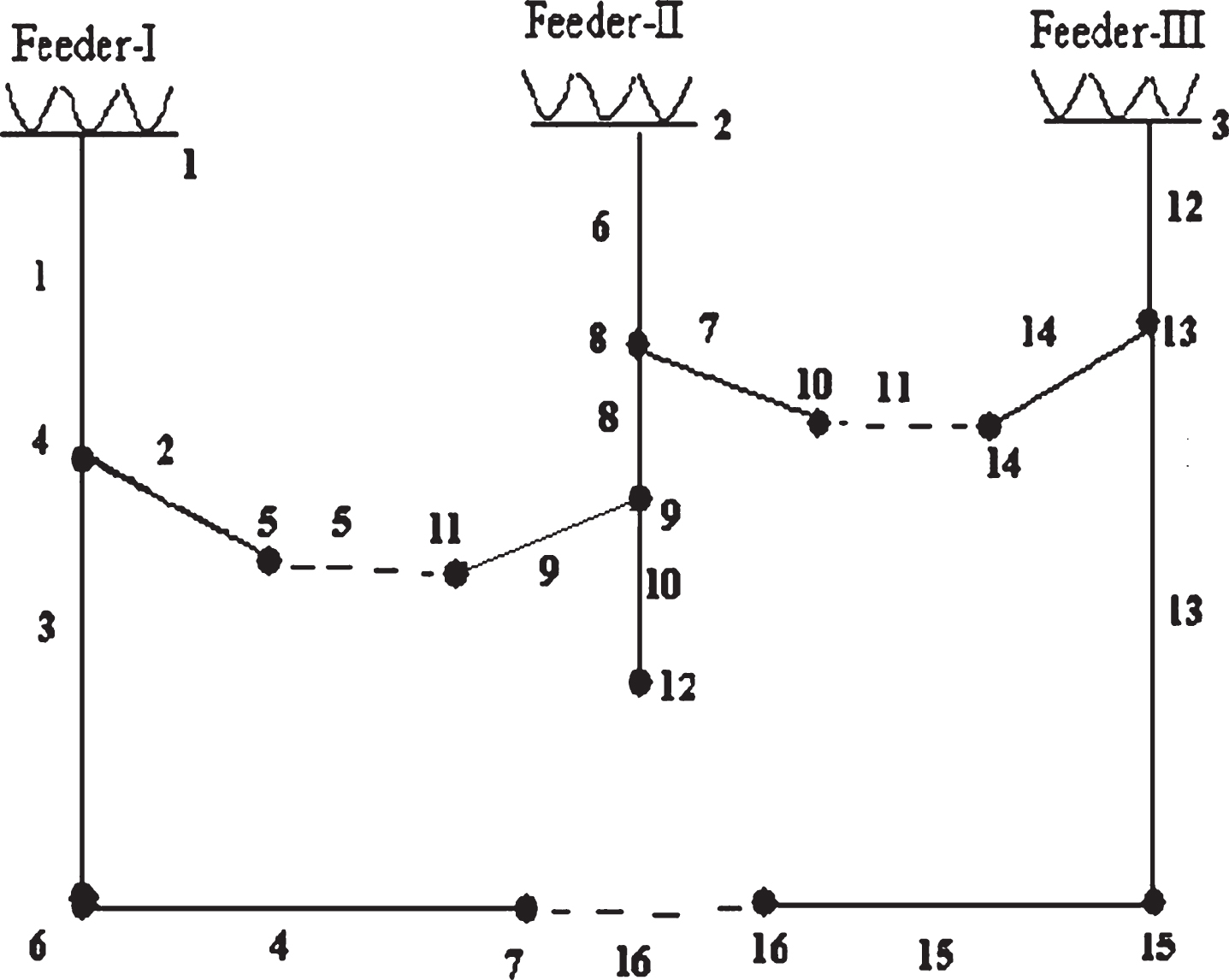
16-bus diagram.
Table 4.2 gives the system data for a 16 bus distribution system given in Fig. 4.1.
From the above Table 4.1 it is noticed that the value of loss is reduced to 421.33kW when the switches 9, 14, 16 are in open condition. The computing time is 1.722 sec which is less. Before the reconfiguration the base loss is found to be 511.41kW and after reconfiguration it is lowered to 421.33kW. Figure 4.2 depicts the comparison chart for power loss of SOSA with other relevant approaches. It is observed that the suggested SOSA gives less power loss value for 16 bus when compared to the methods such as RGA, BFOA, Bee colony, VHDE and HDE. Figure 4.3 depicts the plot for convergence using the proposed SOSA method.
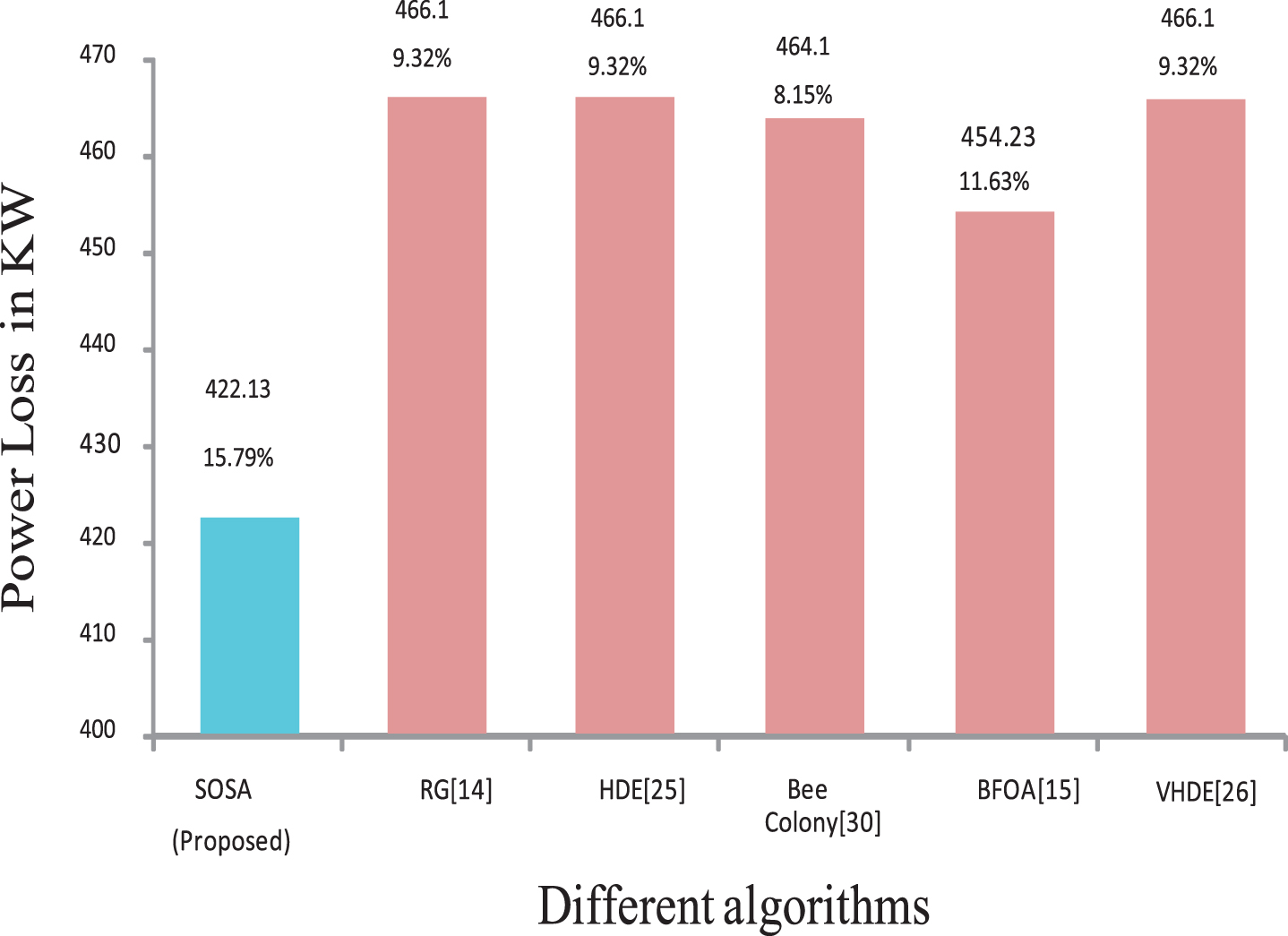
Comparison chart of power loss for 16-bus.
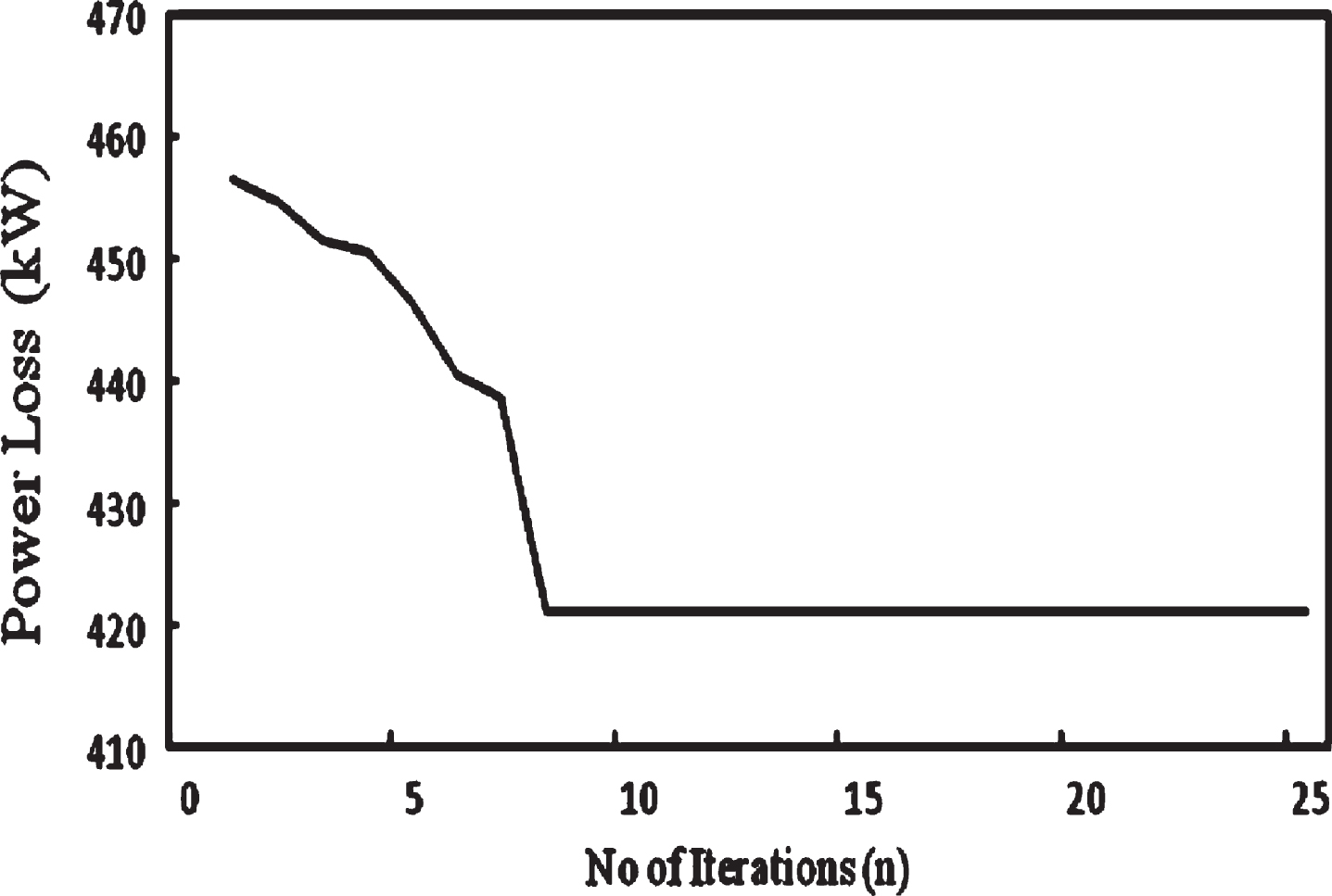
Plot for convergence for 16-bus using SOSA.
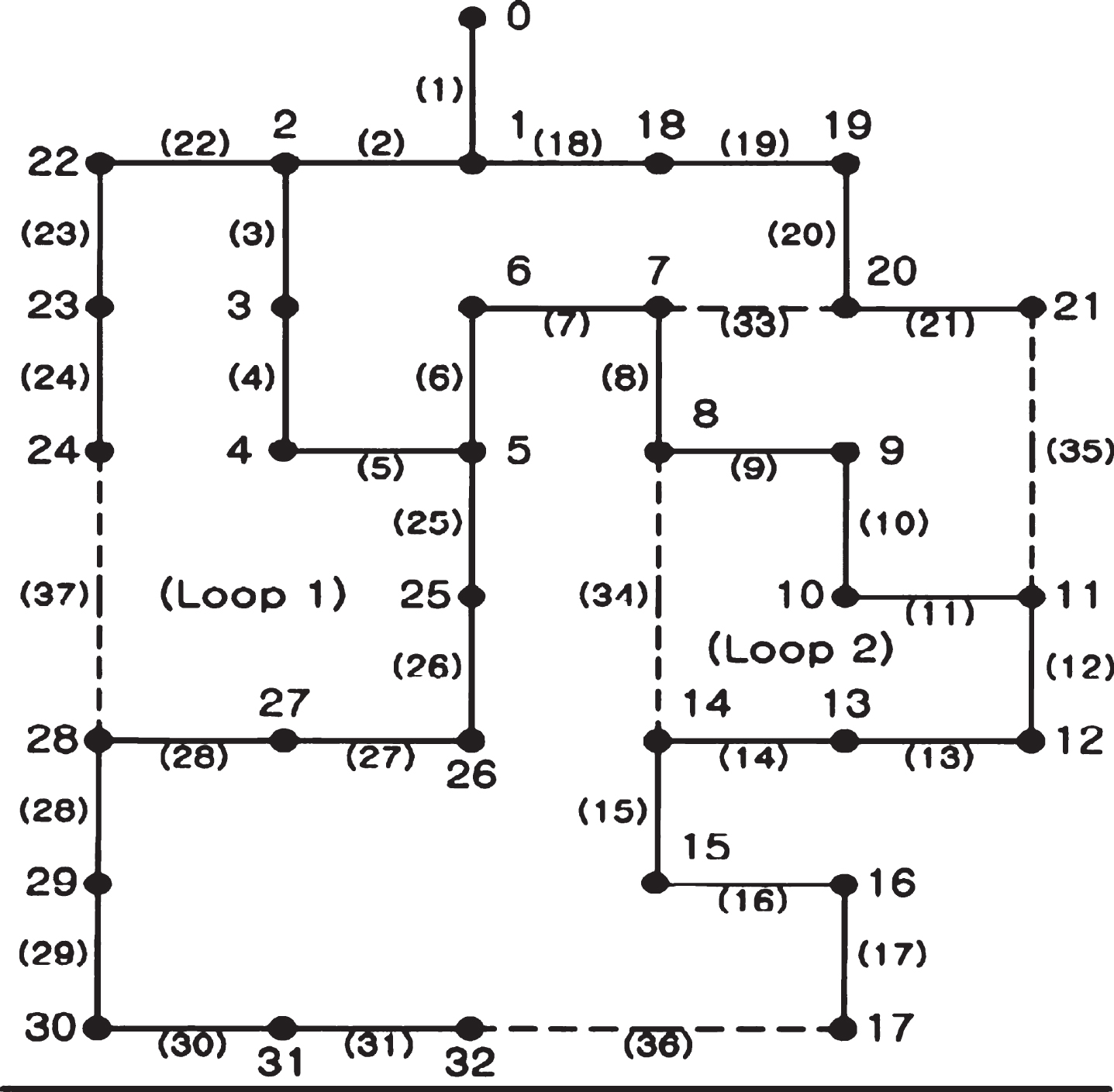
33-Bus diagram.
Results for SOSA - 16 bus
16 Bus Network data
Table 4.3 shows the loss results for SOSA for 33 bus standard system. The value before reconfiguration is known as base configuration and loss value was found to be 202.71kW and it is reduced to 132.81kW after reconfiguration using SOSA when 7, 9, 13, 23, 36 switches are at open condition. The computational time was found to be 2.194 sec which is very low. Figure 4.5 depicts the comparison for power loss of SOSA with other relevant approaches. It is observed that the proposed SOSA gives less power loss value for 33 bus when compared to the approaches such as RGA, BFOA, ACSA, HSA, Bee colony, AG and Heuristics. Figure 4.6 depicts the graph of convergence for the proposed method.
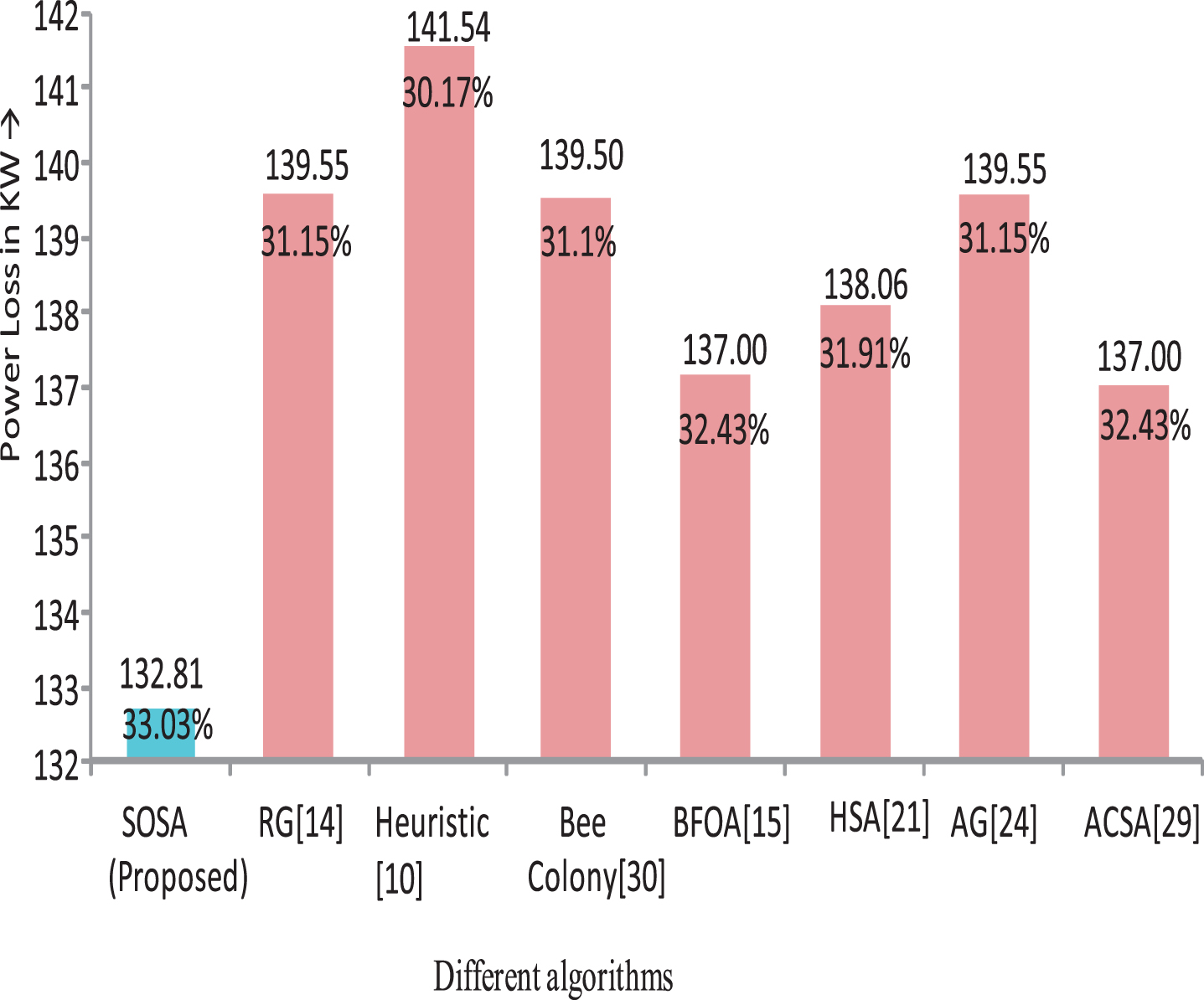
Comparison chart of power loss for 33-bus.
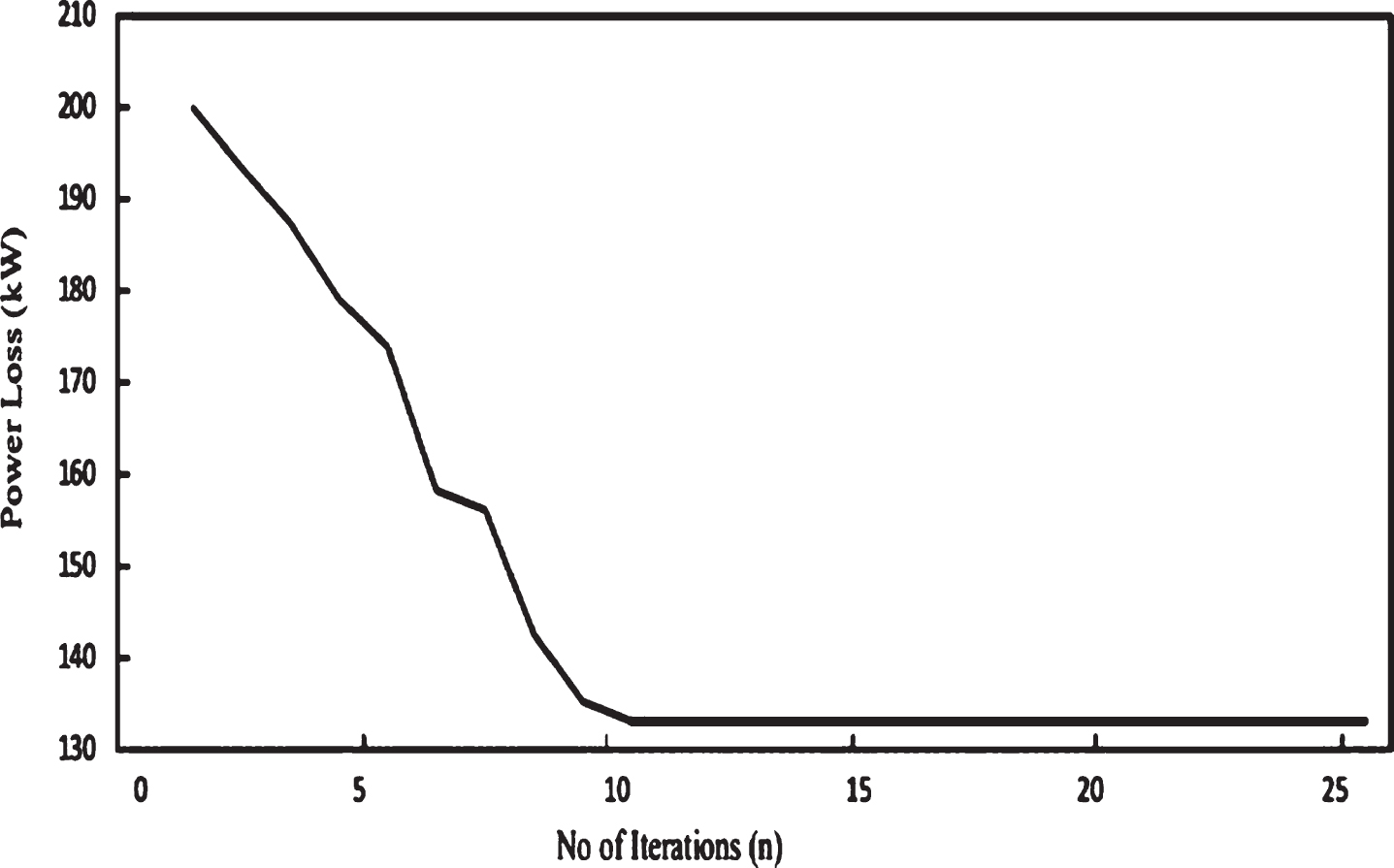
Plot for convergence for 33-bus using SOSA.
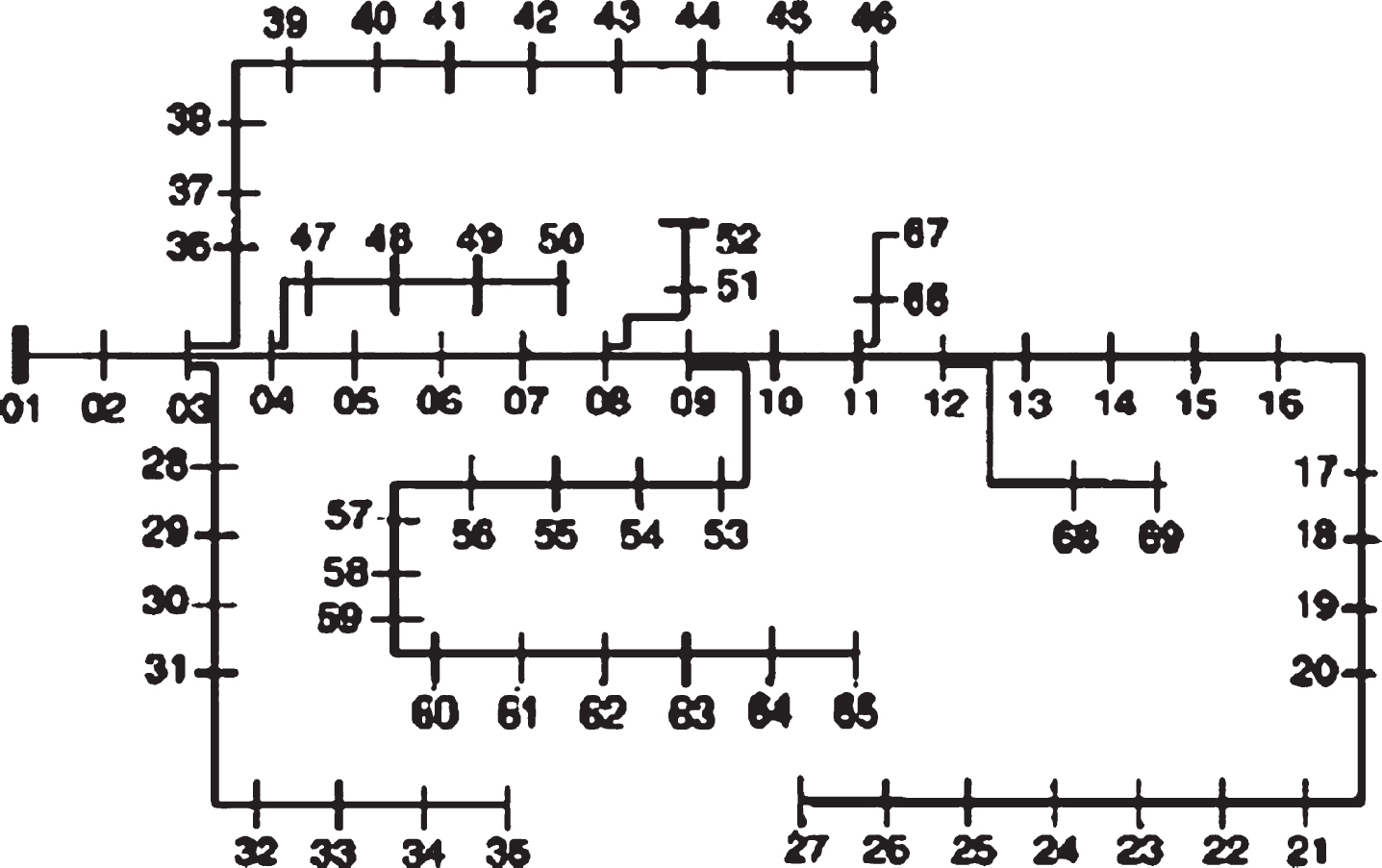
69-Bus diagram.
Results for SOSA - 33 bus
Table 4.4 shows the loss results for SOSA for 69 bus standard system. The value before reconfiguration is known as base configuration and loss value was found to be 225kW and it is reduced to 98.32kW after reconfiguration using SOSA when 18, 47, 56, 61, 69 switches are at open condition. The computational time was found to be 2.578 sec which is very low. Figure 4.8 depicts the comparison for power loss of SOSA with other relevant approaches. It is observed that the proposed SOSA gives less power loss value for 69 bus when compared to the approaches such as MBFOA and HSA. Figure 4.9 depicts the graph of convergence for the proposed method.
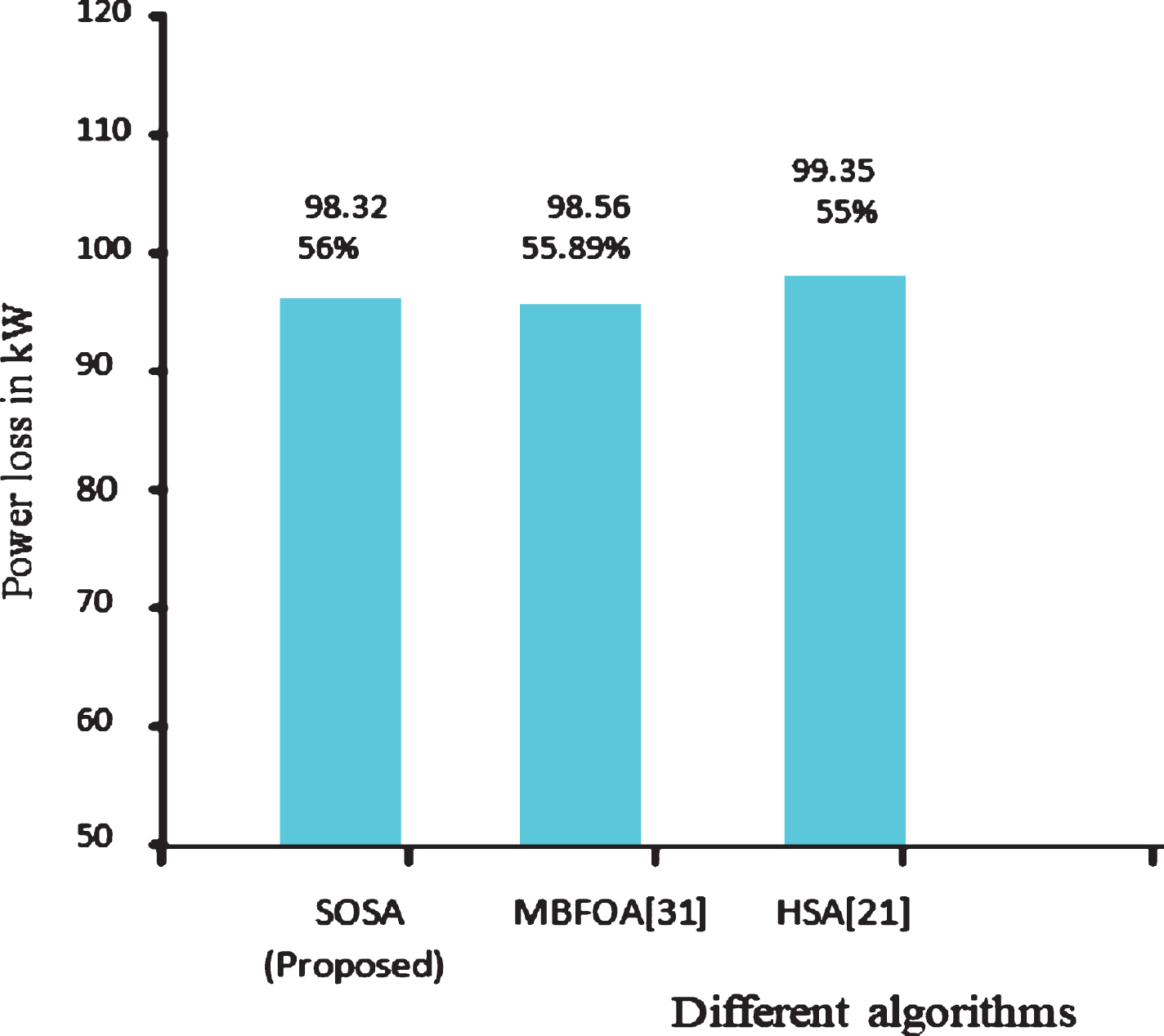
Comparison chart of power loss for 69-bus.
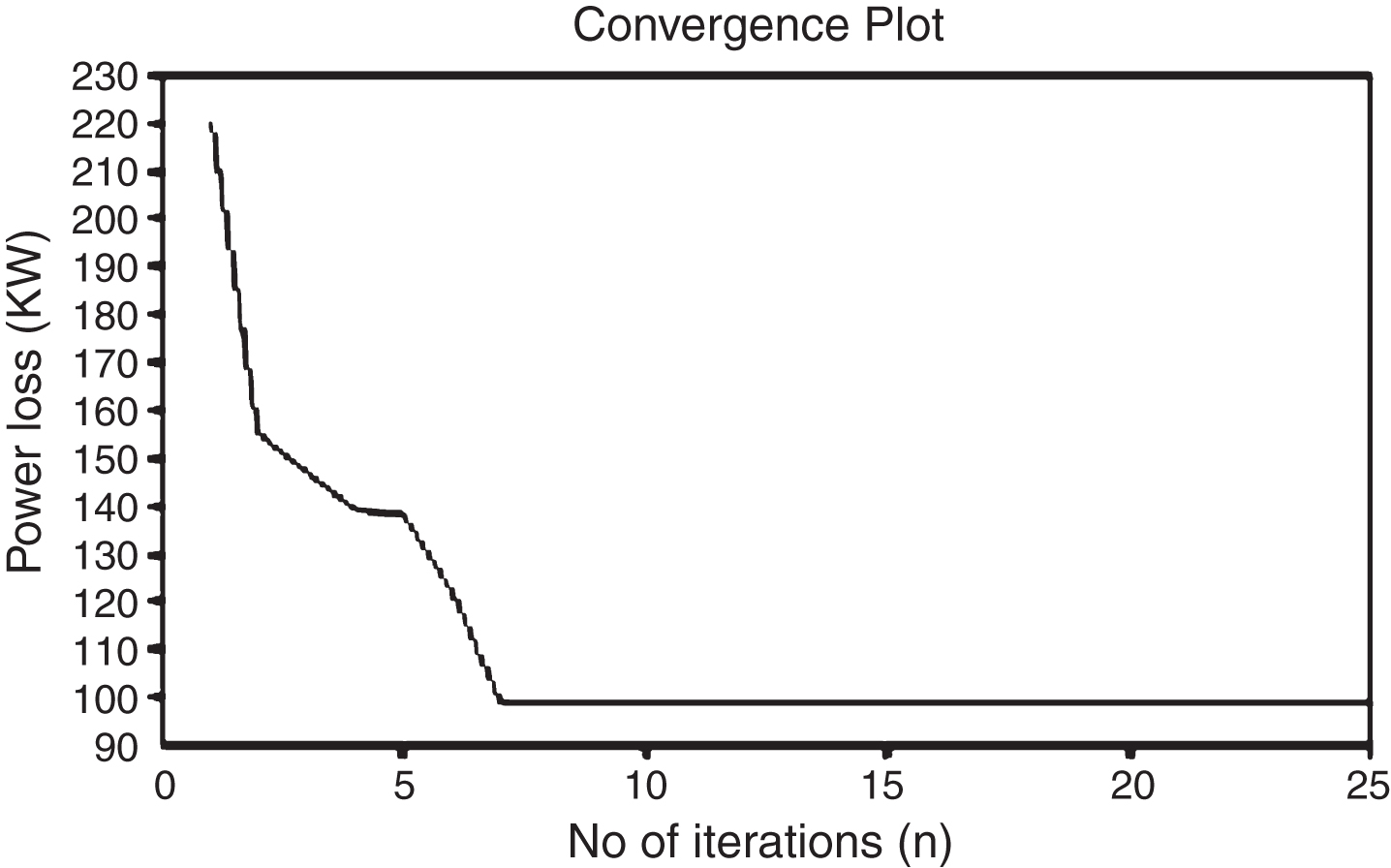
Plot for convergence for 69-bus using SOSA.
Results for SOSA - 69 bus
To check the robustness of SOSA it has been tested with 16 and 33 test systems by taking 50 iterations and some random initializations. A software tool have been used in MATLAB to execute this algorithm in Intel Core i5, 4200U CPU with 1.60 GHz processor and 8 GB RAM for calculating the distribution power loss. The minimum value of loss is suggested when [9, 16] switches are OFF for 16 bus and when [7, 9, 13, 23, 36] switches are OFF for 33 bus the loss value is found to be minimum with less calculation time. The loss is decreased by 17% for 16 bus and 34% for 33 bus test system approximately.
Conclusion
In this paper a recently developed meta-heuristics Symbiotic Organism Search algorithm (SOSA) has been formulated to solve the multi objective problems. The goodness of SOSA is that it is a parameter free algorithm. Thus the developed multi objective optimization problem is also parameter free. This method is tested using standard 16 and 33 bus systems. The end results led to an optimal reconfiguration which minimizes the true loss. Comparison is also made with other existing algorithms in which SOSA proves the superiority in losses minimization and faster execution time. The real power loss values for 16 bus and 33 bus distribution systems are calculated as 421.33 and 132.81 kW. With reference to the results obtained this method can be implemented for real time larger systems also.Among the nature inspired algorithms thi SOSA algorithm is computationally efficient.