In recent years, theory of rough sets has grabbed attention of many researchers owed to its incredible role in the field of data analysis. In this paper, group homomorphism is used to develop a relationship between the lower and upper approximations of groups. Further, the lower and upper approximations of two quotient groups are connected using natural projection group homomorphism. This work provides its application in the field of information technology, where it can be used to connect two information systems.
In 1982, Pawlak proposed an innovative concept of rough set theory. It is a first non-statistical approach in data analysis. It uses only internal knowledge and does not rely on prior assumptions such as probabilistic distribution in statistical approach. This theory is the generalization of set theory, defined by a pair of sets called the lower and upper approximations. The lower approximation space can be viewed as a subset of X, whereas the upper approximation space can be viewed as a superset of X. This theory provides simple algorithms to characterize the objects having the same value of attributes of an information system. This subject has been studied in many research articles (see [26–29]).
Over the years, it has attracted attention of many researchers. It deals with the vagueness and uncertainty in the data. It has been used in resolving various data mining problems (knowledge discovery in database parameters, analysis of imprecise information, detection and estimation of data dependency, etc). Nowadays, its usage is much wider than in the past, particularly in the area of artificial intelligence and computer science (material sciences, intelligent control, decision support system, machine diagnoses, neural networks, etc).
Rough set theory overlaps with many other known theories, especially with fuzzy set theory, soft set theory, evidence theory and Boolean theory. Nevertheless, it has its own distinguished features. Very auspicious new areas of its applications are likely to appear in near future including rough control systems, rough data bases, rough information retrieval, rough neural networks and many others.
In recent years, many authors have related rough sets with various algebraic structures. Initially, rough groups and rough quotient groups were defined in [2, 23]. In [7], Davvaz extended the concept of rough set to ring theory and introduced the notion of rough ideals and rough sub-rings with respect to an ideal of a ring. Afterward, the lower and upper approximation of rough prime (primary) ideals and their homomorphism images were discussed by Kazanci and Davvaz in [14].
In [10, 11], Dubois and Prade defined the notion of rough fuzzy sets and fuzzy rough sets. They also figured out that a rough fuzzy set is a particular case of a fuzzy rough set. Later on, the upper (lower) rough prime ideals and rough fuzzy prime ideals in a semigroup were discussed, [34].
Mi and Zhang (resp. Wu and Zhang) provide the axioms for approximation operators, as a fuzzy generalization of rough sets (see [22, 33]). More-general structure for rough fuzzy sets was studied in [19, 32]. For the different descriptions and versions of fuzzy and rough sets (see [35–38, 40–49]).
Kuroki and Wang proved some properties of the lower and upper approximations in a group with respect to a fuzzy subgroup (see [18]). Kuroki gave some properties of the approximation spaces with respect to congruences and fuzzy congruences on a semigroup (see [16]). Zhan and Davvaz defined the notion of rough rings and ideals (see [6, 41]). They also proved some fundamental properties of the approximation spaces with respect to an ideal in a ring.
The notion of soft hemirings was introduced as an extension of rough hemirings and soft hemirings, in [42]. In [45], the concept of rough n-ary semigroups and rough homomorphisms was introduced. Also, their relative properties were investigated. Recently, the notion of lower and upper approximations in quotient groups was introduced using conjugacy relation (see [21]).
Here, the lower and upper approximations in a group (particularly in a quotient group) is made via normal fuzzy group. In addition, the relation between lower and upper approximations of two different groups using group homomorphisms is presented. This can help in connecting two information systems for extraction of useful information.
Lower and upper approximations in a group
Some auxiliary and preliminary results about rough and fuzzy sets are detailed in this section.For thorough reading, we refer to [26, 39]. In this section, universal set will be denoted by U.
Definition 2.1. The ordered pair (U, θ) is called a Pawlak approximation space. Here, θ is an equivalence relation over U.
Definition 2.2. Let (U, θ) be a Pawlak approximation space. Then the lower and upper approximations of X ⊆ U are defined as
where [x] θ denotes the equivalence class of x ∈ U with respect to θ.
Definition 2.3. Suppose that (U, θ) is a Pawlak approximation space and X ⊆ U. Then, X is called a rough set, if .
Definition 2.4. (see [39]) A function μ : U → [0, 1] is called a fuzzy subset of X.
Definition 2.5. (see [24, Definition 1.1.11]) Suppose that f : U → V is a function. Let μ and ν be fuzzy subsets of U and V respectively. Then, the image (resp. pre-image) of μ (resp. ν) are defined as
for all x ∈ U and y ∈ V. Here, ∨ denotes the maximum value.
In this paper, a multiplicative group with identity element e will be denoted by G. Note that, if μ and ν are two fuzzy subsets of G. Then, μ ∩ ν and μ ∘ ν are defined as
for all x ∈ G (see [24, Definition 1.1.5] and [24, Definition 1.2.1]). Here, ∧ stands for the minimumvalue.
Definition 2.6. (see [24, Definition 1.2.3]) Let μ be a fuzzy subset of G. Then, μ is called a fuzzy subgroup of G, if the following conditionshold:
μ (xy) ≥ μ (x) ∧ μ (y),
μ (x−1) ≥ μ (x),
μ (e) =1,
for all x, y ∈ G.
Definition 2.7. dfe (see [24, Definition 1.3.2]) Let μ be a fuzzy subgroup of G. Then, it is said to be a normal fuzzy subgroup of G, if any of the following equivalent conditions hold:
μ (xy) = μ (yx),
μ (xyx−1) ≥ μ (y),
μ (xyx−1) ≤ μ (y),
for all x, y ∈ G.
Definition 2.8. (see [30, Definition 5.7]) If μ is a fuzzy subgroup of G, then the left and right co-sets of μ with respect to x ∈ G are defined as follows:
for all g ∈ G.
Clearly, from above definition, xμ = μx for all x ∈ G, if μ is a normal fuzzy subgroup of G. For fundamental results on fuzzy subgroups and normal fuzzy subgroups, see [15, 30]. In the rest of paper, μ will be denoting normal fuzzy subgroup of G.
Definition 2.9. Let θ be an equivalence relation over G with respect to μ, defined as:
Note that, Kuroki and Wang’s relation (for t = 1), defined in [18], can be reproduced from above equivalence relation. Hence, by [18, Lemma 6.1], θ is a congruence relation over G. Therefore, (G, θ, μ) becomes a Pawlak approximation space.
Let us denote the equivalence class of x ∈ G by [x] θ,μ. So, it is the following set:
In the following Lemma, the relation between product and intersection of equivalence classes will be proved. Recall that the intersection of two normal fuzzy subgroups of G is again a normal fuzzy subgroup (see [30, Exercise 5.4.15]).
Lemma 2.10. 1 With the previous notion, suppose that ν is a normal fuzzy subgroup of G. Then, for any x1, x2 ∈ G, the following conditions are true:
x1 (μ ∩ ν) = x1μ ∩ x1ν for all x1 ∈ G.
For any x1, x2 ∈ G, we have x1 (μ ∩ ν) = x2 (μ ∩ ν) if and only if x1μ = x2μ and x1ν = x2ν.
In particular
for all x1, x2 ∈ G.
Proof. (1) If a ∈ G, then note that
This proves the claim in (1).
(2) First of all, let x1 (μ ∩ ν) = x2 (μ ∩ ν). Then, . In particular, we have . This implies that;
It follows that or x2μ ⊆ x1μ. Reverse inclusion can be proved on similar lines. Hence, x1μ = x2μ. Similarly, one can show that x1ν = x2ν. Note that, the converse follows from (1). This completes the proof of (2).
Note that, [x1] θ,μ [x2] θ,μ = [x1x2] θ,μ for all x1, x2 ∈ G, since θ is a congruence relation over G.
Now, if y ∈ [x1] θ,μ ∩ [x1] θ,ν. Then, yμ = x1μ and yν = x1ν. By (1), it implies that:
Hence, y ∈ [x1] θ,μ∩ν and [x1] θ,μ ∩ [x1] θ,ν ⊆ [x1] θ,μ∩ν.
For the proof of other inclusion, suppose that y ∈ [x1] θ,μ∩ν. It implies that x1 (μ ∩ ν) = y (μ ∩ ν). This induces, x1μ = yμ and x1ν = yν (see (2)). Hence, y ∈ [x] θ,μ and y ∈ [x] θ,ν. Therefore, y ∈ [x] θ,μ ∩ [x] θ,ν. This proves the equality [x1] θ,μ∩ν = [x] θ,μ ∩ [x] θ,ν. □
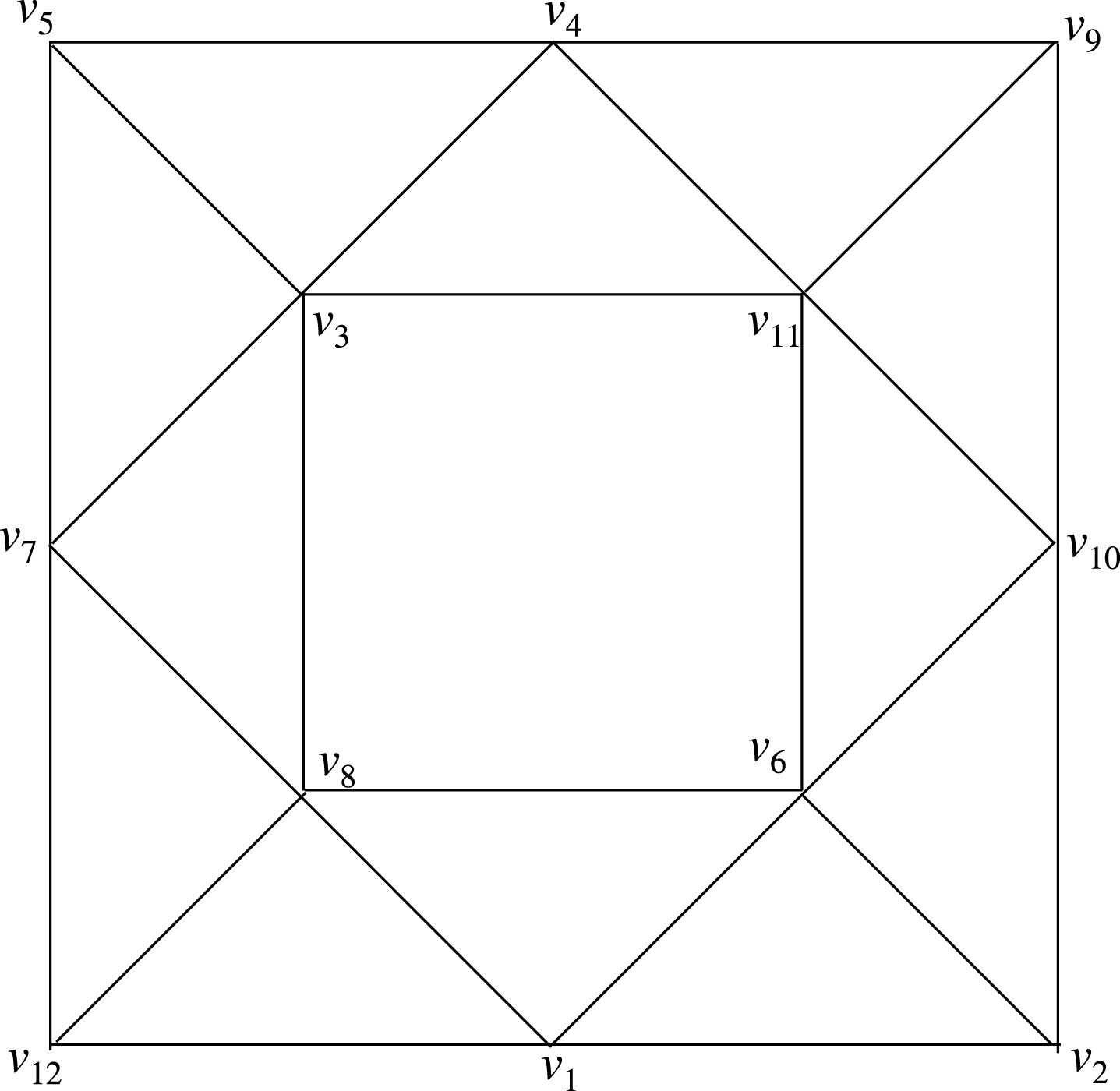
As an Example, our approximation space (G, θ, μ) will be used to color a graph. Note that, graph coloring is a procedure of labeling graph vertices such that no two adjacent vertices have the same color. Moreover, a graph is called simple, if it has no graphical loops or multiple edges.
Example 2.11. 55.555 Let U = G be a simple graph (see Fig. 1) with vertex set {v1, …, v12}, where denotes the group of integers under modulo 12.
A Simple Graph G.
Suppose that P is the following subset of attributes:
Let us denote for all i = 1, 2, …, 12. Define a fuzzy subset μ of U as follows:
It is easy to see that μ is a normal fuzzy subgroup of U. Let θ be the equivalence relation over U with respect to μ. Suppose that x, y ∈ U have the same color if xθy. Then, the following equivalence classes can be obtained:
Now, consider the following information system (Table 1):
Information System
Red
Blue
Green
v1
Yes
−
−
v2
−
Yes
−
v3
−
−
Yes
v4
Yes
−
−
v5
−
Yes
−
v6
−
−
Yes
v7
Yes
−
−
v8
−
Yes
−
v9
−
−
Yes
v10
Yes
−
−
v11
−
Yes
−
v12
−
−
Yes
Above table demonstrates that U is a 3– colored graph.
Let H be some subset of G, then the subsets of G are defined as follows:
These are called the lower (resp., upper) approximations of H with respect to μ in (G, θ, μ).
Remark 2.12. With the above notion, suppose that μ is injective. Then, we claim that [x] θ = {x}. In particular:
To prove the claim, assume that y ∈ [x] θ. It implies that yμ = xμ. Then:
Since, μ is injective. Then, it follows that x−1y = e or y = x. Hence, the claim is proved.
Proposition 2.13.With the same notion followed and μ ⊆ ν, there are the following inclusions:
It is important to note that if μ and ν are two normal fuzzy subgroups of G, then μ ∘ ν is a normal fuzzy subgroup of G (see [30, Exercise 5.4.17]).
Corollary 2.14.Let μ and ν be two normal fuzzy subgroups of G. For any non-empty subset H of G, the following results are true:
and .
and
and .
and .
Proof. Note that, μ ∩ ν ⊆ μ and μ ⊆ μ ∘ ν. So, all the claims follow from Proposition 2.13. □
The next Example shows that the inclusions are strict in Corollary 2.14. Moreover, it is shown that the lower and upper approximations are not subgroups of G.
Example 2.15. Let =}. Consider the following normal fuzzy subgroups μ and ν of G:
Note that, μ ∩ ν = ν. Also, there are the following equivalence classes:
If Then, by definition, and . Hence, .
Also, and . This proves that . Observe that, none of the following sets is a subgroup of G:
In [18, Proposition 6.9], it is shown that if H is a subgroup of G and . Then is a subgroup of G. In Lemma 2.16, it is shows that, with these assumptions, we do not gain any new information about H.
Lemma 2.16.Let H be a subgroup of G. If then:
Proof. Suppose that and is any element. Then, there exists h ∈ [x] θ,μ ∩ H. We need to prove that [h] θ,μ ⊆ H. To do this, assume that y ∈ [h] θ,μ. It follows that hμ = yμ. Since, μ is a normal fuzzy subgroup. It induces that (h−1y) μ = μ. This proves that:
But h ∈ H and H is a subgroup of G. It implies that y ∈ H. Then, we have proved that [x] θ,μ = [h] θ,μ ⊆ H and . Therefore, . □
Note that, Lemma 2.16 can alternatively be proved by considering that the set is non-empty.
Proposition 2.17.Suppose that where H is a subgroup of G. Then:
Proof. Let H be a subgroup of G such that . We claim that is a subgroup of G. Let for all i = 1, 2. Then, [xi] θ,μ ⊆ H for all i = 1, 2. Since, H is a subgroup. It follows that for all i = 1, 2. Then, Lemma 2.10 implies that:
Hence, . This proves the claim. So, the result follows from Lemma 2.16. □
Remark 2.18. If H is a subgroup of G. Then, by Proposition 2.17, either or . Hence, the approximation spaces of a subgroup do not provide any new information with non-empty lower approximation. Proposition 2.20 illustrates the criterion for, .
Corollary 2.19.Let μ and ν be two normal fuzzy subgroups of G and H ⊆ G a subgroup. If or . Then, we have following equalities:
Proof. It is straightforward in view of Corollary 2.14(2) and Proposition 2.17. □
In the next result, we need the following definition of μ∗:
Proposition 2.20.If H be a subgroup of G, then the following conditions are equivalent:
.
μ∗ ⊆ H.
Proof. Note that, (1) is equivalent to (2) (see Proposition 2.17). Now, we prove that (2) and (3) are equivalent. First of all, assume that . If x ∈ μ∗, then by definition of μ∗, μ (x) = μ (e) =1. This proves that xμ = μ and hence x ∈ [e] θ ⊆ H. Recall that . Therefore, μ∗ ⊆ H.
Conversely, suppose that μ∗ ⊆ H. We claim that . If x ∈ [e] θ, then xμ = μ. This proves that μ (x) = μ (e) =1. Hence, x ∈ μ∗ ⊆ H. It follows that [e] θ ⊆ H and . □
Theorem 2.21.Let μ and ν be two normal fuzzy subgroups of G. If H is a subgroup of G, then the following statements hold:
If is non-empty, then:
Proof. (1) By Corollary 2.14(3), we have and . Since, H is a subgroup. Then, is also a subgroup (see [18, Proposition 6.8]). It follows that:
Conversely, assume that . Then, there exists y ∈ [x] θ,μ∘ν ∩ H. So, we have x (μ ∘ ν) = y (μ ∘ ν). It implies that (μ ∘ ν) (y−1x) = (μ ∘ ν) (e) =1. By definition of μ ∘ ν, there exist a, b ∈ G such that:
It follows that μ (a) =1 = μ (e) and ν (b) =1 = ν (e). This proves that bμ = eμ and bν = eν. Hence, e ∈ [a] θ,μ ∩ H and e ∈ [b] θ,ν ∩ H. Then:
Also, xμ = yabμ or xb−1a−1μ = yμ. Hence, y ∈ [xb−1a−1] θ,μ ∩ H. So, we conclude that . By Proposition [18, Proposition 6.8], is a subgroup of G. It follows that:
Then, . This proves the required equality.
(2) If it implies that and are also non-empty sets (see Corollary 2.14(4)). Then, the result follows from Proposition 2.17. □
Lower and upper approximations via group homomorphisms
Suppose that f : G → G′ is a group homomorphism between two groups. If ν is a normal fuzzy subgroup of G′. By [30, Proposition 5.17], it follows that f−1 (ν) is a normal fuzzy subgroup of G. In this section, several relations between the approximation spaces of G and G′ will be developed. Throughout this section, θ and θ1 will be denoting the equivalence relations over G′ and G with respect to ν and f−1 (ν), respectively.
Lemma 3.1.With the same notion followed and x ∈ G, the following statement is true:
Proof. If x ∈ G, then note that:
□
Example 3.2. Let and be two universe sets, where and for all i = 1, …, 8 and j = 1, …, 4. Consider the following subset of attributes:
Define a normal fuzzy subgroup ν of G′ as:
Suppose that x, y ∈ G (resp. x′, y′ ∈ G′) have the same value of attributes if xθ1y (resp. x′θy′). Consider the information system (U′, P) as follows (Table 2):
Information System (U′, P)
Normal
Headache
Flu
Temperature
v1
Yes
No
No
No
v2
No
Yes
Yes
No
v3
Yes
No
No
No
v4
No
Yes
Yes
No
If f : U → U′ is the natural group homomorphism with for all i = 1, …, 8. By Lemma 3.1, it follows that both x ∈ U and f (x) ∈ U′ have the same value of attributes. Hence, it induces the following information (Table 3) system (U, P):
Information System (U, P)
Normal
Headache
Flu
Temperature
u1
Yes
No
No
Yes
u2
No
Yes
Yes
No
u3
Yes
No
No
Yes
u4
No
Yes
Yes
No
u5
Yes
No
No
Yes
u6
No
Yes
Yes
No
u7
Yes
No
No
Yes
u8
No
Yes
Yes
No
Proposition 3.3.With the same assumptions as in Lemma 3.1, suppose that ∅ ≠ H ⊆ G and ∅ ≠ H′ ⊆ G′. Then, the following implications are true:
Proof. If then:
Hence, this proves the first implication. Similarly, it can be proved that:
This finishes the proof of Proposition. □
Theorem 3.4.With the previous notion, assume that f is onto. Then, the following implications hold:
Proof. Suppose that f : G → G′ is onto and . Let y ∈ [f (x)] θ,ν be an arbitrary element. It follows that:
This proves the first implication. The second implication can be proved following same steps. □
Theorem 3.5.With the same assumptions as in Theorem 3.4, the following implication hold:
In addition, if H is a subgroup of G with Ker (f) ⊆ H, then:
Proof. Let f be onto and . There exists y ∈ [f (x)] θ,ν ∩ H′. Since f in onto, assume that y = f (a) for some a ∈ G. Hence, f (a) ∈ H′ and a ∈ [x] θ1,f−1(ν) (see Lemma 3.1). It implies that a ∈ f−1 (H′) ∩ [x] θ1,f−1(ν). So, .
Now, assume that H is a subgroup of G with Ker (f) ⊆ H. If then y ∈ [f (x)] θ,ν ∩ f (H) for some y ∈ G′. By surjectivity of f, we can write y = f (a), where a ∈ G. We claim that a ∈ H. Note that, f (a) ∈ f (H) and a ∈ [x] θ1,f−1(ν) (see Lemma 3.1). It implies that:
Then, h−1a ∈ Ker (f) ⊆ H and hence a ∈ H. Recall that H is a subgroup. This proves that a ∈ [x] θ1,f−1(ν) ∩ H and □
Proposition 3.6.With the same assumptions as in Lemma 3.1, suppose that ∅ ≠ H′ ⊆ G′. Then:
In addition, if H is a subgroup of G with Ker (f) ⊆ H, then:
Proof. Let and y ∈ [x] θ,f−1(ν). By Lemma 3.1, it follows that f (y) ∈ [f (x)] θ,ν ⊆ H′. It implies that y ∈ f−1 (H′).
But y ∈ [x] θ,f−1(ν) was an arbitrary element. So, [x] θ,f−1(ν) ⊆ f−1 (H′). Hence, By the similar arguments, the other claim can be proved. □
If f : G → G′ is an onto group homomorphism and μ a normal fuzzy subgroup of G. Then, f (μ) is a normal fuzzy subgroup of G′ (see [1, Theorem 3.7]). From now on, θ2 and θ3 will be denoting the equivalence relations over G and G′ with respect to μ and f (μ), respectively. Note that, μ is called constant over Ker (f), if μ (x) = μ (y) for all x, y ∈ Ker (f).
Lemma 3.7.With the previous notion, suppose that x ∈ G. Then, we have the following implication:
Also, the converse is true, if μ is constant over Ker (f).
Proof. If y ∈ [x] θ2,μ, then yμ = xμ. It implies that μ (x−1y) =1. Note that, for any a ∈ G′, we have:
This proves that f (μ) ⊆ f (y) −1f (x) f (μ) or f (y) f (μ) ⊆ f (x) f (μ). Similarly, the other inclusion can be proved. Hence, f (y) f (μ) = f (x) f (μ). It follows that f (y) ∈ [f (x)] θ3,f(μ).
Conversely, if μ is constant over Ker (f) and f (y) ∈ [f (x)] θ3,f(μ). Then, f (y) f (μ) = f (x) f (μ). Since, f is a homomorphism. Then, it follows that:
Since μ is constant over Ker (f). Then, by [25, Lemma 3.2.5], this proves that μ (x−1y) =1. It follows that xμ = yμ. Hence, y ∈ [x] θ2,μ. □
The following Example illustrates that the converse in Lemma 3.7 become invalid, if μ is not constant over Ker (f).
Example 3.8. Let and be two groups. Consider the natural onto group homomorphism f : G → G′, as for all x ∈ G. Let μ be a normal fuzzy subgroup of G, defined as:
Since, . Then, μ is not constant over Ker (f). Note that, 1 = f (μ) (f (4) - f (0)). Hence, f (4) + f (μ) = f (0) + f (μ) = f (μ) and f (4) ∈ [f (0)] θ3,f(μ). On the other hand, we have 4 ∉ [0] θ2,μ.
Theorem 3.9.With the same assumptions as in Lemma 3.7, assume that ∅ ≠ H ⊆ G, ∅ ≠ H′ ⊆ G′ and x ∈ G. Then, the following statements are true:
Proof. Using Lemma 3.7, this can be proved following the same methodology as in proof of Proposition 3.3. □
Theorem 3.10.With the previous notion, suppose that f is onto and μ is constant over Ker (f). Then the following implications hold:
Proof. This can be proved along the similar lines to that of Theorem 3.4. □
Proposition 3.11.With the same notion followed, we have:
In addition, if H is a subgroup of G containing Ker (f). Then:
Proof. The proof is obvious in view of Lemma 3.7. To prove this result, one can proceed along the similar lines to that of Theorem 3.5. □
Proposition 3.12.With the same assumptions as in Lemma 3.7, suppose that ∅ ≠ H′ ⊆ G′ and x ∈ G. Then, we have:
In addition, if H is a subgroup of G containing Ker (f). Then:
Proof. To prove these claims, follow the same steps as in proof of Proposition 3.6. □
Roughness in quotient groups
Throughout this section, N and M will be considering normal subgroups of G. Also, f : G → G/N and g : G → G/M will be denoted as the natural onto group homomorphisms, that is, f (x) = xN and g (x) = xM for all x ∈ G. Assume in addition, N ⊆ M. Then, there exists a natural onto group homomorphism k : G/N → G/M, defined as k (aN) = aM for all a ∈ G.
Lemma 4.1.With the above notion, if we set G′ = G/N in Lemma 3.1. Then, for any y ∈ G, the following conditions are equivalent:
y ∈ [x] θ1,f−1(ν).
yN ∈ [xN] θ,ν.
Proof. The proof is straightforward in view of Lemma 3.1. □
If N ⊆ H ⊆ G, then the set H/N is defined as:
Theorem 4.2.With the same notion followed, suppose that x ∈ G. Then, we have:
In addition, if H is a subgroup of G. Then, the following implication is true:
Proof. Note that, f (H) = H/N = {hN : h ∈ H}. If H is a subgroup of G, then f−1 (H/N) = H. Hence, the proof is obvious in view of Propositions 3.3 and 3.6 and Theorems 3.4 and 3.5. □
The converse of the second implication in Theorem 4.2 does not hold in general, see Example 4.3.
Example 4.3. wewe Let be the set of integers, and H = N ∪ {±1, 2}. Then, H/N = G/N. Suppose that the coset x + N is denoted by . Consider the following normal fuzzy subgroup ν of G/N:
It follows that for all x ∈ G. Also, by definition of f−1 (ν), we have:
Then, Lemma 4.1 implies that:
Hence, the lower approximation space of H (resp. H/N) with respect to f−1 (ν) (resp. ν) is:
Note that and
Lemma 4.4.Let η be a normal fuzzy subgroup of G/M and x ∈ G. For any y ∈ G, the following conditions are equivalent:
y ∈ [x] θ1,g−1(η).
yM ∈ [xM] θ,η.
In addition, if N ⊆ M. Then, the following condition is equivalent to the above conditions:
Proof. It follows from Lemma 3.1. □
Theorem 4.5.Let η be a normal fuzzy subgroup of G/M, N ⊆ M ⊆ H ⊆ G and x ∈ G. Then, the following implications hold:
Moreover, the converse is true, if H is a subgroup of G.
Proof. The proof of the following implications is obvious in view of Lemma 4.4. One can proceed along the similar lines to that of Proposition 3.3 and Theorem 3.4.
For the converse, suppose that H is a subgroup of G and . If y ∈ [x] θ,g−1(η), then by Lemma 4.1, it follows that yN ∈ [xN] θ,k−1(η) ⊆ H/N. It implies that:
Then, h−1y ∈ N ⊆ H and hence y ∈ H. Hence, [x] θ,g−1(η) ⊆ H. Then, This proves the converse of first implication.
Finally, if then there exists yN ∈ [xN] θ,k−1(η) ∩ H/N. It implies that yN ∈ [xN] θ,k−1(η) and yN = hN, where h ∈ H. Then, h−1y ∈ N ⊆ H and hence y ∈ H. Recall that H is a subgroup and h ∈ H. Also, by Lemma 4.4, it follows that y ∈ [x] θ,g−1(η). That is we have:
So, . This proves that:
□
Corollary 4.6.With the previous notion, suppose that H is a subgroup of G containing M. Then, the following statements are true:
Hence, ⇔ ⇔ .
Proof. By Proposition 2.17, Theorems 4.2 and 4.5, the proof is obvious. □
Concluding remarks
Theory of rough set has witnessed enormous growth in the last few years. Rough set has become a valuable aid for handling uncertainties and vagueness in the data. Expanding domain of its application demands further extension of theory. The interpretations of the rough fuzzy set theory help us to gain much more insight into the logical structures. In this paper, we established the relationship among upper and lower approximations of two groups using group homomorphism. We successfully implemented our results for developing the connection between the approximation spaces of two different quotient groups. As an application, connection between two information systems has been demonstrated. Extension of this work to other algebraic structures can contribute significantly in extension of rough set theory.
Footnotes
Acknowledgements
The authors are grateful to the reviewers for suggestions to improve the manuscript.
References
1.
AjmalN., Homomorphism of fuzzy groups, correspondence theorem and fuzzy quotient groups, Fuzzy Sets and Systems61 (1994), 329–339.
2.
BiswasR. and NandaS., Rough groups and rough subgroups, Bull Polish Acad Sci Math42 (1994), 251–254.
3.
BonikowaskiZ., Algebraic structures of rough sets, In ZiarloW.P. (Ed.), Rough sets fuzzy sets and knowledge discovery, Springer-Verlag, Berlin (1995) pp. 242–247.
4.
ChakrabortyM.K. and BanergeeM., Logic and algebra of the rough sets, In ZiarkoW.P. (Ed.), Rough sets fuzzy sets and knowledge discoverySpringer-Verlag, London, (1994) pp. 196–207.
5.
ChengW., MoZ.-W. and WangJ., Notes on the lower and upper approximations in a fuzzy group and rough ideals in igroups, Infor Sci177 (2007), 5134–5140.
6.
DavvazB., Roughness in rings, Inform Sci164 (2004), 147–163.
7.
DavvazB., Roughness based on fuzzy ideals, Inform Sci164 (2006), 2417–2437.
8.
DavvazB. and MahdavipourM., Roughness in modules, Inform Sci176 (2006), 3658–3674.
9.
SongW.D., Application of the theory of rough set on the groups and rings, Master Thesis, 2004.
10.
DuboisD. and PradeH., Twofold fuzzy sets and rough setssome issues in knowledge representation, Fuzzy Sets and Systems23 (1987), 3–18.
11.
DuboisD. and PradeH., Rough fuzzy sets and fuzzy rough sets, Int J Gen Syst17(2–3) (1990), 191–209.
HanS., ChengW. and WangJ., Rough rings revisited, Guangzhou, pp. , Proceedings of the Fourth International Conference on Machine Learning and Cybernetics (2005), 3157–3161.
14.
KazanciO. and DavvazB., On the structure of rough prime (primary) ideals and rough fuzzy prime (primary) ideals in commutative rings, Infor Sci178 (2008), 1343–1354.
15.
KumarR., Fuzzy Algebra I, University of Publ. Division, Delhi, 1993.
16.
KurokiN., Rough ideals in igroups, Inform Sci100 (1997), 139–163.
17.
KurokiN. and MordesonJ.N., Structure of rough sets and rough groups, J Fuzzy Math5(1) (1997), 183–191.
18.
KurokiN. and WangP.P., The lower and upper approximations in a fuzzy group, Inform Sci90 (1996), 203–220.
19.
LiuG., Axiomatic systems for rough sets and fuzzy rough sets, Internat J Approx Reason48 (2008), 857–867.
20.
MaX., LiuQ. and ZhanJ., A survey of decision making methods based on certain hybrid soft set models, Artif Intell Rev47 (2017), 507–530.
21.
MahmoodW., NazeerW. and KangS.M., The lower and upper approximations and homomorphisms between lower approximations in quotient groups, J Intell Fuzzy Systems33 (2017), 2585–2594.
22.
MiJ.S. and ZhangW.X., An axiomatic characterization of a fuzzy generalization of rough sets, Inform Sci160 (2004), 235–249.
23.
MiaoD., HanS., LiD. and SunL., Rough group, rough subgroup and their proprties, International Workshop on RSFDGRC. (ŚlezakD. ed.), Springer-Verlag, Berlin-Heidelberg, 2005, pp. 104–113.
24.
MordesonJ., BhutaniK., RosenfeldA., Fuzzy group theory, Studies in Fuzziness and Soft Computing, Springer, vol. 182, Berlin-Heidelberg-New York, 2005.
PawlakZ., Rough sets, Int J Inform Comput Sci11 (1982), 341–356.
27.
PawlakZ., Rough Sets-Theoretical Aspects of Reasoning about Data, Kluwer Publishing Academic, Dordrecht, 1991.
28.
PolkowskiL., SkowronA., (Eds), Rough sets in knowledge discovery 1, Methodology and Applications, Studies in Fuzziness and Soft Computing, vol. 18, Physical-Verlag, Heidelberg, 1998.
29.
PolkowskiL., SkowronA., (Eds), Rough Sets in Knowledge Discovery 2, Applications, Studies in Fuzziness and Soft Computing, vol. 19, Physical-Verlag, Heidelberg, 1998.
30.
WangX., RuanD. and KerreE., Studies in fuzziness and soft computing, Mathematics of fuzzinessbasic issues, 2009, Springer-Verlag, Berlin-Heidelberg.
31.
WangaC. and ChenD., A short note on some properties of rough groups, Comput Math Appl59 (2010), 431–436.
32.
WuW.Z., LeungY. and ZhangW.X., On generalized rough fuzzy approximation operators, Transactions on rough sets. V, 263–284, Lecture Notes in Comput. Sci. 4100, Springer, Berlin, 2006.
33.
WuW.Z. and ZhangW.X., Constructive and axiomatic approaches of fuzzy approximation operators, Inform Sci159 (2004), 233–254.
34.
XiaoQ.M. and ZhangZ.L., Rough prime ideals and rough fuzzy prime ideals in igroups, Inform Sci176 (2006), 725–733.
35.
YaoY.Y., Constructive and algebraic methods of the theory of rough sets, Inform Sci109 (1998), 21–47.
36.
YaoY.Y., A comparative study of fuzzy sets and rough sets, Inform Sci109 (1998), 227–242.
37.
YaoY.Y., Relational interpretations of neighborhood operators and rough set approximation operators, Inform Sci111 (1998), 239–259.
38.
YaoY.Y. and LinT.Y., Generalization of rough sets using modal logic, J. Intell. Automation & Soft Computing2 (1996), 103–120.
39.
ZadehL.A., Fuzzy sets, Inform and Contr8 (1965), 338–353.
40.
ZhanJ., AliM.I. and MehmoodN., On a novel uncertain soft set model: Z-soft fuzzy rough setmodel and corresponding decision making methods, Appl Soft Computing56 (2017), 446–457.
41.
ZhanJ. and DavvazB., Notes on roughness in rings, Inform Sci346–347 (2016), 488–490.
42.
ZhanJ., LiuQ. and DavvazB., A new rough set theory: Rough soft hemirings, J Intell Fuzzy Systems28 (2015), 1687–1697.
43.
ZhanJ., LiuQ. and HerawanT., A novel soft rough set: Soft rough hemirings and its multicriteria group decision making, Appl Soft Computing54 (2017), 393–402.
44.
ZhanJ., LiuQ. and ZhuW., Another approach to rough soft hemirings and corresponding decisionmaking, Soft Computing21 (2017), 3769–3780.
45.
ZhanJ., ZhouX. and XiangD., Roughness in n-ary igroups based on fuzzy ideals, J Intell Fuzzy Systems30 (2016), 2833–2841.
46.
ZhanJ. and ZhuK., A novel soft rough fuzzy set: Z-soft rough fuzzy ideals of hemirings and corresponding decision making, Soft Computing21 (2017), 1923–1936.