



Abstract
This paper proposes and investigates new possibilities applied to enrich SWOT analysis mechanism using elements of artificial intelligence, and, especially, the computing with words paradigm. This approach is novel due to the originality of the encoding of input words that describe the situation under the investigation in a new functional organization of the SWOT engines, and the originality of the method used for decoding and aggregation of numerical outputs into a verbal form. Promising results of the experimental simulation of the prototype of SWOT+CWW tool are delivered as well.
Keywords
Introduction: SWOT + CWW
Nowadays, a very promising new trend in the field of information processing is witnessed and is expressed by the famous chain:
This indicates a human being tendency to use elements of natural language in various kinds of evaluations, reasoning, decision makings and recommendations ([1–5, 20–24] and many others). Attempts to use natural language are usually based on soft computing (SC), artificial and/or computational intelligence (AI and/or CI) and more or less developed computing with words (CWW) paradigms (for example [2, 23]). The road map of challenges in CWW for decision making in general everyone can find in [20]. Currently the scientific literature is overflowed with tremendous amounts of publications concerning the paradigms. Google Search in less than one second delivers 16 700 000 titles in the field of SC, 23 400 000 – in AI, 3 290 000 – in CI, 99 500 – in CWW (data on January 31, 2017).
Thus, it is the right time to expand elements of CWW in practice. The goal of this paper is to describe the experience of the Centre of Real Time Computer Systems at Kaunas University of Technology, Lithuania, where an attempt to enrich SWOT (Strengths, Weaknesses, Opportunities and Threats) analysis by means of using the elements of CWW was successfully implemented.
The most promising basic and new linguistic computational models are proposed and discussed in [2, 23]. In spite of the fact that we use not uniformly and symmetrically distributed linguistic term sets (mentioned in [22]) for SWOT decision making, we start SWOT+CWW tool implementation on the base of less sophisticated approach; we do not use any additional context information ([22]), or data about experts’ hesitancy ([23]). Even the question of consensus reaching in case of linguistic group decision making (see [21]) in our paper is omitted, because of two reasons: 1) SWOT analysis is based on individualized linguistic/verbal evaluation of the situation under consideration, 2) new linguistic approach based on fuzzytech mechanism ([19]) to the consensus reaching is delivered in our presentation “The generalized methodology for risk evaluation based on fuzzy logic and computing with words” at University of Bath, UK, conference on Understanding Risk: From Theory to Application in Policy and Practice; 20–22nd June 2016 (in press).
The SWOT analysis is a world-wide spread methodology of decision making in industrial and business management, banking, military operations planning, science, and as an obligatory tool on the governmental level as well as public or private life. An exceptional interest in this methodology can be witnessed by Google Search analysis demonstrating that a number of publications with the acronym SWOT in titles exceeds 8 950 000. It is known that SWOT stands for strengths (ST), weaknesses (WK), opportunities (OP) and threats (TH) surrounding any idea, plan, or project to be investigated and/or implemented [6]. Opportunities and threats are usually defined as external issues of the project and signify possible positive and negative achievements when the project will be realized. At the same time strengths and weaknesses mean internal issues that enable and impede the achievement of the main goals and development of project possibilities. A quantitative interaction between OPs, THs, STs and WKs usually is expressed by a numerical SWOT matrix which shows the influence of STs and WKs on opportunities and threats. It is necessary to emphasize that up till now all numerical data in the matrix mentioned above had to be collected (or even extracted) from experts and decision makers. Thus it has been a very hard, ambiguous, slow and inefficient task.
This article aims at finding out ways how to overcome the drawbacks mentioned above by using verbal qualitative evaluation in the process of delivering descriptions of data necessary to for SWOT analysis. Seeking to perform necessary SWOT computations and deliver the obtained SWOT analysis results in a verbal form OPs, THs, STs and WKs were characterized by means of using words. It indicates that CWW methodology enriches SWOT methodology and creates a possibility for SWOT users and decision makers to communicate using the newly developed tool and words of common language.
To discuss the SWOT analysis mechanism this paper has been organized in the following way. Section 2 presents a general description of SWOT mechanism and the generic structure of computing with words (CWW) for SWOT analysis. The functional organization of the system that includes words, vocabulary, encoding process, the description of SWOT engine and decoding is presented in Section 3. Whereas Section 4 is dedicated to overview simulation results of the tool. Concluding remarks are presented in Section 5.
Preliminaries
This section aims to separately present both mechanisms of SWOT and CWW in order their positive abilities could be joined to create a new tool for decision makers and to enable them to perform the analytical work using words, sentences and phrases. Two types of parenthesis are used: 1) {WORD} for words and 2) [W] for numerical value of the variable W (if it is necessary to distinguish the form of information presented).
A generalized description of the mechanism of SWOT analysis
As presented [6], SWOT analysis deals with opportunities (OP), threats (TH), strengths (ST), and weaknesses (WK), in a very complicated manner interacting around the project under investigation. Thus, experts and decision makers usually work on four lists of entities:
Here {OP o } , { TH t } , { ST s } , { WK w } are words that stand for the names to indicate an opportunity (o), a threat (t), a strength (s) and a weakness (w) correspondingly.
Firstly, experts and decision makers are asked to evaluate the importance degree of each possible/predicted opportunity c o (o = 1, … O) and the importance degree of each possible/predicted threat c t (t = 1, … T). The degree is a real number from the interval [0–1].
Secondly, a similar procedure is performed and is related to possible values of truth ρ o , ρ t for all o = 1, … O and t = 1, …, T. This evaluation also consists of numbers from the same interval [0–1].
On the basis of such information the initial SWOT table (Fig. 1) can be constructed.

The initial SWOT table.
Thirdly, the influence of strengths and weaknesses on all opportunities and threats, possible to be predicted and evaluated, must be assessed and applied in the same SWOT table.
The influence calculated is presented as numerical values from the interval [0–1] for ∀o, t, s, w: ST
os
– the influence of the strength s on the opportunity o (usually positive/stimulating). WK
ow
– the influence of the weakness w on the opportunity o (usually negative/suppressing). ST
ts
– the influence of the strength s on the threat t (negative/suppressing). WK
tw
– the influence of the weakness w on the threat t (usually positive/stimulating).
This is the most efforts requiring and time consuming process for experts and decision makers.
The final evaluation of summarized opportunities OP
Σ
as well as threats TH
Σ
is performed according to formulas (1) and (2):
As a matter of fact, such an old fashioned technology of SWOT analysis requires various improvements and innovations. First of all, OPs, THs, STs and WKs must be characterized or described applying words. Secondly, these words must be automatically transformed into numbers and, only after that, can be filled into the SWOT table. Thirdly, after necessary SWOT computations the obtained results must be delivered in a verbal form.
As it is emphasized in [3] and especially in [7–9], traditional computing deals with numbers. Computing with words (CWW) manipulates more sophisticated elements inherent to natural languages. Unfortunately, the authors of the article have just started to carry out research and model abilities of human brains and act on the basis of perceptions. At the moment the CWW paradigm is simplified to the level of word processing according to the functional structure depicted in Fig. 2.

Functional structure of the CWW paradigm.
In order words and phrases/sentences could be understood and processed they must be coded on the basis of contextual information that is given in advance. The encoder transforms words into numerical antecedents ready for a fuzzy inference according to the list of fuzzy rules and algorithms that simulate the type of human reasoning.
The obtained consequent numerical results are aggregated on the basis of contextual information that is given in advance. Later, the aggregated results are subjected to the decoding procedure that transforms the resulting numerical information into elements of natural language: words and phrases/sentences, ready for the use of human beings.
The contextual information, mentioned above, mostly consists of: 1) the vocabulary of words that determine and limit the space of input word set, and 2) the vocabulary and/or lists of output phrases/sentences/recommendations to be received after decoding. Therefore, in every case vocabularies are predetermined by the field of possible applications of the concrete tool. In this particular case under the investigation, the CWW paradigm has been used for the applied SWOT analysis that has been discussed in the previous subsection 2.1.
The generalized structure of such a tool of SWOT analysis, constructed according to the CWW paradigm, presented in Fig. 2, is demonstrated in Fig. 3.
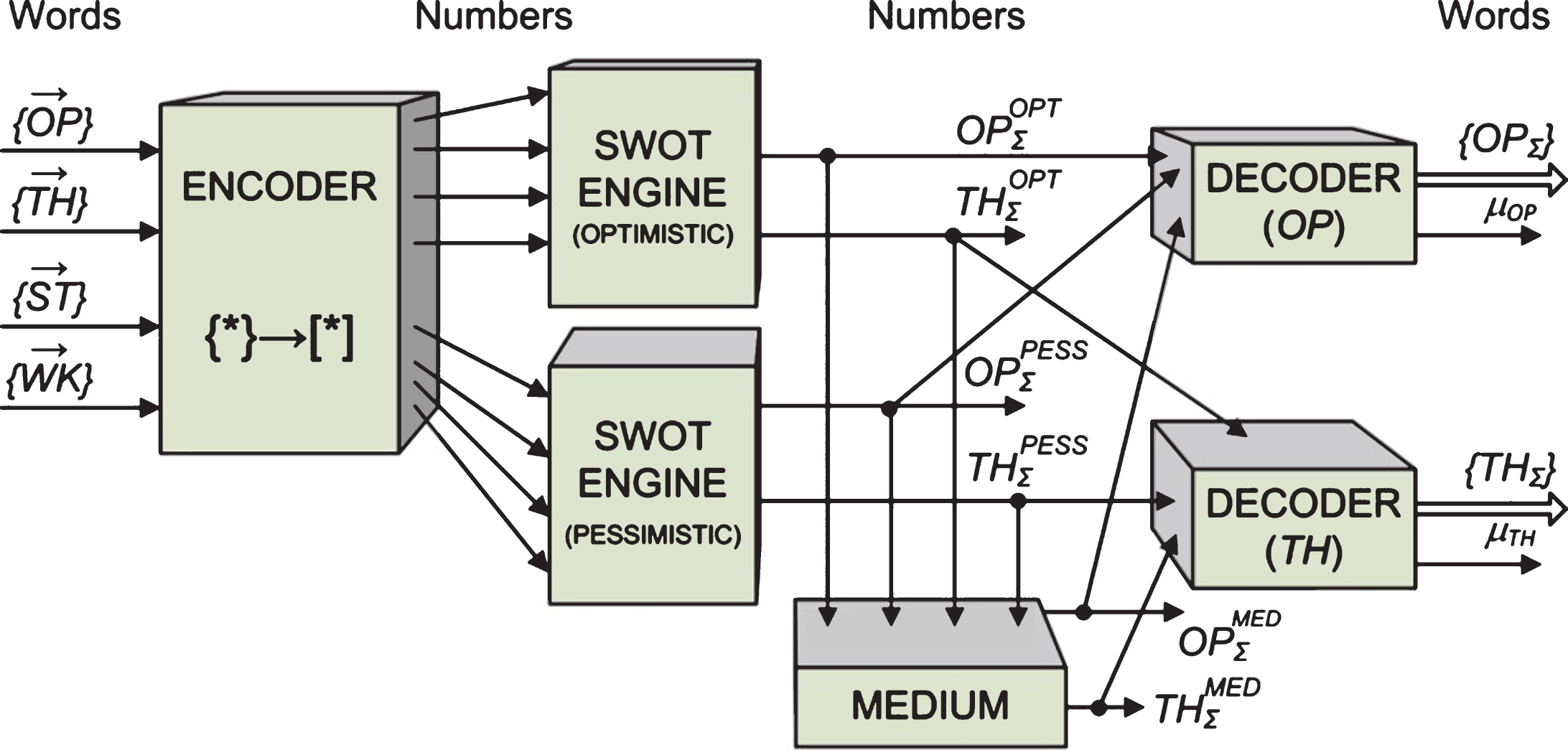
A possible structure of the SWOT analysis tool enriched by CWW elements.
Here verbal descriptions of all four sets {OP
o
} , { TH
t
} , { ST
s
} , { WK
w
} are symbolically taken as the input vocabulary for ∀o, t, s, w Verbal descriptions of {OP
Σ
} and {TH
Σ
} together with their numerical evaluation of their truth certainty are used as an output vocabulary. Two SWOT engines (for optimistic and pessimistic versions) are applied as inference engines (see Fig. 2). Summarized opportunities and threats of the changeable determination of
Coding of newly proposed and developed words and decoding procedures of results and the general functional organization of this system are presented in the next section.
This section covers three main topics of the functional implementation of the system: 1) the question of the vocabulary used for descriptions of situations under SWOT analysis and the encoding method of words; 2) the organization of analysis of all four lists of entities
Vocabulary and encoding
This paper presents a unified vocabulary for the verbal evaluation of all possible entities of SWOT analysis. The following set consisting of six words, described below, has been applied in the research: {Z} – None/Zero {VS} – Very small {S} – Small {M} – Medium {L} – Large {VL} – Very large
A very old paradigm that was first proposed by H. C. Orsted in 1833 [10], has been applied and developed to confirm that the ability of human beings to distinguish and evaluate the qualitative difference more or less objectively does not exceed six grades. Currently this fact is kept under the consideration in the field of fuzzy engineering and CWW ([11, 12], and many others).
The collection of membership functions corresponding to the proposed set of words is presented in Fig. 4.
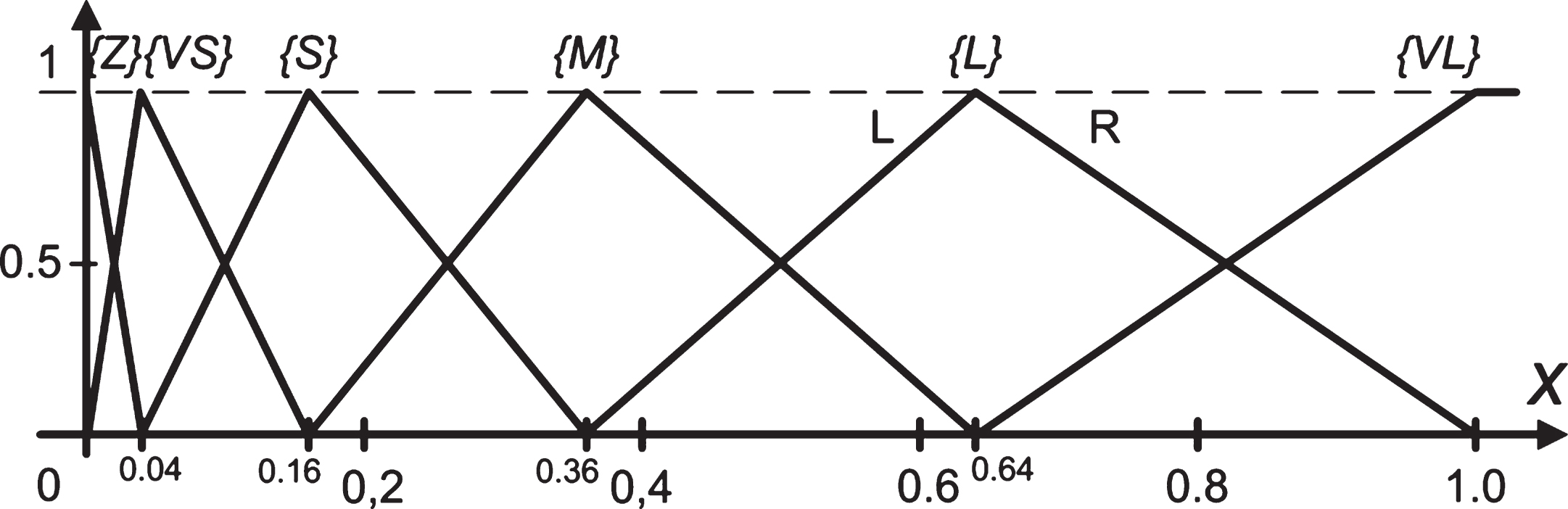
Membership functions for the words of the selected vocabulary.
End points of intervals for each word as well as points of vertexes of simplified membership functions are chosen according to recommendations based on psychological features of human reasoning that guaranty the convergence of multiple evaluation processes. It means that the size of the intervals between each two neighboring vertices must increase slower than a quadratic parabola [5, 14].
During the encoding process experts of SWOT analysis face at least three options that are described below.

Three examples of Type-1 and Type-2 fuzzy relational verbal encoding: a) pure Type-1 case, b) limit Type-1 case, c) Type-2 case.
This case corresponds to the pure Type -1 fuzzy relational data model and encoding [15].
In this case two answers from the left (L) and the right (R) shoulder of the same term {L}
IF the verbal evaluation = {L} & μ
L
(x) = μ, THEN
Here
Experts and decision makers during the process of SWOT analysis work on four lists of entities under the investigation as it has been presented in the subsection 2.1. The entire problem, idea or project to be realized is usually discussed by a team of experts who participate in so-called brain storming process. All four lists are processed one by one according to the structural flow chart, presented in Fig. 6. The encoded information is transferred into two SWOT engines shown in Fig. 3. The elaborated picture of such a transfer is depicted in Fig. 7.
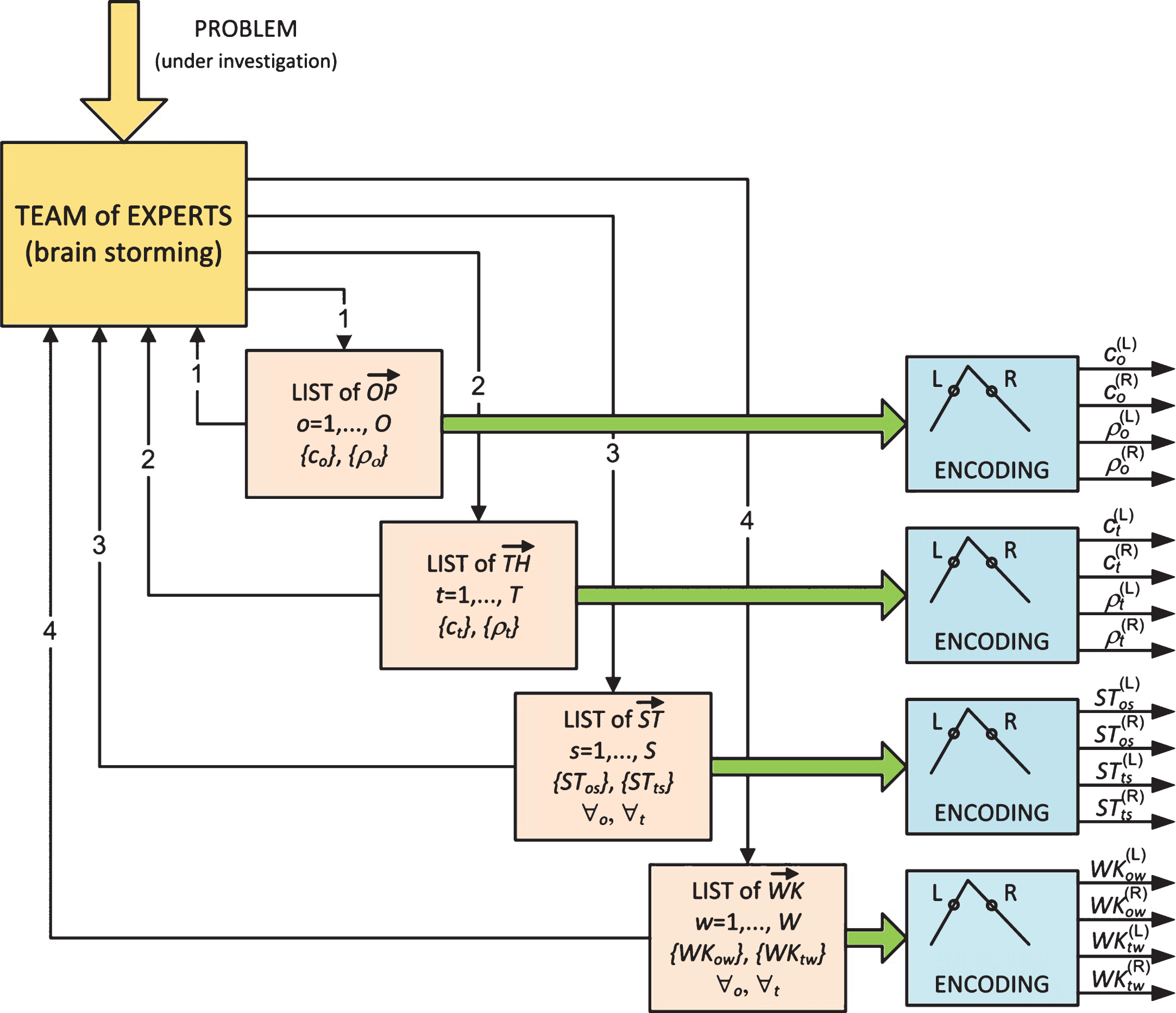
Functional organization to encode verbal evaluations of entities according the lists of SWOT analysis.

Optimistic and pessimistic versions of tables in SWOT engines.
Numbered, closed loop chains (1, 2, 3, and 4) produce all necessary outputs of codes according to indexes of SWOT entities, such as o = 1, …, O ; t = 1, …, T ; s = 1, …, S and w = 1, …, W, and the type of verbal information where all the three options, described in subsection 3.1, are possible and are delivered by the team of experts.
Figure 6 depicts a symbolic structure that enables determining all the necessary numerical results of SWOT analysis, presented in pairs such as:
Transformation of any pair of numerical results [OP Σ ] , [TH Σ ] during SWOT analysis into their verbal evaluations {OP Σ } and {TH Σ } together with their numerical degrees of truth μ OP , μ TH is performed as a result of decoding. The symbolic structure of the decoder for the case discussed in subsection 3.2 is presented in Fig. 8.

The decoder of numerical output results into a verbal form.
The decoder produces three pairs of verbal evaluations (OP Σ , TH Σ ) as well as their numerical degrees of truth (μ OP , μ TH ) that correspond to 1-2, 3-4 and 5-6 combinations. It means that verbally evaluated OPTIMISTIC, MEDIUM and PESSIMISTIC versions of the evaluations related to the problem under the investigation are obtained.
In reality the situation is usually slightly different and the form of membership functions installed in this decoder must be taken into account. Here the same universal set of membership functions discussed in subsection 3.1 has been applied. It must be emphasized that if two or more membership functions with different degrees of truth correspond to the value to be decoded, the verbal evaluation also has two or more meanings with corresponding degrees of truth as the case discussed in the article demonstrates. Such an example is shown in Fig. 9.

A set of membership functions of the decoder.
The decoder must generate the following answer: {MEDIUM} with the degree of truth 0.86 and/or {LARGE} with the degree of truth 0.14. And only a decision-maker is able to take a risk to accept a more optimistic or more pessimistic prediction.
The mechanism of decoding could be explained as follows. When the same set of membership functions, which has been used during the encoding process, is applied it is important to decide what the value “1.0” on the horizontal axis of membership functions in changing situations with different possible maximum values of OP Σ and TH Σ means. The decoding process in this particular SWOT+CWW tool is based on the paradigmatic approach that takes into consideration the fact that max OP Σ = O* as well as max TH Σ = T*. These values must be calculated keeping in mind the fact that when c o = 1 and ρ o = 1 for ∀o (this corresponds to the maximal certainty), O* = ∑ o c o ρ o . Similarly, when c t = 1 and ρ t = 1 for ∀ t , then T* = ∑ t c t ρ t . Thus, for the decoder of OP Σ the value “1.0” on the horizontal axis of membership function means O* and for the decoder of TH Σ the value “1.0” corresponds to T*. That is the main reason why in Fig. 9 the value, for example, 0.4T* after the decoding verbally means {MEDIUM} and the degree of truth is 0.86 and {LARGE} with the corresponding degree of truth equal to 0.14.
The final result after the decoding of the SWOT + CWW system usually presents to an expert team which works on the evaluation of the project in a verbal form accompanied by the numerical evaluation of reasoning related to truth degrees of systems. An example of such results is delivered below: The OPTIMISTIC version for OPPORTUNITIES [OP
Σ
]= {M} is medium with the degree of truth μ
OP
= 0.86 and/or {L} – large with the degree of truth μ
OP
= 0.14. The PESSIMISTIC version for OPPORTUNITIES [OP
Σ
]= {VS} is very small with the degree of truth μ
OP
= 0.7 and/or {S} – small with the degree of truth μ
OP
= 0.3. The MEDIUM version for OPPORTUNITIES [OP
Σ
]= {VS} is small with the degree of truth μ
OP
= 0.9 and/or {M} – medium with the degree of truth μ
OP
= 0.1.
Line 1 corresponds to the result presented in Fig. 9, while lines 2 and 3 have been artificially created to present clear explanations. The final decision belongs to decision makers who are responsible for the interpretation of the final result and further activities.
The functional organization of the SWOT+CWW system described in section 3 was implemented in a specialized software tool for an experimental investigation and confirmation of the vitality and efficiency of proposed ideas. The tool was built using browser technologies (HTML5 with JavaScript) in order to have a possibility to run it on every device which has a browser and the Internet connection and is not restricted by any specific platform (such as operating systems like Windows, Linux or Android).
Users’ convenience was achieved while employing a widely spread experience of different packages, dedicated for common SWOT analysis, and packages of fuzzy systems projects such as WINSWOT, Inghenia SWOT and SwotExpert, FuzzyTECH7.5 [16–19]. The best features of the packages mentioned above were enriched by means of adding the CWW possibilities adapted and adopted to the needs of SWOT.
All explanations and illustration of the functionality of the tool under the investigation are based on the verbal SWOT analysis of an artificially simplified project of the construction and opening of a new gasoline station {NGS} in a certain part of a selected city. Three possible opportunities
Figure 10 presents the starting window for user’s dialog.
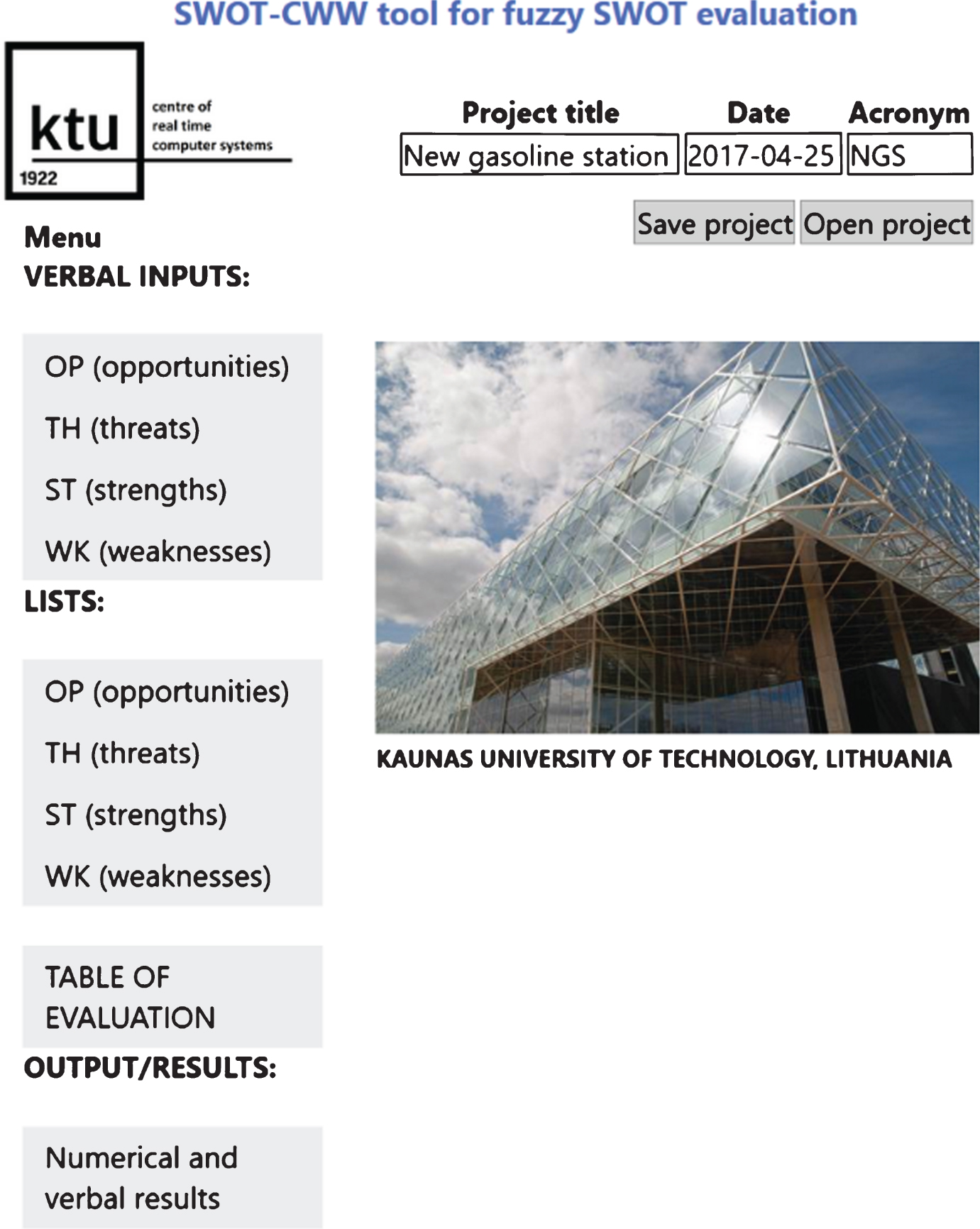
The starting window for user’s dialog.
A user is able to analyze as many different cases as he wants. Each case is considered as a new project. Usually the user has to enter the title, date and acronym of the project. The project title is a unique identifier, whereas the date and the acronym represent the metadata. The menu presented on the left side of the window in Fig. 10 is repeated in all other windows that are dedicated for the user’s dialog with the tool of SWOT+ CWW analysis. In the centre of Fig. 10 a picture of a building is displayed where the Centre of Real Time Computer Systems at Kaunas University of Technology is located. The menu of the tool consists of three main groups: verbal inputs, lists of OPs, THs, STs and WKs and output results.
In Fig. 11 the window for a verbal description of each opportunity is presented. The verbal evaluation must be performed using the same vocabulary that has been presented in subsection 3.1. A user friendly dialog is organized to enable the user to enter his verbal evaluation of the level of the opportunity under the consideration (the VALUE OF THRUTH of the opportunity), the verbal or numerical certainty of this evaluation and its importance degree for the entire project. A similar window structure is used for verbal inputs of all possible threats.

A window for a verbal description of opportunities.
The user can add as many opportunities (threats) as he wants. Every opportunity (threat) has its own unique identifier number (No), title and acronym. It must be noted that all verbal evaluations can be presented in three different ways: The user enters a verbal evaluation from the vocabulary mentioned above being absolutely certain about his personal opinion (certainty equals 1 according to the default value); The user enters a verbal evaluation and its certainty by means of a digital value; The user enters a verbal evaluation and its certainty using another verbal value from the same vocabulary.
When all fields are filled in, the button “Add an Opportunity” (or threat) allows joining a new opportunity to the list of opportunities.
All predicted strengths and weaknesses are listed and introduced in a similar dialog-windows manner and their influence on certain opportunities and threats is evaluated as well. Figure 12 depicts a window for a verbal evaluation of the influence of any STRENGHT {Financial Support} on an OPPORTUNITY ({IS} the improvement of infrastructure).
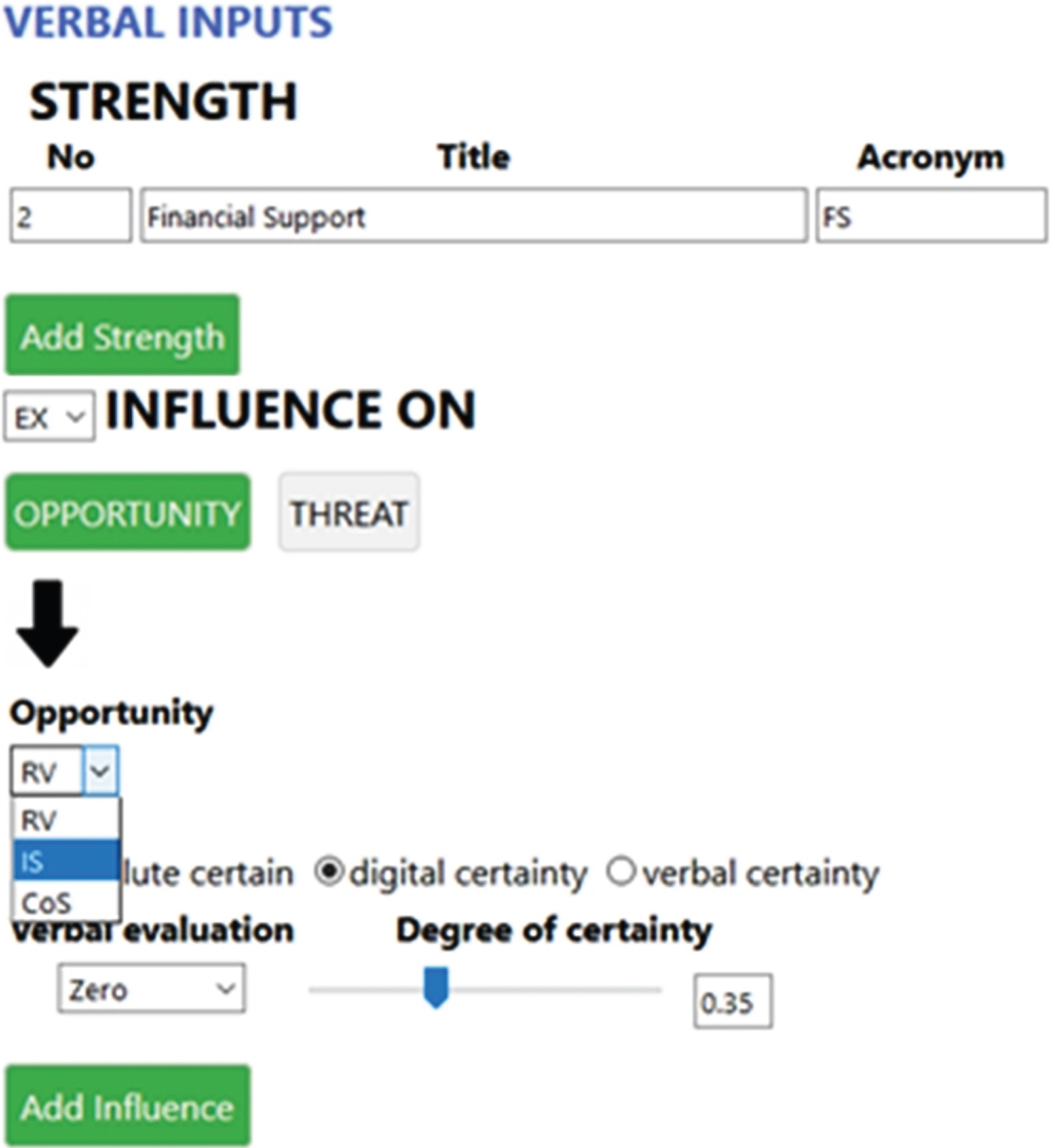
A window for a verbal evaluation of the influence of a certain strength.
Here two main procedures are performed: the input of the STRENGHT itself, and the verbal evaluation of its INFLUENCE ON the OPPORTUNITY. The verbal evaluation of influences can be performed in the same three ways, mentioned above. The same procedures are performed in the case of the verbal evaluation of the influence of strengths on each threat.
A similar window structure is used for a verbal evaluation of influences of all possible predicted weaknesses on opportunities and threats.
For the user’s convenience all intermediate stages of the evaluation process are available on the screen when proper commands from the menu such as LISTS and TABLE OF EVALUATION are used.
For example, Fig. 13 depicts a list of opportunities (RV, IS, CoS) and a table of evaluation that demonstrates verbal evaluations in the common table of SWOT analysis.

An example of the list of OPs and the table of verbal SWOT evaluations.
According to the last menu item (OUTPUT/RESULTS) the numerical and verbal results are obtained. This process is based on the functional organization of the tool described in subsection 3.2. In this article the pseudocode has been used to clarify the encoding procedure. Yet, the following substitutions have been applied:
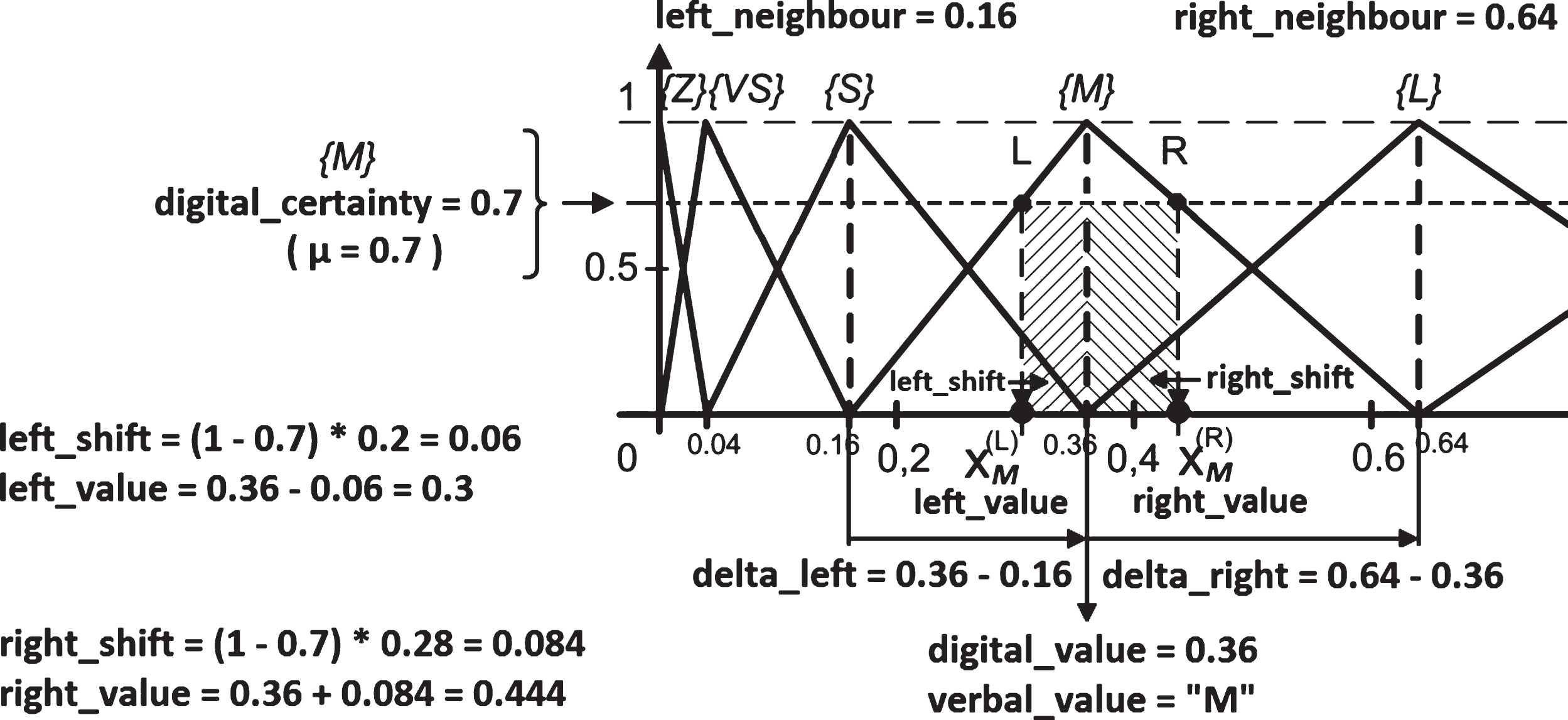
An example of the encoding procedure.
The encoding of all verbal input values is based on the following algorithmic pseudocode:
set verbalValues to [“Z”, “VS”, “S”, “M”, “L”, “VL”]
set verbalDigitalValuesMap to [0, 0.04, 0.16, 0.36, 0.64, 1]
set indexOfVerbalValue to index of verbal value from verbalValues
set digital_value to verbalDigitalValuesMap[indexOfVerbalValue]
set digital_certainty to digital value of input certainty
set delta_left to 0
set delta_right to 0.04
set delta_left to (1–0.64)
set delta_right to 0
set leftNeighbour to verbalDigitalValuesMap [indexOfVerbalValue – 1]
set rightNeighbour to verbalDigitalValuesMap [indexOfVerbalValue + 1]
set delta_left to digital_value – leftNeighbour
set delta_right to rightNeighbour – digital_value
set left_shift to (1-digital_certainty) * delta_left
set right_shift to (1-digital_certainty) * delta_right
set left_value to digital_value – left_shift
set right_value to digital_value + right_shift
set [X(L); X; X(R)] to [left_value; digital_value; right_value]
And the decoding process of output results after their aggregation is based on the following algorithmic pseudocode and demonstrated in Fig. 15:
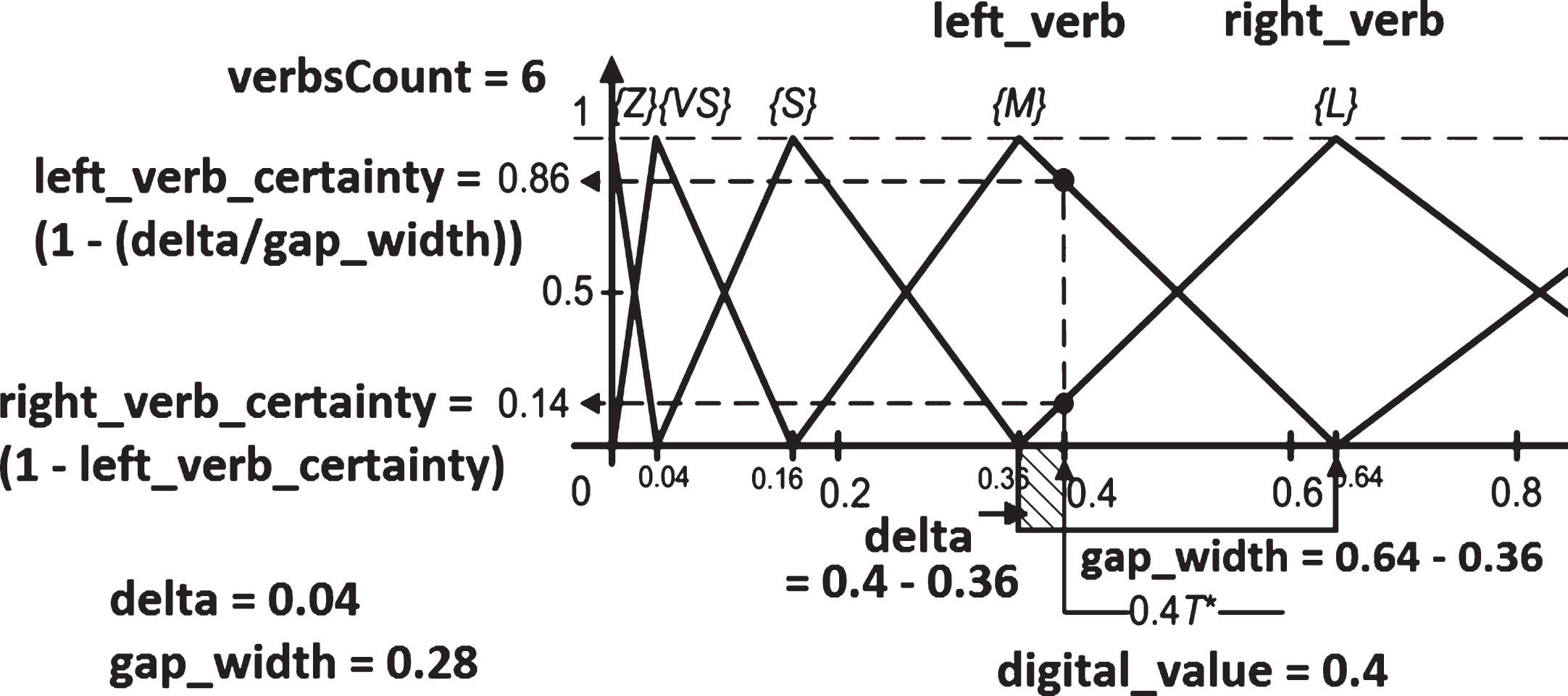
An example of the decoding procedure.
set verbalValues to [“Z”, “VS”, “S”, “M”, “L”, “VL”]
set verbalDigitalValuesMap to [0, 0.04, 0.16, 0.36, 0.64, 1]
set indexOfVerbalValue to index of verbal value from verbalValues
set digital_value to verbalDigitalValuesMap [indexOfVerbalValue]
set verbsCount to count of verbalValues
set result to 100% of verbalValues[i]
add 0% of verbalValues[i-1] to result
add 0% of verbalValues[i+1] to result
set gap_width to verbalDigitalValuesMap[i+1] – verbalDigitalValuesMap[i]
set delta to digital_value – verbalDigitalValuesMap[i]
set left_verb_certainty to 1 – (delta/gap_width)
set right_verb_certainty to 1- left_verb_certainty
set result to left_verb_certainty% of verbalValues[i] and
right_verb_certainty% of verbalValues[i+1]
set result to 100% of “VL” and 0% of “L”
Figure 16 below presents a window with digital and verbal results.
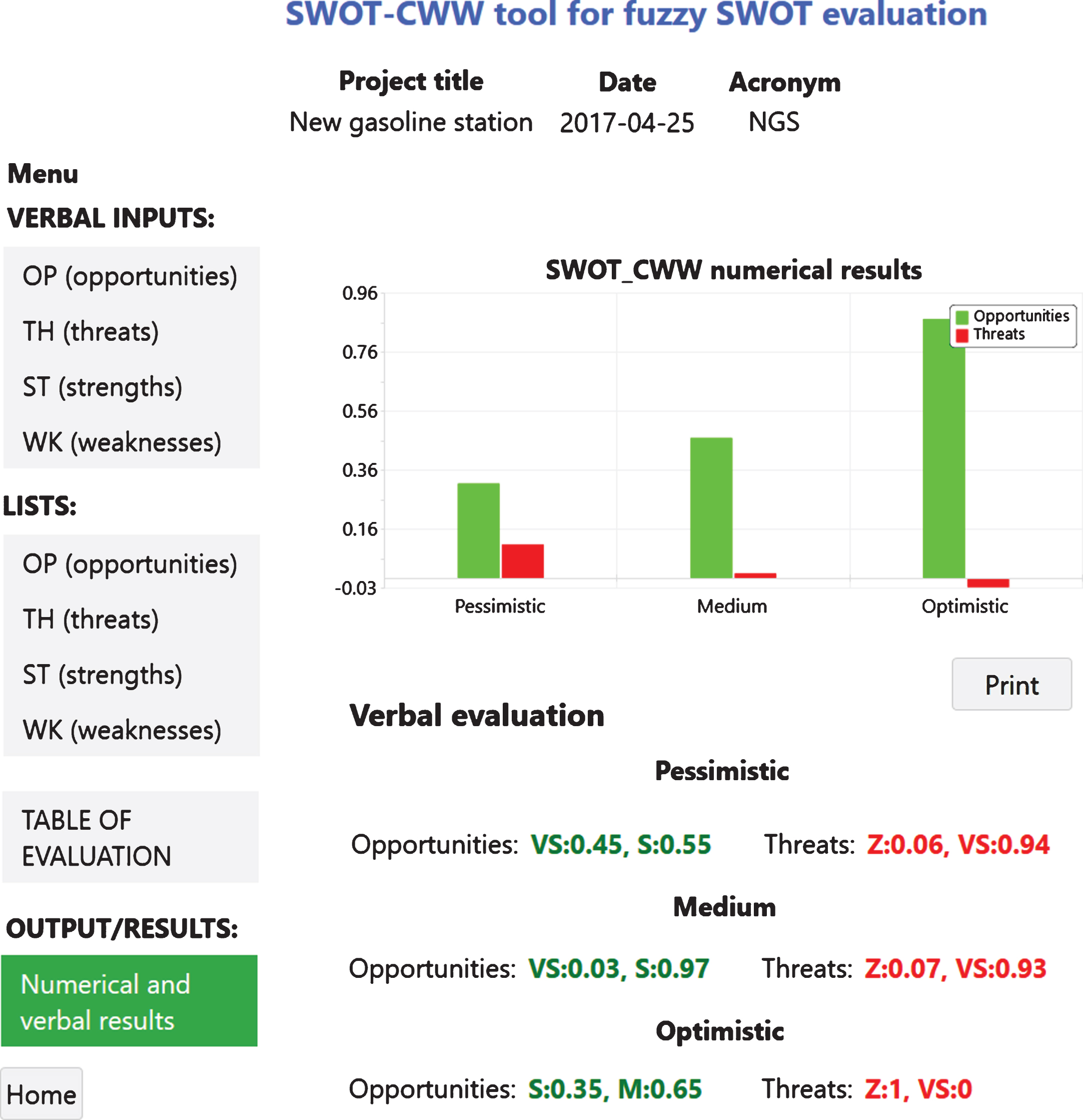
Digital and verbal results of SWOT analysis.
The presented results of the verbal evaluation of the simplified project to open a new gasoline station (NGS) in a certain part of a selected city demonstrate that the medium version of the verbal SWOT analysis predicts the value of the summarized opportunity OP Σ (success) as S – small with a certainty of 0.97 and the summarized threat TH Σ (losses) as VS-very small or none with a certainty of 0.93.
The article delivers a new approach that consists of attempts to use elements of computing with words (CWW) to improve the SWOT analysis and to provide a possibility to use natural language in both stages: 1) the stage of descriptions of situations under the investigation, and 2) the stage of evaluations of numerical output results in the form of summarized possibilities and threats and recommendations presented in natural language. We would like to stress the threefold paper’s impact on CWW: 1) as an example of the significant practical application of the CWW paradigm confirming its vitality; 2) as a start to open door for new research in CWW+SWOT tools’ networking and training [24], and optimal distributed collective decision making [5, 23]; and 3) as an example of a new structure of the inference engine [3] (or the new structure of manipulation block in terms of Jager’s CWW scheme [21]), supplemented with several additional specialized engines (three SWOT engines in our case as it is shown in Fig. 3).
The field of SWOT analysis is enriched, first of all, by the possibility to communicate verbally with the decision evaluation tool. Secondly, users of the proposed SWOT+CWW tool at last have a possibility to avoid often misleading procedures of conversion of their verbal evaluations into numbers. As a matter of fact, words usually mean different things for different people [21], but in our case the membership functions are chosen according to recommendations based on psychological features of human reasoning, and the tool presents verbal optimistic, pessimistic and medium evaluations of the situation under consideration.
The implementation of this approach is based on: The original methodology of the encoding of input words; The new structure of SWOT engines; The original method of the decoding and aggregation of numerical outputs into verbal form.
Vitality and efficiency of the functional organization of the proposed SWOT+CWW tool is confirmed by successful experimental simulations of all processes delivered in this paper.