An intuitionistic fuzzy rough model is a hybrid model which is made by combining two mathematical models namely, intuitionistic fuzzy sets and rough sets. This hybrid model deals with soft computing and vagueness by using the lower and upper approximation spaces. In this research study, the concept of intuitionistic fuzzy rough sets is applied to graphs. The notion of intuitionistic fuzzy rough graphs and various methods of their construction are presented. An application of intuitionistic fuzzy rough graphs in decision-making problem is discussed. In particular, an efficient algorithm is developed to solve decision-making problems. Time complexity of proposed algorithm is computed.
Zadeh [32] introduced the concept of fuzzy sets as a method of representing uncertainty and vagueness. From thenceforth, the theory of fuzzy sets has been applied in different disciplines. Atanassov [5] introduced the concept of intuitionistic fuzzy sets as an extension of the fuzzy sets. It has been successfully applied in many fields for decision making and pattern recognition. Decision-making is an intellectual process which deals with selection of the best option among multiple available options, it begins when we need to do something but we do not know what. It involves single criteria decision making, multi criteria decision making and group decision making. Several researchers, including Liu et al. [15–18] and Wei [25, 26] have studied different decision-making methods. The theory of rough sets was originally proposed by Pawlak [21] as a formal tool for modeling and processing incomplete information. Using the concepts of lower and upper approximations in rough set theory, knowledge hidden in information systems may be unraveled and expressed in the form of decision rules. This has lead to various other generalized rough set models (Bi et al. [7]; Liu [15]; Pei et al. [22]; Wu et al. [27]; Zhang et al. [34] and Zhang et al. [35]). In recent years the concept of fuzzy rough set [10] was worked to be more useful in decision making problems. The fuzziness in rough sets was also studied in [8].
Zhou et al. [36] studied the pair of lower and upper intuitionistic fuzzy rough approximation operators induced from an arbitrary intuitionistic fuzzy relation. Basic properties of the intuitionistic fuzzy rough approximation operators are then examined. By introducing cut sets of intuitionistic fuzzy sets, classical representations of intuitionistic fuzzy rough approximation operators are presented. The connections between special intuitionistic fuzzy relations and intuitionistic fuzzy rough approximation operators are further established [13]. An operator-oriented characterization of intuitionistic fuzzy rough sets is proposed, that is, intuitionistic fuzzy rough approximation operators are defined by the axioms. Different axiom sets of lower and upper intuitionistic fuzzy set-theoretic operators guarantee the existence of different types of intuitionistic fuzzy relations which produce the same operators. Cornelis et al. [9] described intuitionistic fuzzy rough sets. Mi et al. [19] applied composition in intuitionistic fuzzy rough approximation spaces. Xu et al. [29] considered intuitionistic fuzzy rough sets model based on operators. Wu also worked on intuitionistic fuzzy rough set in the papers [27, 28]. Yang et al. [30, 31] dealt bipolar fuzzy rough set model on two different universes. They also illustrated the application of the bipolar rough set model.
Graph theory is a useful tool to study different network models and pairwise relationships among objects. Intuitionistic fuzzy rough set has a vital role in vagueness. Fuzzy graph theory is finding an increasing number of applications in modeling real time systems where the level of information inherent in the system varies with different levels of precision. Fuzzy models are becoming useful because of their aim of reducing the differences between the traditional numerical models used in engineering and sciences and the symbolic models used in expert systems. Kaufmann [14] defined first fuzzy graphs. Rosenfeld [23] considered fuzzy graphs and obtained analogs of several graph theoretical concepts. Afterwards, Bhattacharya [6] provided some thoughts on fuzzy graphs. Mordeson and Peng [20] defined some operations on fuzzy graphs. Sunitha et al. [24] introduced the complement of a fuzzy graph. Gani et al. [11, 12] introduced several new ideas in fuzzy graph. Recently, Akram et al. [1–4] has discussed several new concepts with applications. On the other hand, recent investigations have shown how fuzzy set, rough set and graph theory can be combined into a more flexible, more expressive framework for modeling and processing incomplete information in information systems. At the same time, intuitionistic fuzzy rough sets have been proposed as an attractive extension of fuzzy sets, enriching the latter with extra features to represent uncertainty (on top of vagueness). We intend to fill an obvious gap by introducing a new definition of intuitionistic fuzzy rough graph, as the most natural generalization of Pawlak’s original concept of rough sets. When dealing with decision-making problems, considering the relations among alternatives gives more valuable results. Therefore, it would be beneficial to use graphical approaches instead of set theory and logic. Fariha and Akram [33] have introduced rough fuzzy graphs. In this research paper, the concept of intuitionistic fuzzy rough sets is applied to graphs.
Preliminaries
Definition 2.1. [21] Let K be a nonempty finite set and L ⊆ K × K an indiscernibility relation on K. Further, consider L is an equivalence relation. A pair (K, L) is called an approximation space. Let Z be a subset of K and it can be characterized by a pair of lower and upper approximations:
where [z] L denotes the equivalence class containing z. A pair (L∗Z, L∗Z) is called a rough set, if L∗Z ≠ L∗Z .
Dubois and Prade [10] presented the concept of fuzzy rough sets.
Definition 2.2. [10] Let K be a finite set and L a fuzzy equivalence relation on K. Let Z ∈ F (K), where F (K) denotes the fuzzy power set. The lower and upper approximations of the fuzzy set Z, denoted by L∗Z and L∗Z respectively, are defined as fuzzy sets in K, ∀ z ∈ K such that:
The pair LZ = (L∗Z, L∗Z) is called a fuzzy rough set if L∗Z ≠ L∗Z .
Definition 2.3. [36] Let K be a nonempty finite set and L ∈ IF (K × K). A pair J = (K, L) is called an intuitionistic fuzzy approximation space, where IF (K × K) is an intuitionistic fuzzy relation (IFR) on K. For any Z ∈ IF (K) , the upper and lower intuitionistic fuzzy rough approximations of Z w.r.t. (K, L) , denoted by L∗Z and L∗Z, are two intuitionistic fuzzy sets defined as follows:
where k ∈ K and
Moreover, Z is an intuitionistic fuzzy rough set, if K∗Z ≠ K∗Z .
Intuitionistic fuzzy rough graphs
Definition 3.1. Let C★ be a Boolean set and P an intuitionistic fuzzy relation on C★. Let C be an intuitionistic fuzzy set on C★ and PC = (P∗C, P∗C) an intuitionistic fuzzy rough set. Let D★ ⊆ C★ × C★ and Q an intuitionistic fuzzy relation on D★ such that, for all p1p2, q1q2 ∈ D★,
Let D be an intuitionistic fuzzy set on D★ such that, for all p, q ∈ C★,
Then the lower and upper approximations of D, denoted by Q∗D and Q∗D respectively, are defined as intuitionistic fuzzy sets in C★ × C★ such that, for all pq ∈ D★, Q∗D = (Q∗D+, Q∗D-) , Q∗D = (Q∗D+, Q∗D-) , where pq ∈ D★ and
A pair QD = (Q∗D, Q∗D) is called an intuitionistic fuzzy rough relation.
Definition 3.2. An intuitionistic fuzzy rough graph on a non-empty set C★ is a 4-ordered tuple (P, PC, Q, QD) such that
P is an intuitionistic fuzzy relation on C★,
Q is an intuitionistic fuzzy relation on D★⊆ C★ × C★,
PC = (P∗C, P∗C) is an intuitionistic fuzzy rough set on C★,
QD = (Q∗D, Q∗D) is an intuitionistic fuzzy rough relation on C★ .
Thus is an intuitionistic fuzzy rough graph, where and are lower and upper approximate intuitionistic fuzzy graphs of such that, ∀ c, d ∈ C★,
Example 3.1. Let C = {(c1, 0.6, 0.1) , (c2, 0.1, 0.3) , (c3, 0.4, 0.4) , c4, 0.3, 0.5) , (c5, 0.0, 0.0)} be an intuitionistic fuzzy set on C★ = {c1, c2, c3, c4, c5} and P an intuitionistic fuzzy relation on C★ as given in Table 1. PC = (P∗C, P∗C) is an intuitionistic fuzzy rough set, where P∗C and P∗C are lower and upper approximations of C, respectively, given below:
Intuitionistic fuzzy relation on C★
P
c1
c2
c3
c4
c5
c1
(0.6,0.1)
(0.5,0.2)
(0.4,0.3)
(0.3,0.2)
(0.9,0.1)
c2
(0.4,0.2)
(0.9,0.1)
(1.0,0.0)
(0.7,0.1)
(0.1,0.1)
c3
(0.8,0.1)
(0.1,0.8)
(0.0,0.0)
(0.2,0.0)
(0.3,0.3)
c4
(0.5,0.1)
(0.6,0.2)
(0.6,0.4)
(0.0,0.4)
(0.0,0.9)
c5
(0.3,0.4)
(0.1,0.0)
(0.2,0.3)
(0.6,0.1)
(0.0,1.0)
Let D★ = {c1c2, c2c5, c3c1, c4c3, c5c4} ⊆ C★ × C★ and Q be an intuitionistic fuzzy relation on D★ defined in Table 2. Let D = {(c1c2, 0.3, 0.1) , (c2c5, 0.2, 0.3) , c3c1, 0.5, 0.1) , (c4c3, 0.4, 0.1) , (c5c4, 0.1, 0.3)} be an intuitionistic fuzzy set on D★. Then, the upper and lower approximations of D are calculated as:
Intuitionistic fuzzy relation on D★
Q
c1c2
c2c5
c3c1
c4c3
c5c4
c1c2
(0.4,0.0)
(0.1,0.1)
(0.4,0.2)
(0.3,0.2)
(0.7,0.1)
c2c5
(0.1,0.0)
(0.0,0.6)
(0.3,0.3)
(0.1,0.0)
(0.1,0.0)
c3c1
(0.3,0.1)
(0.1,0.1)
(0.0,0.0)
(0.2,0.0)
(0.3,0.1)
c4c3
(0.1,0.0)
(0.0,0.3)
(0.3,0.2)
(0.0,0.2)
(0.0,0.0)
c5c4
(0.3,0.0)
(0.0,0.0)
(0.2,0.1)
(0.6,0.3)
(0.0,1.0)
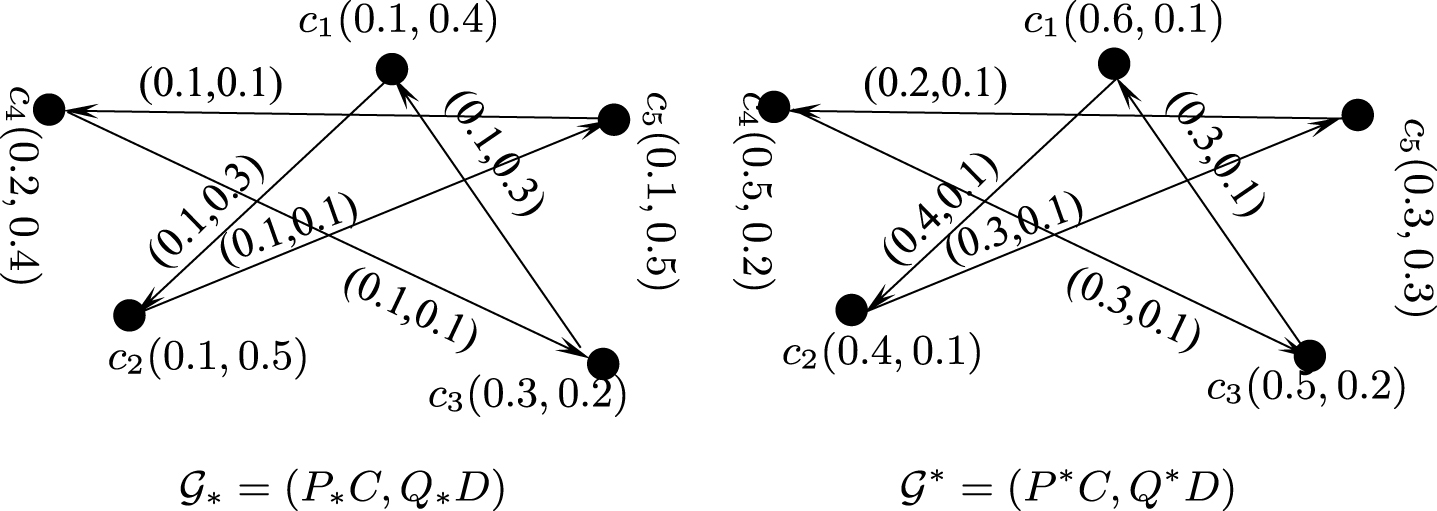
Hence, (Q∗D, Q∗D) is an intuitionistic fuzzy rough relation on C★. Thus, and are intuitionistic fuzzy graphs as shown in Fig. 1.
Intuitionistic Fuzzy Rough Graph .
Now the algebraic operations are presented on intuitionistic fuzzy rough graphs.
Definition 3.3. The lexicographic product of and is an intuitionistic fuzzy rough graph where and are intuitionistic fuzzy graphs, respectively, such that
.
.
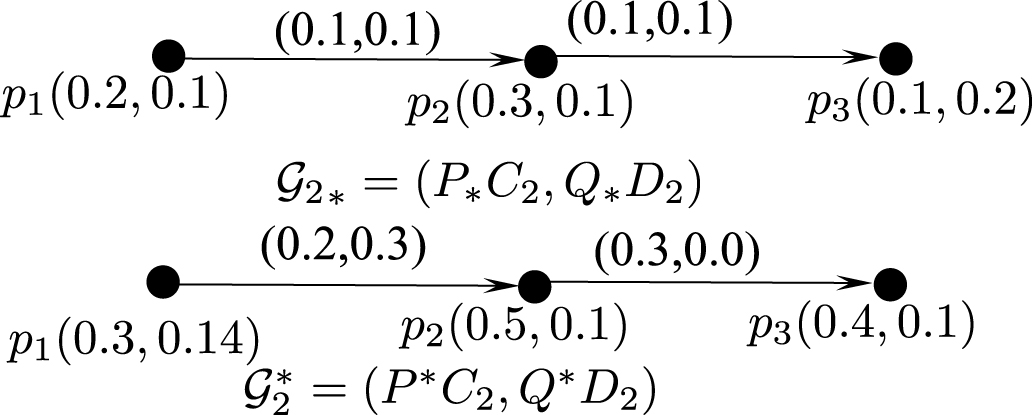
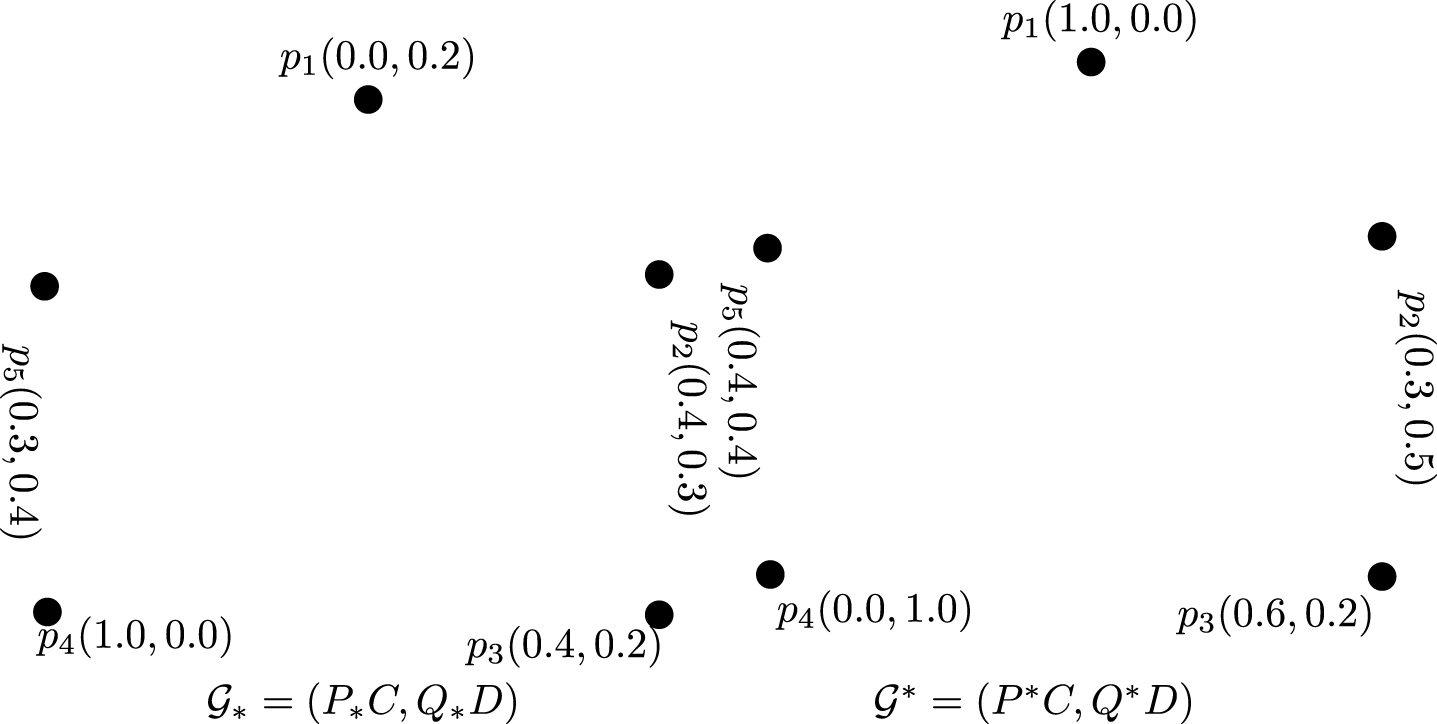
Example 3.2. Let C★ = {p1, p2, p3} be a set. Let and be two intuitionistic fuzzy rough graphs on C★, where and are intuitionistic fuzzy graphs as shown in Fig. 2. Thus
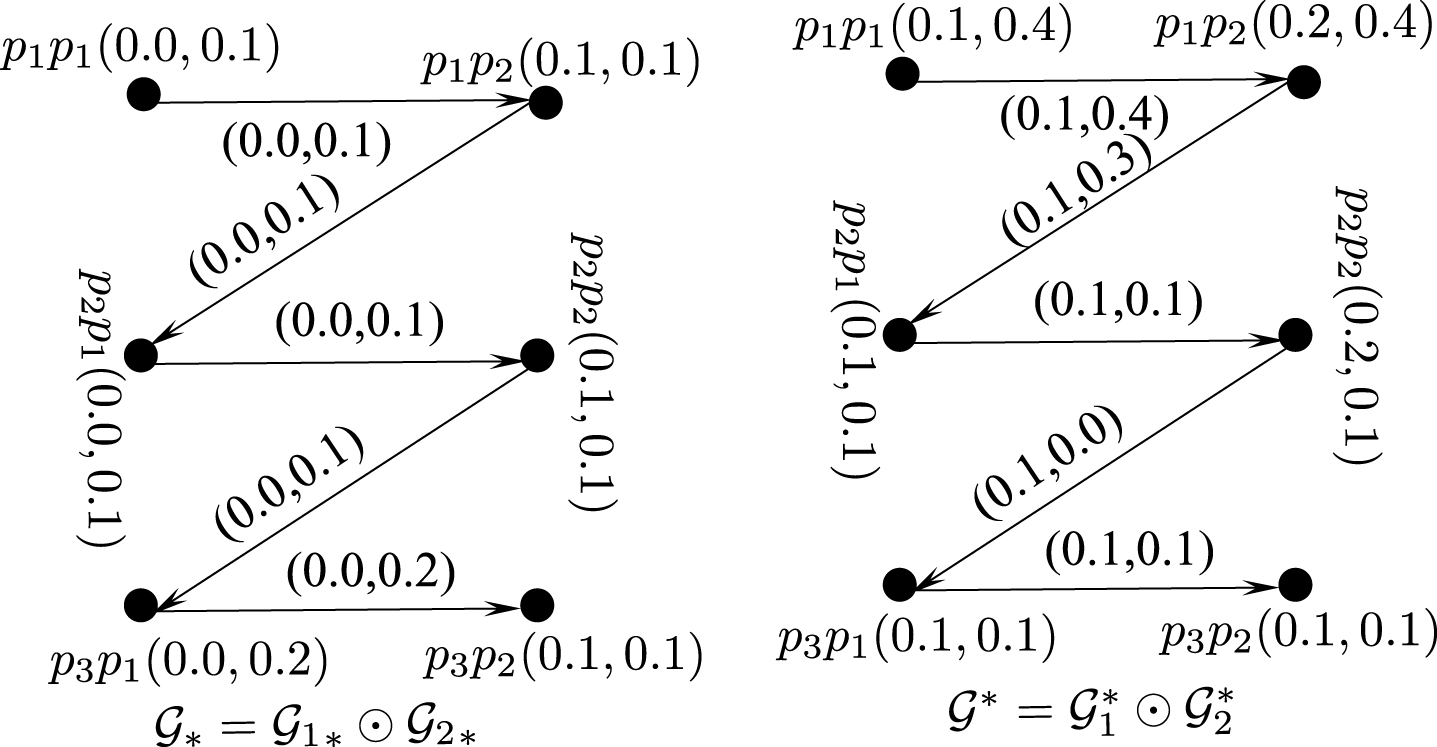
and are intuitionistic fuzzy graphs as shown in Fig. 3. The lexicographic product of and is , where and are intuitionistic fuzzy graphs as shown in the Fig. 4. Hence is an intuitionistic fuzzy rough graph.
Intuitionistic Fuzzy Rough graph .
Intuitionistic Fuzzy Rough graph .
Intuitionistic fuzzy Rough Graph ⊙=⊙ ⊙ .
Theorem 3.1.The lexicographic product of two intuitionistic fuzzy rough graphs is an intuitionistic fuzzy rough graph.
Proof. Let and be two intuitionistic fuzzy rough graphs. Let be the lexicographic product of and , where and For proving is an intuitionistic fuzzy rough graph. It is enough to show that Q∗D1 ⊙ Q∗D2 and Q∗D1 ⊙ Q∗D2 are intuitionistic fuzzy relations on P∗C1 ⊙ P∗C2 and P∗C1 ⊙ P∗C2, respectively. First, Q∗D1 ⊙ Q∗D2 is shown as an intuitionistic fuzzy relation on P∗C1 ⊙ P∗C2.
If x ∈ P∗C1, p2q2 ∈ Q∗D2 then,
Similarly, we can prove that,
If p1q1 ∈ Q∗D1, p2q2 ∈ Q∗D2 then,
Similarly, it can be proved that
Thus, Q∗D1 ⊙ Q∗D2 is an intuitionistic fuzzy relation on P∗C1 ⊙ P∗C2. Similarly, Q∗D1 ⊙ Q∗D2 is an intuitionistic fuzzy relation on P∗C1 ⊙ P∗C2. Hence, is an intuitionistic fuzzy rough graph.
Definition 3.4. The strong product of and is an intuitionistic fuzzy rough graph where and are intuitionistic fuzzy graphs, respectively, such that
.
.
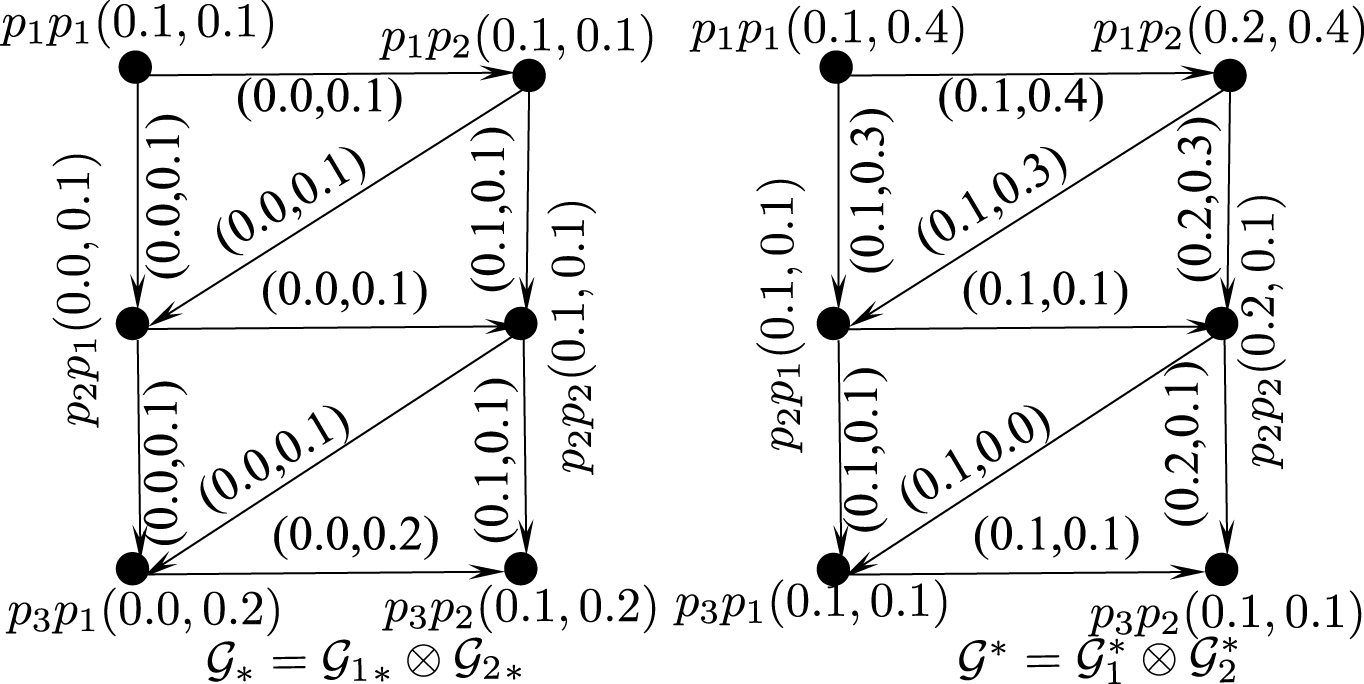
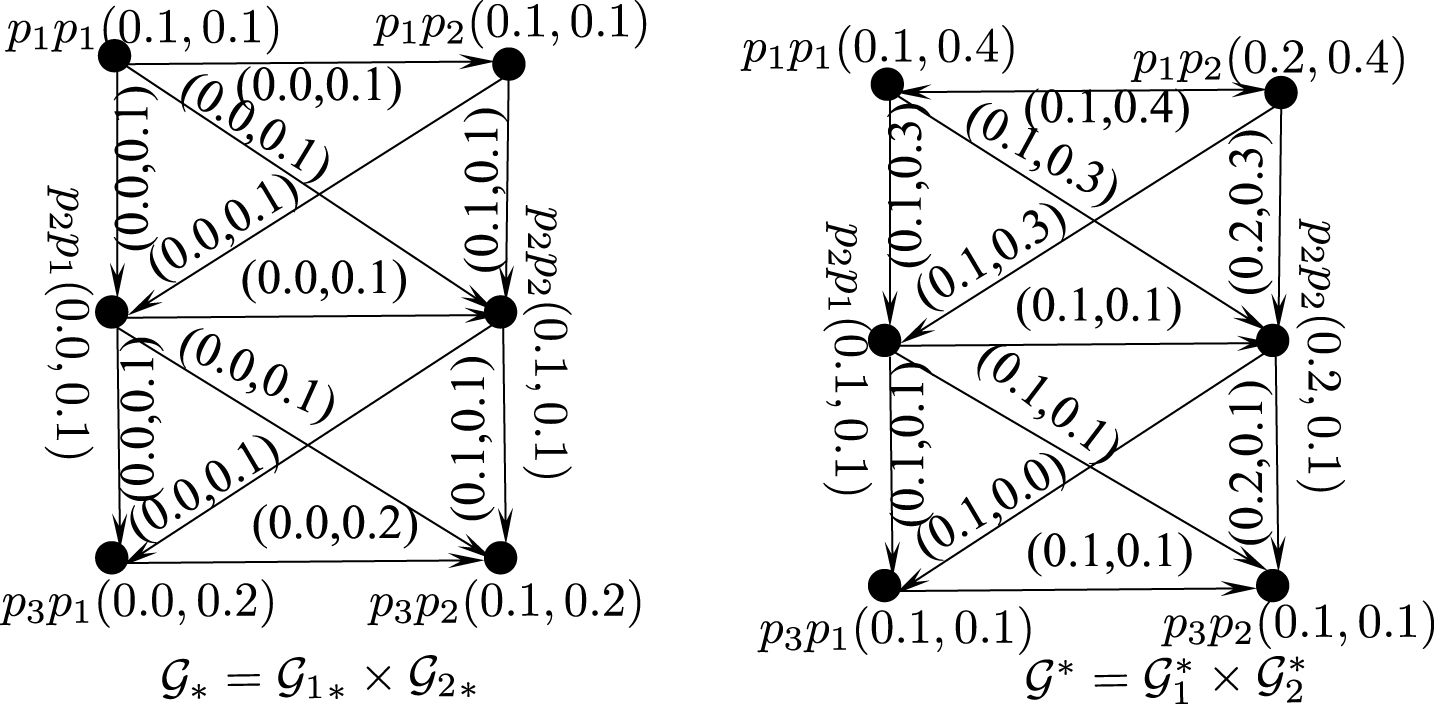
Example 3.3. Consider the two intuitionistic fuzzy rough graphs and as shown in Figs. 2 and 3. The strong product of and is , where and are intuitionistic fuzzy graphs as shown in Fig. 5.
Intuitionistic fuzzy Rough Graph ⊗ ⊗ , ⊗ .
Theorem 3.2.The strong product of two intuitionistic fuzzy rough graphs is an intuitionistic fuzzy rough graph.
Proof. Let and be two intuitionistic fuzzy rough graphs. Let be the strong product of and , where and For proving is an intuitionistic fuzzy rough graph. It is enough to show that Q∗D1 ⊗ Q∗D2 and Q∗D1 ⊗ Q∗D2 are intuitionistic fuzzy relations on P∗C1 ⊗ P∗C2 and P∗C1 ⊗ P∗C2, respectively. First, Q∗D1 ⊗ Q∗D2 is shown as an intuitionistic fuzzy relation on P∗C1 ⊗ P∗C2. If x ∈ P∗C1, p2q2 ∈ Q∗D2 then,
Other cases can be proved similarly.
Thus, Q∗D1 ⊗ Q∗D2 is an intuitionistic fuzzy relation on P∗C1 ⊗ P∗C2. Similarly, Q∗D1 ⊗ Q∗D2 is an intuitionistic fuzzy relation on P∗C1 ⊗ P∗C2. Hence, is an intuitionistic fuzzy rough graph. □
Definition 3.5. The composition of and is an intuitionistic fuzzy rough graph where and are intuitionistic fuzzy graphs, respectively, such that
.
.
Example 3.4. Consider the two intuitionistic fuzzy rough graphs and as shown in Figs. 2 and 3. The composition of and is , where and are intuitionistic fuzzy graphs as shown in Fig. 6.
Intuitionistic fuzzy Rough Graph × × , × .
Remark 3.1. In Definition 3.4, if there is an edge between ‘p1p2’ and ‘q1q2’ then there must be an edge between p1 and q1 in approximations graph and p2 and q2 in approximation graph . Whereas in Definition 3.5, if there is an edge between ‘p1p2’ and ‘q1q2’ then there must be an edge between p1 and q1 in approximations graph but not necessarily an edge between p2 and q2 in graph .
Theorem 3.3.The composition of two intuitionistic fuzzy rough graphs is an intuitionistic fuzzy rough graph.
Proof. Let and be two intuitionistic fuzzy rough graphs. Let be the composition of and , where and For proving is an intuitionistic fuzzy rough graph. It is enough to show that Q∗D1 × Q∗D2 and Q∗D1 × Q∗D2 are intuitionistic fuzzy relations on P∗C1 × P∗C2 and P∗C1 × P∗C2, respectively. First, Q∗D1 × Q∗D2 is shown as an intuitionistic fuzzy relation on P∗C1 × P∗C2 . If x ∈ P∗C1, p2q2 ∈ Q∗D2 then,
Similarly, we can prove other cases.
Thus, Q∗D1 × Q∗D2 is an intuitionistic fuzzy relation on P∗C1 × P∗C2. Similarly, Q∗D1 × Q∗D2 is an intuitionistic fuzzy relation on P∗C1 × P∗C2. Hence, is an intuitionistic fuzzy rough graph. □
Definition 3.6. Let be an intuitionistic fuzzy rough graph. The μ-complement of is defined as , where (PC) μ = PC = (P∗C, P∗C) and (QD) μ = ((Q∗D) μ, (Q∗D) μ) and for all a, b ∈ C★ such that
When (QD) (ab) ≠0,
When (QD) (ab) =0,
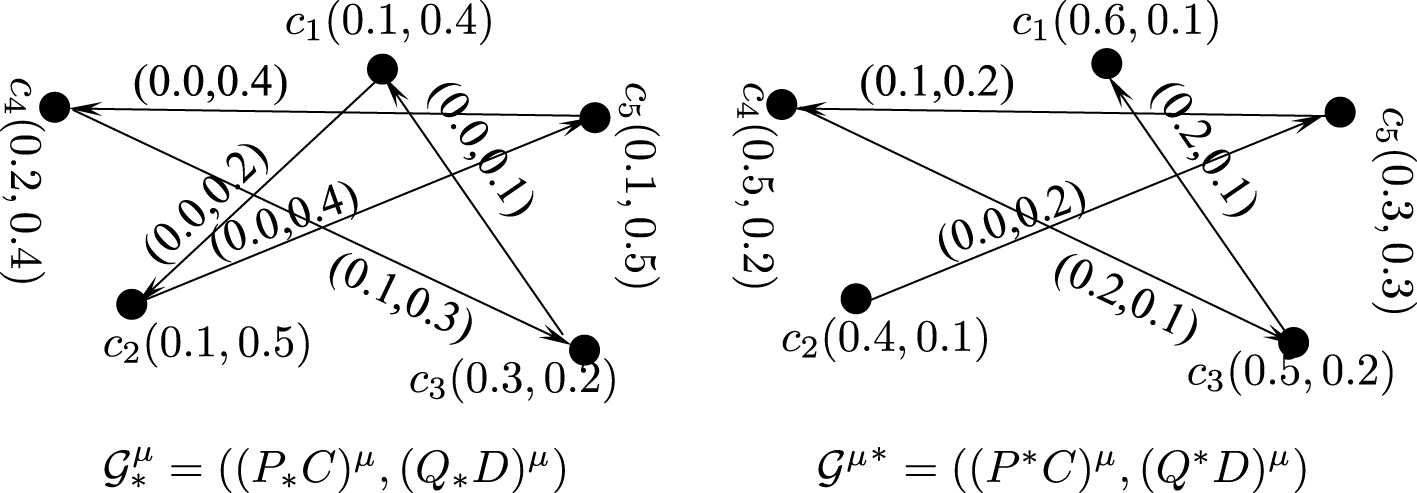
Example 3.5. Consider an intuitionistic fuzzy rough graph as shown in Fig. 1. The μ-complement of is , where are intuitionistic fuzzy graphs as shown in Fig. 7”.
Intuitionistic Fuzzy Rough Graph .
Strong Intuitionistic Fuzzy Rough Graph .
Definition 3.7. An intuitionistic fuzzy rough graph is called strong intuitionistic fuzzy rough graph if ∀ pq ∈ D,
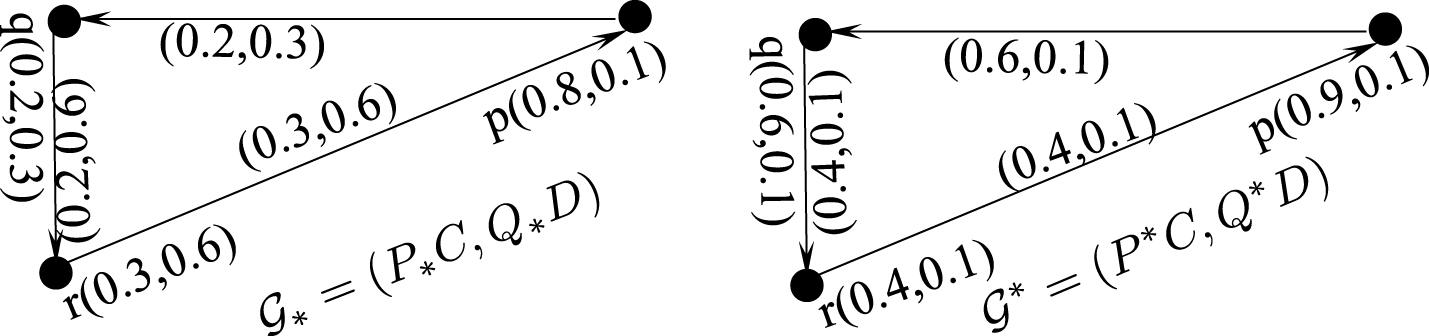
Example 3.6. Consider a graph such that C★ = {p, q, r} and D★ = {pq, qr, rp} . Let C be an intuitionistic fuzzy rough subset of C★ and D an intuitionistic fuzzy rough subset of D★ defined in the Table 3.
Intuitionistic Fuzzy Rough Sets on C★ and D★
C★
P∗ (C)
P∗ (C)
p
(0.9, 0.1)
(0.8, 0.1)
q
(0.6, 0.1)
(0.2, 0.3)
r
(0.4, 0.1)
(0.3, 0.6)
D★
Q∗ (D)
Q∗ (D)
pq
(0.6, 0.1)
(0.2, 0.3)
qr
(0.4, 0.1)
(0.2, 0.6)
rp
(0.4, 0.1)
(0.3, 0.6)
Hence, is a strong intuitionistic fuzzy rough graph.
Definition 3.8. An intuitionistic fuzzy rough graph is called complete intuitionistic fuzzy rough graph if ∀ p, q ∈ C★,
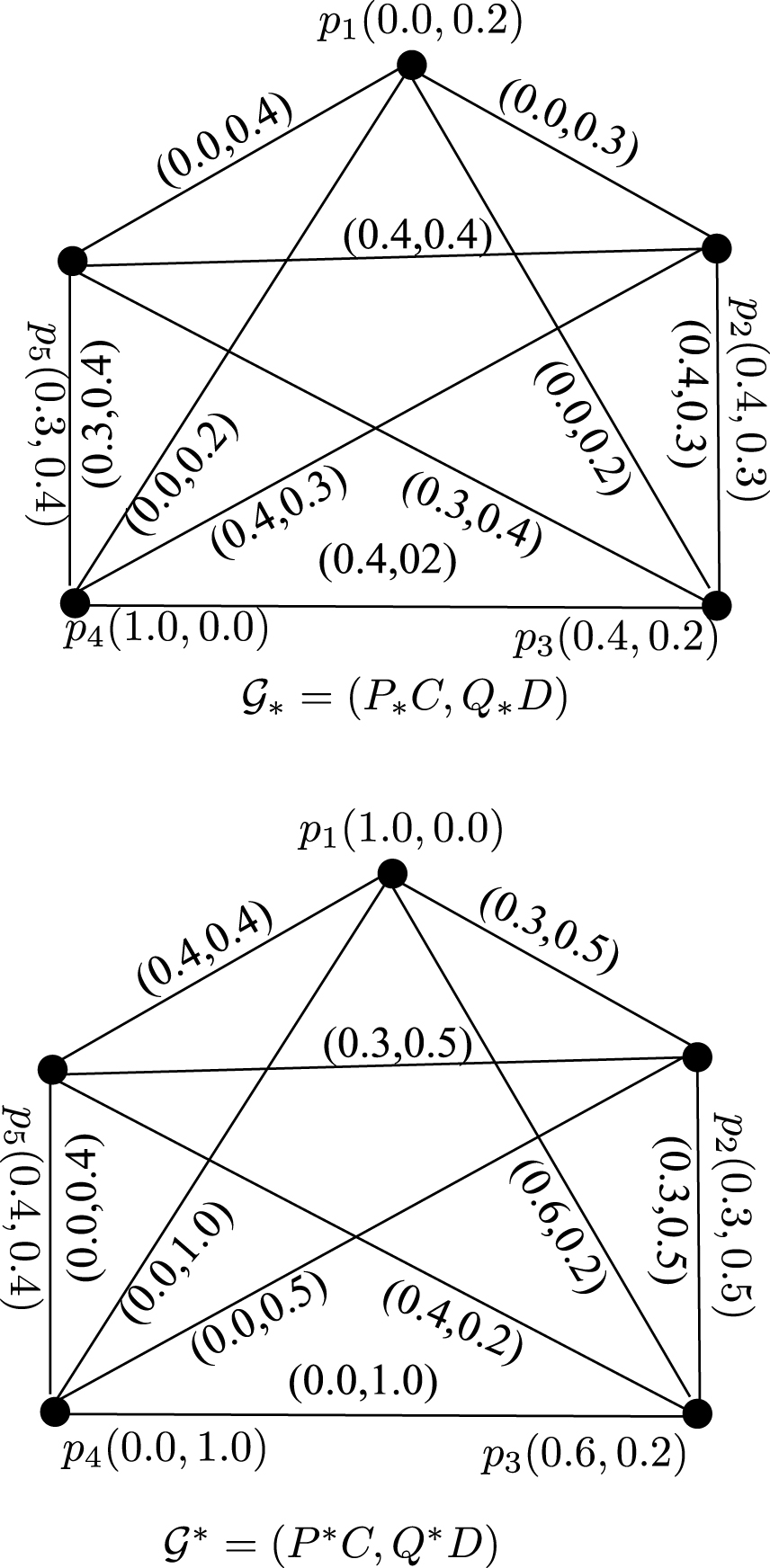
Example 3.7. Consider a graph such that C★ = {p1, p2, p3, p4, p5} and D★ = {p1p2, p1p3, p1p4, p1p5, p2p1, p2p3, p2p4, p2p5, p3p1, p3p2, p3p4, p3p5, p4p1, p4p2, p4p3, p4p5, p5p1, p5p2, p5p3, p5p4} . Let be an intuitionistic fuzzy rough graph of C★ as shown in Fig. 9.
Complete intuitionistic Fuzzy Rough Graph .
Definition 3.9. An intuitionistic fuzzy rough graph is isolated, if ∀ p, q ∈ PC
Definition 3.10. A strong intuitionistic fuzzy rough graph is called self complementary if
Example 3.8. The graph in Fig. 9 is not only strong but also self complementary. Moreover, The complement and μ-complement of the graph are isolated as shown in Fig. 10.
Complement and μ-complement of Intuitionistic Fuzzy Rough Graph .
Theorem 3.4.Let be an intuitionistic fuzzy rough graph then has isolated nodes if and only if is a strong intuitionistic fuzzy rough graph.
Proof. Let be a strong intuitionistic fuzzy rough graph. When ∀ pq ∈ D★,
Otherwise,
By applying Definition 3.6 Equation 1. Therefore, is an isolated intuitionistic fuzzy rough graph. Conversely, assume is an isolated intuitionistic fuzzy rough graph. It follows that
By Definition 3.6, for an edge pq ∈ D★,
Using Definition 3.9, ∀ pq ∈ D★,
Hence, has isolated nodes if and only if is a strong intuitionistic fuzzy rough graph. □
Definition 3.11. Let and are intuitionistic fuzzy rough graph. A homomorphism of an intuitionistic fuzzy rough graphs is a map which satisfies and i.e.,
Definition 3.12. Let and are intuitionistic fuzzy rough graph. A isomorphism of an intuitionistic fuzzy rough graphs is a map which satisfies and i.e.,
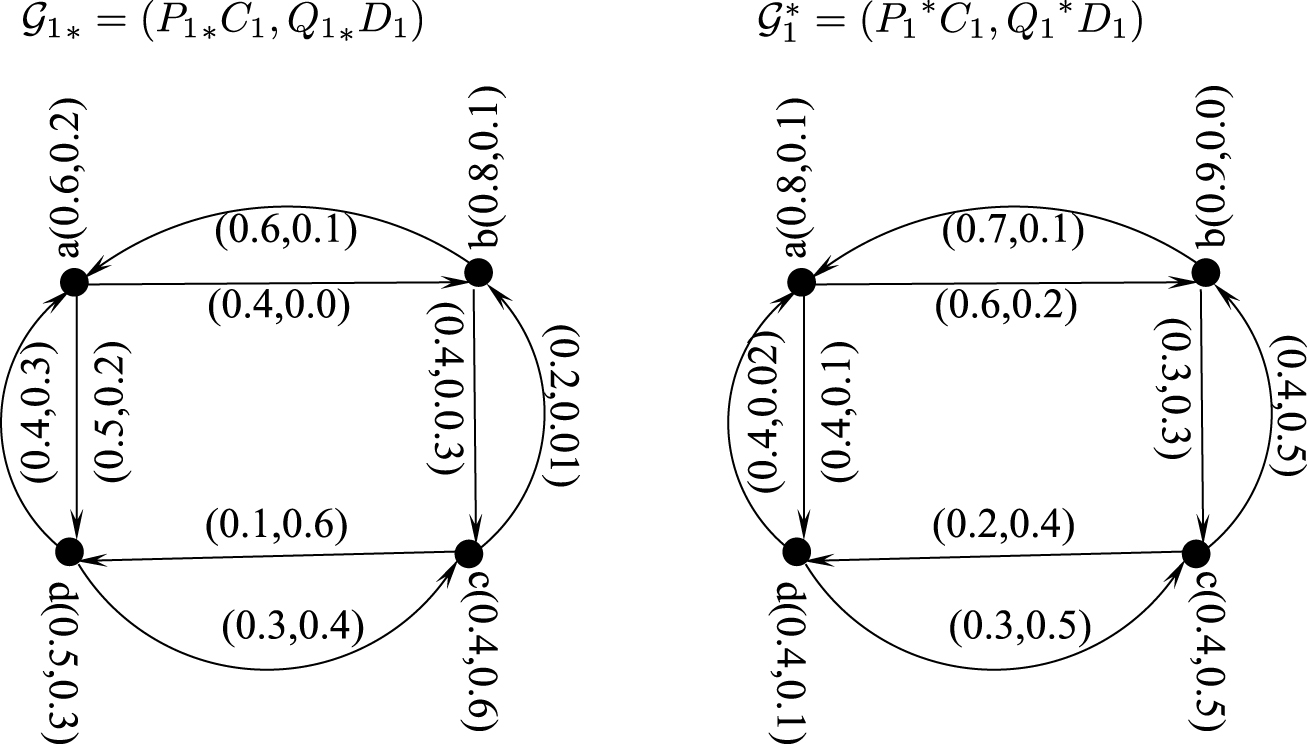
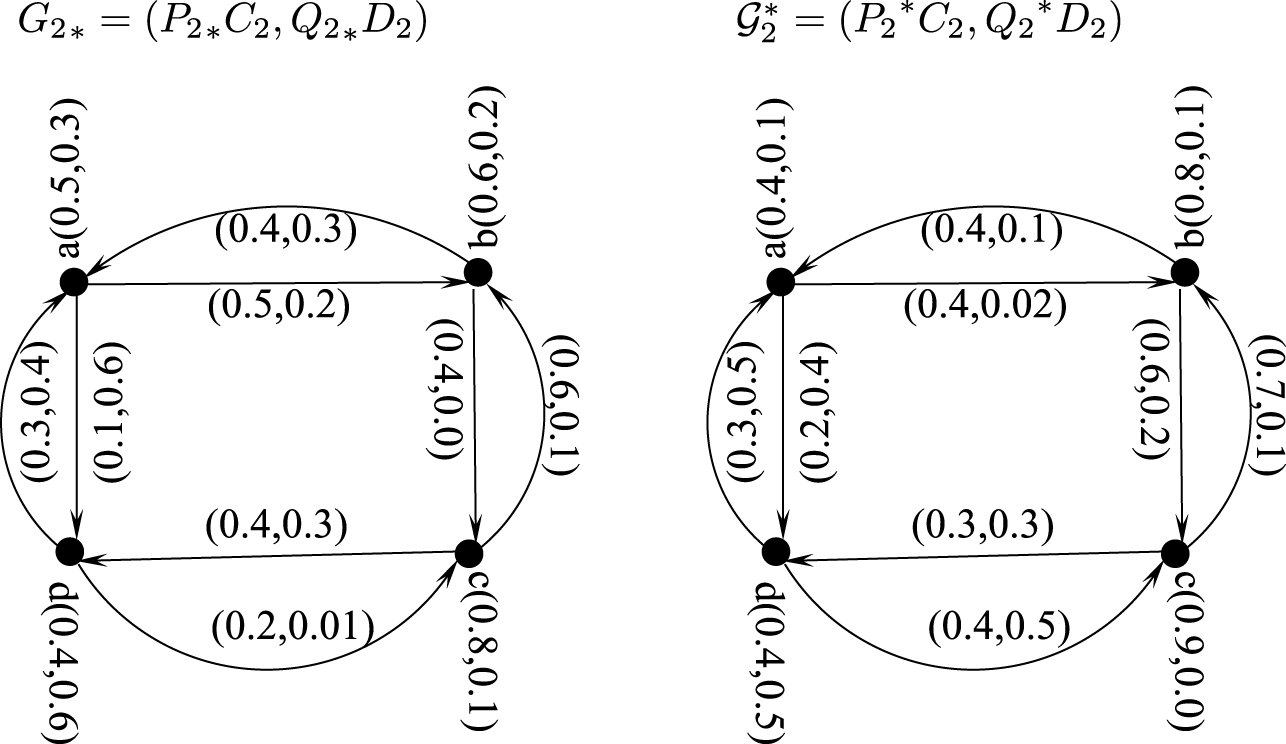
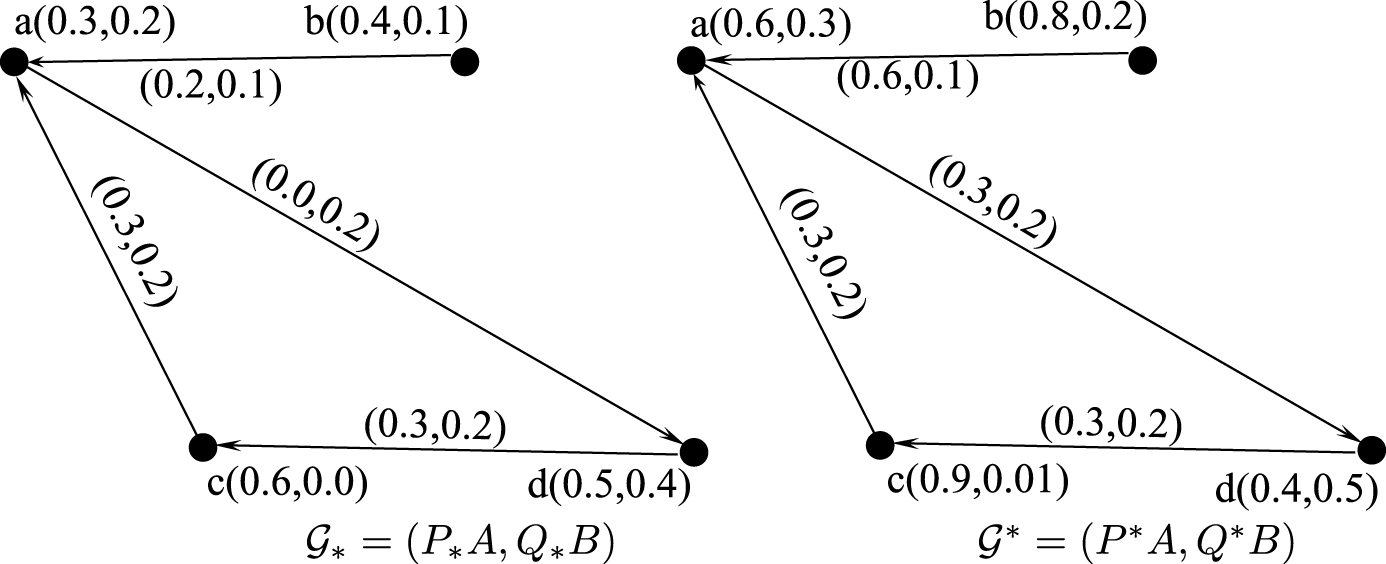
Example 3.9. Let and be two intuitionistic fuzzy rough graphs on C★ = {a, b, c, d}, where , and , are intuitionistic fuzzy graphs as shown in Figs. 11 and 12, respectively. The graphs and are isomorphic under . A mapping is defined as
Intuitionistic Fuzzy Rough Graph .
Intuitionistic Fuzzy Rough Graph .
Definition 3.13. Let and be two intuitionistic fuzzy rough graphs. A weak isomorphism is a bijective homomorphism of an intuitionistic fuzzy rough graph is a map that satisfies i.e.,
Definition 3.14. Let and be two intuitionistic fuzzy rough graphs. A co-weak isomorphism is a bijective homomorphism of an intuitionistic fuzzy rough graph is a map that satisfies i.e.,
Example 3.10. Consider the two intuitionistic fuzzy rough graphs and as shown in Figs. 2 and 3 on a set C★ = {p1, p2, p3}. Let and be two intuitionistic fuzzy rough graphs on C★, where and are intuitionistic fuzzy graphs. Also and are intuitionistic fuzzy graphs. and are neither homomorphism under P nor weak homomorphism nor co-weak homomorphism. In any case either or can not be defined because the above conditions are not satisfied.
Definition 3.15. Given an intuitionistic fuzzy rough graph with the underlying set C★. The order of is defined and denoted as
The size of is defined and denoted as
Definition 3.16. In an intuitionistic fuzzy rough graph, the sum of upper and lower approximations of arcs directed away from the vertex a is called the outdegree of vertex a ∈ C★, it is denoted by
Definition 3.17. The sum of upper and lower approximations of arcs directed to the vertex a is called indegree of vertex a ∈ C★, and defined by
Definition 3.18. The degree of a vertex a ∈ C★ in an intuitionistic fuzzy rough graph is defined as
The ordered pair (od (a) , id (a)) is called the degree pair of a.
Definition 3.19. The total degree of a vertex a ∈ C★ in an intuitionistic fuzzy rough graph is defined as
Definition 3.20. The minimum degree of is
The maximum degree of is
Definition 3.21. An edge ab ∈ D★ in an intuitionistic fuzzy rough graph is called an effective edge,
Definition 3.22. A node a ∈ C★ in an intuitionistic fuzzy rough graph is called a busy node if
Otherwise, it is called a free node.
Example 3.11. Consider an intuitionistic fuzzy rough graphs as shown in Fig. 1. The order , size of and degree of vertices c1, c2, c3, c4, c5 are respectively,
has busy nodes i.e c4, c5. Moreover, has no effective edge but has an effective edge, that is; c1c2 .
Remark 3.2. Let be an intuitionistic fuzzy rough graph.
is a self μ- complementary intuitionistic fuzzy rough graph, if where
A graph is a self weakμ- complementary intuitionistic fuzzy rough graph, if weak isomorphism with .
is a self weak μ- complementary intuitionistic fuzzy rough graph, if where
If where
Then may not be self μ- complementary intuitionistic fuzzy rough graph but it is self weak μ- complementary.
Definition 3.23. An intuitionistic fuzzy rough graph is called regular, if in each approximation is regular intuitionistic fuzzy graph. Equivalently, an intuitionistic fuzzy rough graph is called regular intuitionistic fuzzy rough graph if in each approximation, each vertex has same indegree and outdegree.
If each vertex in and has same indegree k and outdegree k in each approximation space then is said to be a regular intuitionistic fuzzy rough graph. In other words if the degree pair of a vertex a are same is called k-regular intuitionistic fuzzy rough graph. Both approximation graphs have a vertex of same innerdegree as well as outerdegree.
where ki are constants ∀ i = 1, 2, 3, 4 .
Example 3.12. Let C = {(c1, 0.2, 0.2) , (c2, 0.2, 0.2) , (c3, 0.2, 0.2)} be an intuitionistic fuzzy set on C★ = {c1, c2, c3} , and P be an intuitionistic fuzzy relation on C★ as given in Table 4. PC = (P∗C, P∗C) an intuitionistic fuzzy rough set, where P∗C and P∗C are lower and upper approximations of C, respectively given below:
Intuitionistic fuzzy relation on C★
P
c1
c2
c3
c1
(0.6,0.3)
(0.6,0.3)
(0.6,0.3)
c2
(0.6,0.3)
(0.6,0.3)
(0.6,0.3)
c3
(0.6,0.3)
(0.6,0.3)
(0.6,0.3)
Let D★ = {c1c2, c2c3, c3c1} ⊆ C★ × C★ . Let Q be an intuitionistic fuzzy relation on D★ defined s given in Table 5. Let D = {(c1c2, 0.2, 0.1) , (c2c5, 0.2, 0.1) , (c3c1, 0.2, 0.1)} be an intuitionistic fuzzy set on D★. Then by definition, the upper and lower approximation relations are calculated as
Intuitionistic fuzzy relation on D★
Q
c1c2
c2c3
c3c1
c1c2
(0.6,0.3)
(0.6,0.3)
(0.6,0.3)
c2c3
(0.6,0.3)
(0.6,0.3)
(0.6,0.3)
c3c1
(0.6,0.3)
(0.6,0.3)
(0.6,0.3)
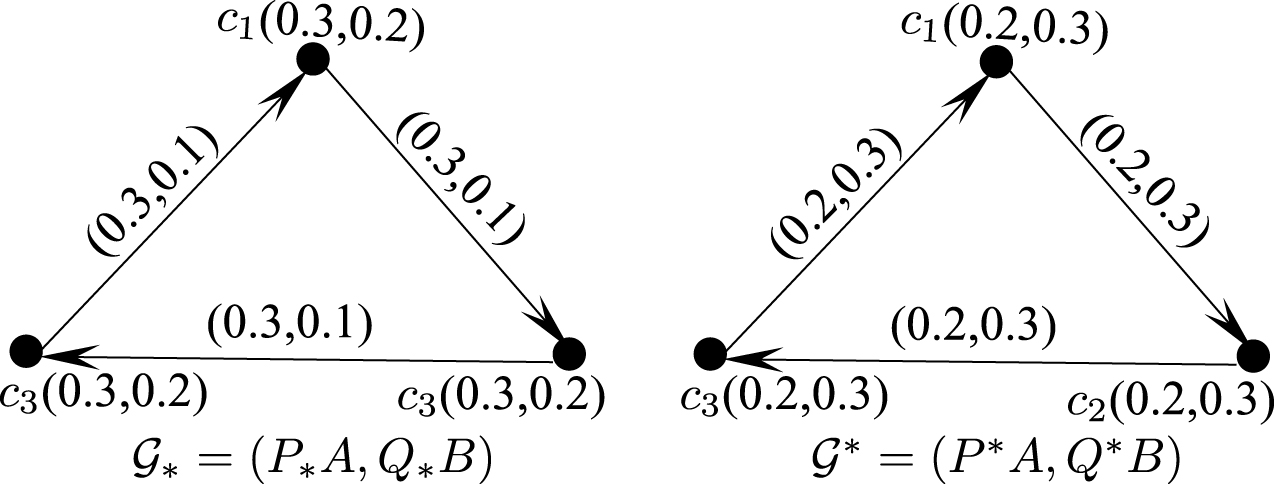
Hence, (Q∗D, Q∗D) is an intuitionistic fuzzy rough relation on C★. Thus, and are intuitionistic fuzzy graphs as shown in Fig. 13. It is a regular and total regular intuitionistic fuzzy rough graph.
Intuitionistic Fuzzy Rough Graph .
Definition 3.24. An intuitionistic fuzzy rough graph is called totally regular, if in each approximation space is an intuitionistic fuzzy graph with same total degree. Equivalently, if in each approximation is a totally regular intuitionistic fuzzy graph, i.e.,
where ti are constants ∀i = 1, 2, 3, 4 .
Theorem 3.5.Let be an intuitionistic fuzzy rough graph. If is a regular (totally regular) and PC = (P∗C, P∗C) is a constant function, then is a totally regular (regular) intuitionistic fuzzy rough graph.
Proof. Let be an intuitionistic fuzzy rough graph, where and If is regular and PC is constant, then for any a ∈ PC, (ab) ∈ QD,
where ki and mi are constants ∀ i = 1, 2, 3, 4.
Therefore,
Hence, is totally regular. □
Theorem 3.6.If an intuitionistic fuzzy rough graph is regular and PC = (P∗C, P∗C) is a constant function, then and are regular.
Proof. By using the same approach of the proof in Theorem 3.5 and definition of complement of ,
Therefore, Gc is regular. By Definition 3.6 of G. When (QD) (ab) ≠0,
When (QD) (ab) =0,
Hence, μ-complement of is regular. □
Theorem 3.7.If an intuitionistic fuzzy rough graph is totally regular and PC is a constant function, then and are totally regular.
Proof. Let be an intuitionistic fuzzy rough graph, where and If is totally regular and PC is constant, then by Theorems 3.5, Gc is regular. Therefore, by Theorem 3.6 Gc and Gμ are regular. Hence, Gc and Gμ are totally regular. □
Definition 3.25. Let be an intuitionistic fuzzy rough graph. Then is irregular, if there is a vertex which is adjacent to vertices with distinct indegree and outdegree in each approximation spaces.
Definition 3.26 Let be a connected intuitionistic fuzzy rough graph. Then is said to be a neighbourly irregular intuitionistic fuzzy rough graph if every two adjacent vertices of have distinct degree pair in each approximation spaces.
Definition 3.27. Let be an intuitionistic fuzzy rough graph. Then is totally irregular, if there is a vertex which is adjacent to vertices with distinct total degrees in each approximation.
Example 3.13. Let C★ = {p, q, r} be a set. Let be an intuitionistic fuzzy rough graphs on C★, where and are intuitionistic fuzzy graphs as shown in Fig. 8. The graph is an neighbourly and totally irregular intuitionistic fuzzy rough graph.
Definition 3.28. Let be a connected intuitionistic fuzzy rough graph. is said to be a highly irregular intuitionistic fuzzy rough graph if every vertex of is adjacent to vertices with distinct degree pair.
Remark 3.3. A highly irregular intuitionistic fuzzy rough graph need not be a neighbourly irregular intuitionistic fuzzy rough graph.
Example 3.14. Let C★ = {a, b, c, d} be a set. Let be an intuitionistic fuzzy rough graph on C★, where and are intuitionistic fuzzy graphs as shown in Fig. 14. The graph is a highly irregular intuitionistic fuzzy rough graph. As degree pair of c and d are same: od (c) = (0.0, 0.1) = od (d) , id (c) = (0.0, 0.1) = id (c) in lower approximation graph and od (c) = (0.1, 0.1) = od (d) , id (c) = (0.1, 0.1) = id (c) in upper approximation graph, therefore, it is not neighbourly irregular intuitionistic fuzzy rough graph.
Intuitionistic Fuzzy Rough Graph .
Theorem 3.8.Let be an intuitionistic fuzzy rough graph. is highly irregular intuitionistic fuzzy rough graph and neighbourly irregular intuitionistic fuzzy rough graph if and only if the degree pair of all vertices of are distinct.
Proof. Let be an intuitionistic fuzzy rough graph with n vertices u1, u2, u3, ⋯ , un . Assume that is highly irregular and neighbourly irregular intuitionistic fuzzy graph. Let the adjacent vertices of u1 be u2, u3, ⋯ , un with outdegree and indegree (k2, l2) , (k3, l3) , ⋯ , (kn, ln) and (p2, q2) , (p3, q3) , ⋯ , (pn, qn) respectively. Since, is highly irregular,
The outdegree od (u1) of u1 cannot be either of (k2, l2) , (k3, l3) , ⋯ , (kn, ln) and the indegree id (u1) of u1 not either of (p2, q2) , (p3, q3) , ⋯ , (pn, qn) as is neighbourly irregular. Therefore, the degree pair of all vertices of are distinct. Similarly, the degree pairs of all vertices of are distinct. Hence, the degree pair of all vertices of are distinct. Converse part is obvious. □
Example 3.15. Let C★ = {c1, c2, c3, c4, c5} be a set. Let be an intuitionistic fuzzy rough graphs on C★, where and are intuitionistic fuzzy graphs as shown in Fig. 1.
The graph is a highly irregular intuitionistic fuzzy rough graph. As degree pair of c4 and c5 are same: od (c5) = (0.1, 0.1) = od (c4) , id (c5) = (0.1, 0.1) = id (c4) in lower approximation graph, therefore, it is not neighbourly irregular intuitionistic fuzzy rough graph.
Theorem 3.9.Let be an intuitionistic fuzzy rough graph. If G is neighbourly irregular and PC is a constant function, then is a neighbourly total irregular intuitionistic fuzzy rough graph.
Proof. Assume that is a neighbourly irregular intuitionistic fuzzy rough graph, i.e., the degrees of every two adjacent vertices are distinct in each approximation. Consider two adjacent vertices u1 and u2 with distinct degree pair, as out degree (k1, l1) and (k2, l2) and indegree (p1, q1) and (p2, q2) respectively, in i.e., od (u1) = (k1, l1) , id (u1) = (p1, q1) and od (u2) = (k2, l2) , id (u2) = (p2, q2) where k1 ≠ k2, l1 ≠ l2, p1 ≠ p2, q1 ≠ q2, and d (u1) ≠ d (u2) . Also assume that (P∗C) (u1) = (c1, c2) = (P∗C) (u2), a constant ci ∈ [0, 1] , i = 1, 2.
Therefore td (u1) d (u1) + (P∗C) (u1) = (k1, l1) + (p1, q1) + (c1, c2) ; td (u2) = d (u2) + (PC) (u2) = (k2, l2) + (p2, q2) + (c1, c2) To prove: td (u1) ≠ td (u2). Suppose td (u1) = td (u2) ; d (u1) + (P∗C) (u1) = d (u2) + P∗C (u1) d (u1) = d (u2) , a contradiction to d (u1) ≠ d (u2) . Therefore, td (u1) ≠ td (u2) in , i.e., for any two adjacent vertices u1 and u2 with distinct degrees, its total degrees are also distinct, provided PC is a constant function. Thus, is a neighbourly total irregular intuitionistic fuzzy graph. Similarly, is a neighbourly total irregular intuitionistic fuzzy graph. The above argument is true for every pair of adjacent vertices in . □
Theorem 3.10.Let be a intuitionistic fuzzy rough graph. If is both neighbourly irregular and neighbourly total irregular intuitionistic fuzzy rough graph, then PC need not be a constant function.
Proof. This proof follows from Theorems 3.5, 3.6 and 3.9.
Application to decision making
Decision-making plays an important role in our daily life. Same decisions are very important that they can change the course of our lives. The process of decision-making yields a choice among different alternatives. Decision-making is considered very useful in gathering as much information from different sources and evaluating all possible alternatives to the problem or situation at hand. Going through this whole process we arrive at the best possible solution for the problem. Here we present some applications of decision-making from our real World. The given decision-making method can be used to evaluate upper and lower approximations to develop deep considerations of the problem. The presented algorithms can be applied to avoid lengthy calculations when dealing with large number of objects. This method can be applied in various domains for multi-criteria selection of objects. The amazing collection of bridal dresses has been introduced in many fashion shows by the best and leading fashion designers of our country. Usually the brides take too much interest in different types of gowns for wedding so this collection also contains beautiful gowns. Different famous fashion designers took part in many fashion weeks related to wedding so that these outfits are worked with different reactivities. If these bridal dresses are compared with the Pakistani dresses which were delivered, they are totally different from them as they hold their own value. The outfits for bridles are according to the traditions and mayoon, mehndi, baraat and reception outfits are including in this collection. Let a new fashion designer wants to make a bridal dress. The brides look more traditional in lehngas and shararas made by using different types of embroidery such as Dabka, Beats, Naqshi, Mukesh, Pearls, Crystals, Studded Squins, Motifs and Work of Zari so they are also available for all the girls. He decides to make the bridal dresses which are customary and traditional along with the modern twist. He uses a set F★ consisting of f1 = Dabka, f2 = Mukesh, f3 = Pearls, f4 = Crystals and f5 = Work of Zari, on a red tradition color with coffee color.
F = {(f1, 0.8, 0.1) , (f2, 0.7, 0.2) , (f3, 0.6, 0.1) , (f4, 0.8, 0.1) , (f5, 0.8, 0.1)} is an intuitionistic fuzzy set on F★, shows the quality of above embroideries and P an intuitionistic fuzzy relation on F★ defined as given in Table 6.
Intuitionistic fuzzy relation on F★
P
f1
f2
f3
f4
f5
f1
(0.9,0.0)
(0.7,0.1)
(0.6,0.2)
(0.5,0.1)
(0.3,0.2)
f2
(0.8,0.1)
(0.4,0.4)
(0.8,0.1)
(0.7,0.1)
(1.0,0.0)
f3
(0.7,0.2)
(0.3,0.1)
(0.0,0.6)
(0.2,0.2)
(0.6,0.2)
f4
(0.6,0.1)
(0.5,0.5)
(0.4,0.4)
(0.7,0.2)
(0.3,0.4)
f5
(0.9,0.0)
(0.0,1.0)
(0.1,0.1)
(0.5,0.5)
(0.3,0.3)
PF = (P∗F, P∗F) an intuitionistic fuzzy rough set, where P∗F and P∗F are lower and upper approximations of F, respectively, as pursued:
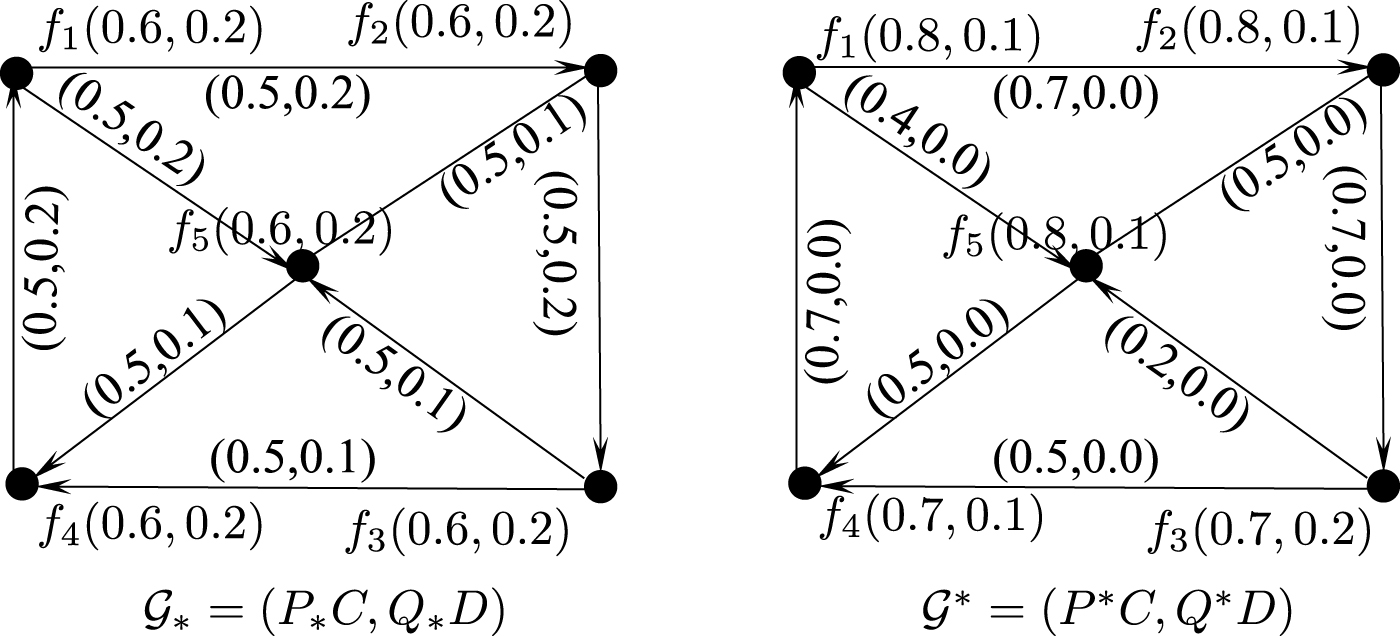
F is an intuitionistic fuzzy rough set as . Let D★ = {f1f2, f1f5, f2f3, f2f5, f3f4, f3f5, f4f1, f5f2, f5f4} ⊆ F★ × F★ and Q an intuitionistic fuzzy relation on D★ defined as given in Table 7.
Intuitionistic fuzzy relation on D★
Q
f1f2
f1f5
f2f3
f2f5
f3f4
f1f2
(0.4,0.2)
(0.9,0.0)
(0.6,0.1)
(0.7,0.1)
(0.4,0.0)
f1f5
(0.0,0.0)
(0.3,0.2)
(0.0,0.0)
(0.3,0.3)
(0.4,0.5)
f2f3
(0.3,0.1)
(0.5,0.0)
(0.0,0.2)
(0.4,0.3)
(0.2,0.2)
f2f5
(0.0,0.3)
(0.3,0.0)
(0.0,0.4)
(0.0,0.3)
(0.1,0.1)
f3f4
(0.4,0.2)
(0.2,0.0)
(0.2,0.4)
(0.3,0.1)
(0.0,0.1)
f3f5
(0.0,0.0)
(0.2,0.0)
(0.1,0.1)
(0.1,0.0)
(0.0,0.4)
f4f1
(0.6,0.0)
(0.2,0.0)
(0.5,0.0)
(0.2,0.0)
(0.4,0.0)
f5f2
(0.0,0.3)
(0.3,0.0)
(0.0,0.4)
(0.0,0.3)
(0.1,0.1)
f5f4
(0.5,0.4)
(0.3,0.3)
(0.0,0.9)
(0.0,0.8)
(0.1,0.1)
Q
f3f5
f4f1
f5f2
f5f4
f1f2
(0.5,0.2)
(0.4,0.1)
(0.3,0.4)
(0.1,0.1)
f1f5
(0.3,0.1)
(0.4,0.0)
(0.0,0.6)
(0.2,0.4)
f2f3
(0.6,0.1)
(0.7,0.1)
(0.2,0.0)
(0.2,0.0)
f2f5
(0.1,0.1)
(0.5,0.1)
(0.0,0.3)
(0.3,0.3)
f3f4
(0.0,0.1)
(0.2,0.1)
(0.5,0.1)
(0.4,0.1)
f3f5
(0.0,0.4)
(0.2,0.1)
(0.0,1.0)
(0.2,0.2)
f4f1
(0.3,0.0)
(0.7,0.0)
(0.3,0.0)
(0.3,0.0)
f5f2
(0.1,0.1)
(0.5,0.1)
(0.0,0.3)
(0.3,0.3)
f5f4
(0.1,0.3)
(0.5,0.0)
(0.3,0.4)
(0.3,0.2)
Let D = {(f1f2, 0.6, 0.1) , (f1f5, 0.5, 0.0) , (f2f3, 0.7, 0.0) , (f2f5, 0.7, 0.0) , (f3f4, 0.6, 0.1) , (f3f5, 0.5, 0.2) , (f4f1, 0.7, 0.0) , (f5f2, 0.7, 0.0) , (f5f4, 0.7, 0.1)} be an intuitionistic fuzzy set on D★, represents the enhancement of beauty in the structure combined the type of embroidery and QD = (Q∗D, Q∗D) an intuitionistic fuzzy relation, where Q∗D and Q∗D are lower and upper approximations of D, respectively, as follows in Table 8.
Intuitionistic fuzzy rough edge set
QD
f1f2
f1f5
f2f3
f2f5
Q∗D
(0.7,0.0)
(0.4,0.0)
(0.7,0.0)
(0.5,0.0)
Q∗D
(0.5,0.2)
(0.5,0.2)
(0.5,0.2))
(0.5,0.1)
QD
f3f4
f3f5
f4f1
f5f2
f5f4
Q∗D
(0.5,0.0)
(0.2,0.0)
(0.7,0.0)
(0.5,0.0)
(0.5,0.0)
Q∗D
(0.5,0.1)
(0.5,0.1)
(0.5,0.2)
(0.5,0.1)
(0.5,0.1)
Thus, and are fuzzy digraphs as shown in Fig. 15. Score value is given in Table 9. Since f1 has maximum value, designer uses dabka in his work to enhance the beauty in the dress. The algorithm with time complexity (TC) of this application is shown in Table 10.
Intuitionistic Fuzzy Rough Graph .
F★
f1
f2
f3
f4
f5
Ti
0.5064
0.3828
0.4162
0.2828
0.2
Algorithm of Decision-making problem
Algorithm
TC
1. Begin
O(1)
2. Input the vertex set C★ of embroidery f1, f2, …, fn.
O(n)
3. Input an intuitionistic fuzzy relation P on C★.
O(n2)
4. Input an intuitionistic fuzzy set C on C★.
O(n)
5. Input the edge set D★ of relations l1, l2, …, lr where, li = fjfk, for some j, k ∈ {1, 2, …, n}.
O(r)
6. Input an intuitionistic fuzzy relation Q on D★ ⊆ C★ × C★.
Rough set theory is a mathematical tool to deal with incomplete and vague information. An intuitionistic fuzzy set theory deals the problem of how to understand and manipulate imperfect knowledge. Present researchers have been shown that these two theories can be combined into a more flexible and expressive framework for modeling and processing incomplete information in information systems. In this research article, the concept of intuitionistic fuzzy rough relation and intuitionistic fuzzy rough graphs have been introduced. Some algebraic operations on intuitionistic fuzzy rough graphs are studied. An applications of intuitionistic fuzzy rough graphs has been presented in decision making problems. This research work can be extended to intuitionistic fuzzy rough hypergraphs.
Footnotes
Acknowledgment
The authors are very grateful to the Associate Editor and the reviewers.
References
1.
AkramM., AshrafA. and SarwarM., Novel applications of intuitionistic fuzzy digraphs in decision support systems, The Scientific World Journal2014 (2014), ArticleID904606.
2.
AkramM. and NawazS., Fuzzy soft graphs with applications, Journal of Intelligent & Fuzzy Systems30(6) (2016), 3619–3632.
3.
AkramM. and ShahzadiS., Novel intuitionistic fuzzy softmultipleattribute decision-making methods, Neural Computing and Applications (2016). doi:10.1007/s00521-016-2543-x
4.
AkramM., AlshehriN., DavvazB. and AshrafA., Bipolar fuzzy digraphs in decision support systems, J Multiple-Valued Logic and Soft Computing27 (2016), 531–551.
5.
AtanassovK.T., Intuitionististic fuzzy sets, Fuzzy Sets and System20(1) (1986), 87–96.
6.
BhattacharyaP., Some remarks on fuzzy graphs, Pattern Recognition Letters6(5) (1987), 297–302.
7.
BiY., AndersonT. and MccleanS., A rough set model with ontologies for discovering maximal association rules in document collections, Knowledge-Based Systems16(5-6) (2003), 243–251.
8.
ChakrabartyK., BiswasR. and NandaS., Fuzziness in rough sets, Fuzzy Sets and Systems110(2) (2000), 247–251.
9.
CornelisC., De CockM. and
KerreE.E., Intuitionistic fuzzy rough sets: At the crossroads of imperfect knowledge, Expert Systems20(5) (2003), 260–271.
10.
DubiosD. and PradeH., Rough fuzzy set and fuzzy rough sets, International Journal of General System17(2–3) (1990), 191–209.
11.
GaniA.N. and LathaS.R., On irregular fuzzy graphs, Applied Mathematical Sciences6(11) (2012), 517–523.
12.
GaniA.N. and RadhaK., On regular fuzzy graphs, Journal of Physical Sciences12 (2008), 33–40.
13.
HuangB., GuoC., ZhuangY.L., LiH. and ZhouX., Intuitionistic fuzzy multigranulation rough sets, Information Sciences277 (2014), 299–320.
14.
KauffmanA., Introduction a la Theorie des Sous-embles Flous, Masson et Cie12(4) (1973), 213–227.
15.
LiuG.L., Rough set theory based on two universal sets, its applications, Knowledge-Based Systems23(2) (2010), 110–115.
16.
LiuP. and ChenS.M., Group decision making based on Heronian aggregation operators of intuitionistic fuzzy numbers, IEEE Transactions on Cybernetics47(9) (2017), 2514–2530.
17.
LiuP., HeL. and YuX.C., Generalized hybrid aggregation operators based on the 2-dimension uncertain linguistic information for multiple attribute group decision making, Group Decision and Negotiation25(1) (2016), 103–126.
18.
LiuP. and WangP., Some improved linguistic intuitionistic fuzzy aggregation operators and their applications to multiple-attribute decision making, International Journal of Information Technology & Decision Making16(3) (2017), 817–850.
19.
MiJ.-S. and ZhangW.-X., Composition of general fuzzy approximation spaces, Advances in Soft Computing2275 (2002), 497–501.
20.
MordesonJ.N. and PengC.S., Operations on fuzzy graphs, Information Sciences79(3-4) (1994), 159–170.
21.
PawalakZ., Rough sets, International Journal of Computer, Information Sciences11(5) (1982), 341–356.
22.
PeiD.W. and XuZ.B., Transformation of rough set models, Knowledge-Based Systems20(8) (2007), 745–751.
23.
RosenfeldA. (1975), Fuzzy graphsZadehL.A., FuK.S. and ShimuraM., Fuzzy Sets, their Alications,, New YorkAcademic Press, pp. 77–95.
24.
SunithaM.S. and VijayakumarA., Complement of a fuzzy graph, Indian Journal of Pure, Applied Mathsemematics33(9) (2002), 1451–1464.
25.
WeiG.W., Interval-valued dual hesitant fuzzy uncertain linguistic aggregation operators in multiple attribute decision making, Journal of Intelligent and Fuzzy Systems33(3) (2017), 1881–1893.
26.
WeiG.W., Picture fuzzy cross-entropy for multiple attribute decision making problems, Journal of Business Economics and Management17(4) (2016), 491–502.
27.
WuW.Z., MiJ.S. and ZhangW.X., Composition of approximation spaces, its applications, Journal of Engineering Mathematics19(3) (2002), 86–94.
28.
WuW.Z., Intuitionistic fuzzy rough sets determined by intuitionistic fuzzy implicators, IEEE International Conference on Granular Computing2010536–540.
29.
XuW., LiuY. and SunW., Intuitionistic fuzzy rough sets model based on (⊖, Phi),-operators, 2012 9th International Conference on Fuzzy Systems, Knowledge Discovery (2012), 234–238.
30.
YangH.L., LiS.G., GuoZ.L. and MaC.H., Transformation of bipolar fuzzy rough set models, Knowledge-Based Systems27 (2012), 60–68.
31.
YangH.L., LiS.G., WangS. and WangJ., Bipolar fuzzy rough set model on two different universes, its application, Knowledge-Based Systems35 (2012), 94–101.