



Abstract
An m-polar fuzzy model is a generalization of the fuzzy model. This model is useful for multi-polar information, multi-agent, multi-attribute and multi-object network models. In this research study, we introduce the notion of m-polar fuzzy directed hypergraphs, and present some properties. We depict certain operations on m-polar fuzzy directed hypergraphs. We also consider an application of m-polar fuzzy directed hypergraphs in business strategy company.
Keywords
Introduction
In mathematics, graph theory is the knowledge of graphs used to ideal the pairwise relationship among objects. Graph theory is an efficacious structure used in different fields of life, including socially to scrutinize the diffusion mechanism, in biology node exemplify the regions of certain species and the edges symbolize the migration path between the regions. In mathematics, computer science and engineering, graphs are used for the designing and the result of combinatorial optimization. Graphs are only practicable for forming of the pairwise intercommunication. But in many problems, data deals with more than two objects. To handle such type of synergy, we use a hyperedge, as it contains more than two objects. Hypergraph is a elongated form of ordinary graphs as it contain a definable collection of objects. Hypergraphs have been broadly and profoundly studied in Berge [9]. In real-world problems, hypergraph techniques are more beneficial in many regions including declustering problems to enhance the enforcement of parallel databases [15]. In various fields of discrete mathematics, hypergraphs are used to model ideas and systems. The rewriting systems, problem solving, databases and logic programming can be described using hypergraphs [8]. In computer science, undirected hypergraphs [13] are suitable. But in deductive databases and in model checking, directed hypergraphs are suited. To model different combinatorial structures, directed hypergraphs are used.
In science and technology, there are many problematic phenomena, in which given data is not precise. To overcome such problems, we adopt such mathematical models that involve elements of ambiguity planted on fuzzy set theory. The notion of fuzzy set was given by Zadeh [25] in 1965 whose membership value lie in [0, 1]. In different fields of life including chemistry, economics, computer science, engineering, medical and decision-making problems, fuzzy sets are trifling a durable performance. In 1986, Atanassov [7] popularized the idea of intuitionistic fuzzy sets. There are many problems which based on two-sided knowledge, one is positive and other is negative. To deal them, in 1994, Zhang [26] introduced the bipolar fuzzy set as the continuation of fuzzy set whose membership function ranges over [-1, 1]. By using bipolar fuzzy models, a variety of decision-making problems based on two-sided data can be solved. Recently, the concept of bipolar fuzzy set was elongated to m-polar fuzzy set by Chen et al. [11] whose membership function lies in [0, 1] m , where m is an ordinal number representing the m-tuples aspects of an object. To represent the interrelationship between different individuals, m-polar fuzzy sets can be used. In various real world problems, information consists n parameters (n ≥ 2), that is, multiple information exist which cannot be handled by fuzzy sets and bipolar fuzzy sets because these are single and double information models, respectively. They do not give any information about multiple information, therefore, we need an m-polar fuzzy set.
The initial perception about fuzzy graph was given by Kaufmann [14] based on Zadeh’s fuzzy relation in 1973. The conception of fuzzy graphs structure was expressed by Rosenfeld [19] to deal with relations involving uncertainty. After that, Bhattacharya [10] gave some comments on fuzzy graphs. Mordeson and Chang-Shyh [17] considerded operations on fuzzy graphs. Akram and Sarwar [6] introduced novel applications of m-polar fuzzy competition graphs in decision support system. The idea of fuzzy hypergraphs was studied by Kaufmann [14]. The notion of interval-valued fuzzy hypergraphs was imported by Chen [12]. Lee-Kwang and keon-Myung [16] redefined the fuzzy hypergraph. The view of transversals of m-polar fuzzy hypergraph with applications was explained by Akram and Sarwar [5]. In 2013, Parvathi and Thilagavathi defined the intuitionistic fuzzy directed hypergraphs [20]. Myithili et al. [18] examined the certain types of intuitionistic fuzzy directed hypergraphs. Akram and Luqman [3] formalized the many concepts of bipolar fuzzy directed hypergraphs. Akram and Luqman [4] also illustrated a new decision-making method based on bipolar neutrosophic directed hypergraphs. In this research study, we introduce the notion of m-polar fuzzy directed hypergraphs, and present some properties. We depict certain operations on m-polar fuzzy directed hypergraphs. We also consider an application of m-polar fuzzy directed hypergraphs in businees strategy company. For other notations and applications, readers are referred to [1, 21–24].
Directed hypergraphs under m-polar fuzzy environment
We note that [0, 1]
m
(m-power of [0, 1]) is
considered a poset with the point-wise order ≤, where m is an arbitrary
ordinal number (we make an appointment that m =
{n|n < m} when m
> 0), ≤ is defined by x ≤ y ⇔
p
i
(x) ≤
p
i
(y) for each
i ∈ m (x, y ∈ [0, 1]
m
), and p
i
:
[0, 1]
m
→ [0, 1] is the i-th projection mapping
(i ∈ m).
An mF directed hyperarc (or hyperedge)
e
i
∈ ɛ is an ordered pair
(t (e
i
), h
(e
i
)), such that, t
(e
i
)≠ ∅, is called its tail and
h (e
i
) ≠ t
(e
i
) is its head, such that
In an mFDH, the vertices v i and v j are adjacent vertices if they both belong to the same mF directed hyperedge. Two mF directed hyperedges e i and e j are called adjacent if they have non-empty intersection. That is, supp (e i )∩ supp (e j ) ≠ ∅, i ≠ j.
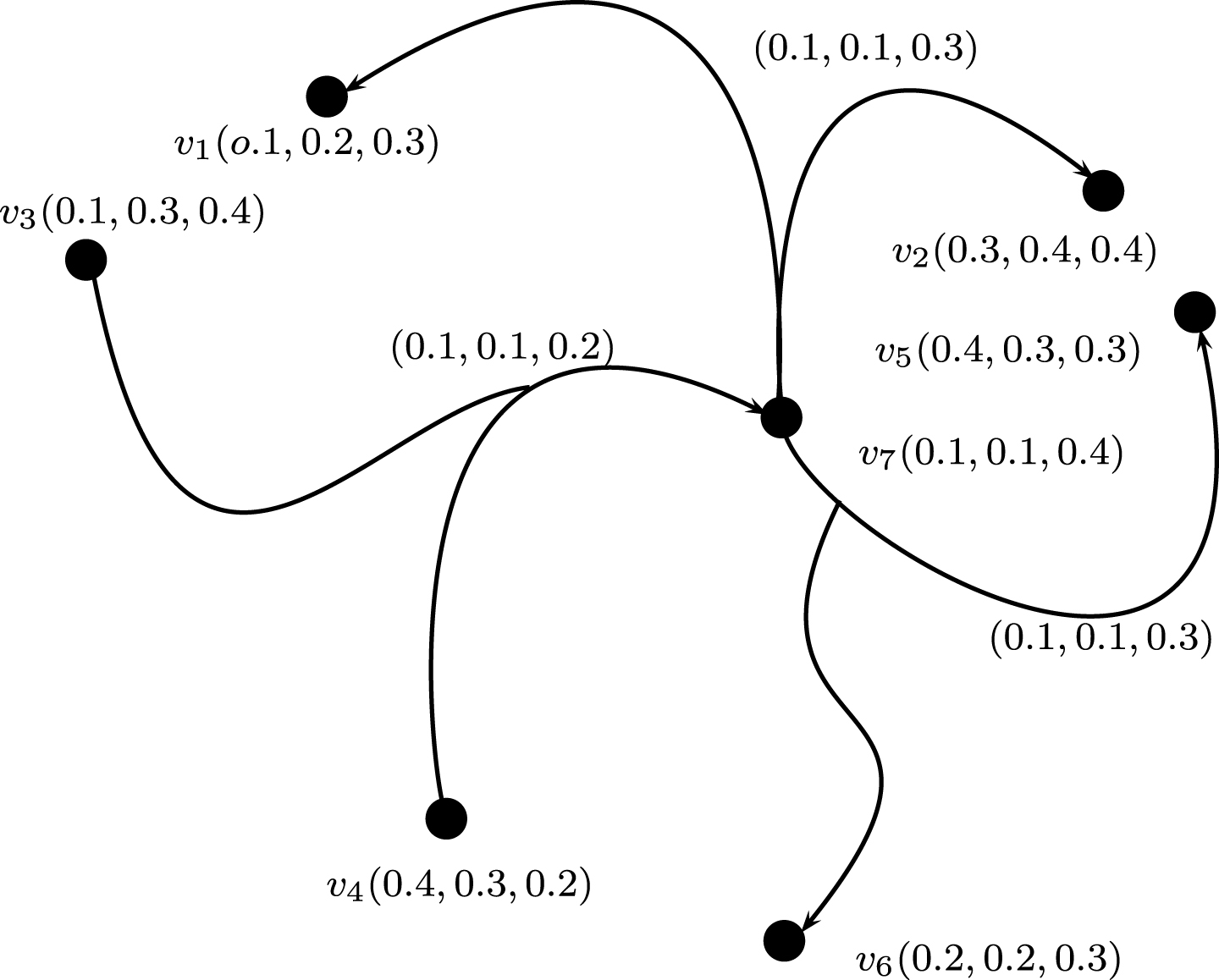
3-polar fuzzy directed hypergraph.
The 3-polar fuzzy relation ɛ is defined as ɛ (v1, v2, v7) = (0.1, 0.1, 0.3), ɛ (v5, v6, v7) = (0.1, 0.1, 0.3), ɛ (v3, v4, v7) = (0.1, 0.1, 0.2). Clearly, H is simple, strongly support simple and support simple, that is, it contains no repeated directed hyperedges and if whenever e j , e k ∈ ɛ and supp (e j ) = supp (e k ), then e j = e k . Further, O (H) = (1.6, 1.8, 2.3) and S (H) = (0.3, 0.3, 0.8).
The out-degree
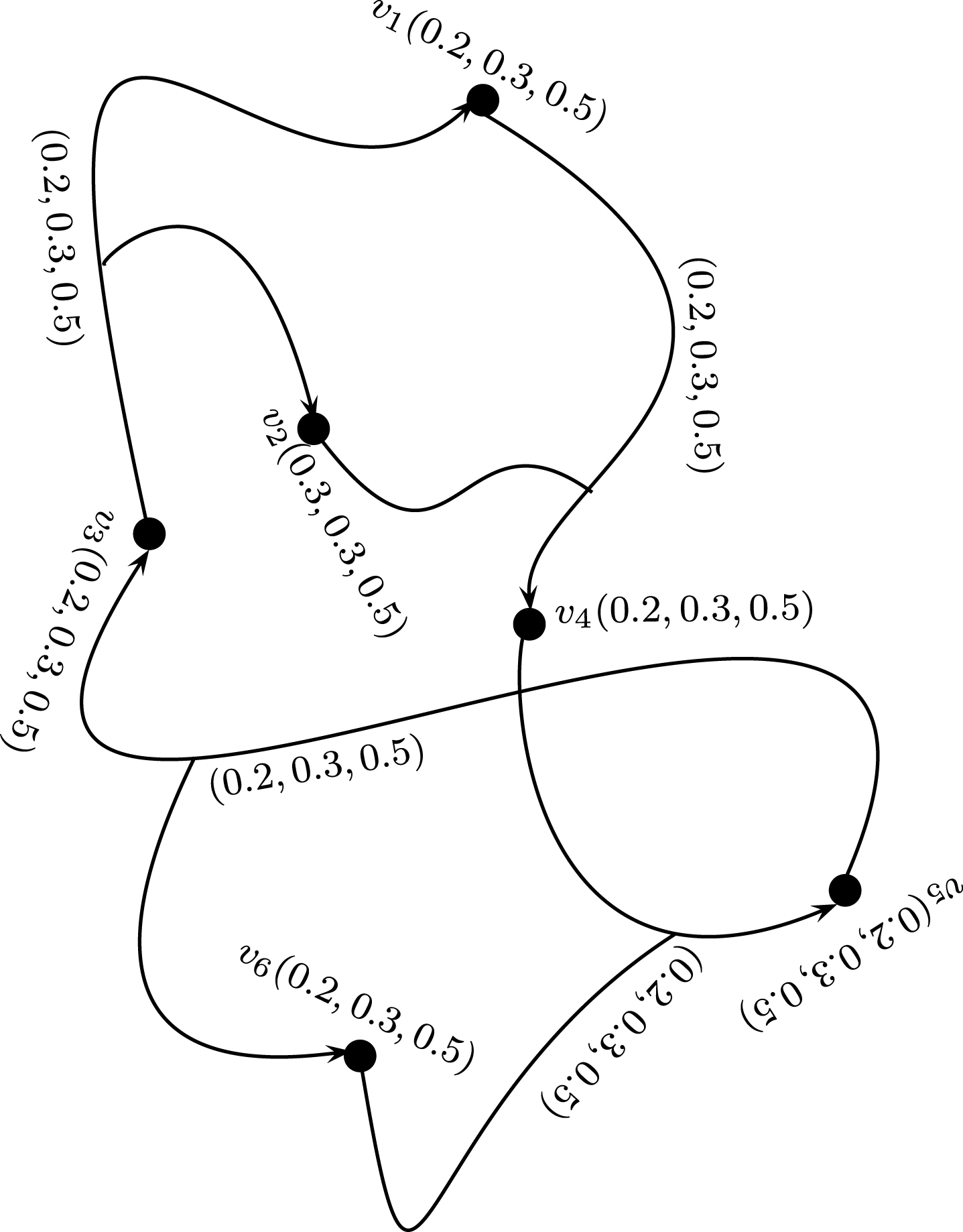
Regular 3-polar fuzzy hypergraph.
By routine calculations, we see that the 3-polar fuzzy directed hypergraph is regular. Note
that,
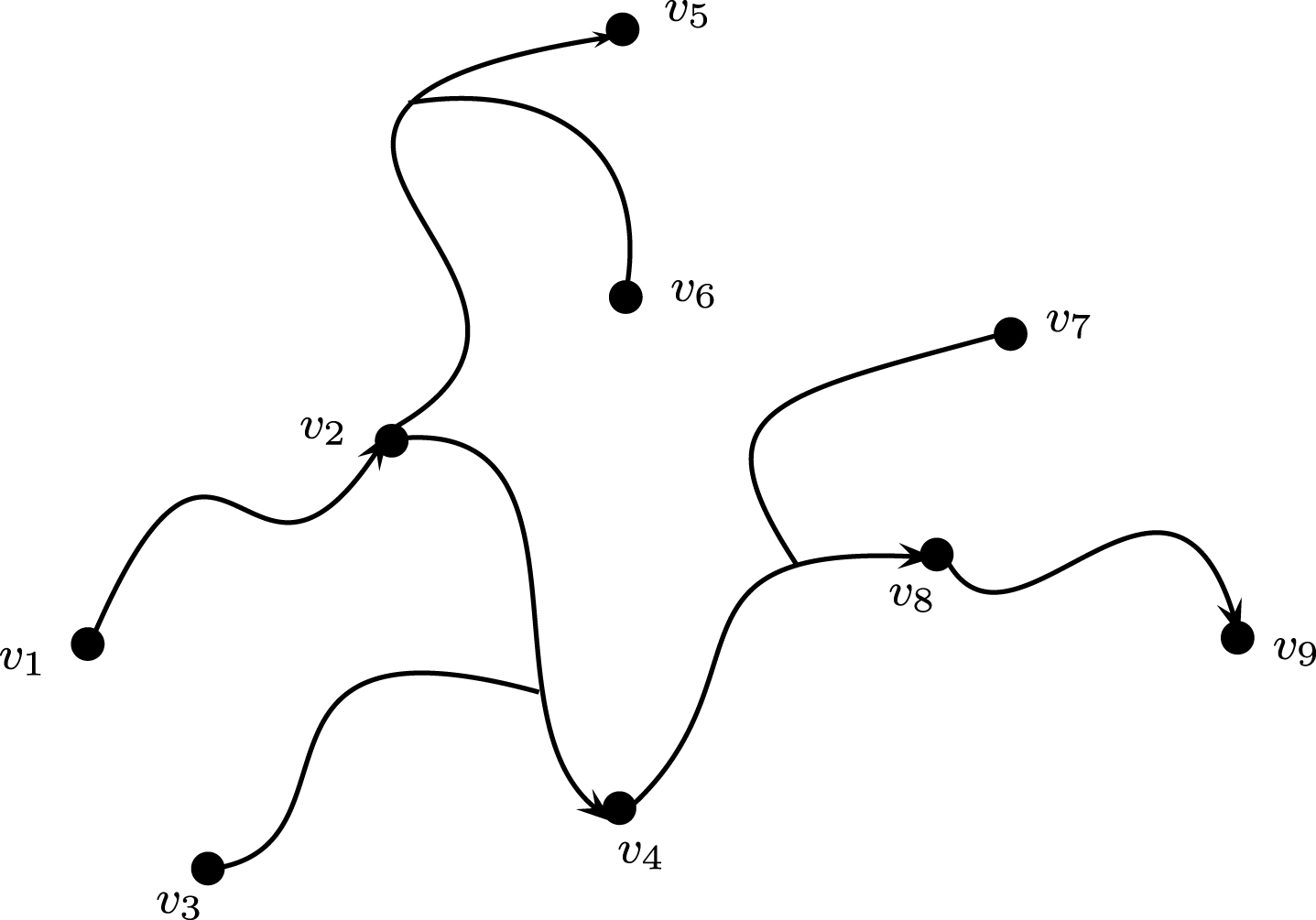
Directed hyperpath (denoted by a thick line).
ɛ (e
i
) >0,
i = 1, 2, …, k, v
i
,
vi+1 ∈
e
i
.
The consecutive pairs (v i , vi+1) are called the directed arcs of the directed hyperpath. The path is shown by a thick line in Fig. 3.
Elementary 3-polar fuzzy directed hypergraph

Elementary 3-polar fuzzy hypergraph.
ɛ
σ
is called the
If ɛ
are satisfied, is called a fundamental sequence (FS) of
H. The sequence is denoted by FS (H).
The
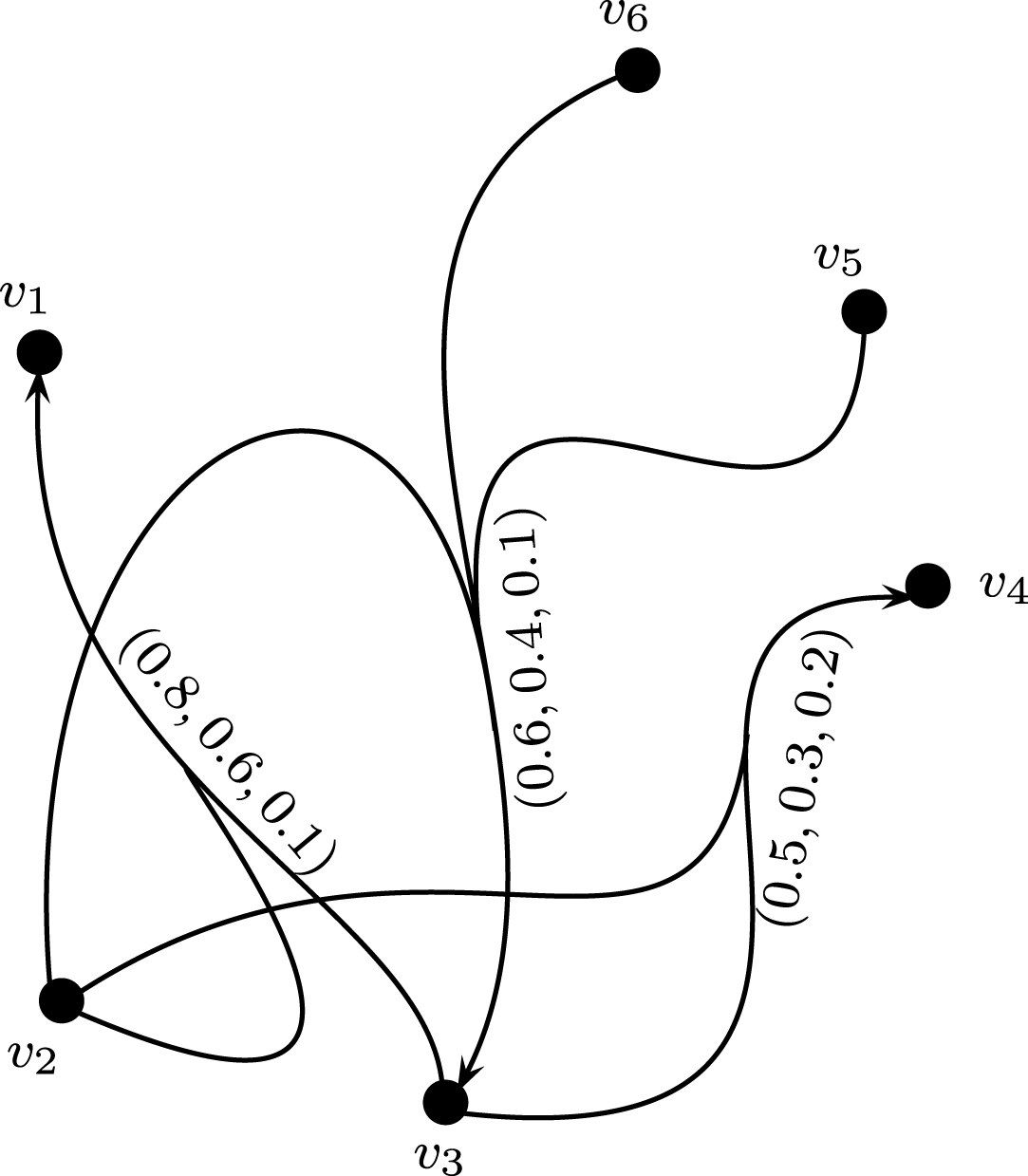
3-polar fuzzy directed hypergraph.
3-polar fuzzy directed hypergraph
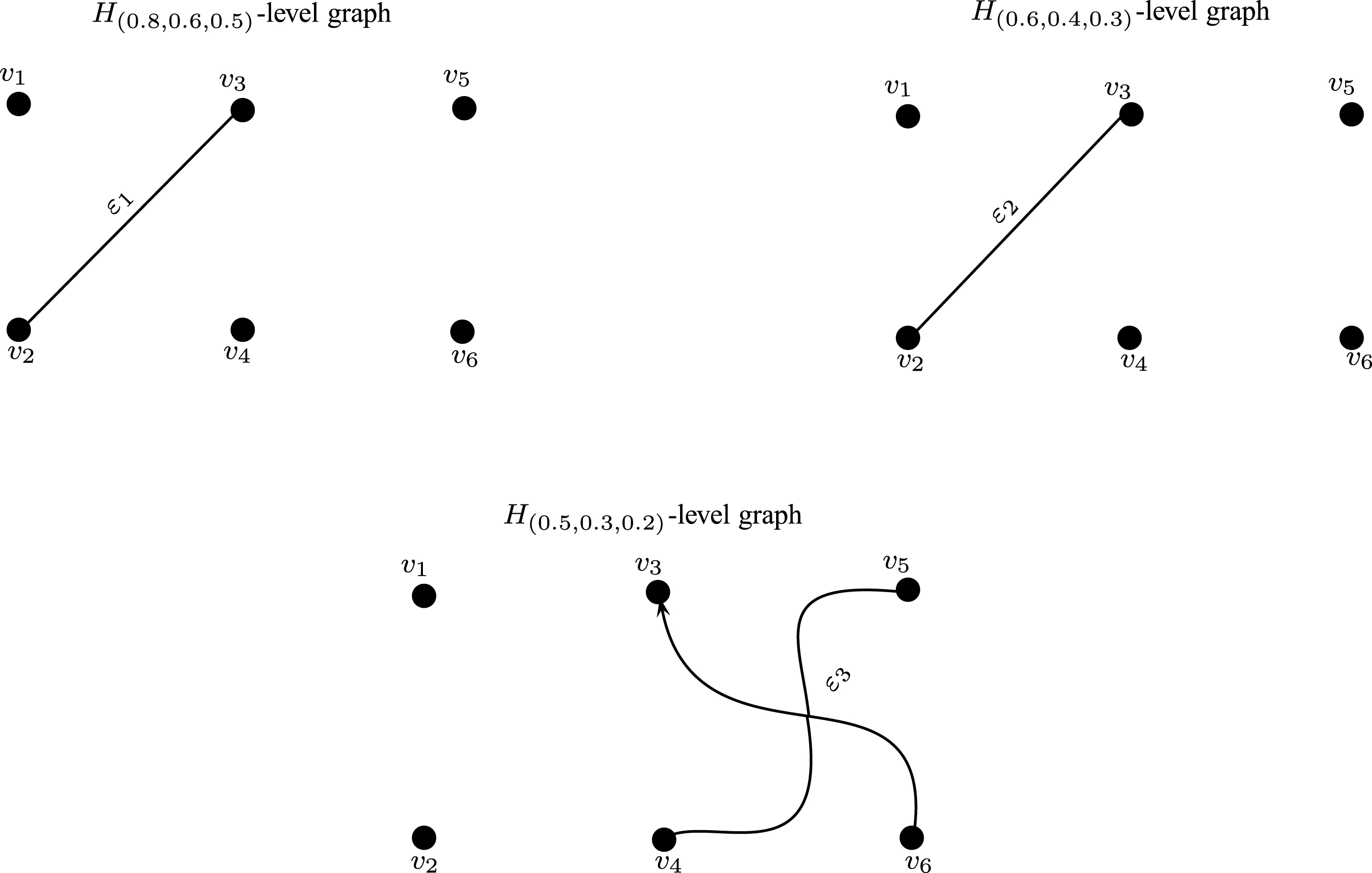
H induced fundamental sequence.
Furthermore, H(0.8,0.6,0.5) ≠H(0.6,0.4,0.3). H is not sectionally elementary since ɛ2(μ) ≠ ɛ2(0.8,0.6,0.5) for μ = (0.6, 0.4, 0.3). The 3-polar fuzzy directed hypergraph is ordered, and the set of core hypergraphs is c (H) = {H1 = H(0.8,0.6,0.5), H2 = H(0.5,0.3,0.2)}. The induced fundamental sequence of H is given in Fig. 6.
Index matrix
Now we present certain operations on mFDHs.
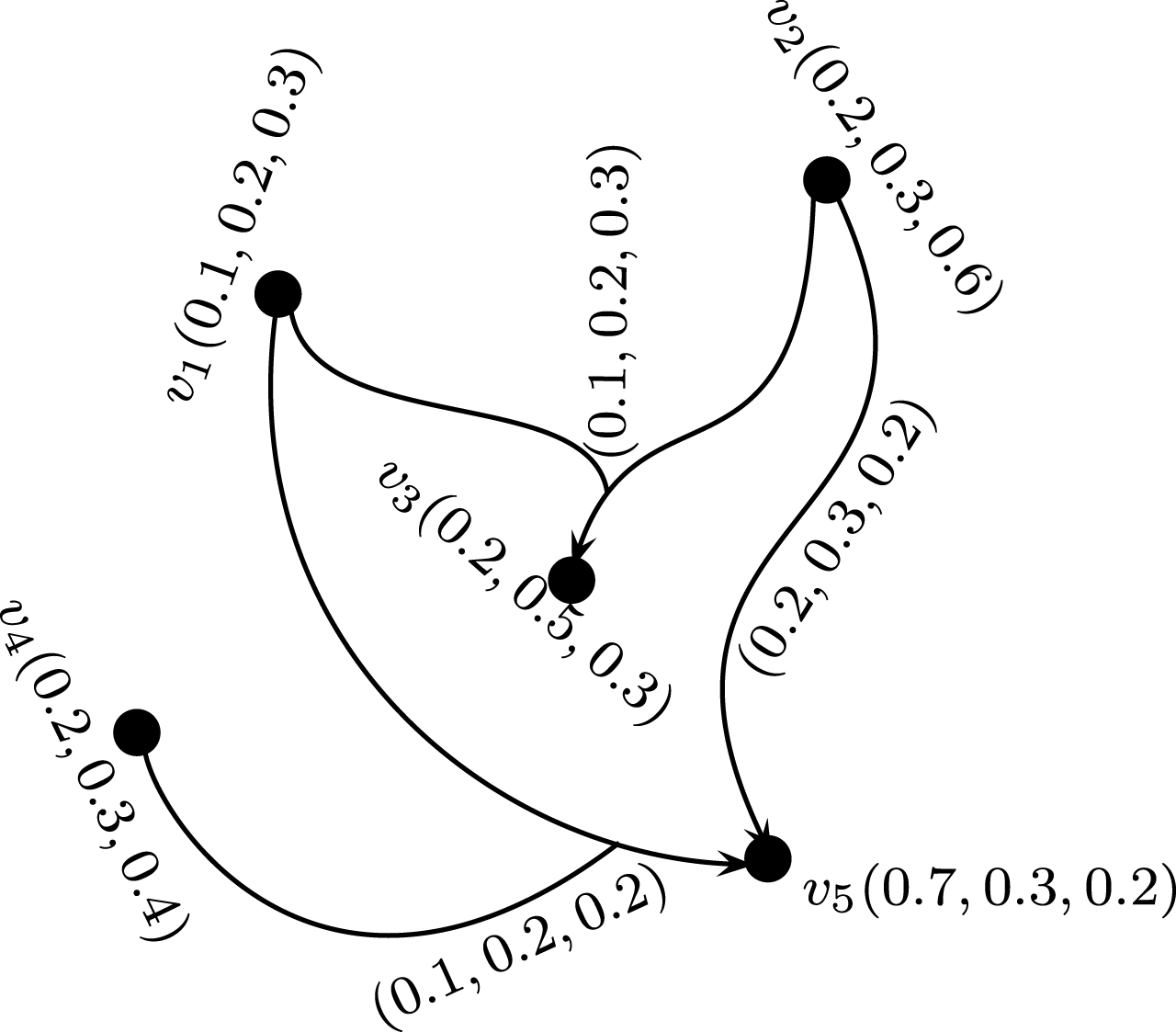
H1.

H2.
Index matrix of H1
Index matrix of H2
Index matrix of H1boxplusH2
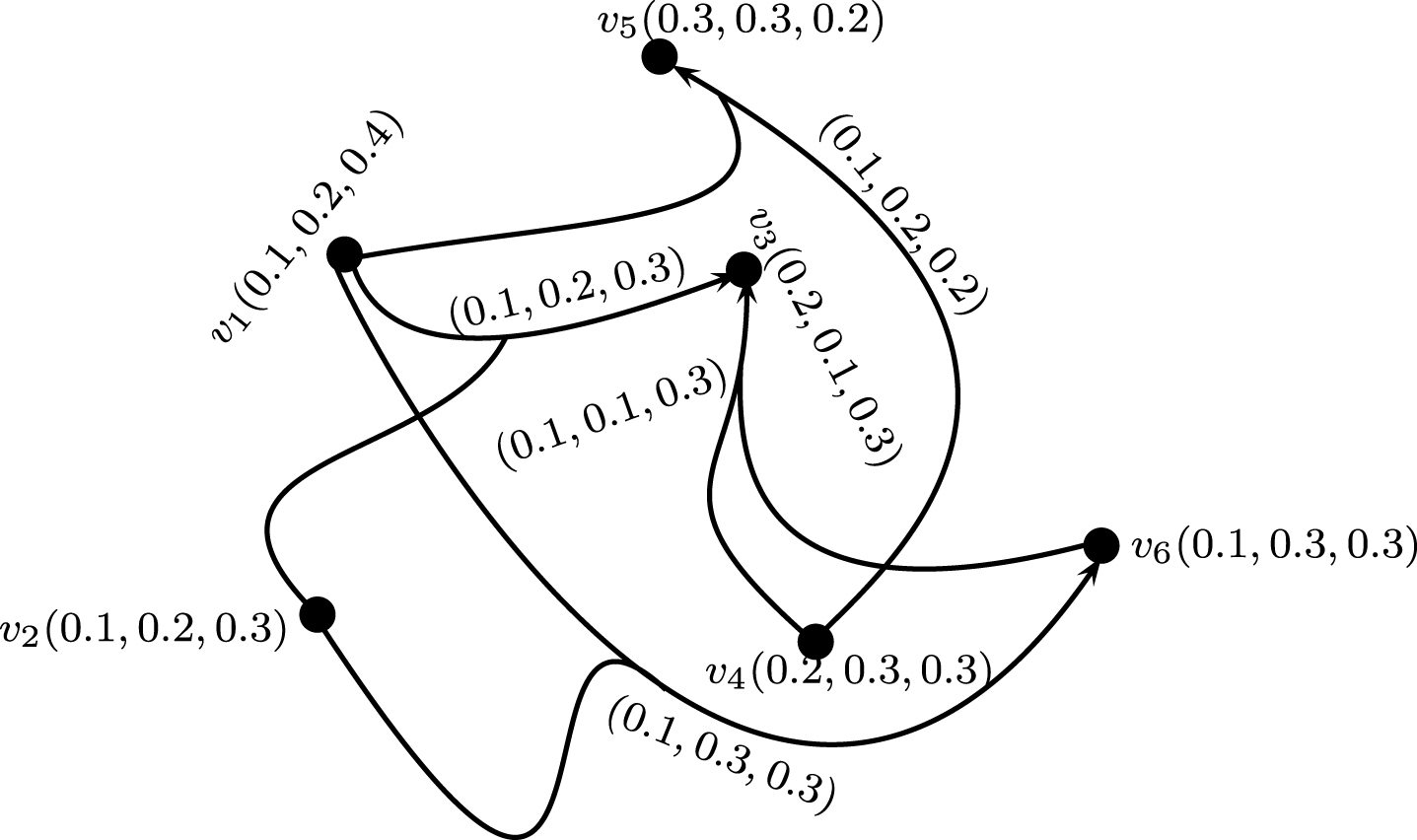
H1boxplusH2.
Index matrix of H1 ⊗ H2
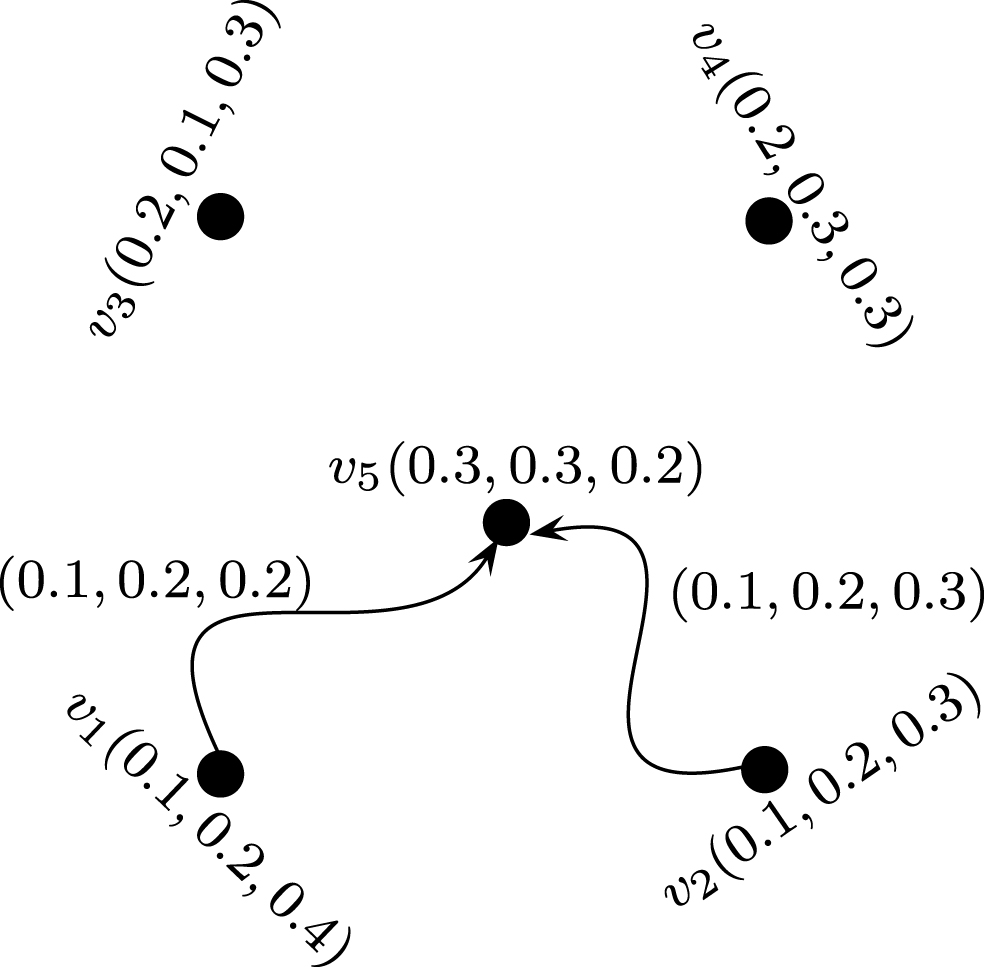
H1 ⊗ H2.
Index matrix of H1boxminusH2

H1boxminusH2.
The graph H1boxminusH2 is shown in
following Fig. 11.
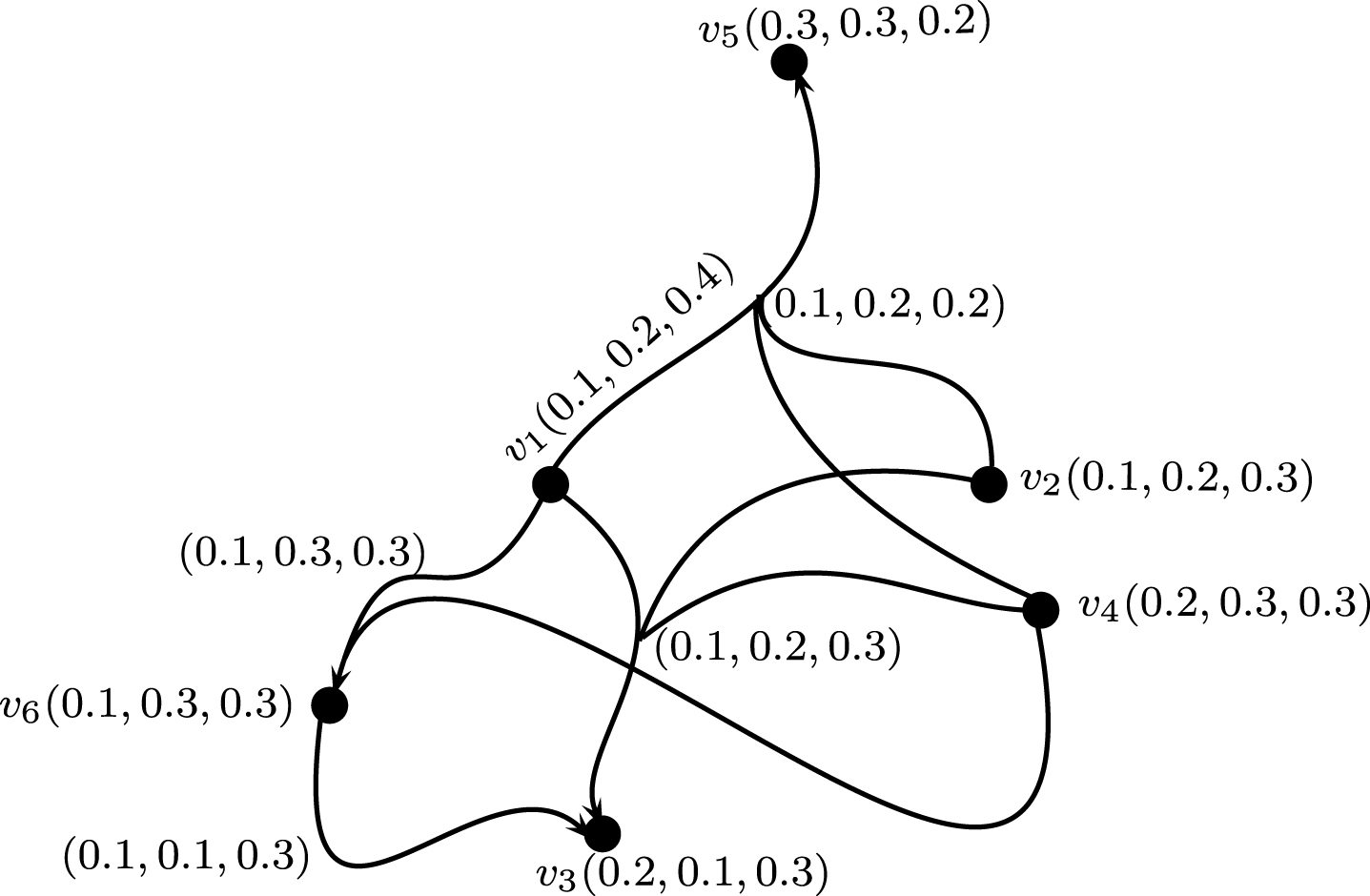
H1 ⊙ H2.
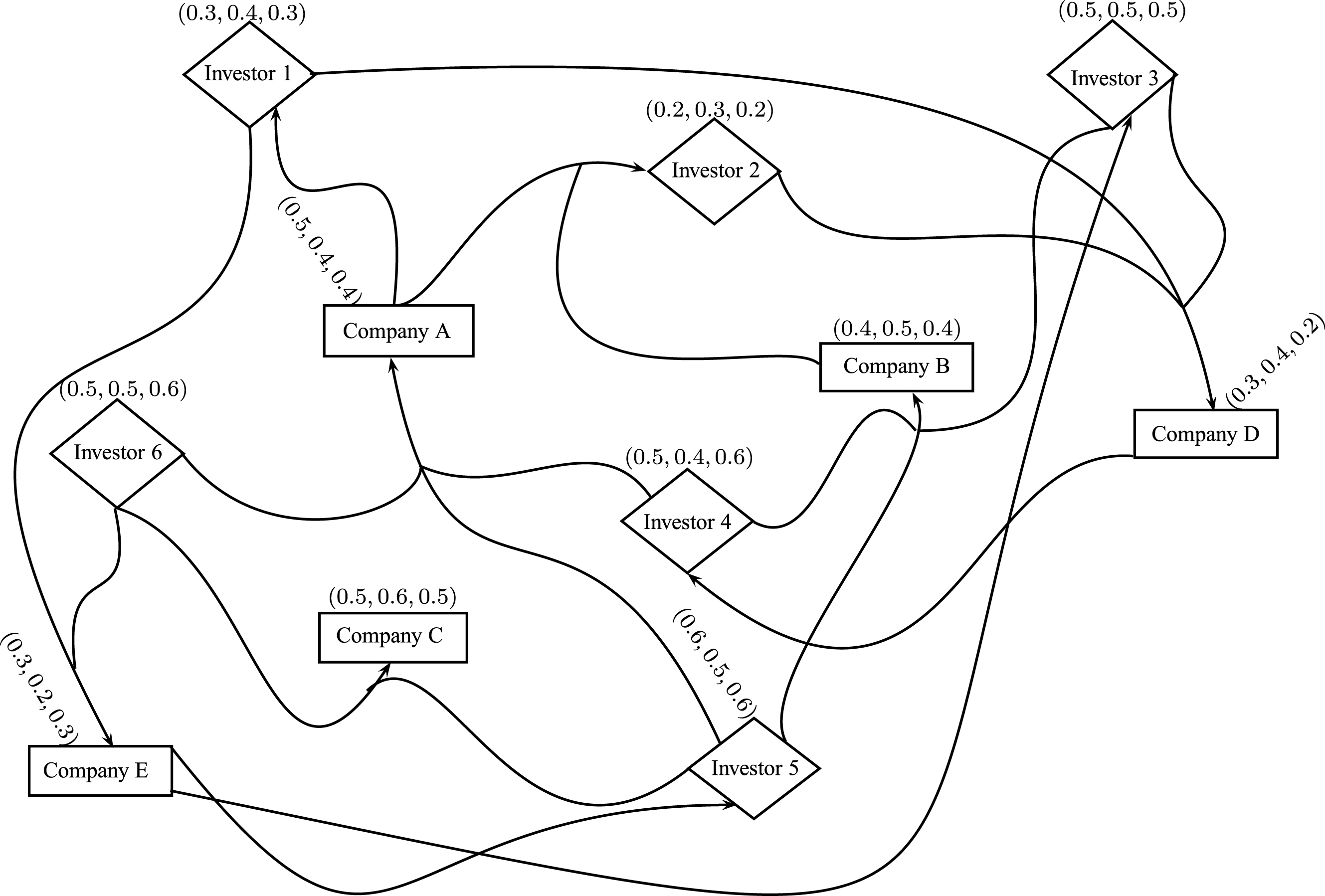
3-polar fuzzy directed hypergraph model between investors and business strategy companies.
Index matrix of H1 ⊙ H2
Decision-making is regarded as the intellectual process resulting in the selection of a belief or a course of action among several alternative possibilities. Every decision-making process produces a final choice, which may or may not prompt action. Decision-making is the process of identifying and choosing alternatives based on the values, preferences and beliefs of the decision-maker. Problems in almost every credible discipline, including decision-making can be handled using graphical models.
In this fast running world where every investor is searching out a best business strategy company so that they invest their money on the company to promote the business and to compete their competitors. Then to select a good marketing business company which will achieve its goals, meet the expectations and sustain a competitive advantage in the marketplace, we develop a 3-polar fuzzy directed hypergraphical model that how an investor can choice the greatest salubrious company to promote the business by following a step by step procedure. A 3-polar fuzzy directed hypergraph demonstrating a group of investors as members of different business strategy companies is shown in Fig. 13.
If an investor wants to adopt the most suitable and powerful business company to which he works and get the progress in business, the following procedure can help the investors. Firstly, one should think about the cooperative contribution of investors towards the company, which can be find out by means of membership values of 3-polar fuzzy directed hypergraphs. The membership values given in Table 9 show the collective interest of investors towards the company.
Collective interest of investors towards companies
Collective interest of investors towards companies
The first membership value showing the how much investors invest money on company, second showing the sharp-minded quality of investors to run the business and third showing how can strongly they make production by working with company. It can be noticed that the company C has strong collective interest of investors which is maximum among all others companies. Secondly, one should do his research on the powerful impacts of all under consideration companies on their investors. The membership degrees of all company nodes show their effects on their investors as given in Table 10.
The membership values showing three different positive effects of company on investor, first one shows how much a company is financially strong already, second showing its business growth in the market and third one showing the strong competitive position of company. Note that, company C has most benefits for investors. Thirdly, an investor can observe the influence of a company by calculating its in-degrees and out-degrees. In-degrees show the percentage of investors joining the company and out-degrees show the percentage of investors leaving that company. The in-degrees and out-degrees of all business strategy companies are given in Tables 11 and 12.
Benefits of company on the investors
In-degrees and out-degrees of companies
Hence, a best business strategy company has maximum in-degrees and minimum out-degrees. However, in case when two companies have same minimum out-degrees, then we compare their in-degrees. Similarly, when in-degrees same, we compare out-degrees. From all above discussion, we conclude that company C is the most appropriate company to fulfill the requirements of the investors because it is more financially strong, best in competitive position and business growth of this company is more suitable to run the business and compete the competitors. The method of searching out the constructive and profitable business strategy company is explained in the following algorithm.
The algorithm runs linearly and its net time complexity is O(n) where, n is the number of membership values of all nodes(investors).
A directed hypergraph is a generalization of directed graphs in which each directed hyperedge has one or more source (tail) nodes and has one or more destination (head) nodes. Directed hypergraphs have fructiferous appliances in different fields of life including medical, social analysis, network modeling and many others fields. In real world problems, data comes from m factors, that is, multiple information arises which can not be disentangled by fuzzy system and any other system, so we need m-ploar fuzzy set to handle the multiple uncertainty and vagueness in data. m-polar fuzzy set are helpful to deal m-tuples properties of an object. mFDH are playing a useful model in handling many complications of life. One of the most effective use of mFDH is that it is helpful to handle problems of business. In this research paper, we have studied the certain concepts and operations of mFDHs and use of mFDH in decision-making problem to solve our real world problem. We will extend our research work on hybrid models of mF rough sets such as, (1) soft mF rough hypergraphs, (2) rough soft mF hypergraphs.
Footnotes
Acknowledgments
The authors are highly thankful to the Associate Editor, and the anonymous referees for their valuable comments and suggestions.