



Abstract
An attribute reduction can make the structure of concept lattices more convenient in formal fuzzy contexts. Thereby, it is beneficial to discover the knowledge. Based on the notion of “one-side fuzzy concept”, we propose a method of attribute reduction combining with the directed graph theory. Employing the proposed approach, a judgment theorem is given for determining concepts and irreducible elements in formal fuzzy contexts. According to the significance of attributes, these attributes are classified three types: core attributes, relatively necessary attributes and unnecessary attributes, which are referred to the attribute characteristics. Applying with the directed graph, We propose the judgment theorems and the corresponding algorithms for computing the three types of attributes sets. On this basis, a corresponding method of attribute reduction is given in a fuzzy-crisp formal context. The feasibility and effectiveness of the algorithm has been proved via an example. The approach presents a mew method for knowledge reducible in formal fuzzy contexts.
Keywords
Introduction
The theory of formal concept analysis (FCA), proposed by Wille [1, 2], arouses mathematical approach for conceptual data analysis and knowledge processing. The main concern of FCA is the lattice structure, constructed by the formal concepts embedded in a concept hierarchy. As an effective tool for knowledge processing, FCA has been applied to a variety of fields such as information retrieval, knowledge discovery, data mining, machine learning, software engineering, etc. [3–8, 17].
FCA is formulated on the basis of a formal context. In recent years, many people have learned theoretical investigations and practical applications of FCA. However, only crisp attributes are suitable for the formal context. In practical problems, formal fuzzy context are more common than their crisp counterparts. Several extensions of FCA theory via fuzzy logic reasoning or fuzzy set theory have been attempted over the years. For instance, Belohlavek [9] proposed fuzzy concepts based on a residuated lattice, and the proposed fuzzy concept lattices have almost all properties in classical concept lattice. Based on properties of m-polar fuzzy graphs, Ghorai and Pal [10, 11] discussed the applications. Medina and Ojeda-Aciego [12] developed the so-called t-concept lattice as a set of triples associated to graded tabular information interpreted in a non-commutative fuzzy logic. From the perspective of fuzzy graphs, Sarwar and Akram [13, 14] gave the application of m-Polar Fuzzy Concept Lattic and the metheod for computing strength of competition. On the other hand, Krajci [8] proposed a “one-side fuzzy concept”, and the crisply generated fuzzy concept lattice is isomorphic to the one-side fuzzy concept lattice [15, 16].
As is well known, knowledge reduction is an important issue by reducing attributes and objects while the concept lattice obtained from the reduced context is isomorphic to the induced from the original context. In the past decades, there have been a rapid growth of interests in knowledge reduction in FCA [1, 18–24]. Hence, it is more meaningful to study the knowledge reduction in a formal fuzzy context which has a simpler. A little research has been done on attribute reduction in formal fuzzy contexts [20, 32–34]. For instance, Shao [26] proposed a method for data reduction using meet-irreducible elements and attribute characteristics in formal fuzzy context. Since Wei [27] have studied the irreducible element judgement theory based on pictorial diagrams, the graph theory plays an important role in studying concepts. Up to now, many models of graphs have been proposed [40]. At the same time, Fuzzy graph theory is one of the developing area of research, which has a variety of applications in different fileds. A fuzzy set is an important mathematical structure to represent a collection of objects whose boundary is vague. There are some interesting applications of fuzzy graphs [35–39].
However, we find that there are some lacks in finding meet-irreducible elements in formal fuzzy contexts. In order to deal with these problems, we will compare to the classical formal contexts and obtain irreducible elements and attribute characteristics combining with a directed graph on the basis of the nation of “one-side fuzzy concept” in formal fuzzy contexts. With the assistant of directed graphs, we propose judgment theorems of meet-irreducible elements and give corresponding algorithms for core attributes, relatively necessary attributes and unnecessary attributes. The proposed approach to compute attribute reduction based on the directed graph is an improvement to Shao’s method.
The paper is organized as follows. To facilitate our discussion, basic notions of fuzzy logic with their related work and graph theory are firstly introduced in Section 2. In Section 3, we introduce the directed graph and obtain the judgment theorems of meet-irreducible elements based on some properities of the directed graph in formal fuzzy contexts. In Section 4, using the directed graph, we analyze attribute characteristics and make up the corresponding algorithms in formal fuzzy contexts. After that, An attribute reduction method and the corresponding algorithm of formal fuzzy contexts are put forward in Section 5. We demonstrate the experiments using the proposed method with example. At the final part-Section 6, it concludes this paper and points out our further works.
Preliminaries
In this section, we review some basic notions and fuzzy-crisp formal concepts as well as the corresponding fuzzy-crisp concept lattice, and then give some notions about graphs which are used in this paper.
Fuzzy-crisp concept lattices
To promote our discussion, we firstly recall some relevant notions of fuzzy logic, and then discuss some properties of the crisply generated concept lattices.
(L, ∧ , ∨ , 0, 1) is a complete lattices with the least element 0 and the great element 1; (L, ⊗ , 0, 1) is a commutative monoid, i.e, ⊗ is commutative, associative, and a ⊗ 1 =1 ⊗ a = a for each a ∈ L; ⊗, → from an adjoint pair, i.e. x ⊗ y ≤ z iff x ≤ y → z hold for all x, y, z ∈ L.
In what follows, the complete residuated lattices L = (L, ∧ , ∨ , ⊗ , → , 0, 1) is fixed with the supporting set [0,1] i.e. L = [0,1]. The notions of a residuated lattices provides a very general truth structure for fuzzy logic and fuzzy set theory.
Let L be a residuated lattice and U a nonempty set. For X, Y ∈ L
U
, X ⊆ Y if and only if X (x) ≤ Y (x) for all x ∈ U. operations ∧ and ∨ on L
U
are defined as follows:
A formal fuzzy context is a triple
Let U be a finite and non-empty set called the universe of discourse. The class of all subsets (respectively, fuzzy subsets) of U will be donated by P (U). For any
A formal fuzzy context
A formal fuzzy context
While (x1: worse, x2: bad, x3: good x4: better, x5: best).
By Definition 2, the following properties can be obtained.
For a formal fuzzy context
All the fuzzy-crisp concepts of
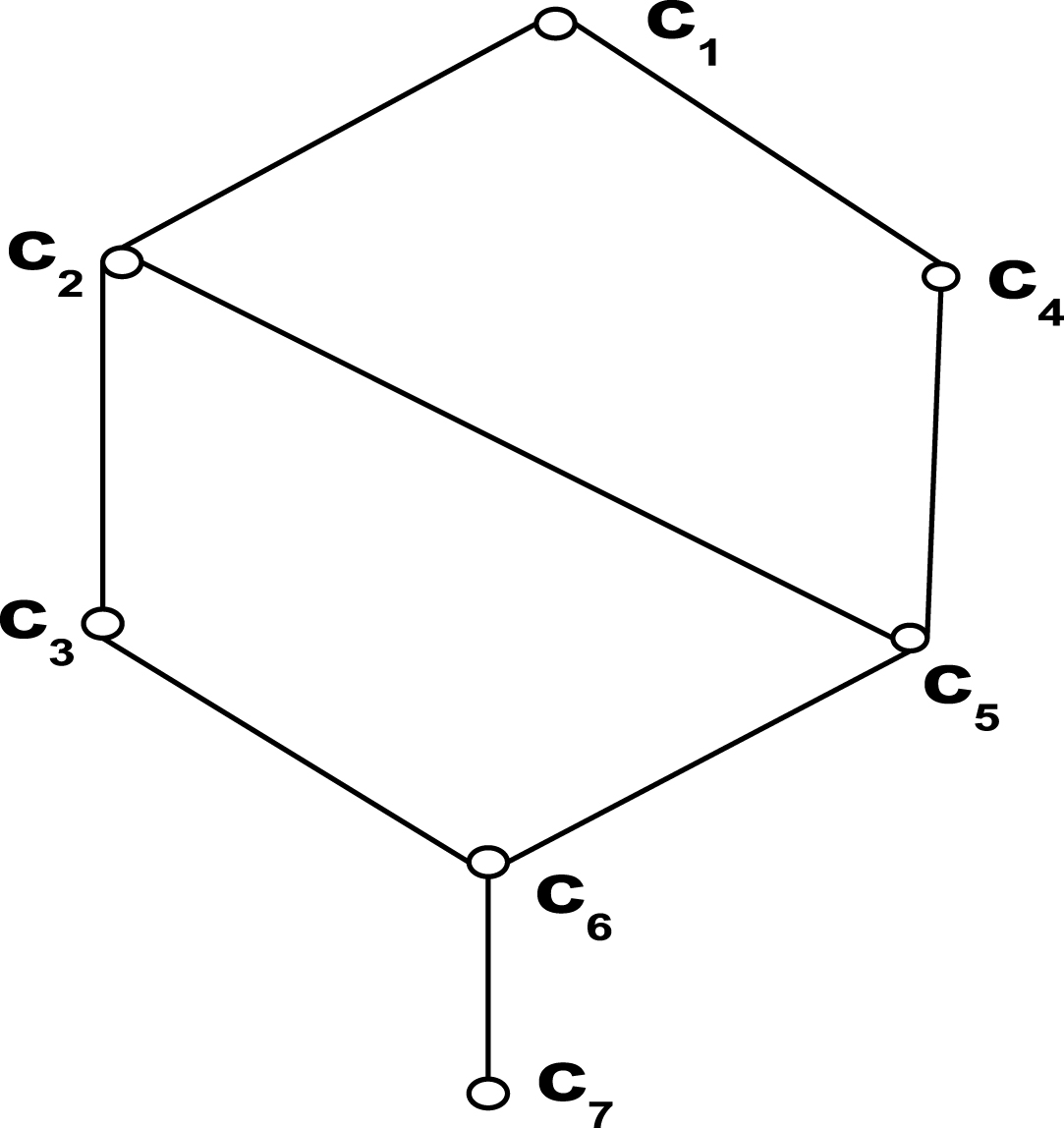
Fuzzy-crisp formal concepts derived from Table 1
In this paper, all used graphs are assumed to be finite. The definition of a directed graph D is referred to Bonby and Murty [31].
The number of arcs in D is denoted by |A (D) |. The vertices which dominated a vertex v are its in-neighbors, those which are dominated by the vertex its out-neighbors. These sets are denoted by N- (v) and N+ (v), respectively.
(2) If v is a vertex of a graph D, we may obtain a graph on |V (D) -1| vertics, by deleting from D the vertex v together with all edges incidents with v. The resulting graph is denoted by D ∖ {v}.
Attribute reduction based on the directed graph in formal fuzzy contexts
To realize the visualization of searching concepts in a context. Similarly, to realize the visualization of attribute reduction in a formal fuzzy context, the main outline of our work is the following: To establish a directed graph To find all the meet-irreducible elements in Explore attribute characteristics using the directed graph and give the theorems and the corresponding algorithms for judging the attribute characteristics in formal fuzzy context. Give an approach to calculate the attribute reduction.
Directed graph in formal fuzzy contexts
In this section, we give the definition of the directed graph combining with graph theory, and present its properties.
The directed graph If ∀ x ∈ U, If ∀ x ∈ U, The Correlation matrix
In any case, g (v
i
, v
i
) =1, the double-arrow v
i
↔ v
j
, then g (v
i
, v
j
) = g (v
j
, v
i
) =1.

A directed graph is proposed in a formal fuzzy context, and by | · | we denote the cardinality of set.
According to Definition 3.1, the directed graph

A formal fuzzy context has two sets: objects and attributes. This illustrates that a directed graph cannot completely reflect a formal fuzzy context. However the meet-irreducible elements and the attribute characteristics are obtained from the directed graph.
Irreducible elements play a vital role in the process of attribute reduction. In this section, we introduce the notion of meet-irreducible elements constituted by the fuzzy-crisp formal concepts, and present its properties.
When O (a) = {b ∈ R|a ↔ b}, then
By Definition 2.2 and property 1.1, we obtained
By Property 1 (ii), we have
For another, for any b ∈ g ∘ f (N+ (a) ∪ O (a)),
By Property 1.1 (i) and (iii), we conclude that
That is f (a) ≤ f (b), which means
Hence, b ∈ N+ (a). and from which we can conclude that
It follows from Equations (1 and 2) that g ∘ f (N+ (a) ∪ O (a)) = g ∘ f (a) = N+ (a) ∪ O (a) and (f (a) , N+ (a) ∪ O (a)) is a fuzzy-crisp formal concept.
It should be noted that every fuzzy-crisp concept
If |N+ (a) |=0. Then N+ (a) has no attribute b in R. Hence, by Definition 3.2, (f (a) , N+ (a) ∪ O (a)) itself is a meet-irreducible element.
If |N+ (a) |=1, then N+ (a) has only one attribute b, and we denote it as (f (b) , N+ (b) ∪ O (b)). By Definition 3.1, we know that f (a) ≤ f (b). It is evident that
By Definition 3.2, we can conclude that (f (a) , N+ (a) ∪ O (a)) is a meet-irreducible element.
If |N+ (a) | = | {b1, ⋯ , b
n
} |>1, then according to the Definition 3.1, we can know that
It is evident that ∀ i, = 1, ⋯ , n .
That is
By Definition 3.2, we can conclude that (f (a) , N+ (a) ∪ O (a)) is a meet-irreducible element.
From the directed graph in a formal fuzzy context, We can compute all attribute concepts to judge whether or not an attribute concept is a meet-irreducible element in
Due to |N+ (a) |=0, |N+ (c) |=0, |N+| (e) |=0, by Theorem 3.2, we can conclude that
(f (c) , N+ (c) ∪ O (c)) = (f (c) , ce) and
(f (a) , N+ (a) ∪ O (a)) = (f (a) , a) are meet-irreducible elements.
|N+ (b) | = | {c, e} |=2 > 1, and f (c) ∧ f (e) ≠ f (b)
|N+ (d) | = | {a, b, c, e, h} |=5 and
f (c) ∧ f (e) ∧ f (a) ∧ f (b) ∧ f (h) ≠ f (d)
|N+ (h) | = | {a, b, c, e} |=4 and
f (a) ∧ f (b) ∧ f (c) ∧ f (e) = f (h)
by Theorem 3.3., we can conclude that (f (b) , bce) and (f (d) , abcdeh) are meet-irreducible elements.
According to the importance of attributes, we classify the attributes into three types: core attributes, relatively necessary attributes and unnecessary attributes in parallel with the definitions of attribute characteristics in rough set theory. we will establish judgment theorems for classifying attributes. Moreover, we will propose the corresponding algorithms for the characteristic of the three attribute types stated above.
Let
From the results stated about, the core attributes are included in every reduct. A relatively necessary attribute is included in some reducts and unnecessary attribute is not in any reducts. Thus, according to the attribute reducts, the attribute set R is divided into three disjoint parts: Core attribute set C = ∩ Red (FC); Relatively necessary attribute set K = ∪ Red (FC) - ∩ Red (FC); Unnecessary attributes set U = R - ∪ Red (FC).
|N+ (a) | = | {b1, ⋯ , b
n
} |>1 and
According to Theorem 3.3, we can know that (f (a) , N+ (a) ∪ O (a)) is not a meet-irreducible element, then,
Based on the judgment Theorem 3.4, one can get all unnecessary attribute using the directed graph in a formal fuzzy context. The produce for computing unnecessary attributes is shown in algorithm 1. Then, the time complexity of Algorithm 1 is
Computing the unnecessary attribute set of
Computing the unnecessary attribute set of
For N+ (b) = {c, e} and f (c) ∩ f (e) ≠ f (a); N+ (d) = {a, b, c, e, h} and f (a) ∩ f (b) ∩ f (c) ∩ f (e) ∩ f (h) ≠ f (d); since a, d are not unnecessary attributes.
For N+ (h) = {a, b, c, e} and f (a) ∧ f (b) ∧ f (c) ∧ f (e) = f (h).
By Theorem 3.4, we can conclude that h is an unnecessary attribute in
By Theorem 2, we can conclude that (f (a) , N+ (a) ∪ O (a)) ∈ M R and ∃ b ∈ R - {a} such that f (a) = f (b).
According to the Definition 3.4, we know that
The pseudocode of the procedure for computing the relatively necessary attributes is shown in Algorithm 2, and its time complexity is
Computing the relatively necessary attribute set of
By Theorem 3.2, we can conclude that (f (a) , N+ (a) ∪ O (a)) ∈ M R , and there has no b ∈ R - {a} such that f (a) = f (b).
According to Definition 3.5, we know that
Then,
Based on Theorem 3.6, one can obtained all core attributes. The pseudocode of the procedure for computing the core attributes is shown in Algorithm 3, and its time complexity is
Computing the core attribute set of
Hence, a is a core attribute.
For N+ (b) = {c, e} =2 and |O (b) = {b} |=1, then
|N+ (d) | = | {a, b, c, e, h} |=5 and |O (d) = {d} |=1,
By Theorem 3.6, we can conclude that a, b and d are core attributes in
As we know, discernibility function is a useful tool in the calculation of all reducts of an information system in rough set theory. In order to compute all attribute reducts, we construct distribution function of formal fuzzy contexts based on fuzzy-crisp concept lattices in this section. Then we propose an approach and an algorithm for attribute reduction in a formal fuzzy context.
Let
Where
We denote W
k
= {a
s
|s = 1, ⋯ , z
k
}. By Theorem 3.7, we obtain that {W
k
|k = 1, ⋯ , t} is the set of all attribute reducts of
Using Theorem 3.7, one can obtained all the attribute reducts of
Computing all attribute reduction of
Computing all attribute reduction of
Combing this fact with the results in Example 3, we have
Therefore, {a, b, c, d} and {a, b, d, e} are relative attribute reducts in
In this paper, we discuss the issue of attribute reduction using the directed graph based on the fuzzy-crisp concept in formal fuzzy contexts. A reducible attribute must have a special characterization in some path in the directed graph. According to the important of the attributes, we have classified the attributes into three types: core attributes, relatively necessary attributes and unnecessary attributes. Therefore, we obtain the meet-irreducible elements and the attribute characteristics combining to the properties of the directed graph such as the optimal path in a directed graph.
Most importantly, we have given the judgment theorems and the corresponding algorithms for computing the three types of attribute sets. Finally, the proposed approaches and algorithms in this paper are used to conduct knowledge reduction in formal fuzzy contexts, which is complement to the existing methods. Studying on attribute reduction in a formal fuzzy context becomes more meaningful. Since an example is given as an application of the results of this paper, we hope that other researchers can obtain some good applications and consequences. As we know, fuzzy graph plays a vital role in many fileds. Therefore, we can try to study how to find the method of knowledge reduction using to fuzzy graph in our further works. There still remain some interesting problems worthy of our further researches.
Footnotes
Acknowledgments
The author sincerely acknowledges the financial support from the Nature Science Foundation of China (61572011) and Nature Science Foundation of Hebei Province (A201820117).