




Abstract
Complex fuzzy sets have been successfully applied to many domains. In some applications, complex fuzzy operators play an vital role, especially those results depend on the particular choice of the conjunction, disjunction and complement operators. This paper introduces an equivalence relation on complex fuzzy sets, called parallelity. Then we provide a criterion that operators should satisfy the property of parallelity preserving, for the choices of complex fuzzy operators. Finally, several parallelity preserving inference methods are discussed for complex fuzzy reasoning.
Keywords
Introduction
Since Ramot et al. [11] defined a complex fuzzy set as an important extension of traditional fuzzy set in which the range of the membership function was the unit disc of the complex plane. Various applications have been proposed based on the theory of complex fuzzy sets [1, 12–15]. For each application, certain complex fuzzy operators are used to build a link between complex fuzzy inputs and complex fuzzy outputs. Then a corresponding problem arises, how to choose suitable operators in complex fuzzy systems? This is an important issue in complex fuzzy systems. For example, we can choose an operator from the criterion whether it has continuity property based on distances of complex fuzzy sets [15]. This is concerned with stability of complex fuzzysystems.
As mentioned in [3], complex fuzzy membership grades should be viewed as vectors in the plane, rather than scalar quantities. For a membership vector, there are many concepts and properties for the amplitude of the vector, which are defined in traditional fuzzy sets and operators. Some researchers made attempts to get the answers from geometric point of view, which mostly rely on the phase of the membership vector. There are two corresponding concepts on the choice of complex fuzzy operators.
One is introduced by Dick [3], who defined the rotational invariance of complex fuzzy operators. This concept is developed from the assertion “phase is relative” in [12]. Rotational invariance states that an operator is invariant under a simple rotation. Under this criterion, the algebraic product and negation are excluded from use in rotationally invariant lattices. Moreover, the removal of this criterion was also examined for the choices of operators based on the techniques of vector logic [9, 10].
The second concept is introduced by Hu et al. [4], who defined the orthogonality between complex fuzzy sets. This orthogonality relation is a dependency relation, i.e., is symmetric and reflexive, but is not transitive. Based on this relation, they presented a new criterion for the choice of complex operations, “orthogonality should be preserved for complex fuzzy operations”.
The method of this paper also relies on the phase of the membership vector. Similar to the orthogonality in geometry, the parallelity relation also is an important concept between two vectors. However, the orthogonality relation in complex fuzzy sets This orthogonality relation is a dependency relation, but is not an equivalence relation. Consequently, we make another attempt to the solution of the above problem in this paper. We propose an equivalence relation of complex fuzzy sets, denoted by the parallelity relation between complex fuzzy sets. Then we introduce the concepts of parallelity preserving operators. Orthogonality preserving property might serve as a certain criteria for choices of complex fuzzy operators in some of real applications.
The remainder of this paper is organized as follows. In Section 2, we review some related work. The concepts of parallelity between complex fuzzy sets are introduced in Section 3. Then, we discuss whether parallelity can be preserved for complex fuzzy operations and complex fuzzy inference in Sections 4 and 5, respectively. Finally, conclusions are presented in Section 6.
Related work
Rotational invariance
In order to develop the assertion “phase is purely relative” in [12], Dick [3] introduced the following definition,
Rotational invariance states that an operation is invariant under a simple rotation. According to this point of view, Dick discuss the choices of complex fuzzy operations under the criterion “complex fuzzy operations should satisfy the rotational invariance property”.
A dependency relation between complex fuzzy sets was given by Hu et al. in [4], as follows,
Moreover, the concept of orthogonality preserving was presented as follows,
Then they discussed the choices of complex fuzzy operators under the new criterion “complex fuzzy operations should preserve the property of orthogonality”.
This section introduces the concept of parallelity betwen complex fuzzy sets. By intuition, this is analogous to parallelity of vectors in complex plane. In this way, the parallelity is a relation of two complex fuzzy sets which membership vectors of each element of universal set have the same (or opposite) direction. See Fig. 1 for an example, two membership vectors A and B are parallelity with same direction, and two membership vectors A and C are parallelity with opposite direction.
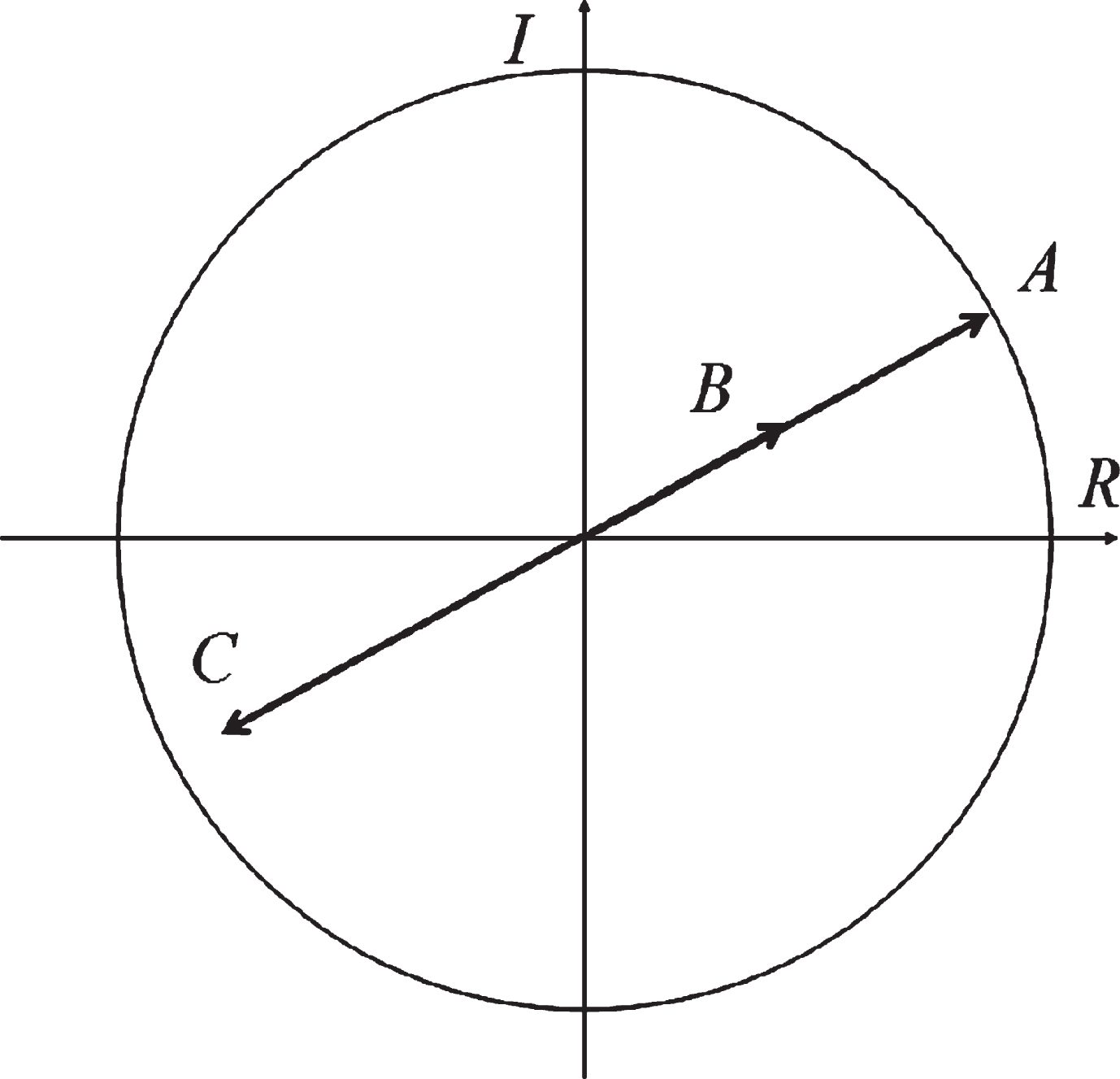
Parallelity between complex fuzzy sets.
Let U be a universe of discourse, and CFS (U) be the set of all complex fuzzy sets on U. A complex fuzzy set A on the universe U is given as
The inner product of r1 · e
jw
1
, r2 · e
jw
2
∈
Similarly, for subset
(Reflexivity): A ∥ A, for all A ∈ CFS (U), (Symmetry): A ∥ B if and only if B ∥ A, for all A, B ∈ CFS (U), (Transitivity): if A ∥ B, B ∥ C then A ∥ C, for all A, B, C ∈ CFS (U).
This section discusses whether parallelity can be preserved for complex fuzzy operations.
The concept of parallelity preserving is formally expressed as follows,
Set rotation and reflection operations, described in [11], are parallelity preserving.
Let U be a universe of discourse, A be a complex fuzzy sets on U, and μ A (x) = r A (x) · ejθ A (x) be its membership functions.
The Rotation of A by θ radians, denoted by R
θ
(A), is defined as
The reflection of A, denoted by Ref (A), is defined as
If A ∥ B then Ref (A) ∥ Ref (B). If A ∥ B then R
θ
(A) ∥ R
θ
(B) for any θ radians.
Let U be a universe of discourse, A be a complex fuzzy sets on U, and μ
A
(x) = r
A
(x) · ejw
A
(x) its membership functions. The following three complex fuzzy complement ¬
i
(i = 1, 2, 3), introduced by Ramot et al. [11], are given as
Thus, A ∥ B ⇒ ¬ 1A ∥ ¬ 1B. Similarly, we can prove A ∥ B ⇒ ¬ 2A ∥ ¬ 2B and A ∥ B ⇒ ¬ 3A ∥ ¬ 3B. ■
Then we have A ∥ B and
Then we can verify that ¬ i A ∥ ¬ i B for any i ∈ {1, 2, 3}.
Let U be a universe of discourse, A and B be two complex fuzzy sets on U. The complex fuzzy union of A and B, introduced in [11], is given as
The following functions are possibilities of θA⊗B.
If <r2 · e
jθ
2
, r3 · e
jθ
3
> = r2 · r3, then cos(|θ2 - θ3|) =1.
Thus, A ∥ B ⇒ A ∪ C ∥ B ∪ C when θ•⊗• is Sum function. Similarly, we can prove the case of θ•⊗• is Difference function. ■
Then we have A ∥ B.
If ⊕ is max union function and θ•⊗• is the Sum function, then
We can verify that A ∪ C ∥ B ∪ C.
If ⊕ is max union function and θ•⊗• is the Max function, then
We can verify that A ∪ CnotparallelB ∪ C.
Now we give a example with A ∥ B, A ∥ CnotRightarrowA ∥ B ∪ C when θ•⊗• is Sum function.
Then we have A ∥ B and A ∥ C.
If ⊕ is max union function and θ•⊗• is the Sum function, then
We can verify that Anotparallel (B ∪ C).
If θ•⊗• is Sum function. Since | (θ A (x) + θ B (x)) - (θ C (x) + θ D (x)) | = | (θ A (x) - θ C (x)) + (θ B (x) - θ D (x)) |. Based on cos |θ A (x) - θ C (x) |=1 and cos |θ B (x) - θ C (x) |=1 = 1, it is easy to obtain cos | (θ A (x) + θ B (x)) - (θ C (x) + θ D (x)) |=1. Then A ∪ C ∥ B ∪ D.
Similarly, we can prove the case of θ•⊗• is Difference function. ■
Let U be a universe of discourse, A and B be two complex fuzzy sets on U. The complex fuzzy intersection of A and B, introduced in [11], is given as
Next, we discuss whether parallelity can be preserved in a complex fuzzy inference system. Here, we only consider the complex fuzzy inference method of Ref. [12].
Let U and V be two universes of discourse. The form of fuzzy modus ponens(FMP) of complex fuzzy inference is given as follows:
The sets A, A* ∈ CFS (U) and B, B* ∈ CFS (V) are complex fuzzy sets.
In [12], μA→B (x, y) is given as follows,
Then membership degree of B* is given as follows,
Similar to Definition 5, the concept of parallelity preserving complex fuzzy inference is given as follows.
Then we obtain
If two inputs respectively are
We see that A* ∥ A*′.
If g is Sum function, ★ is Min t-norm, form of f is the function of (29). Then
We can verify that FMP (A, B ; A*) ∥ FMP (A, B ; A*′).
If f is the function of (27). Then
We can verify that FMP (A, B ; A*) notparallelFMP (A, B ; A*′).
Then we have
If two inputs respectively are
We see A* ∥ A*′.
If g is Sum function, ★ is Min t-norm, form of f is function in (29). Then
We can verify that FMP (A, B ; A*) ∥ FMP (A, B ; A*′).
If form of g is Max function, then
We can verify that FMP (A, B ; A*) notparallelFMP (A, B ; A*′).
In this paper, we introduced the parallelity relation between complex fuzzy sets. This is an equivalence relation. Then we explored the choices of complex fuzzy operators based on the criterion “complex fuzzy operators should be parallelity preserving”, and obtained the following results,
A ∥ B, ⇒ A ∘ C ∥ B ∘ C: Sum and Difference (See Theorems 4 and 7); A ∥ B, A ∥ C ⇒ A ∥ B ∘ C: Max, Min and Winner Take All (See Theorems 5 and 8); A ∥ B, C ∥ D ⇒ A ∘ C ∥ B ∘ D: Sum and Difference (See Theorems 6 and 9).
Our results are different from that obtained by Hu et al. [4], who defined the orthogonality preserving operators. The differences can be summarized as in Table 1.
Comparison of the parallelity preserving with orthogonality preserving of complex fuzzy operators
√ and × represent the corresponding property holds and does not hold respectively.
The parallelity relation and the corresponding criterion maybe are very strict requirements for complex fuzzy sets and operators. As future work, we can consider a weaker parallelity relationship, denoted by “approximate” parallelity, and discuss approximately parallelity preserving operators in complex fuzzy sets.
Acknowledgments
This project was supported by the Science and Technology Foundation of Guizhou Province, China (LKS (2013) 35 and LKS (2012) 34), the Opening Foundation of Guangxi Colleges and Universities Key Laboratory of Complex System Optimization and Big Data Processing (Grant No. 2017CSOBDP0103) and the Guangxi University Science and Technology Research Project (Grant No. 2013YB193).