



Abstract
Surge arresters are essential equipment for power system protection against transient overvoltages. Therefore, their operating condition and fault diagnosis are very important. Leakage current analysis is a conventional method of surge arrester condition monitoring. In this paper, the impacts of disruptive factors on harmonic components of surge arrester current have been evaluated experimentally. Experimental tests have been done on different surge arresters to investigate disruptive factors effects on surge arresters leakage current. To show the ability of introduced indicators, obtained dataset was applied to fuzzy network for recognition task and classification. In order to increase the accuracy of proposed system, the optimum vector of radius has been found using the optimization algorithm. Bees algorithm, genetic algorithm, imperialist competitive algorithm and particle swarm optimization have been applied to evolve adaptive network based fuzzy inference system. Also the performance of adaptive network based fuzzy inference system has been compared with other classifiers to investigate the capability of the proposed classifier. Results show that the success rates of Bees-ANFIS is higher than the performance of other systems.
Keywords
Introduction
The main function of metal oxide surge arresters (MOSAs) is utility protection against switching and lightning overvoltages. These are the most essential equipment for the protection of power system components and insulation coordination design of the power system. So they definitely contribute to raise power system performance and reliability. Consequently, their condition monitoring has considerable impact on power system performance or reliability [1, 2].
Under normal operation condition, MOSA can be considered as an insulator that its behavior can be changed as results of various mechanisms of degradation. The impact of these degradation factors can be classified from electrical stresses due to continuous operating voltage, impulse current stresses of internal partial discharge, humidification, atmospheric condition, etc. A great increase of the leakage current especially its harmonic content and resistive component is a commonly feature of these mechanisms [3].
Many online and offline techniques have been proposed in literature for surge arresters condition monitoring. Power loss method [4], V-I characteristic analysis [5], measuring of leakage current [6–9], temperature evaluation [10–12], and the measurement of electro-magnetic field [13, 14] are some of monitoring methods. Total leakage current separating to their components (capacitive and resistive) is the most practical methods [6–9]. Offline and online techniques can be applied to measure total leakage current that precise results are achieved by offline methods but expensive equipment requirement and object disconnecting are the weaknesses of offline methods [15]. The online measurement of total leakage current and resistive component extraction by analytical methods are the most general technique [15]. Resistive current detection methods are being progressed and many researchers have recommended advanced methods and serviceable equipment [16–20].
In this article, the effects of several conditions such as exterior pollution, varistor degradation and ultraviolet (UV) aging have been tested on harmonic contents of total leakage current and its components. It can help the technical person in preventive and predictive maintenance activities. In this paper, a features database for the different conditions of surge arrester including clean aged, clean virgin, external contamination after and before ultraviolet aging and degraded varistor has been produced based on experimental tests on polymer housed surge arresters. Obtained results were applied to the fuzzy network for recognition task and classification. In the proposed method, an expert system has been developed which has fuzzy rules obtained by adaptive network based fuzzy inference system (ANFIS). In ANFIS training process, the vector of radius has high efficiency on the performance of system. In order to increase the accuracy of proposed system, the optimum vector of radius has been found using the optimization algorithm. This tool is able to distinguish above conditions based on extracted features information with acceptable precision.
Measuring process
To extract proper features, the experimental test setup was arranged to analyze surge arresters conditions effects on total leakage current and its resistive and capacitive components. To achieve required tests, as shown in Fig. 1, experimental test setup has been arranged. According to Fig. 1, experimental setup comprises of a high voltage transformer with variable voltage range, protective resistor (R1), voltage measuring tool and leakage current measuring system. Leakage current measuring system consists of back to back Zener diodes for overvoltage protection and a shunt resistor (Rsh = 470 Ω) for leakage current measuring. Total leakage current and measured voltage have been acquired by two channel digital oscilloscope during experimental tests.
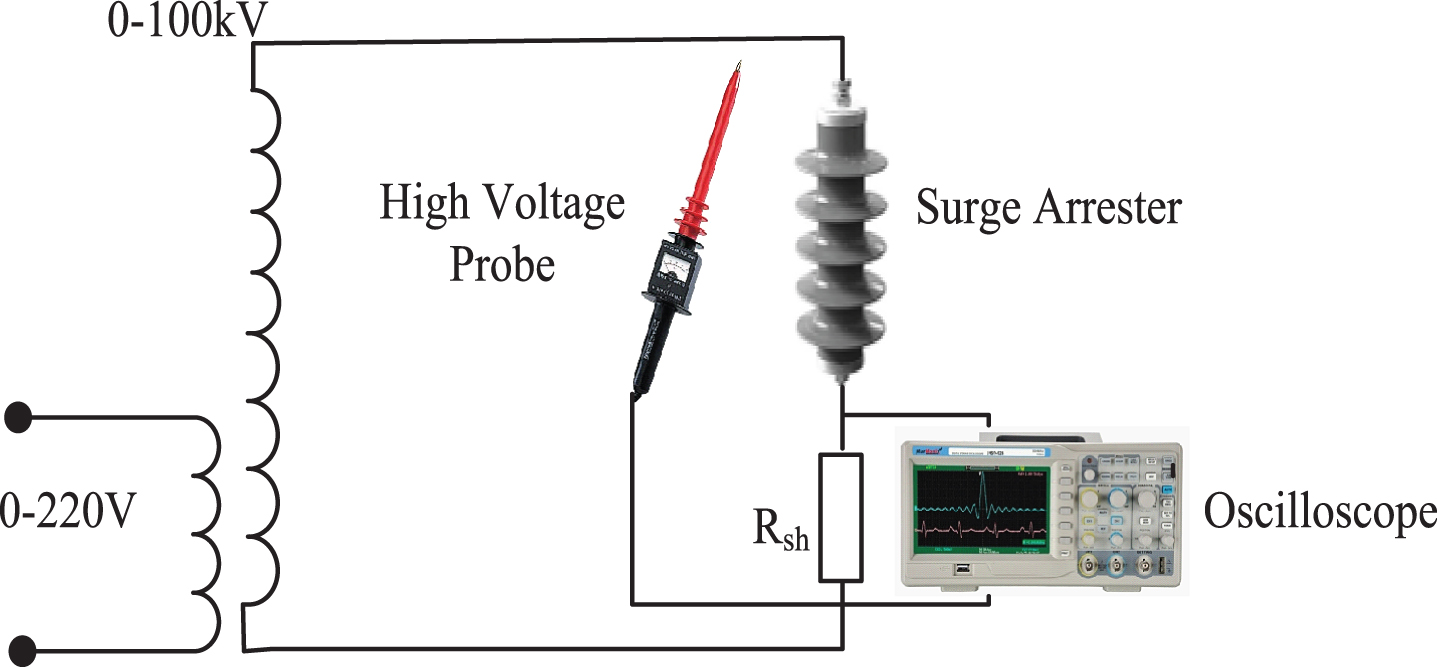
The experimental setup for voltage and current measurement.
20 kV polymer surge arresters have been utilized for leakage current measuring under different conditions corresponded to the typical failures and excellent condition (clean virgin samples). The technical characteristics of evaluated surge arresters have been represented in Table 1.
Technical characteristics of tested surge arresters
It should be noted that, the explained method in [20] has been implemented to separate measured resistive and capacitive components from total leakage current. Also Fast Fourier Transform (FFT), which is a well-known technique of extracting the harmonic content of a real measured signal, has been applied to achieve harmonic components of extracted resistive and capacitive currents.
The first considered condition on studied surge arrester was the good condition during experimental tests. In this situation, the tested surge arresters were virgin and without external contamination. Other defective conditions are UV aged, aged-polluted and virgin-polluted samples and surge arresters with degraded varistors in active column.
Pollution on surge arrester housing has been investigated experimentally by solid layer technique with pre-contamination in high voltage laboratory [21]. The salt amount has direct influence on the conductivity of polluted layer. Therefore, different kinds of solutions have been prepared to contaminate the surge arresters exterior surfaces. The contamination levels of MOSA surface are classified to moderate, light and very light in accordance with the contamination slurries and computed equivalent salt deposit density (ESDD).
The influence of UVC aging on polymer housed surge arrester leakage current has been investigated experimentally. Therefore SAs have been located in a wood structure chamber with aluminum sheeted walls and have been exposed to UVC radiation for 3000 hours to do aging process. Figure 2 shows the sequence of aging test. Also to consider varistor degradation effect on leakage current, aged varistors have been detached from surge arrester that has been worked in power system for 15 years. Finally, they have been located in three different locations in the active columns of MOSA.

The sequence of aging test.
In this segment, total leakage current harmonics and their components (capacitive and resistive) have been measured experimentally for 11.54 kV (rms phase to ground) under mentioned different situations. For this purpose, three states have been considered and Figs. 3–5 shows one example of measured total leakage current waveform and its decomposed components for three considered scenarios.
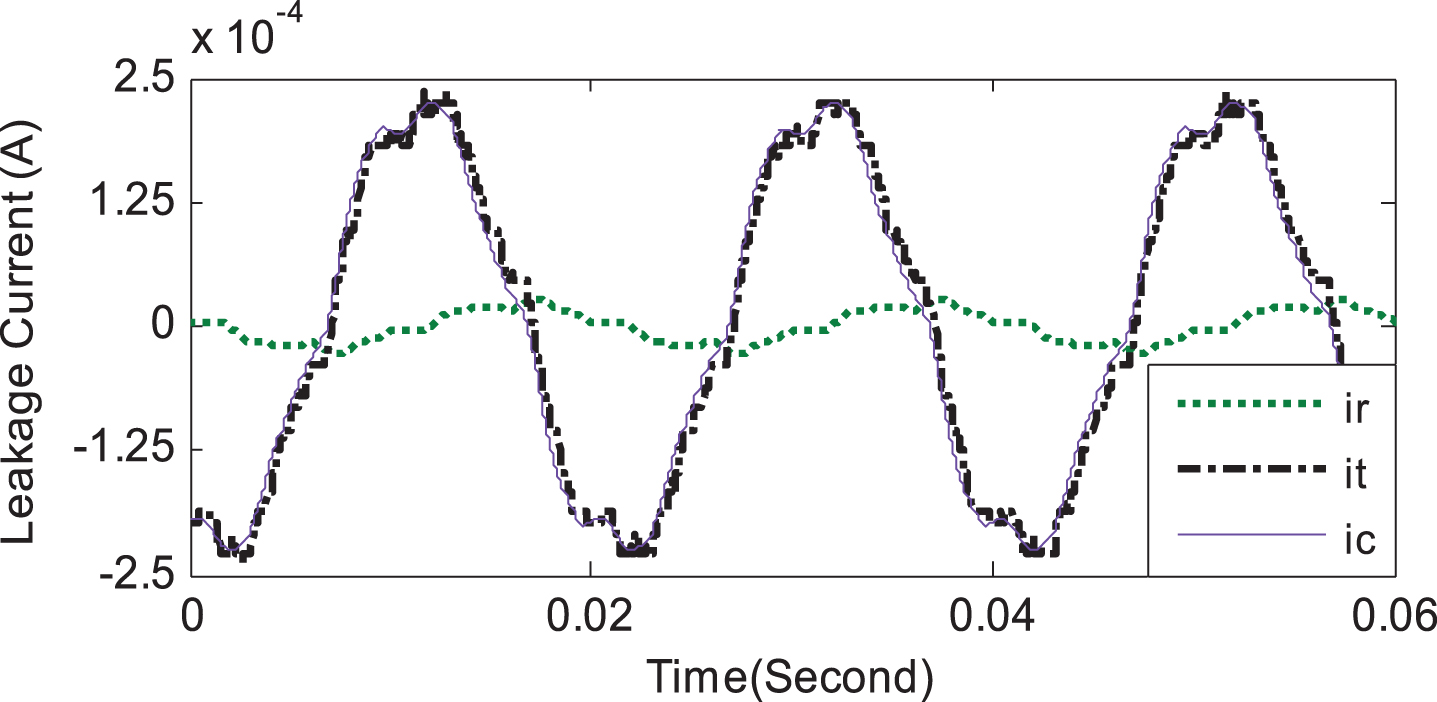
Total leakage current and its components of clean virgin A surge arrester.

Total leakage current and its components of Aged-Moderate polluted A surge arrester (85% humidity).

Total leakage current and its components of A surge arrester with degraded varistor.
In this status, the influences of surface aging on surge arrester leakage current and its components have been investigated. For this purpose, leakage currents of clean surge arrester in age and virgin situation have been measured experimentally. Table 2 shows the harmonic components of clean surge arrester leakage current before and after UV radiation exposure.
Harmonic components of the virgin and UV aged surge arrester
Harmonic components of the virgin and UV aged surge arrester
It should be mentioned that in order to be confident about measured values, each experimental has been repeated more times and the average data has been used to determine values of each specific situations. Moreover, to see the agreement of the measured data the variances of all harmonic amplitude of the series of data has been calculated. It has been seen that the variances were so small. After UV radiation aging process, fundamental and third order harmonics of resistive component have been increased (particularly the third harmonic) but the fifth order harmonic has been reduced. In clean aged situation, due to the surface aging, resistive current harmonics, particularly third and fifth order harmonics, have been changed compared to clean virgin.
In this status, the influences of pollution on surge arrester leakage current and its components have been evaluated. For this purpose, leakage currents of aged and virgin surge arresters in different pollution levels have been measured experimentally. To investigate pollution and UV effects, Tables 3 and 4 show harmonic spectrum analysis of polluted and combination of aged and polluted situations for A and B surge arresters, respectively.
Harmonic analysis of the contaminated virgin and UV aged surge arrester (A)
Harmonic analysis of the contaminated virgin and UV aged surge arrester (A)
Harmonic analysis of the contaminated virgin and UV aged surge arrester (B)
According to the tables results, due to surface conductivity increment in polluted virgin or aged samples, ir1 and it1 increases, but for clean samples, which are not exposed to the contamination, it does not vary. So, the fundamental harmonic of total leakage current and resistive component has a severe relationship with surface pollution. Therefore, it can be used as a criterion for distinguishing clean conditions from polluted ones. Also, the aged exterior surfaces absorb greater amounts of water in relation to the new ones. It is due to hydrophobicity loss. Hence, in UV aged polluted samples, ir1 and it1 have increased more than virgin polluted ones. Moreover, UV radiation had more effect on ir3 and ir5 than virgin contaminated samples. Consequently, ir3 and ir5 has extreme correlation with the ageing and can be used to recognize aged samples from virgin ones. Comparing UV aged samples with virgin ones; it is obvious that it3 has increased whereas fifth order harmonic has decreased.
To investigate varistors degradation effects on MOSA leakage current, a degraded ZnO block has been located in three different positions of A surge arrester active column which has seven varistors. Harmonics spectrum analyses of the measured currents are represented in Table 5.
Leakage current harmonic spectrum analysis of degraded varistor
Leakage current harmonic spectrum analysis of degraded varistor
According to the Table 5, it is obvious that fundamental and other harmonics of resistive and total measured leakage currents have changed equated with the clean virgin harmonics. Resistive and total leakage current fundamental harmonics have increased and as a result ir1 and it1 have relatively high relationship with varistor degradation. Moreover, resistive third harmonic has increased but resistive fifth harmonic has reduced compared to the clean virgin components. In accordance with the mentioned experimental results in Table 5, it3 and it5 in degraded condition decrease in comparison with virgin clean samples but in aged contaminated samples, it3 has raised but it5 has diminished.
As indicated, the MOSA operating characteristics change as a consequence of several factors. In this paper, external pollution, UV aging and varistor fault effects have been investigated to analyze leakage currents behaviors of polymer housed MOSAs. For comprehensive investigation, Fig. 6 shows the average of obtained results from experimental tests of A surge arrester graphically.
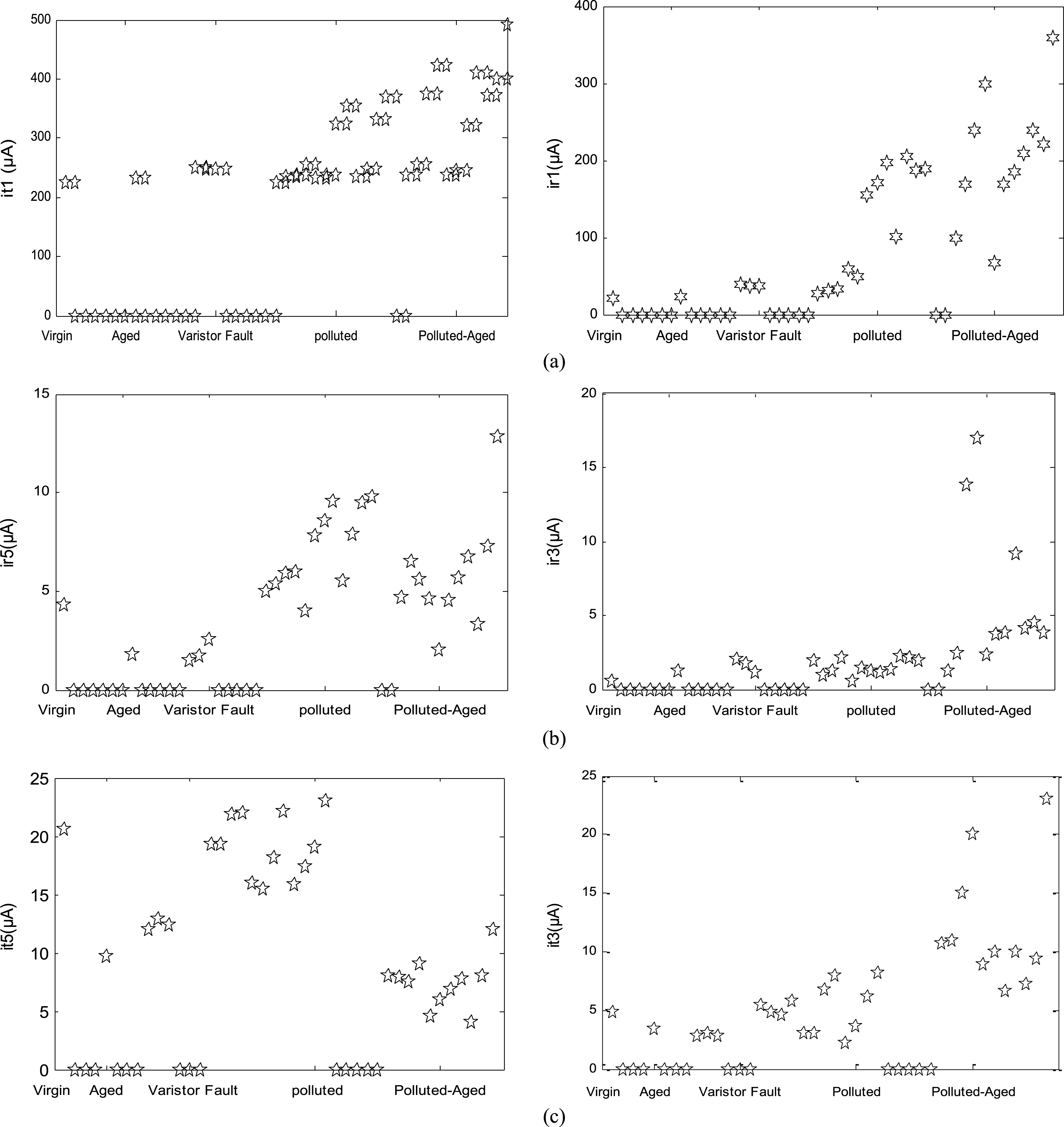
Obtained results from experimental tests for A surge arrester (a): ir1 and it1 (b): ir3 and ir5 (c): it3 and it5.
In this section, the performance of introduced criteria is evaluated. An overview of the proposed method is presented in Fig. 7. For this purpose the aforesaid dataset of the different conditions of A surge arrester was used which 60% of data have been used for training of the classifier and the rest for testing.
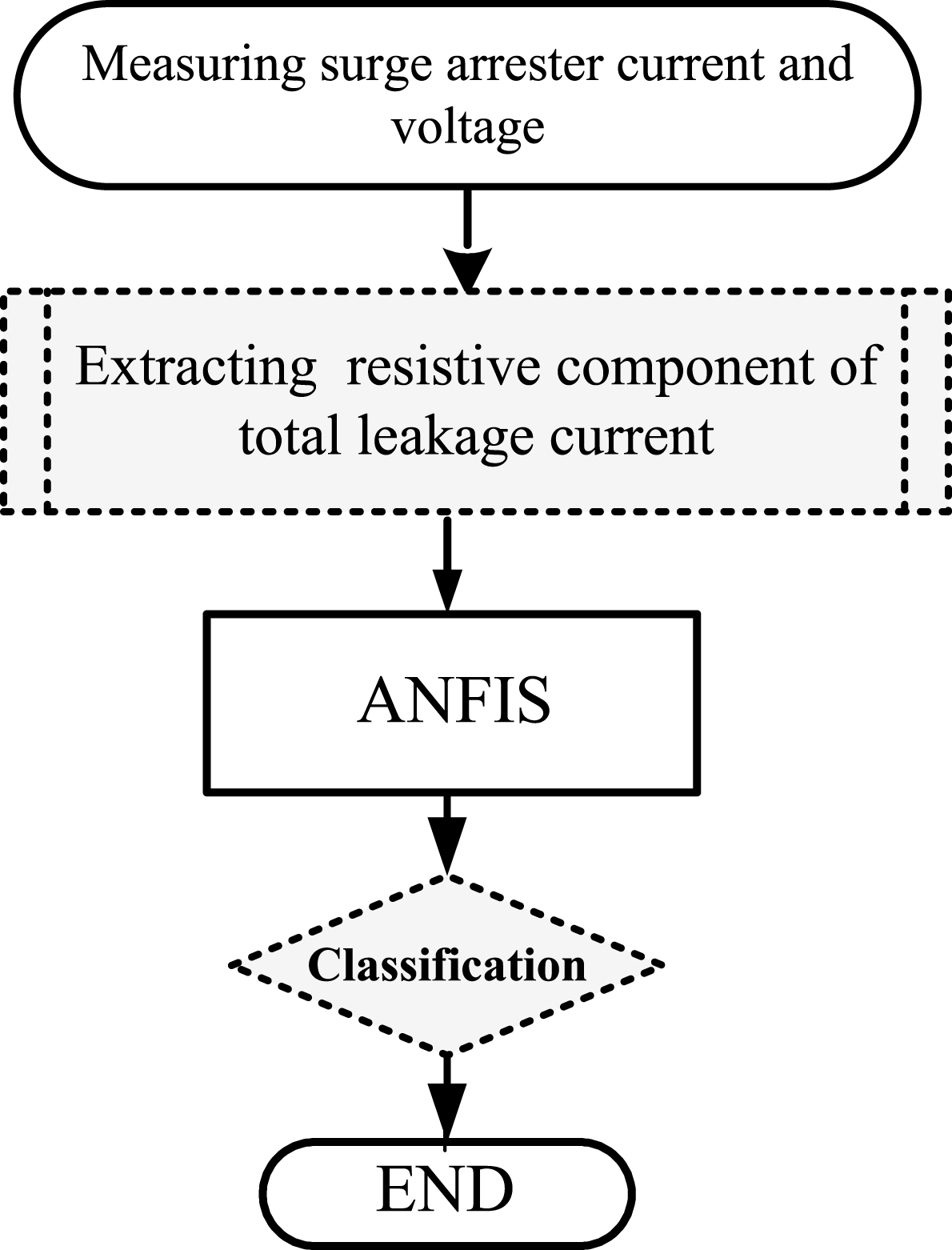
An overview of the classifier based on measured leakage current.
For example, data dispersion of ir1 and ir3 has been shown in Fig. 8 which obtained from experimental tests of A surge arrester.
In order to compare the performance of classifiers, the k-fold cross validation technique is used. The k-fold cross validation technique proposed by Salzberg [22] was employed in the experiments, with k = 2. The data set was thus split into two portions, with each part of the data sharing the same proportion of each class of data. One data portion was used in the training process, while the remaining part was used in the testing process. The ANFIS training methods were run two times to allow each slice of the data to take turn as a testing data. The classification accuracy rate is calculated by summing the individual accuracy rate for each run of testing, and then dividing of the total by two. All the obtained results are the average of 50 independent runs.

The dispersion of measured data (a): ir1 (b): ir3. V: Clean virgin A: Clean Aged PA: Polluted Aged PV: Polluted Virgin DV: Degraded Varistor.
The ANFIS represents a useful neural network approach for the solution of function approximation problems. Data driven procedures for the synthesis of ANFIS networks are typically based on clustering a training set of numerical samples of the unknown function to be approximated. Since introduction, ANFIS networks have been successfully applied to classification tasks, rule-based process controls, pattern recognition problems and the like [23, 24]. For simplicity, it is assumed that the fuzzy inference system under consideration has two inputs and one output. The rule base contains two fuzzy if-then rules of Takagi and Sugeno’s type [25] as follows:
Where A and B are the fuzzy sets in the antecedents and z = f(x,y) is a crisp function in the consequent. f(x,y) is usually a polynomial for the input variables x and y. But it can also be any other function that can approximately describe the output of the system within the fuzzy region as specified by the antecedent. When f(x,y) is a constant, a zero order Sugeno fuzzy model is formed, which may be considered to be a special case of Mamdani fuzzy inference system [26] where each rule consequent is specified by a fuzzy single ton. If f(x,y) is taken to be a first order polynomial a first order Sugeno fuzzy model is formed. For a first order two-rule Sugeno fuzzy inference system, the two rules may be stated as:
In this inference system the output of each rule is a linear combination of input variables added by a constant term. The final output is the weighted average of each rule’s output. The corresponding equivalent ANFIS structure is shown in Fig. 9.
Bees-ANFIS

The corresponding equivalent of ANFIS structure.
Bees Algorithm (BA) is an optimization algorithm inspired by the natural foraging behavior of honey bees to find the optimal solution. Figure 10 shows the pseudo code for the algorithm in its simplest form. The algorithm requires a number of parameters to be set, namely: number of scout bees (n), number of sites selected out of n visited sites (m), number of best sites out of m selected sites (e), number of bees recruited for beste sites (nep), number of bees recruited for the other (m-e) selected sites (nsp), initial size of patches (ngh) which includes site and its neighborhood and stopping criterion. The algorithm starts with the n scout bees being placed randomly in the search space. The fitnesses of the sites visited by the scout bees are evaluated in step 2. In step 4, bees that have the highest fitnesses are chosen as “selected bees” and sites visited by them are chosen for neighborhood search. Then, in Steps 5 and 6, the algorithm conducts searches in the neighborhood of the selected sites, assigning more bees to search near to the best e sites. In step 7, the remaining bees in the population are assigned randomly around the search space scouting for new potential solutions [26].

Pseudo code of Bees algorithm.
A subtractive fuzzy clustering was generated to establish a rule base relationship between the input and output parameters. The data was divided into groups called as clusters using the subtractive clustering method to generate fuzzy inference system. In this study, the Sugeno-type fuzzy inference system was implemented to obtain a concise representation of a system’s behavior with a minimum number of rules. The linear least square estimation was used to determine each rule’s consequent equation. A radius value was given in the MATLAB program to specify the cluster center’s range of influence to all data dimensions of both input and output. If the cluster radius was specified a small number, then there will be many small clusters in the data that results in many rules. Therefore in this study, Bees-ANFIS is proposed to find the optimum vector of radius.
In this section, the ability of measured data via ANFIS recognizer has been evaluated. First, the performance of the recognizer without optimization has been evaluated. Next, the Bees algorithm has been used to find the optimum vector of radius. Table 6 shows the recognition accuracy of tested samples. It can be seen that ANFIS with unprocessed data achieves 92.71% recognition accuracy.
Recognition accuracy of the recognizer
Recognition accuracy of the recognizer
Combining the BA with the ANFIS significantly improves the classification performance relative to the stand-alone ANFIS model. It can be seen that BA-ANFIS with unprocessed data achieves 96.12% recognition accuracy. In order to indicate the details of the recognition for each pattern, the confusion matrix of the recognizer is shown by Table 7. The values in the diagonal of confusion matrix show the correct performance of recognizer for each pattern. In other words, these value show that how many of considered pattern are recognized correctly by the system. The other values show the mistakes of system. For example, look at the first row of this matrix. The value of 32 shows the rate of correct recognition of forth pattern and the values of 1 and 2 show that this type of pattern is wrongly recognized with third and fifth patterns respectively. In order to achieve the recognition accuracy of system, it is needed to compute the average value of that appears in diagonal.
Confusion matrix for best result (96.12%)
The performance of the proposed classifier has been compared with other classifiers for investigating the capability of the proposed classifier, as indicated in Table 8. In this respect, Multilayered perceptron (MLP) neural network with different training algorithm such as: Back propagation (BP) learning algorithm, Resilient propagation (RP) learning algorithm [27–33] and radial basis function neural networks (RBFNN) [34] are considered. In order to increase the accuracy of proposed system, the optimum spread value has been found using the BA. It can be seen from Table 8 that the proposed method has better recognition accuracy than other classifiers.
Comparison the performance of proposed classifier (BA-ANFIS) with other classifiers
Comparison the performance of proposed classifier (BA-ANFIS) with other classifiers
In order to compare the performance of BA with another nature inspired algorithms, we have used several nature inspired algorithms such as genetic algorithm (GA) [35], imperialist competitive algorithm (ICA) [36] and particle swarm optimization (PSO) [37] to evolve the ANFIS. Table 9 shows the obtained results. It can be seen that the success rates of BA-ANFIS is higher than the performance of other systems.
Comparison among the performance of GA-ANFIS, ICA-ANFIS, PSO-ANFIS and BA-ANFIS
In this paper, different operating conditions of surge arresters have been investigated experimentally. It has been done to represent monitoring features for metal oxide surge arresters conditions classification based on leakage current harmonics. The most important findings of experimental results are as follows:
The influences of UV aging, pollution and degraded varistors have been investigated and these are main factors that lead to magnitude increasing of total leakage current and its components. Therefore, the high amplitude of measured current signals do not principally confirm defected surge arresters.
Exterior pollution of surge arrester housing or degraded varistor raises ir1 and it1. Therefore, these are useful and efficient criteria to distinguish clean aged and virgin conditions from polluted and varistor degraded conditions.
UV radiation is caused a main effect on ir3 increment and ir5 reduction. Consequently, ir3 and ir5 has strong relationship with the ageing and they can be applied to recognize aged polluted from virgin ones or aged clean samples from virgin ones.
The classification of degraded varistor from aged polluted samples is complicated. These conditions lead to similar changes in ir1, it1, ir3 and ir5. Degraded samples have been recognized from contaminated aged situations via it3 and it5 variation respect to the virgin clean samples.
The capability of introduced indicators for surge arrester condition monitoring is evaluated by Adaptive network based fuzzy inference system. First we have evaluated the performance of the recognizer without optimization. it can be seen that ANFIS with unprocessed data achieves 92.71% recognition accuracy. Next, we apply BA to find the optimum vector of radius. Combining the BA with the ANFIS (BA-ANFIS), we demonstrate a significantly improved performance relative to the stand-alone ANFIS model. The highest recognition accuracy (96.12%) is achieved with only 13 fuzzy rules.
The performance of the proposed classifier has been compared with other classifiers for investigating the capability of the proposed classifier. In this respect, Multi layered perceptron (MLP) neural network with different training algorithm such as: Back propagation (BP) learning algorithm, resilient propagation (RP) learning algorithm and radial basis function neural networks (RBFNN) are considered.
In order to compare the performance of BA with another nature inspired algorithms, we have used several nature inspired algorithms such as genetic algorithm (GA), imperialist competitive algorithm (ICA) and particle swarm optimization (PSO) to evolve the ANFIS. Results show that the success rates of BA-ANFIS is higher than the performance of other systems.