



Abstract
In this paper, the judgment of fuzzy bases of a closed G-V fuzzy matroid is studied and a necessary and sufficient condition of judging fuzzy bases is presented. Based on the results, an intuitive tree structure of a closed G-V fuzzy matroid is proposed and some of its properties are obtained.
Introduction
The concept of fuzzy matroid was firstly introduced by Goetschel and Voxman (G-V fuzzy matroid for short) in [1]. Many correlative notions which extend those in crisp matroids have been introduced, such as fuzzy base, fuzzy circuit, fuzzy rank function, fuzzy dual matroid, fuzzy matroid sum, fuzzy matroid product, etc., and their properties have been also studied [2–17].
Recently, Shi introduced a new approach for the fuzzification of matroids and presented the concept of an (L, M)-fuzzy matroid and then proved that a perfect [0,1]-matroid is equivalent to a G-V fuzzy matroid [18, 19]. Shi et al. also studied the bases axioms, circuits axioms and the rank functions of fuzzifying matroids or perfect [0, 1]-matroids [20–22]. Xiu and Pang studied the base axioms and subbase axioms in M-fuzzifying convex spaces [23–25]. Al-Hawary introduced the notions of fuzzy feasible sets and studied some fuzzy greedoid [26]. He also studied the properties of fuzzy regular-flats, fuzzy C-flats, fuzzy alternative-sets and furtherly introduced the notions of fuzzy C-matroids and fuzzy closure matroids which are new methods for the fuzzifying of matroids [27–30].
However, so far, we don’t find any results of an intuitive structure of a G-V fuzzy matroid in the literature. For this purpose, an intuitive structure of a closed G-V fuzzy matroid has been considered in this paper. Through studying the judgment of fuzzy bases of a closed G-V fuzzy matroid, based on Theorem 2.2 in [9], we present a more precise necessary and sufficient condition for judging fuzzy bases. Combined with the conditions and some theories of Graph Theory [34], we propose an intuitive tree structure of a closed G-V fuzzy matroid and study its properties.
The contents are arranged as follows. In Section 2, some fundamental results are presented. In Section 3, the judgment of fuzzy bases is studied and a tree structure of a closed G-V fuzzy matroid and closed regular G-V fuzzy matroid are proposed, respectively. Finally, some properties of the tree structure are studied in Section 4.
Preliminaries
In this section, some fundamental notions and results on matroids, fuzzy sets, G-V fuzzy matroids and fuzzy bases based on G-V fuzzy matroids are introduced. Most of them are cited from [1–4, 31–33].
φ ∈ I. If X ∈ I, and Y ⊆ X, then Y ∈ I. If X, Y ∈ I, and |X| < |Y|(where |X| denotes the cardinality of X), then there exists W ∈ I, such that X ⊂ W ⊆ X ∪ Y.
Then we call the pair M = (E, I) a (crisp) matroid, I a system of independent sets on E. For each subset X ⊆ E is called an independent set of M if X ∈ I, otherwise, X is called a dependent set of M. Any member of I that has maximal cardinality is called a basis of M. That is B is a basis of M if B ∈ I, but there isn’t a B′ ⊃ B, such that B′ ∈ I.
The following notation will be used in this paper.
If E is a finite set, then a fuzzy set μ on E is a mapping μ : E → [0, 1]. We denote the family of all fuzzy sets on E by F (E). If μ, ν ∈ F (E), then
supp μ = {x ∈ E|μ (x) >0},
m (μ) = inf {μ (x) |x ∈ supp μ},
R+ (μ) = {μ (x) |μ (x) >0, ∀ x ∈ E},
C r (μ) = {x ∈ E|μ (x) ≥ r}, where r ∈ [0, 1],
μ ∨ ν = max {μ, ν}, μ ∧ ν = min {μ, ν}.
If μ, ν ∈ F (E), then we write μ ≤ ν if μ (x) ≤ ν (x) for each x ∈ E.
We write μ < ν if (1) μ ≤ ν; (2) μ (x) < ν (x) for some x ∈ E.
If E is a finite set, we denote the “cardinality” of a fuzzy set μ ∈ F (E) by |μ| = ∑x∈Eμ (x). We say that μ is an elementary fuzzy set if |R+ (μ) | = 1.
(Fψ1) If μ ∈ ψ, ν ∈ F (E), and μ < ν, then ν ∈ ψ.
(Fψ2) If μ, ν ∈ ψ and |supp μ|< | supp ν|, then there exists ω ∈ ψ such that μ < ω ≤ μ ∨ ν. m (ω) ⩾ min {m (μ), m (ν)}.
Then the pair M = (E, ψ) is called a G-V fuzzy matroid on E, and ψ the family of independent fuzzy sets of M. Let μ ∈ F (E), we say that μ is an independent fuzzy set of M if μ ∈ ψ, otherwise, μ is a dependent fuzzy set of M. A fuzzy basis of M is a maximal member μ in ψ(where μ is said to be maximal in ψ if whenever ν ∈ ψ and μ ≤ ν then μ = ν).
For each r, 0 < r ≤ 1, let M
r
= (E, I
r
) be a crisp matroid on E(where I
r
= {C
r
(μ) | ∀ μ ∈ ψ}). Since E is a finite set, there is at most a finite number of matroids that can be defined on E. Thus there is a finite sequence 0 = r0 < r1 < r2 < ⋯ < r
n
≤ 1 such that I
s
≠ φ, if 0 < s ≤ r
n
; I
s
= φ, if s > r
n
. If r
i
< s, t < ri+1, then I
s
= I
t
, i = 0, 1, ⋯, n - 1. If r
i
< s < ri+1 < t < ri+2, then I
t
⊂ I
s
, i = 0, 1, ⋯, n - 2. The sequence 0 = r0 < r1 < r2 < ⋯ < r
n
≤ 1 is called the fundamental sequence of M. For any i (i = 1, 2, ⋯, n), let Suppose that 0 = r0 < r1 < r2 < ⋯ < r
n
≤ 1 is the fundamental sequence of M = (E, ψ). Then M is closed if I
r
= I
r
i+1
(where I
r
= {C
r
(μ) | ∀ μ ∈ ψ}) whenever r
i
< r ≤ ri+1 (i = 1, 2, ⋯, n). Suppose that 0 = r0 < r1 < r2 < ⋯ < r
n
≤ 1 is the fundamental sequence of M = (E, ψ). Let μ ∈ F (E). Then M is closed if and only if for any μ ∈ ψ, there exists a basis ν ∈ ψ such that μ ≤ ν. μ ∈ ψ if and only if for any β ∈ R+ (μ), we have C
β
(μ) ∈ I
β
. If μ ∈ ψ is a basis of M, then R+ (μ) ⊆ {r1, r2, ⋯, r
n
}, and for any r1 ≤ r ≤ m (μ), we have C
r
(μ) = Cm(μ) (μ) is a basis of (E, I
r
). Let E be a finite set, and let 0 = r0 < r1 < r2 < ⋯ < r
n
≤ 1 be a finite sequence. Suppose that (E, I
r
1
), (E, I
r
2
) …, (E, I
r
n
) is a sequence of matroids on E such that I
r
i-1
⊃ I
r
i
(where i = 2, 3, ⋯, n). For each r, let I
r
= I
r
i
if ri-1 < r ≤ r
i
(i = 1, 2, ⋯, n), and let I
r
= φ if r
n
< r ≤ 1.
Suppose further that ψ = {μ ∈ F (E) |C r (μ) ∈ I r , ∀r, 0 < r ≤ 1}, then M = (E, ψ) is a G-V closed fuzzy matroid and the M-induced matroid sequence is M r 1 ⊃ M r 2 ⊃ ⋯ ⊃ M r n (where for i = 1, 2, ⋯, n, M r i = (E, I r i )).
(2) Let M = (E, ψ) be a closed regular G-V fuzzy matroid with the fundamental sequence 0 = r0 < r1 < r2 < ⋯ < r n ≤ 1. Let μ ∈ F (E). If μ is a fuzzy basis of M, then R+ (μ) = {r1, r2, ⋯, r n }. Moreover, for any i (i = 1, 2, ⋯, n), C r i (μ) is a basis of (E, I r i ).
The tree structure of a closed G-V fuzzy matroid
In this section, we study the relationship of the set B of all the fuzzy bases and the family ψ of independent fuzzy sets of G-V fuzzy matroids and present a more precise necessary and sufficient condition of judging fuzzy bases based on Theorem 2.2 in [9]. Furthermore, we propose a tree structure of closed G-V fuzzy matroids and that of closed regular G-V fuzzy matroids.
The judgment of fuzzy bases of a closed G-V fuzzy matroid
On the other hand, for any ω ∈ ψ*, there exists μ ∈ B ⊆ ψ such that ω ≤ μ. It follows that ω ∈ ψ. So ψ* ⊆ ψ.
Therefore, ψ = ψ*.
From Theorem 3.1 and Corollary 3.1, we can learn that the set of all the fuzzy bases of a closed G-V fuzzy matroid is uniquely determined. A necessary and sufficient condition of judging fuzzy bases is studied as follows.
The set A1 = supp μ is a basis of matroid (E, I
r
1
). There exists a sequence A2, ⋯, An-1, A
n
(A
i
∈ I
r
i
) which satisfies A1 ⊇ A2 ⊇ ⋯ ⊇ An-1 ⊇ A
n
and A
i
is a maximal subset of Ai-1(i = 2, 3, ⋯, n) such that μ (x) = r
n
for any x ∈ A
n
, and μ (x) = r
i
for any x ∈ A
i
∖ Ai+1, i = 1, 2, ⋯, n - 1.
By Remark 2.1 (3), R+ (μ) ⊆ {r1, r2, ⋯, r
n
} and A1 = supp μ = Cm(μ) (μ) is a basis of matroid (E, I
r
1
). Let A
i
= C
r
i
(μ)(i = 2, 3, ⋯, n). Then C
r
i
(μ) ∈ I
r
i
. By the hypothesis, we have C
r
1
(μ) ⊇ C
r
2
(μ) ⊇ ⋯ ⊇ C
r
n-1
(μ) ⊇ C
r
n
(μ). It follows that A1 ⊇ A2 ⊇ ⋯ ⊇ An-1 ⊇ A
n
.
Assume that there exists a set A i in I r i (i = 2, 3, ⋯, n) such that A i is not a maximal subset of Ai-1 in I r i-1 . Then there exists a set B in I r i such that B is a maximal subset of Ai-1 and B ⊃ A i .
If i = 2, let
Then μ < ω and C r i (ω) = B ∈ I r i . And for any j (j = 1, 2, ⋯, i - 1), there is C r j (ω) = A j ∈ I r j , for any j (j = i + 1, i + 2, ⋯, n), there is C r j (ω) = C r j (μ) ∈ I r j . Thus by Remark 2.1 (3), ω ∈ ψ, which contradicts that μ is a fuzzy basis of M.
Sufficiency. From the two conditions, it is obvious that R+ (μ) ⊆ {r1, r2, ⋯, r n } and for any r i ∈ R+ (μ), we have C r i (μ) = A i ∈ I r i (i = 1, 2, ⋯, n). It follows that μ ∈ ψ.
Assume that μ is not a fuzzy basis of M. Since μ ∈ ψ, there exists a fuzzy basis ω of M such that μ < ω and m (μ) ≤ m (ω) and supp μ⊆ supp ω.
Case 1 supp μ = supp ω. Since ω is a fuzzy basis of M, then A1 = supp μ = supp ω is a basis of matroid (E, I r 1 ). Because A1 ⊇ A2 ⊇ ⋯ ⊇ An-1 ⊇ A n and A i is a maximal subset of Ai-1(A i ∈ I r i , i = 2, 3, ⋯, n), by the Necessity, we have ω (x) = r n for any x ∈ A n and ω (x) = r i for any x ∈ A i ∖ Ai+1 (i = 1, 2, ⋯, n - 1). Then for any x ∈ supp μ = supp ω, we have μ (x) = ω (x), that is μ = ω, which contradicts the assumption that μ < ω.
Case 2 supp μ ⊂ supp ω. Since ω is a fuzzy basis of M, then Cm(ω) (ω) = supp ω is a basis of matroid (E, I r 1 ). From condition (1), Cm(μ) (μ) = supp μ is also a basis of matroid (E, I r 1 ). Then supp μ = supp ω, which is in contradiction with supp μ ⊂ supp ω.
Therefore, μ is a fuzzy basis of M.
From Theorem 3.2, we can easily obtain the following corollary.
There exists a sequence A1, A2, ⋯, An-1, A n which satisfies A1 ⊇ A2 ⊇ ⋯ ⊇ An-1 ⊇ A n and A i is a basis of M r i = (E, I r i )(i = 1, 2, ⋯, n) such that μ (x) = r n for any x ∈ A n and μ (x) = r i for any x ∈ A i ∖ Ai+1, i = 1, 2, ⋯, n - 1.
The tree structure of a closed G-V fuzzy matroid
Based on Theorem 3.2, we propose a tree structure of a closed G-V fuzzy matroid as follows.
Let M = (E, ψ) be a closed G-V fuzzy matroid on E with the fundamental sequence 0 = r0 < r1 < ⋯ < r n ≤ 1 and M r 1 ⊃ M r 2 ⊃ ⋯ ⊃ M r n is the M-induced matroid sequence (where M r i = (E, I r i ), i = 1, 2, ⋯, n).
Suppose that there are m bases in matroid M
r
1
= (E, I
r
1
). For any basis
The sequence

The tree structure of a closed G-V fuzzy matroid.
Each tree can be divided into n levels. The sets in the first level (r1 level) are the bases of matroid M
r
1
= (E, I
r
1
) and the sets in the i - th level (r
i
level) are not only the independent sets of matroid M
r
i
= (E, I
r
i
) but also the maximal subsets of the corresponding set in the (i - 1) - th level. By Theorem 3.2(2), for each sequence discussed above
On the other hand, let μ be a fuzzy basis of a closed G-V fuzzy matroid M = (E, ψ), by the necessity of Theorem 3.2, supp μ = C r 1 (μ) is a basis of matroid M r 1 = (E, I r 1 ) and supp μ = C r 1 (μ) ⊇ C r 2 (μ) ⊇ ⋯ ⊇ C r n-1 (μ) ⊇ C r n (μ) and C r i (μ) ∈ I r i (i = 1, 2, ⋯, n) is a maximal subset of C r i-1 (μ). Therefore, the sequence C r 1 (μ), C r 2 (μ), ⋯, C r n-1 (μ), C r n (μ) is corresponding to a branch of some tree. By Theorem 3.2, a branch of a tree is uniquely determined by the fuzzy basis a closed G-V fuzzy matroid. Thus the tree structure of a closed G-V fuzzy matroid can be defined as follows.
Obviously, the branch and the leaf are one-to-one corresponding.
Then (E, I1),
and let ψ = {μ ∈ F (E) |C r (μ) ∈ I r , r ∈ (0, 1]}. Then by Remark 2.1 (4), M = (E, ψ) is a closed G-V fuzzy matroid and its tree structure is shown in Fig. 2.
From Fig. 2, there are six leaves in the tree structure which contains four trees. Then by Remark 3.1, there are six bases of the closed G-V fuzzy matroid M = (E, ψ) and they are as follows:
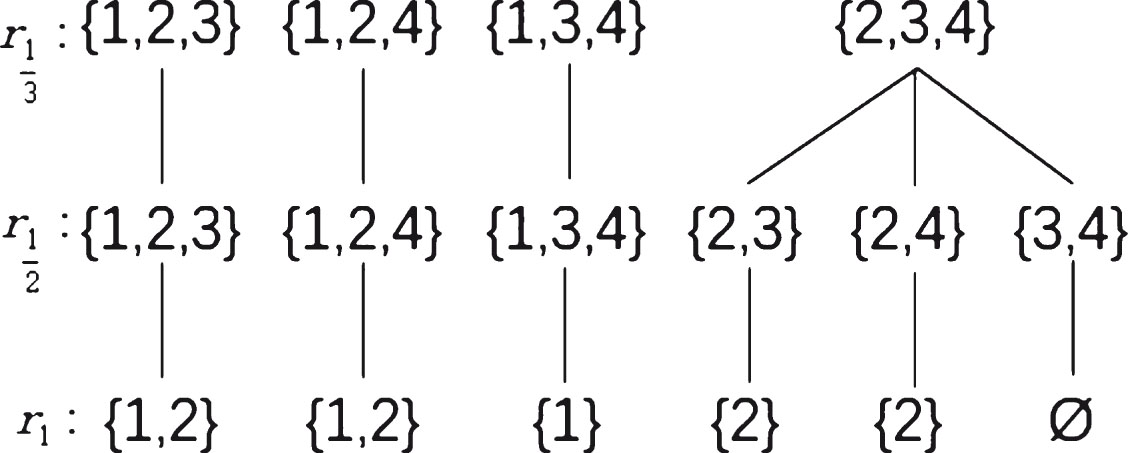
The tree structure of Example 3.1.
There are the same results in a closed regular G-V fuzzy matroid as those in a closed G-V fuzzy matroid.
Let M = (E, ψ) be a closed regular G-V fuzzy matroid on E with the fundamental sequence 0 = r0 < r1 < ⋯ < r n ≤ 1 and M r 1 ⊃ M r 2 ⊃ ⋯ ⊃ M r n is the M-induced matroid sequence (where M r i = (E, I r i ), i = 1, 2, ⋯, n).
Suppose that there are m bases in matroid M
r
1
= (E, I
r
1
). For any basis
Then (E, I1) and
and let ψ = {μ ∈ F (E) |C r (μ) ∈ I r , r ∈ (0, 1]}. Then by Remark 2.1 (4) and Remark 2.2, M = (E, ψ) is a closed regular G-V fuzzy matroid and its tree structure is shown in Fig. 3.
From Fig. 3, there are two leaves in the tree structure which contains one tree. Then by Remark 3.1, there are two bases for the G-V fuzzy matroid M = (E, ψ) as follows.
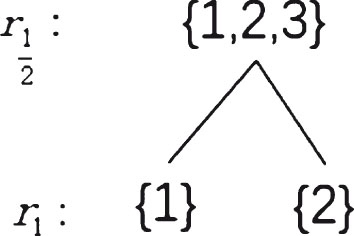
The tree structure of Example 3.2.
In this section, the properties of the tree structure for a closed G-V fuzzy matroid are considered.
Suppose now that the theorem holds whenever i = k. When i = k + 1, for any basis Ak+1 of matroid M r k+1 = (E, I r k+1 ), since (E, I r k+1 ) ⊂ (E, I r k ), then Ak+1 ∈ I r k . It follows that there exists a basis A k of (E, I r k ) such that Ak+1 ⊆ A k . Obviously, Ak+1 is a maximal subset of A k in I r k+1 . It implies that Ak+1 is in rk+1 level of the tree structure.
But the converse of Theorem 4.1 doesn’t hold. From Example 3.1, the basis {1, 2} of matroid (E, I1) is in r1 level, the bases {1, 2, 3}, {1, 2, 4} and {1, 3, 4} of matroid
From Example 3.2, all the bases {1} and {2} of matroid (E, I1) are in r1 level, the only basis {1, 2, 3} of matroid
Let T be the tree structure of a closed G-V fuzzy matroid M = (E, ψ). Suppose that B
i
is the set of all the maximal subsets in r
i
level of the tree structure. Then all the bases of matroid (E, I
r
i
)(i = 1, 2, ⋯, n) belong to B
i
. Let T be the tree structure of a closed regular G-V fuzzy matroid M = (E, ψ). Suppose that B
i
is the set of all the sets in r
i
level of the tree structure. Then the set of all the bases of matroid (E, I
r
i
)(i = 1, 2, ⋯, n) is equal to B
i
.
Therefore, k0, k1, k2, ⋯, k n is the fundamental sequence of M.
Conclusion
In this paper, based on the study of fuzzy bases, a precise necessary and sufficient condition of judging fuzzy bases of a closed G-V fuzzy matroid and an intuitive tree structure of a closed G-V fuzzy matroid are proposed and some of its properties are studied. The tree structure can represent a closed G-V fuzzy matroid because of the one-to-one corresponding between a tree structure and the set of the fuzzy basis of a closed G-V fuzzy matroid. Therefore, the idea of the tree structure for a G-V fuzzy matroid will make G-V fuzzy matroid apply to combinatorial optimization problems.
Footnotes
Acknowledgments
The authors would like to thank the unknown reviewers for their valuable comments and suggestions.
This work was supported by the National Natural Science Foundation of China (Grant Nos. 11671001 and 61472056), the Natural Science Foundation Project of CQ CSTC of China (Grant Nos. cstc2015jcyjA00034), and the Project of Humanities and Social Sciences planning fund of Ministry of Education of China (18YJA630022).