In this paper, a multiple-input single-output (MISO) fuzzy rules system is decomposed into its equivalent collection of single-input single-output (SISO) fuzzy rules systems. First, the constructive and destructive linguistic models are reviewed. Under certain conditions, the final consequence of the constructive linguistic model working on a MISO fuzzy rules system is equivalent to the final consequence of the constructive linguistic model working on a collection of SISO fuzzy rules systems. Meanwhile, under another conditions, the final consequence of the destructive linguistic model working on a MISO fuzzy rules system is equivalent to the final consequence of the destructive linguistic model working on a collection of the SISO fuzzy rules systems. The decomposition of the MISO fuzzy rules system with fuzzy singleton consequent parts is also investigated. This paper shows the MISO fuzzy rules system requires many more rules than the SISO fuzzy rules system. Through the decomposing process, we can realize the inference result with fewer rules.
Since the notion of fuzziness was introduced into systems theory by Zadeh [1], various linguistic models based on collections of if-then rules with vague predicates and using fuzzy reasoning have been constructed [2]. A fuzzy rules system with one input variable and one output variable is called a single-input single-output (SISO) fuzzy rules system. A fuzzy rules system with more than one input variable and only one output variable is called a multiple-input single-output (MISO) fuzzy rules system [2, 3]. Mamdani [4] first applied the fuzzy if-then rules system to a steam engine experimental device. There were also many applications of fuzzy if-then rules system in the field of control. An introduction of fuzzy control systems design can be found in [5]. Recently, many researchers achieved some great works in fuzzy control and successfully handled nonsmooth input such as dead-zone, backlash. For example, an adaptive fuzzy control scheme was designed in [6] for a class of MIMO nonlinear systems with nonsymmetrical nonlinear dead-zone input described by unknown function. The fuzzy rules systems are employed to approximate the unknown functions. In [7], the authors solved the problem of adaptive fuzzy inverse compensation control for uncertain nonlinear system whose actuator is subjected to generalized dead-zone nonlinearity. The fuzzy rules systems are embedded into compensation structure to handle uncertain input dynamics. Meanwhile, there were some works focused on discrete-time systems. For example, an adaptive fuzzy controller was designed in [8] for a class of nonlinear discrete-time systems with backlash, and the fuzzy rules systems are used to approximate the unknown nonlinear functions and unknown backlash. In [9], an adaptive fuzzy controller was constructed for a class of nonlinear discrete-time systems with the unknown functions, the dead-zone input, and the external disturbance. The fuzzy rules systems are used to approximate the unknown functions. A fuzzy state observer is designed to estimate the immeasurable states. Fuzzy tracking adaptive control of discrete-time switched nonlinear systems was constructed in [10] based on the common Lyapunov function method and by utilizing the fuzzy rules systems to approximate the unknown nonlinear functions. From the above, fuzzy rules systems play a significant role in the application of control systems. The problem is that in some cases, the number of fuzzy rules becomes increasingly huge. Therefore, the setup and adjustment of fuzzy rules become difficult.
The proposed paper is motivated by Seki’ works [11–16]. In [11–15], Seki et al. studied the equivalence conditions between different fuzzy models. In [16], Seki, Ishii and Mizumoto proposed a method for decomposing a MISO fuzzy rules system with nm rules into its equivalent collection of SISO fuzzy rules systems with n × m rules. Through the decomposition, a huge fuzzy rules system with nm rules can be realized by studying an equivalent collection of small fuzzy rules systems with n × m rules. However, in [16], the limitation is that the decomposition is only suitable for T-S MISO fuzzy rules system [17], i.e., the consequent parts must be functional type. In the proposed paper, the restriction of functional type consequent parts is removed. The proposed paper investigates the decomposing problem for both the antecedent and consequent parts being represented by fuzzy sets. Compared with the previous works, the main contributions of the proposed paper are as follows.
First, this paper proposes a method to decompose a MISO fuzzy rules system into its equivalent collection of SISO fuzzy rules systems. The restriction in [16] for the functional type consequent parts is removed and a general form is considered. Through the decomposing process, we can realize the inference result of a fuzzy rules system with fewer rules.
Second, this paper also investigates the decomposition of a special type of MISO fuzzy rules system, that is, the MISO fuzzy rules system with fuzzy singleton consequent parts. The general procedure for decomposing is obtained.
The remainder of this paper is organized as follows. Section 2 presents a brief review of the t-norm, t-conorm, constructive linguistic model and destructive linguistic model. Section 3 presents two propositions for decomposing a MISO fuzzy rules system into its equivalent collection of SISO rules systems. Section 4 investigates the decomposition of the MISO fuzzy rules system with fuzzy singleton consequent parts. Section 5 offers some concluding remarks.
Preliminaries
This section presents a review of the t-norm, t-conorm, constructive linguistic model and destructive linguistic model.
Review of t-norm and t-conorm
First, we review t-norm and t-conorm from the reference [18, Ch.5, 10, 11].
Definition 1. A binary operation ⊗: [0,1] × [0,1] ⟶ [0,1] is a t-norm if it satisfies the following:
Identity: 1 ⊗ x = x, for all x ∈ [0, 1].
Commutativity: x ⊗ y = y ⊗ x, for all x, y ∈ [0, 1].
Associativity: x ⊗ (y ⊗ z) = (x ⊗ y) ⊗ z, for all x, y, z ∈ [0, 1].
Monotonicity: w ⊗ y ≦ x ⊗ z, if for all w, x, y, z ∈ [0, 1] and w ≦ x, y ≦ z.
Definition 2. A binary operation ⊕ : [0, 1] × [0, 1] → [0, 1] is a t-conorm if it satisfies the following:
Identity: 0 ⊕ x = x, for all x ∈ [0, 1].
Commutativity: x ⊕ y = y ⊕ x, for all x, y ∈ [0, 1].
Associativity: x ⊕ (y ⊕ z) = (x ⊕ y) ⊕ z, for all x, y, z ∈ [0, 1].
Monotonicity: w ⊕ y ≦ x ⊕ z, if for all w, x, y, z ∈ [0, 1] and w ≦ x, y ≦ z.
Corollary 1.Min operator ∧ is the largest of all the t-norms.
Corollary 2.Max operator ∨ is the smallest of all the t-conorms.
Next, we provide an example of t-norm and t-conorm operations, as follows.
Example 1. Minimum t-norm; x ⊗ y = min {x, y}, and 0.5 ⊗ 0.3 = min {0.5, 0.3} =0.3.
Product t-norm; x ⊗ y = xy, and 0.5 ⊗ 0.3 = 0.5 × 0.3 = 0.15.
Lukasiewicz t-norm; x ⊗ y = max {0, x + y - 1}, and 0.5 ⊗ 0.3 = max {0, 0.5 + 0.3 - 1} =0.
Maximum t-conorm; x ⊕ y = max {x, y}, and 0.5 ⊕ 0.3 = max {0.5, 0.3} =0.5.
Lukasiewicz t-conorm; x ⊕ y = min {1, x + y}, and 0.5 ⊕ 0.3 = min {1, 0.5 + 0.3} =0.8.
Definition 3. Let ⊗ be a t-norm and ⊕ be a t-conorm. Then we say ⊗ is distributive over ⊕ if for all x, y, z ∈ [0, 1], x ⊗ (y ⊕ z) = (x ⊗ y) ⊕ (x ⊗ z), and that ⊕ is distributive over ⊗ if for all x, y, z ∈ [0, 1], x ⊕ (y ⊗ z) = (x ⊕ y) ⊗ (x ⊕ z).
Definition 4. Let ⊗ be a t-norm and ⊕ be a t-conorm. Then we say ⊗ is a dual t-norm of ⊕ if for all x, y ∈ [0, 1], , where and .
Example 2. Let ⊗ be a minimum t-norm, ⊕ a maximum t-conorm, x = 0.3, y = 0.5 and z = 0.7.
Because x ⊗ (y ⊕ z) = (x ⊗ y) ⊕ (x ⊗ z), we say a minimum t-norm is distributive over a maximum t-conorm.
Because x ⊕ (y ⊗ z) = (x ⊕ y) ⊗ (x ⊕ z), we say a maximum t-conorm is distributive over a minimum t-norm.
Because , we say a minimum t-norm is a dual t-norm of a maximum t-conorm.
Example 3. Let ⊗ be a product t-norm, ⊕ a Lukasiewicz t-conorm, x = 0.7, y = 0.5 and z = 0.3.
Because x ⊗ (y ⊕ z) = (x ⊗ y) ⊕ (x ⊗ z), we say a product t-norm is distributive over a Lukasiewicz t-conorm in case the summation of values does not exceed 1.
Review of linguistic models
This subsection reviews the constructive and destructive linguistic models [2, ch. 5]. First, the following fuzzy rules system is considered:
Premise:
Rule Rj: .
Fact: .
where ui, i = 1, 2, …, n are the input variables and v is the output variable; and Dj, j = 1, 2, …, m, i = 1, 2, …, n are fuzzy sets; The fact are real numbers and F is the inference result for the fact. Note that the total number of rules is m. The constructive and destructive linguistic models are presented as follows.
The constructive linguistic model:
The relevance degree hj of the fact “” to the antecedent parts “” is given as
where ⊕ stands for any t-norm. The inference result Fj (z) for rule Rj is given as
The final consequence F (z) of (1) is aggregated from F1, F2, …, Fm by
where ⊕ stands for any t-conorm. Note that if there is only one input variable, the MISO rules system becomes the SISO rules system.
The destructive linguistic model:
The relevance degree hj of is the same as (2), i. e.,
where ⊗ stands for any t-norm. The inference result Fj (z) for rule Rj is given as
where and ⊕ stands for any t-conorm. The final consequence F (z) of (1) is aggregated from F1, F2, …, Fm by
where ⊗ stands for any t-norm.
Decomposing a MISO fuzzy rules system into a collection of SISO fuzzy rules systems
This section presents two propositions for decomposing a MISO fuzzy rules system into its equivalent collection of SISO rules systems. First, the following MISO rules system is considered:
Premise:
Rule Rj1j2…jn:
Fact: .
where ui, i = 1, 2, …, n are the input variables and v is the output variable; and Dj1j2…jn, ji = 1, 2, …, mi, i = 1, 2, …, n are fuzzy sets; The fact are real numbers and F is the inference result for the fact. Note that the total number of rules is m1m2 … mn.
For the MISO rules system (7), we associate it with the following collection of SISO rules systems. For each i = 1, 2, …, n, a SISO rules system is presented as follows.
Premise:
Rule : .
Fact: .
where Djii, ji = 1, 2, …, mi, i = 1, 2, …, n are fuzzy sets; vi is the output variable; Fi is the inference result for the fact. The other notations are defined in the same ways as in (7). Note that the total number of rules for the rules system (8-i) is mi.
Proposition 1.LetF (z) be the final consequence of the constructive linguistic model working on the MISO fuzzy rules system (7). LetFi (z) be the final consequence of the constructive linguistic model working on the SISO fuzzy rules system (8-i) fori = 1, 2, …, n. Suppose the consequent partDj1j2…jn (z) of (7) and the consequent partof (8-i) satisfy the following relationship
where ji = 1, 2, …, mi, i = 1, 2, …, n, and ⊗ is a t-norm. Suppose the t-norm ⊗ is distributive over the t-conorm ⊕ in the aggregating process (3) and (4) of the constructive linguistic model. Then, the MISO rules system can be decomposed into a collection of SISO rules systems, and the final consequences of the MISO and SISO rules systems are equivalent as follows
Proof. First, the MISO rules system (7) is considered. From (2), the relevance degree hj1j2…jn of the constructive linguistic model for rules system (7) is given as
From (3), the inference result Fj1j2…jn (z) of rule Rj1j2…jn is given as
From (4), the final consequence F (z) of rules system (7) is given as
Then, the SISO rules system (8-i) is considered. From (2), (3) and (4), the final consequence of the constructive linguistic model working on the SISO rules system (8-i) is given as
where i = 1, 2, …, n. Then, the aggregation of Fi (z) by the t-norm is given as
The latter is also the final consequence F (z) for the MISO rules system (7), as shown in (11). Thus, the proof is complete.
Proposition 2.LetF (z) be the final consequence of the destructive linguistic model working on the MISO fuzzy rules system (7). LetFi (z) be the final consequence of the destructive linguistic model working on the SISO fuzzy rules system (8-i) fori = 1, 2, …, n. Suppose the consequent partDj1j2…jn (z) of (7) and the consequent partof (8-i) satisfy the following relationship
where ji = 1, 2, …, mi, i = 1, 2, …, n, and ⊕ is a t-conorm. Suppose the t-conorm ⊕ is distributive over the t-norm ⊗ in the aggregating process (5) and (6) of the destructive linguistic model, and ⊗ is the dual t-norm of ⊕. Then, the MISO rules system can be decomposed into a collection of SISO rules systems, and the final consequences of the MISO and SISO rules systems are equivalent as follows
Proof. First, the MISO rules system (7) is considered. The relevance degree hj1j2…jn of the destructive linguistic model for rules system (7) is given as
From (5), the inference result Fj1j2…jn (z) of rule Rj1j2…jn is given as
From (6), the final consequence F (z) of rules system (7) is given as
Then, the SISO rules system (8-i) is considered. From (5) and (6), the final consequence of the destructive linguistic model working on the SISO rules system (8-i) is given as
where i = 1, 2, …, n. Then, the aggregation of Fi (z) by t-conorm ⊕ is given as
The latter is also the final consequence F (z) for the MISO rules system (7), as shown in (14). Thus, the proof is complete.
Next, the conditions in Propositions 1 and 2 are discussed. There are two conditions to be satisfied in Proposition 1. First condition, the t-norm ⊗ is distributive over the t-conorm ⊕. If we let ⊗ be a minimum t-norm, ⊕ a maximum t-conorm, then ⊗ is distributive over ⊕ as shown in Example 2. The other t-norms and t-conorms satisfying first condition can be also found. Let ⊗ be a product t-norm, ⊕ a Lukasiewicz t-conorm. If the summation of values does not exceed 1, the Lukasiewicz t-conorm will operate as the sum operation. Then the product t-norm is distributive over the Lukasiewicz t-conorm as shown in Example 3. Besides, any t-norm is distributive over the maximum t-conorm and any t-conorm is distributive over the minimum t-norm. In Proposition 2, one more condition to be satisfied is that the t-norm ⊗ must be a dual t-norm of the t-conorm ⊕. Let ⊗ be a minimum t-norm, ⊕ a maximum t-conorm. Then, the above condition is satisfied as shown in Example 2. There are other t-norms and t-conorms are dual such as product t-norm and probabilistic sum t-conorm, Lukasiewicz t-norm and bounded sum t-conorm, etc. The other condition is that Equations (9 and 12) must be satisfied. This condition is discussed in Section 5. To summarize, for Proposition 1, two conditions must be satisfied. First, the t-norm ⊗ must be distributive over the t-conorm ⊕. Second, Equation (9) must be satisfied. For Proposition 2, three conditions must be satisfied. First, the t-conorm ⊕ must be distributive over the t-norm ⊗. Second, the t-norm ⊗ must be a dual t-norm of the t-conorm ⊕. Third, Equation (12) must be satisfied.
From Propositions 1 and 2, this paper proposes the conditions for decomposing a MISO fuzzy rules system into its equivalent collection of SISO fuzzy rules systems. The following example is provided to illustrate the decomposing process.
Example 4. Considering two inputs u1 and u2, the rules system is given as
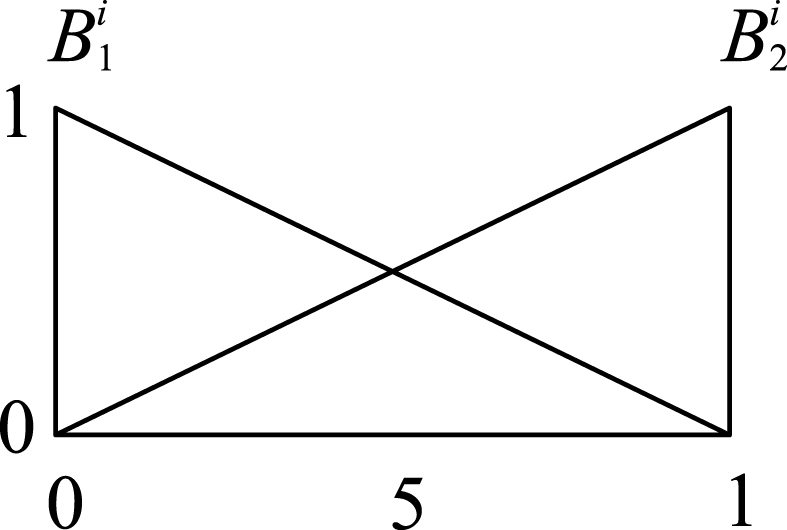
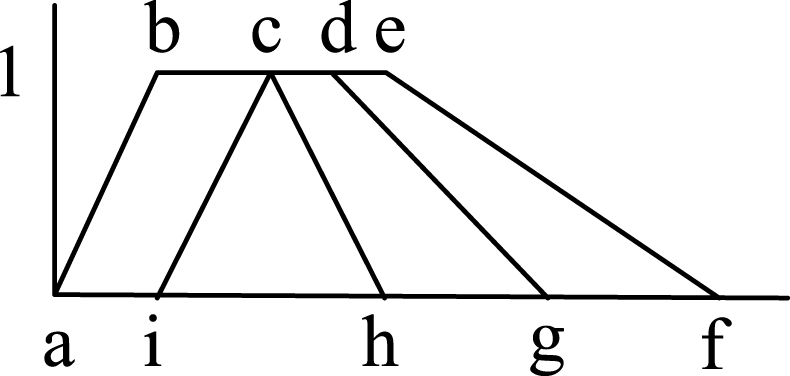
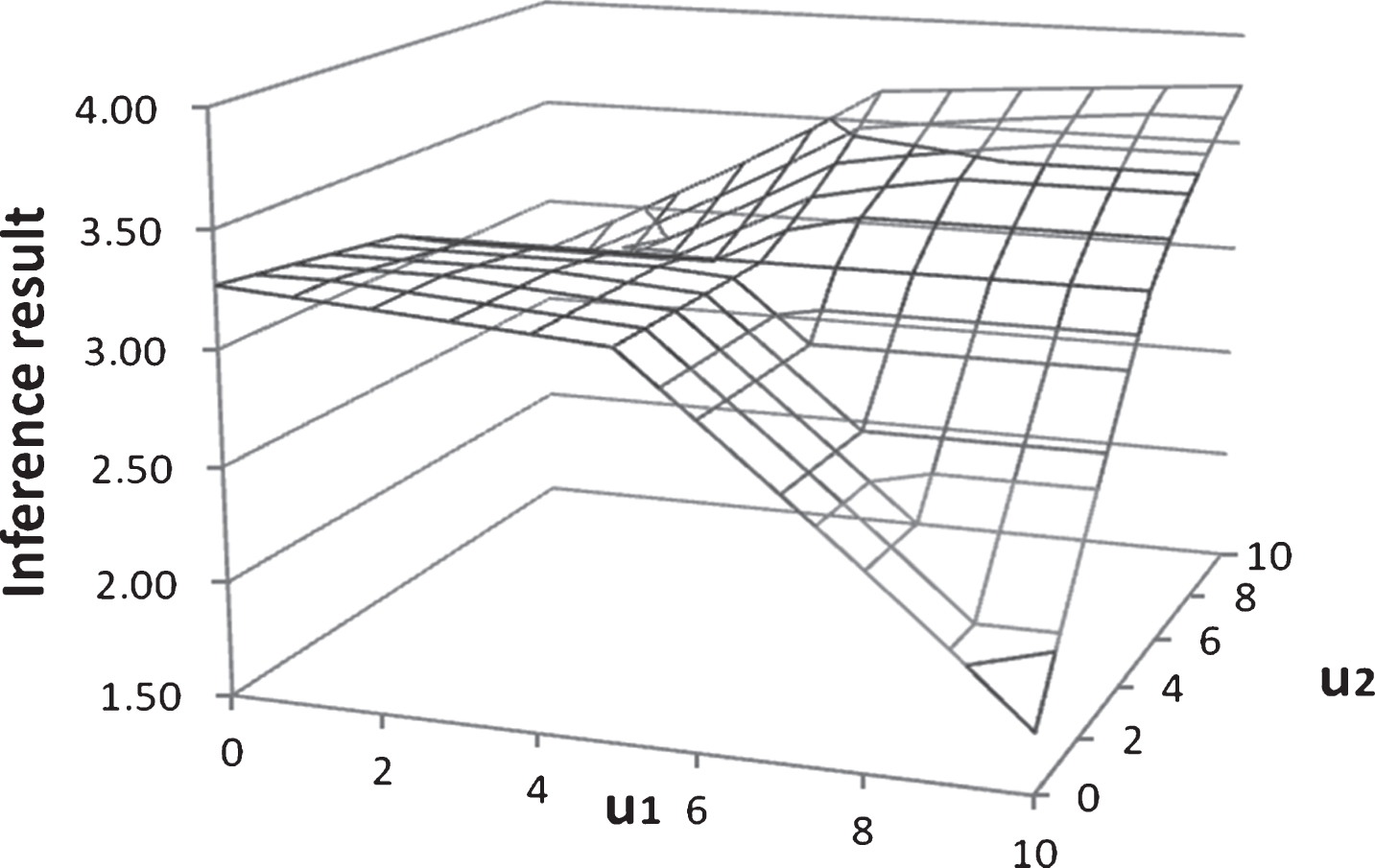
where the fuzzy sets , i = 1, 2 and j = 1, 2, are shown in Fig. 1. The fuzzy set D11 is represented by trapezoid a-b-c-h, D12 by trapezoid i-c-e-f, D21 by triangle i-c-h, and D22 by trapezoid i-c-d-g, as shown in Fig. 2. The x coordinates of a, b, c, d, e, f, g, h and i are 0, 1, 2, 2.5, 3, 6, 4, 3 and 1. First, we solve the problem by the MISO rules system (15). Choose the constructive linguistic model, and choose t-norm ⊗ = min operation, t-conorm ⊕ = max operation. The defuzzification is by the center-of-gravity method. The inference result by the constructive linguistic model working on the MISO rules system (15) is shown in Fig. 3.
Fuzzy sets for and , i = 1, 2.
Fuzzy sets for D11, D12, D21 and D22.
Inference result by the constructive linguistic model working on the MISO rules system (15).
Then, we solve the problem by decomposing the MISO rules system into a collection of SISO rules systems. We associate the MISO rules system (15) with the following SISO rules systems.
where the fuzzy sets , i = 1, 2 and j = 1, 2, are the same as in (15). The fuzzy sets is represented by trapezoid a-b-e-f, by trapezoid i-c-d-g, by trapezoid a-b-c-h, and by trapezoid i-c-e-f, as shown in Fig. 2. Choose the constructive linguistic model, and choose t-norm ⊗ = min operation, t-conorm ⊕ = max operation. The defuzzification is by the center-of-gravity method. From Fig. 2, Equation (9) of Proposition 1 is satisfied as follows.
The other condition in Proposition 1 is also satisfied such that t-norm ⊗ is distributive over t-conorm ⊕. From Proposition 1, the defuzzification result of the constructive linguistic model working on the collection of the SISO rules systems (16-1) and (16-2) is equal to the defuzzification result of the constructive linguistic model working on the MISO rules system (15). Thus, we decompose the MISO rules system (15) into an equivalent collection of the SISO rules systems (16-1) and (16-2). The inference result is the same as in Fig. 3.
Decomposition of the MISO rules system with fuzzy singleton consequent parts
This section investigates the decomposition of the MISO rules system with fuzzy singleton consequent parts. Decomposition for the constructive and destructive linguistic models is both investigated. For clarity, first considering two inputs u1 and u2, the rules system is given as
where , , , , D11, D12, D21, and D22 are fuzzy sets; v is the output variable; , , , and are functions; w1 and w2 are the weights and w1 ≦ 1, w2 ≦ 1; The notation means it is a fuzzy singleton with membership value wi at for i = 1, 2 and j = 1, 2.
Next, the MISO rules system (17) is decomposed into a collection of SISO rules systems. We associate (17) with the following rules systems.
Equation (9) of Proposition 1 is satisfied as follows.
Thus, Equation (9) of Proposition 1 is satisfied. Choose the t-norm and the t-conorm such that the t-norm is distributive over the t-conorm. For example, the minimum t-norm and the maximum t-conorm satisfy the above condition. From Proposition 1, the constructive linguistic model for the SISO rules systems (18-1) and (18-2) is equivalent to the constructive linguistic model for the MISO rules system (17).
Further, there are innumerable solutions satisfying Equation (9). Therefore, it turns out the corresponding SISO rules systems exist innumerably. For example, the following SISO rules systems are considered.
For (19-1) and (19-2), Equation (9) is also satisfied as follows.
Therefore, the constructive linguistic model for the MISO rules system (17) is also equivalent to the constructive linguistic model for the collection of SISO rules systems (19-1) and (19-2).
Meanwhile, if the destructive linguistic model is chosen, the MISO rules system (17) can be decomposed into a collection of SISO rules systems as follows.
Equation (12) of Proposition 2 is satisfied as follows.
Choose the t-norm and the t-conorm such that the t-conorm ⊕ is distributive over the t-norm ⊗, and ⊗ is the dual t-norm of ⊕. For example, the minimum t-norm and the maximum t-conorm satisfy the above conditions. From Proposition 2, the destructive linguistic model for MISO rules system (17) is equivalent to the destructive linguistic model for the collection of SISO rules systems (20-1) and (20-2).
Now, the general form is investigated. Consider the following MISO rules system.
where ji = 1, 2, …, mi, i = 1, 2, …, n; ui, i = 1, 2, …, n are the input variables; , ji = 1, 2, …, mi, i = 1, 2, …, n are the fuzzy sets; v is the output variable; are functions, ji = 1, 2, …, mi, i = 1, 2, …, n; wi is the weight and wi ≦ 1 for i = 1, 2, …, n; The total number of rules is M = m1m2 … mn. The notation means it is a fuzzy singleton with membership value wi at for i = 1, 2, …, n.
We associate the rules system (21) with the following rules systems:
where ji = 1, 2, …, mi, i = 1, 2, …, n, and is as follows.
Note that the total number of rules in (22-i), i = 1, 2 … , n, is m1 + m2 + … + mn. It is easy to prove the following equations.
Therefore, Equation (9) is satisfied. Choose the t-norm and the t-conorm such that the t-norm is distributive over the t-conorm. From Proposition 1, the constructive linguistic model for the collection of SISO rules systems (22-i) is equivalent to the constructive linguistic model for the MISO rules system (21).
Moreover, there are innumerable solutions satisfying Equation (9). For example, the following are considered.
It is easy to prove for ji = 1, 2, …, mi, i = 1, 2, …, n. Therefore, the equivalent SISO rules systems exist innumerably.
From above, it is clear the constructive linguistic model for the SISO rules systems is a special case of the constructive linguistic model for the MISO rules system. However, it follows the number of rules is m1 + m2 + … + mn to realize the result of the constructive linguistic model for the SISO rules systems (22-i), and the number of rules is m1m2 … mn to realize the result of the constructive linguistic model for the MISO rules system (21). Thus, too many rules are required in the MISO rules system.
Then, the general form for the destructive linguistic model is investigated. Consider the MISO rules system (21) and the SISO rules systems (22-i) for i = 1, 2, …, n. is as follows.
It is easy to prove the following equations.
Therefore, Equation (12) is satisfied. Choose the t-norm and the t-conorm such that the t-conorm ⊕ is distributive over the t-norm ⊗, and ⊗ is the dual t-norm of ⊕. From Proposition 2, the destructive linguistic model for the collection of SISO rules systems (22-i) is equivalent to the destructive linguistic model for the MISO rules system (21). For clarity, the following example modified from Seki et al. [16] is investigated.
Example 5. Considering two inputs u1 and u2, the MISO rules system is given as
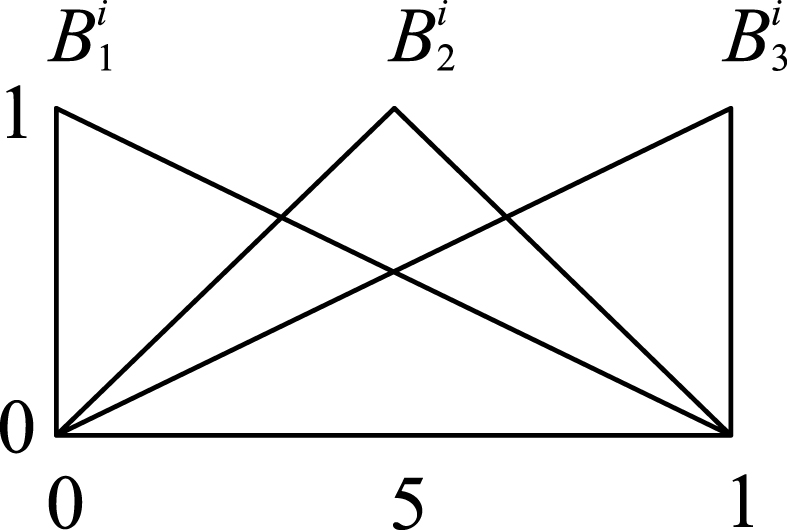
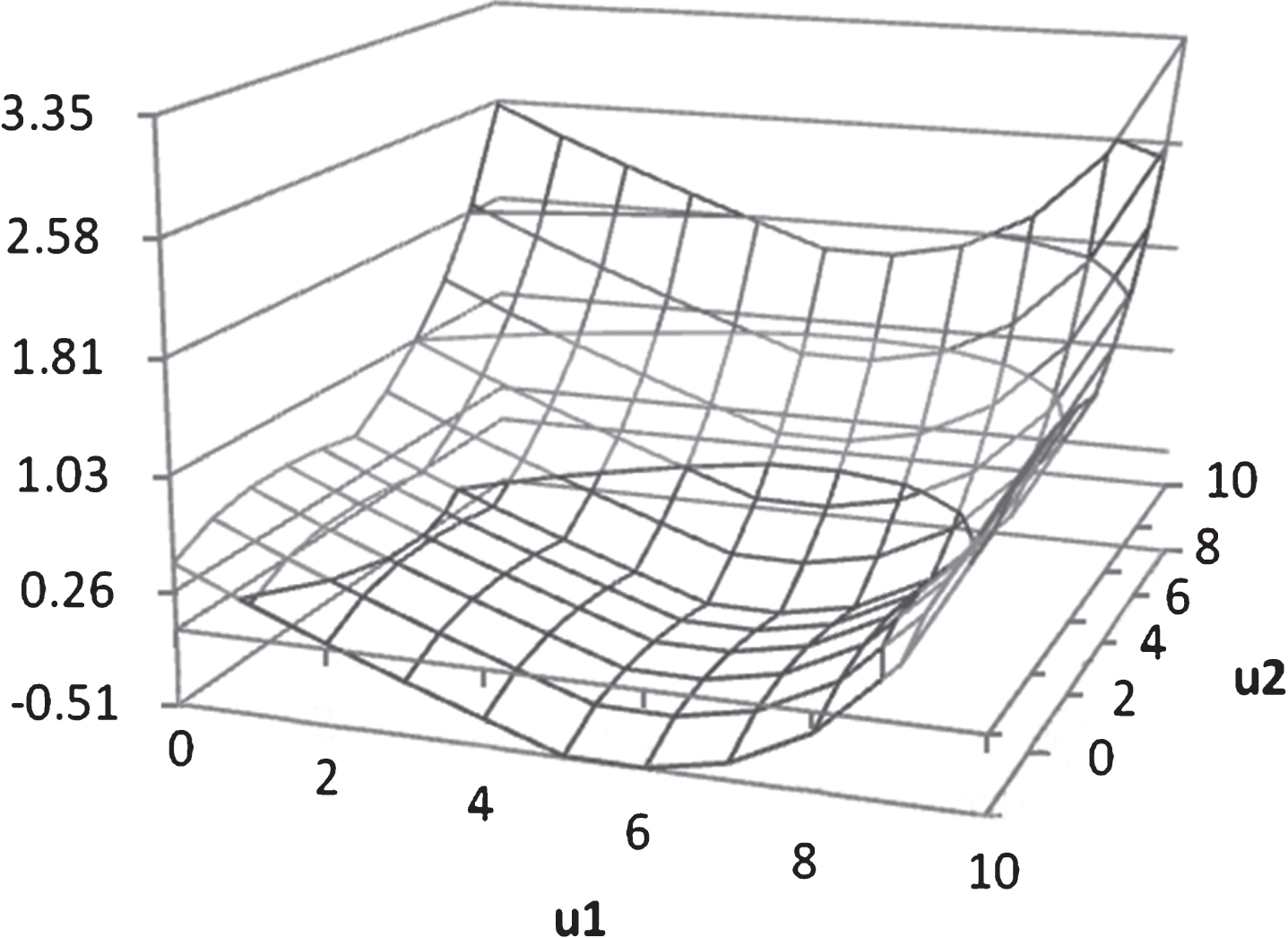
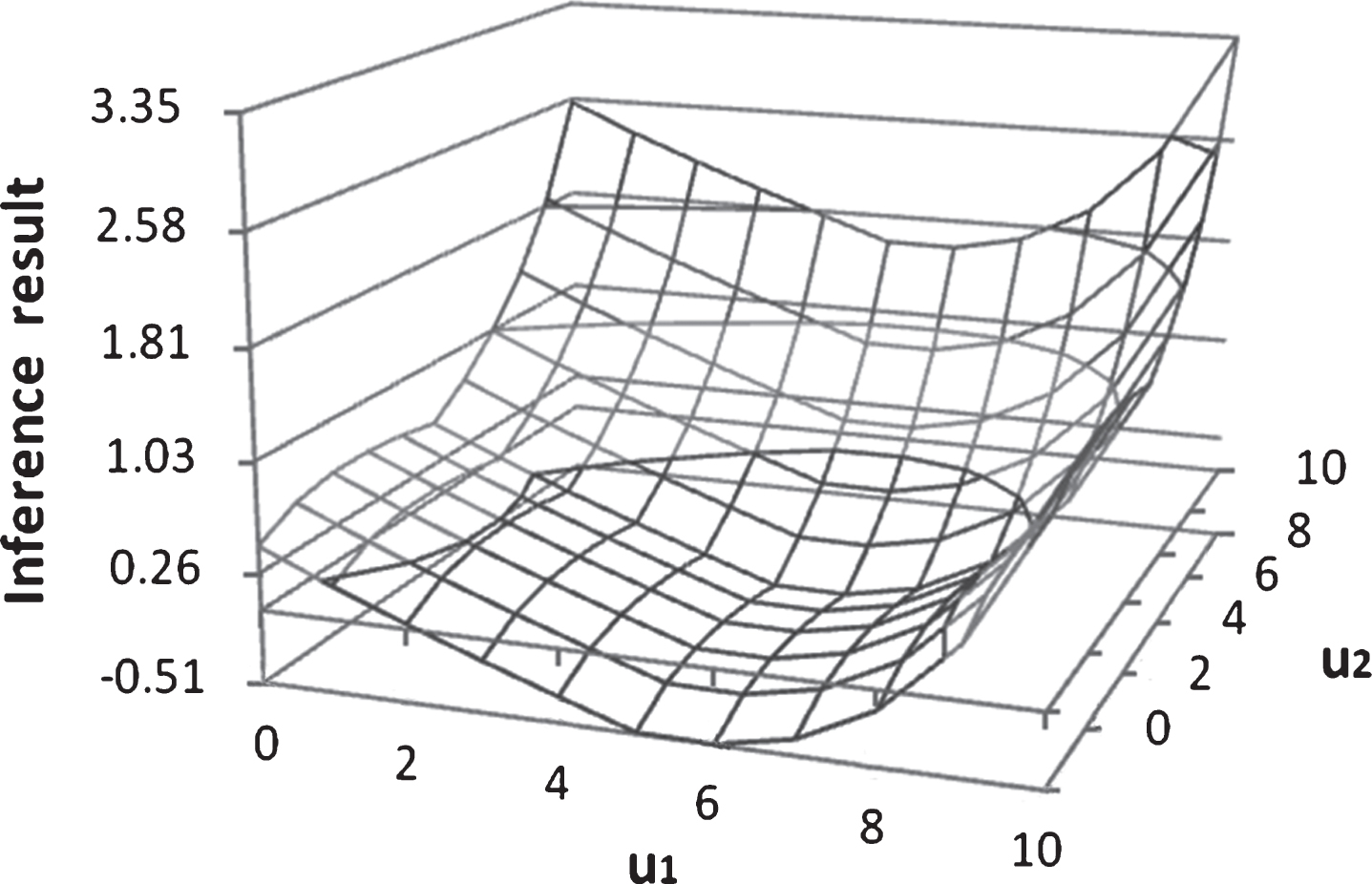
where j1, j2 = 1, 2, 3, , , , , , , , , , , , , w1 = 0.5, w2 = 0.5, and the fuzzy sets in Fig. 4 are used. Dj1j2, j1, j2 = 1, 2, 3 are fuzzy singletons with weight w1 at and weight w2 at . First, we solve the problem by the MISO rules system (26). Choose the constructive linguistic model with the selection of t-norm ⊗= product operation, and t-conorm ⊕= the Lukasiewitz t-conorm, as shown in Example 1. The defuzzification is by weighted aggregation with its membership values as weights. The inference result of the MISO rules system (26) is obtained as shown in Fig. 5.
Fuzzy sets for , , and , i = 1, 2.
Inference result of the MISO rules system.
Then, we solve the problem by decomposing the MISO rules system into a collection of SISO rules systems. We associate the MISO rules system (26) with the following SISO rules systems
From (23), , , , , and are chosen as follows.
where w1 = w2 = 0.5, and , i = 1, 2, j = 1, 2, 3, are the same as shown in (26). Equation (9) of Proposition 1 is satisfied as follows.
The inference result of the constructive linguistic model for the SISO rules system (27-1) is obtained as follows.
The inference result of the constructive linguistic model for the rules system (27-2) is as follows.
Aggregate v1 and v2 by t-norm ⊗ to obtain final result v as
The defuzzification result v* of the fuzzy set v is by weighted aggregation with its membership value as the weight. The defuzzification result v* is obtained as shown in Fig. 6. Note that Figs. 5 and 6 show the same results as expected. In this example, the inference results are obtained from the MISO rules system and the SISO rules systems and they are the same as expected. Note that the rules number of (27-1) and (27-2) is 6 and the rules number of (26) is 9. Using the decomposing process, we can realize the result with fewer rules.
Inference result by the constructive linguistic model working on the SISO rules systems.
Conclusion
This paper proposes a method to decompose a MISO fuzzy rules system into its equivalent collection of SISO fuzzy rules systems. From Proposition 1, suppose the consequent parts of rules satisfy (9) and the t-norm ⊗ is distributive over the t-conorm ⊕. Then, the final consequence of the constructive linguistic model working on a MISO fuzzy rules system is equivalent to the final consequence of the constructive linguistic model working on a collection of SISO fuzzy rules systems. From Proposition 2, suppose the consequent parts of rules satisfy (12), and the t-conorm ⊕ is distributive over the t-norm ⊗, and ⊗ is the dual t-norm of ⊕. Then, the final consequence of the destructive linguistic model working on a MISO fuzzy rules system is equivalent to the final consequence of the destructive linguistic model working on a collection of SISO fuzzy rules systems.
In the decomposing process, the main work is to find the consequent parts of the equivalent SISO rules systems as in (9) and (12). Occasionally, it is difficult to find the consequent parts of the equivalent SISO rules systems. This paper shows that it is easy to find the consequent parts of the equivalent SISO rules systems for a special type of MISO fuzzy rules system, that is, the MISO fuzzy rules system with fuzzy singleton consequent parts. The general procedure for the decomposition of the MISO fuzzy rules system with fuzzy singleton consequent parts is investigated. For the constructive linguistic model, the consequent parts of the equivalent SISO rules systems are found as in (23) and (24). For the destructive linguistic model, the consequent parts of the equivalent SISO rules systems are found as in (25). Choose the t-norm and t-conorm satisfying the conditions in Proposition 1 or 2. The MISO fuzzy rules system (21) can be decomposed into its equivalent collection of SISO fuzzy rules systems (22-i), i = 1, 2, …, n. However, to realize the result of the MISO rules system (21) requires m1m2 … mn rules, and to realize the result of equivalent SISO rules systems (22-i), i = 1, 2, …, n, requires m1 + m2 + … + mn rules. Through the decomposing process, we can realize the inference result with fewer rules.
Summarizing the above results, the main advantages of this paper are that two propositions are proposed for decomposing a MISO fuzzy rules system into its equivalent collection of SISO fuzzy rules systems. Through the decomposing process, the number of fuzzy rules can be sharply reduced. For example, a MISO fuzzy rules system with ten inputs, and 10 * 10 * 10 * 10 * 10 * 10 * 10 * 10 * 10 * 10 rules can be decomposed to a collection of SISO rules system with 10 + 10 + 10 + 10 + 10 + 10 + 10 + 10 + 10 + 10 rules. Moreover, the general procedure for decomposing the MISO fuzzy rules system with fuzzy singleton consequent parts is obtained. The main disadvantage of the paper is that the consequent parts of the equivalent SISO rules systems are not easy to find. The future research is to study this problem.
References
1.
ZadehL., Outline of a new approach to the analysis of complex systems and decision processes, IEEE Trans Syst Man, Cybern3 (1973), 28–44.
2.
YagerR.R. and FilevD.P., Essentials of Fuzzy Modeling and Control, New York: John Wiley, 1994.
3.
WangL.X., A Course in Fuzzy Systems and Control, Prentice Hall PTR, 1997.
4.
MamdaniE.H., Application of fuzzy algorithms for control of simple dynamic plant, Proc IEE121(12) (1974), 1585–1588.
5.
TanakaK. and WangH.O., Fuzzy Control Systems Design and Analysis, John Wiley & Sons, 2001.
6.
LiuY.J. and TongS., Adaptive fuzzy identification and control for a class of nonlinear pure-feedback MIMO systems with unknown dead zones, IEEE Trans Fuzzy Syst23(5) (2015), 1387–1398.
7.
LaiG., LiuZ., ZhangY., Philip ChenC.L. and LiuY., Fuzzy adaptive inverse compensation method to tracking control of uncertain nonlinear systems with generalized actuator dead zone, IEEE Trans Fuzzy Syst25(1) (2017), 191–204.
8.
LiuY.J. and TongS., Adaptive fuzzy control for a class of nonlinear discrete-time systems with backlash, IEEE Trans Fuzzy Syst22(5) (2014), 1359–1365.
9.
LiuY.J., TongS., LiD.J. and GaoY., Fuzzy adaptive control with state observer for a class of nonlinear discrete-time systems with input constraint, IEEE Trans Fuzzy Syst24(5) (2016), 1147–1158.
10.
WangH., WangZ., LiuY.J. and TongS., Fuzzy tracking adaptive control of discrete-time switched nonlinear systems, Fuzzy Sets and Systems316 (2017), 35–48.
11.
SekiH. and IshiiH., On the monotonicity of functional type SIRMs connected fuzzy reasoning method and T-S reasoning method, in: IEEE World Congress on Computational Intelligence, 2008, pp. 58–63.
12.
SekiH., On the equivalence of SIRMs connected fuzzy inference method, in: IEEE International Conference on Fuzzy Systems, 2009, pp. 1209–1215.
13.
SekiH. and MizumotoM., Fuzzy functional inference method, in: IEEE International Conference on Fuzzy Systems, 2010, pp. 1–6.
14.
SekiH. and MizumotoM., On the equivalence conditions of fuzzy inference methods—Part. 1: Basic concept and definition, IEEE Trans Fuzzy Syst19 (2011), 1097–1106.
15.
SekiH. and MizumotoM., SIRMs connected fuzzy inference method adopting emphasis and suppression, Fuzzy Sets and Systems215 (2013), 112–126.
16.
SekiH., IshiiH. and MizumotoM., On the generalization of single input rule modules connected type fuzzy reasoning method, IEEE Trans Fuzzy Syst16(5) (2008), 1180–1187.
17.
TakagiT. and SugenoM., Fuzzy identification of systems and its applications to modeling and control, IEEE Trans Syst Man, Cybern15 (1985), 116–132.
18.
NguyenH.T. and WalkerE.A., A First Course in Fuzzy Logic, Chapman & Hall/CRC: Boca Raton, 2000.