In this paper, we introduce and prove some classes of fuzzy contractive mappings with altering distance function via α and βκ–admissible mappings in the fuzzy metric spaces. We also give some example and graph which demonstrate the validity of the hypotheses of our main results. Our results improve and extend several previously known fixed point theorems of the existing literature. As an application to our main result a fixed point for contraction mappings of integral type in fuzzy metric spaces are presented.
Firstly, we recalled the concept of continuous t-norm with introduced by Schweizer et al. [1] in 1960.
A binary operation ★ : [0, 1] × [0, 1] → [0, 1] is a continuous t-norm if (i) ★ is associative and commutative, (ii) ★ is continuous, (iii) a ★ 1 = a for all a ∈ [0, 1] and (iv) a ★ b ≤ c ★ d whenever a ≤ c and b ≤ d for all a, b, c, d ∈ [0, 1]. A t-norm ★ is called positive, if a ★ b > 0 for all a, b ∈ (0, 1). The examples of continuous t-norm are Lukasievicz t-norm, product t-norm, minimum t-norm, that is, a ★ Lb = max {a + b - 1, 0}, a ★ Pb = ab and a ★ Mb = min {a, b}, respectively.
George and Veeramani [3] modified the concept of a Hausdorff topology in fuzzy metric spaces due to Kramosil and Michálek [2] as follows. Let be an arbitrary nonempty set, ★ is a continuous t-norm, and is a fuzzy set on .
Definition 1.1. [3] is called a fuzzy metric space if satisfying the following conditions,
for all and t > 0,
if and only if x = y for all and t > 0,
for all and t > 0,
for all and t, s > 0,
is continuous for all .
Remark 1.2. By Definition 1.1, we can see that , for all and t > 0 provided x ≠ y (see [23]).
The open ball with a center and a radius 0 < ι < 1 for all t > 0 defined by . A subset in is called open if for each , there exist t > 0 and 0 < ι < 1 such that . Let τ denote the family of all open subsets of . Then τ is a topology on called the topology induced by the fuzzy metric . This topology is metrizable (see in [24]).
Definition 1.3. [3] Let be a fuzzy metric space. A sequence {xn} in is said to be convergent to a point if for all t > 0. A sequence {xn} in is called a Cauchy sequence if, for each 0 < δ < 1 and t > 0, there exits such that for each n, m ≥ n0. A fuzzy metric space in which every Cauchy sequence is convergent is said to be complete.
Lemma 1.4.[6] Let be a fuzzy metric space. is non-decreasing function, for all .
Definition 1.5 Let be a fuzzy metric space. Then the mapping is said to be continuous on if when {(xn, yn, tn)} is a sequence in which converges to a point, i.e.,
Afterwards, many mathematicians presented fixed point theorems in complete fuzzy metric spaces [4–17].
The concept of an altering distance function was defined by Khan et al. [18] in 1984 which improved the metric fixed point theory by introducing a control function.
Definition 1.6. A function φ : [0, 1] → [0, 1] is an altering distance if φ is strictly decreasing, left continuous and φ (ς) =0 if and only if ς = 1. Obviously, we obtain that . We denote
In 2012, Shen et al. [19] introduced the notion of altering distance in fuzzy metric spaces and gave a fixed point results in complete and compact fuzzy metric spaces. Recently, Došenovića et al. [20] introduced and proved fixed point theorems in complete and compact fuzzy metric spaces using altering distance.
The concept of α-admissible for single valued mappings was introduced by Samet et al. [21]. Afterwards, Salimi et al. [22] introduced βκ-admissible mapping with generalized the concept of α-admissible. The concept of α-admissible and βκ-admissible mappings as follows:
Definition 1.7. [21] Let and . Then is an α-admissible mapping if
Definition 1.8. [22] Let , and κ : (0, + ∞) → (0, 1). Then is a βκ-admissible mapping if
for all , t > 0.
In this paper, inspired by Došenovića et al. [20] and Salimi et al. [22] work mentioned above, we study and prove the existence and uniqueness of fixed points for generalized fuzzy contractive mappings in complete fuzzy metric spaces in the sense of George and Veeramani [3] and give an example to illustrate our main results. As an application, we deduce fixed point theorems in generalized fuzzy contractive mappings of integral type in fuzzy metric spaces.
Fixed point results in fuzzy metric spaces via α and βκ–admissible mappings
In this section, we prove the existence and uniqueness of fixed point theorems in fuzzy metric spaces via α-admissible and βκ–admissible mappings.
Theorem 2.1.Let be a complete fuzzy metric space, are α and βκ–admissible mappings and φ ∈ Φ such that implies that
where
Suppose that the following conditions hold:
there exists such that and for all t > 0;
if {xn} is a sequence such that α (xn, xn+1) ≥ 1 for all , and xn → x as n→ ∞, then .
Then has a unique fixed point x* in such that and β (x, t) <1 for all and t > 0.
Proof 1. Let such that and for all t > 0 (from condition (b)). We define the sequence {xn} in such that
Since are α and βκ-admissible mapping, we have we deduce that
and
By continuing this process, we get
for all . This implies that
for all . Similarly, we deduce that
for all and all t > 0. From (2.1), we obtain that
where
If , then
a contradiction. Therefore
so we have
Repeating the same process we conclude that
for all . Letting n→ ∞, we have
Since the function φ left-continuous and by condition (M2), we get
Now, we prove that {xn} is a Cauchy sequence. Let prove by contradiction, that is {xn} is not a Cauchy sequence, then there exists ɛ ∈ (0, 1), which we can find two subsequences {xm(k)} and {xn(k)} of {xn} with m (k) > n (k) ≥ k such that
for all positive integer k and t > 0.
Assume that m (k) is the least integer exceeding n (k) satisfying the above inequality, that is, equivalent,
for all positive integer k and t > 0. By (2.2) follows that for ɛ1 and ɛ2 there exist such that
for all n > n1 and t > 0.
for all n > n2 and t > 0. So, we have
for all n > max {n1, n2}. Letting n→ ∞, we get
Applying (2.1), we have that
which is a contradiction.
If it is not possible to find sequences {m (k)} and {n (k)} with m (k) > n (k) ≥ k such that for all positive integer k and t > 0, then there exists such that , for any . Since, is a monotone and bounded sequence, for any t > 0, i.e. , for some z ∈ (0, 1 - ɛ]. Then,
Letting r→ ∞, we have
which is a contradiction. Thus, {xn} is a Cauchy sequence and complete then there exists x* ∈ X such that xn → x* as n→ ∞, that means, as n→ ∞, for each t > 0. Since, xn ≠ xn+1 for all , we get for all t > 0. Since, α (xn-1, xn) ≥1 for all . By condition (b), we have . So, we get
for all , with x = xn-1 and y = x*. Again, by condition (2.1), we have
where
Letting n→ ∞ in the above inequality, we get
So, we have , for all t > 0. Therefore, , it follows that, and so . That is x* is a fixed point of .
Next, we prove the uniqueness of the fixed point of . Let y* be another fixed point of , x* ≠ y* and such that and β (x, t) <1 for all and t > 0. So, we get
It follows that
where
It follows that
which is a contradiction hence for t > 0, that is, x* = y*. Therefore, x* is the unique fixed point of such that and β (x, t) <1. This completes the proof.
In view of Theorem 2.1, we have the following Corollary 2.2.
Corollary 2.2.Let be a complete fuzzy metric space, are α and βκ–admissible mappings and φ ∈ Φ such that implies that
where
for all x, y ∈ X, x ≠ y, t > 0 and λ > 0. Suppose that the following conditions hold:
there exists such that and for all t > 0;
if {xn} is a sequence such that α (xn, xn+1) ≥1 for all , and xn → x as n→ ∞, then .
Then has a unique fixed point x* in such that and β (x, t) <1 for all and t > 0.
Corollary 2.3.Let be a complete fuzzy metric space, are α and βκ–admissible mappings and φ ∈ Φ such that implies that
where
for all , x ≠ y, t > 0. Suppose that the following conditions hold:
there exists such that and for all t > 0;
if {xn} is a sequence such that α (xn, xn+1) ≥ 1 for all , and xn → x as n→ ∞, then .
Then has a unique fixed point x* in such that and β (x, t) <1 for all and t > 0.
On the other hand, by taking α (x, y) =1 and β (x, t) 2 = κ (t) in Corollary (2.3), we deduce the following correct version of Theorem 2.1. in [20].
Corollary 2.4.[20] Let be a complete fuzzy metric space and . Let φ ∈ Φ and κ : (0, + ∞) → (0, 1) such that:
where
for all , x ≠ y, t > 0. Then has a unique fixed point x* in for all and t > 0.
Now, we give an example to support Theorem 2.1.
Example 2.5. Let and define d (x, y) = |x - y| with d (x, y) < t. Denote a ★ b is Lukasievicz t-norm for any a, b ∈ [0, 1] and
for and t > 0. Then it easy to see that is a complete fuzzy metric space [7]. Define the mapping by
Define
and κ : (0, + ∞) → (0, 1) by
Also, define φ (s) =1 - s for all s ∈ (0, 1) and .
Now, we show that is an α-admissible mapping. Let with
then x, y ∈ [0, 1]. On the other hand, for all x, y ∈ [0, 1], we have . It follows that
Hence, is an α-admissible mapping. In reason of the above arguments, . Let {xn} is a sequence in X such that α (xn, xn+1) ≥1 for all and xn → x as n→ ∞, then {xn} ⊂ [0, 1]. This implies that α (xn, x) ≥1 for all .
Next, we show that is βκ–admissible mapping. Let with then x, y ∈ [0, 1]. On the other hand, for all x, y ∈ [0, 1], , we have . So, is βκ–admissible mapping. We will check that the contractive condition of Theorem 2.1 is fulfilled for 0 ≤ x, y ≤ 1 with and with x ≠ y, we get
By condition (M3), suppose that x > y. For this, we consider the following cases:
Case 1:, for each 0 ≤ x, y ≤ 1, we have
This implies that
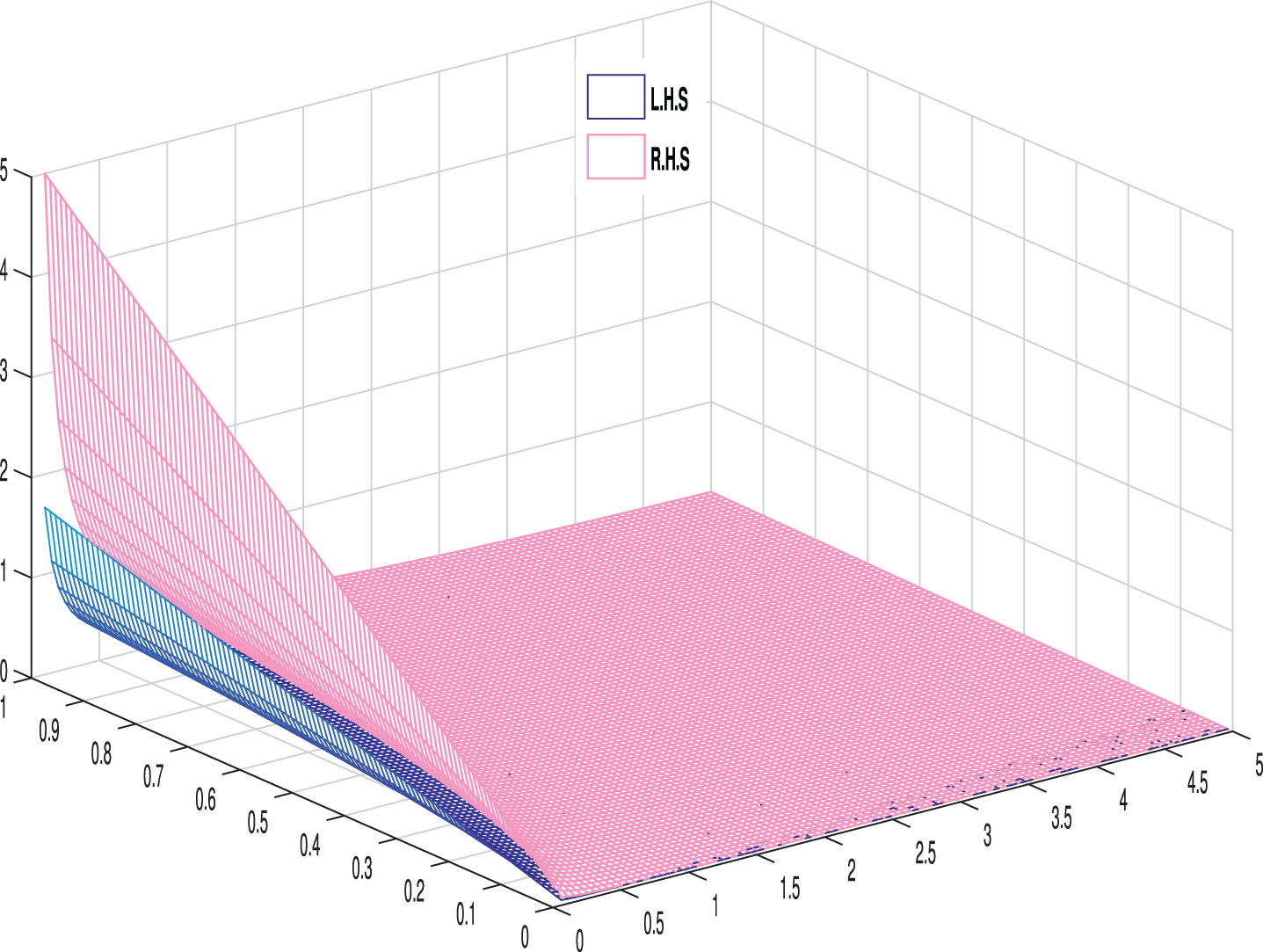
Figure 1. Shows the contractive condition of Example 2.5. Case 1, 3D view which the upper plan is right hand side functions (R.H.S.) and the lower plan is left hand side functions (L.H.S.).
Graph of contractive condition of Example Case1, 3D view.
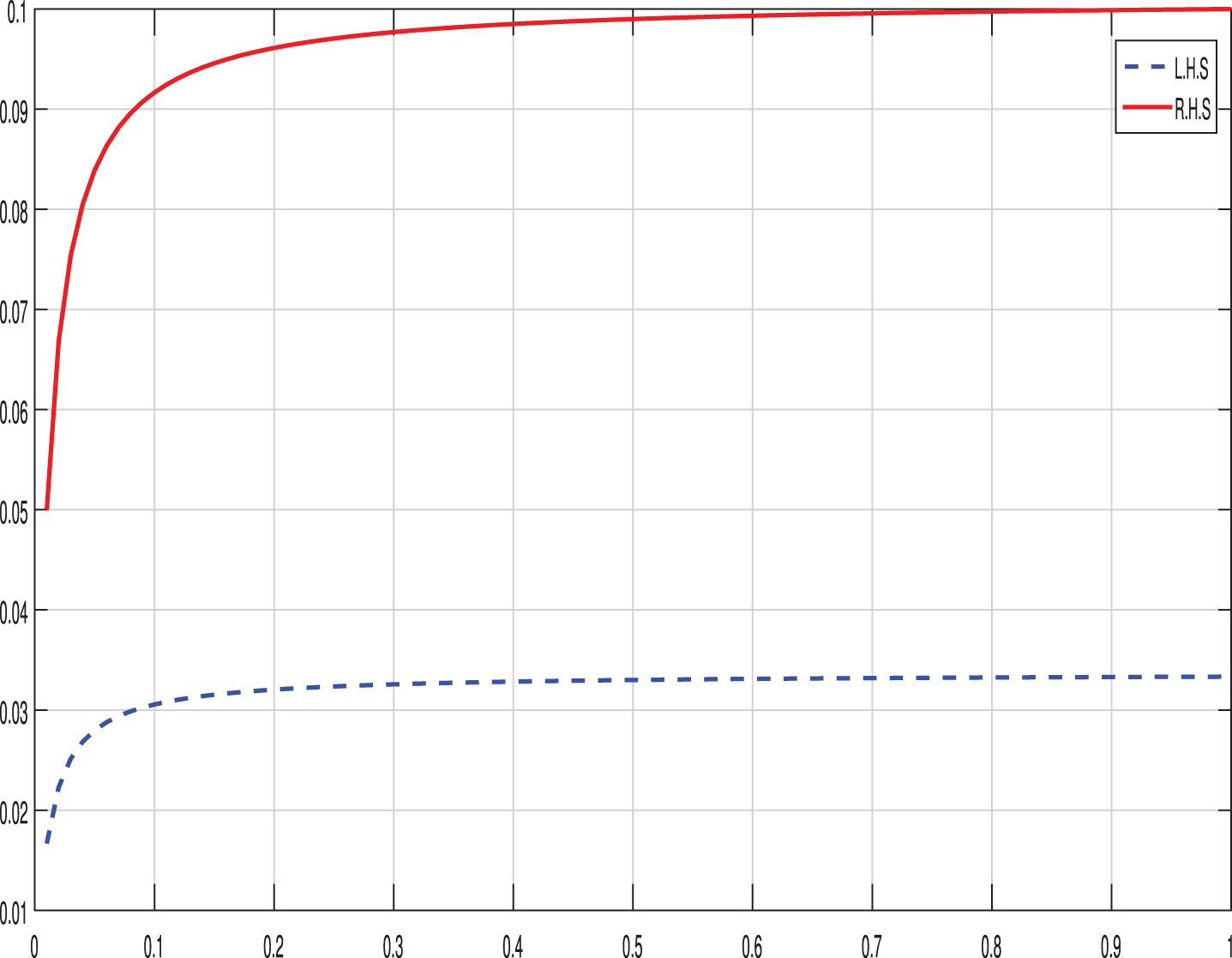
Figure 2. Shows the contractive condition of Example 2.5. Case 1, 2D view which the red line is right hand side functions (R.H.S.) and the blue line is left hand side functions (L.H.S.).
Graph of contractive condition of Example Case1, 2D view.
Case 2:, for each 0 ≤ x, y ≤ 1, we have
This implies that
Figure 3. Shows the contractive condition of Example 2.5. Case 2, 3D view which the upper plan is right hand side functions (R.H.S.) and the lower plan is left hand side functions (L.H.S.).
Graph of contractive condition of Example Case2, 3D view.
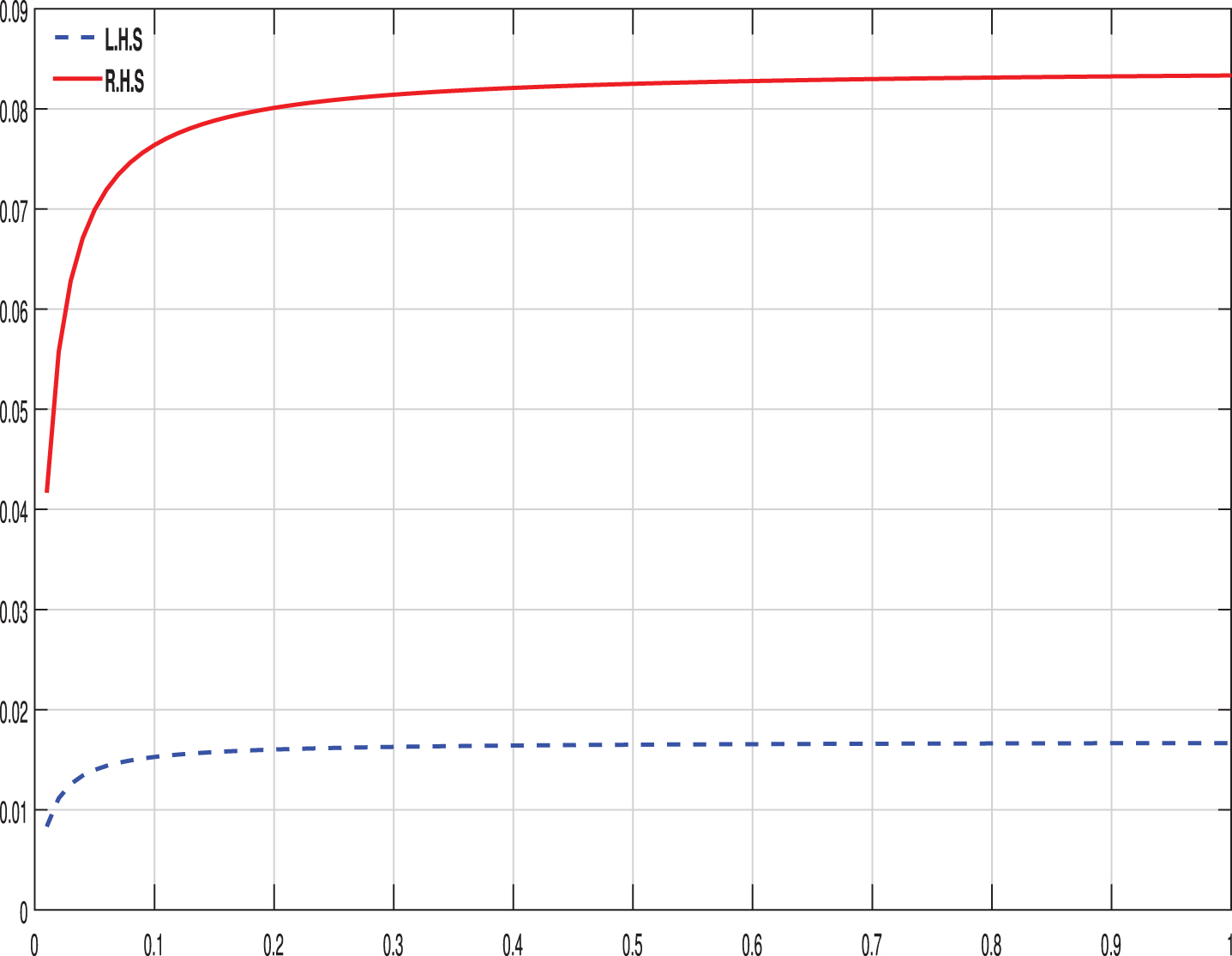
Figure 4. Shows the contractive condition of Example 2.5. Case 2, 2D view which the red line is right hand side functions (R.H.S.) and the blue line is left hand side functions (L.H.S.).
Graph of contractive condition of Example Case2, 3D view.
Therefore, all of conditions in Theorem 2.1 are satisfied. In this example, we have is a unique fixed point of . We can see that Corollarys 2.2 and 2.3 can be applicable to this example.
Now, we show that Corollary 2.4 cannot be applied to . Taking x = 2, y = 4 and t = 3, we can see that are not α-admissible and βκ–admissible mappings.
Therefore Corollary 2.4 cannot be applied to . This complete the prove.
Applications
As an application of our results obtained in previous sections, we present some fixed point results for contraction mappings via α and βκ–admissible mappings with altering distance of an integral type. For this purpose, we first define the following class of functions:
such that φ is nonnegative, Lebesgue integrable, summable on each compact subset of positive real numbers and satisfies
The following theorem is our result on the existence of fixed points or contraction mappings via α and βκ–admissible mappings of integral type in fuzzy metric spaces.
Theorem 3.1.Let be a complete fuzzy metric space, are α and βκ–admissible mappings. Let function φ ∈ Φ and φ ∈ Γ withimplies
where
holds for all , x ≠ y and t > 0. Suppose that the following conditions hold:
there exists such that and for all t > 0;
if {xn} is a sequence such that α (xn, xn+1) ≥1 for all , and xn → x as n→ ∞, then .
Then f has a unique fixed point x* in such that and β (x, t) <1 for all and t > 0.
Proof. Following the lines in the proof of Theorem 2.1 and we consider ψ : [0, 1] → [0, 1] define by
for all δ ∈ (0, 1). It is clear that ψ is altering distance functions. Then the results follow immediately from Theorem 2.1. This completes the proof.
Corollary 3.2.Let be a complete fuzzy metric space, are α and βκ–admissible mappings. Let φ ∈ Φ and φ ∈ Γ with
implies
where
for all , x ≠ y, t > 0. Then has a unique fixed point x∗ in such that and β (x, t) <1 for all and t > 0.
Conclusions
In the present work we introduced some classes of fuzzy contractive mappings with altering distance via α and βκ–admissible mappings in the fuzzy metric spaces. Also, we derived the existence and uniqueness of fixed points for this mappings in the complete fuzzy metric spaces and we also give some example and graph which demonstrate the validity of the hypotheses of our main results.
Finally, we showed some fixed point results for mappings satisfying some classes of fuzzy contractive mappings with altering distance via α and βκ–admissible mappings of an integral type.
Competing interests
The authors declare that they have no competing interests.
Authors contributions
All authors contributed equally to the writing of this paper. All authors read and approved the final manuscript.
Footnotes
Acknowledgments
The first author was supported by Rajamangala University of Technology Rattanakosin Research and Development Institute. This project was supported by the Theoretical and Computational Science (TaCS) Center under Computational and Applied Science for Smart Innovation Cluster (CLASSIC), Faculty of Science, KMUTT. This research work was financially supported by King Mongkut’s University of Technology North Bangkok. Contract No. KMUTNB-60-ART-084.
References
1.
SchweizerB. and SklarA., Statistical metric spaces, The Pacific Journal of Mathematics10 (1960), 313–334.
2.
KramosilI. and MichalekJ., Fuzzy metric and statistical metric spaces, Kyber-Netica11 (1975), 326–334.
3.
GeorgeA. and VeeramaniP., On some results in fuzzy metric spaces, Fuzzy Sets and Systems64 (1994), 395–399.
4.
GregoriV. and SapenaA., On fixed-point theorems in fuzzy metric spaces, Fuzzy Sets and Systems125 (2002), 245–252.
5.
FangJ.X., On fixed point theorems in fuzzy metric spaces, Fuzzy Sets and Systems46 (1992), 107–113.
6.
GrabiecM., Fixed points in fuzzy metric spaces, Fuzzy Sets and Systems27 (1983), 385–389.
7.
GregoriV., MorillasS. and SapenaA., Examples of fuzzy metrics and applications, Fuzzy Sets and Systems170 (2011), 95–111.
8.
MiheţD., On the existence and the uniqueness of fixed points of Sehgal contractions, Fuzzy Sets and Systems156 (2005), 135–141.
9.
MiheţD., On fuzzy contractive mappings in fuzzy metric spaces, Fuzzy Sets and Systems158 (2007), 915–921.
10.
MiheţD., A class of contractions in fuzzy metric spaces, Fuzzy Sets Syst161 (2010), 1131–1137.
11.
LiuY. and LiZ., Coincidence point theorems in probabilistic and fuzzy metric spaces, Fuzzy Sets and Systems158 (2007), 58–70.
12.
RoldánA., Martínez-MorenoJ., RoldánC. and ChoY.J., Multidimensional coincidence point results for compatible mappings in partially ordered fuzzy metric spaces, Fuzzy Sets and Systems, Fuzzy Sets and Systems251 (2014), 71–82.
13.
ŽikićT., On fixed point theorems of Gregori and Sapena, Fuzzy Sets and Systems144 (2004), 421–429.
14.
PhiangsungnoenS., SintunavaratW. and KumamP., Fuzzy fixed point theorems in Hausdorff fuzzy metric spaces, Journal of Inequalities and Applications2014 (2014), 201.
15.
JleliM., KarapinarE. and SametB., On cyclic (ψ, φ)-contractions in Kaleva-Seikkala’s type fuzzy metric spaces, Journal of Intelligent & Fuzzy Systems27 (2014), 2045–2053.
16.
RoldanA., KarapinarE. and KumamP., Irremissible stimulate on ’Unified fixed point theorems in fuzzy metric spaces via common limit range property, Journal of Inequalities and Applications on December 2014 (2014), 257.
17.
RoldanA., KarapinarE. and ManroS., Some new fixed point theorems in fuzzy metric spaces, Journal of Intelligent & Fuzzy Systems27 (2014), 2257–2264.
18.
KhanM.S., SwalehM. and SessaS., Fixed point theorems by altering distances between the points, Bulletin of The Australian Mathematical Society30 (1984), 1–9.
19.
ShenY., QiuD. and ChenW., Fixed point theorems in fuzzy metric spaces, Applied Mathematics Letters25 (2012), 138–141.
20.
DošenovićT.,
RakićD. and BrdaraM., Fixed point theorem in fuzzy metric spaces using altering distance, Filomat28(7) (2014), 1517–1524.
21.
SametB., VetroC. and VetroP., Fixed point theorems for α - ψ-contractive type mappings, Nonlinear Analysis75 (2012), 2154–2165.
22.
SalimiP., VetrobC. and VetroP., Some new fixed point results in non-Archimedean fuzzy metric spaces, Nonlinear Analysis: Modelling and Control18(3) (2013), 344–358.
23.
MihetD., Fixed point theorems in fuzzy metric spaces using property (E.A), Nonlinear Analysis: Theory, Methods & Applications73(7) (2010), 2184–2188.
24.
GregoriV. and RomagueraS., Some properties of fuzzy metric spaces, Fuzzy Sets and Systems115 (2000), 485–489.