



Abstract
In this paper, we introduced a new class of hoops, which are called integral hoops. In order to portray integral hoops, we introduced a new type of filters, named integral filters. We consider fundamental properties of integral hoops and integral filters and give some characterizations of them. Also, we discuss the relations between integral hoops and other types of hoops and prove that an integral hoop is a prefect and local hoop. Especially, we proved that every cancellative hoop is an integral hoop but the converse is not true. Finally, we discuss the relations between integral filters and some types of filters (obstinate, primary, prefect filters) in hoops and prove a filter F is an integral filter if and only if L/F is an integral hoop.
Introduction
Much of human reasoning and decision making is based on an environment of imprecision, uncertainty, incompleteness of information, partiality of truth and partiality of possibility in short, on an environment of imperfect information. Hence how to represent and simulate human reasoning become a crucial problem in information science field. For this reason, various logical algebras have been proposed as the semantical systems of non classical logic systems, for example, MV-algebras, BL-algebras, MTL-algebras, NM-algebras, residuated latticese and hoops. Among these logical algebras, hoops [7] are very basic and important algebraic structures. In the last few years, the theory of hoops has been enriched with deep structure theorems [1–3, 13]. Many of these results have a strong impact with fuzzy logics. In particular, from the structure theorem of finite basic hoops, one obtains an elegant short proof of the completeness theorem for propositional basic logic, which introduced by H
The filter theory of the hoops plays an important role in studying these algebras and the completeness of the correspondence logic system. Recently, the filters on hoops have been widely studied and some important results have been obtained [3, 11]. In particular, Blok introduced the idea of filters in hoops and investigate some important properties of it [3]. After then, the concepts of prime, maximal and primary filters were defined in hoops in [12]. In [11], Kondo was the first to systematically study filter theory in hoops, in which the relations between kinds of filters were obtained and and some of their characterizations were presented. In the last few years, in order to study the consequence operators and MP rules in Basic fuzzy logic, Borzooei [4] introduced a new type filter in BL-algebras, called an integral filter, and obtained some important result about this filters. After then, Borzooei [5] introduced n-fold integral filters in BL-algebras and discuss the relations between other n-fold filters and n-fold integral filters in BL-algebras. As well known, from a logic point of view, various filters in hoops have natural interpretation as various sets of provable formulas in the correspondence fuzzy logic, so is integral filters. Also, in hoops, filters and deductive systems are equivalent and hence filters offer an algebraic foundation for inference in fuzzy logic.
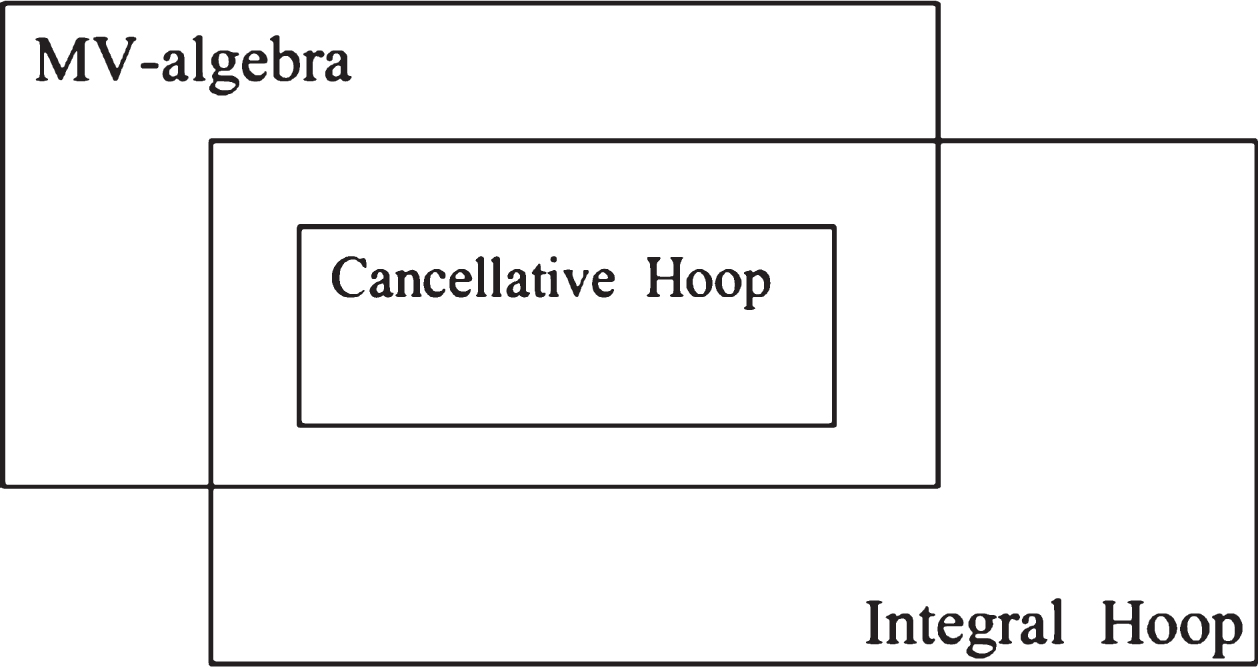
As we know, cancellative hoops form a subvariety of the variety of Wajsberg hoops, and hence it is a subvariety of the variety of MV-algebras. It is a natural problem that is there a class of hoops, which has similar properties with cancellative hoops but is not a subclass of MV-algebras? In order to study the problem we will introduce a notion of integral hoops, which is a generalization of cancellative hoops and is not MV-algebras. This is one of motivations of this manuscript.
In this paper, we introduced integral hoops and integral filters. We consider fundamental properties of integral hoops and integral filters and give some characterizations of them. Also, we prove that integral hoops are prefect and local hoops. Especially, we proved that every cancellative hoop is an integral hoop but the converse is not true. Finally, we discuss the relation between integral filters and some types of filters (obstinate, primary, prefect filters) of hoops and prove a filter F is an integral filter if and only if L/F is an integral hoop.
Preliminaries
In this section, we summarize some definitions and results about hoops which will be used in the following sections.
(L, ⊙, 1) is a commutative monoid, x → x = 1, (x ⊙ y) → z = x → (y → z), x ⊙ (x → y) = y ⊙ (y → x).
In what follows, by L we denote the universe of a hoop (L, ⊙, →, 1). For any x ∈ L, we define x0 = 1 and x n = xn-1 ⊙ x for any natural number n.
On a hoop (L, ⊙, →, 1), we define x ≤ y iff x → y = 1 for all x, y ∈ L. It is easy to check that ≤ is a partial order relation on L and for all x ∈ L, x ≤ 1. Moreover, an algebra (L, ⊙, →, 0, 1) is a bounded hoop if (L, ⊙, →, 1) is a hoop and there exists an element 0 ∈ L such that 0 ≤ x for all x ∈ L. In a bounded hoop (L, ⊙, →, 0, 1), we define the negation ¬ : ¬ x = x → 0 for all x ∈ L. If x ⊙ x = x, that is, x2 = x for all x ∈ L, then the hoop L is said to be idempotent. It is easy to check that an idempotent hoop is equivalent to an Brouwerian semilattice [7].
x ∧ y = x ⊙ (x → y), x ≤ y → x, x → 1 =1, 1 → x = x, x ≤ y ⇒ y → z ≤ x → z, x ≤ y ⇒ z → x ≤ z → y, x → (y → z) = y → (x → z), x → (y → z) = (x ⊙ y) → z, x ⊙ y ≤ z iff x ≤ y → z, x ⊙ y ≤ x, y, x ⊙ y ≤ x ∧ y, 1 ⊙ x = x and 0 ⊙ x = 0, x → y ≤ (z → x) → (z → y), x → y ≤ (y → z) → (x → z), (x → y) ⊙ (y → z) ≤ x → z, 0 → x = 1.
¬0 =1, ¬1 =0, ¬x = 1 iff x = 0, ¬x = ¬¬ ¬ x, x ≤ y ⇒ ¬ y ≤ ¬ x, x ⊙ ¬ x = 0.
if x, y ∈ F, then x ⊙ y ∈ F, if x ∈ F and x ≤ y, then y ∈ F.
Let (L, ⊙, →, 1) be a hoop. A non-empty set F of L is a filter if and only if it satisfies x, x → y ∈ F implies y ∈ F, for any x, y ∈ L. A filter of L is called a proper filter if F ≠ L. A proper filter of L is called a prime filter of L, if x ∨ y ∈ F implies x ∈ F or y ∈ F, for any x, y ∈ L. A proper filter F of L is called a maximal filter of L, if it is not properly contained in any other proper filters of L [11, 12].
An implicative filter of L, if 1 ∈ F and x → (y → z) ∈ F and x → y ∈ F imply that x → z ∈ F, for any x, y, z ∈ L. A fantastic filter of L, if 1 ∈ F and z → (y → x) ∈ F and z ∈ F imply that ((x → y) → y) → x ∈ F, for any x, y, z ∈ L. An obstinate filter of L, if F is a filter and x, y ∉ F imply that x → y ∈ F and y → x ∈ F, for any x, y ∈ L. A primary filter of L, if for any x, y ∈ L, ¬ (x ⊙ y) ∈ F imply that ¬ (x
n
) ∈ F or ¬ (y
n
) ∈ F, for some n ∈ N ∪ {0}. Proper filter F is called a prefect filter of L, if for any x ∈ L, ¬ (x
n
) ∈ F for some n ∈ N if and only if ¬ ((¬ x)
m
) ∉ F for some m ∈ N.
F is a fantastic filter of L if and only if ((x → 0) →0) → x ∈ F, for any x ∈ L, If F is an obstinate filter of L, then F is a fantastic filter of L.
f (1) =1, f (x ⊙ y) = f (x) ⊙ f (y), f (x → y) = f (x) → f (y).
If f is bijective, then the homomorphism f is called hoop isomorphism. In this case we write L1 ≅ L2.
x ≡ F y if and only if x → y ∈ F and y → x ∈ F
is a congruence relation on L. Define ·, ⇀, ⊔, ⊓ on L/F, the set of all congruence classes of L as follows: [x] · [y] = [x ⊙ y], [x] ⇀ [y] = [x → y],
[x] ⊔ [y] = [x ∨ y], [x] ⊓ [y] = [x ∧ y].
Then (L/F, ·, ⇀, ⊔, ⊓, [0], [1]) is a hoop which is called quotient hoop with respect to F.
F is a primary filter of L, L/F is a local hoop.
F is a prefect filter of L, L/F is a prefect hoop.
L is a local hoop, M (L) = {x ∈ L|x
n
≠ 0, ∀ n ∈ N ∪ {0}} is an unique maximal filter of L, for all x ∈ L, ord(x)≤∞ where ord(¬ x) ≤ ∞.
Integral hoops
In this section, we introduce a new class of hoops, called integral hoops and give some characterizations of them. Also, we discuss the relation between integral hoops and other hoops, for example, local and prefect hoops.
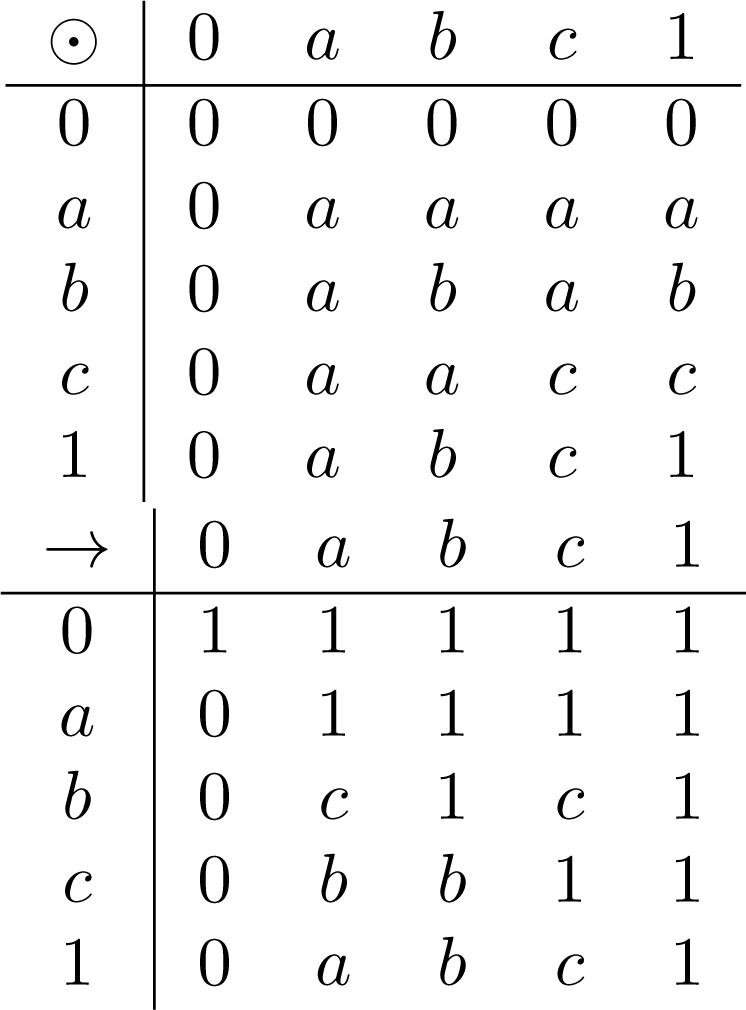
Then (L, ⊙, →, 0, 1) is a bounded hoop. One can easily to check that if x ⊙ y = 0, then x = 0 or y = 0, for any x, y ∈ L and hence L is an integralhoop.
The following example shows that any bounded hoop may not be an integral hoop.

Then (L, ⊙, →, 0, 1) is a bounded hoop, which is not an integral hoop since a ⊙ b = 0 for a, b ≠ 0.
The following example shows that the converse of Theorem 3.5 is not true in general.
L is a local hoop, M (L) = L ∖ {0}, L is a prefect hoop and ord(x)=∞ where 0 ≠ x ∈ L.
(2) Let 0 ≠ x ∈ L ∖ M (L). Then there exists minimal element n ∈ N ∪ {0} such that x n = 0 and x m ≠ 0 for any m ≤ n. Now, since xn-1 ⊙ x = 0 and L is an integral hoop, then xn-1 = 0 or x = 0, which is impossible. Hence M (L) ⊆ L ∖ {0} ⊆ M (L) and so M (L) = L ∖ {0}.
(3) Since L is an integral hoop, then by (1), L is a local hoop. Hence, by (2) and Theorem 2.15, for all 0 ≠ x ∈ L, ord(x)=∞. Moerover, if x = 0, then ord(¬ x) = ∞. Therefore, L is a perfecthoop.
F is a primary filter of L, L/F is an integral hoop.
(2) ⇒ (1) If L/F is an integral hoop, then by Theorem 3.5, F is a primary filter of L.
L is an integral hoop, L is a local hoop.
(2) ⇒ (1) Let L be a local hoop. Then by L ≅ L/{1}, L/{1} is a local hoop and by Theorem 2.12, {1} is a primary filter. Hence, by Theorem 3.10, L/{1} is an integral hoop and so L is an integralhoop.
In [3], Blok introduced a hoop called cancellative hoop if it satisfies x ⊙ y = x ⊙ z imply y = z for any x, y, z ∈ L.
The following example shows that the converse of Theorem 3.12 is not true ingeneral.
The following example shows that integral hoop is not an MV-algebra.
The following example shows that MV-algebra is not an integral hoop.
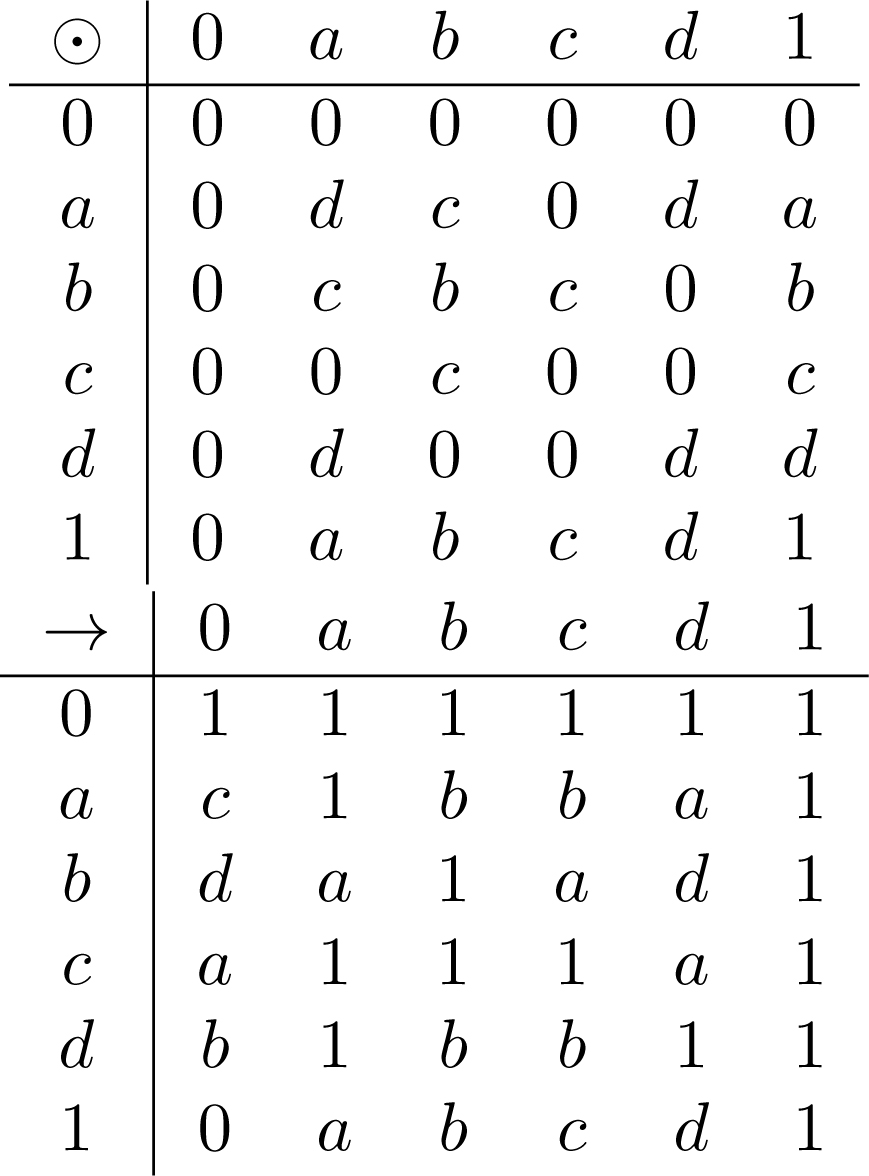
Then (L, ⊙, →, 0, 1) is an MV-algebra, which is not an integral hoop, since a ⊙ c = 0, but a ≠ 0 and c ≠ 0.
Integral filters in hoops
In this section, we introduce a new class of filters in hoops, called integral filters and give some characterizations of them. Also, we discuss the relation between integral filters and other filters in hoops, for example, primary, obstinate and prefect filters.
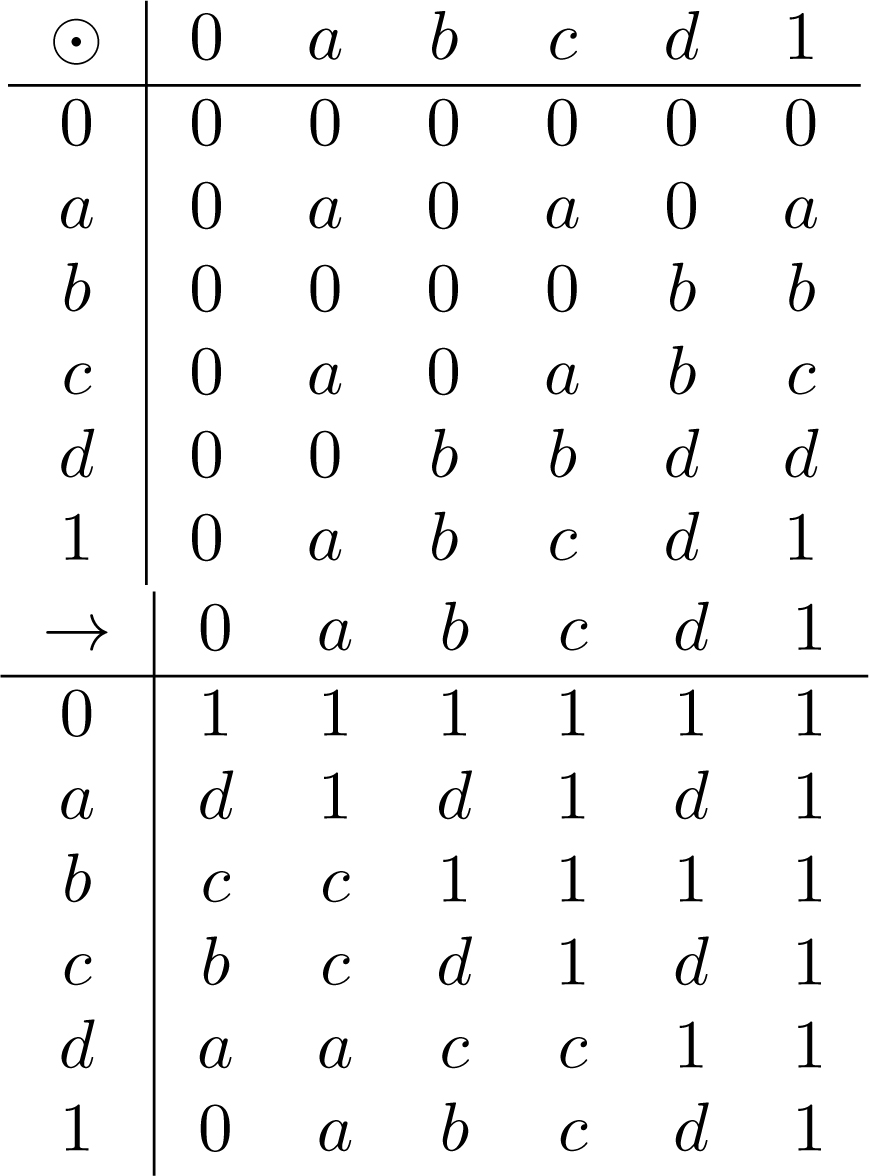
Then (L, ⊙, →, 0, 1) is a bounded hoop and F = {1, a, c} is an integral filter of L. Since if ¬ (x ⊙ y) ∈ F, then ¬ (x ⊙ y) = a or c or 1, and so x ⊙ y = b or d or 0. If x ⊙ y = b, then x = b or c and y = d. If x = b, then ¬b = c ∈ F and if x = c, ¬c = b ∉ F, but ¬d = a ∈ F. By the similar way for x ⊙ y = d or 0, we conclude that F is an integral filter.
The following example shows that the converse of Theorem 4.3 is not true in general.
F is an integral filter of L, L/F is an integral hoop.
(2) ⇒ (1) Let ¬ (x ⊙ y) ∈ F, for any x, y ∈ L. Then [x ⊙ y] = [x] · [y] = [0]. Since L/F is an integral hoop, then [x] = [0] or [y] = [0]. Therefore, ¬x ∈ F or ¬y ∈ F.
{1} is an integral filter of L, any filter of L is an integral filter, L is an integral hoop.
(1) ⇒ (3) Since L ≅ L/{1} and {1} is an integral filter, then by Theorem 4.6, L/{1} is an integral hoop and so L is an integral hoop.
(3) ⇒ (1) By Theorem 4.6, the proof is clear.
L is an integral hoop, L0 = L \ {0}, where L0 = {x ∈ L ∣ x → 0 =0}.
(2) ⇒ (1) Let x ⊙ y = 0, for any x, y ∈ L. Then x ⊙ y ∉ L0 = L \ {0}. Since L0 is a proper filter, then x ∉ L0 or y ∉ L0. Therefore, x = 0 or y = 0 and so L is an integral hoop.
The following example shows that the converse of Theorem 4.10 is not correct in general.
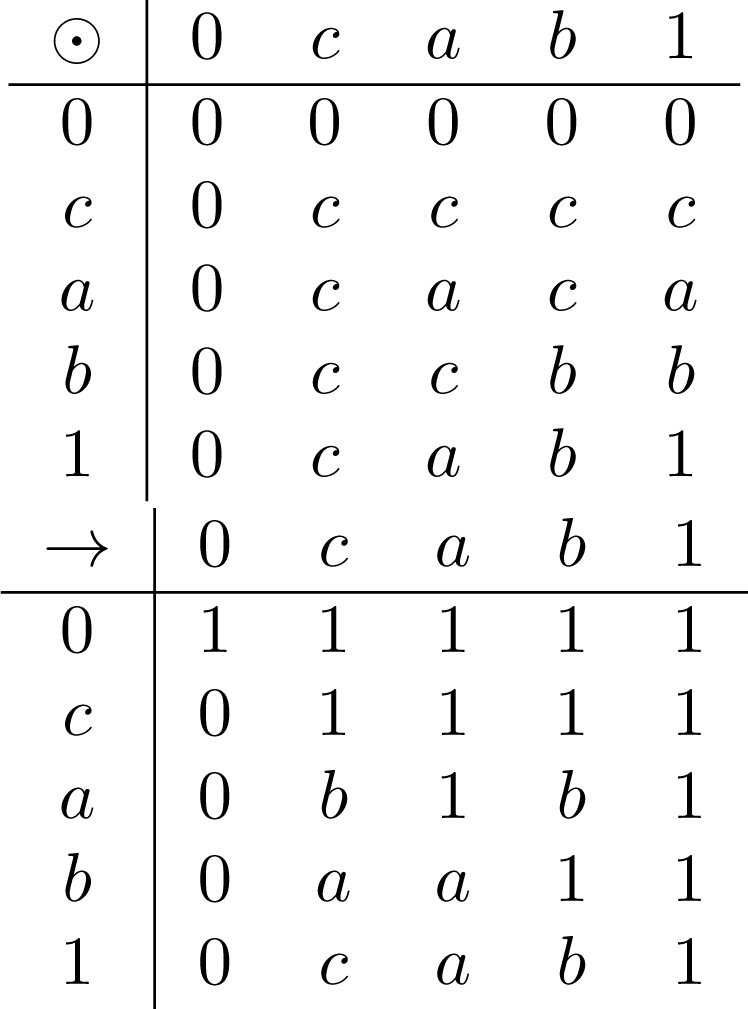
Then (L, ⊙, →, 0, 1) is a bounded hoop and it is clear that F = {b, 1} is an integral filter but is not an obstinate filter. Since, a ∉ F and 0 ∉ F, but a → 0 =0 ∉ F.
From the above example, one can see that every integral filter may not be an obstinate filter. However, if the conditions are strengthened, we can obtain that every integral filter and fantastic filter is an obstinate filter.
F is an integral filter and fantastic filter of L, F is an obstinate filter of L.
(2) ⇒ (1) By Theorem 2.6 and Theorem 4.10, we can get the proof.
Conclusions
In this paper, firstly motivated by the problem “is there a class of hoops, which has similar properties with cancellative hoops but is not a subclass of MV-algebras”, we introduce and study integral hoops, which is a generalization of cancellative hoops and is not MV-algebras. Moreover motivated by the previous research of integral filters in BL-algebras, we extended the concept of integral filters to a more generally algebraic structure, i.e. hoops. We have also presented several different characterizations and many important properties of integral filters in hoops. We also discuss the relations between integral hoops and other types of hoops and prove that an integral hoop is a perfect and local hoop. Moreover, we discuss the relations between integral filter and some types of filters in hoops. The work of this manuscript will provide some new field for study of hoops. In our future work, we will consider relations between integral hoops and abelian ℓ-groups.
Footnotes
Acknowledgments
The authors thank the editors and the anonymous reviewers for their valuable suggestions in improving this paper. This research is supported by a grant of National Natural Science Foundation of China (11571281).