



Abstract
With the increasing of the complexity of a system, there is a variety of indeterminacy in the practical applications of graph theory. We focus on uncertain random graph, in which some edges exist with degrees in probability measure and others exist with degrees in uncertain measure. In this paper, the chance theory is applied to construct the cycle index of an uncertain random graph. Then a method to calculate the cycle index of an uncertain random graph is presented. We also discuss some properties of the cycle index.
Introduction
In real life, graph theory is applied to many problems, such as vertex covering problem (Chen et al. [15]), traveling salesman problem (Ma et al. [35]), vertex coloring problem (Chen et al. [12]), and so on. In classical graph theory, these problems are often considered in a determinacy environment, in which all the edges and the vertices can be completely determined. For more research on the theoretical problems and applications of classical graph theory, we may consult Bondy and Murty [11].
As the system becomes more complex, different types of vagueness are frequently encountered in practical application of graph theory. Sometimes, it cannot be completely determined whether two vertices are joined by an edge or not. Then, a problem is arising: how to deal with these vagueness phenomena? On one hand, many researchers regarded that vagueness phenomena belonged to the fuzziness phenomena, and they introduced fuzzy set theory into the graph theory. Rosenfeld [38] introduced a fuzzy graph with fuzzy vertex set and fuzzy edge set. The membership function of the fuzzy edge set is employed by Rosenfeld [38] to describe whether two vertices were joined by an edge or not. There are some new concepts related to fuzzy phenomena in graph theory, such as: bipolar fuzzy graphs [1], intuitionistic fuzzy hypergraphs [5], strong intuitionistic fuzzy graphs [4],
On the other hand, some researchers handled the indeterminacy phenomena with randomness phenomena, and they used probability theory into the graph theory. The concept of random graph was first investigated by Erdős and Rényi [18], also by Gilbert [26] at nearly the same time. They thought that whether two vertices were joined by an edge or not can be described as a random variable. After that, many researchers, such as Alon et al. [10], Gilmer and Kopparty [27] have done a lot of works in this field.
Although randomness has been used to characterize the indeterminacy phenomena, some imprecise quantities, such as information and knowledge represented by human language, do not behave like randomness (Akram and Dudek [5], Akram and Nawaz [7]). In order to model these imprecise quantities, Liu [28] founded the uncertainty theory. In the area of graph theory, some researchers have employed the uncertainty theory to deal with imprecise quantities in graphs. The concept of uncertain graph was given by Gao and Gao [24]. In their paper, a connectedness index was introduced to measure the degree that an uncertain graph was connected. After that, Zhang and Peng [41] discussed the Euler tour in an uncertain graph. In addition, Gao [23] proposed a method to calculate the tree index, path index, and star index, and Gao et al. [25] discussed the diameter for an uncertain graph. Different from the coloring problem of classical graph, Rosyida et al. [39] introduced a new approach to color an uncertain graph based on an α-cut of the uncertain graph. Chen et al. [12] investigated uncertain vertex coloring problem based on maximum uncertain independent vertex set.
In order to propose the usefulness of uncertain graph, we explain the difference between fuzzy graph and uncertain graph. The fuzzy graph
As the system becomes more complex, the uncertainty and randomness are required to be considered simultaneously in a system. Chance theory, which was pioneered by Liu [32] via giving the concepts of uncertain random variable and chance measure, can be employed to deal with such complex system. Some basic concepts of chance theory such as chance distribution, expected value, and variance were proposed by Liu [32]. As an important contribution to chance theory, Liu [32] presented an operational law of uncertain random variables. After that, chance theory was developed steadily and applied widely. Based on the chance theory, Liu [31] initialized the concept of uncertain random graph. In an uncertain random graph, some edges exist with degrees in probability measure and others exist with degrees in uncertain measure. In the paper of Liu [31], the connectivity index of an uncertain random graph was investigated. Recently, Zhang et al. [42] considered the Euler tour in an uncertain random graph. They put forward a formula to calculate the Euler index of the uncertain random graph, and discussed some properties of the Euler index. Zhang et al. [43] investigated the matching index of uncertain random graph and gave an algorithm to compute the matching index and perfect matching index for uncertain random graph.
Cycle is one of the basic concepts of graph theory (Akram et al. [6]). A tour in traveling salesman problem is one of the representations of cycle in classical graph. The traveling salesman problem has been constructed in an uncertain environment [35]. Meanwhile, Gao [22] investigated the cycle index of uncertain graph. In order to develop some applications of cycle in uncertain random environment, we need to know whether an uncertain random graph is a cycle or not. What is the truth value that an uncertain random graph being a cycle? In order to answer this problem, we need to investigate the cycle index problem of uncertain random graph. To the best of our knowledge, no prior work has investigated the cycle problem of an uncertain random graph. In view of this fact, this paper focuses on studying the cycle index of an uncertain random graph. In this paper, the concept of the cycle index of an uncertain random graph is firstly proposed. Then a method to calculate the cycle index is presented and discussed within the framework of chance theory. We also present an algorithm to calculate the cycle index.
The remainder of this paper is organized as follows. Section 2 presents some basic concepts and theorems selected from uncertainty theory to chance theory and from classical graph to uncertain random graph. In Section 3, we discuss the results on the cycle index of an uncertain random graph, and give some examples to illustrate how to obtain the cycle index. At the end of the paper, a brief summary is presented.
Preliminary
At the beginning of this section, we would like to introduce some basic concepts and results about the uncertainty theory and the chance theory, respectively. The former is a branch of axiomatic mathematics for dealing with belief degrees, while the latter is a mathematical methodology for dealing with complex systems with both uncertainty and randomness. We also recall some fundamental definitions and results of classical graph and uncertain random graph in Subsections 2.3 and 2.4, respectively.
Uncertainty theory
Uncertainty theory is a new mathematical tool to deal with indeterminacy phenomena. Nowadays, uncertainty theory has been applied to network optimization [17], supply chain management [13, 34], portfolio selection [16], transportation problem [14], contract theory [44, 45], and supplier selection [36, 37]. In this subsection, we briefly state some basic concepts and results about uncertainty theory, which are introduced by Liu [28–30] and will be used throughout the paper.
Given a nonempty set Γ and let
The triplet
As a useful tool for describing uncertain quantity, uncertain variable is defined as a measurable function ξ from an uncertainty space
In order to measure the size of an uncertain variable ξ, the expected value of ξ was defined by Liu [28] as the following form,
Liu [29] introduced the concept of independent uncertain variables. The uncertain variables ξ1, ξ2, …, ξ
n
are called independent if
When the uncertain variables ξ1, ξ2, …, ξ
n
are represented by uncertainty distributions, the operational law was given by Liu [30] as follows. Assume that ξ1, ξ2, …, ξ
n
are independent uncertain variables with regular uncertainty distributions Φ1, Φ2, …, Φ
n
, respectively. If the function f (x1, x2, …, x
n
) is strictly increasing with respect to x1, x2, …, x
m
and strictly decreasing with respect to xm+1, xm+2, …, x
n
, then the uncertain variable
Chance theory
In many cases, uncertainty and randomness appear simultaneously in a complex system. In order to describe this phenomenon, Liu [32] first proposed the chance theory, which is a mathematical methodology for modeling complex systems with both uncertainty and randomness. As an application of chance theory, Liu [33] proposed the uncertain random programming as a branch of mathematical programming involving uncertain random variables. Besides, chance theory was applied into many fields, such as uncertain random optimization (Gao et al. [20]) and uncertain random system (Gao and Yao [21]).
Assume that
Based on chance space, an uncertain random variable was introduced by Liu [32] as follows. The uncertain random variable ξ is a function from a chance space
In order to describe uncertain random variables in practice, a concept of chance distribution of an uncertain random variable ξ was defined as Φ (x) = Ch {ξ ≤ x} for any real number
A function is said to be a Boolean function if it is a mapping from {0, 1} n to the set {0, 1}. A random variable (with a probability measure) is said to be Boolean if it takes values either 0 or 1 and an uncertain variable (with an uncertain measure) is said to be Boolean if it takes values either 0 or 1.
Classical graph
In this subsection, a formal definition of graph and some basic terminologies of graph theory are offered, which are excerpted from Bondy and Murty [11].
A loop is an edge whose endpoints are equal. Multiple edges are edges having the same pair of endpoints. A simple graph is a graph having no loops or multiple edges. The number of vertices in G is often called the order of G, while the number of edges is called its size. Every graph in this paper is simple graph with finite order. Let G be a graph with the vertex set V (G) = {v1, v2, ⋯, v
n
} and the edge set E (G) = {e1, e2, ⋯, e
m
}. The adjacency matrix of G is the n × n matrix
A graph is called disconnected if its vertex set can be partitioned into two subsets, V1 and V2, that have no common element, in such a way that there is no edge with one endpoint in V1 and the other one in V2. If a graph is not disconnected, then it is called connected. The degree of a vertex v in a graph G, denoted by deg v, is the number of edges that are incident with v. A graph G is called regular if the vertices of G have the same degree. If deg v = k for every vertex v of G, where 0 ≤ k ≤ n - 1, then G is k-regular.
A graph G of order n is a cycle if and only if it is connected and 2-regular. This conclusion is very useful in the classical graph theory, which is a necessary and sufficient condition to determine whether a graph is a cycle or not.
Uncertain random graph
Recently, Liu [31] presented a concept of uncertain random graph. In uncertain random graph, all edges are independent and some edges exist with degrees in probability measure and others exist with degrees in uncertain measure. We next introduce some denotations in uncertain random graph, which are stemmed from Liu [31].
Let
Let us define two collections of edges:
Then
From the definition of uncertain random graph, the edge set of uncertain random graph
A realization of the uncertain graph
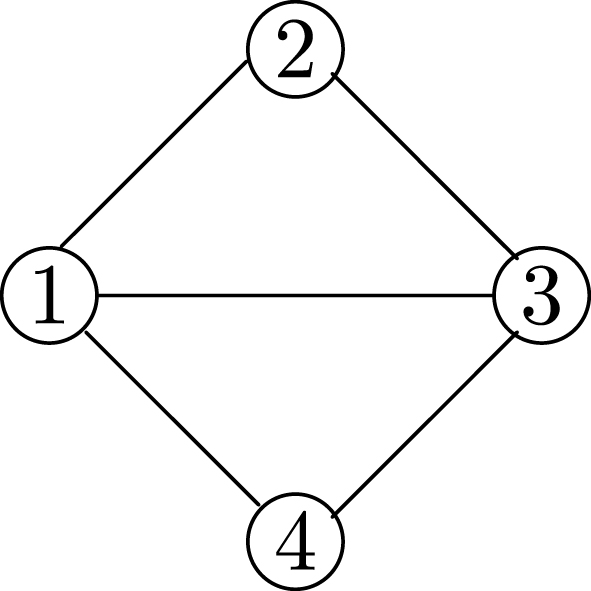
Uncertain random graph
The edges of uncertain random graph
The uncertain random graph
The uncertain random graph

Some realizations of the uncertain random graph
Similar to Liu [31], we first assume that
Next, given a matrix
In order to show how likely an uncertain random graph is connected, a connectivity index was defined by Liu [31] as follows.
For a given uncertain random graph, Liu [31] proposed a method to obtain the connectivity index of the graph. The main results can be summarized as follows.
The object of this section is to investigate how likely an uncertain random graph being a cycle. For this purpose, we first give the definition of cycle function for an uncertain random graph as follows.
Obviously,
A basic problem for us is how to calculate the cycle index when an uncertain random graph is given. The following theorem can completely solve this problem for an uncertain random graph.
Also, all uncertain edges are independent Boolean uncertain variables, being represented by
Let G be a classical graph of order n with adjacency matrix
The degree of a vertex v i is just the sum of entries in the row corresponding to it in X. As we know, a connected graph is a cycle if and only if the graph is 2-regular. That is,
Obviously, the function
It is quite well known that if a graph is cycle then it must be connected. Thus we have Corollary 3.
A property to determine the cycle index of uncertain graph, which was given by Gao [22], can be extended into uncertain random graph. Hence, we have Lemma 3.7.
Given an uncertain random graph
Next, we give an example to illustrate the application of the theoretical result and the proposed algorithm.
The uncertain random adjacency matrix of
The route needed by the salesman is a cycle of the uncertain random graph
In
In
For
In
In
For
For
In
The result can be interpreted as follows: the truth value that the salesman can find a cycle in the uncertain random graph
This paper mainly studied the cycle problem of an uncertain random graph. Firstly, we proposed a cycle index to show the chance measure that an uncertain random graph being a cycle. Following that, a formula for calculating the cycle index was presented. In addition, some simplified forms of the formula were also discussed, and an algorithm for obtaining the cycle index was designed. Finally, a numerical example was given to illustrate the proposed method.
Further research will focus on the following aspects. First, we can investigate how likely an uncertain random graph is Hamiltonian and discuss the connectedness strength of two vertices for an uncertain random graph. Second, some efficient algorithms can be employed to improve the efficiency in the process of finding the cycle index of an uncertain random graph when the size of the graph becomes larger. Finally, the diameter of uncertain random graph is an uncertain random variable (not a constant number), so studying the distribution function of the diameter of uncertain random graph may be an interesting work in the future.
Footnotes
Acknowledgments
This work was supported by the World Class Professor (WCP) Program (No. 291/D2.3/KP/2017), from the Directorate General of Resources, Science, Technology and Higher Education, Ministry of Research Technology and Higher Education of Indonesia of National Natural Science Foundation of China (Nos. 71671135, 61703438), the Key Project of Hubei Provincial Natural Science Foundation (No. 2015CFA144), the 2018 Soft Science Research Project of Technology Innovation in Hubei province (No. 2018ADC044), and the Fundamental Research Funds for the Central Universities (No. 2017IVA067).