



Abstract
Pythagorean fuzzy sets (PFSs), as an extension of intuitionistic fuzzy sets (IFSs) to deal with uncertainty, have attracted much attention since its introduction, in both theory and application aspects. The present work aims at investigating new distance measures in the PFSs and then employing them into multiple criteria decision-making application. To begin with, generalized Pythagorean fuzzy weighted averaging distance operator (GPFWAD) and generalized Pythagorean fuzzy ordered weighted averaging distance (GPFOWAD) measure are firstly introduced in the PFSs. Afterwards, probabilistic generalized Pythagorean fuzzy weighted averaging distance (P-GPFWAD) operator, probabilistic generalized Pythagorean fuzzy order weighted averaging distance (P-GPFOWAD) operator are proposed which are new distance measures and are able to integrate the (ordered) weighted averaging operator, probabilistic weight and individual distance of two Pythagorean fuzzy numbers (PFNs) in the same formulation. These generalized weighted averaging distance measures are very suitable to deal with the situation where the input data are represented in Pythagorean fuzzy numbers (PFNs). Then we present a kind of multiple criteria decision-making method with Pythagorean fuzzy information based on the developed distance measures. Finally, a numerical example is provided to illustrate the practicality and feasibility of the developed method.
Keywords
Introduction
Multi-criteria decision making (MCDM) is an effective framework for comparison and has always been used to find the most desirable one from a finite set of alternatives with respect to the predefined attributes or criteria. Due to the complexities of natural objects and give their assessments on the performance ranking and criteria weights with precise values in many real-word problems, which makes it difficult for decision makers (DMs) to avoid the uncertainty of information. Fortunately, fuzzy set [29], a generalization of classical set theory, has been found to be particularly suitable to describe the uncertainty information when one evaluates decision alternatives for MCDM problems. Fuzzy set has also drawn the attention of many researchers who have extended the fuzzy sets to interval-valued fuzzy sets (IVFSs), intuitionistic fuzzy sets (IFSs), interval-valued intuitionistic fuzzy sets (IVIFSs), various fuzzy decision making methods based on them have been constructed to handle fuzzy and uncertainty information, Blanco-Mesa et al. [2] and Merig
Among these various extensions, the intuitionistic fuzzy set (IFS) proposed by Atanassov [1] is characterized by three parameters, namely a membership degree, a nonmembership degree and a hesitation margin, it is a powerful tool to deal with uncertainty, imprecision and vagueness of information. Pythagorean fuzzy set (PFS) originally introduced by Yager [27, 28] is a useful extension of Atanassov’s IFS [1]. The main difference between the two types of fuzzy sets is that PFS is required to satisfy the constraint condition that the square sum of the membership degree and the non-membership degree is equal to or less than one but the sum of the two degrees may be more than 1, while IFS is required to satisfy the condition that the sum of the two degrees is not more than 1, so PFS has much stronger ability than IFS to model such uncertain information in MCDM problems. After that, related weighted averaging operators [8, 24], Pythagorean fuzzy aggregation operators [10, 22], related distance and similarity of Pythagorean fuzzy numbers (PFNs) [24, 33], correlation coefficient of two PFNs [9], fundamental properties of Pythagorean fuzzy sets [6, 12] have been developed to deal with some decision making problems and other aspects [5, 34].
Information measures have played the key and vital roles in the development of PFSs theory and its application. However, distance measures, a common tool for measuring the deviations of different arguments in decision making, which can be used to compare the alternatives of the problem with some ideal results and obtain the optimal choice. Therefore, the variety distance measures have been proposed, such as Hamming distance, Euclid distance, Hausdorff distance, and so on. It is worth mentioning that Merig
Based on the existing work as reviewed above about the distance measures-related OWA operator, motivated by the ideas of OWAD operator and UPOWAD operator, which are two distance measures using the OWA operator to calculate the Hamming distance, in the present work, we propose some new interval-valued Pythagorean fuzzy distances, namely, generalized probabilistic Pythagorean fuzzy weighted averaging distance (PGPFWAD) operator, generalized probabilistic Pythagorean fuzzy order weighted averaging distance (P-GPFOWAD) operator, by applying related OWA operators, probabilistic weighted (PW) information and individual distance of PFNs. They are also extensions of UPOWA operator. Compared with some existing weighted distance measures, these new Pythagorean fuzzy distance measures can deal with more complex decision making problems which include uncertain information evaluated with the PFNs, the probability information and the OWA operator. The main contributions are summarized as below: (1) introduce generalized Pythagorean fuzzy OWAD operator (GPFOWAD), which is a new aggregation operator that normalizes Pythagorean fuzzy information with OWAWA operator and distance measures; (2) introduce probabilistic generalized Pythagorean fuzzy ordered weighted averaging distance (P-GPFOWAD) operator, which is new distance measures that unifies Pythagorean fuzzy information with OWA operator, probability information and individual distance measures of two PFNs; (3) Based on P-GPFOWAD, construct a MCDM method under Pythagorean fuzzy environment with probabilistic information.
The rest of the paper is organized as follows. In Section 2, we review some definitions on PFSs, score function and accuracy function of Pythagorean fuzzy numbers (PFNs), which are used in the analysis throughout this paper. Section 3 is devoted to the main results concerning the p-distances between two PFNs and its properties. Section 4 is focused on generalized Pythagorean fuzzy weighted averaging distance (GPFWAD) measure and generalized Pythagorean fuzzy OWAD (GPFOWAD) measure, probabilistic generalized Pythagorean fuzzy ordered weighted averaging weighted average distance (P-GPFOWAD) operator and their properties. In Section 5, we construct MCDM approach based on the proposed distance measures. Consequently, a practical example is provided in Section 6 to illustrate this method, compare and analyze the validity of proposed MCDM methods. This paper is concluded in Section 7.
Pythagorean fuzzy sets
In this section, firstly some basic concepts related to IFSs, PFSs are reviewed, which are the basis of this work.
Intuitionistic fuzzy set (IFS) characterized by a membership function and a non-membership function, which is a generalization of the fuzzy set and introduced by Atannassov [1]. it can be defined as follows:
An IFS A in a finite universe of discourse X = {x1, x2, ⋯ , x
n
} is given by
However, we can encountered some decision-making problems in various real-world, the DMs (or experts) may express their preferences concerning the degree of an alternative A i with respect to a criterion C j satisfying the condition, which the sum of the degree to which the alternative A i satisfies the criterion C j and the degree to which the alternative A i dissatisfies the criterion C j is bigger than 1. Obviously, the experts’ preferences are not suitable to be described by using the IFS in this situation. For such situations, Yager [28] introduced a novel concept of Pythagorean fuzzy set (PFS) to deal with this situation, which is defined as follows:
A PFS P in a finite universe of discourse X = {x1, x2, ⋯ , x
n
} is given by
For two PFNs p1 = (μ p 1 , ν p 1 ) and p2 = (μ p 2 , ν p 2 ), a order relation ≤ on the PFNs is defined as follows:
The main difference between PFN and IFN is their corresponding constraint conditions. Obviously, an IFN must be a PFN, the converse is not true in generally. For example, p = (0.5, 0.8) is not an IFN because 0.5 + 0.8 ≰ 1. In order to compare two PFNs, Zhang [35] introduce the concept of score function, which is defined as follows:
For any PFN p = (μ
p
, ν
p
), the score function of s be defined as follows:
For any two PFNs p1, p2,
if s (p1) < s (p2), then p1 ≺ p2.
if s (p1) > s (p2), then p1 ≻ p2.
if s (p1) = s (p2), then p1 ∼ p2.
Peng [22] pointed out that it is easily known that the score function defined in above is not unreasonable. For example, when two PFNs p1 = (0.5, 0.5) and p2 = (0.6, 0.6), so p1 ∼ p2. But in fact, it is not reasonable, so Peng [22] proposed the accuracy function and modify the comparison rules.
For any PFN p = (μ
p
, ν
p
), the accuracy function of a be defined as follows:
For any two PFNs p1, p2, if s (p1) < s (p2), then p1 ≺ p2. if s (p1) = s (p2), then, if a (p1) < a (p2), then p1 ≺ p2; if a (p1) = a (p2), then p1 ∼ p2.
Ordered weighted averaging (OWA) operator [26] provides a powerful tool to aggregate multiple inputs that lie between the max and min operators, it has been used in many ranges of applications. In this section, we will introduce a kind of new distance measure, namely, generalized Pythagorean fuzzy ordered weighted distance measure (GPFOWAD). Before the introduction of GPFOWAD, we first review the concepts related to the OWA operator.
The OWAD operator is an extension of the traditional normalized Hamming distance by using OWA operator. The main difference is the reorder of arguments of the individual distance according to their values.
Motivated by the OWAD operator, we will propose the concept of generalized Pythagorean fuzzy OWAD operator (GPFOWAD). Let A = {α i = (μα i , να i ) |i = 1, 2, ⋯ , n} and B = {β i = (μβ i , νβ i ) |i = 1, 2, ⋯ , n} be two collections of PFNs. Before the GPFOWAD operators are given, we first recall the distance between two PFNs p1 = (μ p 1 , ν p 1 ) and p2 = (μ p 2 , ν p 2 ).
Hereafter, d p (p1, p2) always denote the Pythagorean fuzzy p-distance (PF p-distance) between two PFNs p1, p2 if not specify. In this paper, the symbol d p (p1, p2) just a distance defined in Eq.(5), not p powers of d (p1, p2).
d
p
(p1, p2) ≥0; d
p
(p1, p2) = d (p2, p1); d
p
(p1, p2) =0 if and only if p1 = p2; If p1 ≤ p2 ≤ p3, then d
p
(p1, p2) ≤ d
p
(p1, p3) and d
p
(p2, p3) ≤ d
p
(p1, p3).
Therefore,
Analogously, we can also prove d p (p2, p3) ≤ d p (p1, p3), and complete the proof of (4).
Let X = {x1, x2, ⋯ , x
n
} be a reference set. Consider two Pythagorean fuzzy sets
Specially, if p = 1, GPFWAD will be degenerated Pythagorean fuzzy weighted averaging distance PFWAD
If p = 2, GPFWAD will be degenerated
The fundamental aspects of Pythagorean fuzzy weighted averaging distance operator PFWAD is that it only takes the importance of the given individual distance into account, and then aggregates these difference elements together with their weights under the parameter p. Now we take the order weights into consideration and define a Pythagorean fuzzy order weighted averaging distance operator as following:
Specially, if p = 1, GPFOWAD will be degenerated the Pythagorean fuzzy ordered weighted averaging distance PFOWAD
If p = 2, GPFOWAD will be degenerated
In this section, we introduce the probabilistic generalized Pythagorean fuzzy order weighted averaging distance P-GPFOWAD operator which is a new distances that combining OWA operator, probabilistic weights and individual distances. Therefore, they can evaluate the more complex information which is imprecise and cannot be expressed with exact numbers, but all this imprecision information may be evaluated by PFNs. Its main advantage is that it can unify both concepts considering the degree of importance that they have in the specific problem considered.
In Definition 4.1, if ξ = 0, then P-GPFWAD will be reduced to GPFWAD; if ξ = 1, it will be degenerated to GPFWAD.
If p = 1, then P-GPFWAD will be degenerated probabilistic Pythagorean fuzzy weighted averaging distance operator
Assume the following weight vector ω = (0.3, 0.3, 0.4) and the probabilistic weight vector (0.4, 0.3, 0.3). Now we aggregate this information according to P-PFWAD. Taking ξ = 0.4, p = 1 and p = 2, respectively, we have
Therefore, If p = 1, then P - PFWAD (α, β) =0.36 × 0.32 + 0.30 × 0.28 + 0.34 × 0.35 = 0.3182; If p = 2, then
In Definition 4.2, the parameter ξ reflect the degree of importance of weight, 1 - ξ reflect the degree of importance of probabilistic. If ξ = 0, thenP-PFOWAD will be Pythagorean fuzzy order weight distance operator GPFOWAD; if ξ = 1, it will be degenerated to Pythagorean fuzzy order weight distance operator GPFOWAD.
If p = 1, the probabilistic generalized Pythagorean fuzzy ordered weighted averaging distance operator is P-GPFOWAD will be degenerated probabilistic generalized Pythagorean fuzzy ordered weighted averaging distance operator
In the following example, we will present a numerical example showing how to use the above distance operators in an aggregation process.
We reorder the probabilistic (0.3, 0.4, 0.3) according to d p (α i , β i )
If p = 1, then P - PFOWAD (α, β) =0.3 × 0.35 + 0.36 × 0.32 + 0.34 × 0.28 = 0.3154. If p = 2, then
So, P-GPFOWAD is reflexivity.
The P-GPFOWAD operator is bounded, monotonic and idempotent, that is,
(1) (
(2) (
(3) (
Let A = {α1, α2, ⋯ , α
n
} and B = {β1, β2, ⋯ , β
n
} be two collections of PFNs and d be a distance measures mentioned in this section. For convenience, we denote d (α1, β1) , (α2, β2) , ⋯ , (α
n
, β
n
) as d (A, B). Then following properties hold: 0 ≤ d (A, B); if d (A, B) =0 if and only if A = B, i.e.,α
i
= β
i
for all i ∈ {1, 2, ⋯ , n}; d (A, B) = d (B, A); d (A, A
c
) =1 iff A is a crisp set; If A ⊆ B ⊆ C then d (A, C) ≥ d (A, B), where C = {γ1, γ2, ⋯ , γ
n
} is a set of PFNs.
Multi-criteria decision making, which can be characterized in terms of a process of choosing sufficiently good alternative(s) from a set of alternatives to obtain a goal (or goals) in our daily life. A multi-criteria decision making problems with Pythagorean fuzzy information can be interpreted as follows:
Let X = {x1, x2, ⋯ , x m } be a set of m alternatives, C = {C1, C2, ⋯ , C n } the set of criteria and W = (ω1, ω2, ⋯ , ω n ) T be the weight vector of all criteria, which satisfy 0 ≤ ω i ≤ 1. Assume that the performance of alternative A i (i = 1, 2, ⋯ , m) with respect to criteria C j (j = 1, 2, ⋯ , n) is measured by an Pythagorean fuzzy numbers Rm×n = C j (x i ) = (μ ij , ν ij ) (j = 1, 2, ⋯ , n ; i = , 2, ⋯ , m) and (C j (x i )) m×n is an Pythagorean fuzzy decision matrix. On the basis of the the distance operators mentioned in the Section 4, we develop a new kind multi-criteria decision making approach, in which both the subjective information and the attitudinal character of the decision maker(s) are considered. The method involves the following steps:
For a MCDM problem with PFNs, the decision matrix R = (C
j
(x
i
)) m×n and be constructed or given in advance.
In order to choose the desired alternative, we can compute probabilistic generalized Pythagorean fuzzy ordered weighted distance P-GPFOWAD(A+, A i ) between the positive ideal IVPFS A+ and the alternative A i , as well as the P-GPFOWAD(A-, A i ) between the positive ideal PFS A- and the alternative A i . Intuitively, the larger the similarity P-GPFOWAD(A+, A i ), the better the alternative; while the smaller the P-GPFOWAD(A-, A i ), the better the alternative. In the classical TOPSIS method, we usually need to calculate the relative closeness index of the alternative A i with respect to the positive ideal set PIS A+ as below:
However, Hadi-Vencheh and Mirjaberi [7] pointed out that in some situations, the relative closeness cannot achieve the aim that the optimal solution should have the shortest distance from the PIS and the farthest distance from the negative ideal set NIS, simultaneously. Thus, they suggested that one may use the following formula instead of the relative closeness index
Equation (19) is called the revised closeness used to measure the extent to which the alternative A i is close to the PIS A+ and is far away from the NIS A+, simultaneously.
In this section, we consider a multicriteria decision-making problem that concerns the evaluation of the service quality among domestic airlines (adapted from Ref. [35]) to illustrate the proposed approach.
In order to improve the service quality of domestic airline, the civil aviation administration of Taiwan (CAAT) wants to know which airline is the best in Taiwan and then calls for the others to learn from it. So the CAAT constructs a committee to investigate the four major domestic airlines, which are UNI Air (x1), Transasia (x2), Mandarin (x3) and Daily Air (x4), according to the following four main criteria: Booking and ticketing service (C1), Check-in and boarding process (C2), Cabin service (C3) and Responsiveness (C4). The detailed description of the four criteria can be found in Ref. [35]. Assume that the assessment values of the alternatives with respect to each criteria provided by the committee are represented by PFNs as shown in the Pythagorean fuzzy decision matrix given in Table 1. After careful evaluation, the committee establishes the following probabilistic weights for the criteria and the OWA operator are following, respectively: P = (0.15, 0.25, 0.35, 0.25) T and W = (0.1, 0.25, 0.3, 0.35) T .
Pythagorean fuzzy decision matrix
Pythagorean fuzzy decision matrix
Determine the Pythagorean fuzzy PIS x+ and the Pythagorean fuzzy NIS x- by the score function and accuracy function. The result of scoring by using the score function as shown Table 2.
The results by using score function
From Table 2, we can see that s j (S1) (j = 1, 2, 3, 4) all are different, so do s j (S2) , s j (S3) , s j (S4) (j = 1, 2, 3, 4). Therefore, it is not necessary to calculate the accuracy of the PFNs. And so, we can obtain the Pythagorean fuzzy PIS x+ and Pythagorean fuzzy NIS x- as follows:
We can use the Equation (5), Equations (16) and (15) to calculate the P-GPFOWAD(x+, x i ) (i = 1, 2, 3, 4). For convenience, we denoteP-GPFOWAD (x i , x+) and P-GPFOWAD (x i , x-) as D (x i , x+) and D (x i , x-), respectively. The results can be found in Tables 3 and 4.
P-GPFOWAD between x i and x+
P-GPFOWAD between x i and x-
Calculate the relative closeness of x i (i = 1, 2, 3, 4, 5) according to Equation (19). The results can be found in Table 5.
Relative closeness obtained by P-GPFOWAD
From Table 5, we can see that the ranking are a bit difference by using the P-GPFOWAD when parameter p changes. All of the results show that when 0 < p < 1.2, x2 is the best alternative; when p ≥ 1.2, x3 is the most desirable alternative. When p = 1, the ranking of alternative coincide with the result by Zhang [35]. All the ranking of alternatives are also shown in Fig. 1.
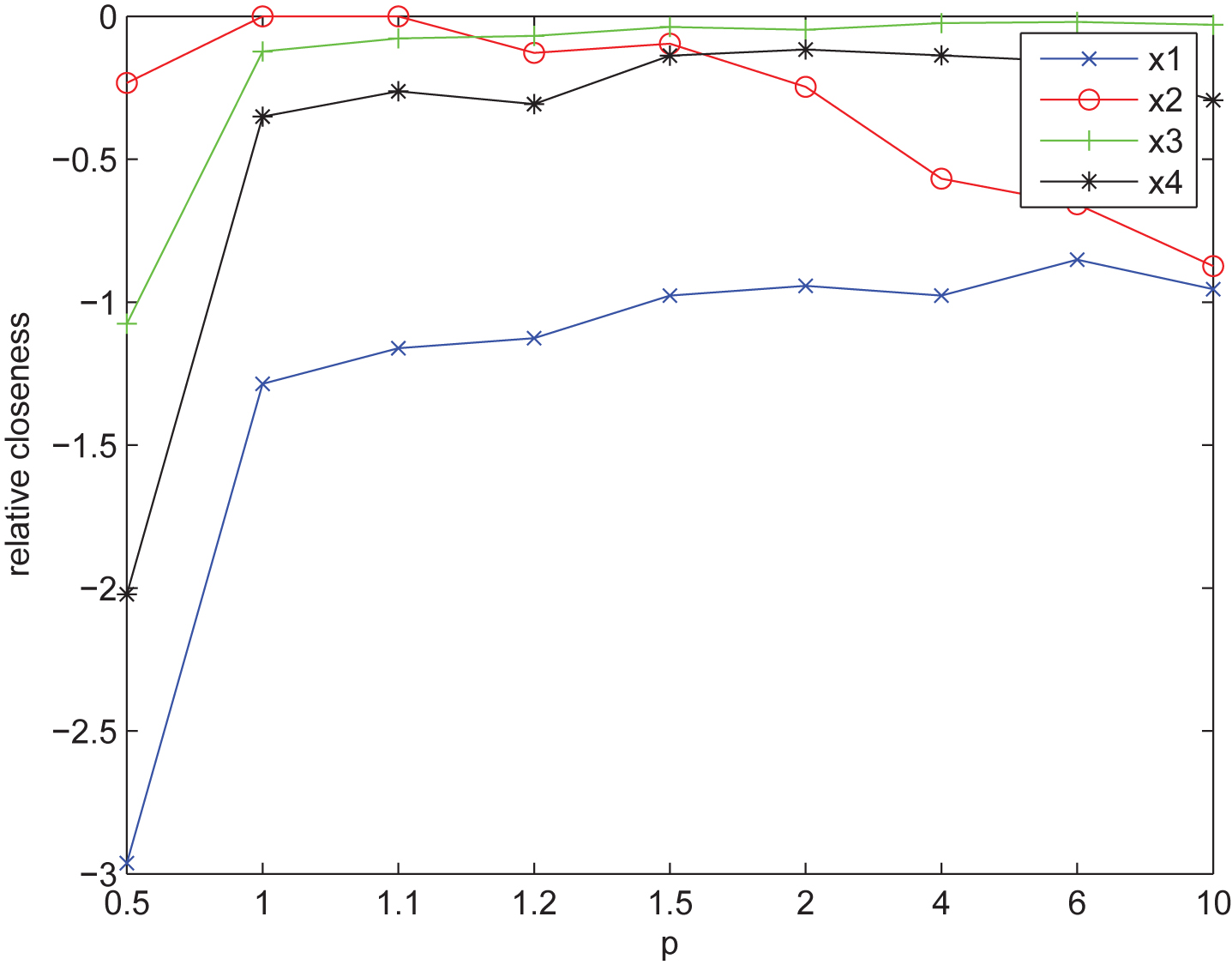
Revised closeness index obtained by P-GPFOWAD different p.
The uncertainty probabilistic OWA distance operators [32] are generally suitable for dealing with the information taking the form of interval values, and yet they will fail in dealing with interval-valued Pythagorean fuzzy information. In this paper, with respect to probabilistic decision-making problems with Pythagorean fuzzy information, new multiple criteria decision-making method is developed. Specifically, GPFWAD and GPFOWAD are developed. In addition, we developed some new distance measures with Pythagorean fuzzy information:P-GPFWAD, P-GPFOWAD which unify the OWA operators, the probability information and also use information represent in the form of Pythagorean fuzzy set. The main advantage of these new distance measures is that they can deal with more complex decision making problems which include uncertain information evaluated with the PFNs, the probability information and the OWA operator.
Decision making methods with uncertainty are always active research direction in decision making field. Kaufmann [14, 15] developed some methods of management techniques for dealing with uncertainty. Gil-Lafuente [13] developed the idea of index of maximum and minimum level and applied to athlete signing. Blanco-Mesa et al. [3, 4] developed new aggregation operators using Bonferroni means, OWA operators and some distance measure. They were able to include coefficient adequacy and the maximum and minimum levels in the same formulation with Bonferroni means and an OWA operator. The main advantages of using these operators are that they allow consideration of continuous aggregations, multiple comparisons between each argument and distance measures in the same formulation. In future research, by the help of these academical idea, we expect to develop some theories and methods of decision making with Pythagorean fuzzy information based on OWA operators and some distance measure, further to develop their applications in some real problems, especially in business decision-making and statistics.
Footnotes
Acknowledgments
The authors are grateful to the anonymous reviewers for their constructive comments and based on which the presentation of this paper has been greatly improved.