We introduce the concept of bipolar fuzzy matroids and describe some properties of various types of bipolar fuzzy matroids. We apply the notion of bipolar fuzzy matroids to graph theory and linear algebra. We present closure of a bipolar fuzzy matroid, bipolar fuzzy rank function, fundamental sequence, circuit rectangles and put special emphasis on bipolar fuzzy circuits. We also describe certain applications of bipolar fuzzy matroids in decision support system and network analysis.
Matroid theory laid down its foundations in 1935 after the work of Whitney [23]. This theory constitutes a useful approach for linking major ideas of linear algebra, graph theory, combinatorics and many other areas of Mathematics. Matroid theory have been a focus for an active research during the last few decades. But the crisp matroids do not discuss the uncertain behavior and degree of dependence of objects. To study this information loss, Goetschel [7] presented the approach of fuzzification to the class of independent subsets called fuzzy matroids. But in various absolute World decisions and problems, the data have double-sided information which cannot be dealt well by means of classical as well as fuzzy set theory. To overcome this issue, and to study two sided behavior of objects, we need the theory of bipolar fuzzy matroids. Bipolar fuzzy matroids can be applied to linear algebra, graph theory, combinatorics and many real World problems, e.g., network analysis, engineering, decision support systems, scheduling of tasks and selection of workers. Bipolar fuzzy matroids can also be used in secret sharing problem to share parts of secret information among different participants such that we have two sided information about each participant.
Fuzzy set theory owes its remarkable origin to the work of Zadeh [25] in 1965. Fuzzy set theory deals with real life data having non-linear uncertainty and vagueness. In 1994, Zhang [32] introduced bipolar fuzzy set theory as an extension of fuzzy set theory in which the membership degree range is [-1,1]. The membership degree 0 of an object, in a bipolar fuzzy set, means that the element is extraneous to the corresponding attribute, the membership value (0,1] of an object shows that the object somewhat satisfies the attribute, whereas the membership value [-1,0) of the object indicates that the object more or less satisfies the implicit counter-property. The main idea behind such characterization is linked with the existence of “bipolar information” (such as, positive information as well as negative information) about the given set. Negative information indicates what is voluntarily impossible, while positive information represents what is considered to be possible. Actually, a wide range of human thinking is based on two-sided or bipolar judgmental decisions on a negative side and a positive side. For illustration, profit and loss, hostility and friendship, competition and cooperation, conflicted interests and common interests, unlikelihood and likelihood, feedback and feedforward, and so on are generally two sides in coordination and decision making. Just like that, bipolar fuzzy set theory indeed have considerable impacts on many fields, including computer science, artificial intelligence, information science, decision science, cognitive science, economics, management science, neural science, medical science and social science. Recently, bipolar fuzzy set theory has been applied and studied a bit speedily and increasingly. Thus bipolar fuzzy sets and bipolar fuzzy graphs not only have applications in mathematical theories but also in real-world problems [6].
In 1988, Goetschel [7] presented the approach of fuzzification to matroid theory and discussed the uncertain behavior of matroids. The same authors [8–10] introduced the concept of bases of fuzzy matroids, fuzzy matroid structures and greedy algorithm in fuzzy matroids. Fuzzy matroids can be used to study the uncertain behavior of objects but if the data have bipolar information to be dealt with, fuzzy matroids cannot give appropriate results. For this reason, we need the theory of bipolar fuzzy matroids to handle data and information having two sided uncertainties. The main idea of this research paper is to apply the useful notion of bipolar fuzzy set to matroid theory and check into thoroughly some basic properties of various types of bipolar fuzzy matroids. We apply the notion of bipolar fuzzy matroids to graph theory and linear algebra. We present closure of a bipolar fuzzy matroid, bipolar fuzzy rank function, fundamental sequence, circuit rectangles and put special emphasis on bipolar fuzzy circuits. We also describe certain applications of bipolar fuzzy matroids in decision support system and network analysis.
We have used basic ideas and terminologies throughout the paper. For different notations, concepts and terminologies which are not mentioned within the paper, the reader are directed to [1–5, 28–31]. We will use bold symbols for the degree of membership of elements throughout the paper.
Preliminaries
The term crisp matroid has various equivalent definitions. We use here the simplest definition of matroid.
Definition 2.1. If Y is a non-empty universe and I is any subset of P (Y), the power set of Y, satisfying the following conditions,
If B1 ∈ I and B2 ⊂ B1 then , B2 ∈ I,
If B1, B2 ∈ I and |B1| < |B2| thenthereexists B3 ∈ I suchthat B1 ⊂ B3 ⊆ B1 ∪ B2 .
Then the pair M = (Y, I) is called a matroid and I is known as the family of independent subsets of M.
Definition 2.2. [7] If M = (Y, I) is a matroid then the mapping R : P (Y) → {0, 1, 2, …, |Y|} defined by
is a rank function for M. If B ∈ P (Y), R is known as rank of B.
Definition 2.3. [25, 26] A fuzzy setτ in a non-empty universe Y is a mapping τ : Y → [0, 1]. A fuzzy relation on Y is a fuzzy subset δ in Y × Y. If τ is a fuzzy set on Y and δ is a fuzzy relation in Y then we can say that δ is a fuzzy relation on τ if δ (y, z)≤ min {τ (y), τ (z)} forall y, z ∈ Y.
Definition 2.4. [7] If is a power set of fuzzy subsets on Y and which satisfy the following conditions,
If and τ2 ⊂ τ1 then, ,
If and |supp (τ1) | < |supp (τ2) | then there exists such that
τ1 ⊂ τ3 ⊆ τ1 ∪ τ2,
m (τ3) ≥ min {m (τ1), m (τ2)} where, m (ν) = min {ν (y) : y ∈ supp (ν)}.
The pair is called a fuzzy matroid. is known as the collection of independent fuzzy subsets of M.
Definition 2.5. [32] A bipolar fuzzy set over a non-empty universe Y has the form , where, and are mappings.
Definition 2.6. [1] Let Y be a non-empty universe. A bipolar fuzzy relation in Y is a mapping such that and , for all y, z ∈ Y.
Definition 2.7. [1] A bipolar fuzzy graph on Y (non-empty universe) is a pair G = (B, D) where, is a bipolar fuzzy set on Y and is a bipolar fuzzy relation in Y such that,
Bipolar fuzzy circuits
In this section, we present the notion of bipolar fuzzy vector spaces, bipolar fuzzy matroids, bipolar fuzzy circuits and study their properties.
Definition 3.1. Let β be any bipolar fuzzy set on Y and t = (tp, tn), tp ∈ [0, 1], tn ∈ [-1, 0] then,
Definition 3.2. A bipolar fuzzy vector space over a field K is defined as a pair (Y, B) where, is a mapping and Y is a vector space over K such that for all c, d ∈ K and y, z ∈ Y,
Example 3.1. Let Y be a vector space of 2 × 1 column vectors over . Define a mapping B : Y → [0, 1] × [-1, 0] such that for each ,
We now show that (Y, B) is a bipolar fuzzy vector space. For , the case is trivial. So the following cases are to be discussed.
Case 1: Consider two column vectors and then, for any scalars c and d,
If either exactly one of c or d is zero or both are non-zero then, cx + du ≠ 0 and cy + dv ≠ 0 and so and .
Case 2: If and then, . If both c and d are non-zero then,
If exactly one of c or d is zero then,
Hence (Y, B) is a bipolar fuzzy vector space.
Definition 3.3. Let (Y, B) be a bipolar fuzzy vector space over K. A set of vectors is known as bipolar fuzzy linearly independent in (Y, B) if
is linearly independent,
, for all , 1 ≤ i ≤ n.
Definition 3.4. A set of vectors is said to be a bipolar fuzzy basis in (Y, B) if is a basis in Y and condition 2 of Definition 3.3 is satisfied.
Proposition 3.1.If (Y, B) is a bipolar fuzzy vector space then any set of vectors with distinct positive and negative degrees of membership is linearly independent and bipolar fuzzy linearly independent.
Proof. We prove this proposition by induction on the number of vectors, n, with distinct degree of membership. For n = 1, {y1}, the statement is trivial. Assume that the statement is true for k vectors. Let be the set of vectors with distinct positive and negative degrees of membership. Suppose are not linearly independent and hence not bipolar fuzzy linearly independent. Then there exist scalars c1, c2, …, ck such that and
It clearly shows that and . A contradiction to the fact that yk+1 has distinct positive and negative degrees of membership. Thus are linearly independent. The bipolar fuzzy linear independence of the vectors can be proved similarly. □
Proposition 3.2.Let (Y, B) be a bipolar fuzzy vector space then,
,
B (ay) = B (y) for all a ∈ K \ {0} and y ∈ Y,
If B (y) ≠ B (z) for some y, z ∈ Y then .
Proof. We prove only 3.2.1 and 3.2.3.
1. For any y ∈ Y, . By Definition 3.2, , for every y ∈ Y. Hence . Similarly, it can be proved that .
3. Suppose for y, z ∈ Y, B (y) ≠ B (z). Without loss of generality, assume that . By Definition 3.2, . Also, . Hence, . Other cases can be proved similarly. □
Remark 3.1. If is a bipolar fuzzy basis of (Y, B) then the membership value of every element of Y can be calculated from the membership values of basis elements, i.e., if then,
We now come to the main idea of this research paper called bipolar fuzzy matroids and bipolar fuzzy circuits.
Definition 3.5. Let Y be a non-empty finite set of elements and be a family of bipolar fuzzy subsets, is a bipolar fuzzy power set of Y, satisfying the following the conditions,
If , and β2 ⊂ β1 then, ,
If and |supp (β1) | < |supp (β2) | then there exists such that
β1 ⊂ β3 ⊆ β1 ∪ β2,
mp (β3) ≥ min {mp (β1), mp (β2)}, , i = 1, 2, 3,
mn (β3) ≤ max {mn (β1), mn (β2)}, , i = 1, 2, 3.
Then the pair is called a bipolar fuzzy matroid on Y, and is a family of independent bipolar fuzzy subsets of .
Note 3.1. is the family of dependent bipolar fuzzy subsets in . A minimal dependent bipolar fuzzy set is called a bipolar fuzzy circuit. Equivalently, a bipolar fuzzy set is a bipolar fuzzy circuit in if and for each β ⊂ α. The family of all bipolar fuzzy circuits is denoted by . A bipolar fuzzy circuit having n number of elements is called a bipolar fuzzy n-circuit. A bipolar fuzzy matroid can be uniquely determined from because the elements of are those members of that contain no member of .
Definition 3.6. Let Y be a non-empty universe. For any bipolar fuzzy matroid, the bipolar fuzzy rank function is defined as,
where, . Clearly the bipolar fuzzy rank function of a bipolar fuzzy matroid possesses the following properties:
If and β1 ⊆ β2 then λr (β1) ≤ λr (β2),
If then, λr (β) ≤ |β|,
If then, λr (β) = |β|.
We now describe the concept of various matroids and bipolar fuzzy matroids by examples.
Examples
A trivial example of a bipolar fuzzy matroid is known as an bipolar fuzzy uniform matroid which is defined as,
It is denoted by where, l is any positive integer and |Y| = n. The bipolar fuzzy circuit of is a bipolar fuzzy subsets α such that |supp (α) | = l + 1.
Consider the example of a bipolar fuzzy uniform matroid where, Y = {e1, e2, e3} and such that for any , β (y) = τ (y), for all y ∈ Y where,
The bipolar fuzzy circuit of is {(e1, 0.2, - 0.3), (e2, 0.4, - 0.5), (e3, 0.1, - 0.3)} .
A bipolar fuzzy linear matroid is derived from a bipolar fuzzy matrix. Assume that Y represents the column labels of a bipolar fuzzy matrix and βx denotes a bipolar fuzzy submatrix having those columns labeled by Y. It is defined as, columns of βx are bipolar fuzzy linearly independent}, is the power set of all bipolar fuzzy submatrices labeled by elements in Y. For any , .
Let Y = {1, 2, 3, 4} be a set of column labels of bipolar fuzzy 2 × 1 vectors over such that for any , βx (y) = A (y) where,
Take then, is a bipolar fuzzy matroid on Y. The family of dependent bipolar fuzzy subsets of is {{3}, {1, 3}, {1, 4}, {2, 3}, {3, 4}} ∪ {η : η ⊆ A, |supp (η) |≥3}. For β = {2, 4}, μr (β) =0.9 .
A bipolar fuzzy partition matroid in which the universe Y is partitioned into bipolar fuzzy sets δ1, δ2, …, δr such that
for given positive integers l1, l2, …, lr. The circuit of a bipolar fuzzy partition matroid is a bipolar fuzzy subset α such that |supp (α) ∩ supp (δi) | = li + 1 .
The very important class of bipolar fuzzy matroids are derived from bipolar fuzzy graphs. The detail is discussed in Proposition 3.3. The bipolar fuzzy matroid derived using this method is known as bipolar fuzzy cycle matroid, denoted by where, Y = {y1, y2, …, yn} is the set of edges and is defined as,
is a bipolar fuzzy set on X ⊆ Y} . Clearly is an independent set of if and only if supp (β) is not an edge set of any cycle. Equivalently, the members of are bipolar fuzzy graphs β such that supp (β) is a forest.
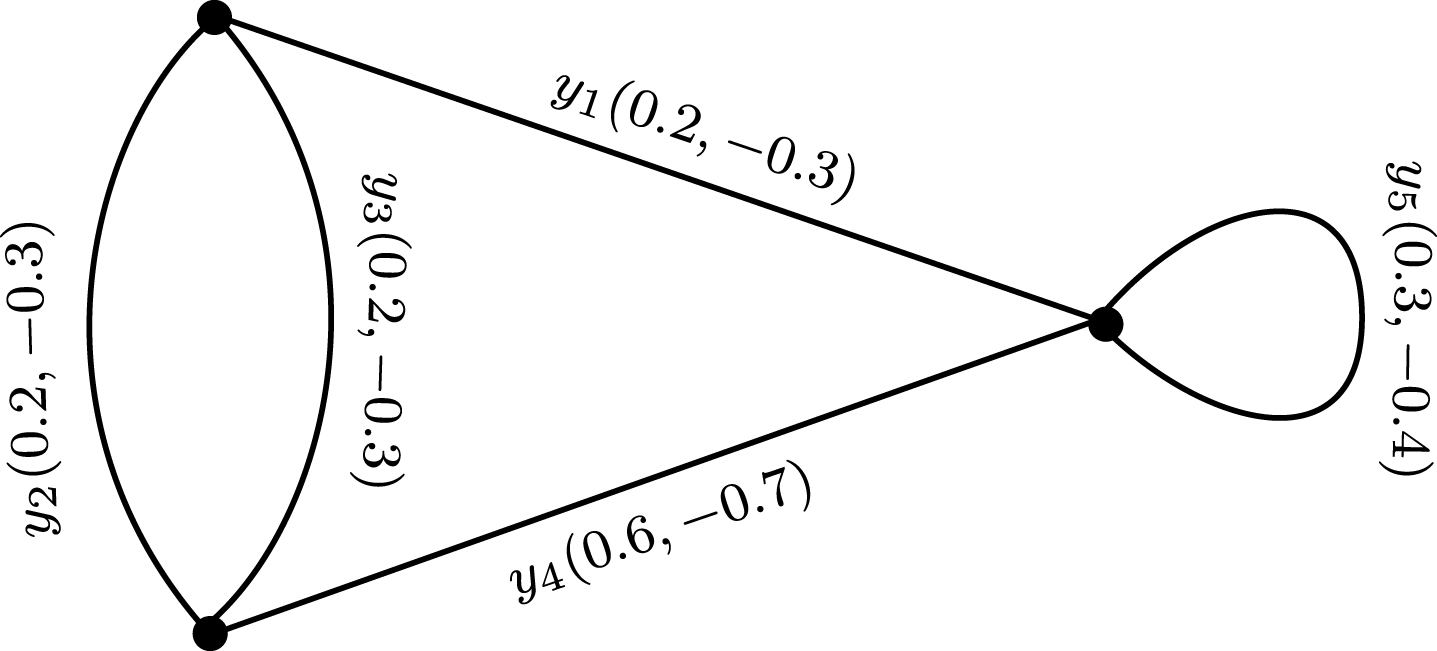
Consider the example of a bipolar fuzzy cycle matroid where, Y = {y1, y2, y3, y4, y5} and for any, , β (y) = D (y), (C, D) is a bipolar fuzzy multigraph with edge set Y as shown in Fig. 1. By Proposition 3.3,
Proposition 3.3.For any any bipolar fuzzy matroid , if is the family of bipolar fuzzy edge sets α such that supp (α) is the edge set of a cycle. Then is the family of bipolar fuzzy circuits on .
The proof of Proposition 3.3 follows from Example 4.
Example 3.2. For any bipolar fuzzy graph G = (C, D) and t = (tp, tn), 0 ≤ tp ≤ 1, -1 ≤ tn ≤ 0 define, , Ft = {F|F isaforestinthecrispgraph (Y, Et)}, where, E (F) is the edge set of F.
Then is a matroid for each t. Define {β∈ βt∈ for each t = (tp, tn), 0 ≤ tp ≤ 1, -1 ≤ tn ≤ 0} then, is a bipolar fuzzy cycle matroid.
Theorem 3.1.Let be a bipolar fuzzy matroid and, for each t = (tp, tn), 0 ≤ tp ≤ 1, - 1 ≤ tn ≤ 0, define . Then (Y, φt) is a matroid on Y.
Proof. We prove conditions 1 and 2 of Definition 2.1. Assume that β1t ∈ φt and α ⊆ β1t. Define a bipolar fuzzy set by
Clearly β2 ⊆ β1, and β2t = α therefore, α ∈ φt. To prove condition 2, let α1, α2 ∈ φt and |α1| < |α2|. Then there exist β1 and β2 such that β1t = α1 and β2t = α2. Define and by
It is clear that . Since is a bipolar fuzzy matroid there exists β3 such that . Since
Therefore, there exists a set α3 such that
Also, α1 ⊆ α3 ⊆ α1 ∪ α2, α3 ∈ φt. Hence is a matroid on Y. □
Remark 3.2. Let be a bipolar fuzzy matroid and, for each t = (tp, tn), 0 ≤ tp ≤ 1, -1 ≤ tn ≤ 0, be a matroid on a finite set Y as given in Theorem 3.1. As Y is finite, so there is a finite sequence t0, t1, t2, …, tm, , such that is a crisp matroid, for each 1 ≤ i ≤ m, and
,
if w = (wp, wn), and ,
If for s = (sp, sn), and then, , 0 ≤ i ≤ m - 1,
If and then, , 0 ≤ i ≤ m - 2.
The sequence t0, t1, t2, …, tm is known as fundamental sequence of . Let for 1 ≤ i ≤ m. The decreasing sequence of crisp matroids is known as indeced matroid sequence.
Definition 3.7. Let t0, t1, …, tm be the fundamental sequence of a bipolar fuzzy matroid. For any t = (tp, tn), 0 < tp ≤ 1 and -1 ≤ tn < 0, define where, and , . If and . Define
for each t = (tp, tn), 0 < tp ≤ 1 and - 1 ≤ tn < 0} .
Then is known as closure of .
Example 3.3. We now explain the concept of closure by an example of a bipolar fuzzy uniform matroid where, Y = {y1, y2, y3} and such that for any , β (y) = τ (y), for all y ∈ Y where,
The fundamental sequence of is {t0 = (0, 0), t1 = (0.2, - 0.3), t2 = (0.3, - 0.4), t3 = (0.4, - 0.5)}. From routine calculations, , , . Now , , . Hence the closure of can be defined as,
Theorem 3.2.The closure of a bipolar fuzzy matroid is also a bipolar fuzzy matroid.
The proof of Theorem 3.2 is a clear consequence of Theorem 3.1.
Definition 3.8. A bipolar fuzzy matroid with fundamental sequence t0, t1, …, tm is known as a closed bipolar fuzzy matroid if for each t = (tp, tn), and , .
Remark 3.3. Note that the closure of a bipolar fuzzy matroid is closed and that it is the smallest closed bipolar fuzzy matroid containing . Also the fundamental sequence of and is same.
Theorem 3.3.Let be a bipolar fuzzy matroid and suppose then, if and only if for each t = (tp, tn), βt ∈ φt where, tp ∈ Rp (β), tn ∈ Rn (β).
Theorem 3.3 follows from the proof of Theorem 3.1.
Theorem 3.4.If is a closed fuzzy matroid, then each dependent bipolar fuzzy set in properly contains a dependent bipolar fuzzy subset.
Proof. Assume that α is a dependent bipolar fuzzy set in and , where, and . By Theorem 3.3, there exists ti, 1 ≤ i ≤ m, such that αti ∉ φti. Since is a closed bipolar fuzzy matroid therefore, there is an ɛ = (ɛp, ɛn), ɛp > 0, ɛn < 0 such that for each t = (tp, tn), , ,
Let γ be a proper bipolar fuzzy subset of α defined by
Note that γti-ɛ ∉ φti-ɛ and hence by Theorem 3.3, . □
As a consequence of Theorem 3.4, we adopt the following definition of a bipolar fuzzy circuit.
Definition 3.9. Let be a bipolar fuzzy matroid. Then is bipolar fuzzy circuit in if and for each z ∈ supp (α), where α ∖∖ z is defined as,
We now characterize the properties of bipolar fuzzy circuits in the form of crisp circuits.
Theorem 3.5.(Characterization Theorem) Assume that is a bipolar fuzzy matroid and . Let and where, and . Then α is a bipolar fuzzy circuit in if and only if
αt1 is a crisp circuit in (Y, φt1),
αti ∈ φti, for 2 ≤ i ≤ m.
Proof. Let α be a bipolar fuzzy circuit then, . By Theorem 3.3, there exists at least one i, 1 ≤ i ≤ m, (say, i = i′) such that αti′ ∉ φti′. We now show that i′ = 1. On contrary, assume that 2 ≤ i′ ≤ m. Since and therefore, αti′ ⊂ αt1. Then there exists, z ∈ αt1 \ αti′. Clearly, (α \\ z) ti′ = αti′ ∉ φti′.
It follows from Theorem 3.3 that which is a contradiction to the supposition that α is a bipolar fuzzy circuit. Thus, for 2 ≤ i ≤ m, αti′ ∈ φti′ and it establishes 3.5.2.
We now prove 3.5.1. It is clear that αt1 ∉ φt1. If αt1 is not a circuit then, there exist B ⊂ αt1 such that B ∉ φt1. If x ∈ αt1 \ B then, B ⊆ (α \\ x) t1 ⇒ (α \\ x) t1 ∉ φt1. So, by Theorem 3.3, . A contradiction to the fact that α is a bipolar fuzzy circuit and it establishes 3.5.1.
Conversely, let satisfies 3.5.1 and 3.5.2. By Theorem 3.3, . Suppose that y ∈ supp (α) then, and . Hence (α \\ y) t1 = αt1 \ y ∈ φt1 and for 2 ≤ i ≤ mαti ⊇ (α \\ y) ti ∈ φti. Clearly, by Theorem 3.3, and so α is a bipolar fuzzy circuit. □
We can say that a bipolar fuzzy circuit α is elementary if it is an elementary bipolar fuzzy set, i.e., α is single valued on supp (α).
Corollary 3.1.Let be a bipolar fuzzy matroid then, α is a bipolar fuzzy circuit in if and only if α = λ ∪ γ where, λ is an elementary bipolar fuzzy circuit, and supp (γ) ⊂ supp (λ).
Proof. Assume that α is a bipolar fuzzy circuit in , and where, and . Define λ and γ as,
Consequently, λ is an elementary bipolar fuzzy circuit, , supp (γ) ⊂ supp (λ) and α = λ ∪ γ.
Conversely, let α = λ ∪ γ, λ is elementary, and supp (γ) ⊂ supp (λ). If and where, and then, , , and . It follows from Theorem 3.5 that,
αt1 is a circuit in φt1,
For 2 ≤ i ≤ m, αti ∈ φti.
Thus, by Theorem 3.5, α is a bipolar fuzzy circuit. □
Note 3.2. Corollary 3.1 implies that every bipolar subset of a bipolar fuzzy circuit is either a bipolar fuzzy circuit or an independent bipolar fuzzy set.
Corollary 3.2.Suppose that is a bipolar fuzzy matroid and . If then, there exists a bipolar fuzzy circuit α such that α ⊆ γ.
Proof. Let and . By Theorem 3.3, there exists ti such that γti ∉ φti. Let B ⊆ γti be a circuit in (Y, φti) and define by
Then α ⊆ γ and , , supp (α) = B and hence α is a bipolar fuzzy circuit. □
Theorem 3.6.If α1 and α2 are bipolar fuzzy circuits in a bipolar fuzzy matroid and α1 ⊆ α2 then, supp (α1) = supp (α2).
Proof. Let α1 and α2 be two bipolar fuzzy circuits in . On contrary, assume that supp (α1) ⊂ supp (α2) then, there exists y ∈ Y such that y ∈ supp (α2) \ supp (α1). Moreover, and hence, . A contradiction to the supposition that α1 is a bipolar fuzzy circuit. □
Circuit rectangles
We now introduce and discuss the notion of circuit rectangles and circuit function.
Definition 3.10. The truncation of a bipolar fuzzy set β at level t = (tp, tn) is a bipolar fuzzy set defined as,
If is a bipolar fuzzy matroid then, define by
The function η is known as circuit function for β.
Example 3.4. Consider the example of a bipolar fuzzy uniform matroid as given in Example 1. Take β = {(e1, 0.2, - 0.3), (e2, 0.4, - 0.5), (e3, 0.1, - 0.3)}.
For t = (0.2, - 0.3), .
For t = (0.1, - 0.3), .
For t = (0.4, - 0.5), .
Clearly, η (β) = (0.2, - 0, 3). If we take β = {(e1, 0.2, - 0.3), (e2, 0.4, - 0.5)} then, η (β) = (1, - 1).
Theorem 3.7.Let be a bipolar fuzzy matroid and η is a circuit function for β. Then the following conditions hold.
If is not a bipolar fuzzy circuit then, η (β) = (1, - 1).
If β is a bipolar fuzzy circuit then, ηp (β) ≥ mp (β) and ηn (β) ≤ mn (β).
Proof. 1 . Since β is not a bipolar fuzzy circuit therefore, for t = (1, - 1), . Consequently, η (β) = (1, - 1).
2 . Let , and , 1 ≤ i ≤ m. For t ∈ {t1, t2, …, tm-1}, is not a bipolar fuzzy circuit and for , is a bipolar fuzzy circuit. For and , . Hence, ηp (β) ≥ mp (β) and ηn (β) ≤ mn (β). □
Definition 3.11. Let be a closed bipolar fuzzy matroid and α be a bipolar fuzzy circuit in . Let I (α) = [mn (α), 0) × (0, mp (α)] is called circuit rectangle for α.
Theorem 3.8.Let α be a bipolar fuzzy circuit in a closed bipolar fuzzy matroid . Let I (α) = [mn (α), 0) × (0, mp (α)] be a circuit rectangle for α then,
If t ∈ I (α) then, αt is a circuit in .
If t ∉ I (α) then, αt ∈ φt.
Proof. By Theorem 3.1, α = δ ∪ γ, where δ is an elementary bipolar fuzzy circuit, , and supp (γ) ⊂ supp (δ). Clearly, and Rn (α) = {mn (α)}. If tp > mp (α) and tn < mn (α) then, αt = γt ∈ φt. If 0 < tp ≤ mp (α) and 0 > tn ≥ mn (α) then, αt = supp (δ). Hence αt is a circuit in if t ∈ I (α). □
Applications: Bipolar fuzzy matroids have interesting applications in graph theory, combinatorics, algebra and many applications in addition to Mathematics. Bipolar fuzzy matroids are used to discuss the uncertain behavior of objects if the data have incomplete information. We now discuss applications of bipolar fuzzy matroids in decision support system and network analysis.
1. Decision support system: Bipolar fuzzy matroids can be used in decision support systems to find the ordering of n tasks to be fulfilled in q days if each task requires full day attention. All tasks are available at 0 time and each task has a profit pp associated with it, and a penalty pn to be paid if it is not completed at deadline d. The profit can be gained if each task j is completed at the deadline dj. The problem is to find a bipolar fuzzy ordering of tasks to maximize the total profit. It doesn’t look like a bipolar fuzzy matroid problem because bipolar fuzzy matroid problem asks to find an optimal bipolar fuzzy subset, but this problem requires to find an optimal schedule. However, this is a bipolar fuzzy matroid problem. The profit and penalty of any ordering can be determined by a bipolar fuzzy subset of tasks that are on or before time.
For a bipolar fuzzy subset S of deadlines {d1, d2, …, dn} corresponding to tasks T = {t1, t2, …, tn} if there is a ordering such that every task in S is on or before time, and all tasks out of S are late. The procedure for the selection of tasks is given in Algorithm 1 whose time complexity is O(n2n).
Algorithm 1
Input the deadline di corresponding to each task ti and set Y = {(ti, di) ∣1 ≤ i ≤ n}.
Input the profit and penalty corresponding to each task ti.
doi from 1 → 2n
supp (βi) ∈ P (Y)
doj from 1 → |supp (βi) |
yj ∈ supp (βi)
end do
end do
Calculate cost= max {cost (βi) ∣1 ≤ i ≤ 2n}
Choose a subset βi such that cost = cost (βi).
Construct a bipolar fuzzy matroid of tasks and deadlines such that,
To perform only |supp (β) | number of tasks on time, any bipolar fuzzy subset of |supp (β) | elements can be chosen from the bipolar fuzzy matroid to gain maximum profit.
As an example consider a set of eight tasks t1, t2, …, t8 with deadlines d1, d2, …, d8. If a task ti is completed on or before deadline, it gains a profit , and if it is late the penalty to be paid is . The percentage profit and penalty associated with each task is given in Table 1. The family of a particular number of bipolar fuzzy tasks that maximize the profit is a bipolar fuzzy matroid. Any bipolar fuzzy subset S of tasks will maximize the profit if is maximum. The bipolar fuzzy matroid is given as,
Decision Support System
Task
Deadline
Profit
Penalty
Task
Deadline
Profit
Penalty
t1
d1
0.8
0.7
t5
d5
0.6
0.8
t2
d2
0.5
0.6
t6
d6
0.7
0.3
t3
d3
0.6
0.8
t7
d7
0.8
0.4
t4
d4
0.9
0.5
t8
d8
0.5
0.1
If d1 < d2 < … < d8 then, the subset supp (S) = {d4, d6, d7, d8} will maximize the profit. If we want to perform only 3 tasks on time then any bipolar fuzzy subset of three elements can be chosen from the bipolar fuzzy matroid and similarly.
2. Network analysis: Bipolar fuzzy matroids can be used in network analysis problems to determine the minimum number of connections for wireless communication. The procedure for the selection of minimum number of locations from a wireless connection is explained in the following steps.
Input the n number of locations L1, L2, …, Ln of wireless communication network.
Input the adjacency matrix ξ = [Lij] n2 of locations.
From this adjacency matrix, arrange the positive membership values in increasing order and negative membership values in decreasing order.
Select an edge having minimum positive membership value and maximum negative membership value.
Repeat Step 4 so that the selected edge does not create any circuit with previous selected edges.
Stop the procedure if the connection between every pair of locations is set up.
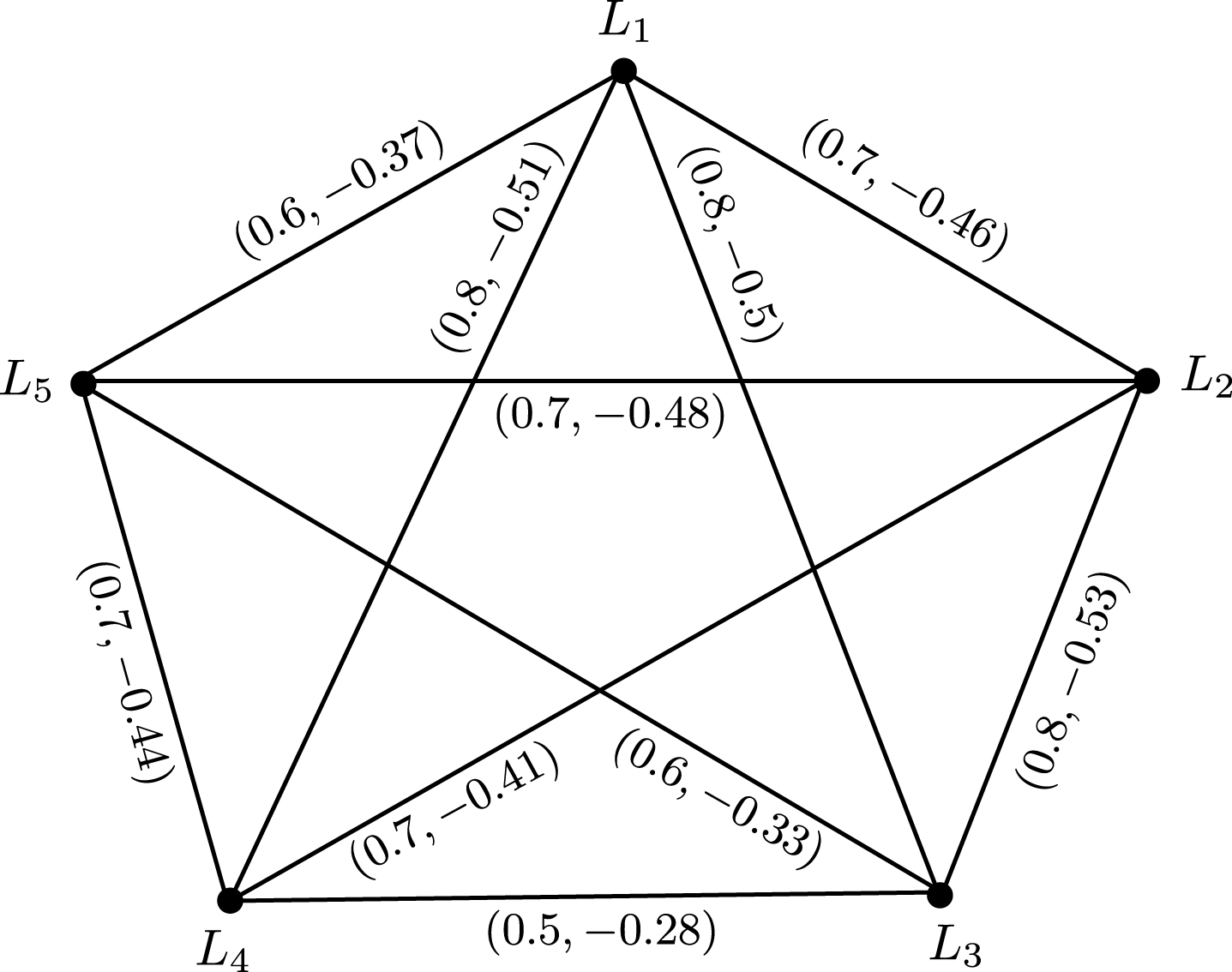
Here we explain the use of bipolar fuzzy matroids in network analysis. Bipolar fuzzy graph in Fig. 2 represents a wireless communication between five locations L1, L2, L3, L4, L5. The positive degree of each edge shows the signal damage through this path, and negative degree indicates the strong signal strength in sending a message from one location to the other. Each pair of vertices is connected by an edge. But, in general, we do not need connections among all the vertices because the vertices linked indirectly will also have a message service between them, i.e., if there is a connection from L2 to L3 and L3 to L4 then we can send a message from L2 to L4 even if there is no edge between L2 and L4. The problem is to find a set of edges such that we are able to send message between every two vertices under the condition that the signal disturbance is minimum. The procedure is as follows. Arrange the positive membership values of edges in increasing order and negative membership values in decreasing order as, {(0.5, - 0.28), (0.6, - 0.33), (0.6, - 0.37), (0.7, - 0.41), (0.7, - 0.44), (0.7, - 0.46), (0.7, - 0.48), (0.8, - 0.5), (0.8, - 0.51), (0.8, - 0.53)}. At each step, select an edge having minimum positive membership value and maximum negative membership so that it does not create any circuit with previous selected edges. The bipolar fuzzy set of selected edges is,
Wireless communication.
Conclusions
A matroid is one of the most useful mathematical tools which is used in linear algebra, graph theory and various branches of Mathematics. Bipolar fuzzy models constitute a generalization of Zadeh’s fuzzy models. In this research paper, we have introduced the concept of bipolar fuzzy matroids and bipolar fuzzy circuits. We also have presented certain applications of bipolar fuzzy matroids in decision support system and network analysis. If we have multiple parameters having uncertain behavior then these applications can also be discussed with generalized soft networks. We are extending our work to (1) Decision support systems based on intuitionistic fuzzy soft circuits, (2) Fuzzy rough soft circuits, (3) and Neutrosophic soft circuits.
Competing Interests: The authors declare that there is no conflict of interest regarding the publication of this article.
Footnotes
Acknowledgments
The authors are highly thankful to the Associate Editor, and the anonymous referees for their valuable comments and suggestions.
References
1.
AkramM., Bipolar fuzzy graphs, Information Sciences181(24) (2011), 5548–5564.
2.
AkramM., Bipolar fuzzy graphs with applications, Knowledge-Based Systems39 (2013), 1–8.
3.
AkramM. and DudekW.A., Regular bipolar fuzzy graphs, Neural Computing and Applications21(1) (2012), 197–205.
4.
AkramM. and SarwarM., Novel applications of m-polar fuzzy hypergraphs, Journal of Intelligent and Fuzzy Systems32(3) (2017), 2747–2762.
5.
AkramM. and SarwarM., Transversals ofm-polar fuzzy hypergraphs with applications, Journal of Intelligent and Fuzzy Systems32(1) (2017), 351–364.
6.
AkramM., Al-shehriN.O., DavvazB. and AshrafA., Bipolarfuzzy digraphs in decision support systems, Journal of Multi-Valued Logic and Soft Computing27 (2016), 531–551.
7.
GoetschelR. and VoxmanW., Fuzzy matroids, Fuzzy Sets and Systems27(3) (1988), 291–302.
8.
GoetschelR. and VoxmanW., Bases of fuzzy matroids, Fuzzy Sets and Systems31(2) (1989), 253–261.
9.
GoetschelR. and VoxmanW., Fuzzy matroids and a greedy algorithm, Fuzzy Sets and Systems37(2) (1990), 201–214.
10.
GoetschelR. and VoxmanW., Fuzzy matroid structures, Fuzzy Sets and Systems41(3) (1991), 343–357.
11.
HanZ.Q., WangJ.Q., ZhangH.Y. and LuoX.X., Group multi-criteria decision making method with triangular type-2 fuzzy numbers, International Journal of Fuzzy Systems (2015), 1–12.
12.
HeY., HeZ. and ShiL., Multiple attributes decision making based on scaled prioritized intuitionistic fuzzy interaction aggregation operators, International Journal of Fuzzy Systems (2016), 1–15.
13.
HsuehY.-C., On fuzzification of matroids, Fuzzy Sets and Systems53 (1993), 319–327.
14.
KoczyK.T., Fuzzy graphs in the evaluation and optimization of networks, Fuzzy Sets and Systems46(3) (1992), 307–319.
15.
MathewS. and SunithaM.S., Types of arcs in a fuzzy graph, Information Sciences179(11) (2009), 1760–1768.
16.
MaX., LiuQ. and ZhanJ., A survey of decision making methods based on certain hybrid soft set models, Artificial Intelligence Review47 (2017), 507–530.
17.
MordesonJ.N. and NairP.S., Fuzzy graphs and fuzzy hypergraphs, Physica Verlag Heidelberg1998, Second Edition, 2001.
18.
NovakL.A., A comment om “Bases of fuzzy matroids”, Fuzzy Sets and Systems87 (1997), 251–252.
19.
RosenfeldA., Fuzzy graphs, Fuzzy Sets and Their Applications, Academic Press, New York, 1975, pp. 77–95.
20.
SarwarM. and AkramM., An algorithm for computing certain metrics in intuitionistic fuzzy graphs, Journal of Intelligent and Fuzzy Systems30(4) (2016), 2405–2416.
21.
SarwarM. and AkramM., Novel concepts bipolar fuzzy competition graphs, Journal of Applied Mathematics and Computing54(1-2) (2016), 511–547.
22.
WilsonR.J., An Introduction to matroid theory, The American Mathematical Monthly80 (1973), 500–525.
23.
WhitneyH., On the abstract properties of linear dependence, American Journal of Mathematics57 (1935), 509–533.
24.
YangH.L., LiS.G., YangW.H. and LuY., Notes on bipolar fuzzy graphs, Information Sciences242 (2013), 113–121.
25.
ZadehL.A., Fuzzy sets, Information and Control8(3) (1965), 338–353.
26.
ZadehL.A., Similarity relations and fuzzy orderings, Information Sciences3(2) (1971), 177–200.
27.
ZadehL.A., Toward a generalized theory of uncertainty (GTU) Ű an outline, Information Sciences172 (2005), 1–40.
28.
ZhanJ. and ZhuK., A novel soft rough fuzzy set: Z-soft rough fuzzy ideals of hemirings and corresponding decision making, Soft Computing21 (2017), 1923–1936.
29.
ZhanJ., AliM.I. and MehmoodN., On a novel uncertain soft set model: Z-soft fuzzy rough set model and corresponding decision making methods, Applied Soft Computing56 (2017), 446–457.
30.
ZhanJ., YuB. and FoteaV.-E., Characterization of two kinds of hemirings based on probability spaces, Soft Computing20 (2016), 637–648.
31.
ZhanJ., LiuQ. and HerawanT., A novel soft rough set: Soft rough hemirings and its multicriteria group decision making, Applied Soft Computing54 (2017), 393–402.
32.
ZhangW.-R., Bipolar fuzzy sets and relations: A computational framework for cognitive modeling and multiagent decision analysis, In Proc of IEEE Conf Fuzzy Information Processing Society Biannual Conference, 1994, pp. 305–309.