



Abstract
This article discusses a vendor-buyer inventory model with permissible delay in payments and controllable lead time in which the order quantity, lead time and the number of shipments delivered from vendor to the buyer in a production cycle are decision variables. Here the production process is imperfect. The lead time is crashed and the crashing cost is an exponential function of lead time. Based on the lead time demand, two models are developed, that is, lead time demand follows a normal distribution in the first model and then distribution free approach is considered in the second model to minimize the joint total expected cost per unit time. Efficient computational algorithm is designed to find the optimal solution. Numerical examples are provided to illustrate the results obtained. Sensitivity analysis is carried out to study the changes in the effect on optimal solution and some managerial phenomena are obtained through sensitivity analysis.
Introduction
A supply chain is a network of facilities that procure raw materials, transform them into intermediate goods and then final products, and finally deliver the products to customers through a distribution system that includes an inventory system [1]. Traditionally, the study of integrated vendor-buyer management has attracted considerable attention, accompanying the growth of Supply Chain Management (SCM). SCM is the oversight of materials, information and finances as they move in a process from supplier to manufacturer to wholesaler to retailer to consumer. SCM involves coordinating and integrating these flows both within and among companies. Integrated supply chain management has been gradually recognized as a core competitive strategy, since enterprises continuously seek to provide products and services to customers faster, cheaper, and better than their competitors [2]. Hill [3] developed an integrated single-vendor single-buyer production inventory model with a generalized policy. Sarmah et al. [4] gave an intended literature review to cover the entire gamut of supply chain coordination mechanism. The purpose of this article is to formulate a single vendor single buyer integrated inventory model for defective items with controllable lead time. This paper considers imperfect production processes and delay in payments. An inspection policy is used to identify the defective items. The lead time crashing cost per order is assumed to be an exponential function of lead time. The lead time demand follows a normal distribution and then we apply the distribution free approach to minimize the joint total expected cost per unit time. Our article optimizes an integrated inventory system by employing the mathematical model with variable lead time and service level constraint. Computational algorithms are framed to determine the optimal solution. Numerical examples are provided to illustrate the solution procedure. Managerial implications are discussed in detail with the help of sensitivity analysis carried.
Literature review
The cooperation between vendor and buyer for improving the performance of inventory control has received a great deal of attention, and the integration approaches were studied for years. Yao et al. [5], Zhang et al. [6], Huang et al. [7] gave an integrated vendor-buyer inventory models. Rau and Ouyang [8] considered an optimal batch size for integrated production inventory policy in a supply chain. Lin and Ho [9] developed an integrated inventory model with quantity discount and price sensitive demand. Chung [2] derived an integrated vendor-buyer production inventory model with backordering using cost-difference rate comparison approach. It is common yet unrealistic to assume that all the units produced are of good quality. The classical Economic Order Quantity (EOQ) model such as Jaggi et al. [10], Geetha and Udayakumar [1, 11], Baten and Khalid [12, 13], Udayakumar and Geetha [14–16] assume that items produced are of perfect quality, which is usually not the case in real production. Huang [17] developed an integrated inventory model for supplier and retailer with defective items. In his article, he incorporates the view of the integrated supplier-retailer approach into the inventory model with imperfect items to determine the optimum ordering quantity and number of deliveries per order. Goyal et al. [18], Sana [19], Lin and Lin [20], Ouyang et al. [21] developed vendor-buyer inventory model for defective items. Hsu and Hsu [22] developed an integrated vendor-buyer cooperative inventory model in an imperfect production process with shortage backordering.
An important component of an inventory model is the lead time, which is the amount of time between the placement of an order to replenish inventory and the receipt of the goods into inventory systems. When the demand during the cycle period is not deterministic but is stochastic, lead time becomes an important issue and its control leads to many benefits. In some practical situations, lead time and ordering cost can be controlled and reduced in various ways. The lead time can be reduced by an additional crashing cost. In this direction, Goyal [23], Ouyang et al. [24, 25], Daya and Hariga [26], developed an integrated vendor-buyer cooperative model with controllable lead time. Jha and Shanker [27] gave a single vendor-buyer production inventory model with controllable lead time and service level constraint for decaying items. Lin [28] developed an integrated vendor-buyer inventory model with backorder price discount and effective investment to reduce ordering cost.
Trade credit is an important external source of working capital financing. It is a short-term credit extended by suppliers of goods and services in the normal course of business, to a buyer in order to enhance sales. Trade credit arises when a supplier of goods or services allows customers to pay for goods and services at a later date. Ho et al. [29] gave an optimal pricing, shipment and payment policy for an integrated supplier–buyer inventory model with two-part trade credit. Ouyang et al. [30] established an optimal strategy for an integrated system with variable production rate when the freight rate and trade credit are both linked to the order quantity. Researchers like Chen and Kang [31], Huang et al. [32], Su [33], Soni and Patel [34] gave integrated inventory model under trade credit policies. Uthayakumar and Priyan [35] derived two echelon inventory models with controllable setup cost and lead time under service level constraint with permissible delay in payments for non-defective items.
To the best of our knowledge, there is no work in the literature considering imperfect production process with service level constraint. Further, the distribution of lead time demand may be known or unknown. To handle this type of situation, we have considered both distribution free approach and the case where the lead time demand is assumed to follow normal distribution. We could not find any work in the literature considering all the above mentioned concepts together. To bridge this gap, we work towards the direction of integrated inventory model for imperfect production process with service level constraint. The lead time is also crashed. The integrated approach is followed where normal distribution model and distribution free model are framed.
Notations and assumptions
Notations
The following notations are used throughout this article. Buyer’s annual demand rate in units per unit time Vendor’s production rate in units per unit time, P > D Buyer’s ordering cost per order Setup cost per production run for the vendor Probability that an item produced is defective The probability density function of ɛ Unit purchase cost paid by the buyer Unit selling price for the buyer, c
b
< p Buyer’s holding cost rate per unit per unit time Vendor’s holding cost rate per unit per unit time The freight (transportation) cost per shipment from the vendor to the buyer The length of the trade credit period Interest charge to be paid per $ per year Rate of Interest earned for the buyer $ per year Rate of Interest for calculating vendor’s opportunity interest loss due to the delay payment, $ per year Expected demand shortage at the end of the cycle, where r is the reorder point The lead time demand in units per unit time, a random variable Proportion of a demand that is not met from stock and hence (1 - α) is the service level
Buyer’s order quantity in units The length of lead time for the buyer The number of lots in which the product is delivered from the vendor to the buyer in one production cycle, a positive integer
Assumptions
The inventory model deals with single-buyer and single-vendor with single item. The buyer orders a lot size of Q units and the vendor produces nQ units with a finite production rate P, (P > D) in units per unit time in one setup but ships in quantity Q units to the buyer over n times. The buyer’s shortages are completely backordered. The production process is imperfect and may produce defective items. On arrival, the items are inspected in a complete inspection process with an inspection cost of c
i
and all defective items are returned to the vendor in the next shipment. The inspection process is shown in Fig. 1. A defective item incurs a cost of c
d
for the vendor. The vendor will sell the defective items at a reduced price to a secondary market at the end of the production period within each cycle. In other words, c
d
is the difference between the regular and the reduced selling prices. The percentage of defective items produced ɛ has a probability density function f(ɛ). To guarantee that the vendor has enough production capacity to produce the buyer’s annual demand, it is assumed that ɛ < 1 - D/P. The inventory is continuously reviewed and the order is placed whenever the inventory level falls to the reorder point r. The reorder point The lead time crashing cost per order R(L), is assumed to be an exponential function of L and is defined as
where C is a positive constant and L0 and L
b
represent the existing and the shortest lead times, respectively. M is less than the reorder point, i.e. credit period should not be longer than the time at which next order is placed. Further, the rate of vendor’s opportunity interest loss due to delay in payment is equal to the rate of interest earned for the buyer.
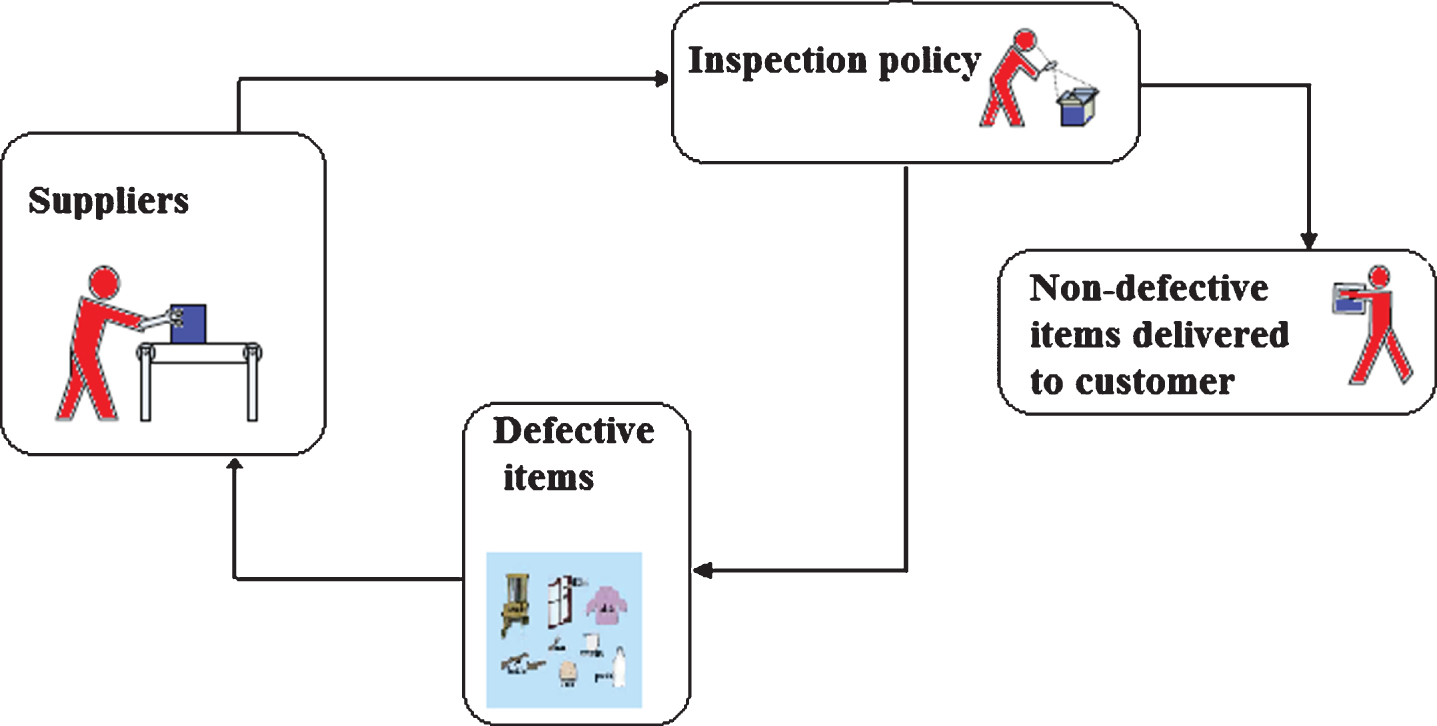
Behavior of buyer’s inspection policy.
Based on the above notations and assumptions, we develop a model for vendor-buyer integrated inventory system for defective items, with controllable lead time under permissible delay in payment to minimize the joint total expected cost.
Buyer’s expected total cost
The buyer places an order of Q units, therefore for expected cycle time of
According to our assumption, the credit period cannot be greater than the ordering time. Therefore, when the buyer’s permissible delay period expires on or before all inventories are depleted completely, the buyer can sell the items and earn interest with the rate of I
e
until the end of the credit period M. Hence, the buyer’s interest earned per unit time is
Hence the total expected annual cost for the buyer consists of ordering cost, holding cost, safety stock cost, opportunity interest cost, lead time crashing cost, interest earned and the transportation cost is expressed as
Once the buyer orders a lot size of Q units, the vendor produces the items in a lot size of nQ units in each production cycle of length nQ/D with constant production rate P units per unit time, and the buyer will receive the supply in n lots each of size Q units. The first lot size of Q units is ready for shipment after time Q/P′ just after the start of the production. During the production period, nQ/P′, the vendor’s inventory is building up at a constant rate, and simultaneously supplies a lot of size Q units to the buyer on every Q/D units of time, thus T = Q/D. By assumption, the production processes are imperfect and the probability of an item to be defective is ɛ, and hence, the vendor’s effective annual production rate P′ = P (1 - ɛ). Since ɛ < 1 - D/P, (i, e . , P (1 - ɛ) > D) , Q/P′, the time taken to produce the first shipment of Q good quality items, is less than the cycle time T. Thus, a new production run will start at time T - Q/P′ after the last shipment of each production run. Hence, the vendors holding cost per year for non-defective items are obtained using the same approach as Uthayakumar and Priyan [35].
At the beginning of each production period, there are zero defective items. After the period of production (which has duration of
Hence, the vendor’s total expected annual cost comprising, the setup cost, inspection cost, the cost of defective items, holding cost and opportunity interest loss, can be expressed as
The expected total annual cost for the vendor-buyer integrated inventory system under permissible delay in payment is given by
Normal distribution model
The lead time demand X follows a normal probability distribution function with mean DL and standard deviation
When the lead time demand follows normal distribution, service level constraint is given by
The total expected cost per unit time for the vendor-buyer integrated inventory system under permissible delay in payment is given by
Now, the problem is to find the optimal lot size, lead time, setup cost and the total number of deliveries in a production cycle that minimize the joint total expected cost
In order to find the minimum total cost for this nonlinear programming problem, we temporarily relax the integer requirement on n, and then try to find the optimal solution of EAC N (Q, L, n) with classical optimization technique by taking the first order partial derivatives of EAC N (Q, L, n) with respect to Q.
For fixed Q and L ∈ [L b , L0] , EAC N (Q, L, n) can be proved to be a convex function of n.
Therefore, for fixed Q and L ∈ [L b , L0] , EAC N (Q, L, n) is convex in n.
Now, for fixed n, we take the first partial derivatives of EAC
N
(Q, L, n) with respect to Q.
By setting the above equation equal to zero, for a given value of L ∈ [L b , L0], we obtain
Theoretically, for fixed n and L ∈ [L b , L0], we can obtain the optimal value of Q. Moreover, for fixed n, the Hessian matrix of EAC N (Q, L, n) is positive definite. (See Appendix A)
In the previous section, a model is developed under the assumption that the lead time demand follows a normal distribution. Practically, it is seen that the information about the probability distribution of the lead time is limited. Hence in this section, we assume that the density function F of lead time demand X belongs to the class of density functions with a known finite mean DL and standard deviation
try to use a mini-max distribution free procedure to solve this problem.
To solve our problem, we apply the following proposition which was asserted by Gallego and Moon [38], Annadurai and Uthayakumar [39].
Substituting
Now using (3) and inequality (8), (6) reduces to minimize
As on before, for fixed n, it can be verified that the values of Q, L and n satisfy the second order sufficient conditions and we can show that EAC
U
(Q, L, n) is a convex in Q. Hence, to find the optimal value, we take the partial derivative of EAC
U
(Q, L, n) with respect to Q.
By setting the above equation equal to zero, for a given value of L ∈ (L b , L0), we obtain
Theoretically, for fixed n and L ∈ [L b , L0], we can obtain the optimal value of Q. Moreover, for fixed n, the Hessian matrix of EAC U (Q, L, n) is positive definite. (See Appendix B)
Let
In this section we illustrate the proposed model with numerical examples.
D = 800 units/year, P = 1600 units/year, k = $200/order, k
v
= $400/setup, h
b
= $4/unit/year, h
v
= $2/unit/year, F = $25/delivery, c
b
= $10/unit, p = $30/ unit, τ= 0.75 (the value of ψ (τ) can be found directly from the standard normal table and is equal to 0.1311), σ= 15units per week, where 1 year = 52 weeks, the service level (1 - α) = 0.985, c
i
= $0.5/unit, c
d
= $25/unit, M = 0.0833 year, I
v
= 0.02 $/year, I
p
= 0.06 $/year, I
e
= 0.02 $/year, crashing cost
If the defective percentage follows a uniform distribution with
Let β = 0.02. The optimal values of Q, L and n are obtained using the computational algorithm 1 and the values are given by L* = 2 weeks, Q* = 101.56 units, number of deliveries n* = 3 and the corresponding expected total cost is EAC N (Q*, L*, n*) = $5794.50.
Sensitivity analysis
The change in the values of parameters may happen due to uncertainties in any decision-making situation. In order to examine the implications of these changes, the sensitivity analysis will be of great help in decision making. Using the numerical example, given in the previous section, the sensitivity analysis of various parameters has been done. The results of sensitivity analysis are summarized in Tables 1 to 10 and Figs. 2–10. When the demand rate D increases, the optimal ordering quantity Q* and the total expected annual cost EAC (Q*, L*, n*) increases in both the models. Increasing the vendor’s production rate P results in a decrease in the ordering quantity Q* and an increase in the total expected annual cost EAC (Q*, L*, n*) when the distribution of the lead time demand is known. Whereas, there is an increase in the ordering quantity Q* and the total expected cost EAC (Q*, L*, n*) when the distribution is unknown. When there is an increase in the buyer’s ordering cost k, there is an increase in the ordering quantity Q* and the total expected annual cost EAC (Q*, L*, n*) in both the models. There is a positive change in the total expected cost EAC (Q*, L*, n*) in both the models when the vendor’s setup cost k
v
increases. Increasing vendor’s holding cost h
v
results in a marginal change in the ordering quantity Q*. The total expected cost EAC (Q*, L*, n*) increases with respect to an increase in h
v
in both the models. There is a decrease in the optimal ordering quantity Q* and an increase in the optimal total cost in the normal distribution model, when the buyer’s holding cost rate h
b
increases. When the distribution of lead time demand is unknown, there is an increase in both the ordering quantity Q* and the total expected cost EAC (Q*, L*, n*). When α decreases, the optimal order quantity Q* and the total expected cost EAC (Q*, L*, n*) increases in both the models. There is a positive change in optimal order quantity Q* and a negative change in the total expected cost EAC (Q*, L*, n*) with respect to M in both the models.
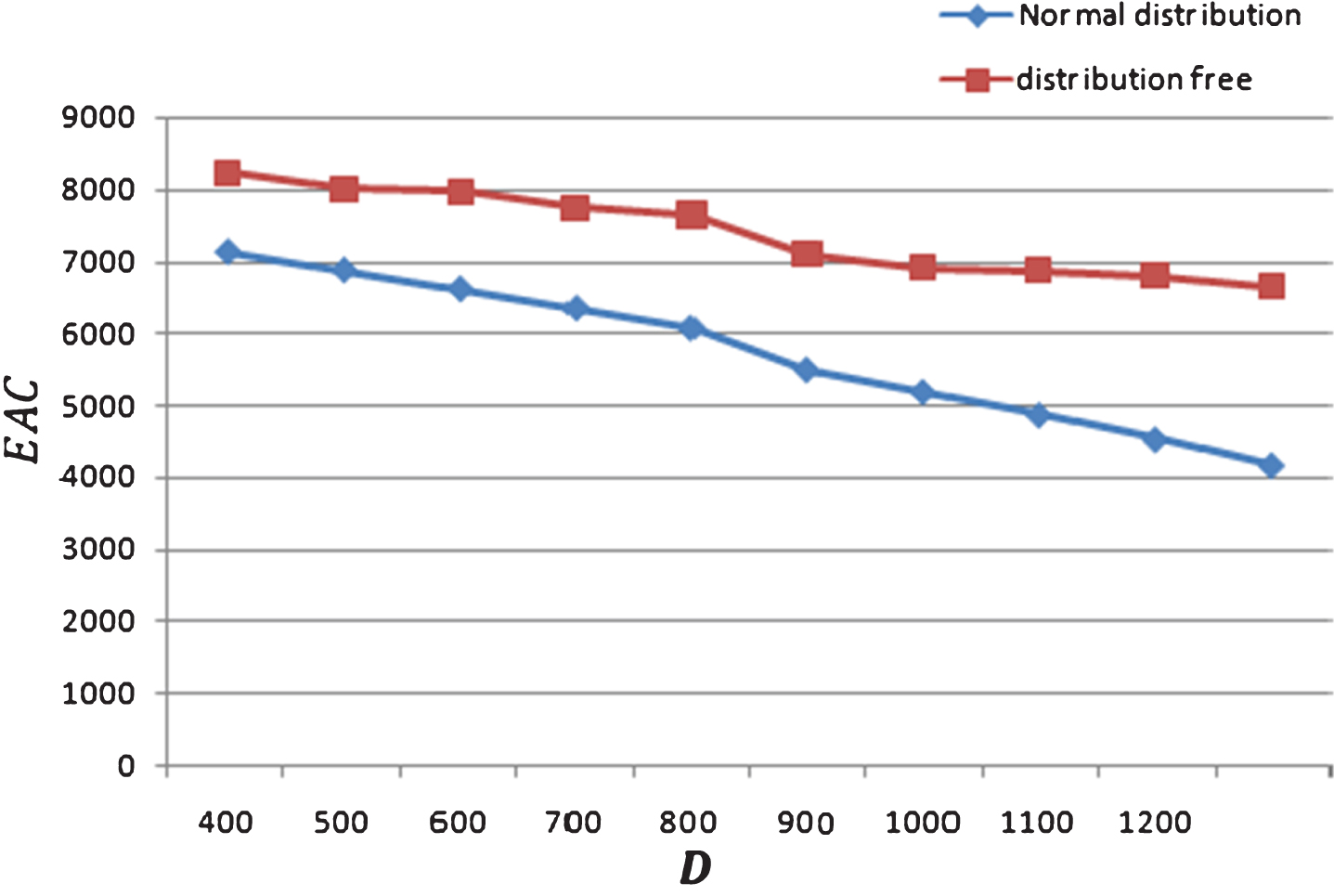
Change of demand rate (D) on EAC.

Change of production rate (P) on EAC.
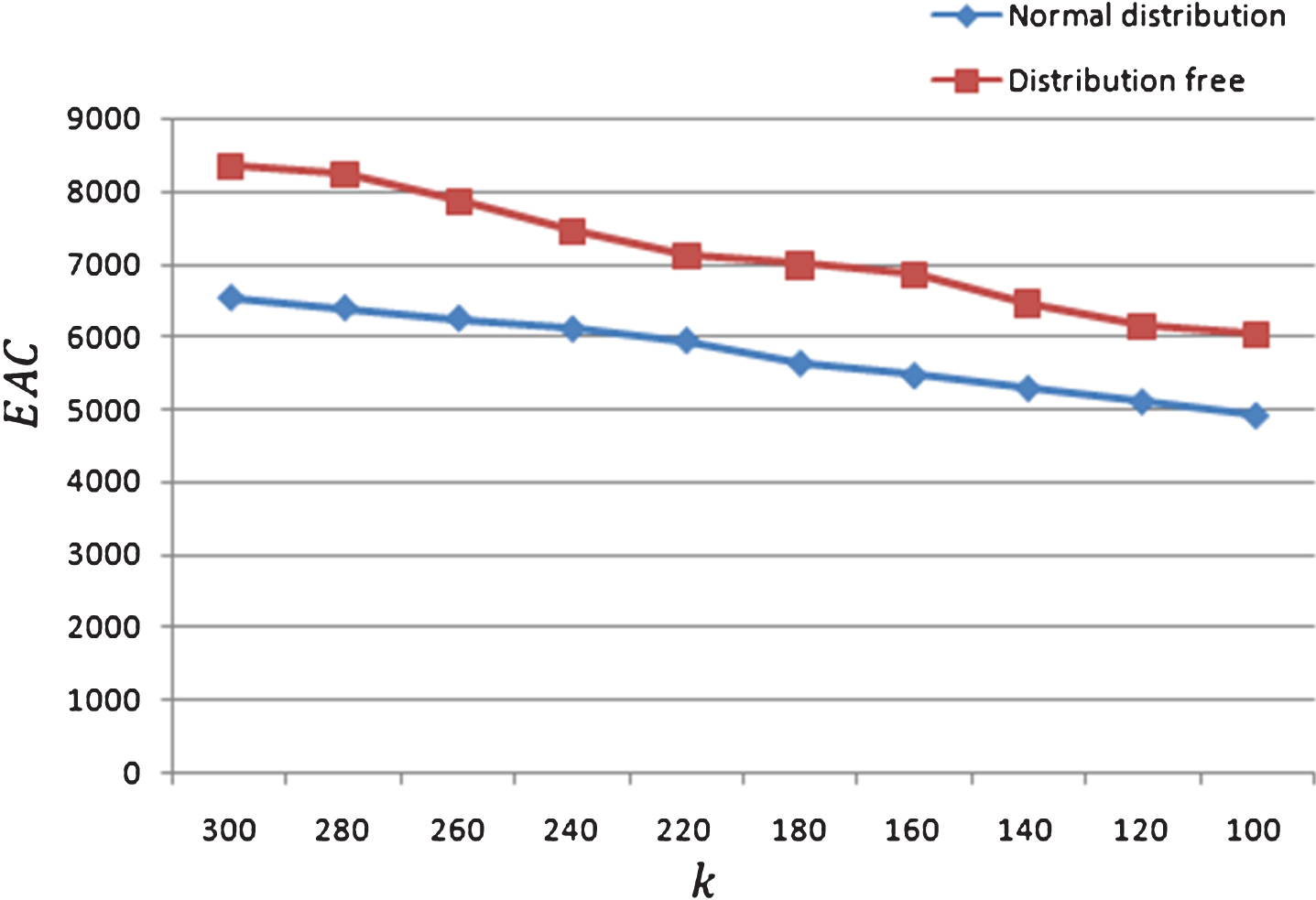
Change of ordering cost (k) on EAC.

Change of setup cost (k v ) on EAC.
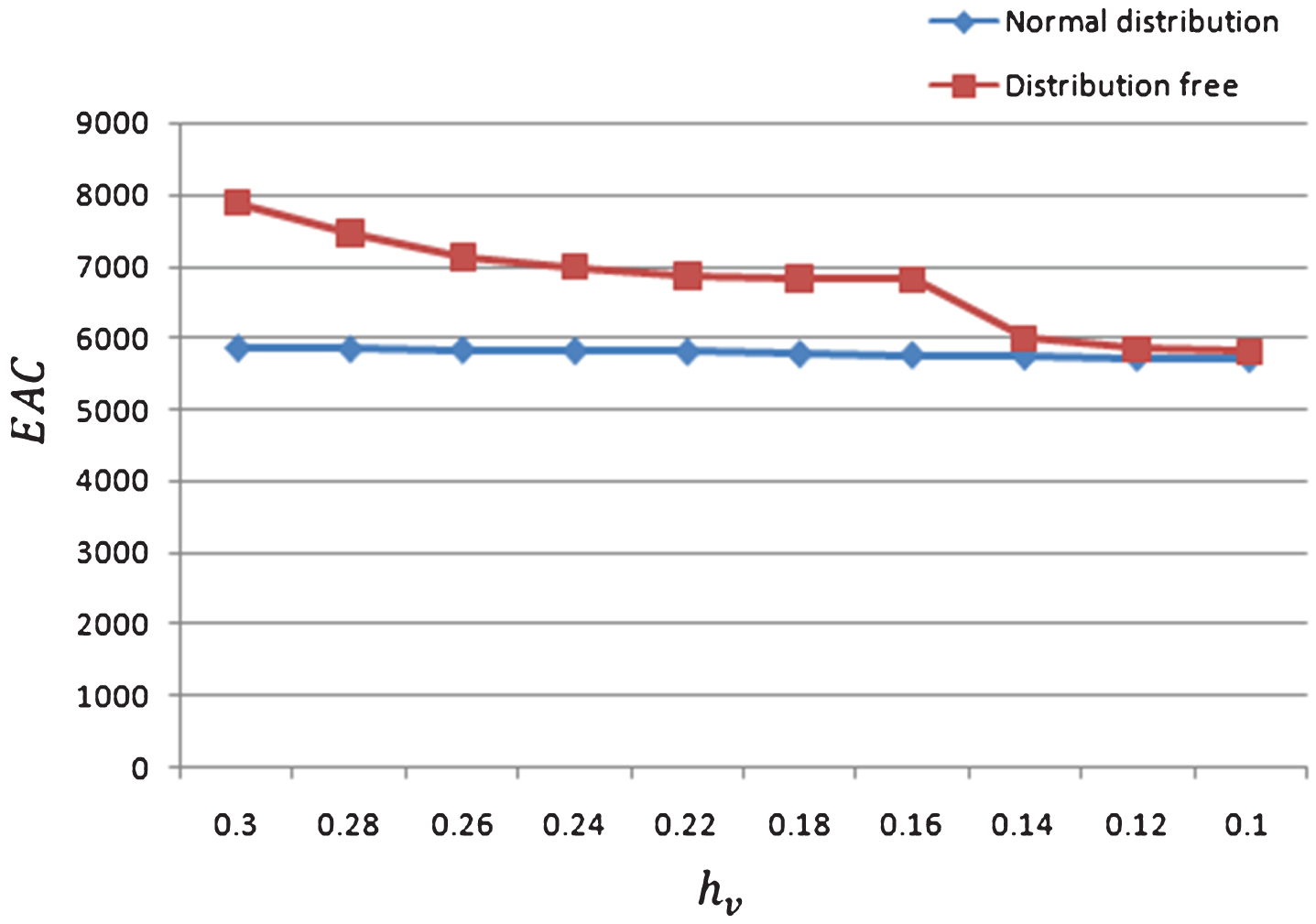
Change of vendor’s holding cost (h v ) on EAC.
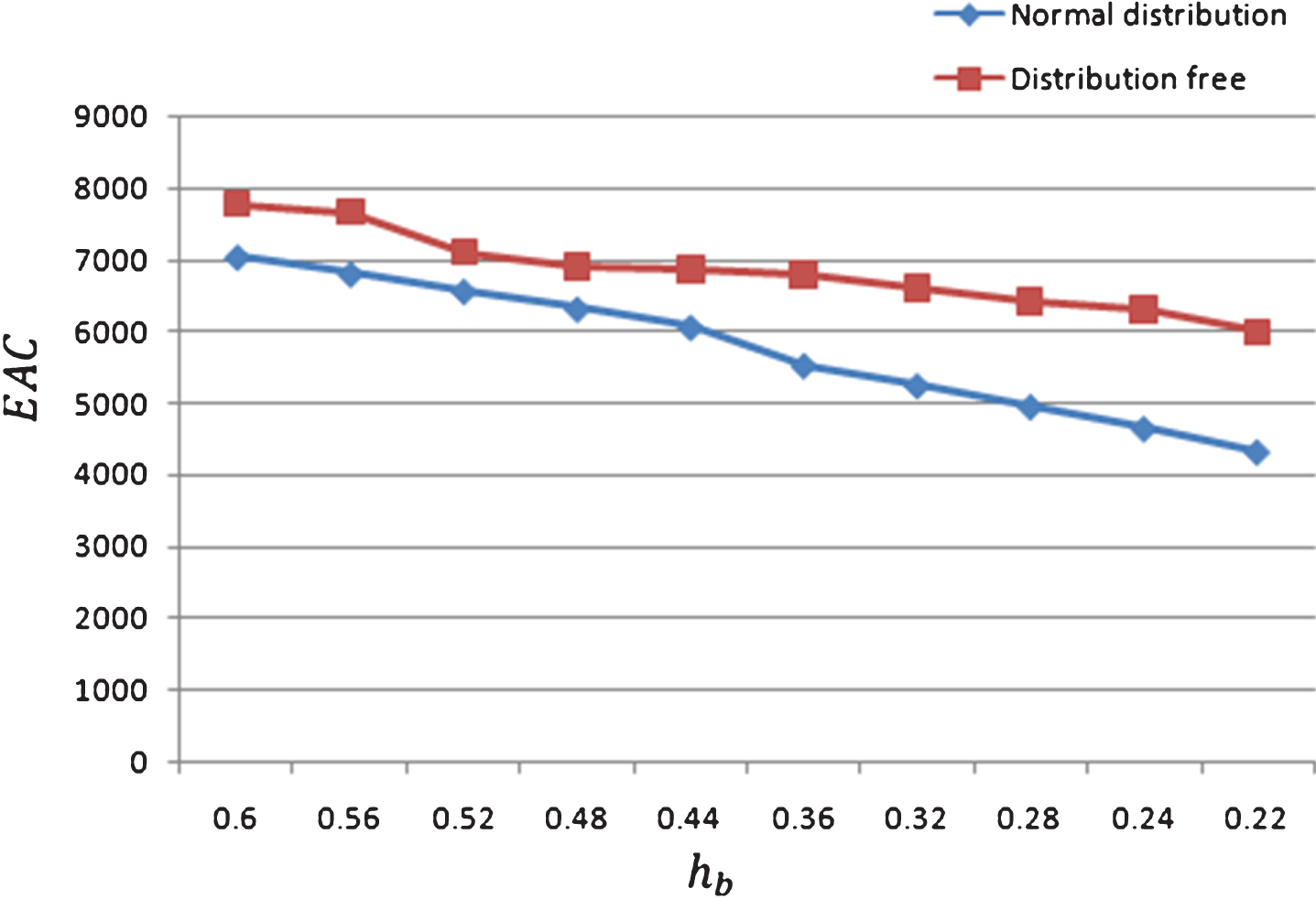
Change of buyer’s holding cost (h b ) on EAC.

Change of (β) on EAC.

Change of freight rate (F) on EAC.
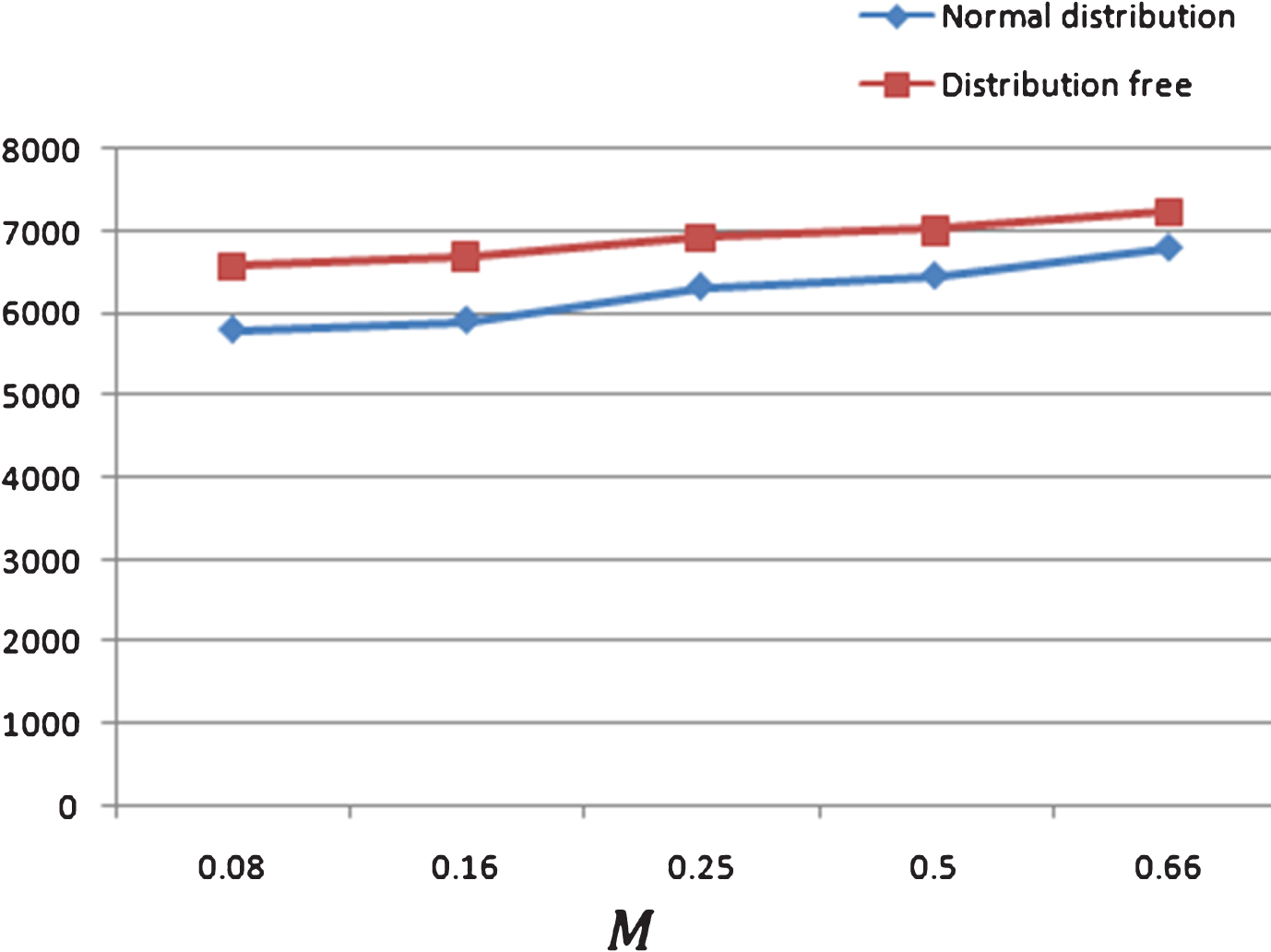
Change of freight rate (M) on EAC.
Effect of change in D on the optimal solution
Effect of change in P on the optimal solution
Effect of change in k on the optimal solution
Effect of change in k v on the optimal solution
Effect of change in h v on the optimal solution
Effect of change in h b on the optimal solution
Also, we examine the performance of the distribution free approach against the normal distribution model.
The optimal solution of the normal distribution model and the distribution free model are EAC N (Q*, L*, n*) and EAC U (Q*, L*, n*) respectively. The added cost obtained by utilizing the mini-max distribution free procedure instead of the normal distribution model is EAC N (Q*, L*, n*) - EAC U (Q*, L*, n*). This is the largest amount that we would be willing to pay for the knowledge of the probability distribution of the demand and this quantity can be regarded as the expected value of additional information (EVAI) and is given in the tables.
Using the sensitivity analysis carried, we infer the following managerial insights:
When there is an increase in Freight cost F, the total expected annual cost and the lot size Q* increases when the lead time demand follows normal distribution. But, in the distribution free model there is a positive change in the optimal order quantity Q* and a negative change in the expected annual cost. From this we infer that, when the transportation cost is high, the retailer should take necessary steps to order large quantity so that the total expected cost is minimized, when the information about the lead time demand is known and it follows normal distribution. Further, we observe that, increase in service level results in an increase in the total expected cost and the optimal order quantity, that is, the buyer could provide improved customer service and gain goodwill of the customer by ordering larger quantity. Increase in the ordering cost k, results in considerable increase in the total expected cost and the order quantity without affecting the lead time. From inventory point of view, the retailer should order more quantity per order when the ordering cost is high. The retailer may take necessary steps to reduce the ordering cost per order by some capital investment. When the demand rate is high, the vendor may lose production efficiency which results in high total cost. Therefore the design of production capacity is important in controlling production cost. Also, the benefit of the integrated model is more significant for high values of demand rate. From Table 7, it can be observed that, increase in the defective percentage ɛ (note that ɛ is uniformly distributed between 0 and β) causes the production quantity to decrease. For higher values of β, the total expected cost is also high. From managerial view point, it is advised that the supplier should find some measure to decrease the defective rate. That is, the supplier should entertain quality production to reduce the total expected cost of the supply chain. The service level constraint (which refers to the performance metrics used to measure the customer service in the supply chain) is an important tool used in industry like software development, automobile, etc. Our research results shows that these industries can provide improved customer service and gain goodwill of the customers by ordering large quantity. The design of the production capacity is also vital. The failure rate of an electronic device in the auto industry affects the entire supply chain. Our analysis shows that some effective measure should be taken to decrease the defective rate and to reduce the total expected cost of the integrated system so that customer satisfaction may be achieved.
Effect of change in β on the optimal solution
Effect of change in β on the optimal solution
Effect of change in F on the optimal solution
Effect of change in M on the optimal solution
Effect of change in α on the optimal solution
In this article, we consider the single-vendor single-buyer integrated inventory problem for defective items. Lead time demand is assumed to follow normal distribution that is suitable to certain environment. There are situations where the information about the lead time demand is limited. Distribution free approach developed in this article will be appropriate to such situations. In our study, we minimize the joint total expected cost per unit time of the vendor and buyer by simultaneously optimizing the order quantity, lead time and the number of lots delivered from the vendor to the buyer in a production cycle with service level constraint.
In day-to-day life, trade credit financing becomes an essential tool to improve sales and gain profits in any industry. This plays a vital role in the financial management of inventory control for many organizations. To suit to this type of circumstances, a decision making integrated inventory model is presented, where trade credit is offered by the supplier to encourage the retailers to buyer more products and improve sales. From the analysis carried, we observe that, when the length of the credit period is longer, the total cost of the integrated system is reduced. Therefore from managerial point of view, trade credit policy may be used to a maximum extent so that both the buyer and the vendor are mutually benefited. To ensure the quality of the products, an inspection policy is used by the supplier and the defective items are removed from the lot and only non-defective items are supplied to the buyer. Necessary steps may be taken by the buyer to order large quantity to provide better customer service. The proposed model is well suitable to industries producing mobile phones, computers, textiles, healthcare products, automobiles etc. In future, this work may be extended by considering inflation rate, different types of demand, price discount and setup cost reduction. The fuzzy nature of the lead time demand may be considered as future work.