




Abstract
In this paper we formulate a dynamic economic emission and spinning reserve dispatch (DEESRD) problem which determines the optimal power and spinning reserve schedule by simultaneously minimizing the power and spinning reserve costs, and the amount of emission under some constraints. Demand response (DR) can improve the reliability and reduce the energy price. In this paper, we focus on Game Theory DR program which is one of the incentive-based DR programs. We incorporate DR into the DEESRD problem by formulating dynamic economic emission and spinning reserve dispatch with demand response (DEESRD-DR) problem. The objective of the DEESRD-DR is to minimize the energy and reserve costs, minimize the amount of emission and maximize the benefit of the generation company (GENCO). The optimal solutions of the DEESRD and DEESRD-DR problems can be obtained using artificial intelligent-based optimization techniques such as differential evolution, particle swarm optimization, artificial immune system, artificial bee colony, etc., however these methods give an open-loop optimal solution. The open-loop nature cannot deals with inaccuracies, modeling uncertainties and unexpected external disturbances where the power system components suffer from, therefore we have designed closed-loop solutions by model predictive control (MPC). The performance of the MPC has been investigated by applying the MPC strategy to the DEESRD and DEESRD-DR problems with test system consisting of five generating units and five customers.
Keywords
Introduction
Dynamic economic dispatch (DED) problem has received considerable attention during the recent years. The objective of the DED problem is to satisfy the predicted load customer’s demand over a certain period (e.g. 24 hours) at minimum generation cost taking into consideration the ramp rate limits of the thermal generating units [1–14]. Several researchers have devoted their efforts to propose optimization methods and techniques for solving the DED problem with different objectives and constraints [15–32]. To reduce the emission of gaseous pollutants produced from thermal units, dynamic economic emission dispatch (DEED) has been formulated with the purpose to minimize both fuel cost and the amount of emission and satisfy the system constraints (see e.g. [33–47]).
In regulated and deregulated power systems, spinning reserve plays an important role in maintaining the power system reliability and security against sudden load changes and generation outages. In regulated systems, the spinning reserve is taken in the static or dynamic dispatch problems as a constraint. In contrast, in deregulated environment it is important to find the optimal spinning reserve requirement. In this case, both the energy and spinning reserve costs are minimized under a set of constraints. In [48–53], the spinning reserve constraint is included into the static and dynamic dispatch problems. Joint generation and spinning reserve dispatch has been studied in [54–59], where the spinning reserve is inserted in the objective function as another optimization variable in addition to the power output variable. To incorporate the spinning reserve into the DEED problem, dynamic economic emission and spinning reserve dispatch (DEESRD) can be formulated. DEESRD is a multi-objective optimization problem which simultaneously minimize the energy and reserve costs and the amount of emission while satisfying the load demand balance form both power and spinning reserve, ramp rate constraints and other constraints.
We note that, the DEESRD problem has been formulated in view point of the generation side. In this case, electricity supplier must satisfy the demand in real time. When the demand is increased during the peak, a power plant is required to increase their power generation to meet rising demand. GENCOs and utilities face some difficulties to satisfy the load demand during the peak hours. One of the easier and cheaper option is to apply demand response (DR) programs. In this case, instead of increase the generation to satisfy the demand, GENCOs and utilities pay energy users to reduce their consumption during the peak. There are two categories for DR programs [60]. Incentive-based programs as: Interruptible/Curtailable; Direct Load Control; Emergency DR; Demand Bidding/Buyback; Ancillary Services; Game Theory DR; Capacity Market; Price based programs as: Time-of-Use; Critical Peak Pricing; Real-Time Pricing.
The main target from applying DR programs is to increase the power system efficiency and this give benefits for customers, reliability, whole market and market performance.
Recently, DR has been incorporated in the dynamic dispatch problem in [61–63] by formulating dynamic economic dispatch with demand response (DED-DR) and dynamic economic emission dispatch with demand response (DEED-DR). In [61] and [62], the spinning reserve has not been considered, while in [63], the spinning reserve is added to the DED as a constraint. Therefore, dynamic economic emission and spinning reserve dispatch with demand response (DEESRD-DR) has not been formulated before. In this paper, we have considered Game Theory DR program and then formulated the dynamic economic emission and spinning reserve dispatch with demand response (DEESRD-DR). The objective of the DEESRD-DR is to minimize the energy and reserve costs, minimize the amount of gases emission and maximize the benefit of the customers and GENCOs. Both DEESRD and DEESRD-DR problems provide open-loop solutions. The open-loop nature cannot deals with inaccuracies, modeling uncertainties and unexpected external disturbances where the power system components suffer from. A good solution of such deficiency is to design a feedback control strategy using model predictive control (MPC) method. MPC provides closed-loop solutions which has the ability to deal with disturbances that arise from real systems. MPC has been applied in power system in [64–70] and [72]. In [66, 67], the MPC has been applied for the optimal dynamic dispatch problems without taking into consideration the DR and spinning reserve. In [70], the MPC has been applied to the DEED-RD problem, however the spinning reserve has been neglected.
In this paper, we first formulate the DEESRD and DEESRD-DR problems, then we construct a feedback control by using the MPC strategy. The performance of MPC algorithm including convergence and robustness have been shown and the controller has been tested with test system consisting of five units and five customers.
Problem formulation
We devote this section to introduce the mathematical formulations of the DEESRD, DR and DEESRD-DR problems.
DEESRD formulation
In this subsection we formulate the DEESRD problem as a multi-objective optimization which simultaneously minimize the energy and reserve costs and the amount of emission so as to meet the predicted power and spinning reserve load demands over a certain period under ramp rate limits and other constraints. Let
There are two methods for solving the multi-objective problem. The first method is by finding the Pareto solutions and the second one is by combining the objectives into a single-objective function. The advantages of the second method include (i) it makes the multi-objective problem easy to solve; (ii) it gives the decision maker the ability to change the weighting factor according to the importance of each objective. The second method will be used in this paper. Let ω ∈ [0, 1] be a weighting factor, and
The price penalty factor h
t
can be determined for a particular demand D
t
as follows [71]: Evaluate the ratio between the maximum fuel cost and maximum emission for each unit as:
arrange add the maximum capacity of each unit, at this stage,
We formulate the DEESRD problem over dispatch interval [0, N T ] as:
where r is forecasted probability that the reserve is actually called up.
Subject to:
Load-generation balance
Spinning reserve and demand balance
Generating unit capacity limits
Ramp rate limits
Generating spinning reserve capacity limits
Unit power and spinning reserve coupling capacity limits
In this case we assume that the spinning reserve demand is 10% of the power demand. This means that
Now instead of solving DEESRD problem over the interval [0, N T ], we solve the problem over an arbitrary interval [k, k + N T ] for any k ≥ 0.
Let
Subject to
Then
We consider the following Game Theory DR program. Let
The parameter η
j
∈ [0, 1] describe the willingness of each customer to shed load, where η
j
= 0 for the “least willing” customer and η
j
= 1 for the “most willing” customer. We can see that as the marginal cost
The benefit for customer j at time t by:
The benefit for GENCO at time t due to the DR program is defined as:
To maximize the benefit of the GENCO over the dispatch period [0, N
T
], we introduce the following optimization problem
Subject to
In this subsection, we integrate DR program into the DEESRD problem. We formulate DEESRD-DR problem with the objective to minimize the energy and spinning reserve costs, minimize the amount of emission and maximize the benefit of the GENCO. We convert the multi-objective optimization into single-objective one using the weight factors ω1, ω2, ω3 where ω1 + ω2 + ω3 = 1. We define the following
Then the mathematical formulation of DEESRD-DR problem is given as:
Problem (15) can be solved over an interval [k, k + N
T
] for any k ≥ 0. Let
Subject to
In this section we show how to apply MPC strategy to the DEESRD and DEESRD-DR problems. It is enough to consider the DEESRD-DR problem. Consider the linear discrete time control system [67]
Substituting transformations (19) into the optimization problem (15) and constraints (2), (4)– (7), (11)– (14) and (16), we get the control version of the dynamic economic emission and spinning reserve dispatch with demand response (CV-DEESRD-DR) problem. Here, the decision variables are
At the time instant t = 2 the whole procedure is repeated.
The objective function of the DEESRD-DR are differentiable and quadratic, and
In this section, we first solve the DEESRD and DEESRD-DR problems. We present two test systems. The first for the DEESRD problem and consists of five generating units. The data of this system is taken from [36]. The second test consists of five generating units and five customers. The data of the five units in the second test system is taken from [36]. We have modified the data the five customers given in [70] (see Tables 1 and 2). We take UB = 25000$.
Hourly values of power interruptibility
Hourly values of power interruptibility
Customer cost function coefficients, customer type and daily customer power limit
First we present the optimal solutions of the DEESRD problem, with ω= 0.5. The optimal solution of this problem is given by Table 3. From the table we can show that that, all constraints are satisfied and our results are accurate.
Hourly power and SR schedule obtained from DEESRD
Hourly power and SR schedule obtained from DEESRD
Our second target in this section is to show that the solution of the MPC converge to the optimal solutions of the DEESRD problem. The initial power and spinning reserve are chosen such that
Figure 1, shows that the MPC solutions approach the optimal solution of the DEESRD problem, in a few hours. To show the inherent robustness properties of the MPC (IRP-MPC), we consider two types of disturbances:
(i) Execution of the controller with disturbances. For this case we take
IRP-MPC-(I):
IRP-MPC-(II):
This means that the power demand is perturbed with 5% and 10% of the nominal one.
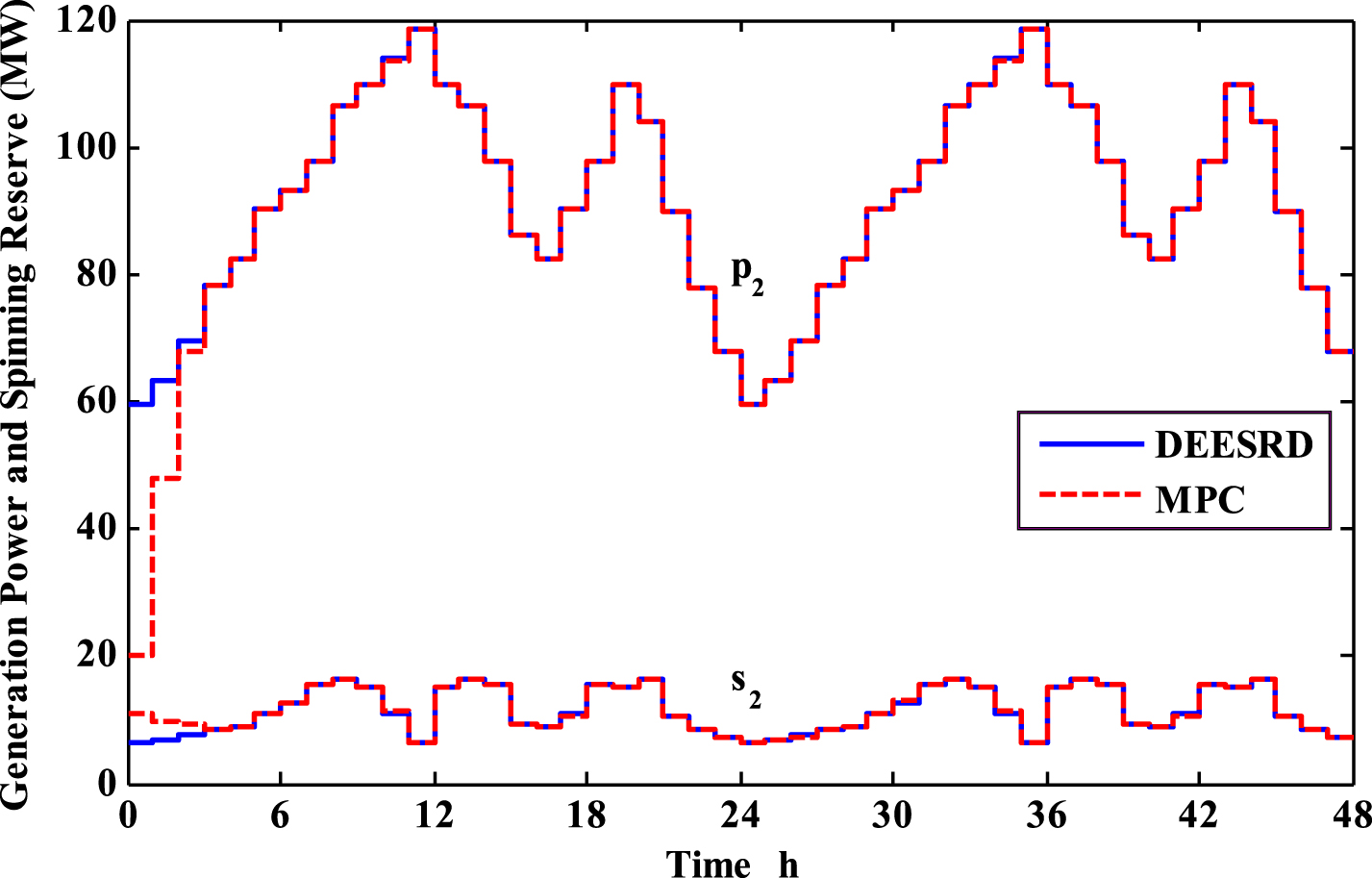
Convergence of the MPC solutions to those of EESRD problem for the power and spinning reserve of unit 2.
We have tested the MPC strategy against IRP-MPC-(I), IRP-MPC-(II), IRP-MPC-(III) and IRP-MPC-(IV). In these cases the initial P1 and S1 for the MPC are chosen as the optimal solution of the DEESRD problem. It has been shown in Figs. 2 and 4 that the MPC can keep the solution near to the optimal solution of the DESRD, DEESRD and PDESRD problems. From Figs. 3 and 5, we can see that, in spite of increasing the disturbance, the MPC still has the robustness when applying to DEESRD problem.

The power and reserve of unit 2 under DEESRD problem and IRP-MPC-(I).

The power and reserve of unit 2 under DEESRD problem and IRP-MPC-(II).
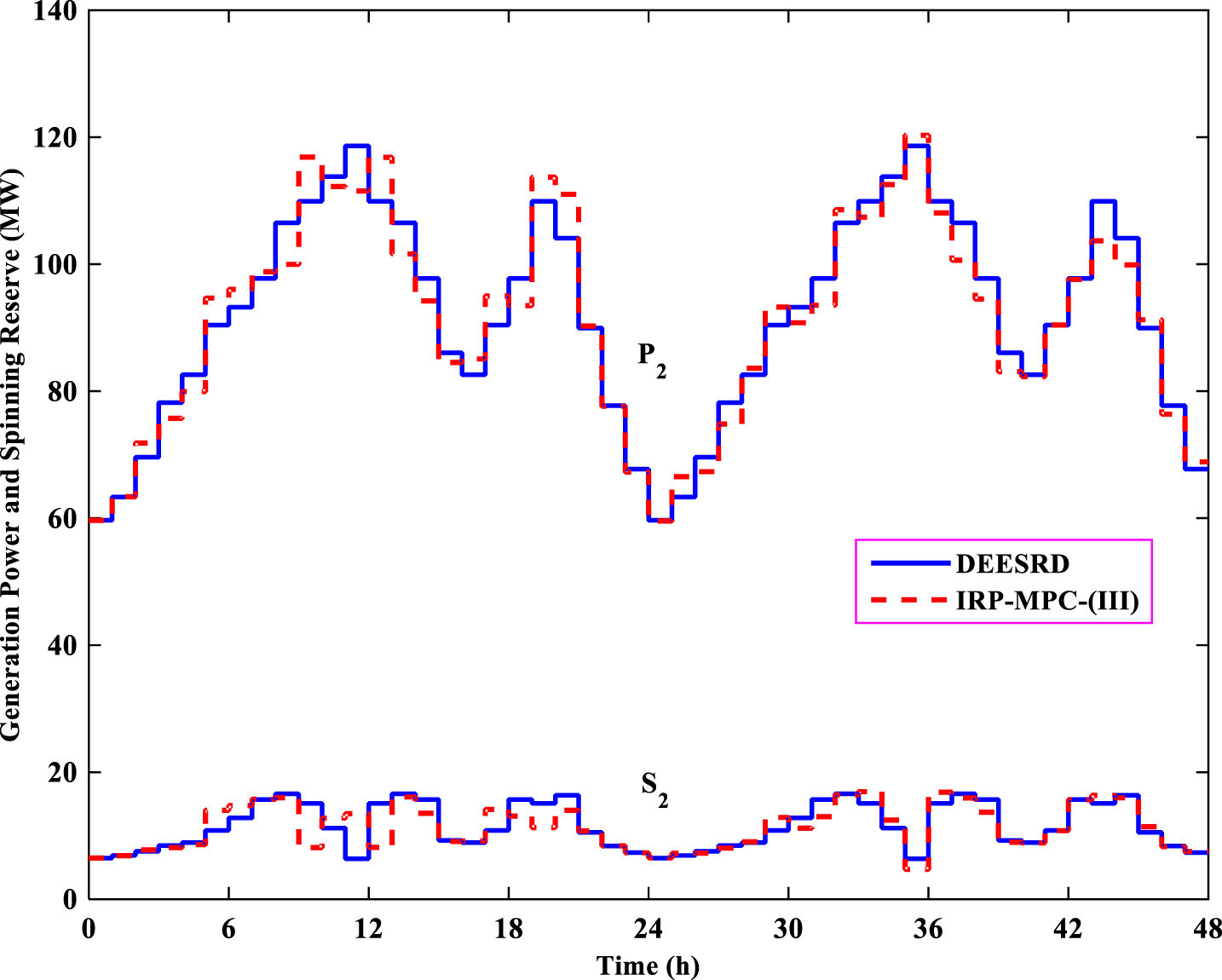
The power and reserve of unit 2 under DEESRD problem and IRP-MPC-(III).
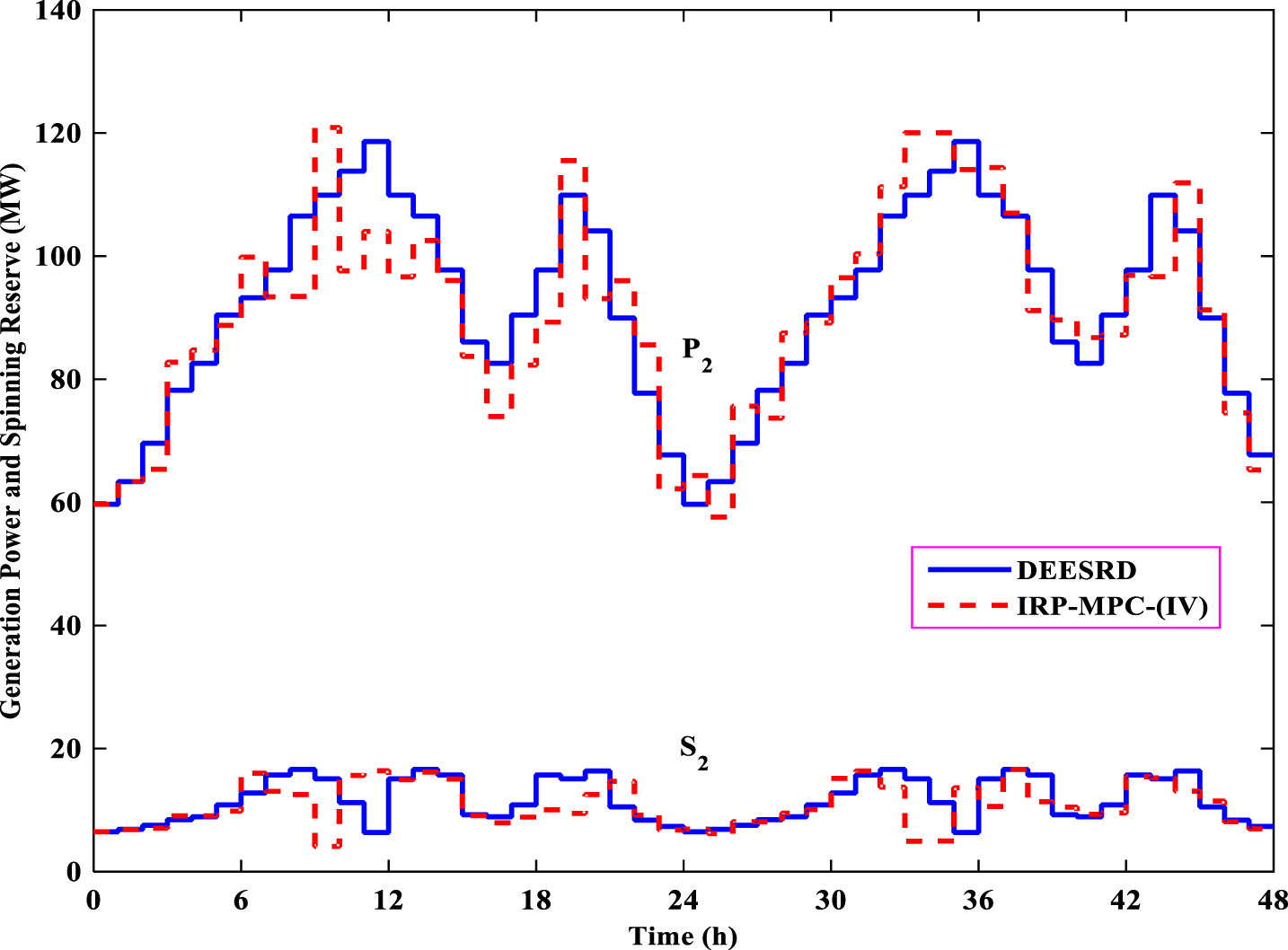
The power and reserve of unit 2 under DEESRD problem and IRP-MPC-(IV).
In this part we first present the optimal solution of the proposed DEESRD-DR. Figure 6 shows that the effect of the demand response on the normal load demand. Tables 4 and 5 summarize hourly power, spinning reserve, customer power curtailed and customer incentive schedule obtained from DEESRD-DR respectively. In Table 6 we present a comparison between the DEESRD and DEESRD-RD problems. One can see that, demand response strategy reduce the cost, emission and transmission line losses. In Figs. 7 and 8, we show that the MPC algorithm converges to the optimal solution of the DEESRD-DR problem.
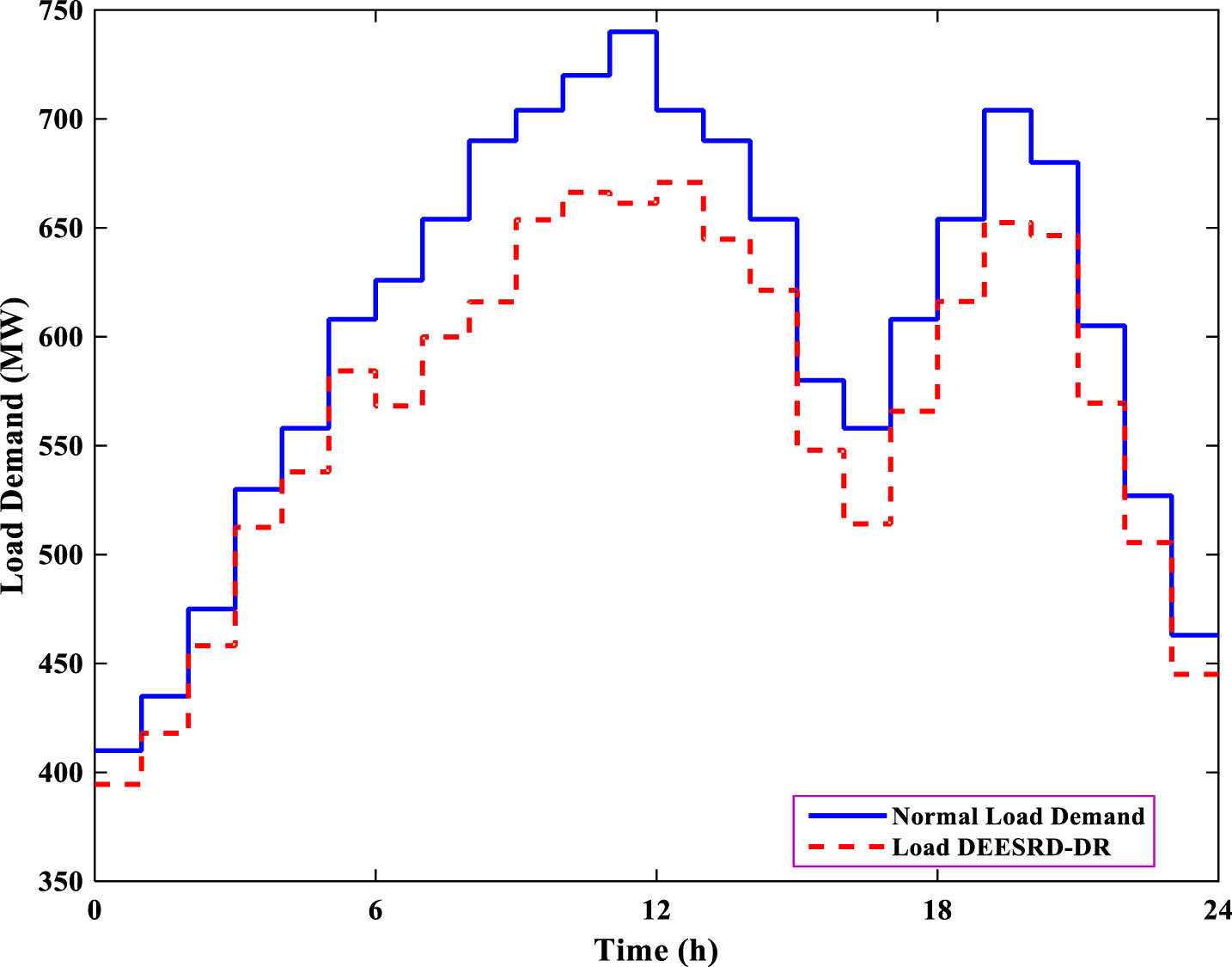
Load profiles before and after demand response.
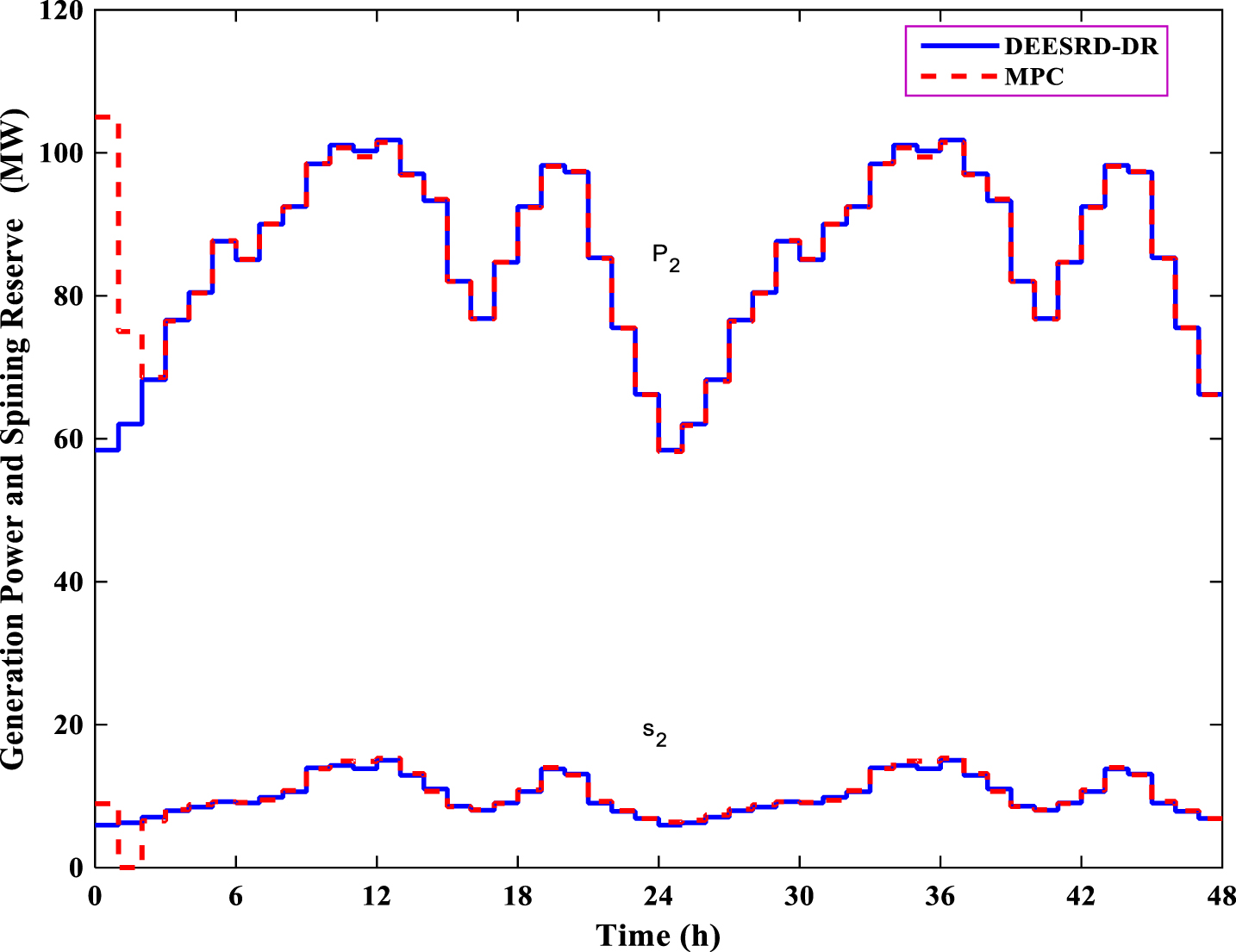
Convergence of the MPC solutions to those of DEESRD-DR problem for the power and spinning reserve of unit 2.
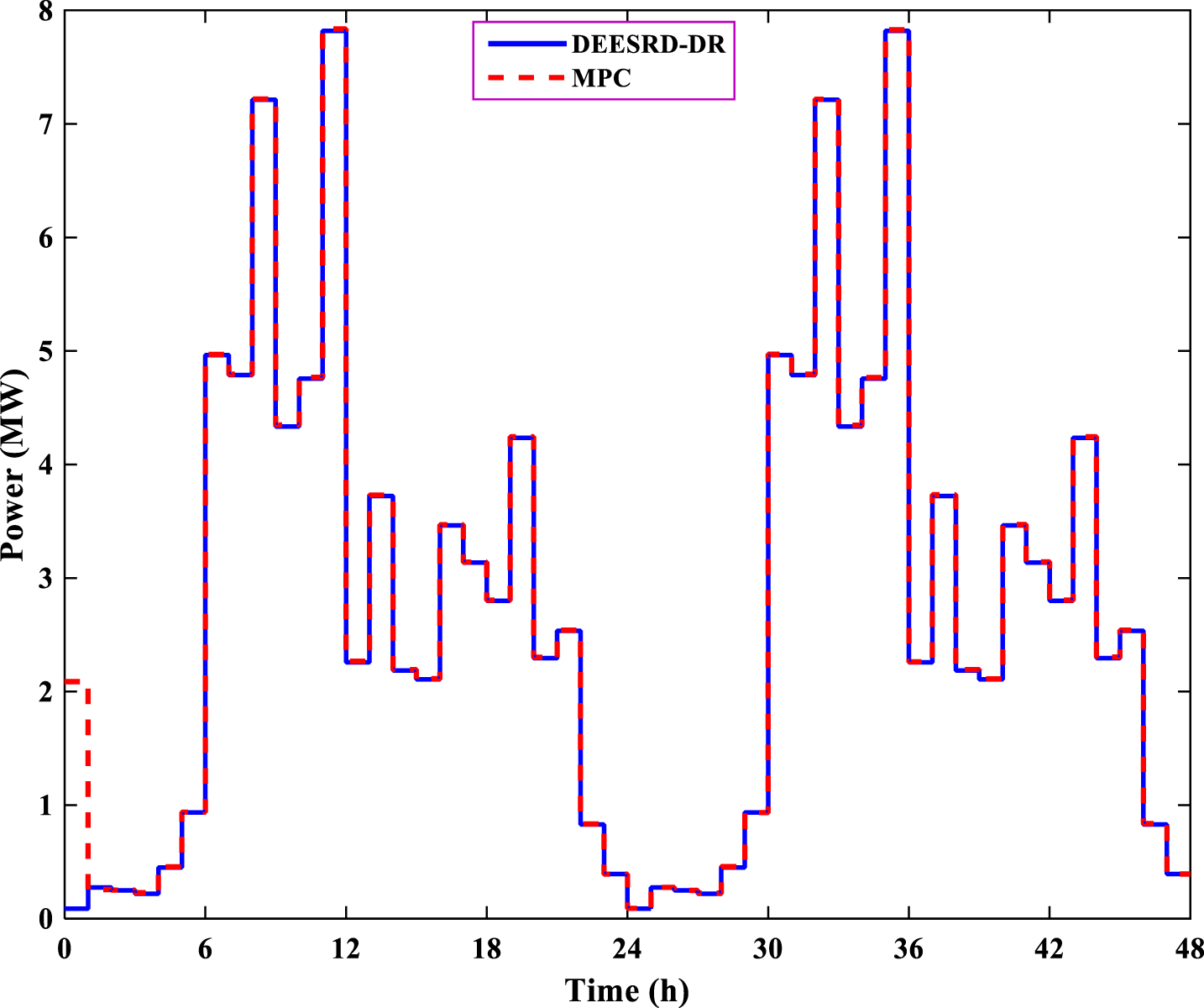
Convergence of the MPC solutions to those of DEESRD- DR problem for the optimal power curtailed from customer 2.
Hourly power and SR schedule obtained from DEESRD-DR
Hourly customer power curtailed and customer incentive schedule obtained from DEESRD-DR
Comparison between DEESRD and DEESRD-DR problems
In this paper, we have formulated dynamic economic emission and spinning reserve dispatch (DEESRD) problem which integrates the spinning reserve into the DEED problem. DEESRD determines the optimal power and spinning reserve allocation by simultaneously minimizing the power and spinning reserve costs, and the amount of emission under dynamic constraints and other constraints. This problem helps GENCOs to participate in the market by submitting bids for both energy and reserve. Implementation of DR programs can improve the reliability and reduce the energy price in the energy markets. We have integrated Game Theory DR program which is one of the incentive-based DR programs into the DEESRD problem.
We have formulated dynamic economic emission and spinning reserve dispatch with demand response (DEESRD-DR) problem which minimizes the energy and reserve costs, minimizes the amount of emission and maximizes the benefit of the GENCOs. In fact the DEESRD-DR model is useful not only for GENCOs but also for customers, since it increases the network reliability and customer’s benefit. Since the optimal solutions of the DEESRD and DEESRD-DR problem are open-loop, we have introduced a suitable version of MPC approach to construct closed-loop solutions. The performance of the MPC has been investigated by applying the MPC strategy to the DEESRD and DEESRD-DR problems with test system consisting of five generating units and five customers.