



Abstract
As the theme of sustainable development in the 21st century, environmental management creates value through the combination of ecological and economic elements and forms the enterprise Eco-efficiency. Enterprise Eco-efficiency can not only measure the performance of the company’s environmental management, but also guide the implementation of enterprise environmental management strategy and the realization of business objectives. There is a mutual causal relationship between environmental management and enterprise Eco-efficiency. Based on the analysis of the forming mechanism of enterprise Eco-efficiency within the environmental management system, it is found that whether the place influencing factors or vicissitude influencing factors, their impacts on the enterprise Eco-efficiency measurement value may be uncertain and ambiguous. In this paper, the similarity model of intuitionistic fuzzy set is established to conduct the intuitionistic fuzzy identification of the enterprise Eco-efficiency influencing factors, and a large-scale oil refining and chemical company is used as an example for application testing to determine measurement effectiveness.
Keywords
Introduction
The concept of Eco-efficiency was first proposed in academia by Schaltegger and Sturm in 1990, which demonstrates the ratio of increased value to increased environmental impact [1]. The World Business Council for Sustainability Development (WBCSD) has made the concept of Eco-efficiency widely disseminated and universally accepted. The core idea of Eco-efficiency “Minimizing environmental impact, maximizing economic value” has exerted great influence in the industry and academia [2]. But how can the Eco-efficiency be improved by minimizing the environmental impact and maximizing the economic value? Which factors could affect the Eco-efficiency numerator and denominator and thus to determine the level of Eco-Efficiency? This is a question that is of practical significance to study.
Enterprises Eco-efficiency and its formation mechanism based on environmental management
The concept of enterprises Eco-efficiency based on environmental management
The object of Eco-efficiency measurement was divided into three different levels by academia: regional level, industry level and enterprise level. WBCSD presented the definition and expression of Eco-efficiency in an industrial sense [3]. Different Eco-efficiency objects determine the different descriptive indicators of “economic value” and “environmental impact” for the numerator and denominator in the Eco-efficiency expression, the different corresponding measurement methods, and the different specific Eco-efficiency affecting factors [4]. Therefore, the canonical expression of Eco-Efficiency’s numerator and denominator should be determined on the premise of a certain Eco-efficiency measurement object.
With the development of ecological economy, environmental management has been integrated into the theme of sustainable development in the 21st century. The new concept of “environmental management” and the new business model are increasingly being put into practice in many countries [5]. The environmental management model is a new business model that adapts to the ecological economy, which considers environmental factors from a strategic perspective and pursues reduction of the environmental load during the entire production and management process [6]. It provides a strategy to solute the environmental issues in business operations by a holistic, strategic, and preventive approach. The essence of environmental management is to organically integrate the environment and economy in the business activities and create values through the combination of ecological environmental factors and economic factors [7]. This is reflected in the business objectives and business behaviors that reduce environmental costs and increase resource utilization value [8]. Therefore, on the attitude of the ecological environment and the business objectives, principles and ideas, enterprise environmental business model and Eco-efficiency have a complete compatibility. Only when the enterprise adopts an environmental management model can it form a high level of Eco-efficiency. The Eco-efficiency measurement value can not only measure the performance of the company’s environmental management, but also encourage and induce the implementation of the business strategy that is conducive to the realization of the environmental management goals. Eco-efficiency has a causal relationship with environmental management [9].
This paper proposes the concept of Enterprise’s Eco-efficiency (EE2) based on environmental management, that is, the ratio of the ecological economic results obtained by the company’s environmental management to the resulting ecological environmental impact, that also is, the ecological economic benefits generated by the unit ecological pressure and the intensity of resources. The definition of ecological environmental impact involves both the consumption of ecological and environmental resources and the pollution of the ecological environment. Taking the ecological environment as a resource is a much profound and comprehensive understanding of the concept of resources, and it can better reflect the concept and essence of resources. The purpose of using the ecological environment as a resource is to urge the company to cherish the ecological environment as much as it cherishes the economic resources, to meticulously protect the ecological environment, and to economically use the ecological resource, thereby to effectively implement the environmental management model.
Theoretical expressions of enterprise’s Eco-efficiency
The object of EE2 measurement is the resource allocation efficiency of the environmental management system. It represents the extent to which the system resources are effectively used, and the ecological environment is effectively protected, and describes the information of the input, output, flow, and inventory of various resources of the system. In order to fulfill the requirements of measuring the resource allocation efficiency on enterprise environmental management systems, to meet the needs of information for environmental management decision-making, control, and evaluation, and to depicts the ecological economic results achieved by the company’s environmental management and the resulting ecological environmental impacts, this paper proposed the concept of EE2 based on environmental management, which could be further described as “the ratio of ecological economic benefit to ecological environmental load” of environmental management, and could be further expressed by the following formula:
The essence of EE2 represented by formula (1) is the resource allocation efficiency of the enterprise environmental management system. The positive eco-resource of the denominator formula (1) is expressed by its input (physical quantity or amount), and the negative eco-resource is expressed by its output (physical quantity or amount). They correspond to the “utilization of resources and energy and its environmental pressure” in the denominator of the Eco-efficiency theoretical definition. According to relevant literature, ecological environment resources can be divided into positive and negative categories from the perspective of corporate environmental management [10]. Positive eco-environmental resources (abbreviated as positive eco-resources) are defined in this paper as eco-environmental resources that are beneficial to the conduction of corporate production and business activities, and the creation of corporate value; negative eco-environmental resources (abbreviated as negative eco-resources) are defined as the pressure on the ecological environment caused by the business production and operation. The input on positive ecological resources and the output of negative ecological resources in this paper are corresponding to Eco-efficiency’s denominator “resource and energy use and its environmental pressure” [11]. The value of the products and services of Eco-efficiency’s molecules, formula (1) is expressed in terms of eco-economic returns, which is an objective and specific representation of the value of products and services in the context of the enterprise’s environmental management. Thus, formula (1) is well matches the WBCSD theoretical definition of the Eco-efficiency.
EE2, as the resource allocation efficiency of the enterprise environmental management system, its measurement is related to the variation of the ecological environment resources and economic resources of the enterprise environmental management system, and the level of its measurement is determined by the stock and variation of the enterprise environmental management system resources. The
From the period of t0 to t1, econ0 is the initial stock of economic resources, econ1 is the stock of changed economic resources,
The EE2 represents the measure of the company’s eco-economic efficiency, and the ΔEE2 represents the difference before and after the EE2 measure change.
The elements of the enterprise environmental management system are divided into two categories. One is the set of various elements that consist the system which collectively referred to as the Place(P), and P ={ P1, P2, …, Pm }. Another is the mechanisms that represents the variance of system elements which collectively referred to as Transitions(T), T ={ T1, T2, …, Tn }; and F is defined as a ordered pair collection consisting of a P-type element and a T-type element, F = {(Pi, Tj) or (Tj, Pi) |Pi ∈ P , Tj ∈ T}, then F ⊆ (P × T) ∪ (T × P), F is called flow, then the corporate environmental management system is represented by the triple network N ={ P, T, F }. P is a finite set of entities and T is a set of finite transitions (mechanisms). Dom(F) ⊆ (P × T) is the input set, and cod(F) ⊆ (T × P) is the output set. The network figure represents the Place by a circle, the Transition is indicated by a box, and the relationship between the two types of elements such as association, dependence, and influence is represented by arrows [12]. The enterprise environmental management system Place P has various resources such as economic resources, positive, negative ecological environment resources and information resources. Define M(P) as the stock of resources for Place P. W(P, T) indicates the amount of change in Place P resources caused by the Transition T. T may increase certain types or categories of resources in Place P, and may also decrease certain types or categories of resources and in Place P. EE2, as the guiding mechanism of the system, belongs to the Transition set T, and has the function of guiding the change of the Place P, and it changes along withthe state change of the Place P caused by the Transition, and the changes are caused and jointly determined by various resources of the Place P. This reflects the opinion of this paper that EE2 and environmental management are mutually causal.
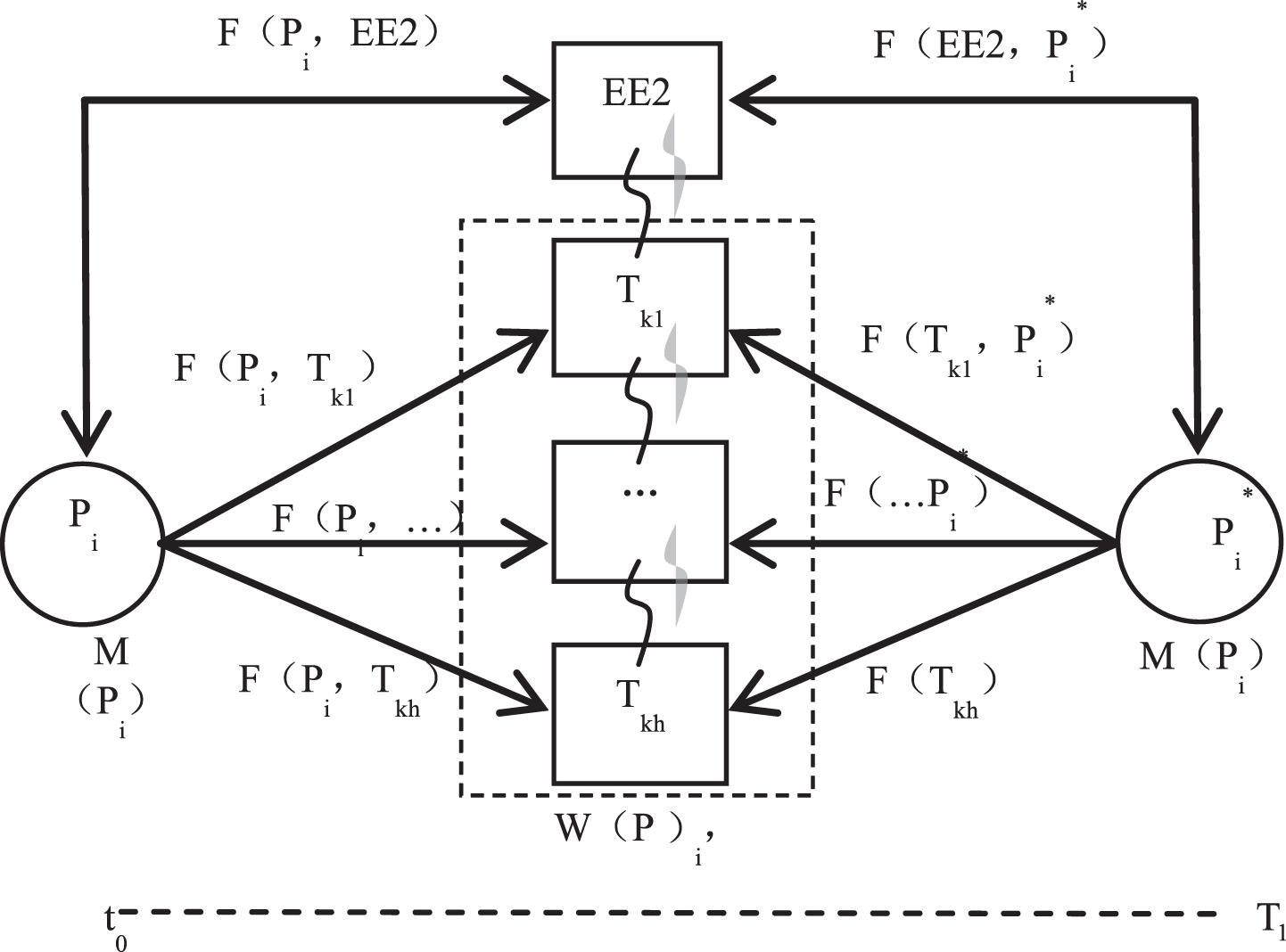
Enterprise’s eco-efficiency mechanism analysis.
In the figure above:
According to the theoretical expression of EE2, the numerator and denominator of its measurement inevitability affected by the changes in the economic resources, the positive and negative ecological environment resources of the enterprise’s environmental management system, and ultimately affect the level of the enterprise’s Eco-efficiency measurement. The variety of transit machines act on variety of Places, resulting the changes of Place state which are the variation of resources stock, thus changing the configuration of environmental management system resources, and affecting the efficiency of environmental management system resource allocation. The transmission path of this influence is complex, and the impact relationship formed is non-linear, and the degree of influence and even the influence direction are not completely determined [13, 14].
From the EE2 mechanism analysis, it can be found that the status of the elements in the environmental management system and the degree to which the system mechanisms exert its functions are both uncertain, thus causing the uncertainty in the EE2 measurement.
The constituent elements and operating mechanisms of the environmental management system are collectively referred to as the environmental management elements. They directly or indirectly determine the operational efficiency of the system and determine the level of EE2 measurement. The factors of the Place directly affect the EE2 measurement, while the Transition factors affect the EE2 measurement indirectly by influencing the state of Place. Further discussion is needed on the main factors affecting the Place features and the factors that affect the Transition. What are the main factors and whether the influence of these influencing factors is determined or ambiguous.
Place influencing factors
Place influencing factors of EE2
Place influencing factors of EE2
Transition factors of EE2
Transition factors of EE2
Similarity method for intuitionistic fuzzy measures of uncertain factors
From the analysis of the previous literatures and the analysis of the Place and Transition factors, it can be known that the impact of some factors on the resource stock of the enterprise’s environmental management system and the further impact on the EE2 measurement are ambiguous and uncertain, and it is difficult to make a clear assertion of whether it is “influential” or “no impact". In this paper, the intuitionistic fuzzy set theory is used to design the method of identifying the influencing factors of EE2 measurement uncertainty. The basic principle of method design is to establish an intuitionistic fuzzy set that may affect the inventory of enterprise environmental management system resources, and an intuitionistic fuzzy set of uncertain influencing factors. Through the fuzzy estimation of the similarity between sets, it will make fuzzy measurement and judgment of influencing degree of uncertain factors.
According to the intuitionistic fuzzy set theory, the intimate level of the object relations represented by the two intuitionistic fuzzy sets can be measured by the degree of similarity of the two sets [20].
o ⩽ T (A, B) ⩽1; T (A, B) =0, if and only if A = B; T (A, B) = T (B, A); If A, B, C ∈ U, A ⊆ B ⊆ C, then T (A, C) ⩾ T (B, A) T (A, C) ⩾ T (B, C)
The distance and the similar relationship between two intuitionistic fuzzy sets can be given by the following theorem:
Set of possible influencing Factors on Resource Stock of Enterprise Environment Management System
Set of possible influencing Factors on Resource Stock of Enterprise Environment Management System
In this paper, the distance between two intuitionistic fuzzy sets in discrete space is measured by the standardized Hamming distance.
Set the domain U = {x1, …, x n }, A, B ∈ IFS (U), then the distance between the two intuitionistic fuzzy sets A and B is:
Take ρ1/2 in the above formula. According to Theorem 1, the similarity between two intuitionistic fuzzy sets A and B in discrete space U based on the standardized Hamming distance can be measured by the following formula:
Suppose domain U is a collection of factors that may have an impact on the enterprise’s environmental management system’s resource stocks,and B1 indicates that the factors have an impact on the system’s economic resources [21, 22], and B2 indicates that the factors have an impact on the system’s positive eco-environmental resource stock, B3 indicates that the factors have an impact on the system’s negative ecological environment resource inventory, then B1, B2, B3 ∈ Ifs (U) [14].
From the above table, U = {P2, T1, T6, T7T9}, A1 = {P2}, A2 = {T1}, A3 = {T6}, A4 = {T7}, A5 = {T9}, then the eigenfunction of A
i
(i = 1, 2, 3, 4, 5) is:
With the eigenfunction A
i
(i = 1, 2, 3, 4, 5) as its membership function, then
This paper combines the actual conditions of the influencing factors on the environmental management system resource stocks, and based on the improved Hamming distance, designs a similarity model that is applicable to the two sets, in the uncertain influencing factors domain U = {P2, T1, T6, T7, T9, } = {x1, x2, x3, x4, x5}
Fuzzy Influence Extent of Uncertain Factors on System Resources Stock
 Bi
BiA i (i = 1, 2, 3, 4, 5,) is the set of uncertain influencing factors, the similarity of each intuitionistic fuzzy set B1, B2, B3 that has influence on the inventory of the enterprise’s environmental management system resources depends on the membership function and non-membership function in the similarity model (4). This paper will apply the fuzzy statistics method combined with contrast compositor method based on the condition and quality of the survey data, to determine the function values of the membership function and the non-membership function, substituting numerical values into the model (4), and calculate the similarity of the relevant intuitionistic fuzzy set, thus to realize the fuzzy identification of the influence of various factors on the enterprise’s environmental management system resources stocks in U ={ P2, T1, T6, T7, T9 }, and then get the degree of fuzzy influence on the stock of system resources for each uncertain influence factor(Sij) [23].
The application of EE2 influencing factors to intuitionistic fuzzy identification method selected a large-scale oil refining and chemical company. In order to obtain survey data, this paper conducted a field survey on the status of environmental operations in this company and conducted interviews with the two vice general managers in charge of production and finance at the senior management level, as well as the leaders and main staff of the company’s offices, and a meeting for technical staff in seven workshops and team leaders. 57 questionnaires were distributed and collected. According to the field survey data, the method of combining the fuzzy statistics with the comparative ranking method was used to process the relevant data and get the result that three intuitionistic fuzzy sets B1, B2, and B3 which contains various uncertain factors of the company’s environmental management resources [24]. The correlation matrix of the impact degree is as follows:
Fuzzy Relation between Uncertain Factors and Environmental Management
Fuzzy Relation between Uncertain Factors and Environmental Management
Fuzzy Influence Degree of Uncertain Factors on System Resources Stock
If λ = 0.5 is selected as the cut-off parameter, it can be determined that the environmental regulatory intensity, environmental management system, industry and region and the company’s environmental management resources, these factors will have an impact on EE2, which should be taken into account in the process of measuring the eco-economic efficiency of the company.
The analysis of the definition and formation mechanism of EE2 in this paper shows that the state and change of enterprise environmental management system elements determine the measurement level of EE2, and the influence of related factors on the environmental management system elements of enterprises indirectly affects the measurement level of EE2. For the influencing factors of uncertainty, regardless of whether it is a Place or Transition factor, an Intuitionistic Fuzzy Measures method can be used in combination with the actual operation of the company’s environmental management to make an objective estimation and judgment of the extent of its influence.