



Abstract
Stampede accidents with serious injuries occur from time to time on escalators. Field observation was conducted on four typical passenger behaviors during taking escalators, namely, walking behavior, subgroup behavior, overtaking behavior and waiting behavior. The effect of behavior characteristics on passenger safety was analyzed according to the observation data. Several scenarios were simulated to quantitatively study the impact of passenger behaviors on crowd stampede risk under different situations. The results show that: (1) the presence of subgroup behavior and overtaking behavior increases the crowd stampede risk by increasing the crowd density and the degree of congestion on the connection plane; (2) the walking behavior reduces the crowd density; (3) the “walk left, stand right” rule decreases the evacuation efficiency; (4) waiting behavior of passengers on the connection plane significantly increases the crowd stampede risk. Management measures were proposed to promote the passenger safety and reduce the stampede injury on escalators.
Introduction
Escalators play a critical role in metro stations, railway stations, airports, shopping malls and other public buildings, as they provide the most efficient method of moving a large number of passengers between adjacent floors. While providing convenience, escalators are potential source of serious injuries and deaths to passengers. On October 23, 2018, a tragedy occurred on an escalator at a metro station in Rome, Italy, injuring 24 passengers. In the United States, around 10,000 escalator-related injuries per year requiring emergency department treatment were reported [18]. In China, escalator-related accidents have consistently been top ranked in special equipment accidents from 2009 to 2014, while the number of injuries and deaths had increased greatly [22].
Crowd stampede is better understood as a “progressive crowd collapse” which often begins when one person falls among a high density crowd [2]. Crowd stampede risk results in serious injuries for passengers, because the fallen passenger becomes an obstacle for the trailing panic passengers and makes them more likely to fall and get injured [10]. The state shifting of the passenger in an escalator stampede is “Normal–Fallen–Stumbled–Pinned–Injured” [10, 12]. Some passenger behaviors, such as walking behavior, subgroup behavior, overtaking behavior and waiting behavior, have a great impact on crowd stampede risk [4, 23]. These behaviors are common among passengers during riding escalators. The dynamic characteristic of these behaviors affect the crowd density and the crowd stampede risk of passengers, especially when the flow of passengers on escalators is relatively large. Although many studies have found that human factor is the main cause of escalator stampedes [1, 22], the issue of the impact of passenger behaviors on crowd stampede risk still remains unsolved.
The purposes of this paper are: 1) to identity the influence of passenger behaviors on passenger safety during taking escalators, and 2) to study the quantitatively impact of these passenger behaviors on crowd stampede risk. This paper is organized as follows. In Section 2, the research methods including field observation and simulation model are detailed. The simulation indicators and results are analyzed in Section 3. The paper is concluded in Section 4.
Methods
Field observation
Field observation was conducted at metro stations in Wuhan, China. The time when the first passenger steps onto the escalator to the time when the last passenger steps off the escalator is an observation period. The observation area is the connection plane between the escalator and the floor ground at the entrance and the exit of the escalator, which is a high-risk location for stampede accidents. The data of 50 observation groups were collected. The behaviors of 8090 passengers on the connection plane were observed. Under normal circumstances, the average walking speed of passenger on the connection plane is between 0.7 m/s and 1.0 m/s, and the average density is 1.13 person/m2.
Walking behavior
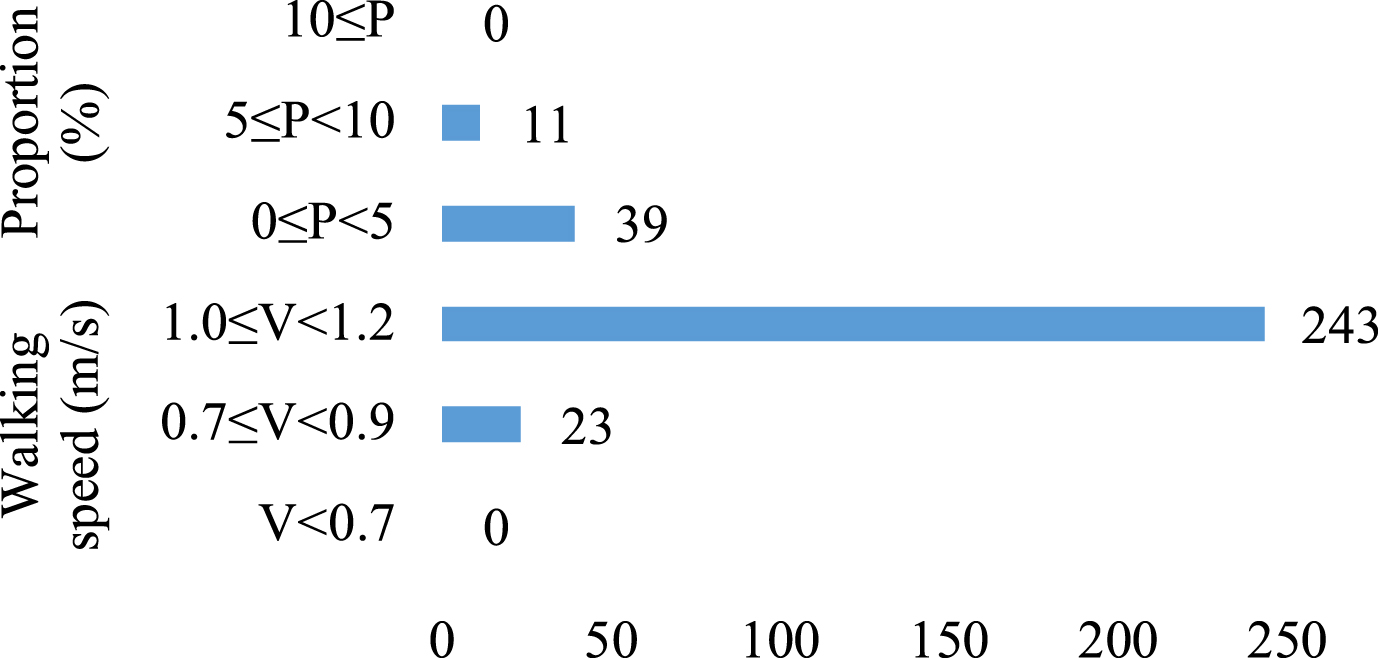
A “walk left, stand right” rule originated in UK is accepted and practiced by escalator passengers around the world. In the right lane of escalators, passengers who choose to stand still after boarding a moving escalator, only travel at the speed of the escalator itself. In the walking lane, walking speed of passengers depends on both escalator speed, and their walking speed which may be constrained by the presence of the front passengers. The data on characteristic of walking behavior are illustrated in Fig. 1.
The observation data of walking behavior.
In each group of observation, only a small number of passengers who are eager to leave the station walk on the escalator, and most of the passengers behind choose to stand on both sides of the escalator. 266 passengers followed the “walk left, stand right” rule and walked on the escalator. The walking speed of 243 passengers with walking behavior on the escalator connection plane is greater than 1.0 m/s. At this point, the passenger density on the connection plane is 0.84 person/m2, lower than average density. The proportion of passengers with walking behavior in 39 observations is less than 5%. It is found that the proportion of walking behavior has an impact on the evacuation time of escalator passengers.
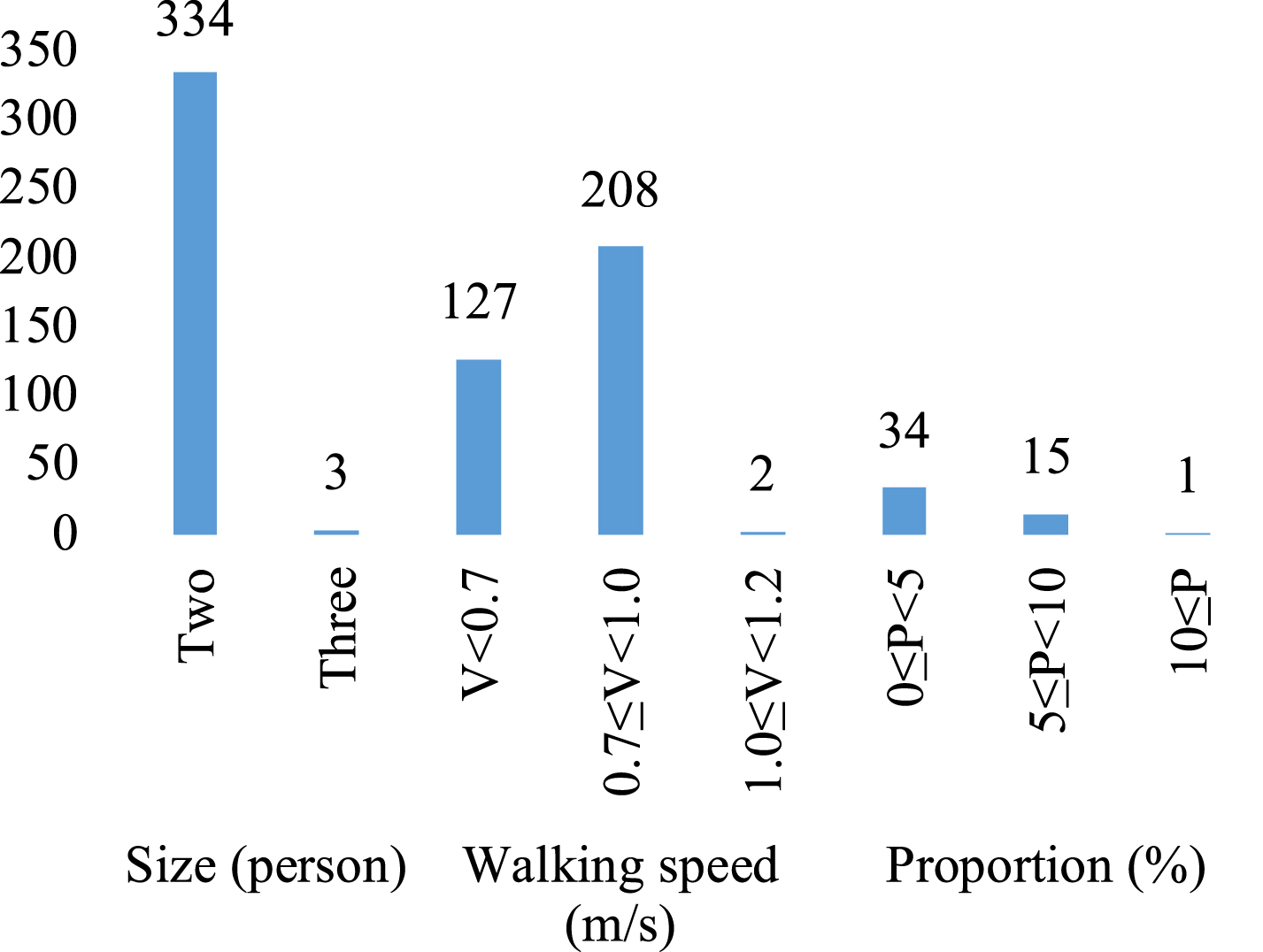
The behavior that group of passengers walk together with same speed and direction due to social relationships and interactions is called as subgroup behavior [3, 19]. The data on group size, walking speed and proportion of subgroup behavior are shown in Fig. 2.
The observation data of subgroup behavior.
It is observed that the density on the connection plane is influenced by the walking speed and the group size of the passengers with subgroup behavior. 127 subgroup passengers walk slower than 0.7 m/s, and 210 passengers travel faster than or equal to the average speed of other passengers. Groups can be regarded as “moving obstacles” amongst passengers, especially for the trailing passengers. The density reaches 1.99 person/m2, and crowd stampede risk increases. 99% of subgroup passengers walk in pairs. The group size is limited by the width of the escalator. The proportion of subgroup passengers in 34 observations is less than 5%.
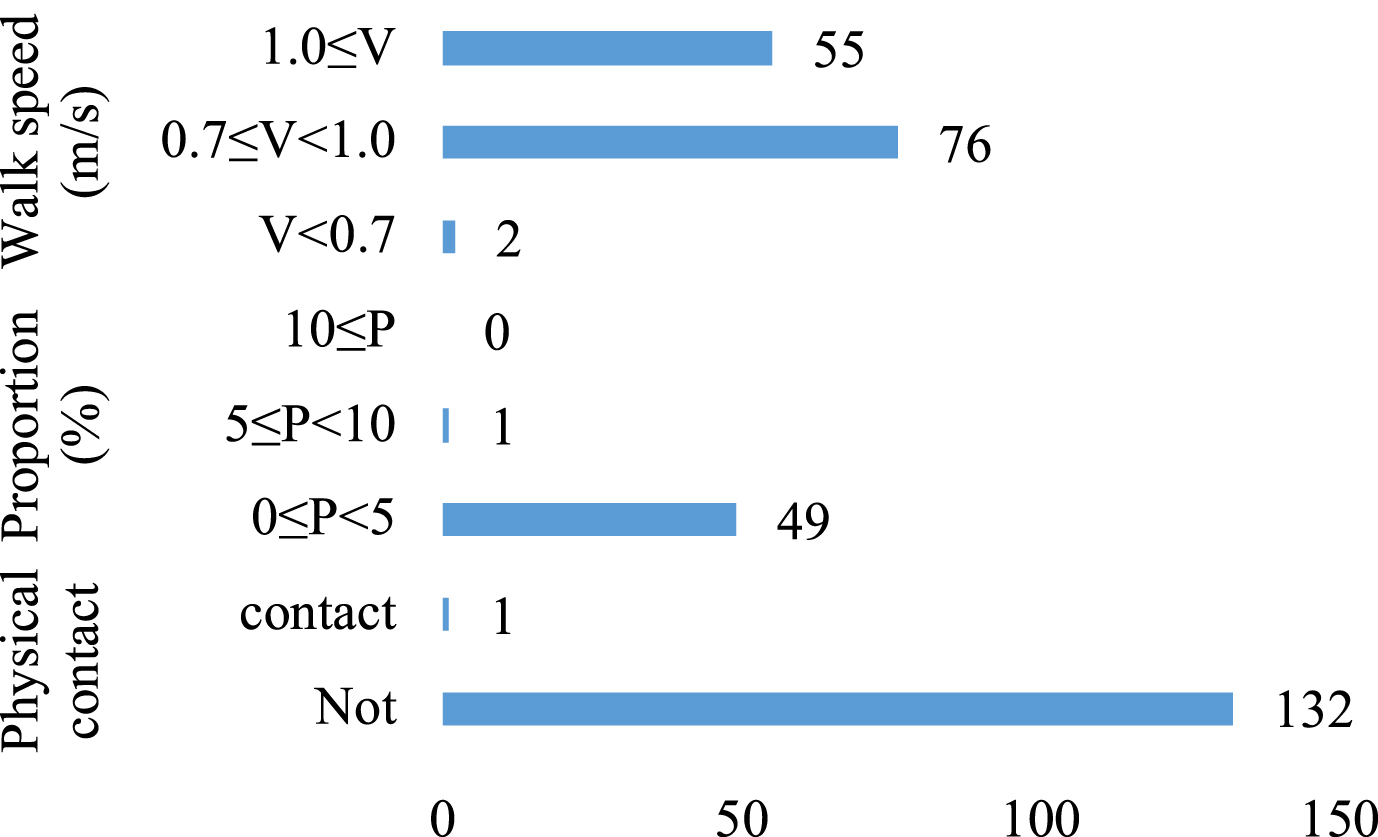
Overtaking behavior of escalator passengers often occurs at metro stations and railway stations during peak hours [14, 20]. In order to catch up with the time, some passengers at the entry exceed the passengers who stand or move slowly in front of the queue, and finally board the escalator earlier. When the passenger flow is high at the exit, after the passengers stepping off the escalator, their walking speeds are greatly affected by the front passengers in a short time. At this period, some passengers with faster speed choose to exceed the slower passengers, to get more comfort space or to get in time. The data on characteristic of overtaking behavior are recorded in Fig. 3.
The observation data of overtaking behavior.
133 passengers was found to overtake their front passengers after stepping off the escalator. Only 1 passenger have physical contact during the process, indicating the crowd stampede risk resulting from the fall is quite small. Among the passenger with overtaking behavior, 41% of them walk faster than their surrounding passenger and 57% walk the same speed as most of other passengers. The proportion of overtaking behavior in 49 observations is less than 5%. The density of connection plane is 1.42 person/m2, slightly increased by the overtaking behavior.
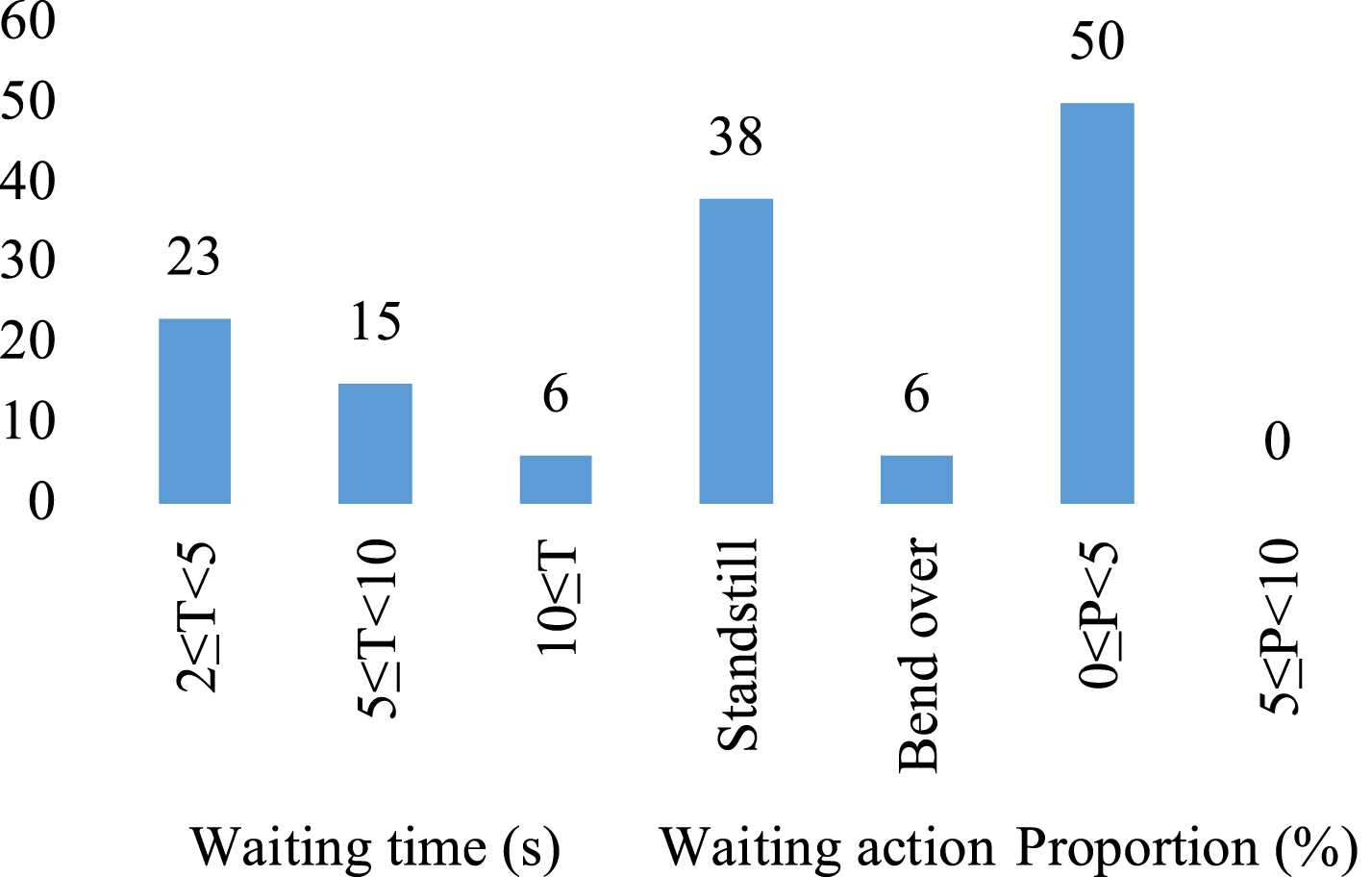
Waiting behavior refers to the behavior that passengers suddenly stop walking forward and stand in place [8, 9]. Passengers stop walking because of different reasons such as physical discomfort, bending over to pick up items or to tie shoelaces, and waiting for someone. It is reported that a stampede accident with 14 injuries has occurred in Shenzhen, China caused by the waiting behavior that a passenger bent over to tie shoes at exit of the escalator. Waiting time, waiting action and the proportion of waiting behavior were observed, as shown in Fig. 4.
The observation data of waiting behavior.
More than half of passengers with waiting behavior just stay less than 5 seconds while around 14% of passengers stay in place for more than 10 seconds. It is found that the density increases to 2.27 person/m2 when passenger stand in the connection plane for 2–4 seconds. The most common waiting action is standstill in the connection plane. The proportion of waiting behavior in all 50 observation groups is less than 5%
More than half of passengers with waiting behavior just stay less than 5 seconds while around 14% of passengers stay in place for more than 10 seconds. It is found that the density increases to 2.27 person/m2 when passenger stand in the connection plane for 2–4 seconds. The most common waiting action is standstill in the connection plane. The proportion of waiting behavior in all 50 observation groups is less than 5%.
A four-stage model for the process of stampede accident
The evolution process of stampede accidents on the escalator is summarized through the field observation and video analysis. Based on this, a four-stage model is proposed to describe the state-shifting process of a stampeded accident, as shown in Fig. 5.
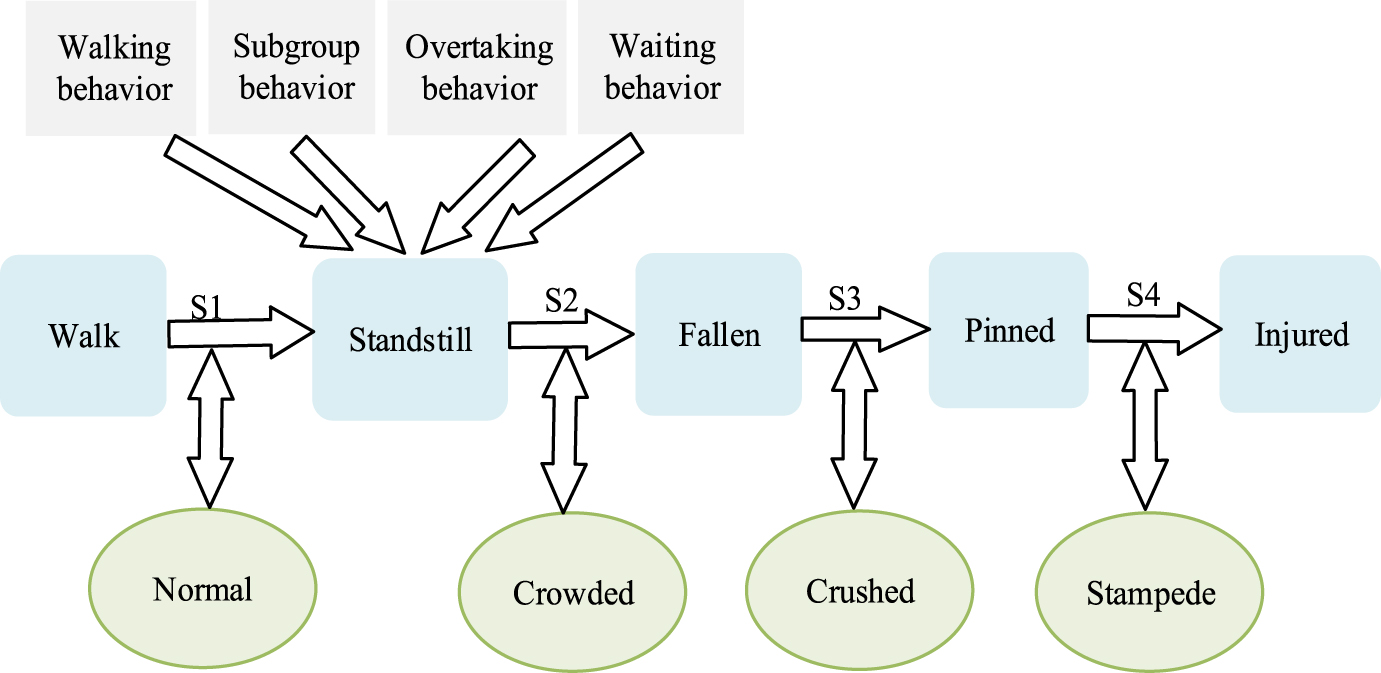
A four-stage model of crowd stampede risk.
Stage 1: Normal. Passengers walk normally after stepping off the escalator. Passenger P0 stops walking or walks very slowly because the movement is constrained by other passengers. Stage 2: Crowded. The stand-still hinders the moving of the trailing passengers, and they have to slow down their walking speed, resulting in a crowded state. Stage 3: Crushed. The passengers in front walk slowly and fail to leave the connection plane in time. The trailing passengers are constrained in the connection plane, and the crowd density sharply increases, forming a crushed state. P0 falls down due to collision or squeezing of surrounding passengers. Stage 4: Stampede. Passenger P1 is stumbled by P0 when P1 does not notice or has no time to dodge the fallen P0. The following passengers P2, P3... Pn are tripped one after another. Stampede accident occurs. Passenger P0 get injured after pinned for a period of time.
The social force model, classically given as Equations (1)–(3), is regarded as one of the bases for microscopic crowd simulation [5]. It regards the passenger as a particle that satisfies the mechanics law, which is influenced by the driving force (self-subjective consciousness)
The social force model has been successfully employed for many applications, and rational crowd patterns such as “faster-is-slower” and “arching phenomenon” can be reproduced [13, 17]. Therefore, the social force model was chosen as the base model for modelling and simulating the crowd stampede risk in this paper.
Description of the scenario
The scenario is an upward escalator at Optics Valley Metro Station in Wuhan, China. The escalator has a width of 1.0 meter (m) and a length of 12 m. The angle of inclination is 30 degrees, the step depth is 0.4 m, and the nominal speed is 0.65 m/s. The observation area in the simulation is a 3.52 square meters (m2) connection plane at the exit of the escalator, as shown in Fig. 6. The size of this area is obtained from field measurements. The maximum density and average density of this area are recorded in the simulation.
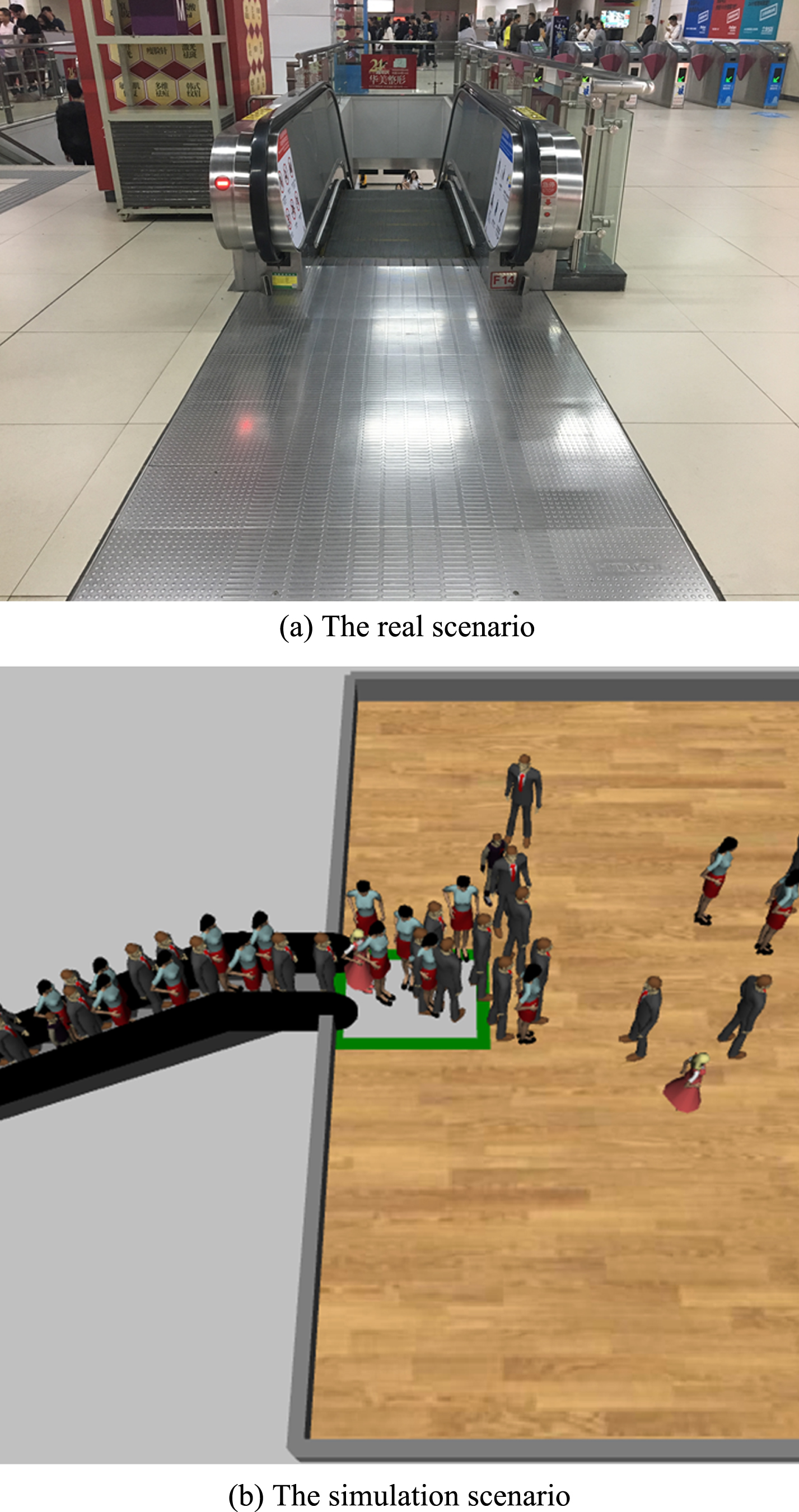
The real scenario and the simulation scenario.
The following indicators are employed to evaluate the possibility of the stampede accident. Maximum density (D
m
). D
m
is the maximum value of crowd density at the connection plane during the simulation time, which has positive correlations with the possibility of the crowd stampede risk: the higher D
m
, the higher degree of the crowded and possibility of crowd stampede risk. The research indicated that crowd density is an important source of risk for crowded stampede accidents [11, 21]. Time to maximum density (t
m
). Time to maximum density refers to the time period from the moment the simulation begins to the moment the density reaches peak. t
m
reflects the evolution time of the possible stampede accident. The longer t
m
, the slower evaluation rate of stampede [11, 12]. Average density (D
a
). Da is the average crowd density of the connection plane during the simulation. This indicator reflects the overall level of congestion in this area. The greater D
a
, the higher the likelihood of the crowd stampede risk [21]. Evacuation time (t
e
). Evacuation time is defined as time period from the moment the first passenger stepping onto the escalator to the moment the last passenger stepping off the escalator. The longer t
e
, the more pinned passengers there are, and the more serious a stampede accident is [10, 12].
Parameter settings and validation
In the simulation, the parameters of passengers are set according to the data from field observations, as follows: arrival rate is 1 person per second, maximum number of arrivals is 200 passengers; the ratio of male passengers to female passengers is 1 : 1; the comfortable speed of passengers is randomly distributed at [0.7, 1.0] m/s. The parameters of the escalator are set according the observation data as mentioned in Section 3.1.
The observation area is the connection plane of an upward escalator at the Optics Valley Metro Station, in Wuhan, China. The simulation parameters and behavior parameters are set according to the observation data. The density of this area under walking behavior, subgroup behavior, overtaking behavior and waiting behavior were simulated respectively, and compared with the actual density observed. The results are shown in Table 1. The results indicated that the model that takes passenger behavior parameters into account effectively simulates the actual situation.
Validation results
Validation results
The crowd stampede risk is triggered by the standstill of passengers the connection plane after stepping off the escalator. Four passengers were randomly chosen to stop 20 seconds on the connection plane. Based on the simulation environment, a few scenarios were simulated to test the impacts of the three typical passenger behaviors. Each scenario was repeated 10 times, and the values of the evaluation indicators were recorded for analysis.
The impact of walking behavior on crowd stampede risk
The impact of walking behavior at the escalator was studied in this section. Five scenarios were simulated. S0 is the scenario in which all passengers stand in both sides of the escalator when riding the escalator, and walk away from the connection plane without overtaking behavior nor subgroup behavior. S1–S4 are scenarios in which passengers follow the “walk left, stand right” rule, and different proportion of passengers choose to walk at the left of the escalator; the proportion of walking behavior at the escalator (P w ) is 0%, 10%, 30% and 50% in S1, S2, S3 and S4 respectively. Based on the simulations, the values for the indicators are listed in Table 2, and the time-density curves are graphed as Fig. 7.
Indicators under different proportion of walking behavior
Indicators under different proportion of walking behavior
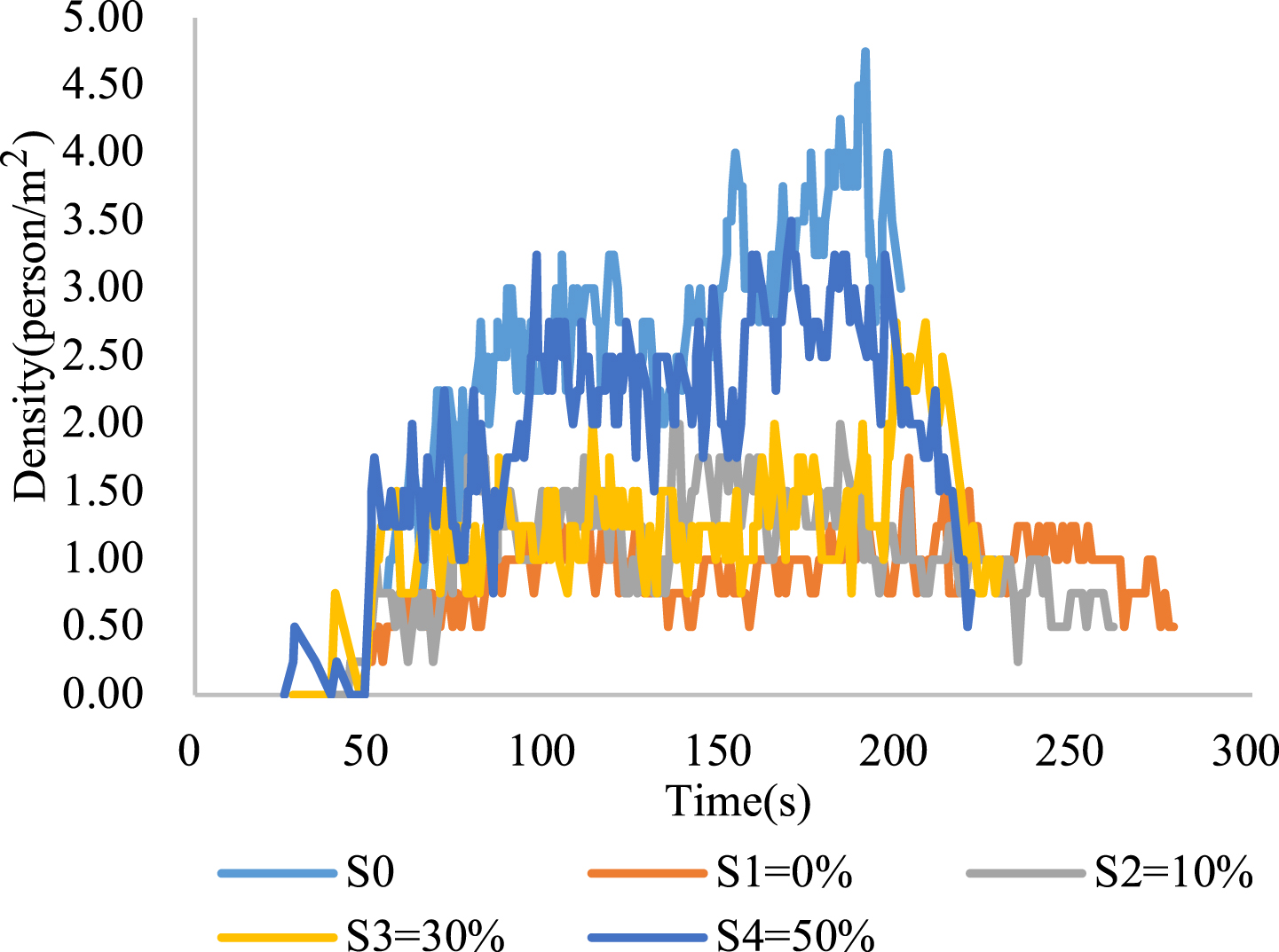
Time-density curves of walking behavior.
The following rules were obtained from the simulated results. Compared with standing on the two lanes of the escalator, when passengers follow the “walk left, stand right” behavior rule, the density on the connection plane at the exit of escalator is relatively lower, and the possibility of crowd stampede risk is relatively smaller. Compare scenarios S1–S4 with S0, the maximum density and the average density of scenarios S1–S4 are lower than that in scenario S0, as seen from S0–S4 in Table 2. The possible reason is that when walking passengers leave the connection plane faster, the space available for the standstill passengers and slow passengers is larger. The high proportion of walking passengers increases the crowd stampede risk on the escalator. When passengers walk on the escalator, the greater the proportion of passengers walking on the left side, the greater the density at the connection plane of the escalator, as seen from S1–S4 in Fig. 7. The result can be understood by reasoning that when there are more passengers walking, the more passengers who step off the escalator at the same time, which is more likely to cause congestion at the connection plane. The four passengers who stop on the connection plane affect the density. The time-density curves of all scenarios have three to five significant upward fluctuations. The result indicates that waiting behavior on the connection plane block the passage of trailing passengers, which easily leads to stampede accident, as demonstrated by many stampedes mentioned in Section 1. The “walk left, stand right” rule increases the evacuation time and decreases the evacuation efficiency. As seen in Table 3, the evacuation time are 278s, 261s, 228s and 220s in S1, S2, S3 and S4, respectively. The result follows the reason that when passengers obey the “walk left, stand right” behavior rule, the left side of escalator steps are vacated for the walking passengers, and the transport efficiency of escalator decreases especially when the proportion of walking passengers is low.
Indicators under different proportion of subgroup behavior
Three scenarios S1–S3 were simulated with different proportion of subgroup behavior (Ps) of 5%, 15%, and 30% for each scenario. The indicator values are listed in Table 3, and the time-density curves are graphed as Fig. 8.
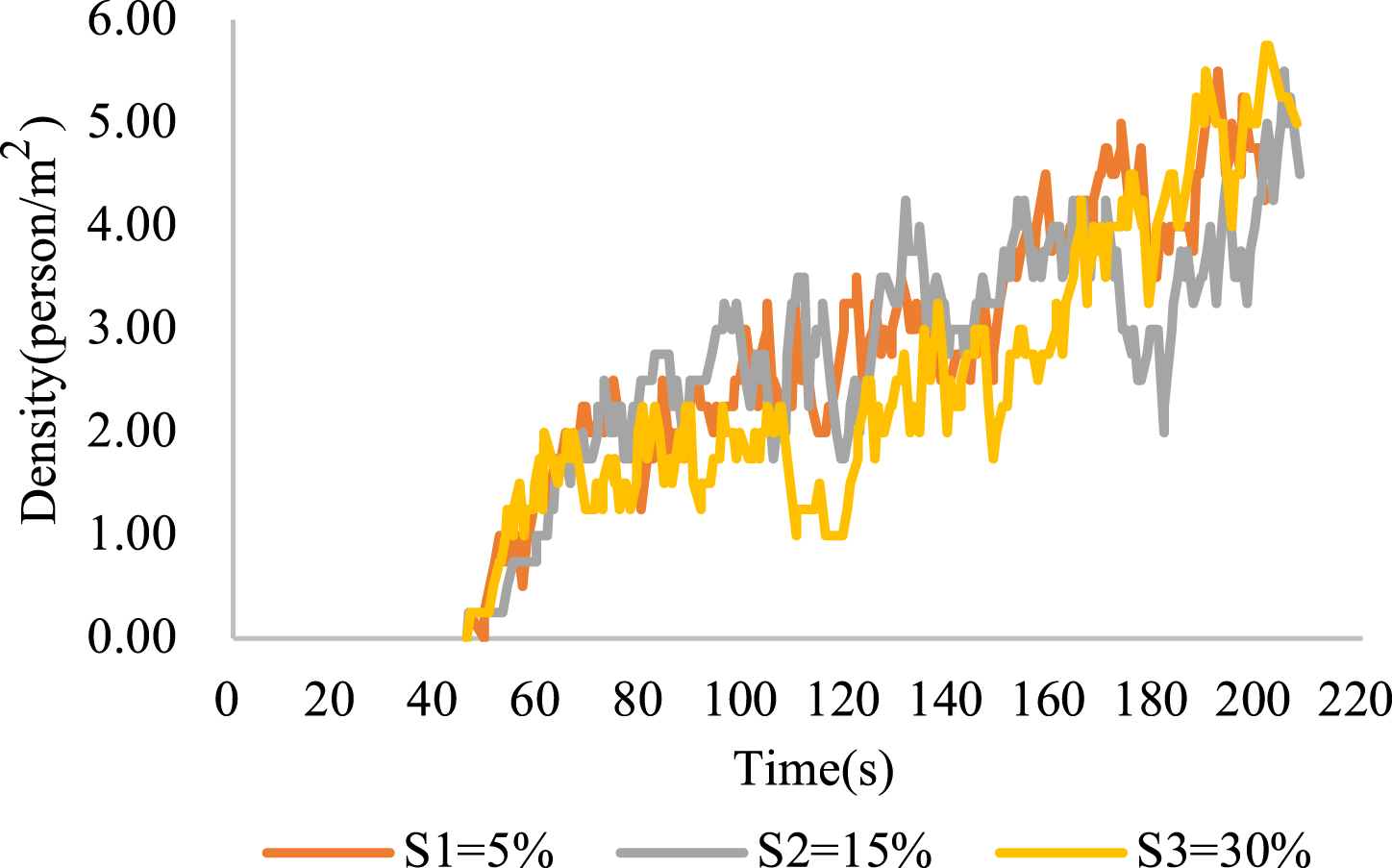
Time-density curves of subgroup behavior.
Certain rules can be found from Table 3 and Fig. 8.
The subgroup behavior of escalator passengers increases the crowd stampede risk. As seen in Table 3, the maximum densities of S1–S4 are greater than or equal to 5.50 person/m2 and the evacuation time of S1–S4 are longer than that of S0, indicating that there is a great possibility of a stampede accident. Many passengers gathers at the connection plane, while the escalator continues to transport passengers to the connection plan. The trailing passengers have no space to walk or stand, which is prone to stampede accidents.
An increase in the proportion of subgroup behavior slightly increases the crowd stampede risk. As seen in Table 4, the maximum density of S1–S3 are around 5.50 person/m2, and the average densities are 2.67, 2.71 and 2.63 person/m2, respectively. When the proportion of subgroup behavior reach a certain value (5% in the simulation), the crowd density is high and the congestion has formed. Bodies of passengers are in touch with each other, and these passengers can be regarded as a huge group who move slowly. Under this situation, the increase in proportion of group behavior just slightly increases the density.
The congestion caused by the subgroup behavior lasts for a long time and the crowd stampede risk is relatively high. As seen in Fig. 8, the densities of S1–S3 continue to increase overall, and peak the maximum value at approximately 200th second. The result indicates that the subgroup behavior is extremely dangerous for passengers in connection plane. Once the congestion has formed, it is hard to recover to smooth walking state.
Indicators under different proportion of overtaking behavior
The impact of overtaking behavior was studied in this section. Three scenarios were simulated using 3 typical proportion of overtaking behavior: 10%, 20% and 30%. The walk speed of passengers with overtaking behavior is 1.5 m/s. The values for the indicators were obtained and are listed in Table 4.
Certain rules can be obtained from the simulated results. The presence of overtaking behavior of escalator passengers increases crowd stampede risk. From Table 4, it is found that when some passengers with faster speed overtake their front passengers, the maximum densities of the connection plane in S1–S3 are greater than 5.00 m/s, indicating the crowd stampede risk are relatively high at certain time point. On the one hand, passengers accelerate the speed and change the direction when they pass beyond the surrounding passengers; on the other hand, they are more likely to have physical contact with other passengers, thus increasing psychological tendency, repulsive force, and the possibility of stampede. An increase in the proportion of overtaking behavior decreases the maximum density and the evacuation time. As seen in Table 4, as the increase in the proportion of overtaking behavior, the maximum density decreases from 5.25 to 5.00 person/m2 and the evacuation time decreases from 209 to 194 second. Generally speaking, in the real world, when the proportion of passengers who walk faster is relatively large, the overall movement speed of the crowd increases. Passengers leave the connection plane faster and there is no crowded.
Conclusions
Stampede accidents resulting from passenger risky behaviors frequently occur at escalators. This is an issue that is worthy of study but neglected. Field observation on escalator passengers were conducted at metro stations and four typical passenger behaviors were identified. The specific impact of different passenger behaviors on crowd stampede risk was quantitatively analyzed through simulation. The research results can be applied to the safety managements to help reduce the occurrence of stampede accidents on the escalator and promote the safety of escalator passengers.
The presence of subgroup behavior and overtaking behavior increases the crowd stampede risk, by increasing the crowd density, the degree of congestion and evacuation time on connection plane of escalator. An increase in the proportion of subgroup behavior increases the crowd stampede risk while an increase in the proportion of overtaking behavior decreases the crowd stampede risk.
Walking behavior decreases the crowd stampede risk on the escalator while an increase in the proportion of walking behavior increases the maximum density and average density on the connection plane. The “walk left, stand right” rule increases the evacuation time and decreases the evacuation efficiency.
Waiting behavior of passengers on the connection plane significantly increases the crowd stampede risk. The congestion caused by waiting behavior can last for a relatively long period of time and thus leads to high probability of a stampede accident.
In addition to the above findings, several safety measures can be derived from this study for both passengers and related safety management departments.
For escalator passengers, they should have safety conscious in mind while taking an escalator. Passengers should ride the escalator in an orderly manner instead of in groups or rush on or out. They need pay much attention to the steps when stepping onto and off the escalator, and leave the connection plane as soon as possible.
To safety management departments, it is necessary to establish a standardized escalator safety guide. In this guide, passenger behaviors like subgroup behavior and overtaking behavior should be suggested to not behave when stepping onto and off the escalator. Some measures can be taken to prevent the stampede injury in connection plane, such as voice guidance and setting barriers.
Footnotes
Acknowledgment
This paper is supported by National Social Science Foundation of China (Project no. 15AGL021).