



Abstract
The transmission of ECG signal is a key technology of wireless body area network technology center. An ECG emotion classification algorithm based on body area network is proposed. In this method, SV vector function is used to fit ECG signals, and the fitting parameters are obtained. After estimating the channel characteristics, the fixed-point parameters are transmitted. Firstly, the wireless body area network technology is analyzed, because the body area network can deal with long-distance dependence and capture the semantic information of input text. Wireless body area network is used to extract the grammatical features of input text. Then, based on the wireless field of network technology, the principle of support vector machine (SVM) is proposed. On the basis of the emotion classification model, an algorithm based on speech recognition is constructed, and the input text vector obtained by CNN is used to represent the emotion category of the output layer. Finally, the experimental results show that the algorithm is effective, and the emotional classification model can obtain the highest accuracy in multiple data sets. The results show that the algorithm can not only fit the waveform of ECG emotional signals well, reduce the compression ratio and achieve a certain fitting effect, but also improve the detection and transmission ability of ECG (emotional) ECG signals.
Introduction
The development of wireless communication technology has completely changed our daily life. Its application involves automatic control, tracking and monitoring. With the development and perfection of wireless sensor network technology (Wireless Sensor Network, WSN), volume domain network (Wireless Body Area Network, WBAN) emerges as the times require. By implanting low-cost, energy-limited and tiny heterogeneous sensor nodes into the human body, a special type of wireless sensor network is formed to collect physiological information. Through the wireless communication with the central base station, the real-time monitoring of various human indicators is realized. WBAN sensor devices provide real-time feedback, which will not cause any discomfort to the human body, thus providing users with greater flexibility and mobility. WBAN sensor devices can replace complex wired medical equipment to continuously monitor important physiological and entertainment signals of human body. Like all other electronic systems, WBAN also needs appropriate power supply to ensure its normal operation, at present, most WBAN systems are like this. Power is provided by batteries, but compared with other WSN systems, the design and application of special sensor networks and WBAN batteries are difficult to change, so the application of various energy-saving technologies provides a long life of WBAN network, which is one of the key areas of research. With the development of science and technology, especially the mobile internet, the Internet has produced a lot of text data containing users’ opinions and emotions, and it is growing rapidly every year. If the technology of text emotional information mining and data classification can be used, it will help to understand the public’s views and attitudes towards public events, so as to help enterprises understand products and users. Therefore, the research of text emotion classification algorithm based on deep learning has important social significance and commercial value, which can solve the problem that traditional supervisory algorithms need more professional knowledge and time cost in constructing features, and greatly improve the performance. However, there is still room for further development of affective analysis technology based on in-depth learning, which can further improve the accuracy of the algorithm. With the continuous development of deep learning technology, more and more new models have been proposed. Therefore, based on wireless body area network technology, speech emotion recognition and support vector machine classification algorithm are used to further classify ECG emotion classification algorithm.
The research is innovative, mainly divided into three parts. In the first part, two emotional classification experiments and six emotional classification experiments are analyzed to explore the ability to distinguish different emotions and the overall ability to distinguish six emotions. According to the results of feature selection, relevant feature parameters are extracted from the speech files in the corpus by speech processing and feature extraction, and the statistical values of these parameters are calculated, which are combined into 12-dimensional quantity group of feature directions. Finally, the experimental sample data were obtained; In the second part, SVM classification algorithm and ECG emotional classification algorithm are used to train and learn the speech sample data, and two classification training models and six emotion training models are obtained; In the third part, taking the students majoring in Physical Education in a university as an example, the emotional classification ability of the model is analyzed and tested by using the language extracted in the process of body area network as experimental data.
Related work
In recent years, more and more scholars have studied the algorithms of affective classification. Zhang Y et al. studied the progressiveness of Chinese micro-blog emotional classification, and proposed an emotional classification method based on recurrent neural network. In the output layer, soft maximum regression classifier was used to predict the emotional orientation of each sentence. The experimental results show that the method can better understand the structural information of negative sentences and double negative sentences, and has good accuracy [1]. Huang Y et al. proposed a Chinese text sentiment classification method based on particle swarm optimization-Gauss process (PSO-GP) algorithm to reduce the data dimension, and then analyzed the sentiment orientation of Chinese text [2]. Kotelnikov E V et al. argued that, unlike traditional wireless sensor networks (WSN) with relatively limited selection of wind or solar cells and WBAN batteries, the effective use of energy resources was the core of all problems [3]. In the construction of domain affective dictionary, He H et al. put forward the idea of using semi-supervised algorithm to construct affective dictionary. Each category has Chinese and English [4]. Liu Y et al. proposed a gate-based neural network loop algorithm, which uses convolutional neural network learning to represent the semantic vector neural network of sentences. By automatically reassembling each sentence and semantic relationship through the door ring, the specific emotional category [5] of the whole document can be obtained. Tang X proposed an online sentiment classification model based on emotional ontology and KNN algorithm by training and testing the data from bean flaps. The results show that the algorithm has better precision and recall [6]. Jin L et al. obtained two classifiers by using different pretreatment methods and training methods, and fused them by Bayesian method. The results show that the accuracy of this method is 85.04%, which is obviously better than the traditional method based on feature extraction [7]. Tian F and others studied the emotional classification algorithm in product reviews, and proposed an example transfer method based on topic sentences, using auxiliary data sets (source data sets) to deal with unbalanced Chinese product reviews [8]. Xu H et al. proposed a dynamic encryption method based on the biometric information between the spectrum of ECG signals, which not only guarantees high classification rate (>90%), but also guarantees energy efficiency of the system. The simulation results show that the improved transmission rate and signal power capacity can make full use of the diversity of time and space, reduce the probability of data interception (LPI) and detection (LPD), and further improve network security [9]. Chukwunonyerem J et al. studied the security of biosensors and energy transfer between nodes in wireless body area sensor networks (WBASN). The results show that different PLI and IPI features are extracted from ECG data to generate unpredictable authentication keys. Energy consumption performance evaluation shows that for successful inter-node transmission, energy consumption is reduced by 25% [10]. Moosavi S R proposed a low latency method for generating cryptographic keys based on secure electrocardiogram (ECG) features. This method achieves low latency. Because key generation depends on four main features of the unreferenced ECG, these features can be obtained in a short time. The analysis shows that the randomness of normal rhythm is slightly better than that of abnormal rhythm. The SEF method is 1.8 times faster than the existing key generation method which only uses the characteristics of the electrocardiogram pulse interval (IPI) [11]. Abiodun A S et al. ’s research on EGG-based emotional classification algorithm aims to solve this problem by introducing a new classification scheme, which provides an architecture routing method for medical sensors. The classification scheme divides sensor readings into emergency, semi-emergency and non-emergency groups [12]. Steffen P et al. described the design and implementation steps of authentication protocol based on ECG through research, applied the model-based design process, discussed the advantages and limitations of each design step, and the result of the overall design effort described was the first biometric authentication in BAN, which reflected the timing and data uncertainty of the physical and network parts of the system [13]. Li R et al. pointed out that wearable attitude measurement unit could realize real-time performance evaluation and provide feedback to end-users. A wearable feedback prototype for freestyle swimming with torso rotation measurement as its core was introduced [14]. Saadeh W et al. proposed a bulk coupled communication (BCC) transceiver (TRX), which reduces all the actual damage of the bulk channel at the same time. The proposed pseudo-orthogonal frequency division multiplexing (P-OFDM) TRX combines baseband BPSK-OFDM with frequency shift keying (FSK) to mitigate the effects of variable grounding effect and contact impedance of skin electrodes on BCC [15].
Through the related research on emotional classification methods by scholars at home and abroad, that most of the current research is focused on text emotional analysis can be seen. With the continuous development of body area network, the research on emotional classification algorithm is very valuable in its technical support [16, 17].
Body area network technology and ECG emotional classification algorithms
Wireless body area network technology
Wireless body area network WBAN (Wireless Body Area Network) is a branch of wireless sensor network, so it is also called wireless body area sensor network (Wireless Body Area Sensor Networks,WBASN). WBAN is a human-centered communication network composed of various network elements related to the human body, including personal terminals, networking equipment, sensors distributed in the human body and in the vicinity of the human body. The information and data collected by these sensors are transmitted to the terminal through wireless network for processing, and communicate with the external network according to the actual needs. WBAN is a cross-field of WPAN (Wireless Personal Area Network), WSN (Wireless Sensor Network) or USN (Ubiquitous Sensor Network), wireless short-distance communication and sensor technology. WBAN has important practical significance and industrialization prospects, and has been widely concerned by industry, academia and standardization organizations. At present, it is mainly used in smart watches, smart wearable devices, wireless sensors, mobile phones and intelligent instruments implanted into human body. Generally speaking, WBAN energy-saving mainly uses more energy-saving electronic devices, reduce the number of energy-consuming devices and adopt more effective algorithms to improve the efficiency of energy use in the operation of the system for a given battery capacity. WBAN energy consumption can be divided into three parts: perception, wireless communication and data processing, in which wireless communication is the most power-consuming. The information collected by the body area network generally has high temporal and spatial redundancy. Through data fusion technology, reducing the wireless communication volume in WBAN can achieve the purpose of saving energy [18, 19].
Principle of support vector machine
Support Vector Machine (SVM) is a product of the development of statistical learning theory for limited samples. SVM not only establishes a set of relatively complete and standardized learning theory and methods based on statistical machines, but also greatly reduces the randomness of algorithm setting [20]. Nowadays, SVM has become a research hotspot in the field of machine learning after neural network. It has been widely used in pattern recognition, probability density estimation, function approximation, dimension reduction and other fields. In recent years, SVM-based feature classification has been widely used in various fields of pattern recognition, and its classification model has also been applied in actual production monitoring links, and achieved good results. Suppose the training data set is (X
i
, y
i
) (i = 1, 2, …, n, X ∈ R
d
, y ∈ {-1, 1} is the category label. In d-dimensional space, g (x) = W · X + b is the general form of linear discriminant function, and the equation of classification surface is W · X + b = 0. Normalized discriminant makes all the samples of the two classes satisfy |g (X) |≥1, which can be realized only by adjusting the same proportion, and it has little effect on classification. In this way, the classification interval is equal to raise0.7ex2 / - lower0.7ex||W||, so finding the maximum of the classification interval becomes finding the minimum of ||W||. In order to satisfy |g (X) |=1’s sample points and get smaller off-line (surface), they determine the optimal classification line (surface), which is called support vector (SV). Suppose the training data set is (f = l, 2,…). It’s a category label. In d-dimensional space, +6 is the general form of linear discriminant function, and the equation of classification surface is obtained. Then, in order to satisfy the sample points and get smaller off-classification line (surface), they determines the optimal classification line (surface), which is called support vector (SV). Then the problem of finding the optimal classification surface can be transformed into the problem of optimization.
The problem of this optimization can be transformed into the problem of dual optimization:
Finally, the optimal classification function is obtained as follows:
There are two ways to solve the problem of linear inseparability. One is the general linear optimization method, which uses relaxation variables to deal with it; The second is the theory of nuclear space, which transfers the low-dimensional data into the space, then maps the non-linear function into the high-dimensional space, and transforms the non-linear classification problem There are four kinds of kernels, including linear kernels, p-order polynomials kernels, Kernel Functions of Multilayer Preceptors and RBF kernels. After using the kernel function, the inner product of vectors in the function can be replaced by the kernel function, and the function of classification becomes:
Select one of the support vectors X
j
arbitrarily, and give the SVM model by the following formula in Formula (4.15):
According to the positive and negative change direction of value, emotion can be divided into positive emotion and negative emotion. Positive emotions, such as pleasure, trust, gratitude and happiness, are generated by the increase of positive value or the decrease of negative value; Negative emotions, such as pain, contempt, hatred and jealousy, are generated by the reduction of positive values or the increase of negative values. According to the intensity and duration of value, emotion can be divided into mood, passion and passion. Mood refers to the emotions with lower intensity but longer duration, which is a weak, calm and lasting emotion, such as tenderness, depression, resentment, etc. Enthusiasm refers to emotions with higher intensity but shorter duration, which is a strong, stable and profound emotion, such as exultation, cheerfulness, perseverance, etc.;Passion refers to emotions with high intensity but short duration, which is a violent, rapid outbreak, short-lived emotion, such as ecstasy, anger, fear, despair and so on. According to the different dominant variables of value, emotion can be divided into desire, emotion and emotion. When the dominant variable is the character of human beings, the emotion that people produce to things is desire; when the dominant variable is the quality characteristic of the environment, people’s emotion to things is emotion; when the dominant variable is the quality characteristic of things, people’s emotion to things is emotion. According to the different types of value subjects, emotions can be divided into personal emotions, collective emotions and social emotions. Personal emotions refer to the emotions produced by individuals towards things; collective emotions refer to the composite emotions produced by collective members towards things. Class emotions are typical collective emotions; social emotions refer to the synthetic emotions of social members on things. National emotions are atypical social emotions.
Based on the principle of support vector machine, the speech emotion recognition of body area network is analyzed by ECG emotion classification algorithm. In this subject’s body area network, firstly, the emotion classification model is established. Secondly, the speech feature parameters extracted by MATLAB language. The function of MATLAB is powerful, which has obvious advantages in speech signal processing, which makes speech feature extraction simple and efficient. The process of feature extraction is shown in Fig. 1:
Feature extraction process.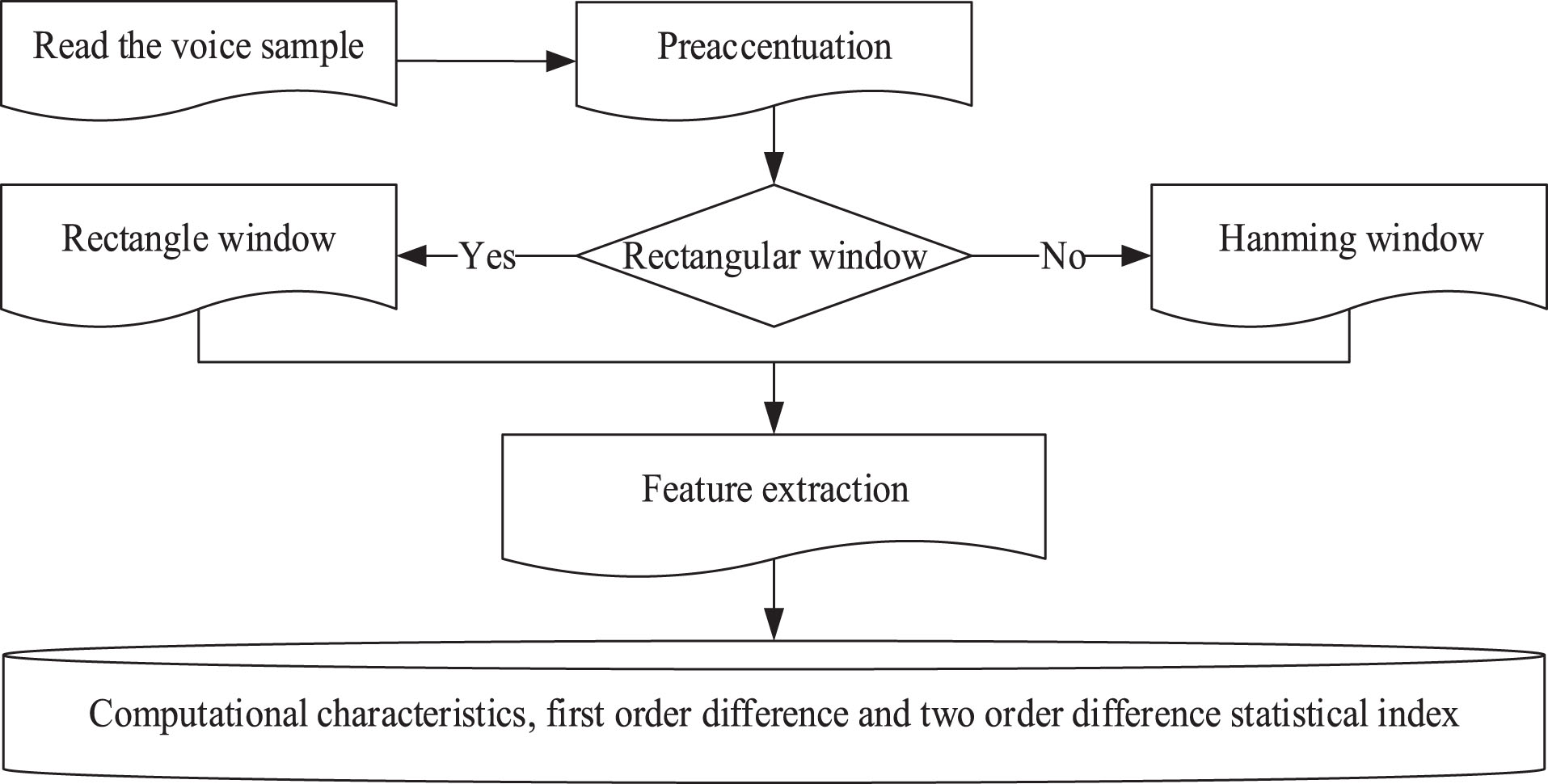
The extracted characteristic parameters include short-time energy, short-time zero-crossing rate, short-time average amplitude, formant and fundamental frequency. Statistical indicators include each characteristic and its maximum value, minimum value, mean value, average rate of change and variance of first-order difference and second-order difference. Finally, the statistical indicators are combined into 1*75 dimension eigenvectors. Energy is an important feature in speech emotion recognition, which has great ability to distinguish emotional expression. Research shows when human emotions are in a state of happiness, anger and surprise, the energy contained in speech is greater, while the energy in a state of sadness is weaker than that in a state of calm. Short-term energy represents the weighted sum of squares of all sampling points in a frame. The extraction formula is as follows:
Among them, N is the window length, x (n) is the input speech signal and w (n) is the window sequence. The number of times a speech signal waveform passes through the horizontal axis (zero level) is called the short-term zero-crossing rate of the speech signal. Short-time zero-crossing rate reflects the frequency characteristics of voice signals, which is often used to distinguish voiceless voice from voiced voice. Unvoiced voice is not the real voice segment, which describes the voice produced by air friction in the mouth, and voiced voice is the voice when the vocal cord vibrates. By combining short-time energy with short-time zero-crossing rate, the start and end points of speech can be effectively detected, which is called endpoint detection technology. Short-term zero-crossing rate Z
n
is defined as follows:
x n (m) denotes the m-th sampling point in the speech signal of the nth frame, and SGN [] is a sign function in the formula. Short-term parity amplitude is a supplement to short-term energy feature, which excludes the sensitive influence of short-term energy on signal level value. Short-term parity amplitude is used to measure the change of voice amplitude. When human emotions are in a state of happiness, anger and surprise, the amplitude of speech changes greatly, while in a state of sadness and tranquility, the amplitude of speech changes slightly. Based on SVM classification principle, speech emotion recognition model is constructed by ECG emotion classification algorithm. SVM is a supervised learning method with fast calculation speed, strong generalization ability and relatively stable training results. SVM classification method is suitable for linear separable sample data.
Experimental environment and data
Under the hardware environment of Windows 7 with Intel (R) Core (TM) i32.4 GHz and 2 G memory, Microsoft Visual C++ 6.0 is used as the experimental data mining platform and My SQL is used as the database management system. This experiment extracts the language of a university’s Physical Education Majors in the process of using body area network as experimental data to analyze and test the emotional classification ability of the model. This data includes the data of badminton teaching of college students in several universities in Wuhan from 2006 to 2008. After eliminating some useless records, the experimental data were 9860. Before the experiment, considering the inconsistency and incompleteness of the experimental data, the data need to be processed to meet the requirements of mining. After pretreatment of the data, in order to improve the quality of badminton application courses for college students and reduce students ‘poor physique level, the data of students’ physique health are processed to provide support for analyzing how to change these factors to improve students ‘badminton level. The resulting rule is shown in Fig. 2.
Rule support / confidence / degree of confidence / degree of lifting.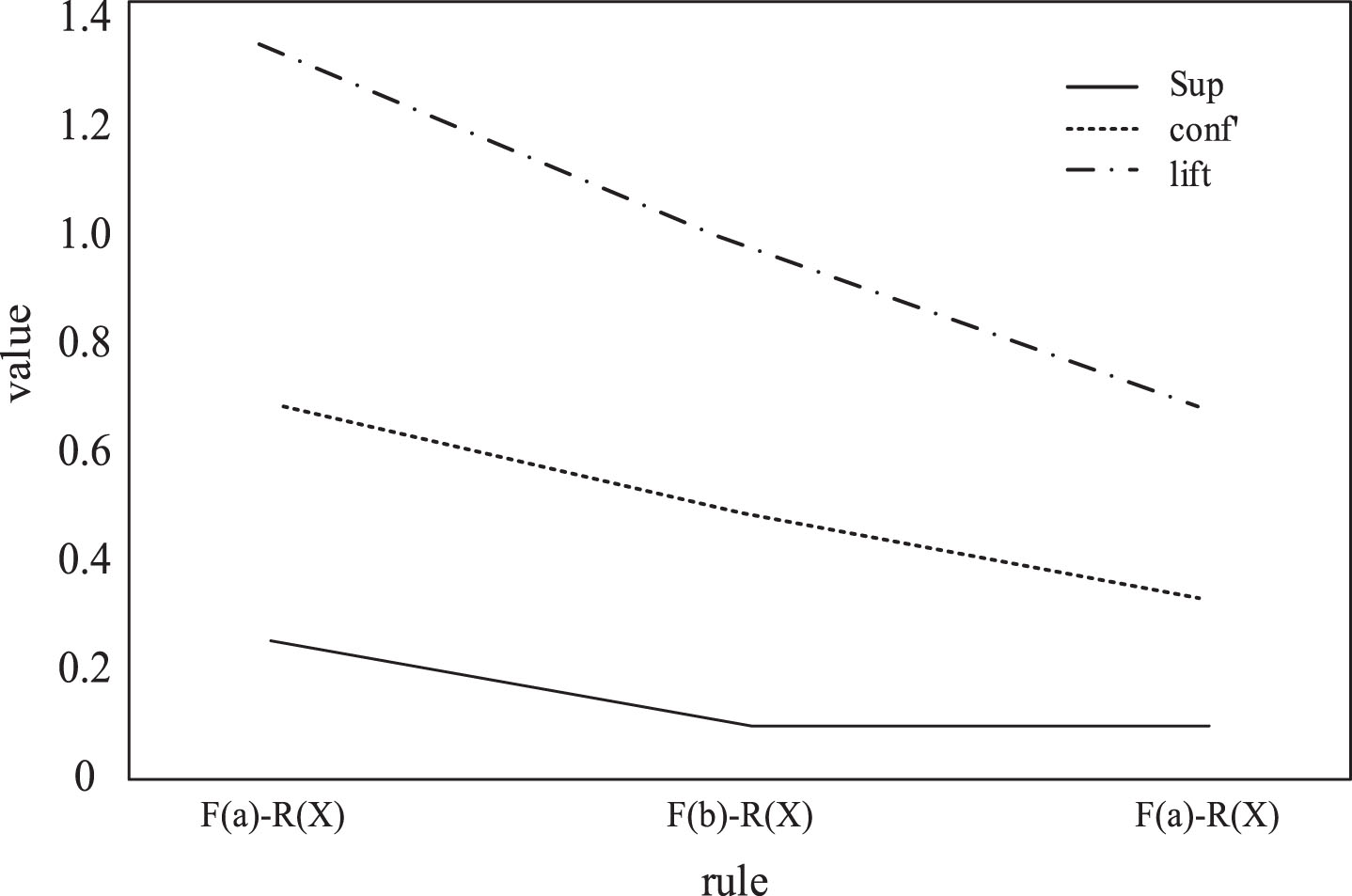
Firstly, the data of badminton teaching items of university students in the experimental data are compressed according to the scoring table of “Chinese Students’ Physical Health Standards”, and these items are merged into an attribute “grade” (the grade includes four cases: excellent, good, pass and fail).
The purpose of feature selection is to find out the feature combinations which have high correlation with emotional expression, and provide valuable reference for the design of speech emotion classifier. order to eliminate the influence of different speaker’s speech habits on feature selection experiments, this topic uses speaker-related emotional voice data as the object of selection and analysis to explore the relationship between static features and emotions.
Static feature information table
Static feature information table
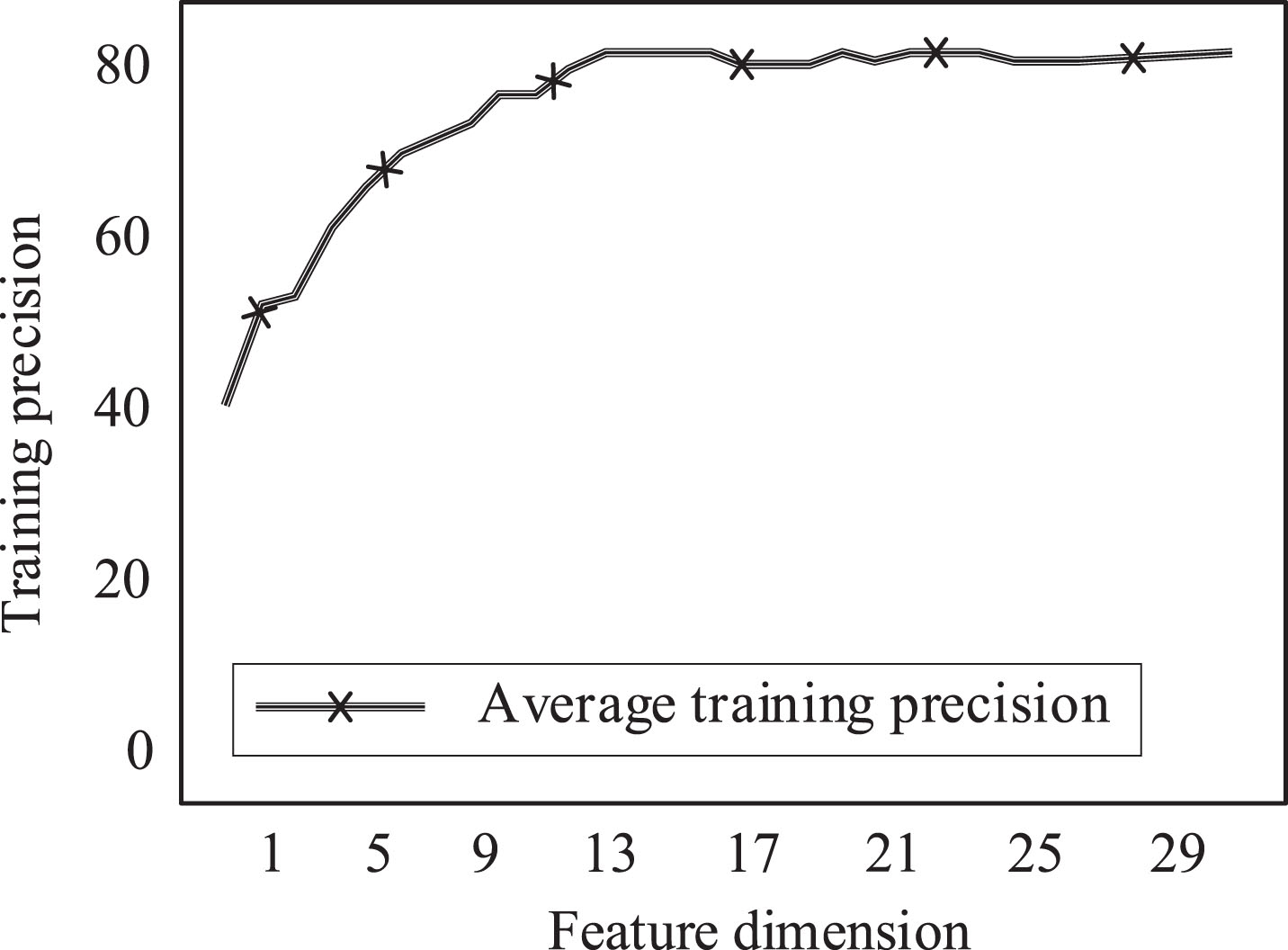
The accuracy of SVM classifier is selected as the criterion value and the search strategy of preferential selection to select the 75 static features mentioned above. The specific experimental process is as follows: Using SVM classification algorithm, the training accuracy of each feature used separately is calculated by leaving a cross-validation method; Sorting features by training accuracy in order from high to low; The training accuracy (d is the dimension of feature selection target) is calculated after the first to the D features are combined into a feature subset. Finally, the top five features of recognition accuracy are the average change rate of short-term average amplitude, the average change rate of short-term energy, the average change rate of short-term energy, the minimum difference of first-order fundamental frequency and the average of fundamental frequency (63). Figure 5 is based on the result of feature ranking. The training accuracy of feature subsets of the first 1 to 30 feature combinations is calculated by using SVM classifier. From the graph, when the dimension of feature increases from 1 to 12, the training accuracy improves obviously. When the feature dimension continues to increase, the accuracy of the classifier fluctuates but does not change significantly.
Compression of experimental data-Part one. Compression of experimental data-Part two. SVM training accuracy with the change of feature dimension.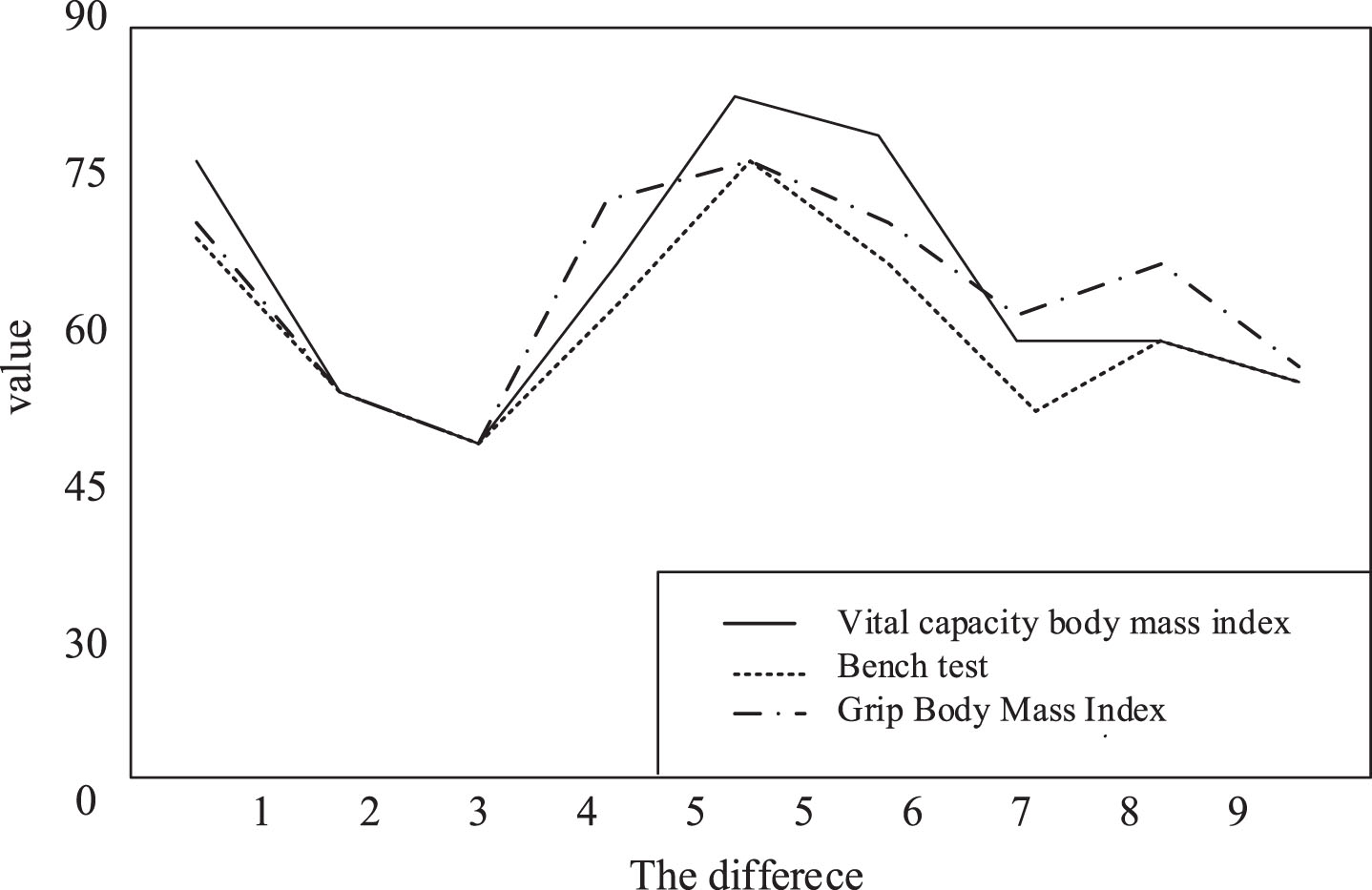

From the above experiments, the statistical characteristics of short-term average amplitude, short-term energy and baseline frequency are highly correlated with emotion, which can be seen. For different emotional training samples, the k values and parameters (C, g) are different when the best training effect is obtained between the samples. In the second classification, the overall training accuracy is more than 90%. Sad-Surprise has the highest training accuracy of 97.5% and Angry-Surprise has the lowest training accuracy of 90%. Figures 6 and 7 are the results of two-class prediction and six-class prediction respectively,which are the investigation of the prediction ability of the model. Two classification prediction results. Six classification prediction results.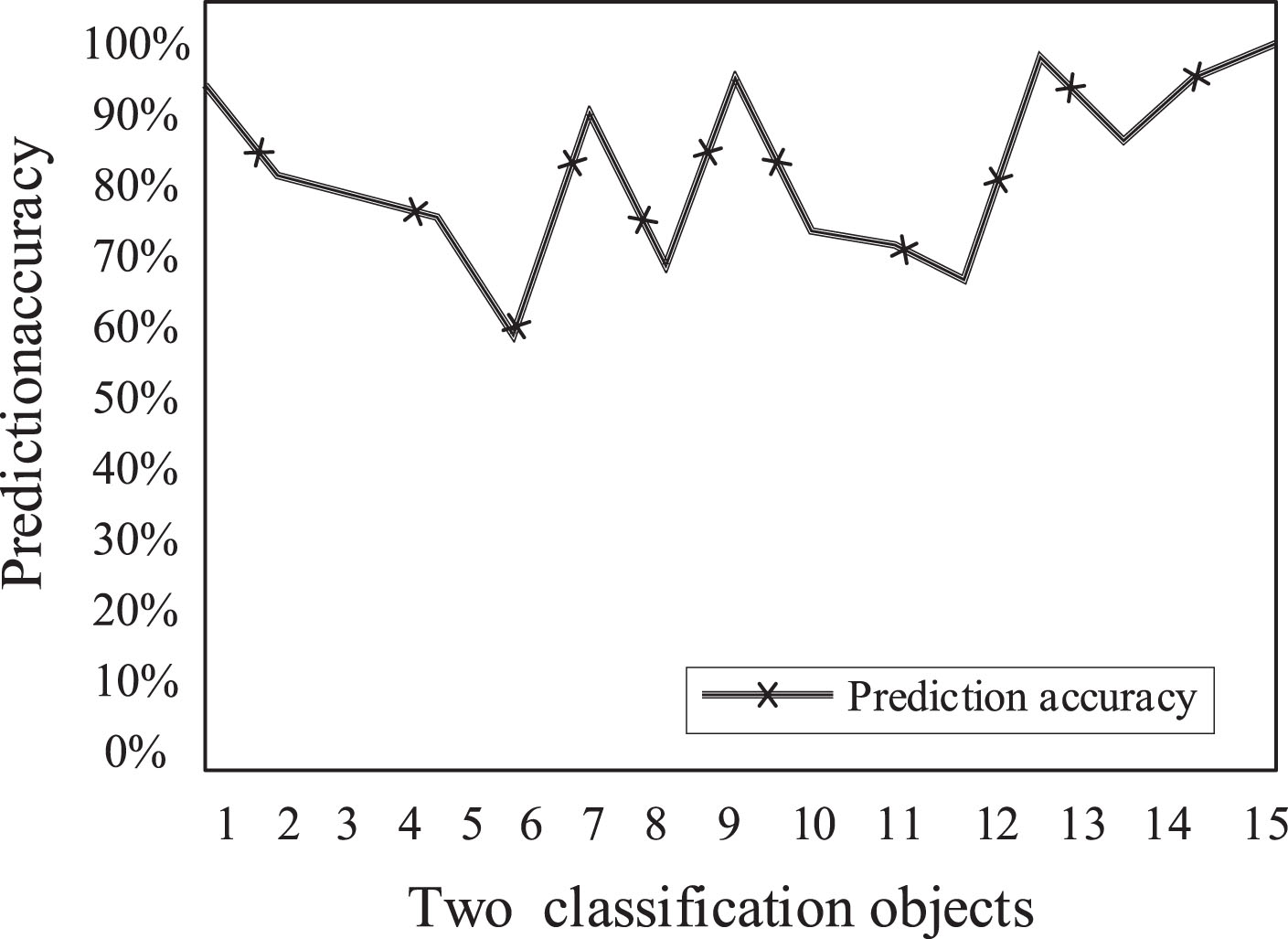
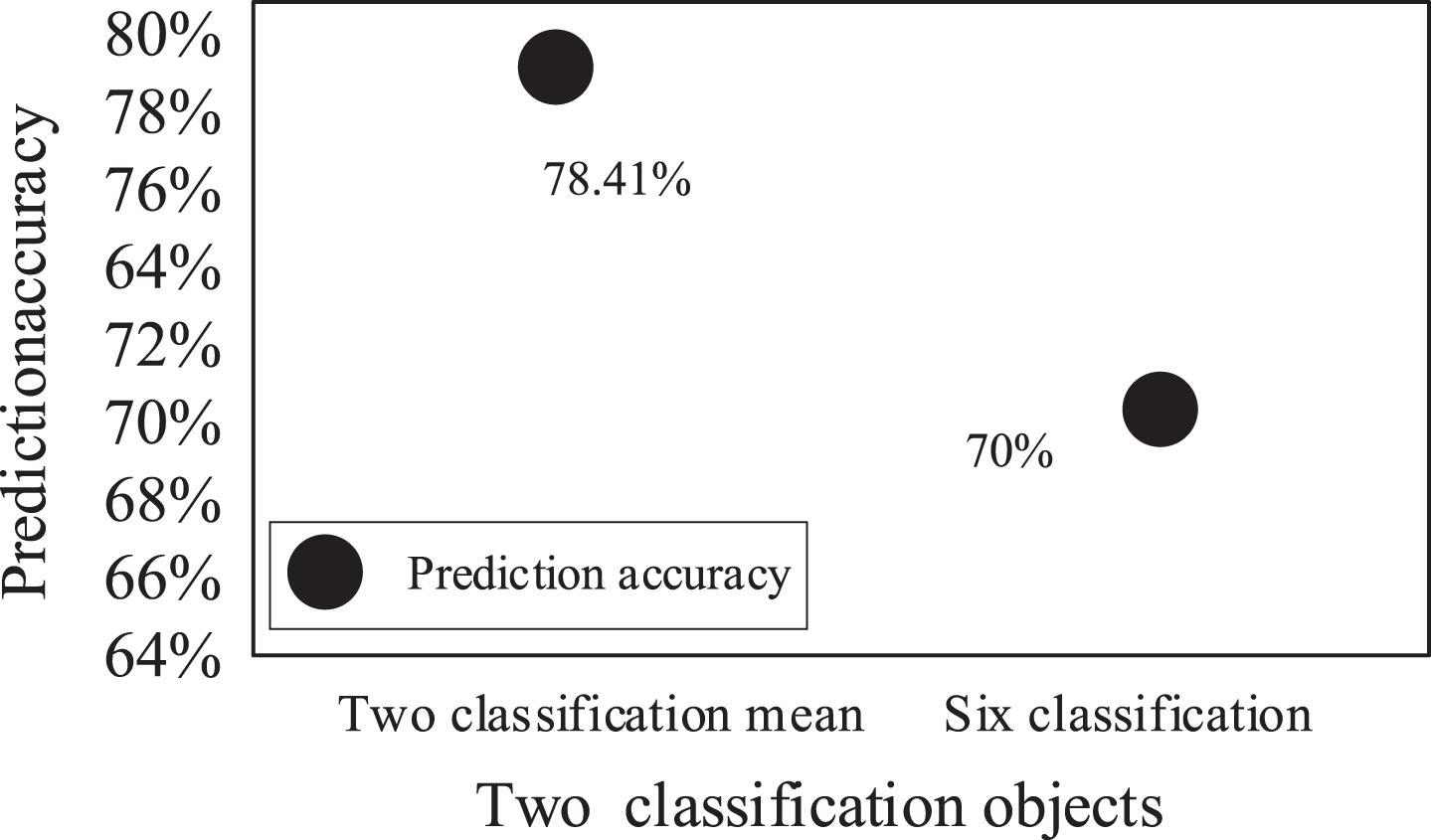
Sad-Surprise, Happy-Surprise, Fear-Sad have good predictive effect in affective binary classification model, and the predictive accuracy is above 90%. Sad-Surprise has the highest prediction accuracy, up to 95%. Angry-Surprise has a poor prediction effect, and its recognition accuracy is only 57.5%. The predictive recognition ability of the emotional dichotomy model is consistent with the training recognition ability, which is in line with expectations. In the emotional six-classification model, the prediction accuracy is 70%, which is lower than the average of the two-classification prediction accuracy. Compared with multi-classification, SVM has better classification effect for binary classification.
With the continuous development of wireless technology and sensor technology, wearable system design is more miniaturized and humanized. The application of WBAN has gradually penetrated into the application of human-computer interaction data analysis and emotional computing classification. Based on this, ECG emotion classification algorithm based on body area network is studied. Based on the combination of wireless body area network technology, ECG emotional classification algorithm is optimized and analyzed by using the principle of support vector machine. From three aspects, speech signal preprocessing, feature parameter extraction and selection, and speech emotion recognition classifier design based on SVM, the construction process of speech emotion recognition model is introduced. Finally, an experimental analysis of the algorithm is carried out. The experimental results show that the emotional classification model can achieve the highest known accuracy in multiple data sets. Compared with the best model known at present, the affective classification model improves 1.3% in Stanford affective tree database, 0.6% in MR database, 0.5% in Chinese hotel review document data set, and the accuracy in IMDB data set is second only to the best model. The experimental results show that the combination of wireless body area network technology and speech emotion recognition based classification algorithm can further improve the accuracy of ECG emotion classification algorithm. Although the model and algorithm have a good effect in the test, the application in specific teaching activities still needs further experiments. Moreover, the system and algorithm should be debugged reasonably according to the actual needs of the body area network.
Footnotes
Acknowledgments
The study was supported by “Scientific research project of Heilongjiang provincial department of education (No. 12541144) and Harbin Research Fund for Technological Innovation (No.2013RFQXJ104)”.