



Abstract
Technological innovation in manufacturing industry is a kind of R&D activity that produces new technologies, including input and output of technological innovation. In this paper, the authors analyze the lean production and technological innovation in manufacturing industry based on SVM algorithms and data mining technology. Data mining can discover novel, effective, potential and ultimately understandable data patterns from a deeper level, and encode the data to predict the development trend of enterprises. The machine learning support vector machine method is used to analyze and model the collected data. At the same time, we constructed a decision tree using random forest, and explained the significance of the training algorithm through the visualization results. The simulation results show that learning growth dimension and market dimension have the greatest impact on business model innovation. In the context of TEC, business model innovation must pay attention to market grasp and customer demand oriented, so as to improve the competitiveness of manufacturing enterprises.
Introduction
With the rapid development of the Internet, the network has become the medium of information exchange and the place to realize the value of the Internet. TEC has changed the original market order and the form of economic activities [1]. By increasing information flow and reducing intermediate links, it eliminated the sequential transmission of information in traditional business activities. In the context of TEC, enterprises must innovate business models suitable for their own development, and the old, non - valuable business models will be eliminated [2, 3]. Business mode refers to the market positioning and profit objectives of an enterprise in a certain field, and a series of overall strategic combinations that meets the needs of the target customers [4]. Business mode is not an entity that exists objectively, but an abstract concept existing in people’s consciousness. It can describe and measure the way and ability of a company’s profit and development.
Manufacturing industry occupies a pivotal position in an economic society, manufacturing level directly on behalf of the national economic development level, the development of China’s manufacturing industry for the construction of socialist modernization of great significance [5]. With the development of society and economy, the social needs are gradually divided, and the demands of the people are becoming different. This requires the manufacturing industry to adapt to the changes in the market, and accordingly adjust the management. The traditional production line model of single species and large scale can not meet the change of social demand. In order to overcome the defects of large batch production, the Toyota Corporation of Japan has been actively exploring. While reforming the traditional pipeline production mode and changing the enterprise management mode, Toyota Corporation has gradually explored the lean production mode which can produce cars in many varieties and small quantities. Lean production reflects the advantages of product quality, cost and resource consumption [6, 7]. It has been paid close attention to by other enterprises, and has been applied by many enterprises. Lean production has been gradually promoted in the world manufacturing industry. And with the production of lean production, the corresponding enterprise management can not adapt to the new production methods, and many new production contradictions exist [8]. The traditional cost management method cannot follow the mode of lean production and market interaction, the traditional cost management system implementation issues such as lack of capacity control is prominent, so enterprises must carry out the transformation of the original cost management system, extensive application of modern management theory and tools, reconstruction cost management framework [9]. At the same time, lean thinking is carried out in the new cost management system, and a new cost management model is established to promote the cost management level of Chinese manufacturing enterprises.
Related work
In the complex target, the analysis of massive data sets, there is no ready-made and can meet the conditions of the general theory of the method of calculation. However, the neural network has a great advantage in the ability of the high bearing capacity of the noise data and the ability to classify the training data [10]. Therefore, it is feasible and necessary to design a data mining method based on neural network, and to use it in real world problems [11]. Artificial neural network can be used in data mining classification, clustering, feature mining, prediction and pattern recognition and so on. Therefore, artificial neural network plays an important role in data mining [12].
Neural Network Artificial has a strong computing power. First of all, there is a huge parallel distributed structure; secondly, it has the ability to learn and the resulting induction [13]. Data mining refers to the process from a large number of incomplete, noisy, fuzzy, random data, extracted implicit in which people do not know in advance, but also potentially useful information and knowledge of the process. It is an effective means of knowledge discovery [14]. Discovered knowledge not only can be used for information management, query optimization, decision support, process control, etc., but also can be used for the maintenance of the data itself [15].
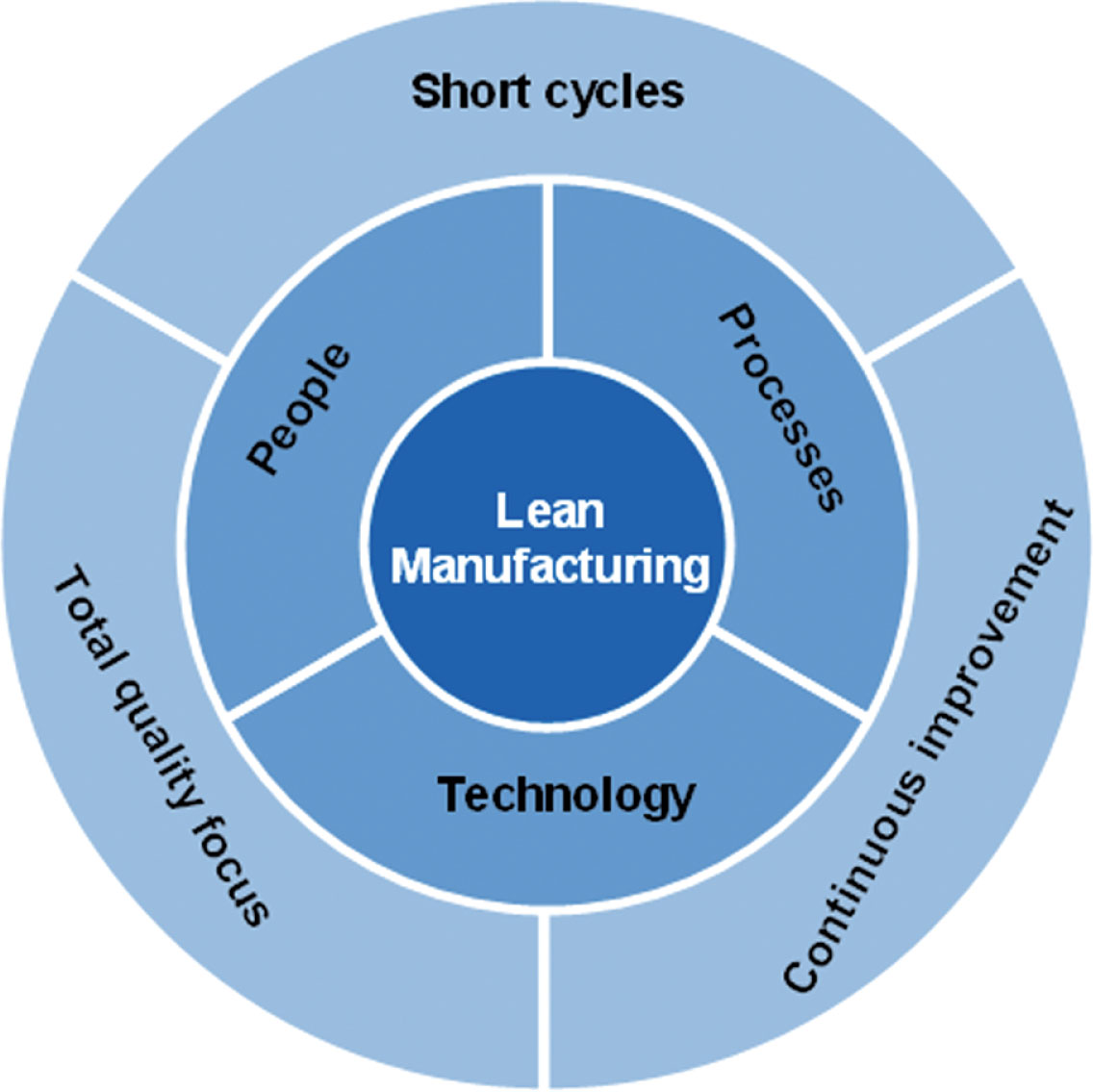
Lean production is a kind of customer demand, minimizes enterprise resources, eliminates waste, reduces enterprise operating cost, makes the enterprise with minimum investment to get the best benefit and improve the response speed to the market as the main target of the mode of production [16]. The core is streamlined by reducing has been to eliminate all non value activities in product design, product manufacturing, production management and related services, shorten the response to customer needs, enhance customer value, increase enterprise capital return rate and profit rate [17]. JIT is oriented to market demand, according to the number of market specific needs and requirements of the rapid production of high quality products to meet market demand, it is based on the “leveling” expenditure rely on market pull production mode [18]. The so-called market pull production, refers to the production of the factory should be based on market demand, according to specific market orders for production preparation [19, 20]. All the links and processes of factory production, parts or products are required to receive the unit from a process according to the required amount of product orders, such a step forward, pulling the control so as to form the whole production system, each process only the needed parts, not many, all the production line only the production orders to produce a product no more [21]. Leveling is the control of parts and processes for production of a wide variety of products of different sizes on a single production line [22]. The level of production, products in the future to the production line work station, professional personnel in accordance with the production time, quantity, variety and orderly qualifying, so each in the production process of the workpiece according to the production plan can smooth and orderly assembly of different products, which can ensure the smooth uninterrupted production line the operation, but also can make the product realization of hybrid production in variety and quantity, the market demand of multi variety and small batch to ensure rapid response and meet. Personnel autonomy means that the production line workers give full play to their initiative in the process of organic coordination of production equipment, and carry out product quality control [23]. In the daily production process, once there is a device failure, it will automatically stop and have specific failure display, at this time, the corresponding staff members need to promptly troubleshoot and resume production. At the same time in the production process, any employee found quality problems, the number of varieties of products and products, and have the right to actively take the initiative to stop the production line, rapid troubleshooting, eliminate quality problems, solve the problem [24]. This will put quality management into the whole production process, fully mobilize the initiative of each employee, and eliminate the product quality problems at the source of production, so that all the work has been transformed into high value effective labor.
Lean production.
Inter organization cost management cost management breaks the traditional boundaries of traditional cost management in enterprise or organization boundary as the boundary, planning and cost control in enterprises or organizations within the scope of control, and the inter organization cost management cost management will be extended to the organization, through the planning and control of the cost of the fabric between the implementation [25]. The lowest total cost target. Inter Organizational cost management is an interdisciplinary theory, which involves cost management theory, organization theory, contract theory, supply chain management theory, etc. As inter organizational cost management crosses the organizational boundaries, the implementation process is more than the traditional cost management obstacles [26]. The target cost plan is a systematic product cost plan that releases the cost of a particular product with a specific function, a specific quality, and a quantity of the product, based on the market expected selling price and profit levels. He believes that the target cost includes direct cost, indirect cost and life cycle cost and target cost plan should not be considered a cost reduction and cost management, target cost plan should be as part of a new product design and the whole process of profit management. Once the product entered the manufacturing stage, the target cost must be constantly updated according to the customer’s expectations, the market environment and the cost of products, value engineering and value analysis (VE/VA) as reducing cost and realizing continuous improvement program of target cost. Detailed cost information, product knowledge, and VE/VA experience are important factors in ensuring that product design innovations meet design, functional, and target cost requirements. At the same time, through improving the operation of suppliers and raw material performance, to help them reduce costs, so as to achieve the target cost of the enterprise.
Spatial feature extractor
The output characteristics of two different neural network layers are introduced as inputs to two long and short time memory models. These two characteristics are the output characteristic f
conv
∈ Rk×k×c of the last convolutional layer of CNN and the output characteristic f
f
c
∈ R
c
of the first fully connected layer. Among them, the behavior sample of such a t frame can be written [18]:
Two pre-trained CNN networks on the ImageNet dataset were selected to serve as spatial feature extractors. These include the famous VGG16 network and the ResNet152 network, and these two classic networks are described in detail.
The VGG16 network was proposed by the Oxford Visual Geometry Group in 2014 to address the classification of large-scale natural images. It won the runner-up of the ILSVRC (Large Scale VisualRecog-nition Challenge) competition and has a good spatial feature extraction capability. Depending on the number of layers of convolutional or fully connected layers, VGG networks contain different variants, such as VGG11, VGG16, VGG19, etc. [19].
The VGG16 network consists of 13 convolutional layers and 3 fully connected layers, and the network structure is shown in Fig. 2. The input RGB image size is [224 * 224 * 3]. The first convolutional layer contains 64 convolution kernels of size [3 * 3], which are then attached to the pooling layer after passing through the next convolutional layer between the particular convolutional layer and the convolutional layer. Among them, Conv [3 * 3 *64] indicates that the convolution kernel has a size of [3 * 3] and the number is 64, MaxPool [2 * 2] represents the maximum pooling of the experience field [2 * 2], FC represents fully connected layer, and 4096 and 1000 represents the number of neurons [20].

Schematic diagram of VGG16 network structure.
Schematic diagram of the residual connection unit in ResNet.
It can be seen that the VGG16 network is mainly composed of a series of convolution kernels of [3 * 3], which undoubtedly reduces the amount of computation compared to the convolution kernel of [5 * 5] in the original AlexNet. As the number of network layers deepens, the size of the network features continues to shrink, but the number of channels continues to increase. The convolution operation can extract information to spatially adjacent pixels and repeating such operations can result in spatial features of the input image in high dimensions [21].
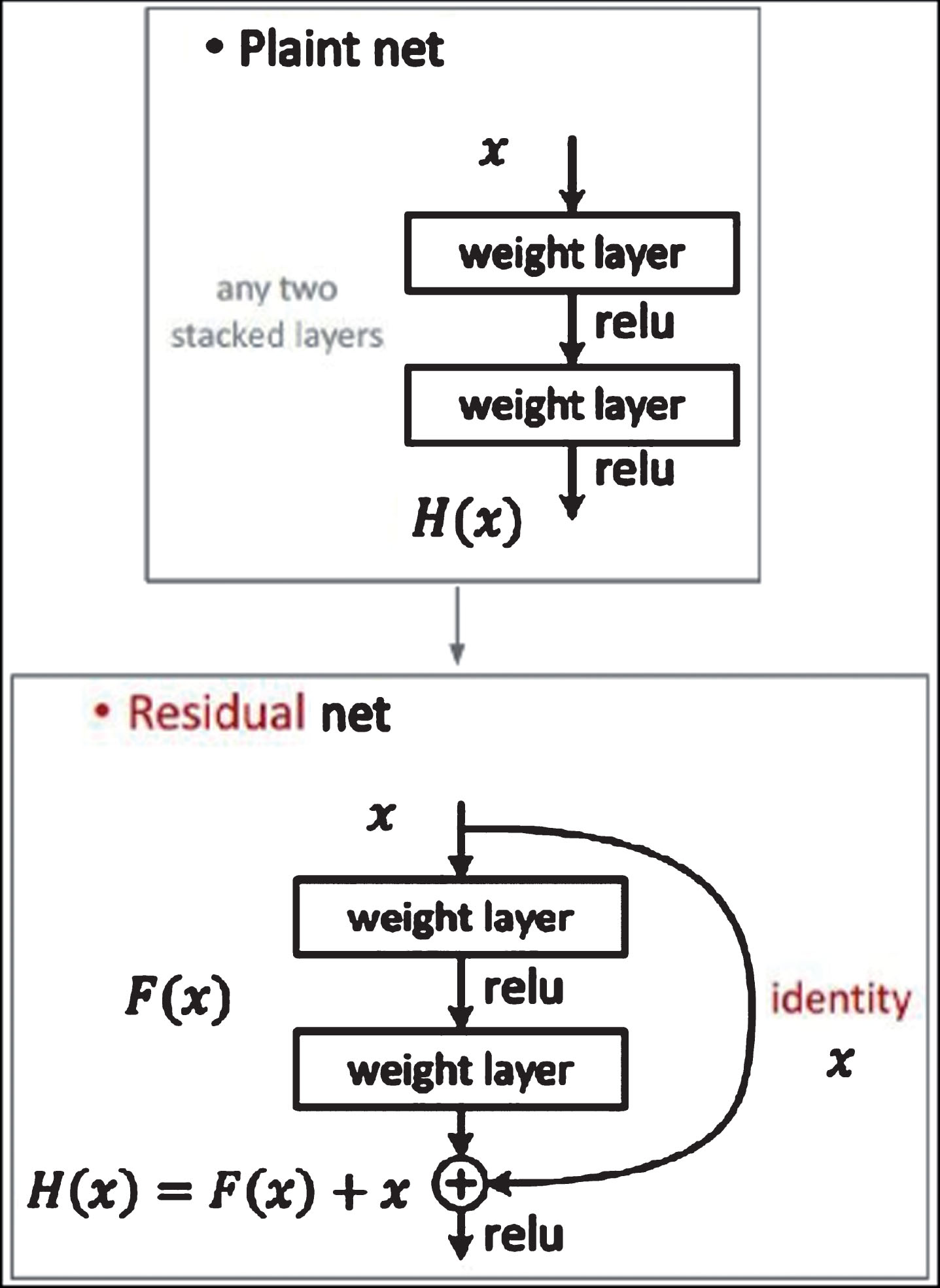
The Deep Residual Network was the work that He Yuming proposed in 15 years and won the ILSVRC championship. As the number of convolution layers deepens, the dispersion or disappearance of the gradient occurs during backpropagation, which does not effectively update the gradient to the previous network layer and causes the previous layer parameters to be unupdated. Therefore, the classic convolutional neural network before ResNet has only a dozen layers of depth.ResNet ResNet proposed a residual connection method, which solved the problem that the gradient cannot be returned during the backpropagation process, and deepened the network layer to more than 100 layers by a large number of convolution stacking, BatchNormalization and Dropout methods, and and also reduced the training parameters [22].
As shown in Fig. 2, a residual connection unit (called a building block in ResNet) can be considered as:
Among them, x and y are the inputs and outputs of the residual connection, f (*) is the convolution operation, and w is the convolution kernel to be learned. Repeating such a residual connection can achieve a very deep neural network. Moreover, rectified linear unit, ReLU is used between layers. In addition, it can be seen that each of the residual connection units contains two convolutional layers.
f (x) + x performs forward propagation through a simple cross-layer connection, which does not add additional parameters or increase the computational complexity, and the entire network can still be end-to-end training through backpropagation [23].
As shown in Fig. 4, the input of the Forgotten Gate consists of two parts: the inputs x
t
at time t and the implicit states ht-1 at time t - 1. Among them, σ (·) is the activation function and the output is f
t
. The forgetting gate decides how much information to discard, thus affecting the state update of the cell, and its equation is as shown in Equation (4) [24]:
Data mining model.
The input gate will be used to update the status of the “cell". In the process of updating Ct-1 to C
t
, the status update of “cell” contains two steps. The input x
t
at time t and the output ht-1 at time t - 1 are mixed and then multiplied by two activation functions σ (·) and tanh(·). Then, the information gain
After
The output gate controls the output h
t
at time t. h
t
is determined by C
t
, ht-1 and x
t
together, and the specific status update steps are:
In summary, an LSTM unit can be represented by the following formula:
Among them, i t , f t and o t represent the input gate, the forgetting gate, and the output gate, respectively; x t and C t represent the input and cell state at time t; ht-1 represents the output at time t - 1; W and U are both vectors to learn, and b represents the bias term; σ (·) represents sigmoid function and ∘ represents point multiplication. With the above equations, the state can be updated step by step.
The original LSTM is a good solution to long-term timing modeling problems and has the ability to process timing information. If the LSTM units are all connected by a full connection, they are called Fully-Connected LSTM, FC-LSTM. Moreover, FC-LSTM lacks the processing power of spatial information. In order to better explore the spatial information in behavioral video, Convolutional LongShort Term Memory (Conv-LSTM) is also introduced.
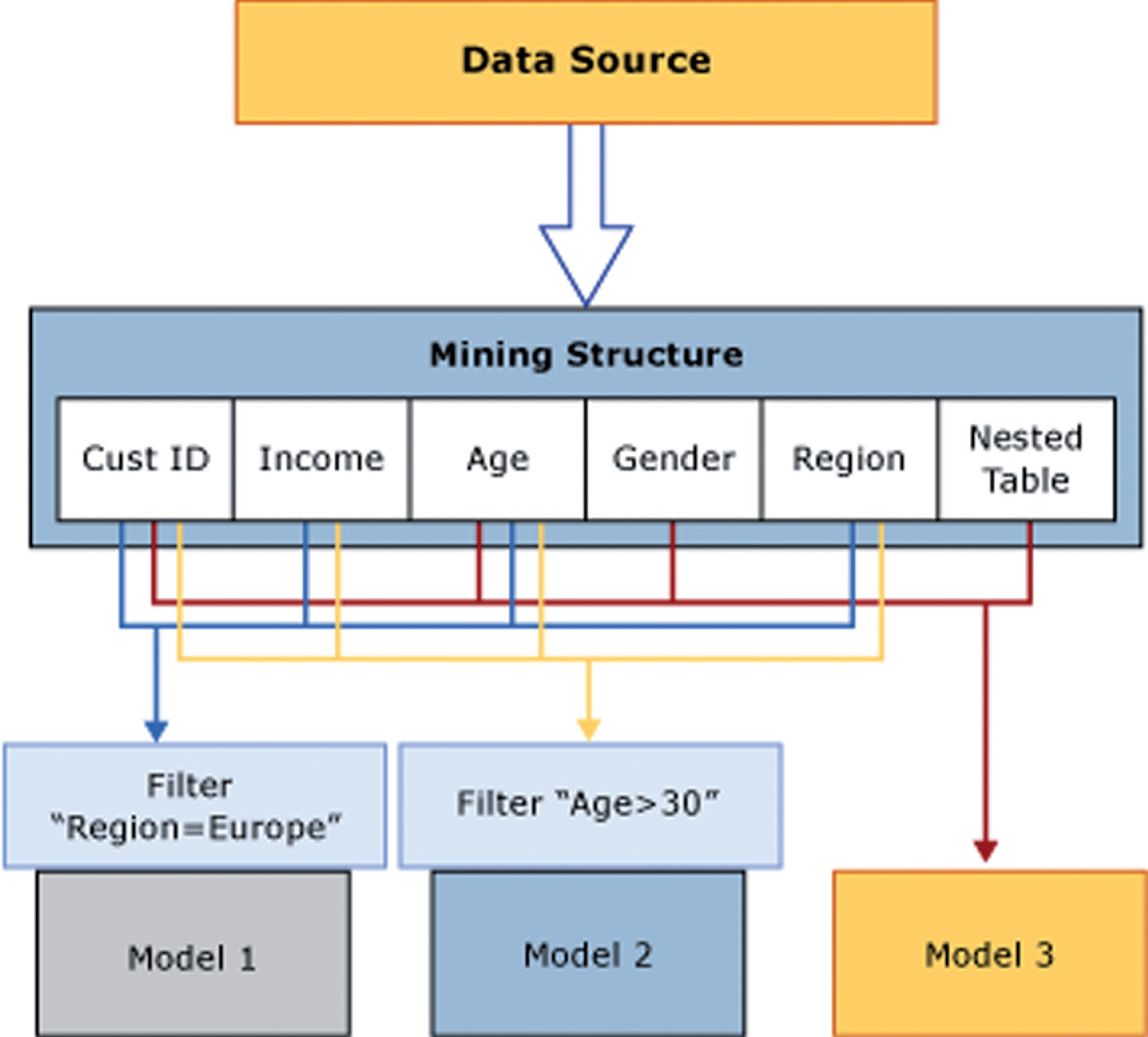
The machine learning support vector machine method is used to analyze and model the collected data. In this research process, the support vector machine program was written in Matlab software, and the model was verified with forty data samples randomly extracted. The specific flow chart is shown in Fig. 4: Fig. 4 is a flow chart of a method for classifying and building a game data set by a support vector machine. If the data in the dataset has only two classifications, the data in the dataset is first cleaned, and the specific steps are the same as above. The data was randomly divided into five groups by a five-fold test method, and the four groups of data were used to train the model, and the remaining set of data was used to verify the trained model. The model is built using the support vector machine method and the classification results is obtained.
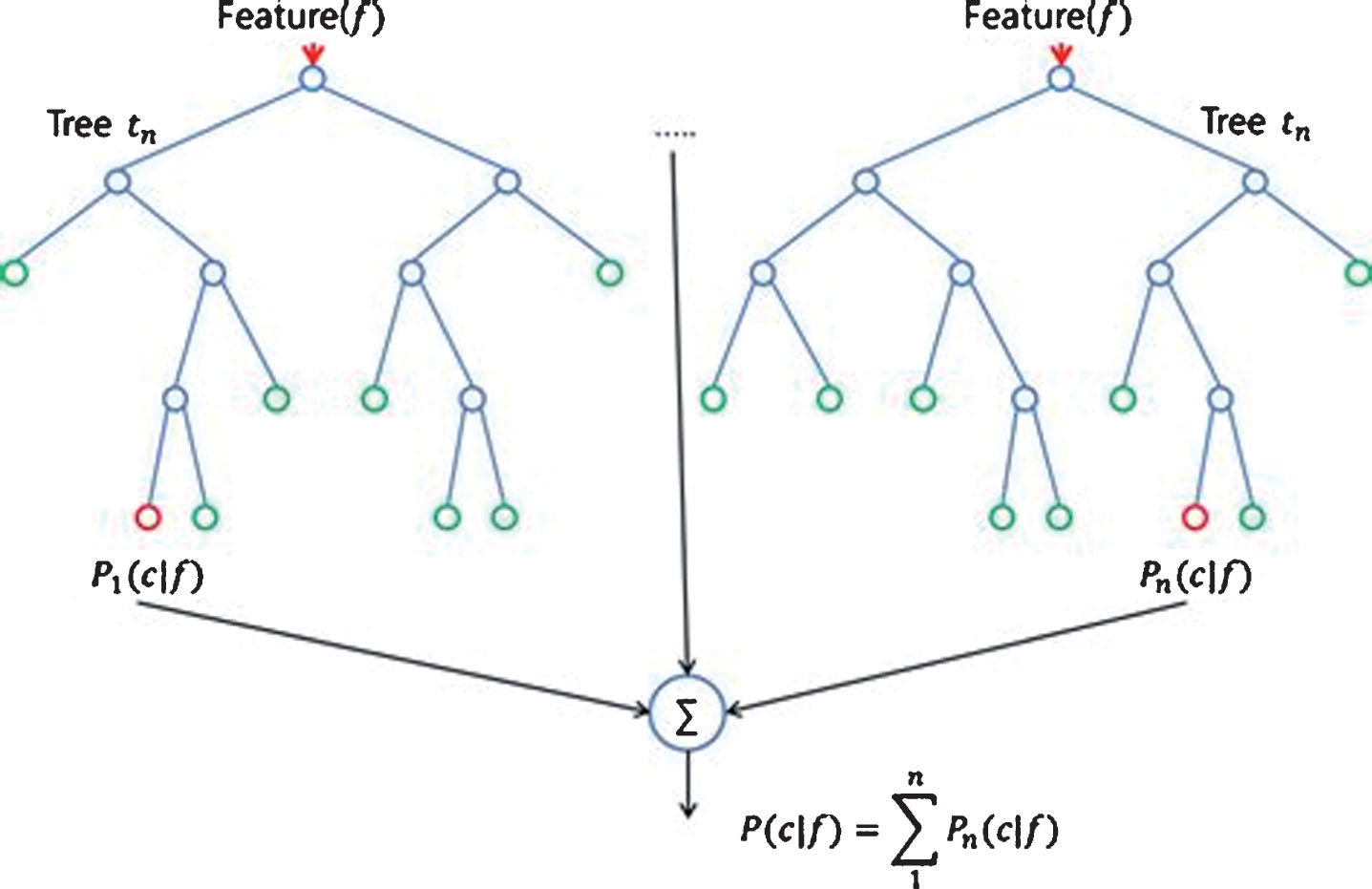
In order to derive the importance of different two levels in the segmented grade data, a decision tree is constructed using random forests in the RF software, and the meaning of training is explained by the results of visualization. The process is shown below. Figure 5 is a flow chart of the model and importance study using a random forest approach.
Random forest.
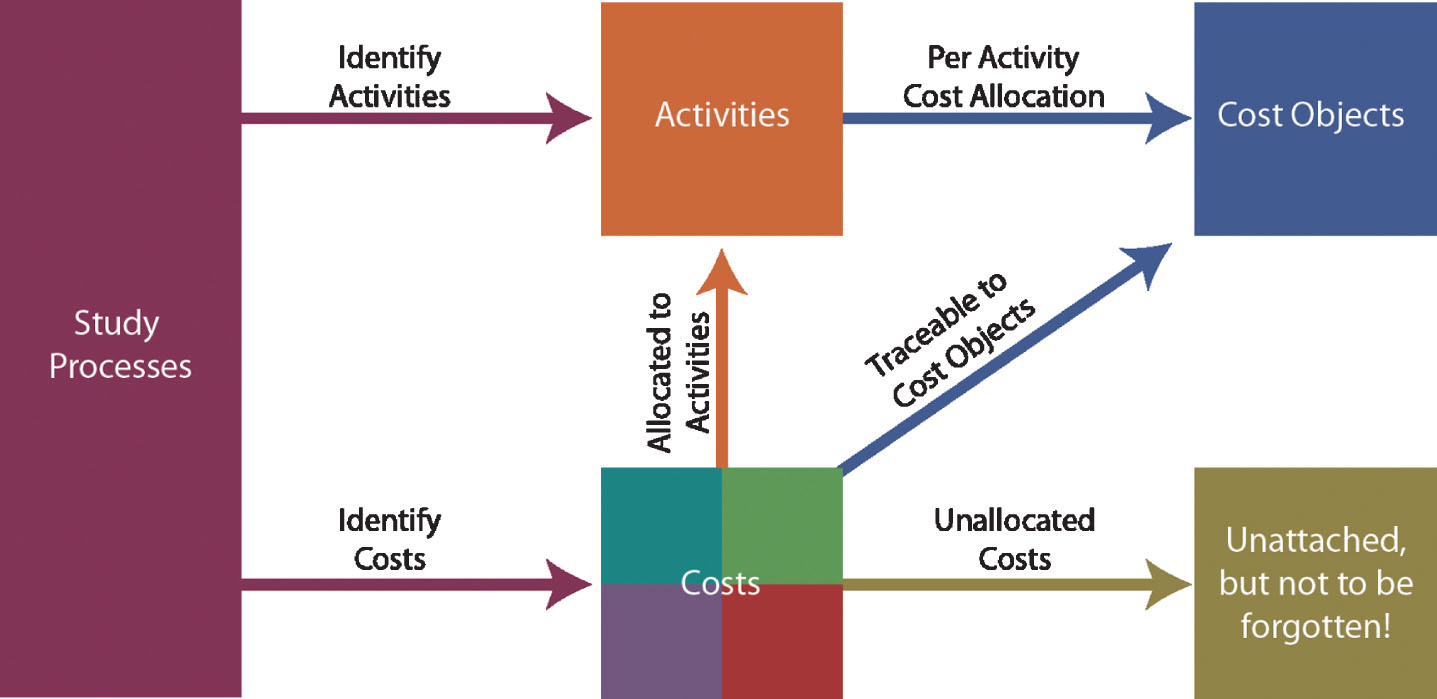
Activity based costing.
Target cost planning
Target cost formulation is the primary task of lean production mode of cost management, the specific implementation steps are as follows: first, in the product design stage, through the “upside down” method to calculate the corresponding target cost of the corresponding products; two is the comparative analysis of the difference between the current product cost and product target cost calculation, and the difference between each function or cost factors; the three is the analysis of differences in motivation, mainly is the ABC (cost drivers, find out the different operations is the main product of no increase in the value of the operation), value engineering method (improved value-added operations, the optimal portfolio is four); follow up state assessment of the target cost, the implementation of non financial index and financial index calculation of target cost; the five is the implementation phase, in the optimization of production cost reduction Product cost to achieve the expected cost target.
Under the lean production management, the target cost is the key to the target cost planning in the cost management way. In this way, in the design and development period of products, you need to plan out on-line product cost tolerance, which is set in advance the cost of the product, so that products in the process of production practice, and the use of sending loss cost control in the cost range. In addition, due to variation of product market the University, if not able to effectively maintain the market competitiveness of products, it will quickly lose market, therefore, keep the good quality and low price, the outstanding performance of the product, has a very important strategic significance. And cost performance prominent, product realization, we must play the role of target cost planning. In the design and development stage of the product, the main process is the pre manufacturing process of the entity product, and the product cost control in the drawing design can effectively control the product design in the actual manufacturing process. Therefore, the product cost is controlled from the source.
Analysis of operations in target cost planning
In the enterprise production system under the requirements of cost accounting mainly reflects the enterprise production and management related cost driving factors, therefore, must be based on the cost drivers as the core to establish the cost calculation method, which leads to the production of the production cost accounting, namely, in the enterprise production management as the actual operation situation of accounting object according to the actual situation, loss of labor, the product according to the rational allocation of product cost, so as to effectively explain the real key factor of product cost, so as to provide a scientific practical production effectively, labor cost information, as a scientific and effective way and method for providing the corresponding improvement cost control. The operation mainly refers to the complex of technology, manpower, raw materials, environment and methods that the enterprise will consume in order to provide a certain service or product. The chain is mainly refers to set up in order to meet the actual requirements of the customer operation product operation based on the complex, and this complex is a business enterprise, is a key driver of production and management of enterprises.
Activity based costing (ABC) plays an important role in the practice of target cost planning. It must be carried out around the operation according to the existing technical conditions. The reason is that the structure design and function of the product, through the value analysis to determine the structure of the product and the specific function, it is important to determine the process, we need on the basis of the existing production conditions of enterprises, according to the target cost and unit process of the actual loss cost value, it is possible to design process of the next step. Through the cost analysis method can analyze the detailed planning of the operation process, find out the useless work, and by improving or eliminating useless operations to reduce costs, provide more useful information for decision makers. Job analysis is mainly from the two levels of job motivation and resource motivation. First of all, the analysis of resource drivers, mainly through the identification and measurement of the operation, confirm and collect the actual cost of the work, comprehensive evaluation of the effectiveness of the various operations. Resource reason analysis of the whole production process based on including product design, production, sales, storage, transportation to users, and in the process on the basis of the definition and measurement of work properly with high similarity, the establishment of operating cost base and operation center. Because the job center is pooled according to sub each resource drivers, therefore, analysis of causes of resources can reveal the operating loss of capital projects, through the corresponding relation between the project and operation, can determine the necessity of resources, and make the necessary restructuring of resources, and ultimately determine the best way to reduce the resource consumption of the work surface to improve the operation efficiency. Secondly, it is necessary to analyze the job motivation, which is mainly caused by job wastage, including the finished product, the output parts and the service. Job motivation analysis is to identify and measure each waste operation, and to collect operating costs and to allocate the cost of the cost library, and finally evaluate the value-added of each operation. After the resource costs into the cost of operating the Treasury for, we have selected some representative job from the job cost center, through the center of the cost calculation rate of representative loss operation confirmation, calculate the cost of operation, with the corresponding operations on the corresponding output, so as to determine the the value of homework. Among them, the value-added operations mainly include: Operation clear function and can create for the final product or service value, in the whole process of product operations in the chain is indispensable, so cannot achieve the three characteristics of the homework is not value-added operations.
Evaluation of development performance level
Evaluation index system
In order to evaluate the performance of the business model innovation system under the TEC background of the degree of customer diffusion, the systematic review and summary of the related literature are made and summarized. Drawing lessons from many experts and scholars, a business mode innovation performance evaluation index system is put forward. The author establishes the evaluation index system of business mode innovation from four aspects: financial dimension, internal operation dimension, learning and growth dimension and market dimension. The result is shown in Table 1.
Index system for evaluation of business model innovation
Index system for evaluation of business model innovation
Data processing
Because the data units of each index are inconsistent, it may lead to a great difference between the observed value and the real value. In order to avoid the influence of different dimensional differences on the development index evaluation, the original data is dimensionless. The calculation formula is as follows:
Determine the weight of each index
In multi index comprehensive evaluation, index weight is the most basic and critical problem. The assignment of weights can directly affect the accuracy and scientificity of evaluation results. Generally speaking, in a multi index comprehensive evaluation, the change of an evaluation index can be explained by the change of other indicators, indicating that the role of the index in the comprehensive evaluation system is smaller, and it should be given its smaller weight; otherwise, it should give greater weight. Based on this, the weight of each evaluation index is determined by the weight of the complex correlation coefficient method. The specific operation steps are as follows:
According to the formula, the correlation coefficient matrix D and the complex correlation coefficient ki can be obtained for the m index.
In formula, D-i represents the correlation coefficient matrix of the removal of the index Xi. The greater the complex correlation coefficient ki shows, the greater the possibility of the index Xi being influenced by the remaining m-1 indicators, the smaller the corresponding weight in the comprehensive development evaluation system.
The correlation coefficient of ki and the countdown was normalized to obtain the weight of each evaluation index.
Calculate the integrated development index F
According to the innovation evaluation index system of the business model, the related economic data of an e - Commerce Company is first collected and collate. Based on the official website annual financial statements and China Statistical Yearbook and other related websites, the basic index data are obtained through detailed reference and comparative analysis. On this basis, SPSS19.0 and DPS data processing software are used to further collate the original data.
After dimensionless processing of original index data, according to formula (1)∼(5), we calculate the multiple correlation coefficients and weights of financial dimensions, internal business dimensions, learning and growth dimensions and market dimensions, and the results are shown in Table 2. On this basis, the formula (6) is used to calculate the comprehensive development index of the business model innovation of 2009∼2017 years and the development index of the dimension. The result is shown in Table 3.
Calculation results of complex correlation coefficient and weight
Calculation results of complex correlation coefficient and weight
The comprehensive development index of business model innovation
In order to analyze the growth trend and evolution characteristics of the comprehensive development index of business model innovation and the change of the dimension development index, we draw the sequence diagram of the comprehensive development index of business mode innovation based on the data in Table 3, as shown in Fig. 7.
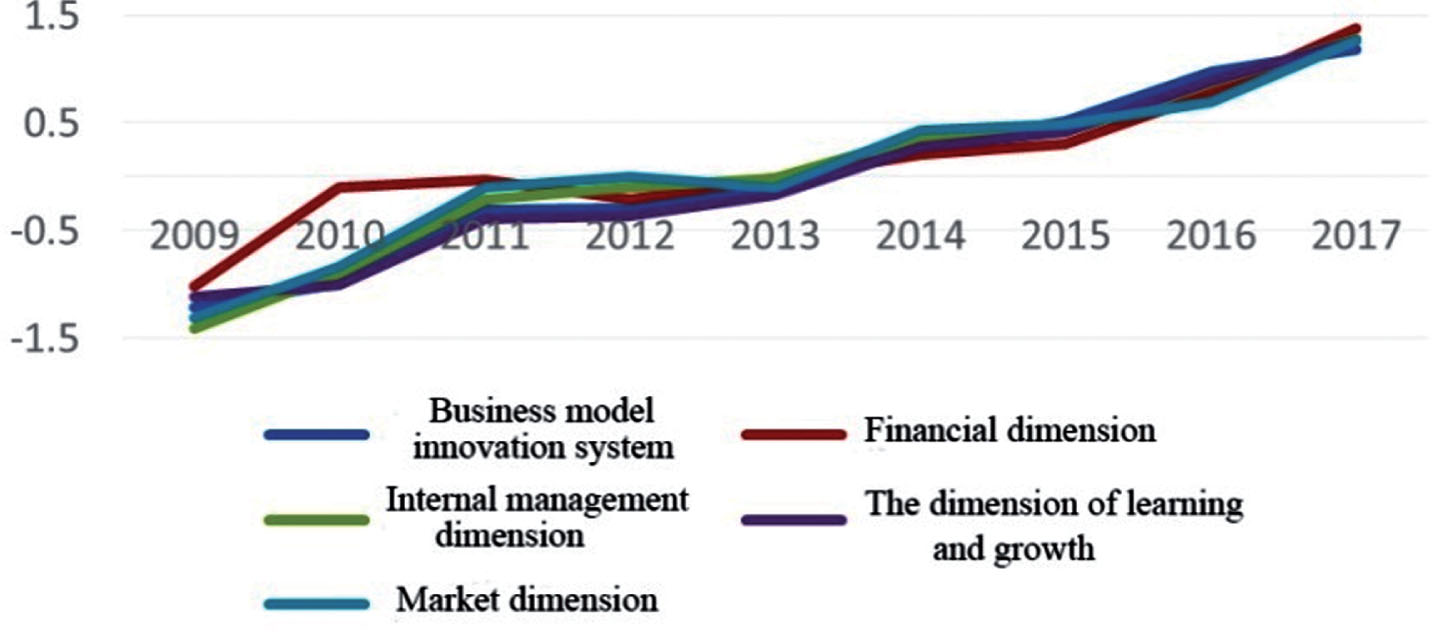
Time sequence diagram of the comprehensive development index of business model innovation.
From Fig. 7, we can see that the degree of innovation of business models and the innovation of all dimensions have been on the rise under the background of TEC, and the influence of learning and growth dimension and market dimension on business mode innovation is the biggest.
Set up the main position of the innovation of the enterprise
The enterprise is the main body of the innovation of the business model. Business model is an important determinant of the success or failure of an enterprise. The important role of business mode innovation in e-commerce era has been affirmed. However, it is necessary to further guide enterprise innovation from the progressive product innovation to the breakthrough development. Another point to be noted is that we must attach importance to the integration and development of enterprises and information technology. According to statistics, 40% of the innovation of American companies is technological innovation, and the 60% innovation is the innovation of business model. At present, the innovation of Chinese business model must make use of information technology to strengthen the traditional industry and develop new market. Therefore, the traditional industry can also create a new business model. It is the development direction of the traditional industry in the future to develop new market space and create new advantages through information technology.
Insist on market oriented innovation
People should actively guide the enterprise to focus on the market development of new technology, and turn the limited market into unlimited market through the Internet. Science and technology are the first productive forces, and the traditional mode of innovation management can further emancipate the productive forces. For a long time, the achievements of China’s scientific research are difficult to succeed in the market. Business model innovation depends on the innovation of new technology, but it is more realistic than technological innovation. The key to the integration of technology and market is to innovate the business mode, let the market accept technological research and development achievements, and promote the industrialization and commercialization of science and technology.
Redefine customer value
In the past, innovation was mainly concentrated in the field of technological innovation and product innovation. Now business model innovation is more important than technological innovation. The struggle of business model has become the key to win the market competition. The new business mode can create new market by dividing the market and reorganizing the market, and applying the new technology that transforms people’s potential needs into real needs. The company has creatively changed the path of product service. The path of Procter & Gamble creative changes in products and services, and the marketing channel of Vichy skin care products are limited to the drugstore, and it is successful. By redefining the value of the customer, the Apple Corp has successfully developed the iPod product and rejuvenated the enterprise.
Conclusion
The western developed countries have applied the activity-based costing in a wide range. With the development of economy and the progress of science and technology, the enterprises of our country have the material conditions to implement the activity-based costing. In view of the problems existing in the implementation of lean production in Chinese enterprises, a lean production system model is designed for Chinese automobile manufacturers. Lean production compared with traditional production methods in value judgment, each production organization, process design and other aspects of the changes, the most important is to mass production, lean production has the advantages of There is nothing comparable to this. In order to cope with the increasingly fierce global market competition environment, enterprises adopt lean production, to maintain absolute superiority performance, quality or cost of products, improve their competitive ability, usually adopt two strategies: one is to develop new products, new features, beyond the competitors; the second is to rival products according to which of their products are targeted for the design and improvement, reduce the cost of products.
The implementation of the two strategies must combine quality management, product development and cost management organically. It is necessary to apply the cost management method under the lean production mode effectively. Business model must be able to highlight an enterprise different from other uniqueness. This uniqueness is manifested in how it wins customers, attracts investors and creates profits. The excellent business mode is rich and meticulous, and its various parts should support and promote each other. Change any part of it, and it will become another model. In the context of TEC, business model innovation must pay attention to market grasp and customer demand oriented, so as to improve the competitiveness of enterprises.