



Abstract
In this paper, we study the qualitative behavior of the positive solutions of a second-order rational fuzzy difference equations with initial conditions and parameters are positive fuzzy numbers. More precisely, we investigate existence of positive solutions, boundedness, persistence and stability analysis of a second-order fuzzy rational difference equation. Some numerical examples are given to verify our theoretical results.
Keywords
Introduction
The theory of discrete dynamical systems and difference equations developed greatly during the last twenty-five years of the twentieth century. Applications of discrete dynamical systems and difference equations have appeared recently in many areas. The theory of difference equations occupies a central position in applied analysis. There is no doubt that the theory of difference equations continue to play an important role in mathematics as a whole. Nonlinear difference equations of order greater than one are of paramount importance in applications. Such equations also appear naturally as discrete analogues and as numerical solutions of differential and delay differential equations which model various diverse phenomena in biology, ecology, physiology physics, engineering, economics, probability theory, genetics, psychology and resource management. It is very interesting to investigate the behavior of solutions of higher-order rational difference equations and to discuss the local asymptotic stability of its equilibrium points. Rational difference equations have been studied by several authors. Especially there has been a great interest in the study of the attractivity of the solutions of such equations. Rational difference equations are special type of nonlinear difference equations. When we divide two difference equations (may be linear or nonlinear), we obtain a rational difference equation (which is always nonlinear). The solutions of rational difference equations can be found rarely in compact or closed forms. For basic theory and applications of nonlinear difference equations we refer the interested reader to [1, 2]. For applications of nonlinear difference equations in population dynamics we refer to [3–7, 18–21].
In case of fuzzy difference equations, parameters, initial conditions and solutions of these equations are fuzzy numbers, while in case of difference equations all these are usually real numbers. Hence study of fuzzy difference equations is more interesting as well as complicated. Using difference equation approach we can investigate dynamical aspects of advanced models in epidemiology, finance and other branches of science. In difference equations assuming the transmission coefficients and other parameter as positive fuzzy numbers, we can explore several dynamics of humans health related issues. These issues include cardiology, hydrology, health services and vital status ascertainment in clinical trials. The readers are referred to see the monographs [22, 29]. For basic theory of fuzzy difference equations see [8]. In [9], embedding problem of non-compact fuzzy number space is given. It is very interesting to investigate the dynamics of nonlinear fuzzy difference equations [10–15]. Bajo and Liz [16] investigated the global behavior of difference equation:
Our aim in this paper is to investigate the qualitative behavior of following second-order fuzzy rational difference equation
u is normal, i . e ., there exist an x in X such that u (x) = 1, u is fuzzy convex function, i . e ., min { u (x1) , u (x2) } ≤ u (tx1 + (1 - t) x2) for all t ∈ [0, 1], and x1, x2 ∈ X, u is upper semi-continuous, The support of u,
An element
[a
β
, b
β
] ⊂ [a
α
, b
α
] for all 0 < α ≤ β
whenever {α
m
} ⊂ (0, 1] in an increasing sequence such that
Moreover, α-cuts of u are given by
A sequence (x
n
) of fuzzy number is said to be bounded and persists if there exist positive real numbers β, γ such that supp x
n
⊂ [β, γ] for n = 1, 2, ⋯. Moreover, if (x
n
) be a sequence of positive fuzzy numbers and x be any positive fuzzy number such that [x
n
]
α
= [Ll,α, Rr,α] and [x]
α
= [L
α
, R
α
] for α ∈ (0, 1] and n = 0, 1, 2, ⋯ then (x
n
) converges to x with respect to metric D, if
Main results
This section is devoted to the main results, which are associated with the proposed problem. Arguing as in [15], we have the following result.
Then from Equation (1), one has
Hence, we obtain the following system
Now, it is easy to show by induction on n that 0 < Ln,α1 ≤ Ln,α2 ≤ Rn,α2 ≤ Rn,α1, n = 0, 1, 2, ⋯.
Similarly, by induction on n, one can show that Ln,α, Rn,α are left continuous for all n = 0, 1, 2, ⋯, and 0 < α ≤ 1. Furthermore, it can be inductively proved that
In order to study the further dynamics of the fuzzy difference Equation (1) we will use the results concerning the behavior of the solutions of the corresponding system of two parametric ordinary difference equations given by:
Let a1 < 1, a2 < 1, then O = (0, 0) and
For every m ≥ 0 the following results hold:
If 1 < a1 and 1 < a2, then every solution For the equilibrium point O = (0, 0) of the System (3) the following results hold: Let 1 < a1 and 1 < a2, then equilibrium point O = (0, 0) of the System (3) is locally asymptotically stable. If 1 > a1 or 1 > a2, then equilibrium point O = (0, 0) of the System (3) is unstable. If 1 > a1 and 1 > a2, then equilibrium point Let 1 > a1 and 1 > a2. Then for k = -1, 0 following statements are true: If If Let 1 < a1 and 1 < a2, then the equilibrium point O = (0, 0) of the System (3) is globally asymptotically stable.
(2) Let α = max {u-1, u0} and β = max{ v-1, v0 }, then it is easy to see from (1) that 0 ≤ u n < α, 0 ≤ v n < β for all n = 0, 1, 2, ⋯.
Hence, every solution
(4) To construct corresponding linearized form of System (3), we consider the following transformations:
The characteristic polynomial of F
J
(0, 0) is given by
Since all eigenvalues of Jacobian matrix F
J
(0, 0) about (0, 0) lie in open unit disk |λ| < 1, if 1 < a1 and 1 < a2. Hence, the equilibrium point (0, 0) is locally asymptotically stable. Similarly, all eigen values of Jacobian matrix F
J
(0, 0) about (0, 0) lie in open unit disk |λ| < 1, if 1 > a1 and 1 > a2. Hence, the equilibrium point (0, 0) is unstable in this case.
(4) The linearized system of (2) about the equilibrium point
Xn+1 = F
J
(E) X
n
, where
The characteristic polynomial of F J (E) is given by
The roots of characteristic polynomial P (λ) are given by
It is sufficient to prove that any one of these roots has absolute value greater than one. For this consider
(5) The proof of 5(i) and 5(ii) follow from induction.
(6) For 1 < a1 and 1 < a2, from (i) of (3) of Theorem 2 (0, 0) is locally asymptotically stable. Moreover, from (2) the solution { (u
n
, v
n
)} of the System (3) is bounded if 1 < a1 and 1 < a2. Now, it is sufficient to prove that { (u
n
, v
n
)} is decreasing. From the System (3) one has
This implies that u2n+1 < u2n-1 and u2n+3 < u2n+1. Hence the subsequences {u2n+1} , { u2n+2 } are decreasing, i . e ., the sequence {u
n
} is decreasing. Similarly, one has
This implies that v2n+1 < v2n-1 and v2n+3 < v2n+1. Hence the subsequences {v2n+1} , { v2n+2 } are decreasing, i . e ., the sequence {v
n
} is decreasing. Hence
The following results give the rate of convergence of solutions of a system of difference equations
Let {(u
n
, v
n
)} be any solution of the System (3) such that
Let
Moreover,
Now the limiting system of error terms can be written as
Using Proposition 1, one has following result.
Where
Let (s
n
, t
n
) be a solution of the System (11) with initial conditions s-1 = β-1, s0 = β0, t-1 = γ-1, t0 = γ0, where β
i
, γ
i
for i∈ { - 1, 0 } are given as
Then, it follows that
Hence by induction one has s
n
≤ Ln,α, t
n
≥ Rn,α for all n = 1, 2, ⋯. Assume that 1 < Al,α, then it follows that 1 < γ
A
, 1 < β
A
. Hence the solution (s
n
, t
n
) of the System (11) is bounded and persist, which is the solution (x
n
) of the Equation (1). Next, from (6) of the Theorem 2, it is easy to see that
Then, the System (3) can be written as
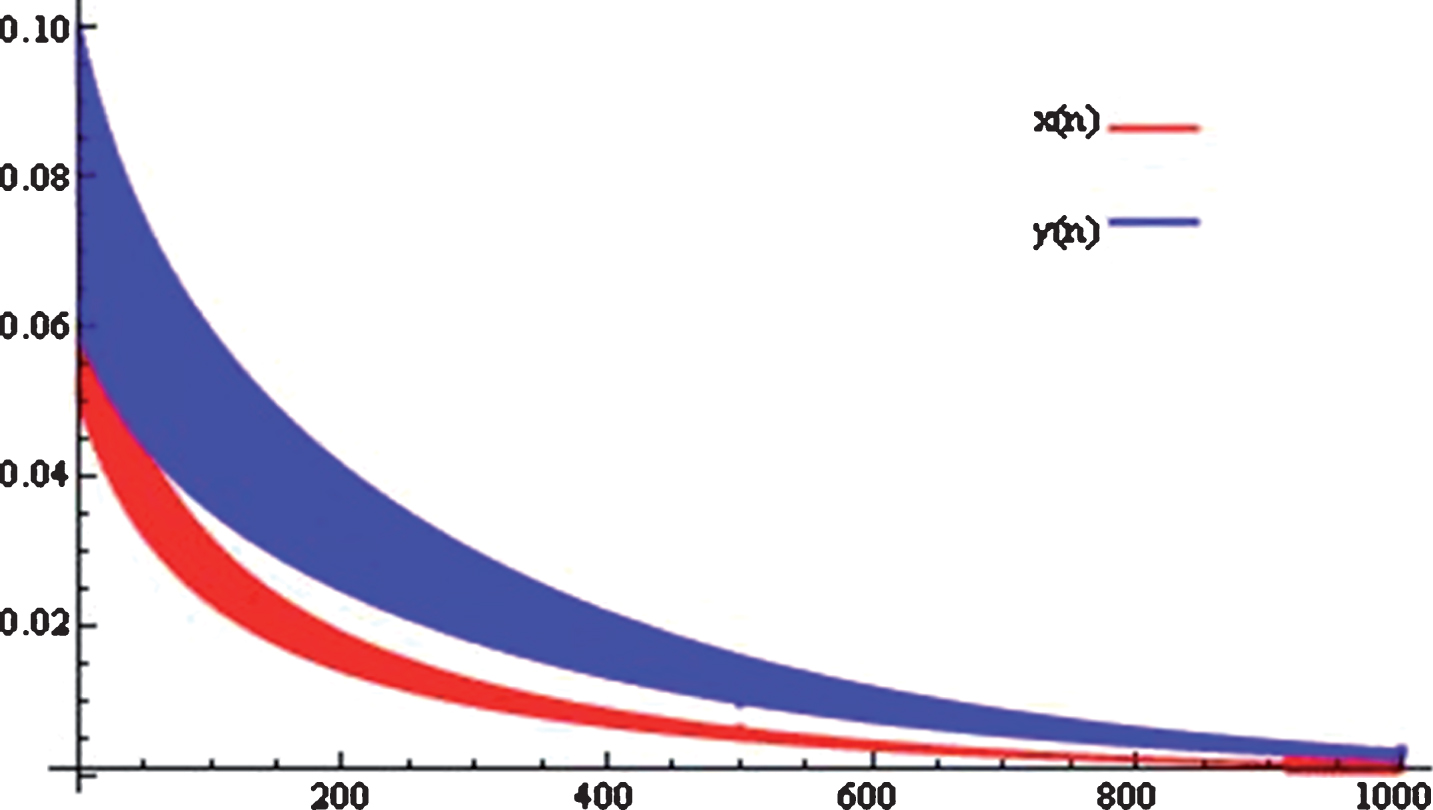
Plot of solutions for the System (12).
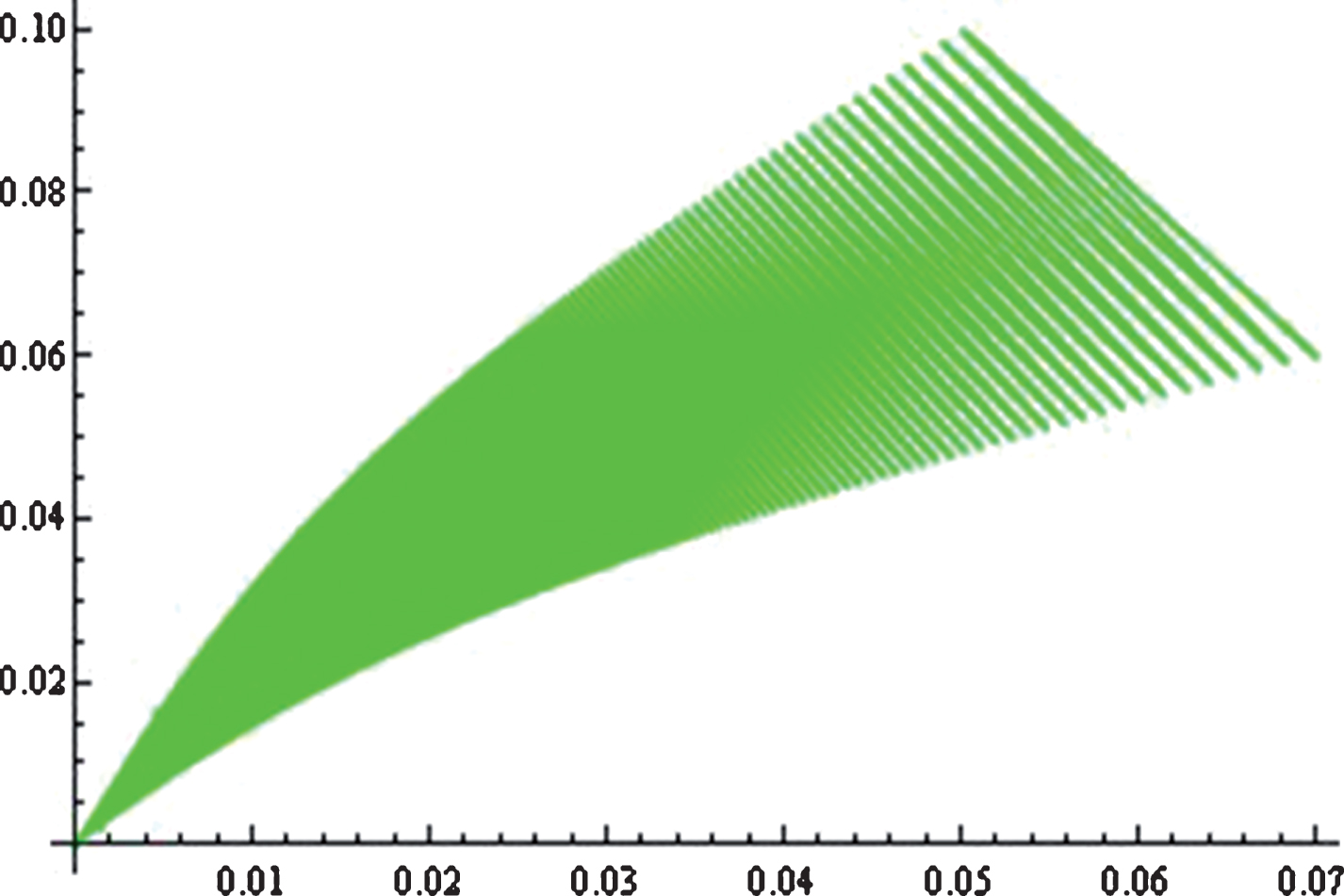
An attractor for the System (12).
Then, the System (3) can be written as
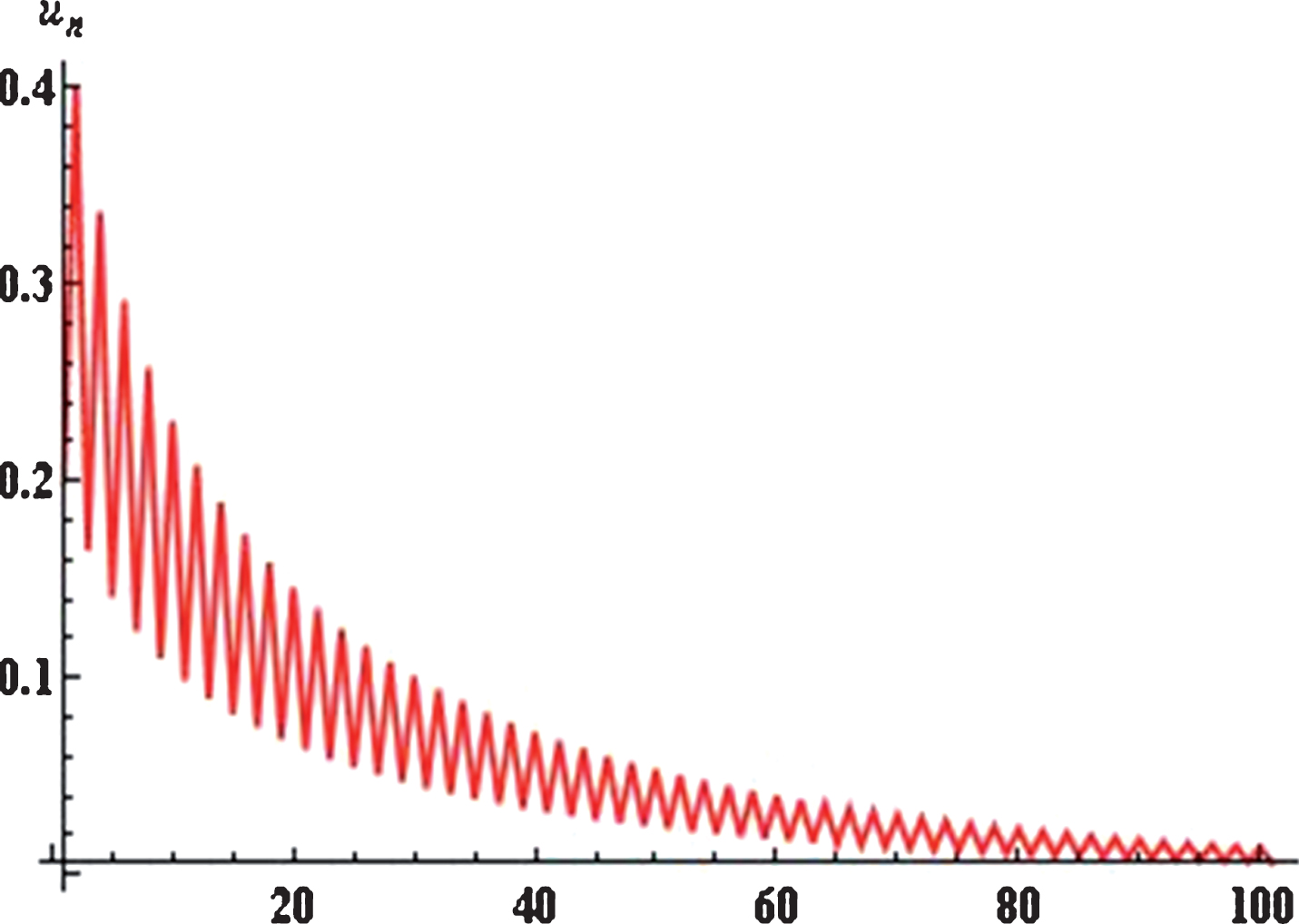
Plot of u n for the System (13).
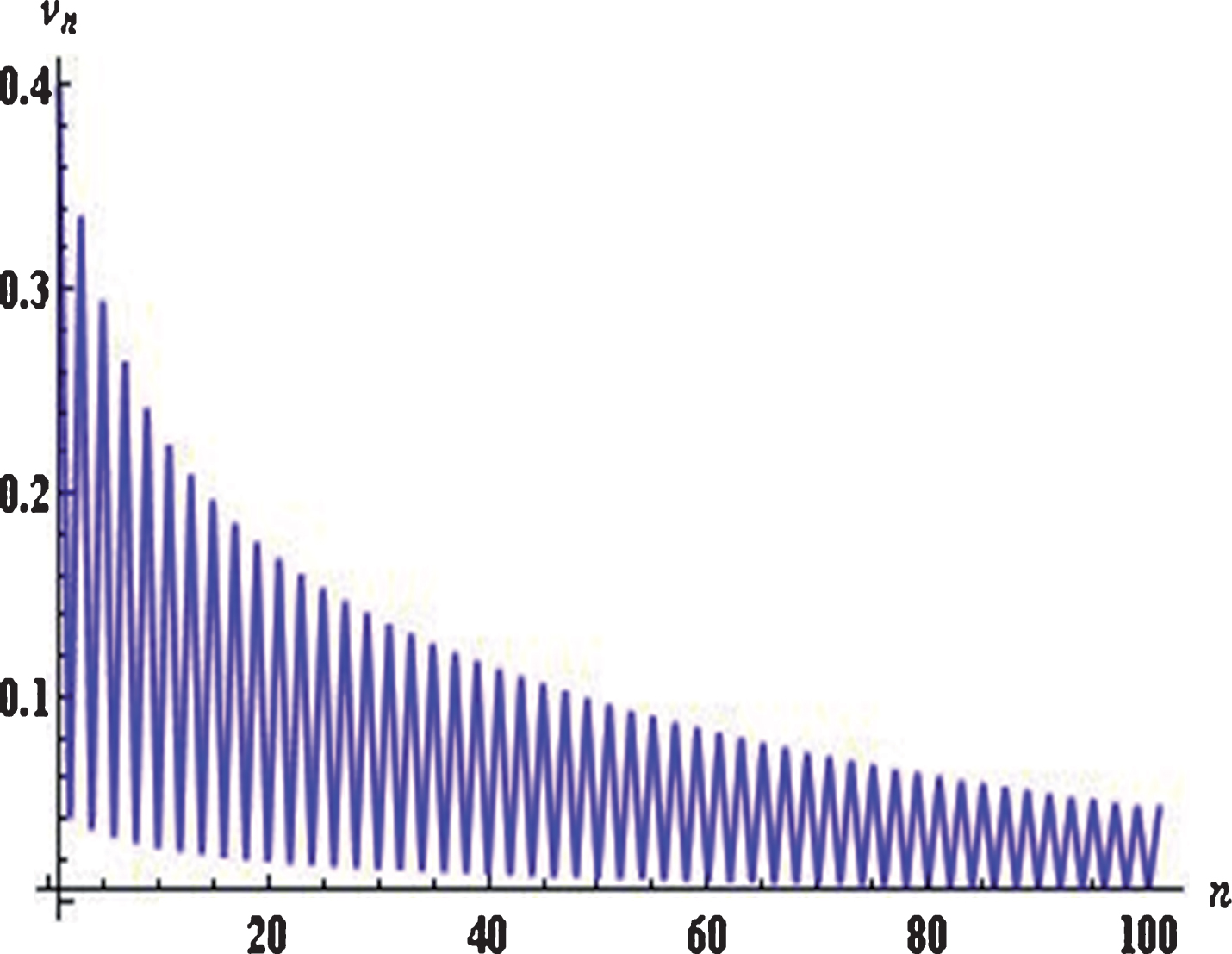
Plot of v n for the System (13).
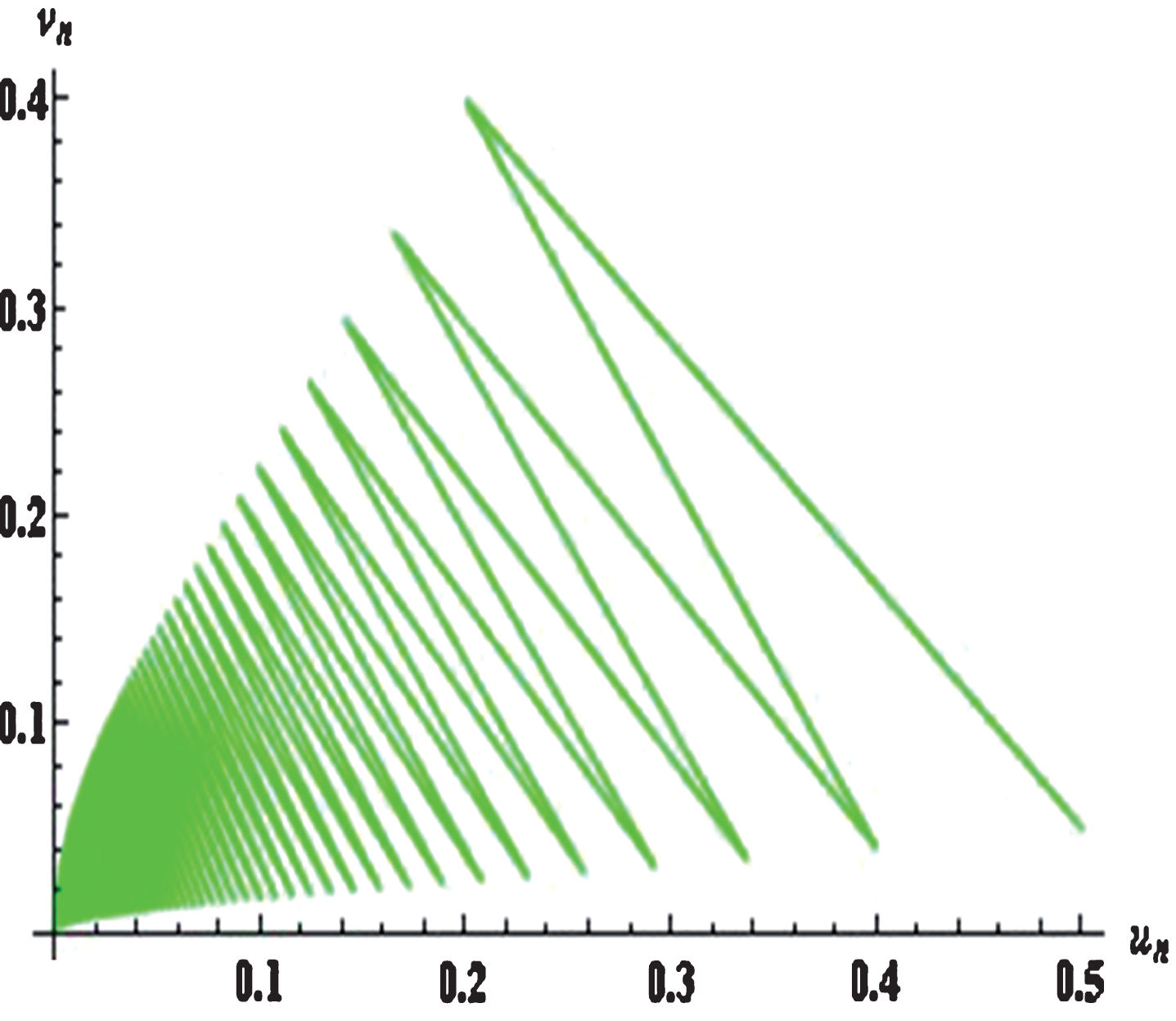
An attractor of System (13).
The present work is related to the qualitative nature of the positive solutions of a second-order rational fuzzy difference equations with initial conditions as well as the parameters are positive fuzzy numbers. Furthermore, the existence of positive solutions, boundedness, persistence, and the parametric conditions for stability analysis are investigated. Due to the diverse applications of fuzzy difference equations in the applied sciences, the researchers are more interested to overcome the problems faced in this numerical technique. Since it is well known that, in fuzzy difference equations parameters are positive fuzzy numbers and problems due to these parameters may be handle through a strong and precise parameterized fuzzy mathematical tools. Therefore, well-known parameterized mathematical tools known as fuzzy soft set [25] and soft fuzzy rough sets (tool used for reduction of parameters) [24, 26–28] can be used to overcome the upcoming difficulties faced in the aforementioned numerical technique.
Footnotes
Acknowledgments
This work was partially supported by the Higher Education Commission of Pakistan.