



Abstract
With respect to the decision making problems where the information of the attribute weights is incomplete under the intuitionistic fuzzy environment, a decision making method based on the improved VIKOR is developed. Firstly considering the advantage of the intuitionistic fuzzy set in expressing the decision makers’ preference information, the intuitionistic fuzzy evaluation matrices are established. In order to derive the attribute weights from the incomplete attribute information of weights, a linear programming model is proposed. Then the traditional VIKOR method is improved by replacing the distance measure with projection model. Finally an illustrative example is given to prove the practicality and effectiveness of the method proposed.
Keywords
Introduction
Multiple attribute decision making (MADM) [1] is one of the complex processes in management to find the appropriate alternative among a set of feasible alternatives. Since the increasing complexity of society and economy, decision makers (DMs) have difficulties in expressing their preference information with crisp value. Zadeh [2] introduced the fuzzy set to deal with the uncertain or vague information. Atanassov [3] generalized the fuzzy set to intuitionistic fuzzy set (IFS), which includes the membership degree, non-membership degree and hesitancy degree. IFS can cope with the imprecise information flexibly. Thus the IFS has attracted more and more attentions from experts and been applied in various fields especially in decision making. Many classical methods such as TOPSIS [4, 5], AHP [6, 7], ELECTRE [8, 9], and PROMETHEE [10, 11] are extended to accommodate the intuitionistic fuzzy environment.
VIKOR [12] is also an effective decision making method developed by Opricovic. It determines a compromise solution, providing a maximum utility for the majority and a minimum regret for the opponent. Many experts have utilized it to deal with different decision making problems. Hamidreza et al. [13] used VIKOR in the selection of subcontractor on the construction management. Vinodh et al. [14] applied VIKOR in the selection of fit concept in modern manufacturing environment. Sarrafha et al. [15] used VIKOR to evaluate the supply chain networks. VIKOR method is also extended by different means. Opricovic et al. [16], Sayadi et al. [17], Vahdani et al. [18], and Wan et al. [19] extended VIKOR to solve the decision making problems with the information of interval number, Triangular fuzzy number, Interval fuzzy number and Triangular intuitionistic fuzzy number respectively. Sanayei et al. [20] employed VIKOR in the selection of suppliers where information is expressed in trapezoidal and triangular fuzzy numbers. Shemshadi et al. [21] extended the VIKOR method with the mechanism of extracting and deploying objective weights based on Shannon entropy concept. You et al. [22] proposed an extended VIKOR method for group multi-attribute supplier selection with interval 2-tuple linguistic information. Opricovic and Tzeng [23] developed fuzzy VIKOR with incomplete information for analyzing land-use strategies for reducing the economic and social costs with potential natural hazards. In addition, many studies combined VIKOR with other decision making methods to solve complex multi-attribute decision making problems. Jin et al. [24] combined VIKOR with dynamic intuitionistic fuzzy weighted geometric operator to solve dynamic intuitionistic fuzzy decision making problem. Chatterjee et al. [25] integrated VIKOR and ELECTRE in industrial robots selection problems. Mohammadi et al. [26] integrated VIKOR and ANP to select the project manager. Chang et al. [27] integrated VIKOR, FAHP, GRA and TOPSIS method in deciding the optimal business models. Safari et al. [28] identified and evaluated enterprise architecture risks by using FMEA and fuzzy VIKOR method. Malekian and Azarnivand [29] integrated Shannon’s Entropy conception and VIKOR to evaluate the flood risk. Mardani et al. [30] proposed a new integrated fuzzy hybrid decision making approach with Fuzzy-AHP, TOPSIS and VIKOR method and applied in quality management fields. Ashtiani et al. [31] developed a trust model based on the integration of fuzzy AHP and fuzzy VIKOR. Opricovic and Tzeng [32] made a comparative analysis of VIKOR and TOPSIS method and found that the TOPSIS method was suitable for the risk aversion type decisions, whereas the VIKOR method was suitable for the profit maximization decisions.
In many MADM problems, the attribute weights information is often incomplete due to the decision making time pressure, the lack of knowledge or data, and limited expertise. Presently, the VIKOR method is seldom extended to solve these problems. Meanwhile, the Euclidean distance or Hamming distance is commonly used in traditional VIKOR method. Compared with the distance measure, the projection model considers not only the distance but also the module and included angle between objects [33]. Therefore, an improved VIKOR method can be proposed by replacing the distance measure with projection model. In order to do so, the reminder of the paper is organized as follows. In the Section 2, some basic concepts related to intuitionistic fuzzy set, projection model, and classical VIKOR method are introduced. Section 3 proposes the improved VIKOR method with intuitionistic fuzzy information as well as linear programming model. In Section 4, an illustrative example is given to verify the effectiveness of the method. Finally, the conclusions are made in Section 5.
Preliminaries
Firstly, we shall briefly introduce some basic definitions and concepts of intuitionistic fuzzy set (IFS), the projection model of intuitionistic fuzzy set and classical VIKOR method.
For convenience, Xu [34] called α = (μ α , ν α ) an intuitionistic fuzzy number (IFN), where μ α , ν α , π α ∈ [0, 1].
The VIKOR method is a compromised ranking approach for multiple attribute decision making problems. It determines a compromise solution, providing a maximum utility for the majority and a minimum regret for the opponent [12].
Assuming that the various n alternatives are denoted as a1, a2,. . . , a n , the various m criteria are denoted as c1, c2,. . . , c m , f ij denotes the rating of alternative a i , i ∈ {1, 2,. . . , n} on the criterion c j , j ∈ {1, 2,. . . , m}. The compromise ranking algorithm VIKOR has the following steps:
Step1: Determine the positive ideal solution and negative ideal solution. Let
Step 2: Calculate the values S
i
and R
i
by the relations
Step 3: Calculate the values Q
i
by the relation
and v ∈ [0, 1] is introduced as the weight of the strategy of “the majority of the criteria”, generally v = 0.5.
Step 4: Rank the alternatives, sorting by the values S, R and Q in increasing order. The results are three ranking lists.
Step 5: Define the compromise solution. a(1) is the best alternative ranked according to the value of Q i , which can be compromise solution if the following two conditions can be satisfied.
①: “Acceptable advantage”:
a(1) must be the best alternative according to the rank of S i or/and R i .
If one of the two conditions above is not satisfied, a set of compromise solution can be proposed.
(1) The compromise solution is a(1), a(2), if condition ② is not satisfied.
(2) The compromise solution is a(1), a(2), ... ,a(J), if condition ① is not satisfied. a(J) is determined by the relation
The multi-attribute group decision making problem has some common elements: alternatives, attributes, the weights of attributes, and multiple decision makers.
(1) Ai: index for alternatives, i ∈ M = {1, 2,. . . , m};
(2) Cj: index for attributes, j ∈ N = {1, 2,. . . , n};
(3) Pk: index for decision makers, k ∈ T = {1, 2,. . . , t};
(4) w j : index for weight of attribute Cj.
A multi-attribute group decision making problem with k decision makers, m alternatives and n attributes can be contained in the following matrix:
The decision making method based on the improved VIKOR method for multi-attribute group decision making in intuitionistic fuzzy environment involves the following steps:
Step 1: Determine the positive ideal matrix and negative ideal matrix.
(1) Positive ideal matrix:
If Cj is the benefit attribute (the bigger the attribute values the better), then
If C
j
is the cost attribute (the smaller the attribute values the better),
(2) Negative ideal matrix:
If Cj is the benefit attribute (the bigger the attribute values the better), then
If C
j
is the cost attribute (the smaller the attribute values the better),
Step 2: Determine the weights of attributes.
In the process of decision making, the information on attribute weights is often incompletely due to the limitation of time or knowledge. Let H be the set of the known weight information, which can be constructed by the following forms [35].
(1) A weak ranking: {w i ⩾ w j };
(2) A strict ranking: {w i - w j ⩾ αi (α i > 0)};
(3) A ranking of differences: {w i - w j ⩾ w k - w l } , j ≠ k ≠ l;
(4) A ranking with multiples: {w i ⩾ βw j } , 0 ⩽ βi ⩽ 1;
(5) An interval form: {0 ⩽ γi ⩽ w i ⩽ γ i + ξ i ⩽ 1};
According to the evaluated information and the known information on attribute weights, the multiple objective optimization models can be established based on projection method.
Let
Model 1
Since each alternative is non-inferior, there exists no preference relation on all alternatives. Then the above multiple objective optimization model can be aggregated into the following single objective optimization model:
Model 2
From the model 2, the optimal weights of attribute can be derived.
Step 3: Calculate the values of S
i
, R
i
, Q
i
for each alternative A
i
by the relations.
Compute the values of Q
i
by the relation.
Step 4: Rank the alternatives according to the value of S i , R i , Q i in increasing order respectively. The smaller the value of the alternative is the better.
Step 5: Define the compromise solution. A(1) is the best alternative ranked according to the value of Q i , which can be the compromise solution if the following two conditions can be satisfied.
Acceptable advantage:
Acceptable stability in decision making:
A(1) must be the best alternative according to the rank of S i or/and R i .
If one of the two conditions above is not satisfied, a set of compromise solution can be proposed.
(1) The compromise solution is A(1),A(2), if condition ② is not satisfied.
(2) The compromise solution is A(1)A(2), ... ,A(J), if condition ① is not satisfied. Where A(J) is determined by the relation
With the increasingly fierce market competition, more and more firms have realized the importance of supply chain strategy. Supply chain logistics outsourcing attracts more and more attention. More and more manufacturers outsource their logistics business to 3PL. GREE is a famous air conditioner manufacturer in China. It wants to select the appropriate third-party logistics service provider to improve the supply chain efficiency. After the initial selection, four alternatives are selected, which are A = {A1, A2, A3, A4}. The firm invites four experts e = {e1, e2, e3, e4} to evaluate the four alternatives according to the criteria in Table 1.
Criteria used in selection of suppliers
Criteria used in selection of suppliers
The evaluation information can be listed in Table 2.
Ratings of the alternatives
Now the proposed improved VIKOR method can be utilized to select the best supplier.
Step1: Determine the positive ideal matrix and negative ideal matrix.
The positive ideal matrix and the negative ideal matrix are given in Table 3.
The positive ideal matrix and negative ideal matrix
Step 2: Determine the weights of attributes.
The information on the criteria weight given by four experts can be listed as follows.
Utilize the model 2 to establish the optimal programming model to get the weight vector of criteria.
Step 3: Calculate the values of S i , R i , Q i for each alternative A i .
When v = 0.5, the values of S i , R i , Q i for each alternative A i can be calculated by using Equation.(16–18). The result can be listed in Table 4.
The values of S i , R i , Q i for each alternative
Step 4: Rank the alternatives according to the value of S i , R i , Q i in increasing order respectively. The smaller the value of the alternative is thebetter.
According to the value of Q, the best alternative is A1. However, since
Due to that the value of parameter v is various in the interval from 0 to 1, the ranking order of the potential third-party logistics service providers may be also various. The profound analysis can be made by figuring out the relation between Q i and parameter v. The result can be listed in Table 5.
The values of S i , R i , Q i for each alternative
According to the value of Q, we can see that when 0 ⩽ v < 0.6893 the best alternative is A1, when 0.6893 < v ⩽ 1, the best alternative is A3 . However, as Fig. 1 shows when 0 ⩽ v ⩽ 0.3416, the best alternative is A1, when 0.3416 < v ⩽ 1,
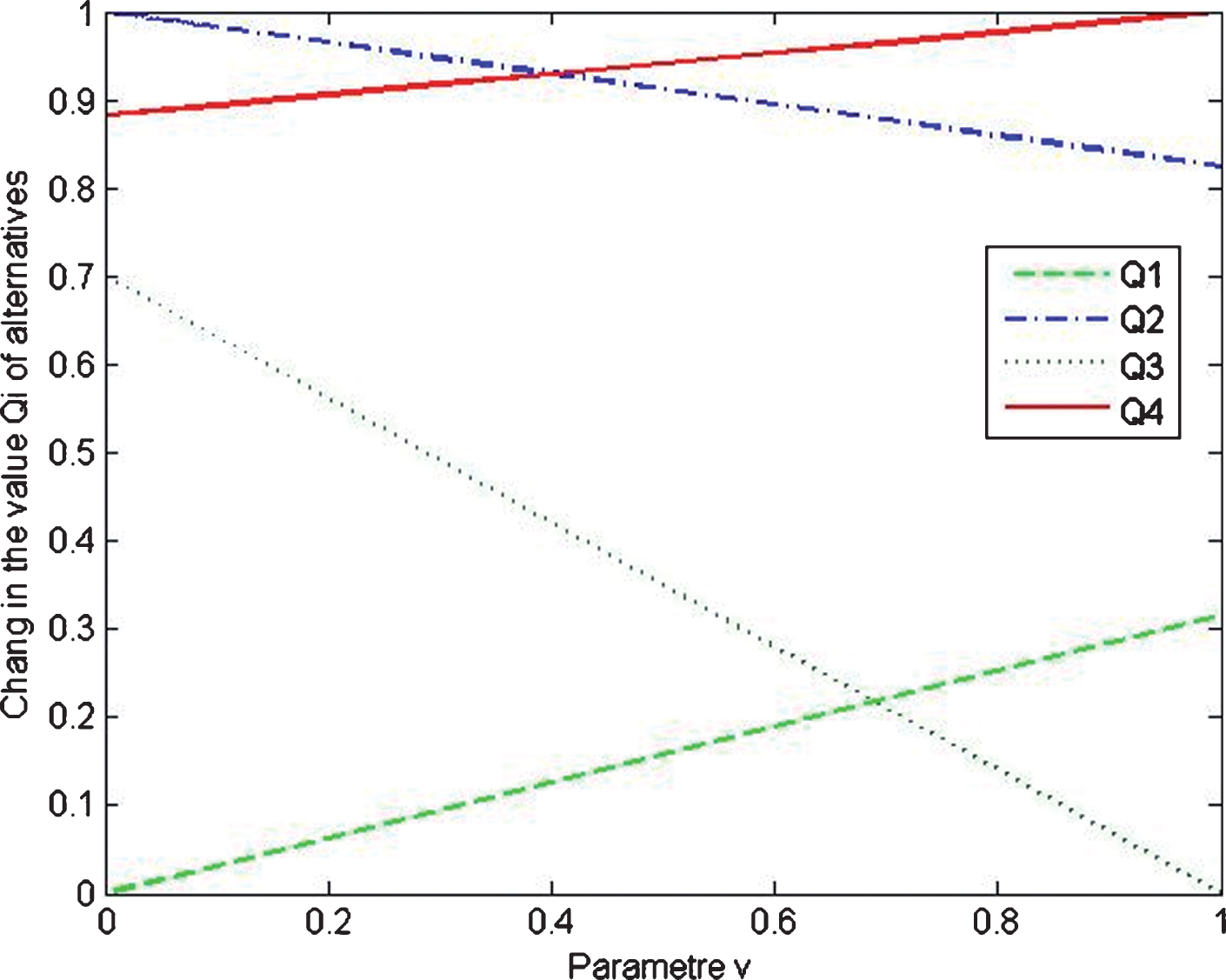
The relation between Q i and parameter v.
Thus, if the decision makers pay more attention to the minimum individual regret of the alternative, A1 is the appropriate third-party logistics service provider. If decision makers put emphasis on both the maximum group utility and the minimum individual regret or only the maximum group utility, A1, A3 are the appropriate third-party logistics service providers.
In order to make a comparison between the improved VIKOR method and classical VIKOR method, we apply the method into the problem (adopted form Jin et al. [24]). On the condition that the decision result is not influenced, Jin et al. [24] simplified the work of the calculation to only calculate the distance between the positive ideal solutions with alternatives. Thus we calculate the projection of the alternatives on positive ideal solution. The values of S i , R i , Q i for each alternative are listed in Table 6.
The values of S i , R i , Q i for each alternative
The decision results of different methods are compared in Table 7.
The comparison between the results by different method
In the classical VIKOR method the decision result is the set of compromise solution {x1, x4} when v ∈ [0, 1]. In the improved VIKOR method the decision result is x1 when 0 ⩽ v ⩽ 0.0186, the decision result is the set of compromise solution {x1, x4} when 0.0186 < v ⩽ 1. We can see some difference in the decision results by two methods. From the view of ranking order, in the classical method the alternative x4 has more advantages, while in the improved method the alternative x1 is better. Some reasons can be listed as follows.
Firstly the variances of the values of S i , R i on the alternatives are calculated. The variances of the value S i of the alternatives by improved VIKOR method and classical VIKOR method are 0.0408 and 0.0098. The variances of the values R i of the alternatives by two methods are 0.0118 and 0.0018. As we know the variances can reflect the deviations of a collection of arguments from their mean. The improved VIKOR method amplifies the separations among alternatives. Secondly the improved VIKOR method highlights the valued of R i (i.e. minimum individual regret). In the improved VIKOR R i of x1 and x4 are 0.4552 and 0.5182, but in the Table 5(b) of Jin et al. [24] the values are 0.0451 and 0.0456. Thus when decision makers pay more attention to the minimum individual regret of alternatives, the alternatives x1 has more advantages in the improvedVIKOR.
In order to solve the MADM problem in which the information of the attribute weights is incomplete under the intuitionistic fuzzy environment, a decision making method based on the improved VIKOR method is proposed. Compared the distance measure, the projection model consider not only distance but also module and angle between objects. Thus the classical VIKOR method can be improved by replacing the distance measure with the projection model. Also based on the property of projection measure, a linear optimization model is established to derive the attribute weight form the limited information. To verify the effectiveness of the method proposed, the improved VIKOR method is used to solve the supply chain logistics services outsourcing decision making problems. Finally, a comparative analysis shows that compared with the classical VIKOR method, the improved VIKOR method can distinguish the alternatives more effectively and apply in more complex decision making fields.
Footnotes
Acknowledgments
This paper is supported by Research Project of Philosophy and Social Science of Zhejiang Province (No. 18NDJC283YB), the Key Research Center of Philosophy and Social Science of Zhejiang Province – Modern Port Service Industry and Creative Culture Research Center (No. 16JDGH067).