



Abstract
This paper proposes two kind of new cubic chaotic maps based on Li-Yorke’s chaos criterion theorem, and gives the corresponding chaos discriminant conditions. The dynamical behaviors of systems are numerically simulated by nonlinear techniques including bifurcation diagrams and Laypunov exponents, and the simulation results show the cubic chaotic maps display chaotic characteristics as the provided theorems expect. Using spectral entropy algorithm, this paper analyses the complexity of chaotic sequences generated by cubic chaotic maps after quantitative process, and further compares the complexity of the chaotic pseudorandom sequences based on different quantitative methods. The results show different quantitative methods has a significant effect on the complexity of chaotic sequences; the pseudorandom sequences generated by the systems and quantitative method provided in this paper turns to have a better complexity. The above conclusions provide a theoretical basis for generating pseudorandom sequences with better quality.
Introduction
Chaos is one special behavior of nonlinear dynamic systems, and has many applications in various fields nowadays. For chaos theory researchers, construction of new chaotic systems has been one of important subjects about chaos. In 1975, Li and Yorke proposed a criterion for existence of chaos in one-dimensional discrete systems. However, it is difficult to determine whether a cubic polynomial map is chaotic in terms of this criterion. So far, only a little related work is reported.
This paper firstly constructs two cubic polynomial maps with special form, and then uses the Li-Yorke’s chaos criterion theorem to find their chaos discriminant conditions. Secondly, the dynamical behaviors of systems are numerically simulated by nonlinear techniques including bifurcation diagrams and Laypunov exponents. Furthermore, the spectral entropy (SE) algorithm is applied to analyze the complexity of pseudorandom sequences generated by the cubic chaotic maps. Using SE algorithm, this paper also compares the complexity of the chaotic pseudorandom sequences based on different quantitative methods.
The most important breakpoint of this paper is purposing two cubic polynomial maps with special form, which can be successfully verified the existence of chaos by Li-Yorke’s chaos criterion theorem. Based on this, this paper proposes two chaos criterion theorems on new cubic chaotic maps. Then, the analysis results based on SE algorithm show different quantitative methods has a significant effect on the complexity of chaotic sequences, and the pseudorandom sequences generated by quantitative method provided in this paper turns to have a better complexity.
The rest parts of this paper is organized as follows. Section 2 introduces the related work of this paper. Section 3 sets up two chaos criterion theorems on cubic polynomial maps based on Li-Yorke’s chaos criterion theorem. Using SE algorithm, Section 4 analyzes the complexity of chaotic pseudorandom sequences generated by cubic chaotic maps. Finally, Section 5 concludes the article.
Related work
In 1975, Li and Yorke firstly proposed the mathematical definition of chaos. They also established a criterion for existence of chaos in a seminar paper “Period Three Implies Chaos” [1]. The criterion plays an important role in studying the chaotic characteristics of one-dimensional discrete dynamical systems.
Constructing new chaotic systems in terms of the existing theory has attracted scholars’ extensive attention all the time [2–4]. Since the Logistic map was provided, the polynomial chaotic systems have been a research hotspot of most scholars [5–7]. Ref. [8] obtained a sufficient and necessary condition for the existence of the three-periodic points of a quadratic polynomial by decomposing the real coefficient polynomial in complex field. Ref. [9] constructed a cubic polynomial which is a self-mapping on interval [0, 1], and showed that the map has chaotic behaviors with the help of numerical simulation. However, Ref. [9] did not set up a chaos criterion of the cubic system. Based on Li-Yorke’s chaos criterion, Ref. [10] set up a chaos criterion theorem on a cubic discrete system.
Chaotic systems have most essential properties such as ergodicity, extremely sensitive to initial conditions and good pseudo-randomness, which makes pseudorandom number generator based on chaotic systems become an important application of chaos [11–13]. Naturally, the following problem is how to evaluate the quality of a chaotic pseudo-random sequence. In many cases, scholars agree with that the complexity of the chaotic pseudo-random sequence is one of the effect standards for evaluating a sequence [14, 15]. Recently, fuzzy entropy [16], wavelet packet energy entropy [17] and spectrum entropy [18] are used to measure the complexity of a chaotic sequence. In Ref. [18], in order to analyze the complexity of the sequences precisely, spectral entropy algorithm is used to analyze the chaotic pseudo-random sequences generated by Logistic map, Gaussian map and TD-ERCS system, and the results show that SE algorithm is effective for analyzing the complexity of a sequence.
Chaos criterion theorems on cubic polynomial maps
Cubic polynomial chaotic maps
d ≤ a < b < c (or d ≥ a > b > c).
Then
T1: For every k = 1, 2, ⋯, there is a periodic point in J having period k.
T2: There is an uncountable set S ∈ J (containing no periodic points), which satisfies the following conditions:
(A) For every p, q ∈ S with p ≠ q
(B) For every p ∈ S and periodic points q ∈ J
Using theorem 1, this paper proposes two chaotic criterion theorems for cubic polynomial chaotic maps.
Case (I) Let
Case (II) Let
then f : J → J satisfies theorem 1. Hence, f is a chaotic map.
Solving f′ (x) =0 gives
It is easy to verify that map f reaches the minimum value at the point x4, and
Besides, map f reaches the maximum value at the point x5, and
Since f (- x) = - f (x), map f is an odd function.
Case (I) Let
First we show that f : J → J.
Since the maximum value and the minimum value of f in the interval J are
Solving
gives
Next, let us find four points y
i
(i = 1, 2, 3, 4) such that
Let
gives
Solving y2 = f (y1) gives
Denote
Solving g (y2) >0 gives g (y2) = y3 - y2 > 0, so this equation always holds under the condition (3).
By g (y4) = g (f (y3)) ≤0, this means
Substituting y4 = f (y3) into the above equation and simplifying it gives
If (2), (3) and (4) all hold, then
Using Matlab program to solve Equation (5) gives
The diagram of relationship between u and b is shown in Fig. 1.
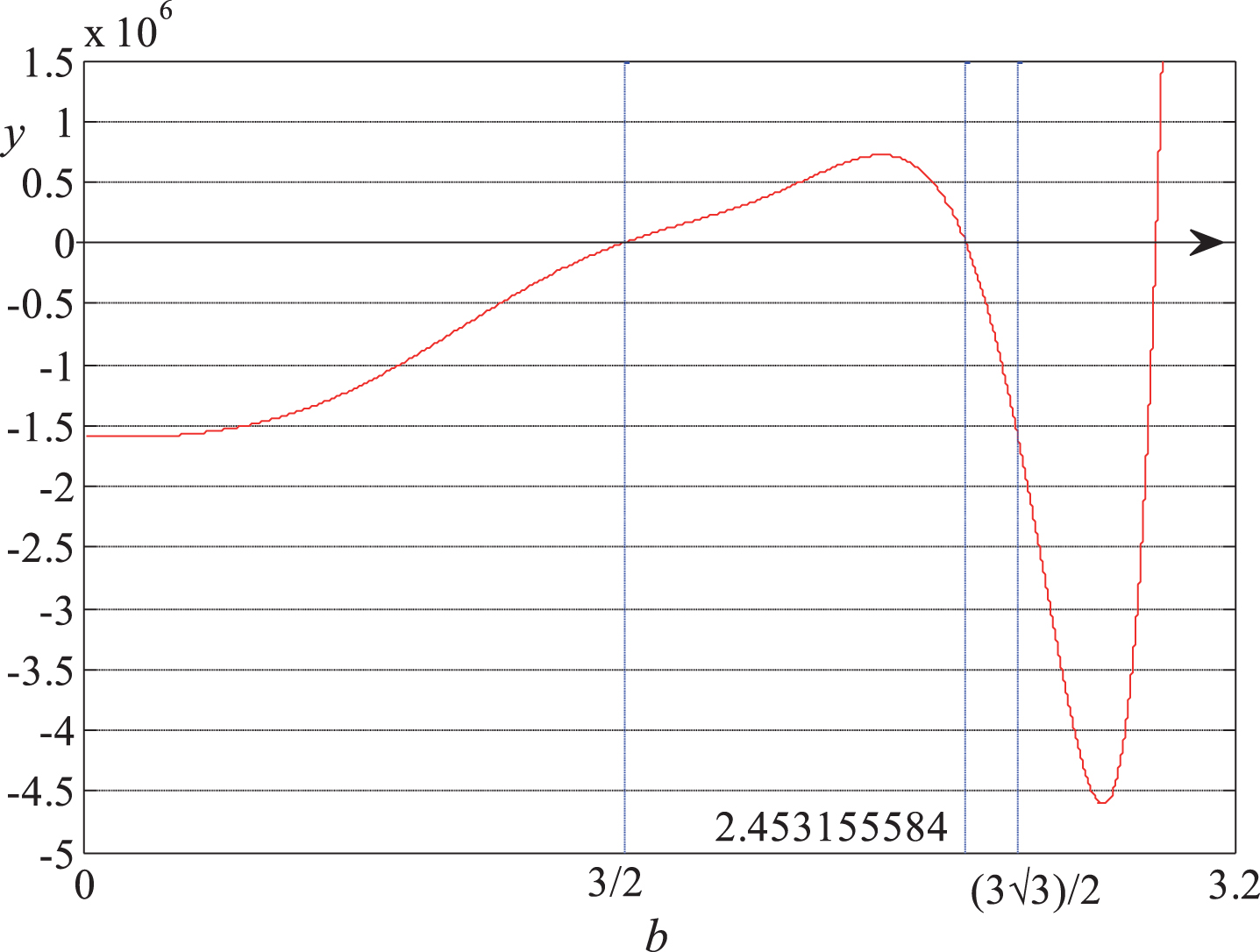
Diagram of the relationship between u and b.
Therefore, if b satisfies condition (6), then f satisfies theorem 1, and is a chaotic map.
Case (II)
First we show that f : J → J.
In fact, map f is an odd function. Then f : J → J is equal to
that is
If f (x5) > x3, we have
Next, let us show that under condition (3), we can find four points y
i
(i = 1, 2, 3, 4) such that
Let y3 = x3, then y4 = f (y3) =0.
Since f (0) =0 < x3 < f (x5), then there is a point y2 ∈ (0, x5) such that f (y2) = y3.
Since f (0) =0 < y2 < x5 < x3 = f (y2), then there is a point y1 ∈ (0, y2) that makes f (y1) = y2.
In summary, if b satisfies conditions (7) and (8), that is
Then f satisfies theorem 1, and is a chaotic map.
Using the same approach given in theorem 2, we have theorem3.
Let J = [0, - b/a] (a < 0) or J = [- b/a, 0] (a > 0), if a and b satisfy
or
According to Equation (10),
When a < 0, map f have three roots:
where 0 = x1 < x2 < x3.
Solve f′ (x) =0 and obtain two extreme points:
If
If
It is easy to verify that f reaches the maximum value at both points x4 and x5, and f (x4) = f (x5).
Denote
If f (x5) < x3, that is
Then f is a map from [0, - b/a] → & [0, - b/a].
If f (x4) ≥ x2, we have
Now, let us show that under condition (12), we can find four points y
i
(i = 1, 2, 3, 4) such that
Let y3 = x2, then y4 = f (y3) =0.
If f (x4) = x2, set y2 = x4, and hence f (y2) = y3.
If f (x4) > x2 > 0 = f (0), then there is a point y2 ∈ (0, x4) that makes f (y2) = y3.
Since f (0) =0 < y2 ≤ x4 < x2 = f (y2), there is a point y1 ∈ (0, y2) such that f (y1) = y2.
In summary, if a and b satisfy conditions (11) and (12), that is
Then f satisfies theorem 1, and is a chaotic map.
In theorem 2, if 2.453155584 ≤ b ≤ 3, then system (1) is chaotic in the sense of Li-Yorke. Set a = -1. Figure 2(a) and (b) show the bifurcation diagram and Lyapunov exponent spectrum of parameter b in system (1) respectively, where b ∈ [2, 3].

System (1) (a) bifurcation diagram of b; (b) Lyapunov exponent spectrum of b.
Figure 2(a) shows that when 2.453155584 ≤ b ≤ 3, the bifurcation diagram of b displays chaotic characteristics as theorem 2 expects.
In theorem 3, let a = ±1, then if
Figure 3(a) and (b) show the bifurcation diagram and Lyapunov exponent spectrum of parameter b in system (10) respectively, where
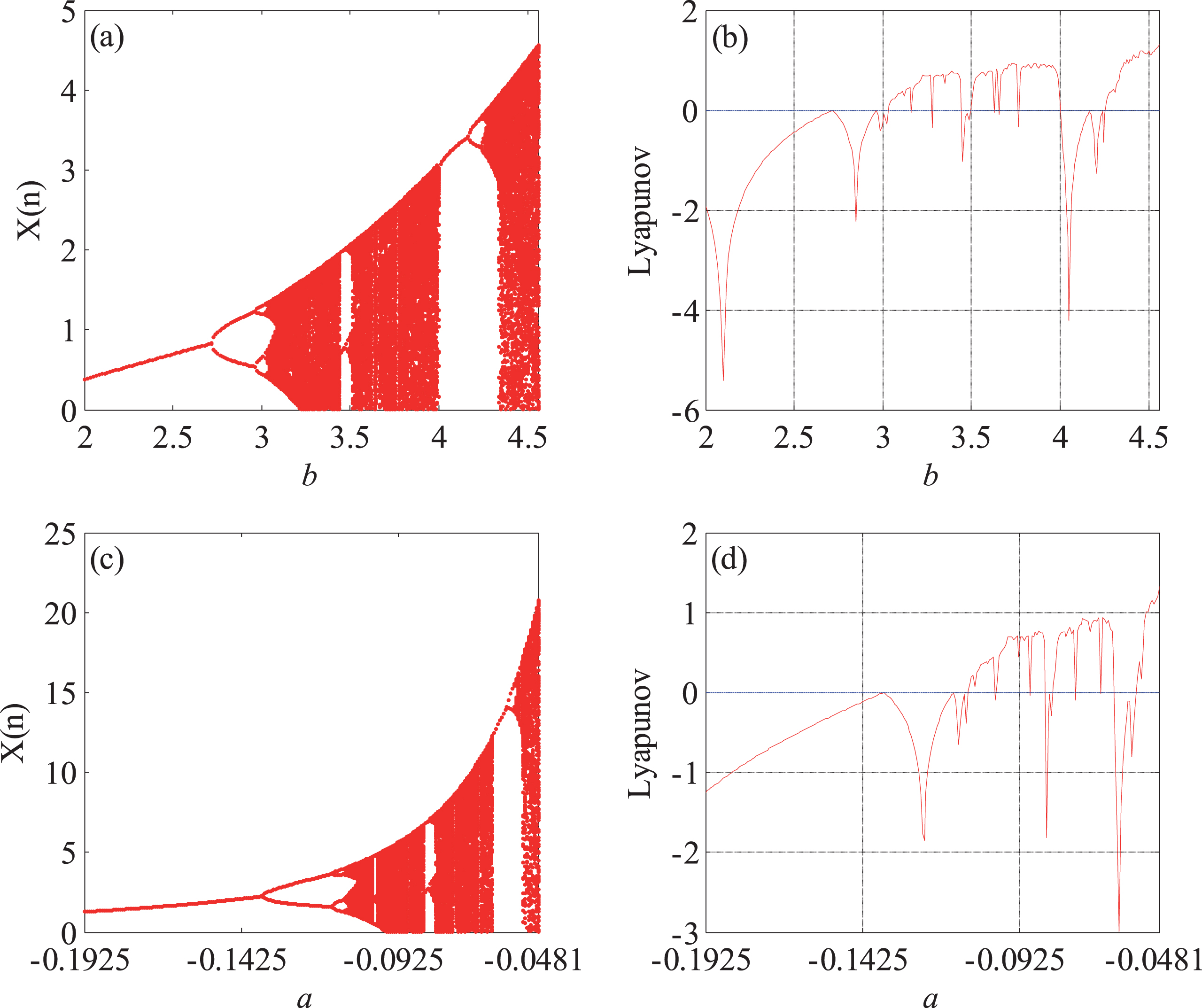
System(10) (a) bifurcation diagram of b; (b) Lyapunov exponent spectrum of b; (c) bifurcation diagram of a; (d) Lyapunov exponent spectrum of a.
Figure 3(a) shows that when
Figure 3(c) and (d) show the bifurcation diagram and Lyapunov exponent spectrum of parameter a in system (10) respectively, where
Figure 3(c) shows when a ∈
SE algorithm and quantitative method
Based on SE algorithm [18], this subsection analyzes to the complexity of the chaotic pseudorandom sequences generated by the cubic chaotic maps given in section 2. SE can be defined as
According to the property of the Shannon entropy, the more balanced the power spectrum of the sequence is, the more complex the structure of the power spectrum is. Hence, the larger value of SE means the more complex of sequences. In this paper, the value of SE is used to evaluate the complexity of the chaotic pseudorandom sequences directly, so denote the complexity of sequences as SE complexity in the following analysis.
This paper gives a quantitative method to transform chaotic sequence {Z n } to the chaotic pseudo-random sequence {Y n } in base number K, and for instance, K = 2 means the sequence {Y n } is a binary sequence. The major steps as follows:
Step 1: Assign values to parameters in chaotic systems and initial value, iterate the chaotic system n times, and then obtain chaotic sequence {Z n }.
Step 2: Start from the 1001th sequence value z1001 of {Z n }, and then truncate the sequence {X n } of length N, which means X i = Zi+1000, i = 1, 2, ⋯ , N.
Step 3: Define sequence {Y
n
} as
where L = 1015, Xmin = min {X n }, Xmax = max {X n }.
Note: In the following calculation, without special declaration, set K = 2, n = 40000, N = 1000.
SE complexity analysis
Chaotic systems (1) and (10) will be used to generate chaotic sequences for the SE complexity analysis.
In system (1), let a = -1, b ∈ [2, 3]. In system (10), let b = 1,
As shown in Fig. 4, the parameters in system (1) and (10) has little influence to the SE complexity of pseudorandom sequences.
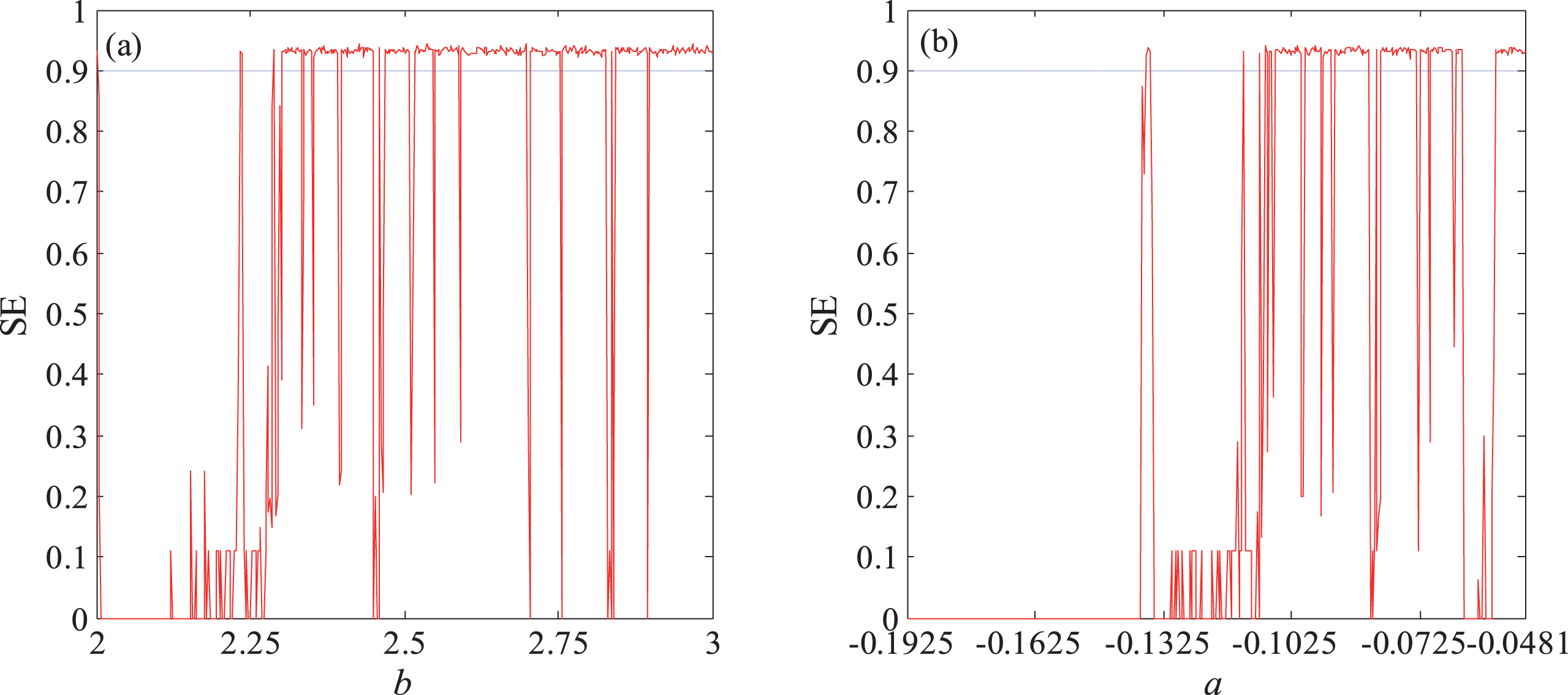
SE of pseudo-random sequence in two system while a or b varies (a) system (1); (b) system (10).
In system (1), let a = -1, b = 3, x0 ∈ [0, 4]. In system (10), let
As shown in Fig. 5, initial value x0 has little influence to the SE complexity of pseudorandom sequences.
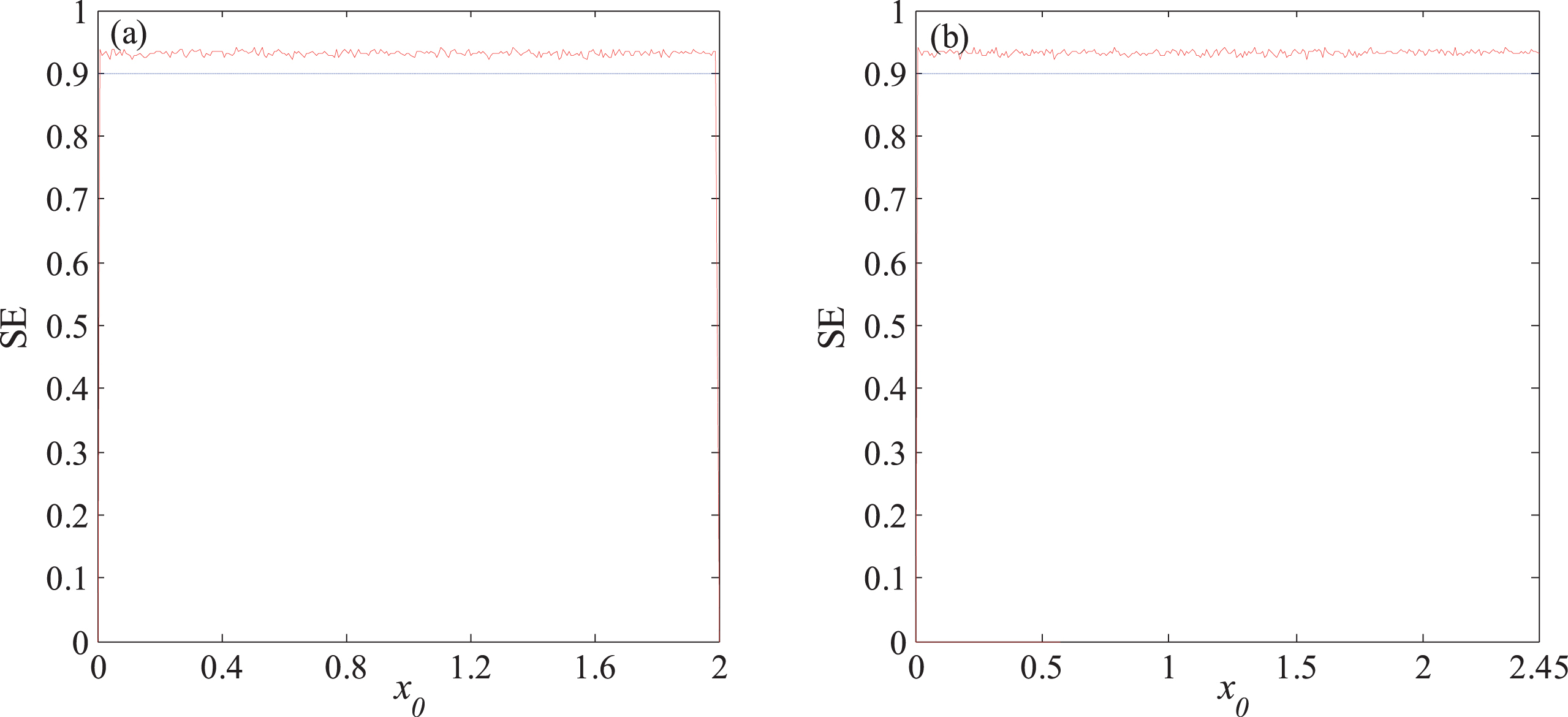
SE of pseudo-random sequence in two system while x0 varies (a) system (1); (b) system (10).
The quantitative methods in this paper and in Ref. [18] is different from each other. Now, we further analyze the influence of different quantitative methods to SE complexity of the sequences. The following is discussed from the parameters in systems, number K and length of sequence N.
For system (1) and (10), using the quantitative method in Ref. [18], the SE complexity of pseudo-random sequences in two systems while parameters vary is shown in Fig. 6(a) and (b).
Comparing the results in Figs. 4 and 6, we can find that with the same initial conditions, the SE complexity of sequences based on the quantitative method in this paper is generally higher than the SE complexity of sequences based on the quantitative method in Ref. [18]. The results also shows that the different quantitative methods have a significant influence to the SE complexity of sequences.
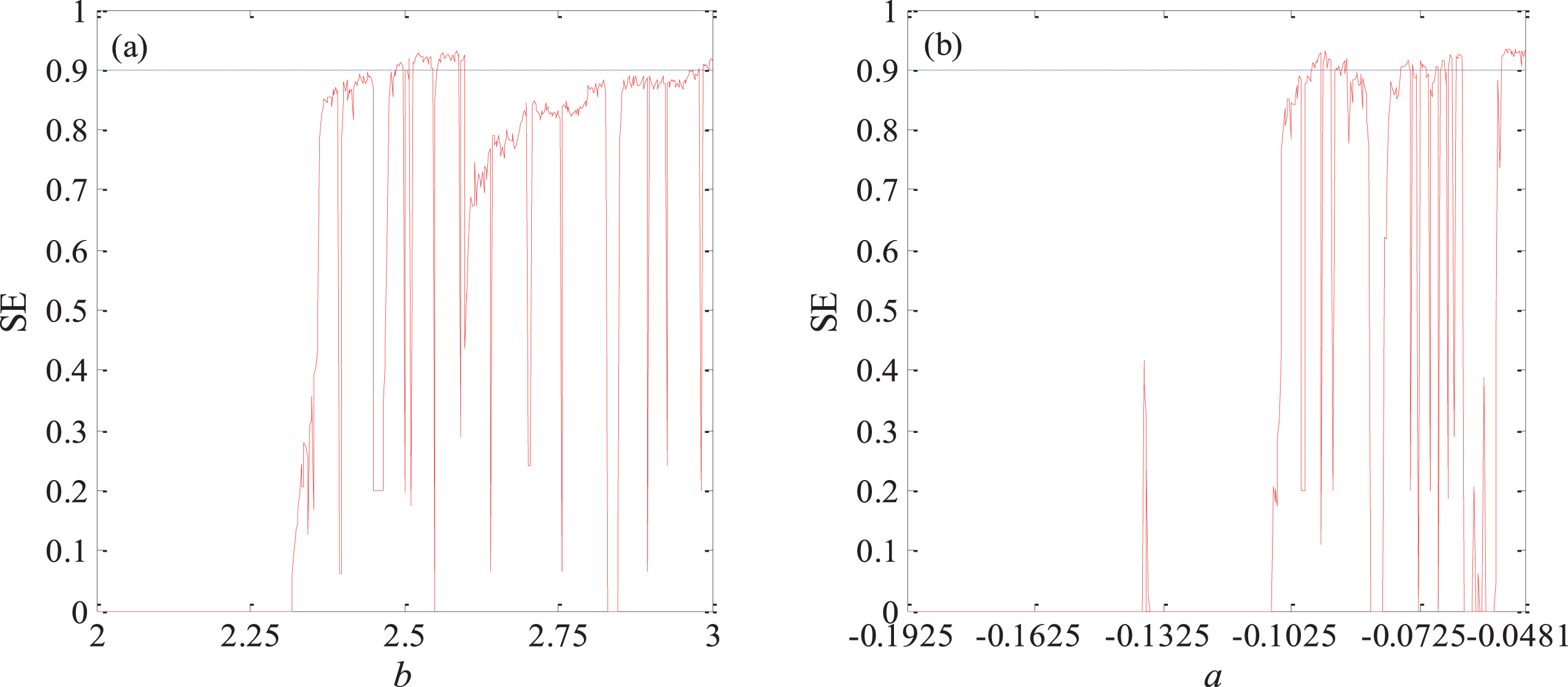
SE of pseudo-random sequence in two system while a or b varies (a) system (1); (b) system (10).
Furthermore, we analyze the influence of number K and length of sequence N to SE complexity of sequences while other conditions keep same. In system (1), let a = -1, b = 3. In system (10), let a = -0.072, b = 1. Set x0 = 0.43.
Figure 7(a) and (b) show the SE complexity of sequences based on the quantitative method in this paper while parameters K or N varies. Figure 7(c) and (d) show SE complexity of sequences based on the quantitative method in Ref. [18] while parameters K or N varies.
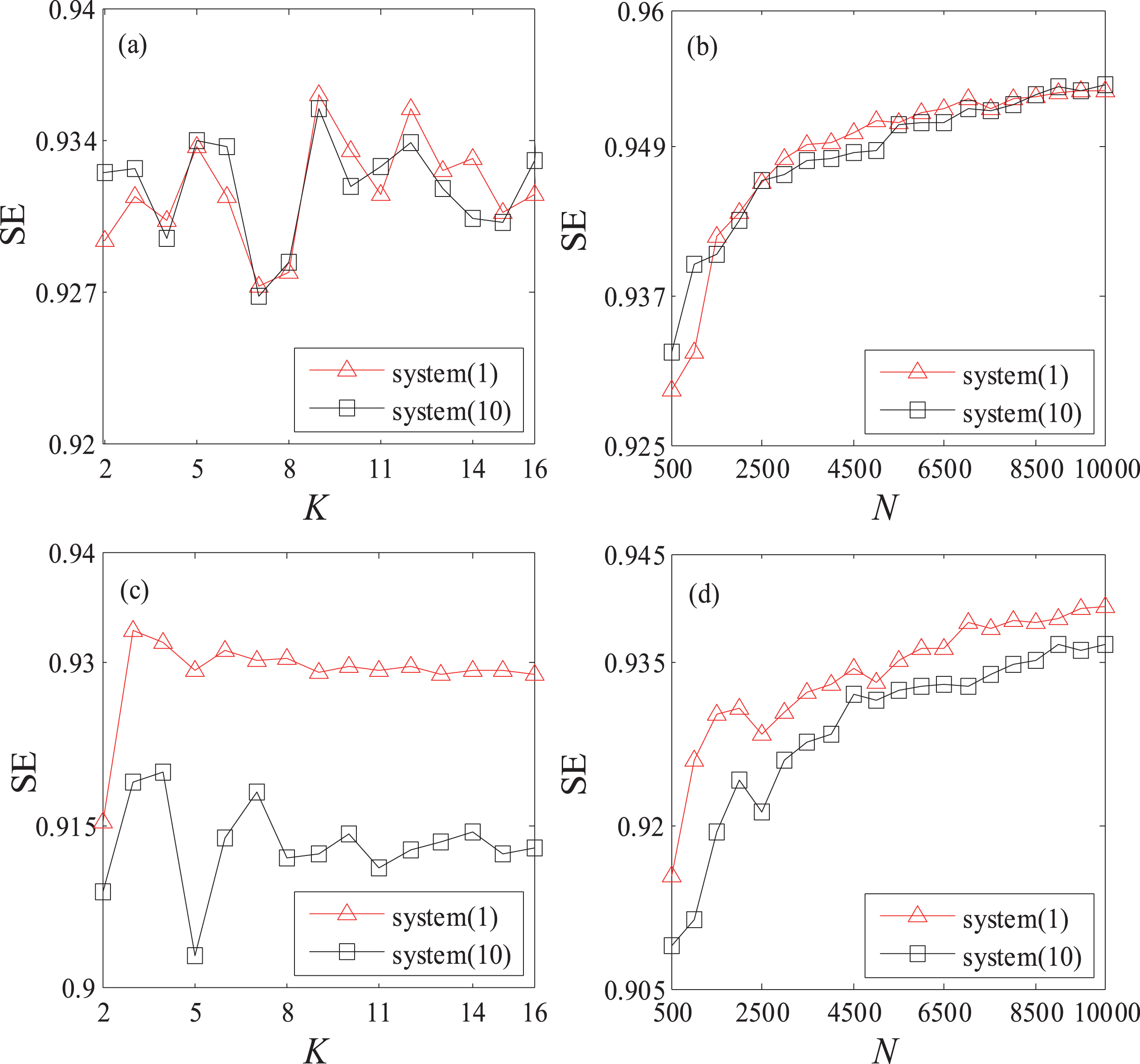
SE of pseudo-random sequences in different chaotic systems (a), (c) K; (b), (d) N.
As shown in Fig. 7(a) and (b), based on the on the quantitative method in this paper, the SE complexity of pseudo-random sequences generated by system (1) and (10) have no significant difference. However, as shown in Fig. 7(a) and (b), based on the on the quantitative method in Ref. [18], the SE complexity of pseudo-random sequences generated by system (1) is significantly higher than the SE complexity of pseudo-random sequences generated by system (10). Hence, the results also show that the different quantitative methods have a significant influence to the SE complexity of sequences.
Firstly, based on Li-Yorke’s chaos criterion, this paper sets up two new chaos criterions on cubic polynomial maps. It is needed to note that the purposed cubic polynomial maps are both limited in special form. Hence, more work should be carried out to chaos discriminant conditions for general cubic polynomial maps. The numerical simulations of the bifurcation diagram and Lyapunov exponent spectrum are carried out to show that the theorems purposed in this paper can be easily used and verified.
Secondly, this paper analyze the complexity of the pseudorandom sequences generated by the given cubic chaotic maps. The numerical results shows that initial values and parameters in systems have little influence to the SE complexity of sequences. Furthermore, the comparative results of SE complexity of sequences based on different quantitative methods show that the quantitative method has a significant influence to the SE complexity of sequences. And it is showed that the quantitative method in this paper makes the pseudo-random sequences have a better SE complexity comparing with the Ref. [18].
Nonetheless, the complexity of chaotic systems cannot been only evaluated by SE complexity. More performance evaluation is required to gain the more accurate conclusions.
Footnotes
Acknowledgments
The work was supported by the Fundamental Research Funds for the Central Universities of China (Grant Nos. 06108236).