



Abstract
Knowledge representation is one of the most explored areas in nowadays computer science research. In this paper authors pursue definition and semantics of semantic networks that are defined as part of Semantic Knowledge Base being a hybrid knowledge oriented system. The approach presented in here aims at introducing advanced properties of networks such as cardinality, partitioning or certainty at the same time using simple structure based on two operands and operators. Following paper is an extension of a conference publication that introduced advanced aspects of semantic networks modelling with the use of Association-Oriented Metamodel. The extension includes a discussion related to the formal description of the structure, as well as the description and use of association-oriented design patterns.
Keywords
Introduction
This article is an extension of authors previous conference work, where one of the modules of the Semantic Knowledge Base (SKB) has been presented. More precisely it was elaborated how the use of structures based on the operator’s relationship with the operands allows building complex knowledge representation structures. The implementation of extended semantic networks within the ESNMSKB module of the Semantic Knowledge Base is based on n-ary structures, i.e. those in which one of the elements can simultaneously form relationships with arbitrary any number of other elements. This approach is rather intuitive, although its implementation in the data layer is not trivial.
As part of the original article, the authors focused on issues related to the presentation of the ESNMSKB SKB module properties. The aspect of implementation of this module in the Association-Oriented Metamodel (AOM) was only indicated as a proof that all concepts that were introduced are implementable. The choice of the method used for constructing abstract structures as part of a specific implementation of the knowledge representation system is often overlooked, mainly due to the relatively limited choice in this respect. The authors however believe that such a choice is one of key aspects of knowledge representation system design. Therefore, they primarily focused on the selection of the implementation method in terms of the possibility of direct implementation of all defined functionalities of the module without the need to carry out far-reaching changes in the concept itself. Thus, the AOM has been chosen with its high semantic capacity.
The main achievement presented in this article is therefore the use of the AOM to represent the ESNMSKB module of SKB. As part of the presentation, the authors will show how they applied AOM grammatical structures allowing to achieve the intended effect without the need to overly complicate the resulting model. As part of the introduction, it was decided to re-present the idea of semantic networks. To this end, SKB was briefly characterised in section 2, in order to introduce the issue of modelling knowledge by the use of semantic networks in section 3. Section 4 presents an approach to the implementation of semantic networks adopted by the authors that uses the operator-operand structure. The last but one section, focuses on the description of the implementation of the concept of extended semantic networks within the AOM. The last section is a summary.
Semantic Knowledge Base as a knowledge representation and processing system
Semantic Knowledge Base is the knowledge base system that consist of separate modules [16, 19] modelled in AODB [11]. The main idea is to utilise various techniques of knowledge representation into one hybrid system in such a way that each module is dedicated to store specific type of knowledge but uses other modules when needed. Below, short description of each module will be provided in order to present the hybrid nature of SKB:
Semantic networks
Semantic Network is a network that represents semantic relations (edges) between concepts (nodes). Edges (like relations) can be both directed and undirected (bidirectional). Edges may be binary, as in the classical semantic networks, or n-ary like e.g. in ESNMSKB. Edges can have one predefined character for example in the case of semantic networks describing taxonomy, meronymy, etc. Edges may also belong to a predefined set containing their types. In the most general case, it is possible to define any edge type, but then they should have a type that allows for the definition of their role in the relationship, namely the relationship semantics. Nodes can be concepts form OCMSKB or any other elements that are the associated elements. It is also possible to specify node type, which allows a more precise definition of semantics. Such elements of ESNMSKB as cardinality constraints, modifiers, quantifiers, represent a significant semantic capacity expansion of semantic network.
Related work
Semantic networks are the template used by humans for more than centuries. The Tree of Porphyry drawn in the third century AD by the Greek philosopher Porphyry showing taxonomy of concept types is probably one of first written approaches [29]. On the other hand the oldest semantic network is probably a graph called Graph, which provided the philosopher comment to Aristotle Categories. It presents concepts as nodes while the edges were the IS-A relationship, both in the context of a generalization-specialization compound as well as class-instance. In the computer science research the outburst of interests in semantic networks dates in 1960s. An example is the concept of semantic memory presented as Teachable Language Comprehender (TLC) [5, 24]. Quillian’s model was based on assigning a words (terms) to nodes of semantic network which represent concepts. The concepts had their inherent properties (has-a), as well as connectivity to other concepts through links in order to store IS-A compounds. Quillians’ concept has become the standard for the semantic network in the area of knowledge engineering followed by many researchers. They are making changes, defining new symbol notation or text representations. Hendrix’s partitioned semantic network theory [8, 3] seems worth mentioning here. It introduced the distinction between a single concept and the whole system of concepts which constitutes a kind of a separate subnet. It derives from the fact that the network elements can be fused together in a space on an equal level and consequently be treated as independent nodes. Another idea worth mentioning is a variation of a semantic network i.e. inheritance networks proposed by Brachman [1] and further developed by other researchers [9, 30]. These networks are directed acyclic graphs and model generalisation-specialisation relationship with its semantic consequences in the form of inheritance of features. Another idea presented and accepted as one of leading formal definition of semantic networks are Conceptual Graphs by Sowa [28]. They are used to represent formulas in first order logic in the form of directed labelled graphs.
Among many applications of semantic networks one can find visualisation of economical and financial knowledge [6]. The idea of the semantic networks as knowledge representation is not merely a conceptual tool. There are a number of project that are either abandoned or being still developed. One of the most well-known is SNePS [27] by S. Shapiro. It is a hybrid system using knowledge representation based on frames and semantic networks. The use of semantic networks in SNePS system involves the representation of sentences in the form of directed, labelled graph. Helbig [7] developed a MultiNet paradigm based on an expanded concept of the semantic network. This system is based on the terms, allowing to assign them the concept in the form of nodes connected by edges, performing relationships predefined in the system. Its main objectives are the possibility of being a interlingua for natural language processing systems, and thus, a layer of semantic annotation of natural languages. Universal Networking Language is a very well documented and interesting project with rich set of semantic relations [4]. At present an extremely popular is a topic of the Semantic Web [26]. Despite the similarity of names it is a distinct trend in relation to the development of the semantic networks. Semantic Web primarily uses two languages: RDF and OWL. RDF allows you to represent knowledge in the form of SOP triples, which define a common semantic network. It is worth to mention that semantic networks can be used to model structures having more constrains, however easier to compute on them. One of the examples are trees with such implementations as [22].
Key features of ESNMSKB
The following assumptions have been made and fulfilled while designing of semantic network model of the ESNMSKB: formal universal semantic network semantics, unambiguous method of relationship interpretation, e.g. ISA arc can be: A is kind of B, A is subset of B, A is part of B, A is instance of B, due to ambiguity of term “is” in many natural languages. Some natural languages are able to cope with this issue, but the majority allows multiple meanings. freedom in definition of relations. In majority of systems the relations are narrowed to closed set of few or several relation types, ability of quantification, logical operators (including negation), credibility, time representation, uncertain and incomplete information, definition of cardinality constraints.
Operand-operator constructions in ESNMSKB
Syntax and semantics
The proposed grammar and semantics of the knowledge representation system has a number of very important features, especially for the precision of knowledge expression as well as for possibility to build knowledge processing systems.
The basic structure of the operator-operand:
r – operator,
p k – operand, k ∈ 1 .. n
provides a natural approach to n-ary compound, as a primary element of facts representation. Since each operator may also be used as an operand it allows to create complex networks expressing facts with complex structure. The operator may be set as Activity or State.
Activity requires intentional action to be taken. This means that the ultimate cause of the activity must be an action taken by the actor. The original reason for taking activity may be independent of the actor.
State is characterized by, uninterrupted for the duration of the particular state, having a property set defined for a given concept. Wherein the values describing the property may be defined as a range.
The operands can perform the following pre-defined roles: Actor, Co-operator, Object, Number, Owner, Attribute, Relationship, Adverbial of Manner, Source, Target, Tool. Both operators and operands perform strictly defined roles in the Semantic Network. Assigning specific concepts (
Lets consider an exemplary sentence “John owns the car”, where operand “car” can be further redefined by the modifier “big”, which will modify the sentence to “John owns a big car”. Complementing this sentence with appropriate cardinality constraint leads to the sentence “John owns one big car”. Modifiers can also be recursively modified, e.g. in the sentence “John owns one very big car.” Another important element influencing the semantic capacity are Quantifiers. In ESNMSKB quantifiers cf – certainty factor, tq – time quantifier, sq – space quantifier and q – intensity quantifier are defined.
Figure 1 presents a conceptual representation of the semantic network of ESNMSKB for the sentence: “John owns one very big car” along with its complementary quantifiers.

The diagram depicting the Semantic Network representation of sentence “John owns one very big car”.
The strength of semantic networks lays in the fact that it can consist of more than one node. The information contained in a set of nodes can be read in many different ways depending on the starting point of graph linearization algorithm. Figure 2 is a representation of a set of facts. It is a complex structure with a quite detailed semantics. Simplified representation of this network is as follows: Ford is a car. John owns one very big car. John works in New York. John goes very fast to New York by very big car. New York is a city.

The diagram depicting the Semantic Network representation of complex fact.
However, it should be noted that it lacks lots of details. Considering again the part of the network presented on Fig. 2 we can distinguish following facts, which approximate natural language representation is as follows:
Certainly (cf=1) John owns
intensively (iq=0.9) one probably (cf=0.5) car.
At the same time we know that:
A car is probably (cf=0.5) big and probably
(cf=0.5*0.2) very big.
The above example shows that the semantic networks presented by authors has high expressiveness, meaning that lots of facts and information can be presented using little elements.
The proposed solutions significantly extend the classical approach to semantic networks. It should be emphasized that the network stored in ESNMSKB does not require conversion for permanent storage in the database layer. Is does do not require a text representation, which would be parsed in order to determine its grammatical structure. Facts are represented directly in the Association-Oriented Model, the structure of which is described in the next section.
AOM overview
AOM is part of the AssoBase project that aims at the formal description and the construction of tools for modelling data with complex semantics. It is a metamodel that allows to construct data models, both in the intentional and extensional aspect. Since this paper is dedicated to modelling the structures of semantic networks, further considerations will focus on the properties related to the intentional aspects, namely their use in the aspect of modelling of association-oriented structures. AOM derives its concepts from object modelling, entity-relationships modelling, and the concept of hypergraph structures, although it is not an implementation of any existing paradigm.
The assumptions underlying AOM include the concepts defined by the acronym I USE:
The main ideas of AOM are: separation of data and relationships; the possibility of selective and optional inheritance of individual roles, attributes and rights to playing the role; the notion of n-ary association in the very center of the association-oriented modelling idea; the following principles: one model element should perform only one function in the model, one operation should refer to only one model element; the ability to limit the multiplicity of roles on both sides of the relationship; single metamodel for modelling in many layers; the possibility to limit the lifetime on both sides of the relation at the same time.
The abstract syntax, formal notation, and the description of
Association-Oriented Modeling Language (AML
Some AOM design patterns and modelling techniques
This section describes selected design patterns and association-oriented modelling techniques that have found their application in ESNMSKB structure modeling.
Bicompositional association-collection tandem (BACT)
BACT is a solution that allows to model functionally complex entities. As it was previously mentioned, one of the main assumptions behind AOM creation was functional separation of metamodel categories [20]. This implies that each function is represented in AOM by the means of only one category, i.e. association (Assoc) is a category that is used to define relationships, while collection (Coll) is a container for attributes (Attr) in which data is stored.
Motivation
Due to the functional separation of the categories, there is a need in the AOM to create a structure that will allow to represent those entities for which the clear separation of functionalities is not possible, i.e. they connect other entities as well as to represent data. We will refer to these functionalities as aspects.
The name of this design pattern is not a coincidence. The bicompositional term relates to one of AOM categories, namely Composition, which defines the lifetime constrains of elements connected to a particular (Role). A characteristic feature of AOM is the fact that composition can occur on both sides of the role at the same time. This is the case with the BACT design pattern, to ensure that none of the aspects exist without the other, because they are part of same (conceptual) being. The word tandem suggests a tight cooperation of two elements, that are the main participants of the pattern.
Participants ◊RelationshipAspect – an association that is an aspect of the being that represents the ability of an element to connect to other elements, □DataAspect – a collection constituting an aspect representing the ability of an element to store data.
Structure The structure of BACT is firmly set. An instance of the design pattern is always built from two aspects connected with one role with multiplicity one-to-one and composition on both sides.

Consequences
While using the BACT design pattern, particular care should be taken when it is combined with the generalisation-specialisation mechanism. Due to the separability of relationship building from data aspects, inheritance exists independently for collections and associations [21]. Therefore, if BACT is defined at the generalisation level, the substitutability of types should be taken into account, both in terms of the data aspect as well as the relationship aspect. For example, let us consider the following association-oriented data model:



The expression 5 defines the exemplary instance of BACT. Next, the generalisation-specialisation was defined in which an association fulfilling the aspect of relation in the BACT is set as an generalisation. Subsequent expressions present the structure of associations being specialisations. The all have inherited role Animal : : Animal in which take part all elements of collections being specialisations of BACT’s data aspect.
The exact consequences resulting from the combination of the use of inheritance mechanism and BACT design pattern will be subject of future papers.
Recursive association is an another AOM design pattern that is a specific form of the self-reference. The self-reference pattern is very often used in database modeling in case of hierarchies [2, 13], what is a also a case in object-oriented modeling. It should be noted that despite the similarity to the self-referential structures in other data metamodels, self-referential association has a different grammar, thus its semantics varies from them. In AOM, it is possible to connect two associations with the means of one role, consequently it gives the possibility of direct linking same association with this one role. The conventional approach, i.e. in other methodologies, requires the creation of separate being in the intentional sense, the relationship and two roles that will connect this being through the relationship.
Motivation The recursive association pattern solves the problem of taxonomy modeling for relationships of the same type. Due to one of AOM features, namely the possibility of multiplicity limiting on the relationship side, it is possible to build both tree or generally graph-based structures. It is also the basic building block in the field of networks, if there is no constraint for its nodes to be of different types.
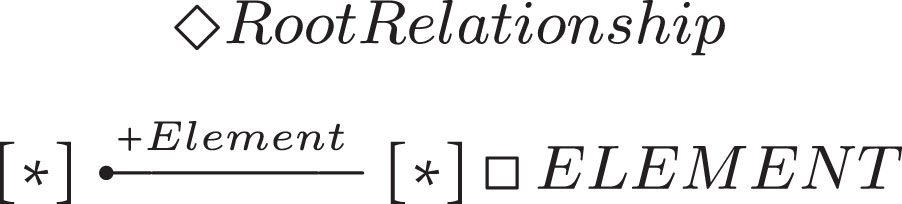
Participants There is always exactly one participant of this design pattern, namely ◊Element being an association that forms the relation.
Structure An exemplary general structure of the recursive association design pattern is shown below:

Consequences The structure of the design pattern as following parameters: multiplicities of the role. With * on both sides an association network representing arbitrary any graph will be created. With the 0 . .1 on the owner side provides the structure representing the tree. navigability of the role. If the role is non-navigable, association objects being the target of the role have no information in regard to the association they take part in. Consequently, the network traverse towards destination → owner is very inefficient from the computational point of view.
Inheritance of associations is the AOM mechanism used to implement the generalization-specialization relationship for named relationships. It is a solution directly resulting from the assumption that the metamodel category of Association should be treated as first-class citizen of models being built. This mechanism allows to use the technique of modeling relations by building complex, multilevel and branched taxonomies.
Motivation Its main motivation is to avoid redundancy at the stage of association’s roles definition by abstracting the common roles to higher-order, possibly abstract associations. This, combined with the primary category characteristics of the association, the Liskov substitution principle is in motion [23]. It means that in every place (in the right to perform the role, following the expression in the query language), where the association A
g
occurs, the association object ao : A
s
k
may occur, assuming that generalization was defined as follows: R
p
⟶ A
s
k
,
Participants ◊RootRelationship is abstract root of a gen-spec relationship hierarchy. ◊ConcreteRelationship1, . . ., ConcreteRelationship
n
are the concrete specialization associations of ◊RootRelationship. ◊OtherRelationship is an association that is referring to the root of association taxonomy by setting its role destination as ◊RootRelationship.
The Association Inheritance design pattern has a general nature due to the number of levels of inheritance hierarchy, the inheritance mode used, as well as the number of nodes at a particular hierarchy level. Its formal structure in the simplest form can be written as follows [10]:



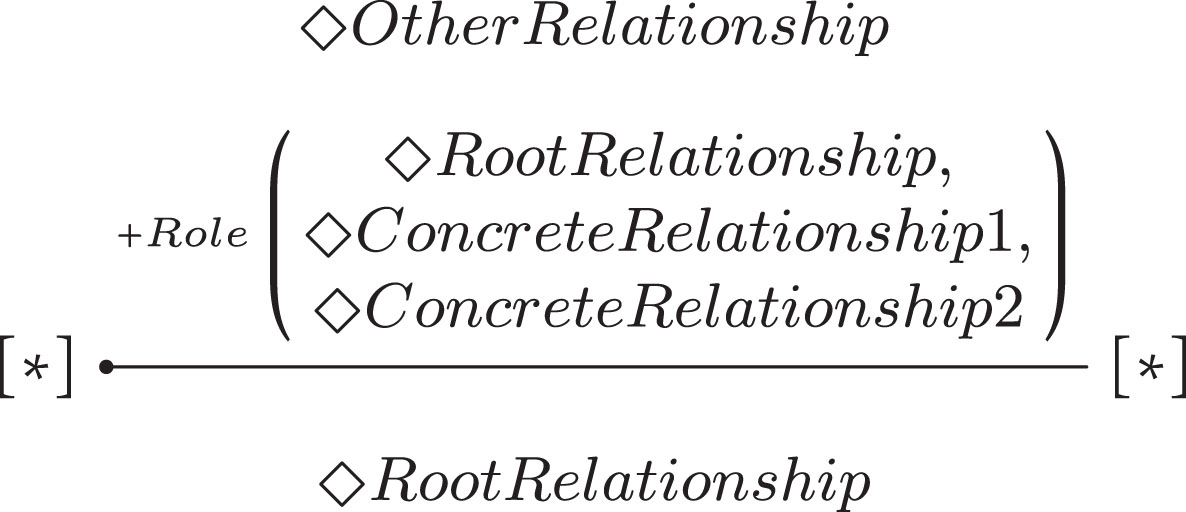
Consequences The consequence of the application of this design pattern is to minimise the effort in modelling relationships, both during the definition of its structure (roles possessed), as well as for relation positioning, ie. to determine in which other relationships it may participate.
As it was stated in the introduction, the main scientific contribution of the authors being an extension of the article [15] is the description of the ESNMSKB model structure by the means of AOM formalism. The model of the system in AML

Intensional part of ESNMSKB model in AOM.
The substructures can be distinguished in the model (including template instances) that implement the issues discussed below.
Inorder to implement the network formally defined as Equation 1 two elements has been defined:
Operator – the occurrence of a specific operator (association),
Operand∅ – the occurrence of an operand within the operator (abstract association).
Moreover, the operator should store information in regard to its type, i.e. Activity, State. Since i has only informative meaning, it shall be represented symbolically as an ASCII character. Thus, the following structure of the operator in the form of a BACT template instance was defined:
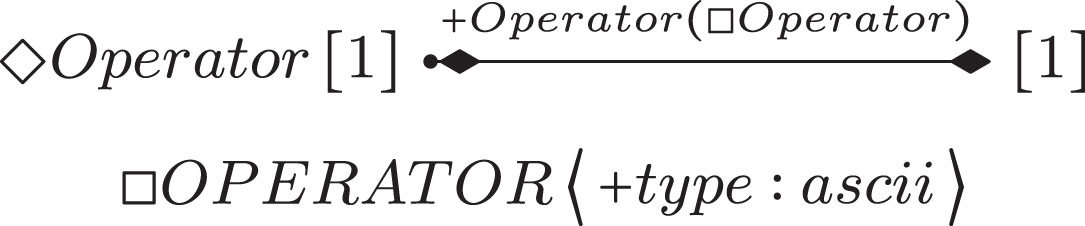
Similarly, to address the issues related to the determination of parameters specific for each operand, including the multiplicities (cardinalitymax, cardinalitymin, margintype, marginmax, marginmin) as well as its the type, the instance of BACT pattern has been proposed for the implementation of the operand. In order to avoid the previously described issues that arise when BACT is used parallel with inheritance mechanism, only one participant in the pattern was defined as abstract.
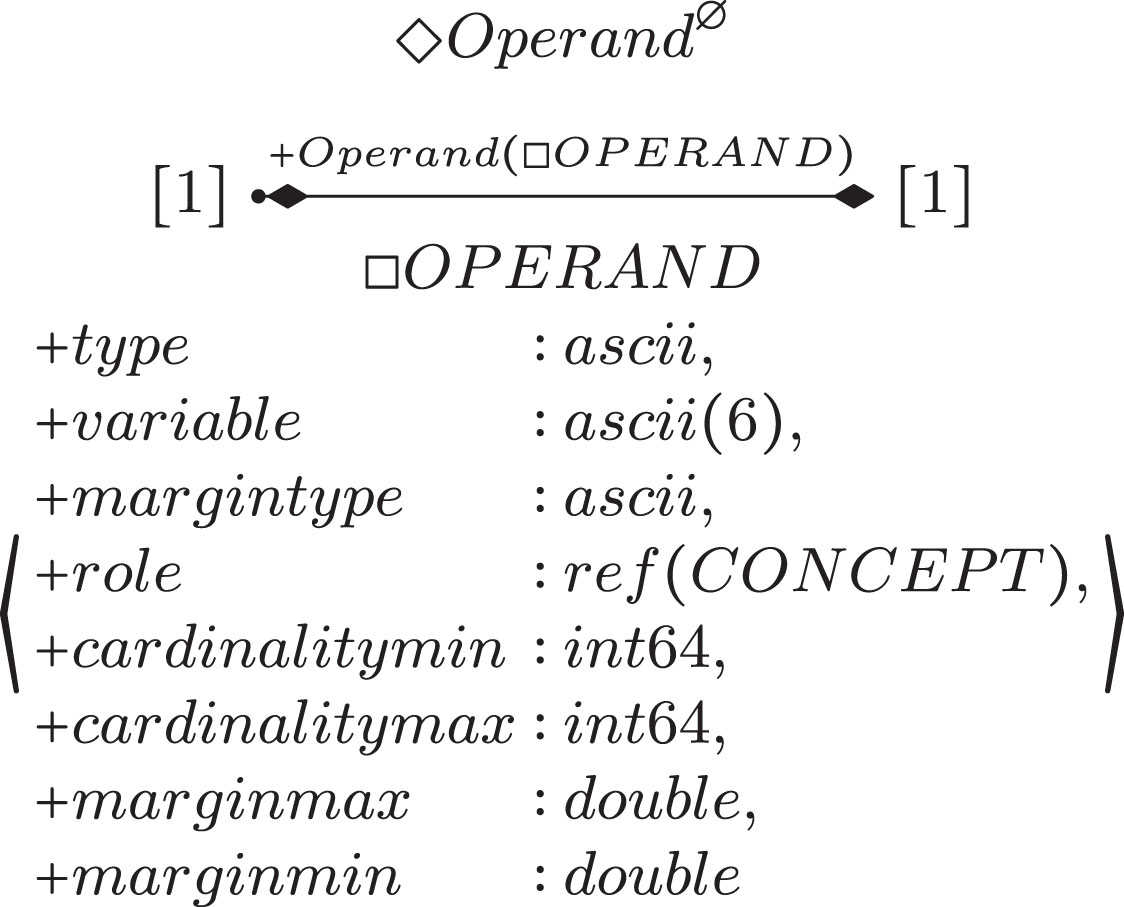
In order to allow determination of different types of operands that differ from each other by a structure, specific specialisations of abstract association were defined ◊Operand∅.

The above-described elements are part of the operator-operand structure. The expression itself was modelled using the role +Operand in association ◊Operator with multiples many-to-many, with the consideration that at least one operator must be present within the operator association. The role may be fulfilled by all specialisations of ◊Operand.
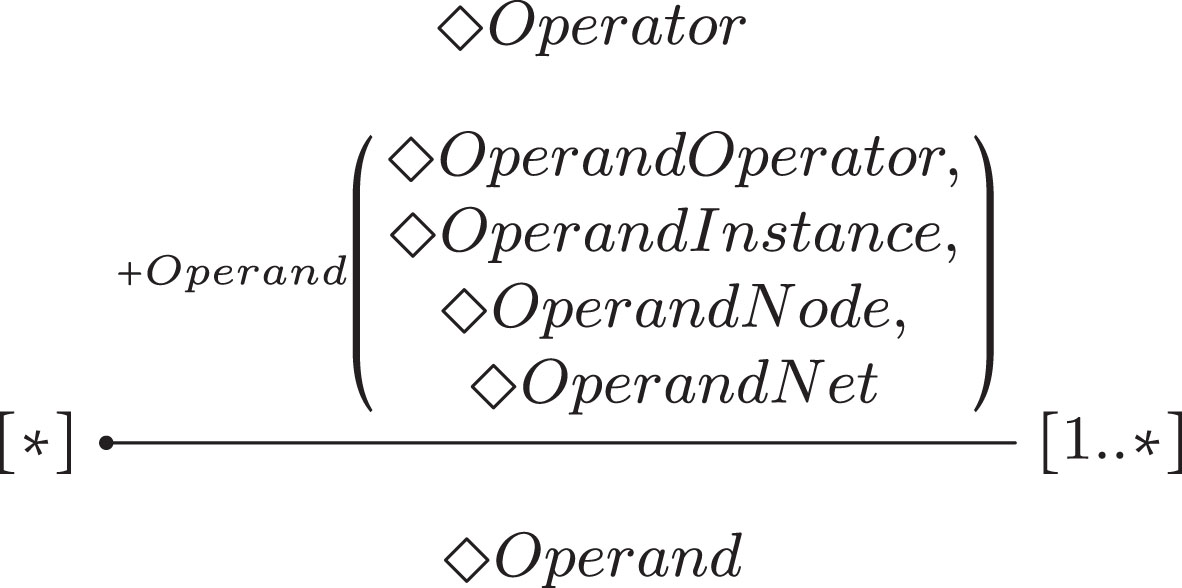
The particular specialisations have the following semantics: OperandOperator – the type of operand that is implemented by the operator, i.e. in this case the operator is treated as an operand in another structure forming multilevel network. OperandInstance – operand type that is taken from ◊Instance∅ and is directly representing a concept defined withing another SKB module – Ontological Core. OperandNode – operand type that is a node defined for a given semantic network, that allows the use of substitutability. OperandNet – operand that is representing a partitioned network, i.e. another network that holds multiple operator-operand structures.
The centre of the semantic network in the ESNMSKB model is the ◊Net association, which is a group of interrelated operators. The network concept was defined as an instance of the BACT design pattern due to the need to include attributes that allow the description of the network.


The ESNMSKB structure allows modular network construction. This means that many subnetworks can be distinguished within one network. This requirement was accomplished using the recursive role of +SubNet in the ◊Net association. At the same time, both ◊Net and ◊Conclusion can be used as the network specialisation for storing networks derived from the applied inference rules.

Regardless of the above-mentioned mechanism, ESNMSKB implements the partitioned network mechanism proposed by Hendrix [8]. This was accomplished through one of the Operand∅ specializations, namely ◊OperandNet. This association has the uninavigable +Net role, through which a specific association object can be combined with any number of networks constituting an operand.


AOM extensional diagram depicting data structure for conceptual example in the Fig. 2.
In this section we will describe the method of defining semantic networks within the ESNMSKB model defined in AOM metamodel. The process of building a network can be considered in the followingsteps: Identify semantic network nodes. These should be identified as the one of the ◊Operand∅ specialisation. Create specialisation association object for each of the network nodes. To implement the example network from the Fig. 1, the following instances have been identified from the SKB ontological core (Fig. 3): object from collection □INSTANCE associated with object from collection □CLASS with attribute object from collection □INSTANCE with attribute For each identified semantic network nodes (operands), create an object in collection □OPERAND. Define reference to the Ontological Core, to predefined concepts defining roles in semantic networks. In the Fig. 4, operands are playing roles designated by the following: an Object object from the □CONCEPT collection, an Actor object from the □CONCEPT collection. For a chosen subset of semantic network nodes (operands), define modification by creating an association object of ◊Modifier. If the modification involves quantification, create describing object of □QUANTIFIER collection defining desired modification. If the modification involves a concept from Ontological Core, associate an object of chosen □CONCEPT subclass by role Concept. If the modification involves existing modifier, associate new association object of association ◊Modifier using role Modifier. In the Fig. 4 few OperandInstance modifications have been shown: modification by quantification (by modification of modifier with additional Define operator structure by creating ◊Operator association object as well as □OPERATOR object, forming together a BACT instance. For each operand o, add o to ◊Operator association object’s Operand role. In the Fig. 4 the operator BACT instance has been created, which has been associated to the own : □ RELATIONSHIP instance from Ontological Core. If needed, create ◊Modifier association object for operator. Use the same recipe as for operand. In the Fig. 4 an operator has been modified by the
Summary
The presented approach to semantic networks modeling is the basis for the solution adopted in of the Semantic Knowledge Base modules, namely Extended Semantic Networks Module. Its main goal is to directly support n-ary links with named roles, which constitute an enhancement in comparison to the previously explored solutions. An important aspect of the presented operator-operand structure is the fact that it was implemented in Association-Oriented Metamodel as a basic construct of ESNMSKB constituting SKB module in which facts and rules are stored and processed. This module supports a number of other features that expand the semantic capacity of the semantic networks, and which are indicated in the 3.2 section. As part of the evaluation two examples were presented as well as data model supplemented with the design methodology. To ensure readability, the examples have been presented in a conceptual way, rather than as an object diagram in AOM.
The presented research results are aimed at showing the relationship that occur between data modelling and knowledge representation. The larger semantic capacity of the metamodel, within which the model of knowledge representation will be expressed, the more clear and accurate the can description of the structure. In addition to the data structures itself, the behavioural aspect is extremely important, which in the field of knowledge representation methods is associated with the mechanisms of inference within a given structure. Further work in the field of SKB, and thus also ESNMSKB, will primarily cover this aspect. In addition, it is also planned to design a query language for the knowledge base, one of which will be able to operate on the presented semantic networks.