



Abstract
Ground Handling Services (GHSs) contain detailed services for airplanes and air passengers when they remain on the airport. In this paper, GHSs received by disabled air passengers and the service provider firms were focused. Neutrosophic MULTIMOORA, a newly developed method, has been used for evaluation. Three Turkish GHSs firms are evaluated by eight criteria. The weights of evaluation criteria are determined by Analytic Hierarchy Process. Then algorithm of Neutrosophic MULTIMOORA method is applied to the problem and sensitivity analysis is presented. In the end, the conclusion is given. Contribution of this paper to the literature is using of the Neutrosophic MULTIMOORA Method firstly for evaluation of GHSs firms.
Introduction
United Nations’ population report points out that the population of World arrived at 7.6 billion in 2017 and expectation for 2030 is 8.6 billion and 11.2 billion for 2100. [1]. By 2030, the urbanization rates are projected to increase 60 per cent over the World [2]. Annual traffic of passenger will increase to 80 trillion passenger-kilometers (% 50 increase) by 2030 [3]. Air transport has an important effect on globalization and economy by accelerating the goods, information, capital and people flows [4]. The International Air Transport Association (IATA) reported that passenger traffic data for the year 2016 showed a 6.3% increase in demand compared to 2015. IATA’s 20-year estimation reports that the number of air passengers will double by 2034 [5].
For air passengers, the journey itself is served as main service, but a series of complementing services are given to the passengers before and after the flight [6]. Services provided before and after the flight are called “Ground Handling Services” (GHSs) [7], despite GHSs has many similar definitions [8–11] it has no formal or official definition.
Some airlines receive GHSs from independent firms, while others prefer to handle GHSs themselves [12, 13]. GHSs are located at the intersection of all activities at the airport where air transportation services are performed. GHSs have vital roles in providing that air transportation is effective, safe and cost-effective [12]. The scope of GHSs is based on the principles determined by international organizations and aviation authorities around the World [6]. The “Standard Ground Handling Agreement” document of IATA draws the framework of the services to be provided by GHSs firms. In Turkey, GHSs are determined by Turkish Directorate General of Civil Aviation in this framework [14].
Customer Satisfaction (CS) is feeling of customer on received services or products [15], CS depends on the quality of the product or the customer’s personal expectation and perception [16]. GHSs given to passengers (general services, departure services, arrival services, inter-modal transportation services by rail, road or sea) [8, 17] plays a direct role in determining CS [18]. Although all GHSs providers take care of all air passengers, some passengers differ from the services they need. These are minors travelling alone, infants and children, groups, disabled passengers and passenger requiring medical clearance [19]. Disabled passengers are handled separately by all aviation authorities as a special and separate group [20–22]. The number of disabled people increases with population growth and ageing, with 15% of the population forming the largest minority in the World [23]. “Accessibility” in air transport services for disabled passengers is the basic criterion and it means “the use of buildings, open spaces, transportation information services and information and communication technologies can be accessed and used safely and independently for the disabled” [21, 22]. Therefore, detailed services for disabled passengers (meeting with assistance, accompanying, check-in, security control, social needs, boarding gate, getting on/off the plane) are specifically defined by the aviation authorities [21, 24] and mainly supplied by GHSs companies [24].
We aim to evaluate the GHSs firms according to the determined criteria. GHSs firm evaluation problem could be called as multi objective decision making (MODM) problem. Both beneficial and non-beneficial criteria are optimized by MODM methods.
MULTIMOORA method is one of the effective MODM developed by Brauers and Zavadskas [25]. The method uses simple calculation operations, gives influential outcomes, and is not affected by the including of any additional parameter [26].
In many MODM problems, crisp data are usually absent and hard to be exposed in real-life problems, decision makers usually needs to take into account the vagueness of the information. Therefore, decision makers need linguistic statement more than crisp numerical data for the assessment of criteria and alternatives. Because of this need, fuzzy sets theory could be used in decision making problems. The theory of fuzzy sets was presented by Zadeh [27] and used to solve MODM problems.
In last years, fuzzy sets have been evolved to new models [28]. Neutrosophic set is one of the evolved models of fuzzy sets and it introduces indeterminacy-membership for the first time by F. Smarandache (1998). A NS is expressed by three parameters, which are called “truthiness”, “indeterminacy” and “falsity”. A NS is defined on universe U . x = x (T, I, F) ∈ A with T, I and F being the real standard or nonstandard subset of . T is the degree of truth-membership function, I is the indeterminacy membership function, and F is the falsity - membership function in the set A.
NS and MULTIMOORA method were merged in neutrosophic MULTIMOORA by Stanujkic et al. (2017). Combining NS and MULTIMOORA method provide flexibility and easy computational operations to overcome MODM problems in vagueness environment. In this study, neutrosophic MULTIMOORA method is used to evaluate GHSs firms according to the determined criteria for the first time in literature.
This paper introduces a neutrosophic multi-objective method to assess GHSs firms in Turkey according to the conflicting criteria. In the application section three different GHSs firms are evaluated by experts. Experts assign the neutrosophic evaluations to the firms according to the eight criteria and get ranking of alternatives.
In the rest of the paper, related studies are given in Section 2. In Section 3, preliminaries are given. The application steps of the neutrosophic MULTIMOORA are presented in Section 4. An application is given in Section 5, and sensitive analysis is given in Section 6. Finally, the conclusions are presented in the Section 7.
Literature review
In this section, we glance at passenger services in aviation transportation, disabled passenger services in aviation transportation and services given to disabled passengers by GHSs firms.
Gourdin [30] presented the price, time schedule, food beverage, baggage carriage, security and seating comfort in terms of CS. Chen et al. [16] showed for air passengers fast, reliable, comfortable and appropriate services are basic needs expected from service providers. Alodhaibia et al. [31] indicated that passengers’ satisfaction increases as time shorten in the system and they demand personalized self-service alternatives with latest technologies. Correia et al. [32] identified “total time of service” and “total distance of walking” as two important indicators showing the level of air passenger service by using a psychometric scaling technique. IATA’s 2017 global passenger survey shows [33] that on board service, boarding, bag collection and border control/immigration issues have more impact on overall passengers’ satisfaction. Kandampully [34] pointed out some innovations like social media communication are new service opportunities for air passengers. Shaw and Coles [35] met with 24 disabled people and highlighted their problems with air travel. Murray and Sproats also [36] pointed out behavioral, physical and economic barriers are the main obstacles [35, 36]. Cavinato and Cuckovich [37] showed accurate information interaction is a facilitator for disabled passengers at air transportation services.
Tretheway and Markhvida [38] indicated GHSs firms are one of the main value creator actors in the air transportation such as airport operators, airlines, aircraft manufacturers, aviation infrastructure providers and leasing firms. Oostveen and Lehtonen [39] studied whether disabled passengers prefer to use automatic systems in place of assistance agent services by interviews and a survey of disabled passengers. Chang and Chen [40] determined the disabled air passengers’ preferential service needs as barrier-free ramp and lift, slip resistant floors, wheelchair services, kindly attitudes of staffs, check-in and boarding priority by using a two-stage survey. Yörükoğlu and Kayakutlu [41] analyzed the services given to disabled passengers by GHSs companies with cognitive mapping technique.
This paper uses neutrosophic MULTIMOORA method in order to evaluate GHSs firms first time unlike the other studies in the literature.
Preliminaries for simplified neutrosophic set
After the fuzzy set theory is developed by Zadeh [42], classical systems have been transformed into their fuzzy versions in order to consider the vagueness and impreciseness in these systems. NS which is an extension of intuitionistic fuzzy sets has been proposed by Smarandache [43].
As an extension of intuitionistic fuzzy sets, neutrosophic logic incorporates a new parameter named as “indeterminacy”. NS needs more information from experts to define a membership function. A NS < T, I, F > is consisting of three parameters which are a degree of truth (T), a degree of indeterminacy (I), and a degree of falsity (F), where T, I, and F and-0 ≤ sup T A (x) + sup I A (x) + sup F A (x) ≤3+ [44].
A simplified neutrosophic set (SNS) is a subclass of NS in order to simplify the arithmetic operations. Therefore, a SNS is proposed [45] which is an extension of NS.
Some concepts and definitions of SNS are introduced in the following definitions [46]:
The functions T A (x), I A (x) and F A (x) are real standard or nonstandard subsets of , that is . There is no limitation on the sum of T A (x), I A (x) and F A (x), so-0 ≤ sup T A (x) + sup I A (x) + sup F A (x) ≤3+.
For each point x in X, we have T A (x) , I A (x) , F A (x) ∈ [0, 1], 0 ≤ T A (x) , I A (x) , F A (x) ≤3. A SNS A ={ 〈 x, T A (x) , I A (x) , F A (x) 〉 |x ∈ X } is indicated by simplified symbol A =〈 T A (x) , I A (x) , F A (x) 〉.
Where W = (w1, w2, . . . . , w
n
) is the weight vector of
Especially, assume W = (1/n, 1/n, . . . . , 1/n), then F w is called as an arithmetic average operator SNS.
In particular, assume W = (1/n, 1/n, . . . . , 1/n), then G w is called as an arithmetic average operator SNS.
The Neutrosophic MULTIMOORA Method consists of Neutrosophic MOORA- Ratio Method, Neutrosophic Moora-Reference Point Method and Neutrosophic MOORA-Full Multiplicative Form.
Neutrosophic MOORA-ratio method
Where
Decision matrix for the GHSs firms
Where
Let x1 =〈 t1, i1, f1 〉 and x2 =〈 t2, i2, f2 〉 are Single Valued Neutrosophic Numbers and the maximum distance between x1 and x2 is as below:
The last rankings of the obtained alternatives could be figured out by using the theory of dominance [47] developed by Brauers and Zavadskas and combines three ranks provided by MULTIMOORA methods into single rank.
Application
In this section, three Turkish GHSs companies were evaluated according to eight determined criteria by three experts from Directorate General of Civil Aviation by common decision, and decision matrix for the GHSs firms are shown in Table 1.
Overall performances of the alternatives
Overall performances of the alternatives
Reference points
C1 -
Weighted deviations from the reference point
Utility values of alternatives
The final ranking order
Then Neutrosophic MOORA-Ratio method was applied in order to get arrangement results. The overall performances of alternatives are shown in Table 2.
Then Neutrosophic MOORA-Reference Point method was applied. Table 3 shows the reference point and the deviation from the reference points are seen in Table 4.
Then we applied Neutrosophic MOORA-Full Multiplicative form method by using Equations (17– 22). Table 5 shows utility value for each alternative.
Finally, we applied dominance theory [47] in order to get the final ranking of three different methods. The final ranking of alternative is seen in Table 6.
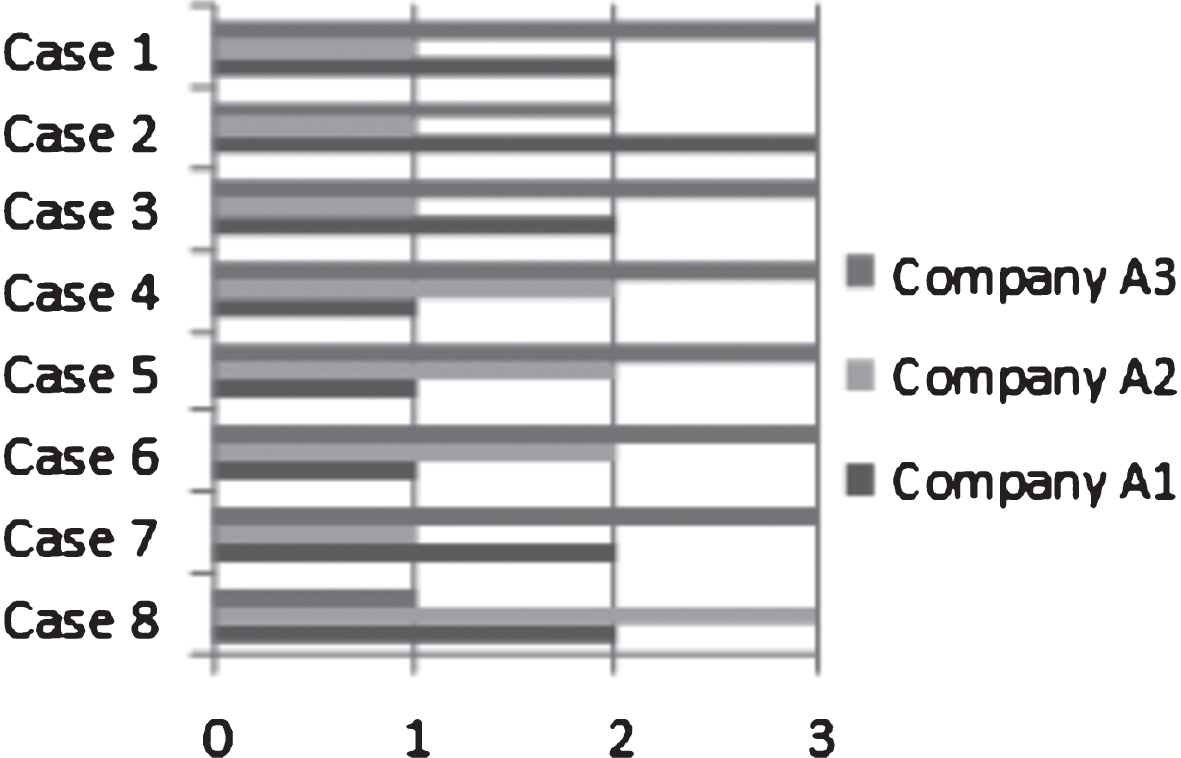
Sensitivity analysis.
Table 6 indicates, the ranking of GHSs firms on the dominance theory is as below: A3, A1, A2.
In this section, we perform sensitivity analysis in order to show our model is sensitive to the chances in elements. We assign different weights to criteria and then we analysis change in final ranking of alternatives. We analyze six different cases; the first case changing the weights of criteria as follows; 0.65, 0.05, 0.05, 0.05, 0.05, 0.05, 0.05, 0.05 and the final rank of alternatives A3, A1, A2. And the weights of criteria are changed as shown in Table 7, and Fig. 1 represents all cases results for sensitivity analysis. We observed that different criteria weights affect slightly the ranking of alternatives. In many cases A3 is chosen the best alternative A3 company has many advantages according to the other alternatives as per determined criteria.
Weights of criteria
Weights of criteria
The existence of sustainable developments in the business world can be ensured by the improvement of both social approaches and scientific methods. This article aims to better identify the services provided to the disabled air travelers in air transport, one of the locomotive sectors of the globalized world, and thus the service providers.
Evaluation of GHSs firms is a decision-making problem based on humans’ thoughts and judgments. Fuzzy methodology can handle such problems consisting of human’s thoughts and judgments. Neutrosophic sets are one of the extensions of fuzzy sets and it uses indeterminacy-membership and carries more information than other fuzzy sets. MULTIMOORA method uses simple equations and gives effective results in multi-objective decision making problems. Neutrosophic MULTIMOORA method can handle multi-objective decision making problem easily and effectively under uncertainty.
In this paper, GHSs firm evaluation multi-objective problem is handled and solved by Neutrosophic MULTIMOORA method. Three Turkish GHSs firms were evaluated with respect to to eight criteria includes both benefit and non-benefit. Finally, firms are ranked according to dominance theory. The Neutrosophic MULTIMOORA method has advantages of capturing experts’ evaluations in ground handling service assessment. Using indeterminacy membership value is the strongest side of the method to model the fuzziness. Therefore, the method is preferred to evaluation of ground handling services firms in fuzzy environment.
The originality of the paper is using Neutrosophic MULTIMOORA method to evaluate GHSs firms for the first time in literature. And, this study will provide a new perspective on determining and improving aviation ground services and similar processes.
For future studies, similar problems could be handled by different types of fuzzy multi-objective methods and the outcomes could be compared.