In this paper, the characterization of Γ-convergence for the first countable topological spaces, characterization of convergence in supremum metric in general setting and some mutual relation between these convergences are discussed. The Γ-convergence is defined as the Kuratowaski-Painlevé convergence of the endographs of the intuitionistic fuzzy sets. The supremum metric is the supremum of Hausdroff distance among the η-cuts of the intuitionistic fuzzy sets. To study these convergences is an important part of the theoretical fundamentals for intuitionistic fuzzy set theory. Some results are given as an application to variational analysis.
Atanassov [2] gave the notion of intuitionistic fuzzy set (IFS), which is an extension of Zadeh’s fuzzy set [26]. It enriches fuzzy set theory with a notion of indeterminacy expressing hesitation or abstention. IFS deals with more complicate and ambiguous real life problems, allowing more freedom. An intuitionistic fuzzy set (IFS) is known as function from some set X to , where . For detail knowledge on IFS see the book by Atanassov [3]. Dubois et al. [11] pointed some terminological difficulties in fuzzy set theory and intuitionistic fuzzy set theory in their remarkable paper. IFS has received more attention and has been applied not only in theoretical fields (differential equation, variational analysis, fixed point theory, etc.) but also in practical fields (artificial intelligence, engineering, medical, similarity measure, decision making, etc.). Ban [5] gave the theory of intuitionistic fuzzy measure and its applications. Latter Atanassov [4] in his book gave the detailed survey on the theory and applications of intuitionistic fuzzy set theory and also described new directions and research problems.
To discuss different types of convergences for fuzzy sets is fundamental in fuzzy set theory [10, 25]. For IFS in literature, there is notion of statistical convergence in the setting of norm spaces [1, 24]. Intuitionistic fuzzy norms deal the situations where norms of the vectors cannot be found exactly. But there are some other important convergences like Γ-convergence, although it is a basic notion of variational analysis has been used in various other fields, in [15] long-term convergence of finite state mean-field games are explred with the use of Γ-convergence, in [9] for variable exponent Sobolev space some critical embeddings are proved by using Γ-convergence and in [22] large derivatives of Gibbs measures are studied by considering Γ-convergence of energy time functionals.
To model above discussed scenarios in intuitionistic fuzzy set theory In [7] different types of convergences like Γ-convergence, pointwise convergence and convergence in supremum metric are designed and relations among them are studied in detail. Latter in [8] a detailed discussion is done on the compatible topology of Γ-convergence. The main aim of this paper is to characterize Γ-convergence and convergence in supremum metric for practical use. This work provides the theoretical frame work for solving the problems of variational analysis like maximization and minimization with intuitionistic fuzzy set theory. For this purpose towards the end of this paper some results are given as applications to variational analysis.
This paper is organized as follows. In Section 2, some basic concepts and auxiliary results are given to understand our proposal. In Section 3, we discussed the characterization of Γ-convergence and its importance in variation analysis. Section 4 is devoted for the detailed study on convergence in supremum metric.
Basic Concepts
At first let us recall some of the definitions from [7]. The following order is used in : for α = (μα, να) , , if and only if μα ≤ μβ and να ≥ νβ. Also, for and exist in , therefore is a complete lattice with (0, 1) as the smallest and (1, 0) as the largest element. To explore different types of convergences of intuitionistic fuzzy sets two pseudo metrics are defined, as follows. For α, β in :
According to above defined pseudo metrics dlower and dupper lower and upper convergences are defined on , respectively.
Another way to explore is to study it by the topologies induced by order defined below.
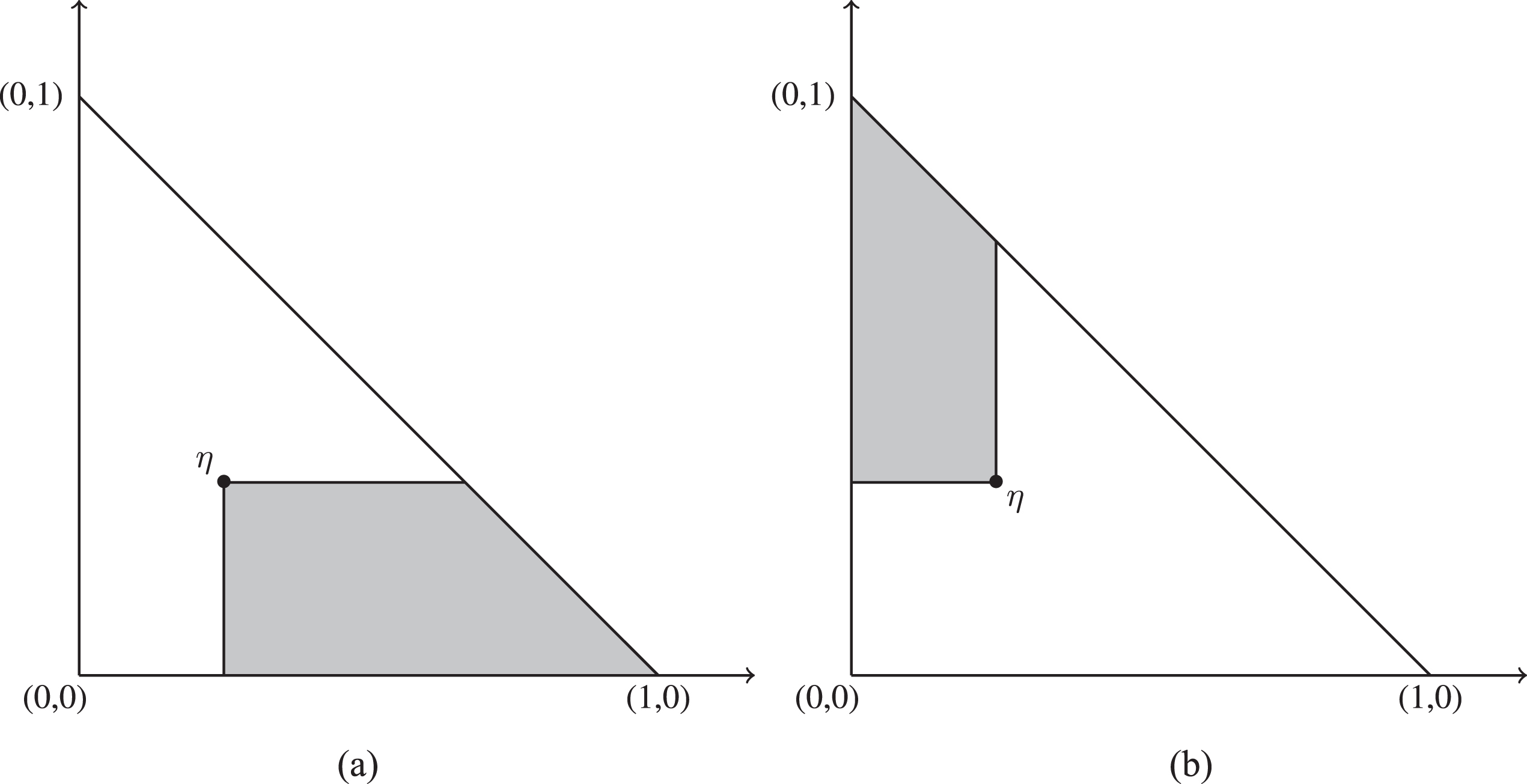
The topologies and are called lower and upper topologies on , respectively. Fig. 1 presents the discerption of open sets in these topologies.
(a) Open set in τ≤, (b) Open set in τ≥.
Also, is explored by the standard Euclidean metric de of . Bd (x, r) stands for an open ball with radius r in arbitrary metric space (X, d). For a subset B of XBd (B, r) = ∪ x∈BBd (x, r) and for x ∈ X is defined to be the set of all neighborhoods of x. Hausdroff extended pseudo metric denoted Hd is the basis to define supremum metric as it is applied between the η-cuts of two IFSs, therefore its definition is given here. Take two subsets B and C in X then
where
is the excess of B over C.
Hd (B, C) can be characterize as
where inf is +∞ if no such ε exists.
Let (X, τ) be a topological space, the set of all IFSs on X is denoted as . For g in its η-cut is known as for , its endograph or hypograph known as and epigraph is known as . We will work on endg in topological space . Furthermore support of g is known as .
Take a net {Bω} ω∈Ω in X then
A subset of Ω is said to be residual if it contains all indices at or beyond some index λ.
A subset of Ω is said to be cofinal if it contains some indices at or beyond each index λ.
the lower limit of {Bω} ω∈Ω is the set
the upper limit of {Bω} ω∈Ω is the set
A net {Bω} ω∈Ω is said to be lower (resp. upper) Kuratowski-Painlevé convergent to B ⊆ X if B ⊆ LiBω (resp. LsBω ⊆ B). See [6, page 2, 145] B for details. Kuratowski-Painlevé convergence is very important set convergence that is used to define Γ-convergence.
Definition 2.1. Take g in . Then:
lower limit of g is defined as
upper limit of g is defined as
The functions and are important functions in discussing the continuity of g.
Definition 2.2. Let . Then at x in X:
g is said to be lower semicontinuous if
g is said to be upper semicontinuous if
g is said to be continuous if and only if .
After defining continuity different types of convergences for a net {gω} ω∈Ω in are discussed.
Definition 2.3. Let {gω} ω∈Ω be a net in . Then for g in .
at x in X {gω} ω∈Ω is said to be Lower pointwise convergent to g if
at x in X {gω} ω∈Ω is said to be Upper pointwise convergent to g if
at x in X {gω} ω∈Ω is said to be Pointwise convergent to g if
{gω} ω∈Ω is said to be lower pointwise, upper pointwise and pointwise convergent to g, if the above hold for all x in X, respectively.
Definition 2.4. Let {gω} ω∈Ω be a net in . Then:
if for all ε > 0 there exists ωε in Ω such that for all x ∈ X and for all ω ≥ ωε
then {gω} ω∈Ω is said to be lower uniformly convergent to g in ;
if for all ε > 0 there exists ωε in Ω such that for all x ∈ X and for all ω ≥ ωε
then {gω} ω∈Ω is said to be upper uniformly convergent to g in ;
if {gω} ω∈Ω is both upper and lower uniformly convergent to g then {gω} ω∈Ω is said to be uniformly convergent to g in .
Definition 2.5. Let {gω} ω∈Ω be a net in . Then for g in :
if there exists ω0 in Ω such that for all x ∈ X and for all ω ≥ ω0
then {gω} ω∈Ω is said to be convergent to g uniformly;
if there exists ω0 in Ω such that for all x ∈ X and for all ω ≥ ω0
then {gω} ω∈Ω is said to be convergent to g uniformly.
Characterization of Γ-convergence
Originally Γ-convergence is the notion of variational analysis, but it has been widely used in other field as well like in studying the embedding of Sobolev spaces [9], in game theory [15]. In [7] Γ-convergence is designed for intuitionistic fuzzy frame work so that if the similar scenarios are modeled with IFSs then we have necessary tools for obtaining solutions of such problems.
Definition 3.1. Let {gω} ω∈Ω be a net in . Then for g in
{gω} ω∈Ω is said to be Γ--convergent to g if the corresponding net of endographs {endgω} ω∈Ω is lower Kuratowski-Painlevé convergent to endg in topological space i.e. endg ⊆ Liendgω;
{gω} ω∈Ω is said to be Γ+-convergent to g if the corresponding net of endographs {endgω} ω∈Ω is upper Kuratowski-Painlevé convergent to endg in topological space i.e. Lsendgω ⊆ endg;
{gω} ω∈Ω is said to be Γ-convergent to g if the corresponding net of endographs {gω} ω∈Ω is both Γ- and Γ+-convergent to g i.e. Liendgω = Lsendgω = endg.
The counter part epi convergence is defined in a similar manner if in above definition endographs are replaced by epigraphs.
Natural question arises whether or not Γ-convergence is topological. In [8] the compatible topology of Γ-convergence is studied in detail for a locally compact Hausdroff topological space X, Γ = Γ+ ∧ Γ- and problem lies with Γ+-convergence as it is not topological, whereas Γ- is always topological any easy to manipulate topologically, in fact the topology of Γ--convergence is Fell topology.
An other aspect is when to use Γ-convergence and its counter part epi-convergence. Basically it is dependent upon the nature of the problem for problems related to maximization Γ-convergence and for minimization epi-convergence is usually used.
To practically determine the Γ-convergence two functions were defined in [7] given below:
and
where
The above functions can be simplified in a metric space (X, d) as follows by replacing arbitrary neighbourhoods by open balls.
Lemma 3.2.[7, Lemma 4.4] BT Let {gω} ω∈Ω be a net in , then
By virtue of the above lemma Γ-convergence is completely determined as follows:
{gω} ω∈Ω is Γ--convergent to g if and only if ;
{gω} ω∈Ω is Γ+-convergent to g if and only if ;
{gω} ω∈Ω is Γ-convergent to g if and only if g (x) = (Ligω) (x) = Lsgω.
We have some nice characterization of Γ--convergence and Γ+-convergence when (X, τ) is a first countable space. First we give some useful lemmas.
Lemma 3.3.(Cf. [6, Lemma 5.2.7]B) Consider (X, τ) a first countable topological space and in . Then (x, η) ∈ Liendgn if and only if there is some such that for n ≥ N we have (xn, ηn) ∈ endgn and {(xn, ηn)} converges to (x, η).
Lemma 3.4.(Cf. [6, Lemma 5.2.8]B) Consider (X, τ) a first countable topological space and in . Then (x, η) ∈ Lsendgn if and only if we have positive integers n1 < n2 < n3 < . . . such that we have (xnz, ηnz) ∈ endgnz and {(xnz, ηnz)} converges to (x, η).
Theorem 3.1.Let be a sequence in where (X, τ) is a first countable topological space. Then for g in :
for any x ∈ X there is some sequence convergent x such that if and only if is Γ--convergent to g;
for any x ∈ X, for all sequences convergent x we have if and only if is Γ+-convergent to g.
Proof. (1): Take with residually endg ⊆ Liendgn. For any x ∈ X, choose η = g (x), we have (x, η) ∈ Liendgn. Now by Lemma 3 there is some sequence convergent to (x, η). Also (xn, ηn) ∈ endgn. Hence .
Conversely, we assumed the existence of convergent sequence for any x ∈ X such that . Take (x, η) ∈ endg then there is some such that for all we have . It gives us (xn, η) ∈ endgn and from the fact that xn → x, we concluded (x, η) ∈ Liendgn.
(2): Take with cofinally endgn ⊆ endg. Let be a sequence convergent to x in X and , this means we take η such that . Which means (x, η) ∈ Lsendgn, but on the other hand Lsendgn ⊆ endg, so . That leads to contradiction for our assumption . Lastly Lemma 3 ensures the existence of at least one sequence in X that is convergent to x in X with .
Conversely, let for all x ∈ X, for all sequences convergent x we have . Take (x, η) ∈ Lsendgn and Consider the constant sequence {x}. Since, , that implies for all there is some such that i.e. .
■
In variational analysis for a net {gω} ω∈Ω of functions, it is important that what happened to maximizers of these functions. For example, in some sense {gω} ω∈Ω converges to a function g then what about the net of {Mgω (X)} does it also converges to Mg (X)? On the other hand let say for all ω ∈ Ω and xω → x, does ? These and their dual questions for minimizers are discussed in [17, 23], but for lower semicontinuous functions. We try to answer these questions in the context of intuitionistic fuzzy sets.
Proposition 3.6.(Cf. [23, Proposition 7.29(b)]RW) Let {gω} ω∈Ω be a net in . Then for all for all x ∈ X if and only if {gω} ω∈Ω is Γ--convergent to g.
Proof. It is straightforward from the Equation 3.1 and Lemma 3. ■
Proposition 3.7.(Cf. [17, Theorem 8.6.6]L) Let {gω} ω∈Ω be a net in for a first countable topological space (X, τ) that is Γ-convergent to some g. is a first countable topological space and a sequence in Γ-convergent to g. For a sequence in X convergent to x, If for all then .
Proof. By Theorem 3 we have . As that means , but also Proposition 3 gives us that . Hence . ■
These results showed some advantages to use Γ-convergence, it maintains many stability properties. Whereas pointwise convergence unable to do so. The relation between pointwise convergence and Γ-convergence is discussed in [7, Theorem 4.5]BT.
Characterization of convergence in supremum metric
Hausdroff metric Hd between two subsets of a metric space is widely used for different purposes. Based on Hd the supremum metric D∞ is defined by taking Hausdroff distance between η-cuts of two IFS, thus enlarging the scope of solving more wide range of problems with IFS theory.
The aim of this section is to characterize the convergence in supremum metric to get a way of establishing convergence practically. Let (X, d) be a metric space and take two IFSs g, h in .
To ease our work on D∞ is split into parts lower quasi-metric and upper quasi-metric known as
The above metrics are not symmetric for this reason they are called quasi-metrics. Now , therefore a net in convergent in D∞ if and only if it is convergent in both and . Further, convergence in and can be characterized by Equation 2.7 as follows.:
for ε > 0 there exists ωε ∈ Ω such that [g] η ⊆ Bd ([gω] η, ε) for all ω ≥ ωε and for all if and only if {gω} ω∈Ω is -convergent to ;
for ε > 0 there exists ωε ∈ Ω such that [gω] η ⊆ Bd ([g] η, ε) for all ω ≥ ωε and for all if and only if {gω} ω∈Ω is -convergent to .
A net {gω} ω∈Ω is convergent to g in when and it is convergent to g in when , therefore convergence in supremum metric is some how related to convergence in that will be discussed in coming subsections. Another way to express and by using the characterization of given in [6, Lemma 1.5.1]B, as follows:
The above discussion leads to following result.
Theorem 4.1.Let {gω} ω∈Ω be net in for a metric space (X, d). Then for all ε > 0 there is some ωε ∈ Ω that for all ω ≥ ωε for all x ∈ X and for all we have
if and only if {gω} ω∈Ω is convergent to g in D∞.
Characterization of Convergence in
Our discussion on D∞-convergence is divided in two parts -convergence and -convergence. A set theoretic approach is taken to characterize . Consider a nonempty set X and its power set . Let {Bω} ω∈Ω be a net in we say is lower limit if
Definition 4.2. Consider a nonempty set X and a net of set functions {qω} ω∈Ω. For a set function if there is some ω0 ∈ Ω such that for all x ∈ X
then {qω} ω∈Ω is defined to be lower uniformly convergent to set function q.
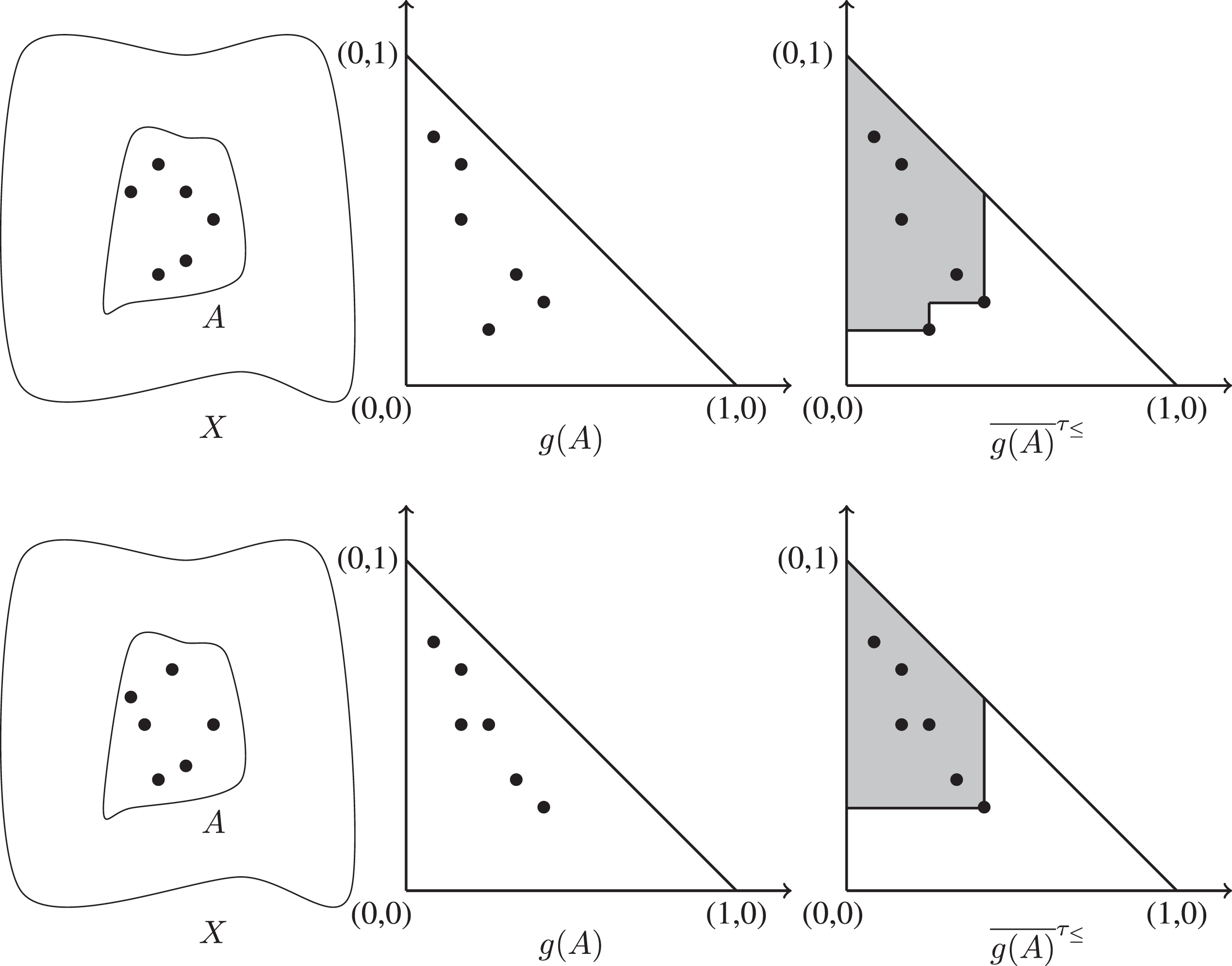
Before moving on to the main theorem, we like to discuss the closure in . Note that for A ⊆ X, if and only if there is some y ∈ A such that The Figure 2 showed the closure in for two important cases.
Closure in
Theorem 4.3.Let {gω} ω∈Ω be a net in with (X, d) a metric space. For ε > 0 consider defined as . Then for all ε > 0 net of set functions is lower uniformly convergent to g if and only if the net {gω} ω∈Ω is -convergent to .
Proof. Let {gω} ω∈Ω be a net -convergent to g. For ε > 0 there is some ωε ∈ Ω such that for all ω ≥ ωε and for all [g] η ⊆ Bd ([gω] η, ε) hold. In particular for η = g (x) we have yω ∈ Bd (x, ε) with for all ω ≥ ωε. Therefore .
Conversely, assumed that is lower uniformly convergent to g. Let x ∈ [g] η for . By hypothesis for ε > 0, there exist ωε ∈ Ω for which . Therefore, we have yω ∈ Bd (x, ε) such that . Hence [g] η ⊆ Bd ([gω] η, ε). ■
Corollary 4.4.Let {gω} ω∈Ω be a net in for a metric space (X, d). Then for all x in X
if {gω} ω∈Ω is -convergent to .
In view of the above the following holds.
From this simplification and by the Definition of (Ligω) 3.3 it is evident that convergence in implies Γ--convergence, that has already been proved in [7]. After characterizing convergence in we discuss about the net {Mgω (Bd (· , ε))} ω∈Ω, indeed convergence of {gω} ω∈Ω in implies -convergence of {Mgω (Bd (· , ε))} ω∈Ω, converse is not true in general. But with extra condition of upper semicontinuity on IFSs following result prove the equivalence.
Theorem 4.5.Let {gω} ω∈Ω be a net of compactly supported upper semicontinuous IFSs in for a metric space (X, d). Then {Mgω (Bd (· , ε))} ω∈Ω is convergent to g uniformly for all ε > 0 if and only if {gω} ω∈Ω is convergent to g in .
Proof. We already proved the necessity in [7, Theorem 5.1]BT, here we only need to prove the sufficiency.
Suppose {Mgω (Bd (· , ε))} ω∈Ω is convergent to g uniformly i.e. for ε > 0 we can find ωε ∈ Ω in a way for all ω ≥ ωε we have . If Mgω (Bd (x, ε/2)) for some ω ≥ ωε then there is some yω ∈ Bd (x, ε) for which and that implies Now for some ω ≥ ωε, if g (x) = Mgω (Bd (x, ε/2)) with (the case g (x) = (0, 1) is trivial). There exist a sequence in Bd (x, ε/2) with with for all . Since gω has compact support, without loss of generality we can assume that is convergent to b in . But by the upper semicontinuity of gω we have . Therefore . Hence by Theorem 4.1 {gω} ω∈Ω is convergent to g in . ■
Corollary 4.6.Let {gω} ω∈Ω be a net in for a metric space (X, d). Then for any ε > 0 we can find ωε ∈ Ω in a way that for all x ∈ X and for all ω ≥ ωε
if and only if {gω} ω∈Ω in convergent to g in D-. Furthermore, if for some ω ≥ ωε,
For a sequence of intuitionistic fuzzy sets we have the following characterization for convergence in for first countable spaces.
Theorem 4.7.Let be a sequence in for a metric space (X, d). Then there exits a sequence where each hn : X → X that converges uniformly to idX and is convergent to g uniformly if and only if {gω} ω∈Ω is convergent to g in .
Proof. Assume that is convergent to g in . For each there exists for which for all x in X [g] g(x) ⊆ Bd ([gn] g(x), 1/z) for all n ≥ nz. we can assume to be strictly increasing without loss. As x ∈ [g] g(x), so for all n ≥ nz we can choose xn,z ∈ Bd (x, 1/z) such that . For any we define
where x0 is some fixed element of X. First of all it is evident that the above sequence is convergent to idX uniformly, as d (x, hn (x)) <1/z for any given z, for all n ≥ nz and for all x ∈ X. Secondly, for all n ≥ nz and for all x ∈ X.
Conversely, we assumed the existence of a sequence of self maps. This means, for ε > 0, there is some nε such that for all n ≥ nε and for all x ∈ X, we have d (x, hn (x)) < ε and . Hence if x ∈ [g] η then x ∈ Bd ([gn] η, ε) for all n ≥ nε. Also nε does not depend on η, so we have the desired result. ■
The following proposition will give the relation between -convergence and maximizers as an application to variational analysis.
Proposition 4.8.Let {gω} ω∈Ω be a net in for a metric space (X, d). Then residually if {gω} ω∈Ω is convergent to g in .
Proof. It follows from the fact that implies Γ--convergence and Proposition 3.
Characterization of convergence in
A similar set theoretical approach is used to characterize -convergence as we did for -convergence. But first we want to discuss the connection between convergence in and Γ+-convergence. In general there is no relationship between these convergences. However we are able to prove with extra condition of uniformly upper semicontinuity on limit function.
Theorem 4.9.Let {gω} ω∈Ω be a net in for a metric space (X, d). Consider a net {gω} ω∈Ω in and g is uniformly upper semicontinuous IFS. Then:
if {gω} ω∈Ω is convergent to g uniformly then {gω} ω∈Ω is convergent to g in ;
if {gω} ω∈Ω is convergent to g in then {gω} ω∈Ω is upper uniformly convergent to g;
if {gω} ω∈Ω is upper uniformly convergent to g then {gω} ω∈Ω is Γ+-convergent to g.
Proof. (1): We suppose that {gω} ω∈Ω is convergent to g uniformly. This means we can find some in Ω such that for all x in X and for all we have . Then it is clear that for all η in and for all [gω] η ⊆ Bd ([g] η, ε).
(2): Assume that {gω} ω∈Ω is convergent to g in . By the upper semicontinuity of g for ε > 0 there exist a δε such that
Hence, for all x in X
From [7, Theorem 5.9(2)]BT, -convergence implies that for all ε > 0 {gω} ω∈Ω is convergent to {Mg (Bd (· , ε))} uniformly. Therefore for this δε we have some ωδε ∈ Ω in a way that for all ω ≥ ωδε
Therefore
for all x in X and for all ω ≥ ωδε .
(3): Let {gω} ω∈Ω be a net convergent to g upper uniformly. For ε0 > 0 there is some ωε0 ∈ Ω in a way for all x in X and for all ω ≥ ωε0
Which means for any ε > 0, we have
therefore by taking ε0 → 0 we can deduce that
Hence,
Corollary 4.10.Let {gω} ω∈Ω be a net in for a metric space (X, d) and g be a uniformly upper semicontinuous IFS. Then {gω} ω∈Ω is Γ+ convergent to g if is convergent to g in .
The reverse implications of Theorem 4.2 are do not hold for arbitrary nets. The examples given below reveal this fact.
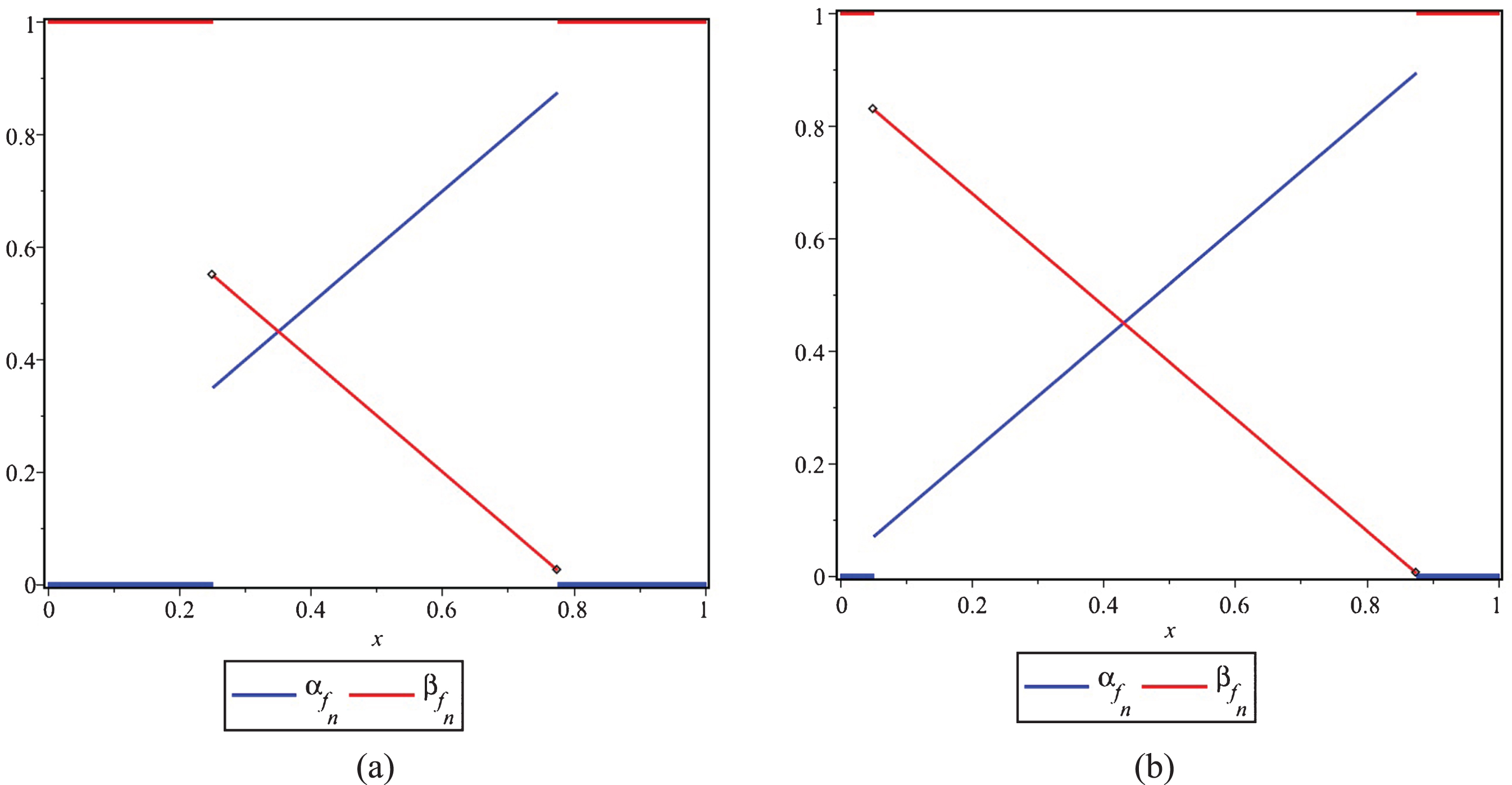
Example 4.11(Converse of (1) is false) Let be a sequence with each gn is upper semicontinuous IFS on [0, 1] defined as
for all . See the behaviour of in Fig. 3.
(a) n = 2, (b) n = 10.
Let
be the intuitionistic fuzzy set on [0, 1]. Given ε > 0, take with 1/5nε < ε. Let , n ≥ nε and x ∈ [gn] η therefore Since then x ∈ Bde ([g] η, ε). Consequently is convergent to g in . On the other hand is unable to converge to g uniformly, since for all .
Example 4.12 (Converse of (2) is false) Define a sequence of IFSs on as . Let for all . It is easy to see that and hence is convergent to g upper uniformly. Whereas, for a given and ε > 0 there exists a η in a way that so but Bde ([g] η, ε) =∅. Hence is unable to converge g in .
Example 4.13 (Converse of (3) is false) For each , define gn: given by
Let for all x ∈ [0, 1].
Since for all x ∈ [0, 1], hence is convergent to g uniformly. Nevertheless, given 0 < ε < 2/3 and then dupper (g (1/(n + 1)) , gn (1/(n + 1))) =2/3 > ε, therefore is unable to converge g upper uniformly.
Now, we come to the main goal of this subsection. Let {Bω} ω∈Ω be a net in . Then a subset is said to be upper limit of {Bω} ω∈Ω if
Definition 4.14. Consider a nonempty set X and a net of set functions {qω} ω∈Ω. For a set function if there is some ω0 ∈ Ω such that for all x ∈ X ⋃ω≥ω0qω (x) ⊆ q (x) ,
then {qω} ω∈Ω is defined to be upper uniformly convergent to set function q.
The net {gω} ω∈Ω can also be consider as net of set functions as {{gω (x)}} ω∈Ω.
Theorem 4.15.Let {gω} ω∈Ω be a net in with (X, d) a metric space. For ε > 0 consider defined as . Then for all ε > 0 net {gω} ω∈Ω treated as set functions is upper uniformly convergent to gε if and only if the net {gω} ω∈Ω is -convergent to .
Proof. Let {gω} ω∈Ω be a net convergent to g in D+. For ε > 0 there is some ωε ∈ Ω such that for all ω ≥ ωε and for all η in we have [gω] η ⊆ Bd ([g] η, ε) for all . Take η = gω (x), [gω] gω(x) ⊆ Bd ([g] gω(x), ε) implies gω (x) ∈ gε (x). Therefore
⋃ω≥ωε {gω (x)} ⊆ gε (x) forallx ∈ X .
Conversely, let {gω} ω∈Ω be a net of set functions that is upper uniformly convergent to gε for all ε > 0. For ε > 0 there exists ωε ∈ Ω in a way that for all ω ≥ ωε and for all x in Xgω (x) ∈ gε (x). For any x ∈ [gω] η, we know that gω (x) ∈ gε (x), therefore we have yω ∈ Bd (x, ε) such that . Hence for all and for all ω ≥ ωε [gω] η ⊆ Bd ([g] η, ε). ■
Corollary 4.16.Let {gω} ω∈Ω be a net in for a metric space (X, d). Then for g in
if {gω} ω∈Ω is convergent to g in
Proof. Assume that {gω} ω∈Ω is convergent to g in . Then {gω} ω∈Ω is convergent to gε upper uniformly by Theorem 4.2. It implies that for any ε > 0, we have ωε ∈ Ω in a way that for all ω ≥ ωε and for all x ∈ X. Therefore, ⋃ω≥ωεendgω ⊆ endMg (Bd (x, ε)). Hence,
■
Theorem 4.17.Let {gω} ω∈Ω be a net of compactly supported upper semicontinuous IFSs in for a metric space (X, d). Then for a upper semi continuous IFS g, {gω} ω∈Ω is convergent to Mg (Bd (· , ε)) uniformly for all ε > 0 if and only if {gω} ω∈Ω is convergent to g in .
Proof. By virtue of [7, Theorem 5.9]BT we just need to prove sufficiency. We assumed that {gω} ω∈Ω is convergent to Mg (Bd (· , ε)) uniformly. For any ε > 0 we have some ωε ∈ Ω in a way that for all ω ≥ ωε and for all x ∈ X. If for some ω ≥ ωε we have then it is clear that we can find yω ∈ Bd (x, ε/2) in a way that . Therefore gω (x) ∈ gε (x) .
On the other hand for some ω ≥ ωε if we assumed that (as for gω (x) = (0, 1) proof is trivial), there exit a sequence in Bd (x, ε/2) in a way that and for all Without loss of generality, we can assume that is convergent to , because g has compact support. But also g is upper semicontinuous, which implies that . Hence gω (x) ∈ gε (x). ■
Corollary 4.18.Let {gω} ω∈Ω be a net in for a metric space (X, d). Then for any ε > 0 we can find ωε ∈ Ω in a way that for all x ∈ X and for all ω ≥ ωε
if and only if {gω} ω∈Ω in convergent to g in D+. Furthermore, if for some ω ≥ ωε,
Now we discuss the relationship between -convergence and maximizers.
Proposition 4.19.Let {gω} ω∈Ω be a net in for a metric space (X, d) and g in . Then residually if {gω} ω∈Ω is convergent to g in .
Finally the convergence in D∞ is characterized in the form of following theorems.
Theorem 4.20.Let {gω} ω∈Ω be a net in for a metric space (X, d) and g in . For ε > 0 consider defined as . Then {gω} ω∈Ω is convergent to g in D∞ if and only if:
for all ε > 0 net of set functions is convergent to g lower uniformly;
for all ε > 0 net {gω} ω∈Ω treated as set functions is convergent to gε upper uniformly.
Theorem 4.21.Let {gω} ω∈Ω be a net of compactly supported upper semicontinuous IFSs in for a metric space (X, d). Then for a upper semicontinuous IFS g, the net {gω} ω∈Ω is convergent to g in D∞ if and only if:
for all ε > 0 {Mgω (Bd (· , ε))} ω∈Ω is convergent to g uniformly;
for all ε > 0 {gω} ω∈Ω is convergent to Mg (Bd (· , ε)) uniformly.
Last but not the least, we discussed some explicit results as an application to variational analysis in the context of convergence in D∞.
Proposition 4.22.Let {gω} ω∈Ω be a net in for a metric space (X, d) and g in . Then Mgω (X) = Mg (X) residually if {gω} ω∈Ω is convergent to g in D∞.
Proof. It follows from Propositions 4.1 and 4.2. ■
Proposition 4.23.Let {gω} ω∈Ω be a net in for a metric space (X, d). Let {gω} ω∈Ω is convergent to a upper semi continuous IFS g in D∞. If the net {xω} ω∈Ω is convergent to and for all ω ∈ Ω then .
Proof. By [7, Theorem 5.9(2)]BT we know that, if {gω} ω∈Ω is convergent to g in then {gω} ω∈Ω is convergent to Mg (Bd (· , ε)) uniformly for all ε > 0. Therefore for given ε > 0 we can find ωε ∈ Ω in a way that for all x in X and for all ω ≥ ωε
By hypothesis {xω} ω∈Ω is convergent to , so without loss of generality assume that
Therefore, for all ω ≥ ωε. Since , we have
for all ω ≥ ωε. By Proposition 4.3 Mgω (X) = Mg (X) residually, therefore
By the upper semicontinuity of g
■
Now we show that the above result result is not true in general, consider the constant {gω} ω∈Ω on the interval [0, 1] with gω (x) = (1, 0) and the IFS
With the above definitions it is straight forward to see that {gω} ω∈Ω is convergent to g in D∞. But on the other hand for all ω ∈ Ω whereas .
Footnotes
Acknowledgment
The work was supported by the National Science Centre, Decision No. 2016/23/N/HS4/019. The authors would like to thank the editors and the anonymous reviewers for their constructive comments and suggestions that have led to an improved version of this paper.
References
1.
AltundağS. and KamberE., Lacunary Δ-statistical convergence in intuitionistic fuzzy n-normed space, J Inequal Appl40 (2014).
BashirZ., RashidT., ZafarS., Maximization based topologies and their relation with Γ-convergence of intuitionistic fuzzy sets, Journal of Intelligent & Fuzzy Systems34 (2018), 537–545.
9.
BonderJ.F., SaintierN., SilvaA., A Gamma convergence approach to the critical Sobolev embedding in variable exponent spaces,189âĂŞ, Journal of Mathematical Analysis and Applications442 (2016), 205.
10.
CroitoruA., Convergences and topology via sequences of multifunctions, Inform Sci282 (2014), 250–260.
11.
DuboisD., GottwaldS., HajekP., KacprzykJ., PradeH., Terminological difficulties in fuzzy set theory-The case of Intuitionistic Fuzzy Sets, Fuzzy Sets Syst156(3) (2005), 485–491.
12.
GrecoG.H., MoschenM.P., Supremum metric and relatively compact sets of fuzzy sets, Nonlinear Anal-Theor64(6) (2006), 1325–1335.
13.
GrecoG.H., MoschenM.P., QuelhoE., Frota Rezende, On the variational convergence of fuzzy sets in metric spaces, Ann Univ Ferrara, Nuova Ser, Sez VII44 (1998), 27–39.
FerreiraR., GomesD.A., On the convergence of finite state mean-field games through Γ-convergence, Journal of Mathematical Analysis and Applications418 (2014), 211–230.
16.
KalevaO., On the convergence of fuzzy sets, Fuzzy Sets Syst17 (1985), 53–65.
17.
LucchettiR., Convexity and Well-Posed Problems, CMS Books Math, Springer, (2006).
18.
MohiuddineS.A., LohaniQ.M.D., On generalized statistical convergence in intuitionistic fuzzy normed space, Chaos, Solitons Fractals42(3) (2009), 1731–1737.
19.
MursaleenM., MohiuddineS.A., On lacunary statistical convergence with respect to the intuitionistic fuzzy normed space, J Comput Appl Math233 (2009), 142–149.
20.
MursaleenM., MohiuddineaS.A., EdelyO.H.H., On the ideal convergence of double sequences in intuitionistic fuzzy normed spaces, Comput Math Appl59 (2010), 603–611.
21.
PedrazaT., Rodríguez-LópezJ., RomagueraS., Convergence of fuzzy sets with respect to the supremum metric, Fuzzy Sets Syst245 (2014), 83–100.
22.
BermanR.J., On Large Deviations for Gibbs Measures, Mean Energy and Gamma-Convergence, Constructive Approximation48 (2018), 3–30.
SenM., DebnathP., Lacunary statistical convergence in intuitionistic fuzzy n-normed linear spaces, Math Comput Model54(11-12) (2011), 2978–2985.
25.
TrutschnigW., Characterization of the sendographconvergence of fuzzy sets by means of their Lp-and level wise convergence, Fuzzy Sets Syst161(8) (2010), 1064–1077.