



Abstract
Hypothesis testing is an important tool of statistical decision making. Classical hypothesis testing is based on a known probability distribution with known population parameters. However, since the data generally include vagueness and impreciseness, a fuzzy set approach should be used. In this paper, interval-valued neutrosophic sets (IVNSs) are used for the purpose of making statistical decisions. In the proposed neutrosophic hypothesis testing approach, neutrosophic linguistic data and neutrosophic parameters are used. Left-sided, right-sided and double-sided neutrosophic hypothesis tests are developed, illustrative example and sensitivity analysis are given.
Introduction
Hypothesis tests are used for testing if a hypothesized parameter value is true or not based on a confidence level. There are three types of hypothesis tests with respect to the side of the tail: left-sided, right-sided, and double-sided hypothesis tests. The hypothesized parameters may be the population mean, population proportion, population variance, difference between two population means, difference between two population proportions, equality of two population variances, population mean for paired samples, and many other hypothesis tests for population correlation coefficient and regression coefficients, etc. They are often used for statistical decision making in the theory and practice.
Probabilities are based on observations in the probability theory. More accurate estimation of probabilities can be achieved with more observations. However, probabilities do not represent degrees of partial truths for describing the imprecision by membership degrees. Fuzzy statistical tools would better be used if there is vagueness and impreciseness in the considered data set and the uncertainty is represented by a possibility distribution rather than a probability distribution.
Ordinary fuzzy sets have been extended to new types of fuzzy sets such as Type-2 fuzzy sets, intuitionistic fuzzy sets, neutrosophic sets, hesitant fuzzy sets, and Pythagorean fuzzy sets. Neutrosophic sets define the membership of an element by its T (Truthiness), I (Indeterminacy), and F (Falsity) parameters whose sum should be at most 3. These parameters can be independently determined by decision makers. In this paper, we employ IVNSs in the proposed hypothesis testing approach.
The rest of this study is organized as follows. Section 2 presents a literature review on neutrosophic sets. Section 3 briefly explains the extensions of ordinary fuzzy sets and presents a representative literature review on their usage for hypothesis tests. Section 4 gives the preliminaries for IVNSs. Section 5 develops an IVN hypothesis testing approach. Section 6 illustrates the application of the proposed model. Section 7 concludes the paper with future directions.
A literature review on neutrosophic sets
Neutrosophic sets have been used in various researches [2–5, 48] since it has been introduced to the literature by Smarandache [16]. As shown in Fig. 1, neutrosophic sets have an increasing trend in the literature especially after 2015 and reached the maximum number of articles (209) in 2018.
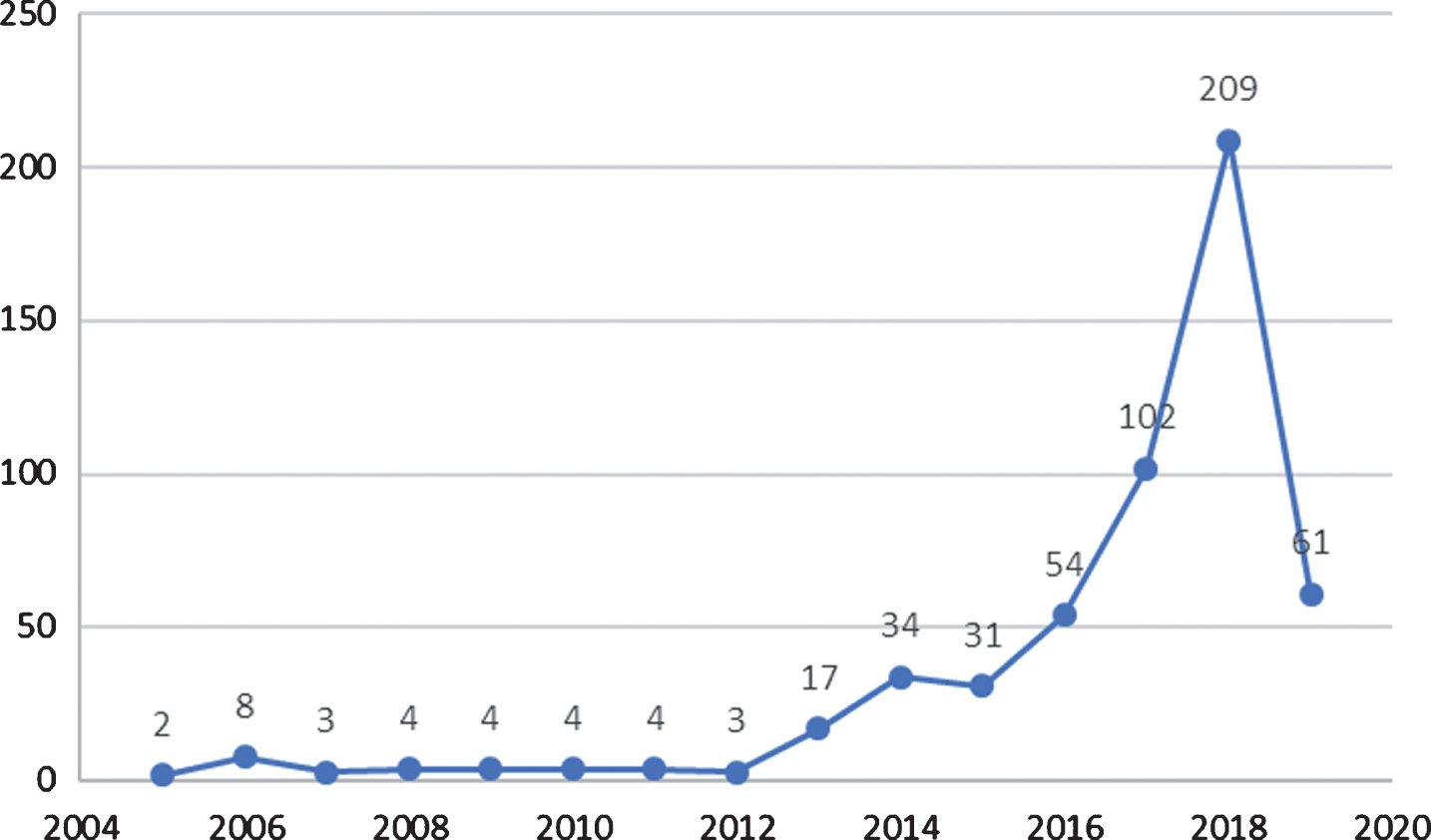
Frequencies of neutrosophic sets publications with respect to years.
The author who has most published on neutrosophic sets is Smarandache with 75 studies and followed by Ye with 48 studies (See Fig. 2).
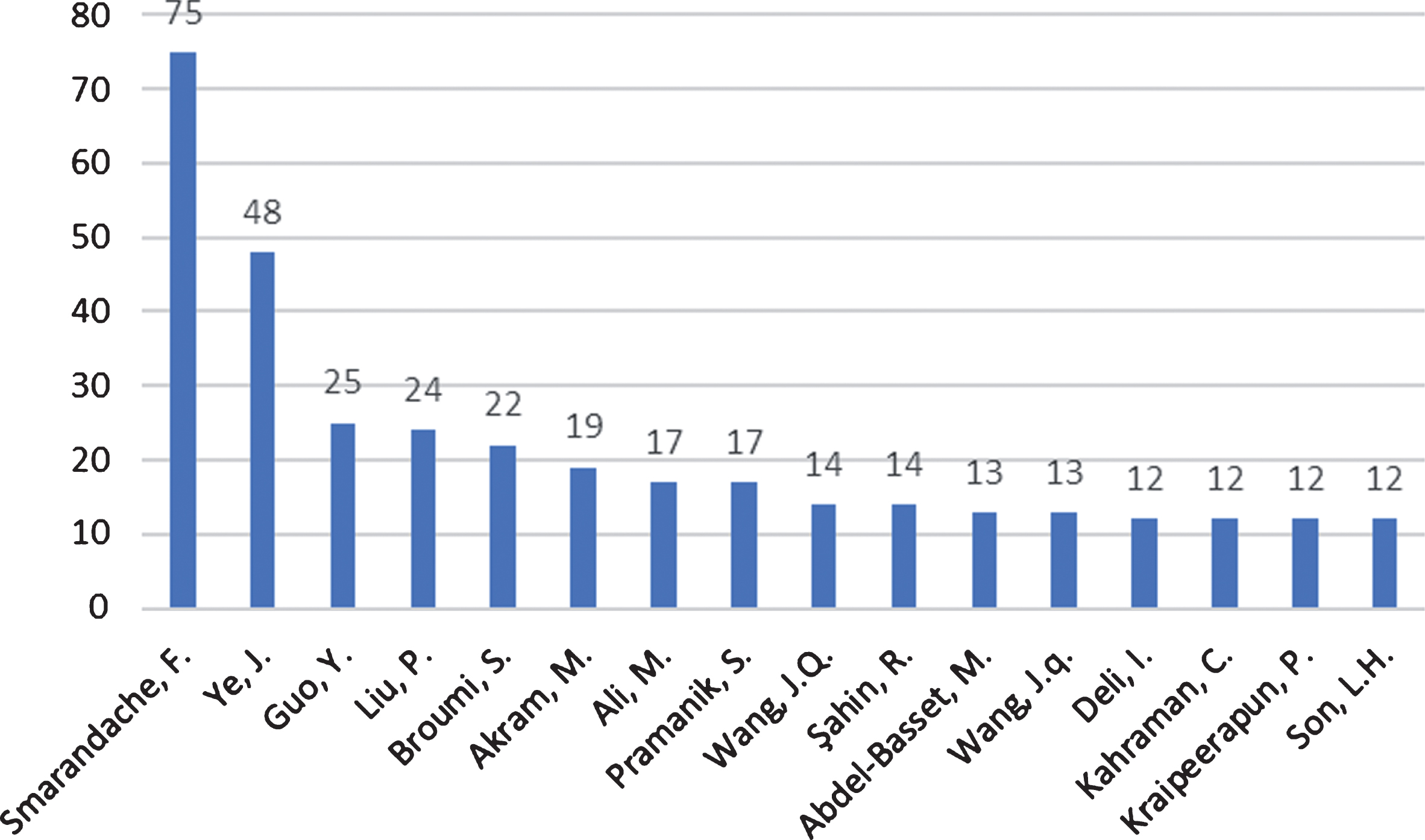
Frequencies of neutrosophic sets publications with respect to their authors.
As it can be seen from Fig. 3, most of the neutrosophic sets publications are related to Computer Science, Mathematics, and Engineering.
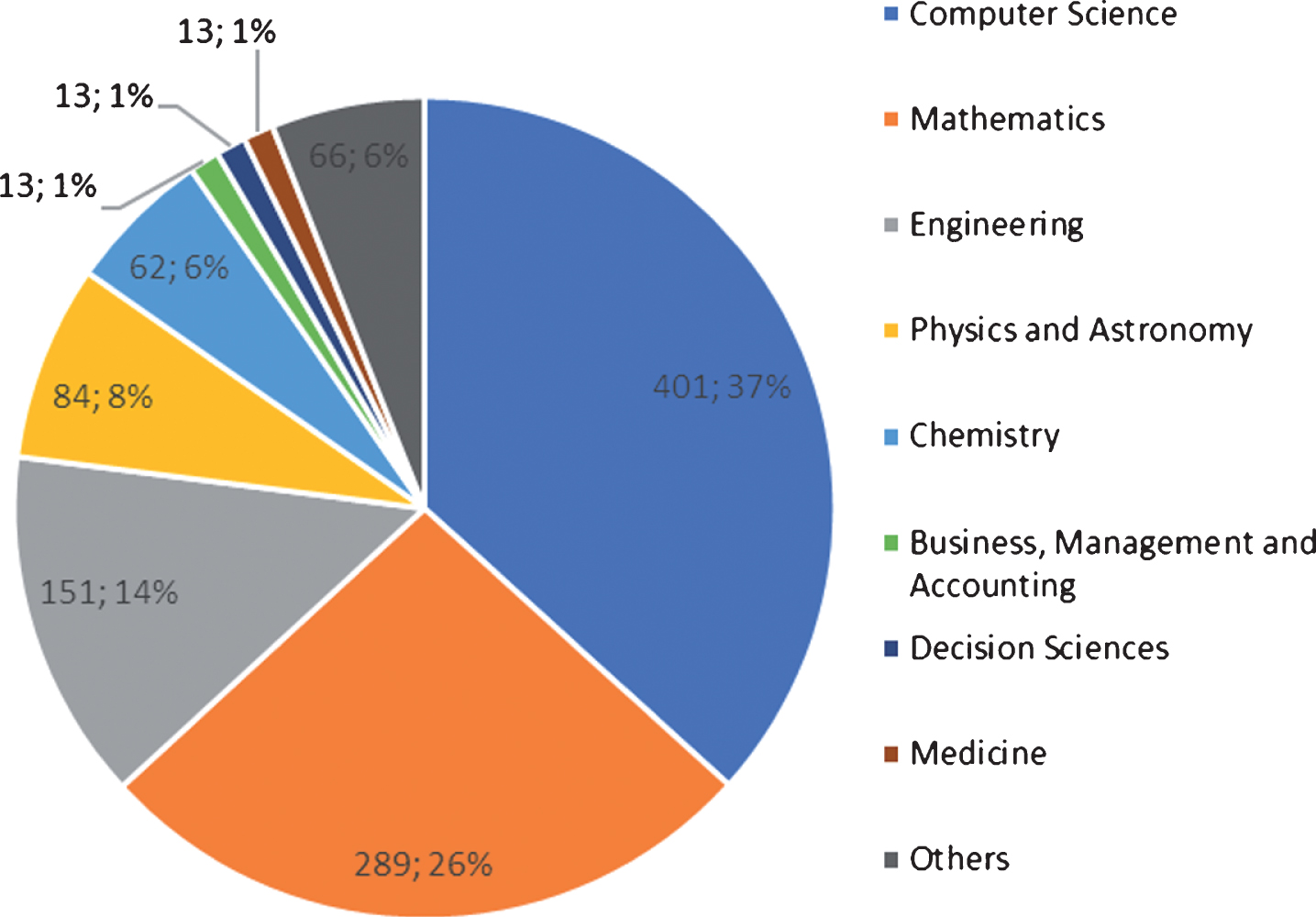
Distribution of neutrosophic sets publications with respect to their subject areas.
After ordinary fuzzy sets were introduced by Zadeh [34], these sets have been extended by various researchers later. Intuitionistic fuzzy sets were presented by Atanassov [33] as a generalization of ordinary fuzzy sets. Smarandache [16] generalized Atanassov’s intuitionistic fuzzy sets to the neutrosophic sets. He defined the concept of neutrosophic sets based on three neutrosophic components (T, I, F). Wang et al. [21] defined the set-theoretic operators on an instance of neutrosophic set and named it as truth-value based interval neutrosophic set. Kraipeerapun et al. [45] combined the interval neutrosophic sets with present soft computing techniques to represent the ambiguity in the prediction of mineral deposit locations. Smarandache [17] generalized the intuitionistic fuzzy set, paraconsistent set, and intuitionistic set to the neutrosophic set. He presented many examples and emphasized the differences between intuitionistic sets and neutrosophic sets. Kraipeerapun et al. [42–44] presented some approaches to develop neutrosophic neural networks. Smarandache [18] defined a geometric interpretation of the neutrosophic set by using the neutrosophic cube. Broumi and Smarandache [49] introduced the concept of correlation coefficients of interval-valued neutrosophic set for the first time and presented respective numerical examples. Ye [30] introduced the concept of simplified neutrosophic sets, defined their operational laws and proposed some aggregation operators. Majumdar and Samanta [46] introduced the notion of distance between two single-valued neutrosophic sets and their properties. Broumi and Smarandache [50] proposed a new distance and various similarity measures between interval neutrosophic sets. Ye [31] proposed a trapezoidal neutrosophic set with some operational rules, their score and accuracy functions based on the combination of trapezoidal fuzzy numbers and a single-valued neutrosophic set. Deli et al. [24] introduced the concept of bipolar neutrosophic set and its some operations with score, certainty and accuracy functions to compare the bipolar neutrosophic sets. They also developed the bipolar neutrosophic weighted average operator and bipolar neutrosophic weighted geometric operator. Şahin and Küçük [47] introduced a neutrosophic subsethood measure for single valued neutrosophic sets. Peng et al. [29] defined some novel operations of simplified neutrosophic numbers (SNNs) and developed a comparison method based on the related research of intuitionistic fuzzy numbers. They proposed some SNN aggregation operators. Yang et al. [22] proposed single valued neutrosophic relations, studied their properties and introduced single valued neutrosophic relation mappings and inverse single valued neutrosophic relation mappings. Deli [23] defined the notion of the interval-valued neutrosophic soft set which combines an interval-valued neutrosophic set and a soft set. Ali et al. [36] proposed the notation of bipolar neutrosophic soft sets which combines soft sets and bipolar neutrosophic sets. Liu and Luo [10] defined the score function, accuracy function and certainty function of single-valued neutrosophic hesitant fuzzy set and proposed the single-valued neutrosophic hesitant fuzzy ordered weighted averaging operator and the single-valued neutrosophic hesitant fuzzy hybrid weighted averaging operator. Nancy and Gary [41] proposed an improved score function for ranking the single as well as interval-valued neutrosophic sets by incorporating the idea of hesitation degree between the truth and false degrees. Zhang et al. [52] proposed new algebraic operations and fundamental properties of totally dependent-neutrosophic sets and totally dependent-neutrosophic soft sets. Mondal et al. [32] proposed two aggregation operators as rough neutrosophic arithmetic mean operator and rough neutrosophic geometric mean operator including some basic properties of those operators. Karaaslan [15] presented a method to measure correlation coefficients between two neutrosophic sets, two interval-neutrosophic sets and two neutrosophic refined sets.
Fuzzy hypothesis tests have been often handled in the literature from different points of view. The first significant works on fuzzy hypothesis tests have been proposed by using ordinary fuzzy sets. Several extensions of ordinary fuzzy sets have been developed by various researchers in the literature.
In the following, these extensions are briefly explained except interval-valued fuzzy sets (IVFS), fuzzy multisets (FM), and nonstationary fuzzy sets (NFS) since IVFS, FM, and NFS are rarely used by researchers. Then, a representative literature review on their usage for hypothesis tests is presented.
Ordinary fuzzy hypothesis tests
Zadeh [34] introduced the fuzzy set theory to the literature. The first type of fuzzy sets is ordinary fuzzy sets, which are represented by only a membership degree for an x value as given in Equation (1).
There are various works on ordinary fuzzy hypothesis testing in the literature. Some representative works are as follows: [6–8, 51].
Type-2 fuzzy sets are developed by Zadeh [35]. A Type-2 fuzzy set
There are few works on Type-2 fuzzy hypothesis testing in the literature. Some representative works are as follows: [1, 28].
Let U be a universe of discourse. An IFS
For any intuitionistic fuzzy set
There are few papers on intuitionistic fuzzy hypothesis testing in the literature. Some representative works are as follows: [11, 54].
Xia and Xu [39] defined hesitant fuzzy sets as follows:
To the best knowledge of the authors, there is no published paper on hesitant fuzzy hypothesis testing.
Let U be a universe of discourse. Neutrosophic set
Neutrosophic hypothesis testing including neutrosophic hypothesis testing errors and neutrosophic level of significance are discussed by Smarandache [19] in his book.
Let U be a universe of discourse. A Pythagorean fuzzy set
For any Pythagorean fuzzy set
To the best knowledge of the authors, there is no published paper on Pythagorean fuzzy hypothesis testing.
Assume we have the IVN data set as in Table 1.
IVN data set
IVN data set
The linguistic data and the corresponding numerical IVN data in Tables 3 and 4 are determined by using the scale in Table 2.
Scale for IVN decision matrix
Linguistic data
Numerical data
The sample mean of the IVN data is calculated as in Equation (15). The summation operation in Equation (15) is realized by using Equation (12) sequentially so that the sum of the first two numbers is added to the third number and so on.
In order to obtain the subtraction
Subtract the sample mean from each value as in Equation (16).
Find the minimum of T, I, and F values as given in Equations (17–19).
By applying Equations (20–22), we transform negative T, I, and F values to zero or positive values.
Before, we determine the maximum of upper T, I, and F values:
Sample standard deviation is obtained by using Equation (24). The summation operation in Equation (24) is realized by using Equation (12) sequentially so that the sum of the first two numbers is added to the third number and so on.
The subtraction and power operations in Equation (24) are calculated by using Equation (25).
Neutrosophic random variable of standard normal distribution is given by Equation (26).
Then, we utilize the score function given by Equation (14) to obtain a crisp standard normal random variable, z.
The crisp interval-valued z value is reduced to a single value by averaging the upper and lower limits.
Let the calculated z value from sample data be z c . If z c ≥ - z α , we “accept” the null hypothesis. Otherwise, we “reject” the null hypothesis. Figure 4 shows left-sided hypothesis test on a graph.
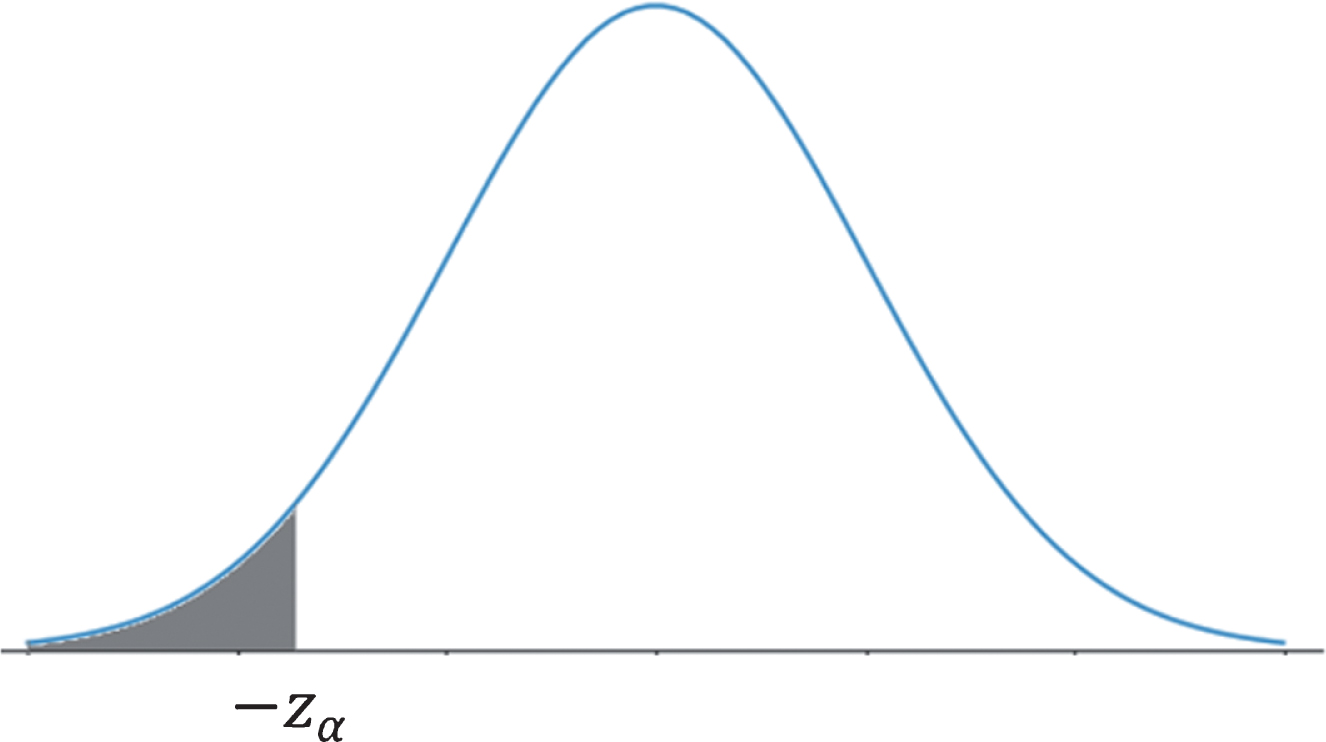
Left-sided hypothesis test.
Let the calculated z value from sample data be z c . If z c ≤ z α , we “accept” the null hypothesis. Otherwise, we “reject” the null hypothesis. Figure 5 shows rightsided hypothesis test on a graph.
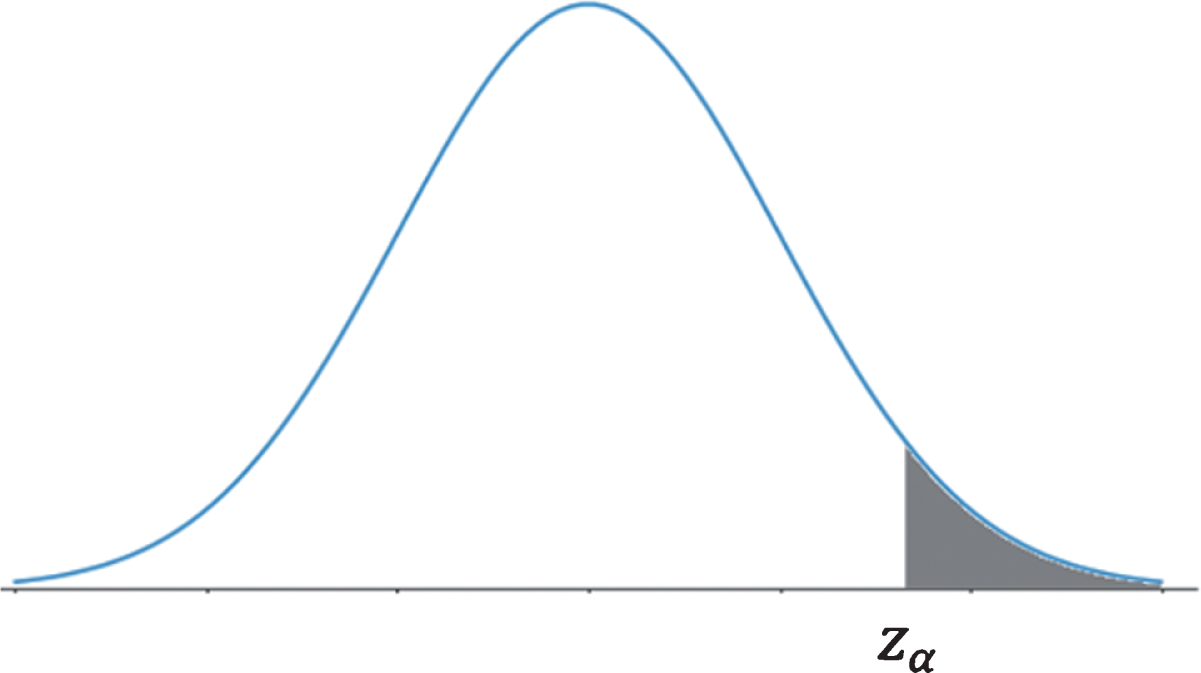
Right-sided hypothesis test.
Let the calculated z value from sample data be z c . If -zα/2 ≤ z c ≤ zα/2, we “accept” the null hypothesis. Otherwise, we “reject” the null hypothesis. Figure 6 shows double-sided hypothesis test on a graph.
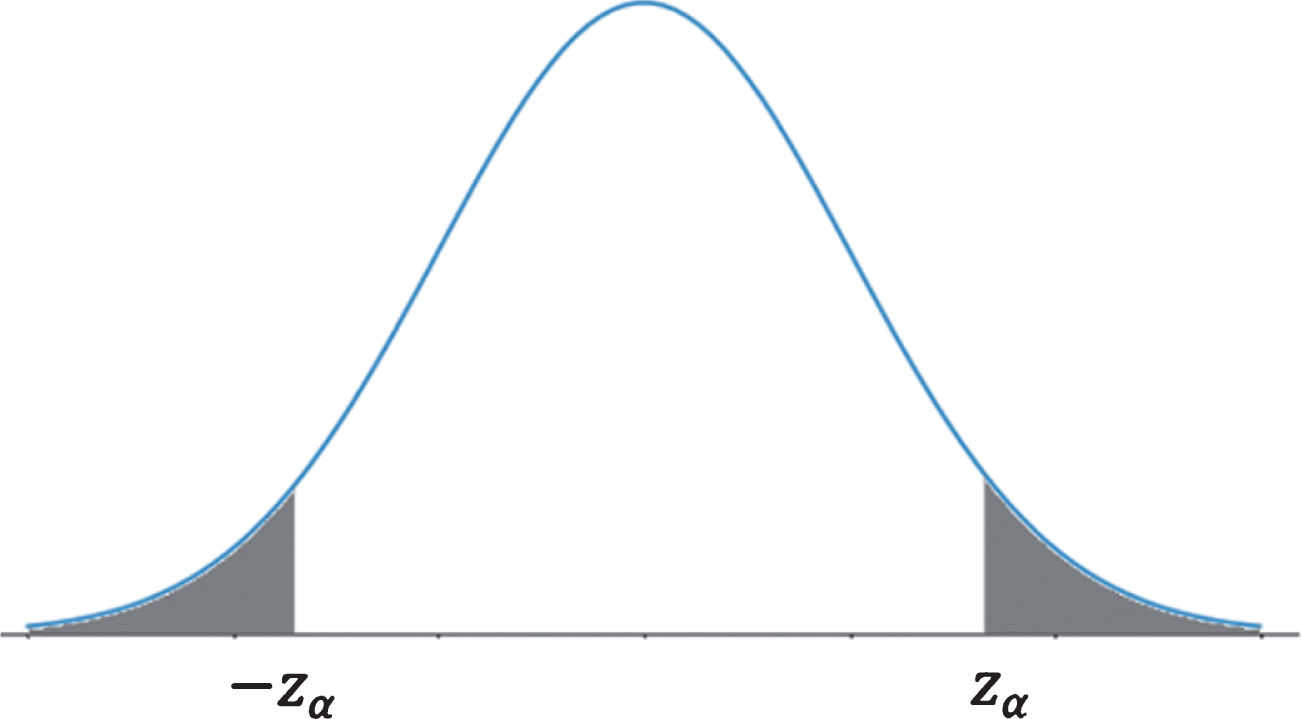
Double-sided hypothesis test.
The performance evaluation of randomly selected 25 workers in a production firm will be realized. It is investigated if the mean performance score of the workers in this firm is larger than
The sample mean of the given neutrosophic data is calculated by using Equation (15) and the obtained result is as follows:
The standard deviation of the given neutrosophic data is calculated by using Equation (24) as follows:
Neutrosophic random variable of standard normal distribution is calculated by using Equation (26) as follows:
Left-sided hypothesis test
We calculated the z value from sample data as 1.0506. Since 1.0506 > -1.645, we “do not reject” the null hypothesis. Results of the left-sided hypothesis test is illustrated on Fig. 7.
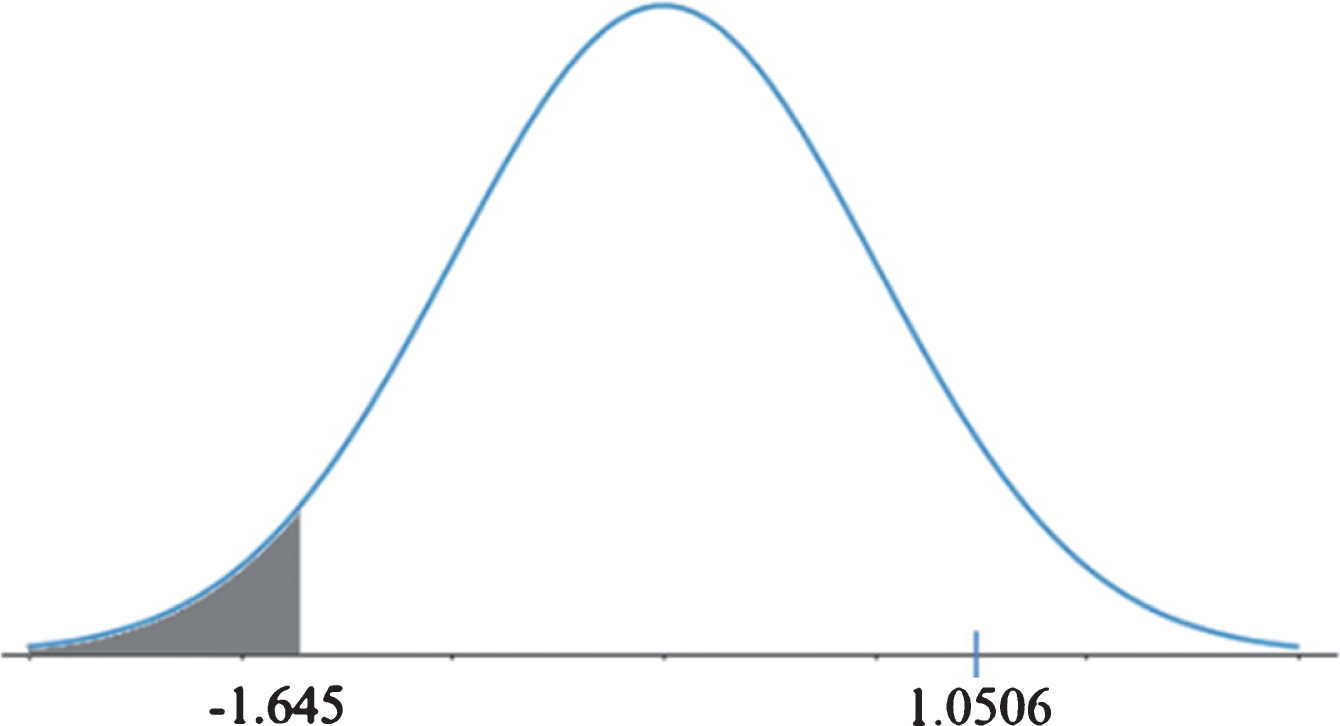
Left-sided hypothesis test.
Since 1.0506 < 1.645, we “do not reject” the null hypothesis. Results of the right-sided hypothesis test is illustrated on Fig. 8.
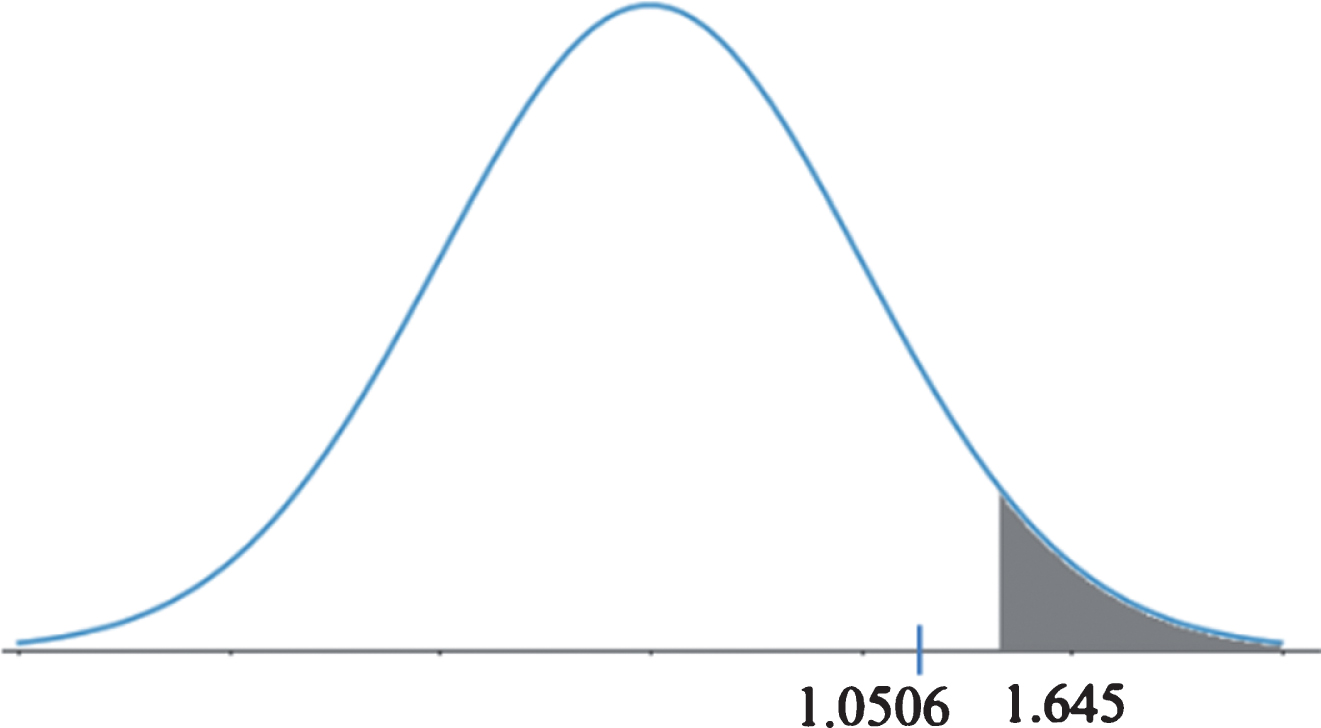
Right-Sided Hypothesis Test.
Since -1.96 < 1.0506 < 1.96, we “do not reject” the null hypothesis. Results of the double-sided hypothesis test is illustrated on Fig. 9.
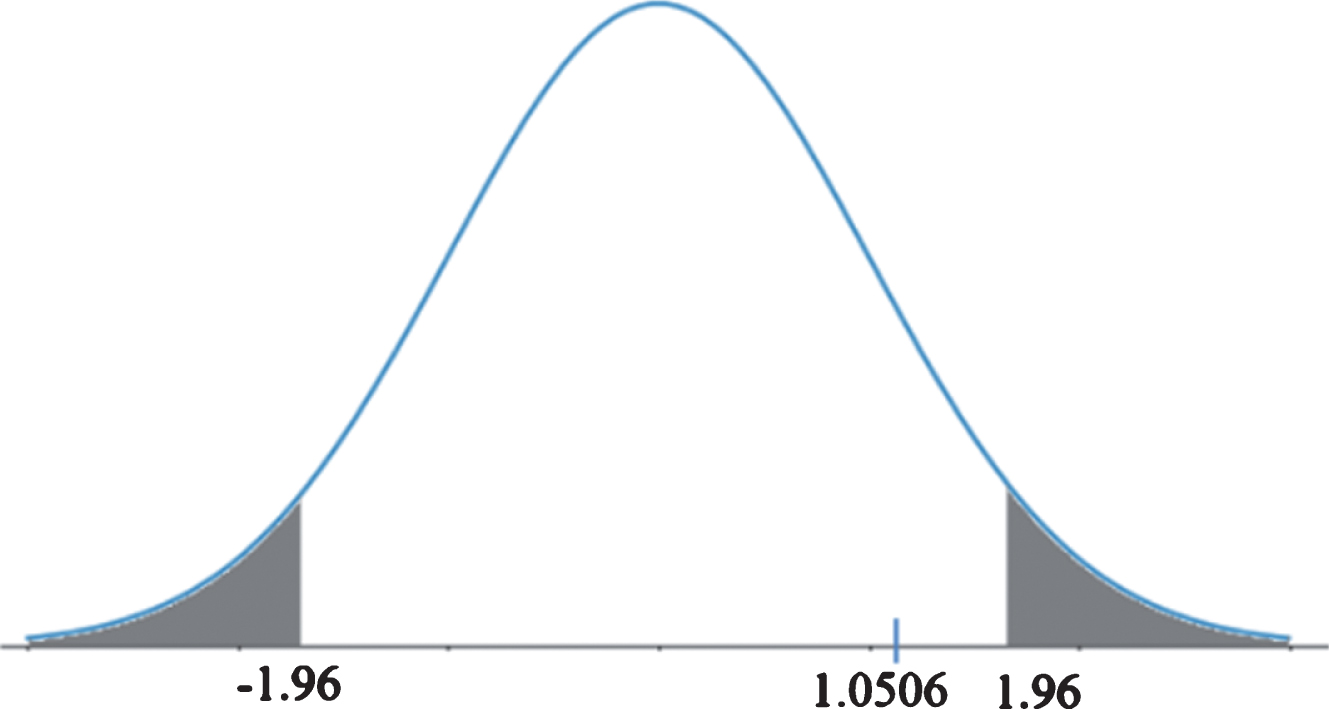
Double-sided hypothesis test.
Hypothesis testing under vagueness and impreciseness has been a research area since the fuzzy set theory has been introduced in 1965. Ordinary fuzzy hypothesis testing, Type-2 fuzzy hypothesis testing, and intuitionistic fuzzy hypothesis testing have been already proposed in the literature by various researchers. Neutrosophic hypothesis testing has been proposed in this paper. The data and the parameters are composed of neutrosophic numbers in the proposed approach. Since there is no consensus on IVN division operation in the literature, the score function has been employed in one of the steps of the proposed method. Our approach has successfully performed the hypothesis testing under uncertainty.
For further research, other extensions of ordinary fuzzy sets can be applied to hypothesis testing such as hesitant fuzzy hypothesis testing, and Pythagorean fuzzy hypothesis testing. Triangular fuzzy, trapezoidal fuzzy, or LR type fuzzy numbers can be also incorporated to our proposed IVN hypothesis testing approach. The results of all these approaches can be compared with each other.