



Abstract
The Three Gorges ship lock, as one of the world leading navigational architectures, plays a significant role in the inland water transport of China. The rapid development of marine transportation increases great pressure on the maritime monitoring and administration in the ship locks. Hence, it is essential to explore the navigational risk factors. This study proposes a new dynamics model to investigate the evolution mechanism of navigational risk in Three Gorges ship lock. Intelligent expert system was used to analyze the risk factors. Experimental validation results demonstrate that the weather may impact the ship navigational safety with a high risk probability. Meanwhile, the navigational risk in flood season is relatively higher than that in dry season due to the increase of flow velocity and rain fall. The present study may provide useful insights to the evolution of inland navigational risk as well as maritime administration in the Three Gorges ship lock.
Introduction
The Three Gorges ship lock is a double-track continuous five-stage lock. It is an important navigational structure of the Three Gorges Project [1]. It is also an inland river lock with the largest number of consecutive stages and the highest total water head, inter-stage water head in the world. As the inland water transport develops, the vessel traffic flow increases rapidly in the recent years, which makes the maritime administration a challenging task. Although great progress has been made in terms of risk formation theory in ship navigation, the maneuverability and hydrodynamics in the ship locks is quite different with that in the regular waterways. So far, very limited studies have been done to address the navigation safety of ship locks. Tang [2] discussed the navigation safety assessment of the Three Gorges Project and proposed solutions to the risk-reduction problem. He suggested establishing an effective systematical dynamic model for navigational risk evaluation in the Three Gorges Ship lock.
System dynamics (SD) is a system simulation method founded by Forrester [3] in the 1950 s. Figure 1 shows the framework of SD approach. SD has been widely used in the design and analysis of engineered systems. Sing et al. [4] applied system dynamics to the engineering field. Roberts et al. [5] developed the system dynamics model to investigate the problem of Childhood Overweight and Obesity in Australia. Lubega [6] utilized SD to establish a quantitative engineering systems model for the energy–water nexus.

General framework of system dynamics approach.
As aforementioned, the risk in ship navigation could be investigated through a number of different ways. For instance, Gucma [7] simulated and evaluated the ship navigation risk based on accident probability statistics by computer. Choi [8] studied the influence of abnormal wave changes on coastal ship navigation. Cao [9] established the system dynamics (SD) model of port ship navigation risk, revealed the characteristics of navigational risk of port ships. Liu et al. [10] established a structural equational model of navigation environmental risk evolution in complex inland waters and concluded that hydrological characteristics were the main factors affecting navigation safety. Fang et al. [11] studied the impact of human factors on the navigational risk. However, the application of artificial intelligence is little in literature for evaluating the risk in the Three Gorges ship lock [12–14].
To bridge this research gap, this paper aims to explore the risk factors and evaluation for ship navigation in the Three Gorges ship lock. The general method of system dynamics modeling is briefly introduced in Section II. Then, the relevant risk factors are analyzed within the circumstance of the Three Gorges ship lock. System dynamics based risk evaluation model is thus established in Section III. The values of model parameters are determined through intelligent expert system. The evolution characteristics of navigational risk are assessed for both flood and dry seasons in the section IV. Concluding remarks are drawn in Section V.
Analysis of navigational risk factors
The analysis of risk formation factors for ship navigation in the Three Gorges ship lock is the fundamental step of system dynamics model establishment. Impact factors are selected and thus quantified or measured in the light of actual situation. According to the preliminary investigation and analysis of navigation risk of the Three Gorges ship lock, the navigation risk factors of Three Gorges ship lock are obtained. Based on the system engineering theory [15], the factors affecting the system safety of ship navigation are divided into four parts: human factors, equipment factors, environment factors and management factors [16]. Referring to work presented by Liu et al. [17], the feedback relationship between human factors, environment factors, management factors and others is obtained and the factors affecting navigational risk of Three Gorges ship lock are subdivided. Due to the practical situation of ship lock operations, more specific attention has been paid to ship risks which replace the original equipment risks. As a result, four major risk factors, named as human, ship, environment and management risks, have been recognized as primary risk factors directly affecting the navigation safety of the Three Gorges ship lock.
Through the field inspection and expert consulting, the secondary navigational risk factors are determined, as shown in Table 1.
Primary and secondary navigational risk factors
Primary and secondary navigational risk factors
The navigational risk model generally includes four sub-systems: human factor system, ship factor system, environment factor system and management factor system. The causal feedback structure based on the cause-and-effect relation is the basic structure of the system dynamics model. Following the results of causal feedback analysis, the navigation risk model of the Three Gorges ship lock is established based on the SD approach. The aforementioned four systems are coupled to formulate the navigation risk of the Three Gorges ship lock. By analyzing each variable of the model, investigating the relationship among the four system factors synthetically, and combining the variable attributes of the relevant factors, the navigation risk stock flow diagram of the Three Gorges ship lock is derived, as shown in Fig. 2.

Navigational risk stock flow diagram.
Determination of constant values
The established navigation risk simulation model in the present study consists of four subsystems. The whole model comprises 1 horizontal variable, 4 rate variables, 12 auxiliary variables and 13 constants. According to the data provided by the Three Gorges Navigation Authority (MOT, P. R. China), the values of each constant are computed and tabulated, as shown in Table 2.
Model parameters
Model parameters
In order to facilitate subsequent computation, all constants in Table 2 are further normalized. Among them, ‘Sailors’ driving age’ and ‘Navigation AIDS availability’ are stochastic and time-independent variables. Thus, the ‘RANDOM’ function is adopted. ‘Traffic densities’ and ‘Abnormal weather’ differ with time, and it is always difficult to assign constant values through a year. Therefore, a monthly description is carried out. Their monthly values are derived from the average of historical data between 2015 and 2017, as shown in Tables 3 and 4, respectively.
Statistics of monthly vessel traffic flow
Statistical results of monthly abnormal weather warnings
In the present study, expert assessment method [18] is utilized to evaluate the impact of different factors on navigation risk of Three Gorges ship lock. Experts from the Three Gorges Navigation Authority (MOT, P. R. China) and Wuhan University of Technology (China) formed an expert group to assess the impact of influencing factors. Therefore, the normalized impact coefficients of each factor on different variables (0-1 between zones) were obtained by expert knowledge. The calculation formula for each variable is finally determined.
Assessment of navigational risk
As the parameters of the navigation risk model of Three Gorges ship lock are determined, the system dynamics simulation software Vensim DSS is used for model simulation and the time length is selected as 12 months in the present study.
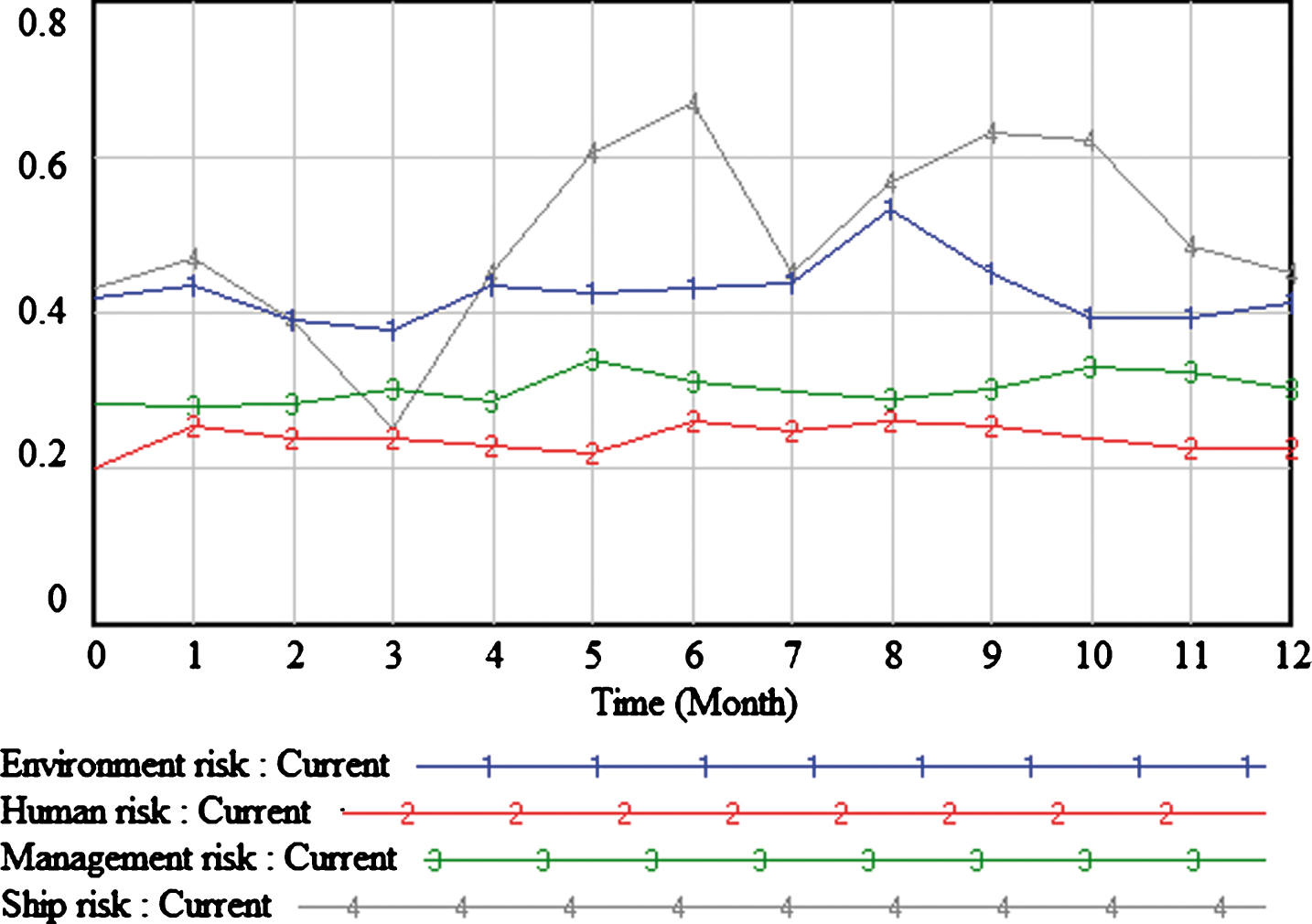
Evolution trends.
According to the Table 4, there are 39 times’ weather abnormal in August, which inevitably leads to an increase in Environment risk. The substantial upward trend of Ship risk from begin to March is the result of the growing traffic flow density and ship carrying capacity on navigation conditions. The management system is less sensitive to external influence and its structure is stable, so it presents a state of vibration around a certain number. Human risk fluctuates slightly in the process of change, which reflects the subjective initiative of staff in their work. The high risk index from May to October should be due to the arrival of flood season, additionally, the increase of accident probability and that of workload of relevant employees. If divide the whole year into flood season and dry season separately, it would be found that the risk of personnel is always relatively constant and the level of work is stable. The impact of the flood season on the Ship risk and Environment risk is very obvious, which reminds researchers to pay attention to safety during the flood seasons from May to October.

Evolution trend of navigation risk.
The figure shows that the average level of the navigation risk of Three Gorges ship lock is around 0.35, and the risk is not that high. By contrast, a period of less than 0.35 for the navigation risk between October and March is a period of low risk, with a sudden increase in risk in April and a subsequent period of more than 0.35 for navigation from May to October.
Combining with the actual situation of the Three Gorges Project, it can be found that the flood season of the Yangtze River is from May to October, and the landform of the Three Gorges Lock is dangerous. The traffic flow density increases, the water flow becomes faster, the ship carrying capacity increases and other problems caused by the flood season will inevitably lead to high navigation risk. In the statistics of abnormal weather of the past three years, April, at the turn of spring and summer, is the month with the largest number of abnormal weather days. In April, the navigation risk of the Three Gorges ship lock reaches a small peak, which shows that severe weather has a great impact on ship navigation. Based on the above analysis, the navigation risk model of Three Gorges ship lock established in this paper can describe evolution trend of navigation risk of Three Gorges ship lock better and more completely, and provide guidance for navigation risk of Three Gorges ship lock.
It is found from Figs. 3 and 4 that abnormal weather and hydrological conditions are the main factors affecting the navigation risk of Three Gorges ship lock. Timely and accurate weather forecast and continuous vigilance during flood season are the best ways to prevent accident. According to the navigation risk model of Three Gorges ship lock, managers can design more optimized risk monitoring personnel arrangements and more reasonable material allocation methods to help improve the situation of Three Gorges ship lock navigation.

Comparison of risk model and monthly average accidents.
Compared with the risk evolution model, the overall number of accidents in the Three Gorges Lock is less, the occurrence of accidents fluctuates little with time, and the trend of the two lines is very similar. Thus, the risk evolution model can well reflect the change of navigation risk of the Three Gorges Lock in one year.
This paper introduces a navigation risk model of Three Gorges ship lock. Firstly, the leading factors of navigation risk of Three Gorges ship lock are determined by field investigation and the support of the Three Gorges Navigation Administration. The feedback relationship among the factors is analyzed. Secondly, based on the system dynamics, the navigation risk model of the Three Gorges ship lock is established. Thirdly, using expert assessment method, this paper sets up the variable equations of the navigation risk of the Three Gorges ship lock. Finally, the navigation risk model of Three Gorges ship lock is simulated.
The model in this paper reveals the evolution trend of the navigation risk of the Three Gorges ship lock, which can be used to predict the navigational risk of the Three Gorges ship lock and contributes to the quantitative analysis of the navigation risk of the Three Gorges ship lock. It is the next step to integrate more influential factors of navigation risk of the Three Gorges ship lock, on basis of which more rational and accurate risk assessment could be accomplished in the future.
Footnotes
Acknowledgments
This research is financially supported by the National Key Research and Development Program of China under Grants 2018YFB1600400 and 2016YFC0402006, Key Laboratory of Hydraulic and Waterway Engineering of the Ministry of Education, Chongqing Jiaotong University under Grant SLK2018A02, and University-industry Cooperation Program, Department of Science and Technology of Fujian Province (No. 2019H6018). The authors would like to express their sincerely gratitude to Three Gorges Navigation Authority (MOT, P. R. China) for providing statistical data in the present study.