



Abstract
With the rapid popularization and rapid development of the Internet in the world, e-commerce has gradually become the mainstream trade mode. E-commerce has its own unique trading mode and brand-new global business opportunities. More and more people conduct online transactions through the Internet. According to the characteristics of data in B2C e-commerce system, data mining management module is designed in B2C e-commerce management system. Data mining technology is used to preprocess data, data mining and mining results. It is implemented using J2EE’s B/S architecture. With the continuous growth of B2C e-commerce scale, logistics bottlenecks have become increasingly prominent, and e-commerce distribution model based on cloud logistics integrates IT information technology with traditional logistics information systems. Integrate logistics service demand and logistics distribution capabilities, and provide corresponding cloud logistics information and management platform system. It will help solve the problem of logistics and distribution of B2C e-commerce in China and promote the healthy and rapid development of e-commerce economy.
Introduction
E-commerce in the B2C model has grown rapidly with the development of the Internet. The B2C e-commerce platform not only provides a good sales channel for merchants, but also brings unprecedented consumer experience to consumers [1]. With the rapid development of the logistics industry, the logistics business has grown rapidly, and technologies such as smart tags, radio frequency identification (RFID) and global positioning system (GNSS) have been widely used in the logistics industry [2]. The high level of information associated with the resulting increase in information exacerbates the risk that existing enterprise logistics information systems tend to collapse. However, it must be recognized that the logistics distribution link is still the bottleneck of B2C e-commerce development [3]. At present, the logistics distribution service of B2C e-commerce in our country lacks a unified management system, and each logistics enterprise does its own thing and lacks the sense of cooperation in service [4]. The information platform between logistics companies and B2C e-commerce enterprises has the problem of information transmission not smoothly and information failure. Data mining is to extract useful information from a large number of data, that is, from a large number of incomplete, noisy, fuzzy, random actual application data to find hidden, regular and unknown [5–7]. But it is also a potentially useful and ultimately understandable process of information and knowledge. With the increasing number of people using online shopping, the important role of logistics industry is more obvious [8]. Logistics will be related to the speed of goods supply, whether goods can be delivered to customers in time, which will directly affect consumer satisfaction with the business [9].
With the development of the Internet, the business volume of B2C e-commerce is growing rapidly, online returns tend to increase, the complexity of reverse logistics management will increase, and the cost will also rise [10]. B2C e-commerce is not limited by time and space. For businesses, it can avoid rent brought by the operation of physical stores, reduce costs, improve efficiency, and bring higher sales revenue [11]. Logistics information is a general term reflecting knowledge, information, images, data and documents in various activities of logistics. Researchers at home and abroad have studied the construction of logistics information system, mainly focusing on the content, but the research combined with data cube is rare [12, 13]. Commodity distribution turns over many times, logistics links are redundant, and logistics costs remain high, which is difficult to meet the needs of consumers. It has caused huge waste and a large number of blind spots. In today’s rapid development of e-commerce, it has been unable to meet the requirements of high-speed, low-cost logistics and distribution services [14]. Data mining methods and mathematical tools include statistics, decision trees, neural networks, fuzzy logic, linear programming, and more. Since 2013, it has been proposed to break the deadlock in the B2C relationship and understand the pre-adoption theory of e-commerce attraction [15]. In the same year, the B2C e-commerce service quality management based on human factors engineering was proposed [16]. In 2014, multi-agent technology and ontology theory supporting B2C e-commerce personalization was also proposed [17]. In 2016, the empirical research on customer retention in B2C e-commerce was also studied by relevant scholars [18].
Modern logistics is a complex social system involving all aspects of social production and life. It involves the whole process of raw material procurement, manufacturing, wholesalers, retailers, end consumers and market circulation. With the increasing number of logistics services in the e-commerce logistics market and the increasing demand for logistics, how to establish B2C e-commerce between the supply and demand sides quickly and at a low cost has become an urgent problem for the development of modern logistics distribution [19]. “Cloud Logistics” provides a new way of thinking to solve the above problems, namely, supported by information technology and platforms such as Internet of Things and cloud computing [20]. According to the individualized needs of customers, a number of logistics services provided by different logistics service providers are distributed. Through the integration of a new service concept and service platform, a new clustered logistics service is formed to create new customer value and customer experience [21]. At present, most domestic B2C e-commerce enterprises adopt the way of consignment, that is, goods are supplied by suppliers to B2C e-commerce enterprises, and relevant introduction of goods is published on the Internet [22]. Then the vast number of consumers can select and screen the goods online, and then generate the purchase intention to achieve the purchase behavior. Finally, the goods should be successfully delivered to the Buyers by the seller through the means of logistics and distribution. To be sure, without the participation of logistics, online purchasing transactions can not be concluded [23].
Model construction of logistics information system based on data cube
The notification verification interface is provided by the third party payment platform to verify the authenticity of the notification, which requires the merchant system to support HTTPS access. The protocol parameters are shown in Tables 1 and 2 below.
Notification verification interface input parameter table
Notification verification interface input parameter table
Notification verification interface output parameter table
On the basis of the existing logistics information system model, data warehouse and other forms of data files are represented as data expression forms with data cube as the basic logical structure [26]. Increase the data cube module and knowledge base module, make the logistics information system more integrated and information sharing, the data form should be more flexible, more intuitive, support enterprises to make logistics information decision [27]. Consumer information as B2C e-commerce enterprise includes registration information and transaction information [28]. Registration information generally includes: customer name, gender, date of birth, ID number, contact number, address, registration password, password prompt answer, e-mail address and other information. Trading information generally includes: user name, password, order commodity name, price, data, contact information, delivery address, payment method and other information [29]. With the passage of time, various kinds of historical data of B2C e-commerce system will be more and more, and the amount of data will be moreand more.
Logistics information system takes logistics as its specific object, combines logistics and logistics information into an organic system, and collects various data of logistics plan, business and statistics in various ways. After targeted and purposeful computer processing, that is, according to the requirements of logistics operation and management, specific software technology is adopted to input the original data processing into the information system [24]. Information authenticity means that in the process of transmitting information in electronic commerce transactions, information can not be tampered with, and must be the same as the original information of the sender. The orderliness of information refers to that in the process of transmitting information in e-commerce transactions, information should be kept in the order of its original information and can not be reorganized. Only by insisting on the integrity of information can we ensure that e-commerce transactions are carried out in real time [25]. For the calculation and selection of the maximum distance, the factors such as the transportation capacity of vehicles, the traffic condition of urban roads and the bearing capacity of the logistics node should be considered comprehensively. The design and planning of urban road network will directly affect the efficiency of cargo transportation, and some special traffic environment can lead to the failure of distribution.
As shown in Fig. 1, in the valid questionnaires received, in the past six months, users who had encountered information security problems while shopping on the B2C e-commerce platform were as high as 74%.

The overall incidence of information security issues in the B2C e-commerce platform shopping process.
In order to prevent the occurrence of information security incidents during the B2C e-commerce platform transaction process, it is very important to take certain precautions. (As shown in Fig. 2).

In order to prevent the occurrence of information security accidents during the B2C e-commerce platform transaction process.
A five-level scale is used for the frequency of occurrence of each logistics risk event, as shown in Table 3.
Logistics risk event frequency assessment standard five-level scale
To build a perfect e-commerce logistics network, we must first set the scope of each distribution node. The so-called appropriate scope of action is that the logistics distribution node can deliver goods to customers in a timely and accurate manner to the maximum affordable distance. Non-repudiation of information refers to the fact that in the process of transmission of transaction information in electronic commerce, both parties have evidence to prove that the information sent or received has been sent or received, and evidence to prove that the information sent or received has not been tampered with. The evidence of transaction information is generally open to both buyers and sellers, and the non-repudiation of information reduces the occurrence of transaction disputes. The data of B2C e-commerce system often has problems such as non-standardity, ambiguity, duplication and incompleteness. There are also a certain amount of noise data, redundant data, and sparse data. For example, the product information in the commodity database and the commodity information definition in the transaction database are inconsistent, and the format, type, and length of the data may be inconsistent. Good transport and warehouse storage, and convenient cargo distribution are prerequisites for the development of a distribution center. Use these superior infrastructure to transform and form your own logistics distribution network.
After investigation and analysis, in the process of B2C e-commerce platform transaction, online shopping users in our country have the information security accident post-processing situation, as shown in Fig. 3.

Processing of B2C electronic commerce platform transactions after information security events.
Since the initial goal of Internet construction is to apply to military, education, and communication fields, the Internet has certain openness and sharing to facilitate communication between various fields. The data logistics-based intelligent logistics information system records various types of information in logistics management activities through barcode technology and wireless identification technology. Collect, process, and transmit various information in logistics activities and deposit them into the data warehouse in a uniform format. If data mining of e-commerce system is to be done, a series of operations such as sorting out, summarizing and cleaning the original data must be carried out in order to be used in data mining. Taking the optimization of e-commerce logistics network as the core, considering the distribution mode of e-commerce logistics and the hierarchical division of logistics network, the design idea of the model is finally determined. E-commerce is that both sides of the transaction trade through the Internet, which requires that the network environment has confidentiality and security. However, the openness and sharing of the Internet has brought a lot of security risks to e-commerce.
There are many restrictions to be considered in the model of e-commerce logistics network. First, we must consider the entire operating cost problem and minimize the cost. In the choice of logistics network nodes, it is necessary to consider whether the surrounding traffic conditions can meet the standard, whether the route selection can be reasonable, and the distance from the location to be transported. Communicate through the Internet and pay for collections through online banking. The Internet at the beginning was not designed for business activities, and Internet resources were characterized by openness and sharing. These characteristics of the Internet are not conducive to the construction of an e-commerce information security environment. This requires computer technical support, such as firewall technology, authentication and identification technology, encryption technology, security protocols for e-commerce, and so on. The middle layer is the data warehouse layer, which extracts the information needed by the model from the external data sources through the inter-network connection program, and also includes feedback information with the portal of logistics enterprises and the business system of logistics information system. Inventory management includes commodity warehousing management, commodity warehousing management, inventory and early warning number management. According to the name of the commodity, the bar code of the commodity and the classification of the commodity, the quantity of the commodity is counted according to the current inventory and the new quantity. If the quantity of commodities is under the warning number, it is necessary to contact the distributor to order the commodities for warehousing management. According to the customer’s order information for goods out of warehouse management, if the customer successfully ordered a commodity, out of warehouse management, it is necessary to subtract a commodity from the total number of goods.
According to the statistics of the questionnaire, the frequency of customer logistics risk is obtained, as shown in Table 4 below.
Risk frequency statistics in questionnaire
Risk frequency statistics in questionnaire
The author draws a conclusion through the network questionnaire and field questionnaire survey that the main information security problems of online shopping users in B2C e-commerce platform in China occur. (See Fig. 4).

Information security problems encountered by netizens when shopping on B2C e-commerce platform.
Through questionnaire survey and statistics, it is concluded that information security incidents occur when shopping on B2C e-commerce platform (as shown in Fig. 5).

Internet users in B2C e-commerce platform shopping after information security incidents.
Seasonal changes, as well as some measures taken by e-commerce enterprises to stimulate consumption, will have a greater impact on the number of online purchases of consumers. If we want to remove the effect of quantity fluctuation in a period of time, we can use the power law to calculate the quantity of online purchase orders flexibly. However, no matter how advanced the technology, there will be loopholes, network hackers, viruses and other unsafe factors will take the opportunity to enter, steal or tamper with user information, resulting in information leakage, seriously threatening the information security of e-commerce. This has caused serious obstacles to the development of e-commerce. The design of intelligent logistics information system is through a series of operations. The logistics information (data) in the system is processed and the business process operation is completed, in order to achieve the goal of the enterprise with the shortest time and the best benefit. The bottom layer of the intelligent logistics information system is the data source, including logistics requirements, contract information, etc. of suppliers, retailers, and purchasers. The maintenance of menu information is based on the promotion of merchandise and merchandise at a specific time, including the addition and deletion of related first and second level menus. The maintenance of basic data mainly maintains information such as merchant number, VIP member credit limit, member comment points, merchant payment key, and bank account. The query operation log information mainly views the operator’s number and name, operation module, operation content, and operation time.
After a questionnaire survey, it was concluded that the online payment security incidents of netizens shopping on the B2C e-commerce platform attracted the attention of most users. (As shown in Fig. 6).
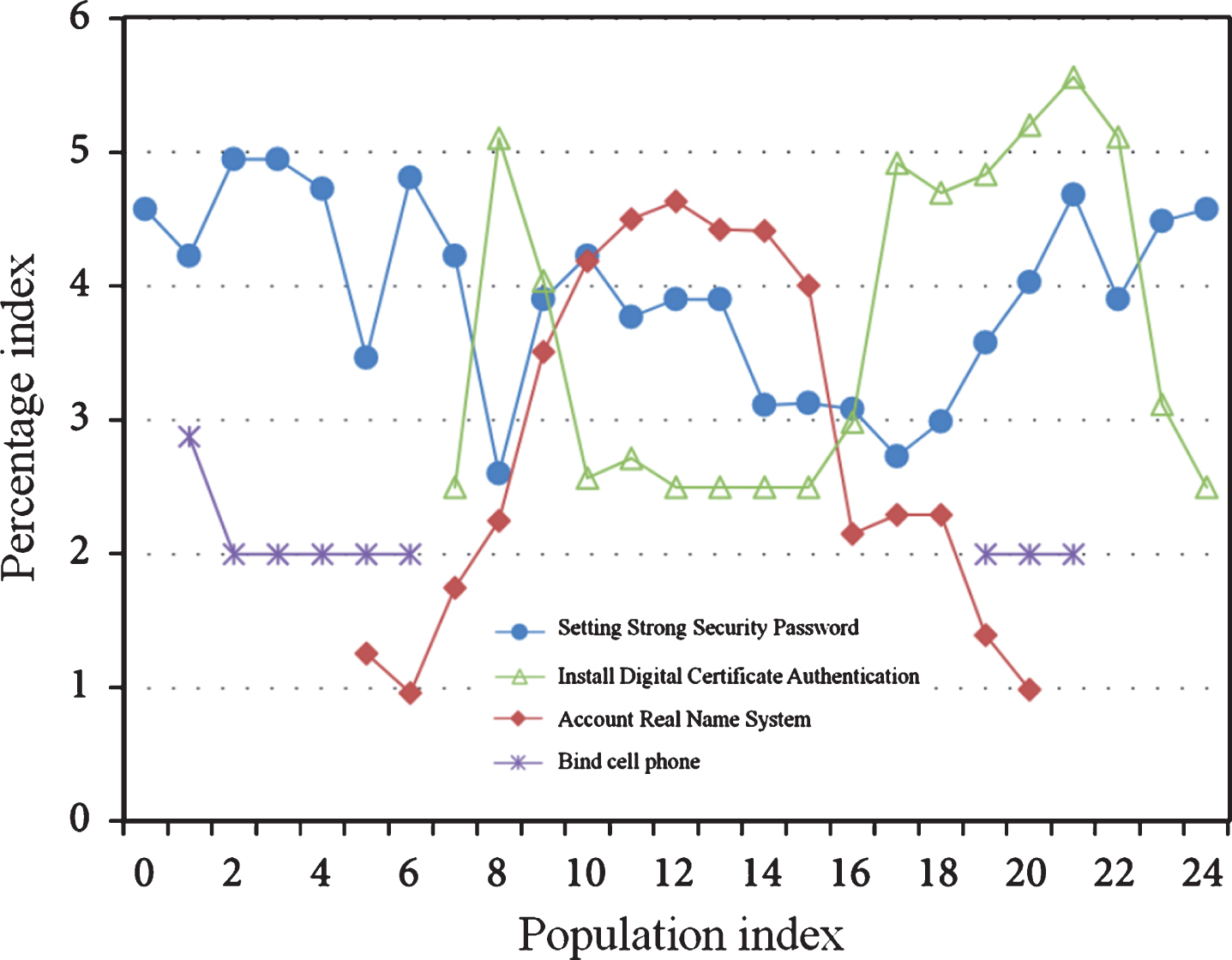
Preventive measures for netizens after online payment security incidents on B2C e-commerce platform.
In the model below, the CDDS only ships the only type of cargo, the customer’s delivery requirements are relatively stable, and the shipping cost and shipping distance are in a linear relationship, resulting in the following formula:
Where: d represents the order capacity of the CDDS node; x represents the operating cost of the CDDS node; y represents the distance from the customer to the node CDDS.
The objective function is as follows:
When the number of online shopping orders per unit area is small, the processing rate and disposal time will increase accordingly. Therefore, A can be expressed as:
Each car D can only serve one L separately:
Every car N can only enter and exit from the same node:
If a car serves both d and k, then i is served by j:
a is the driving performance function of b on c:
Order volume per unit area:
E represents the amount of the nth delivery:
Since the emergence of online group buying model in Laos, the number of group buying websites has increased rapidly. The number of group buying users in China is shown in Fig. 7.
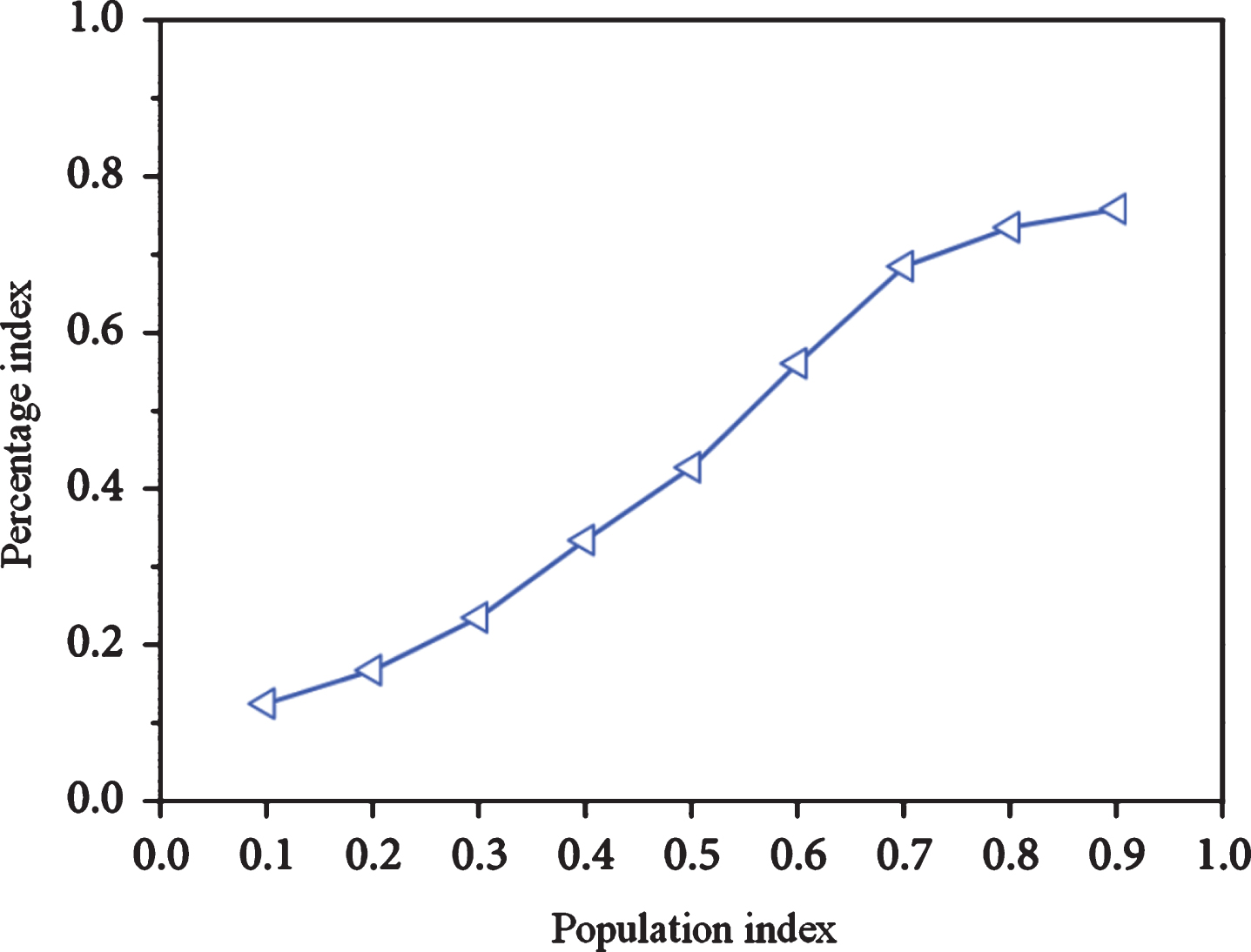
Number of Group Purchase Users and Utilization Rate.
To have a safe shopping environment, we need a trading platform with perfect and mature information management system. The construction of information management system of B2C e-commerce platform is not easy, which requires that B2C e-commerce platform pay more efforts in the process of server selection, website construction and management. Data cubes represent multi-dimensional data, each dimension shows a hierarchical concept, which is suitable for the operation of online analytical processing technology. The online analysis and processing operations of the data cube are mainly realized by scrolling, drilling, slicing, dicing, etc. After analysis and processing, the results of data processing are displayed in the form of data cubes, which better provides a reference for the decision-making of logistics enterprises. Whether data preprocessing is done will affect the efficiency and accuracy of data mining and the effectiveness of the final model. The use of these processing techniques before data mining can greatly improve the quality of data mining patterns and reduce the time required for actual mining. The raw data is generated by data selection, cleanup, integration and transformation to generate a data mining library, ready for the next data mining. The importance of service elements is shown in Table 5.
Service factor importance
The location of the logistics distribution node should be selected, how the nodes of each layer should be allocated and the connections between the nodes of each layer. China’s more representative B2C e-commerce platform is Jingdong, Tmall, etc. It is precisely because these B2C e-commerce platforms have a good level of information security technology and a relatively complete information security management system. Only a large number of merchants choose to settle in here for e-commerce trade, and there will be many consumers who choose to search for merchants and merchandise on such platforms for shopping. The top layer is the front-end tool layer, facing the customer, and can obtain the demand of various users for various information resources from the top-level customer logistics service library. The top layer also includes some tools for query, analysis, processing and processing. For example, data mining tools are used to analyze the information behavior of customers and their internal staff when they browse web pages online. In data mining, many different models can be used, such as classification model, regression model, time series model, clustering model and association rule model. For the same model, different algorithms can be used for data mining. The aim of the algorithm is to find a model suitable for data. Data mining involves multi-step, interaction between systems, special solutions and repeated processes between steps. This problem belongs to the multi-objective programming problem, according to the way to solve this kind of problem. The following models are designed: quantity model of unit area of order, traffic congestion model, scope model of distribution node, order processing capacity model and minimum cost model of logistics distribution network.
The information security management of B2C e-commerce platform needs to form a system to ensure the information security of businesses and consumers participating in e-commerce activities, and to create a secure network trading environment. The rapid development of logistics industry has put forward higher requirements for logistics information system. Data mining technology can play an active role in improving the modern management level of B2C e-commerce enterprises. It can improve the accuracy and timeliness of information on customer management and commodity management in B2C e-commerce enterprises. It can help developers of B2C e-commerce enterprise websites to understand the operation of B2C e-commerce enterprise websites in a timely and comprehensive manner and arrange the page layout of web pages reasonably. Provide personalized service for customers with different browsing habits, and provide technical and information support for each specific work. Propose the optimization of the B2C e-commerce platform information security management law, strengthen its legal constraints, and focus on the management perspective. Strengthen the management of e-commerce information security related personnel, and propose strategies for solving information security problems from the management.
Footnotes
Acknowledgments
The authors acknowledge the financial support of the National Natural Science Foundation of China (71502132), Major Projects of the Ministry of Education of China (16JZDW019), and Qing Lan Project.