



Abstract
Quantum information technology depends on an invaluable and tenuous resource, named quantum correlation, that shows strong significant manifestation of the coherent overlap of states of a combined quantum systems. So the quantifier of this resource under factual conditions that is, whereas corrupted via generalized optical radiation field states is still limited, and common statements on entanglement dynamics. In this article, we describe quantitatively the nonlocal correlation between a two-qubit and squeezed thermal field. Especially, considering the effect thermal photons and number of photons transition between the two qubits and squeezed thermal field. Also, the Mandel parameter, entanglement and atomic Fisher information over the time evolution as a function of implicated parameters in the system are investigated. We have shown that the squeeze parameter and thermal photons have a potential effect of the dynamical properties of the atomic Fisher information, Mandel parameter and entanglement. Also, the AFI is very sensitive to the field parameters rather than the number of photons transition. Furthermore, the results interpreted in the case of thermal environment considering the effect of thermal photons and squeeze parameter on the evolution of the system under consideration.
Introduction
Thermal and coherent states are Gaussian states, while the displaced thermal state is a way of incorporating thermal noise, and the resultant state is still Gaussian. Mixing of thermal and coherent states is another way of including thermal noise, however, the resultant state is non-Gaussian. Also, the displaced thermal state is a mixture of photon-added coherent states of all orders. This has potentially important applications for optical communications and quantum teleportation. So, some efforts have been devoted to exploring theoretically the different effects of thermal radiation at room temperature, usually ignored, is intense for these. Different investigations of the squeezed thermal field (STF) have been done, for example its nonclassically [1–3], quantitative measurement of entanglement and fidelity [4, 5], examination of phase estimation [6]. Moreover, the time-evolution of photon-number distribution and density operator of the STF [7]. Also, the photon system in the black body filled in its interior by a Kerr-nonlinear crystal is in a STF has been discussed [8]. Recently, the STF has an important effects in quantum optics [9] and therefore these effects should have extensive application to fields of technology and information science.
As known that the nonlocal correlation (NLC) between two quantum systems could be quantified through statistical quantities like the entanglement of formation (EOF) or the Von Neumann (VNE) [10]. All the NLC measures depends the transformations under Local Operation Classical Communication (LOCC). On the other hand, the NLC of complex physical system cannot be measured through the basic measure like the VNE. Hence, many tries have been tried in order find out a new quantifier of entanglement of a quantum system. On this regard, the atomic Wehrl entropy (AWE) [11, 12] and the atomic Fisher information (AFI) [13, 14] have been utilized to assess the entanglement and contrasted by the standard VNE. The relationship between the act of AFI and AWE has been explored [13]. The next of the statistical quantities or information quantifier relies on the first product. In this way, it has appeared that the flow of FI can be utilized to discover the Markovian and non Markovian dynamics of a two-level system (2LS) moved by using a phase noise laser [15]. Furthermore, the QFI has been utilized to discover the link between the non-Markovian act of the system-medium in the presence phase noise laser [16]. Finally, entropy and FI has wildly used in the some fields of computer sciences such as image processing [17–19].
This article proposes the statistical properties of the STF and nonlocal correlation between the TQs and STF measured by the concurrence, in addition to the nonlocal correlation between the TQs-STF system identified by the VNE. The effects of the squeezed parameter and mean thermal photon on the statistical properties of the STF and dynamical behavior on the two kinds of nonlocal correlation will be examined.
Interaction between TQs and STF
The TQs-STF interaction is significant type in quantum information processing (QIP). The proposed system of a TQs and STF is given by the Hamiltonian [20].
Next, we consider an initial density operator is given by
The final state for the system of the STF and TQs perceives from
The NLC plays a central role in QIP and have different applications in the interaction between bipartite system [23–26]. The VNE S A 1 A 2 (t) is the essential measure for TQs-STF entanglement. In our case, we use the VNE to measure the NLC between the TQs and STF which has been given in terms of the eigenvalues χ j of the atomic density matrix ρ A 1 A 2 , i.e., [27–30]
As is well-known, quantum correlations, especially entanglement, have a potential applications in information sciences, quantum algorithms and fuzzy systems [31–35]. In this article, we utilize concurrence to measure the qubit-qubit nonlocal correlation or entanglement. In terms of the reduced density matrix for TQs A1 and A2. Concurrence has been defined by [36–39]
In Fig. 1, the temporal variations of the qubit-qubit entanglement measured by the concurrence C
A
1
A
2
, is shown for various values of the number of photons transition k and mean thermal photons number
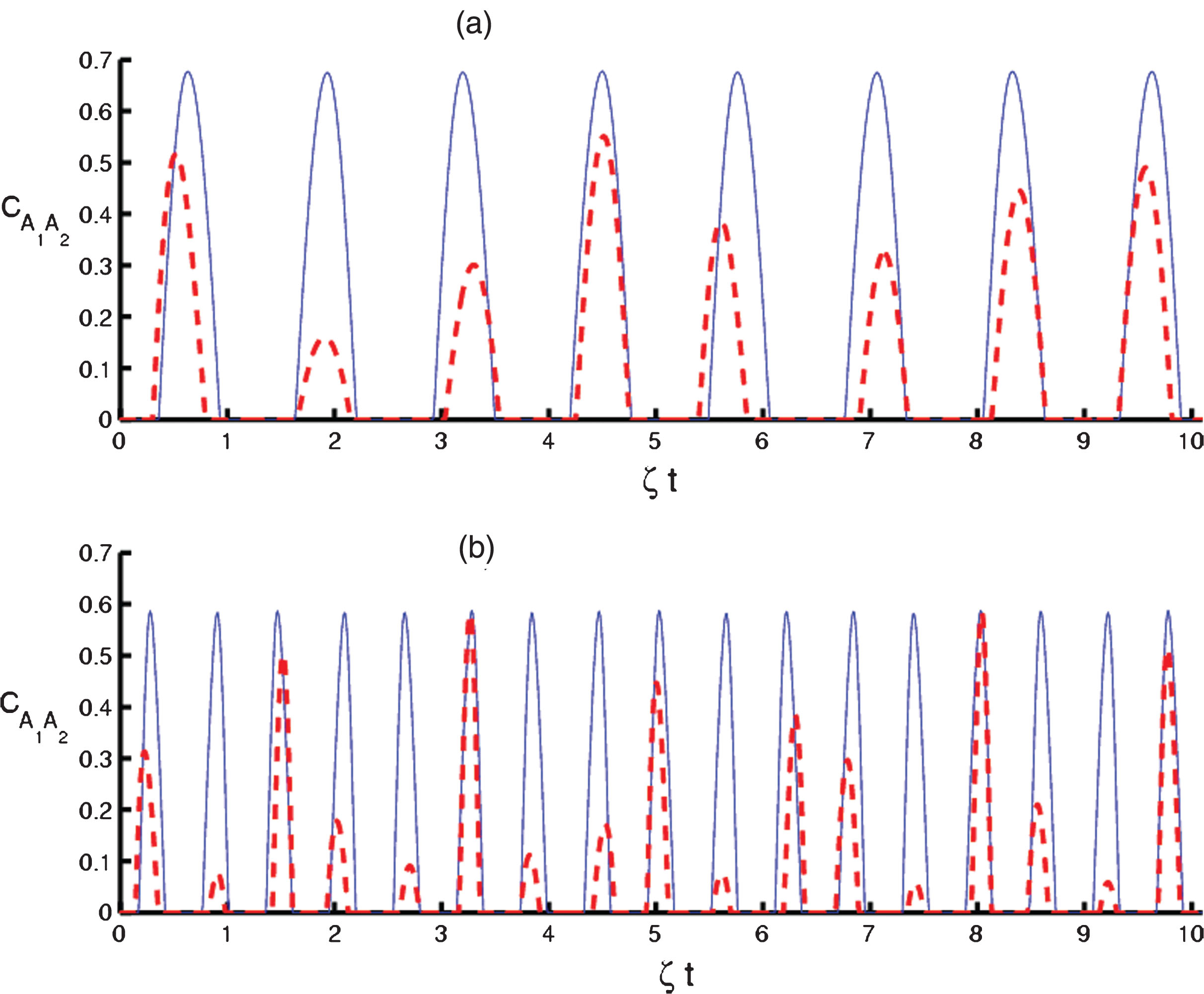
The dynamics of the concurrence C
A
1
A
2
as a function of the dimensionless time ξt with a TQs interacting with a STF: Fig. (a) one photon transition k = 1, squeeze parameter r = 0.1 and average thermal photons
Figure 2, depicts the temporal variations of the TQs-STF entanglement measured by the VNE S
A
1
A
2
, is shown in terms of k and
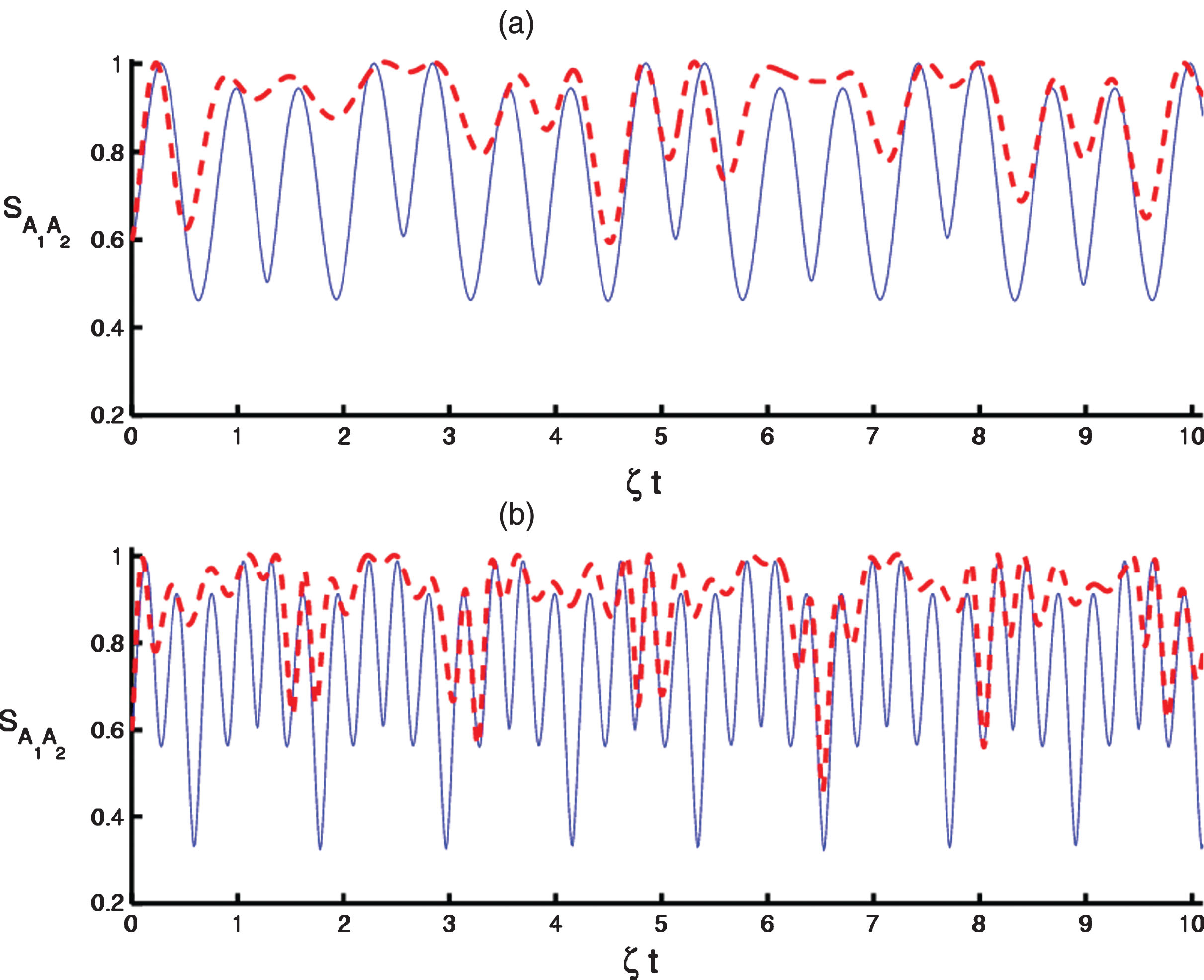
The time evolution of the VNE for the same parameter presented in Fig. 1.
Atomic Fisher information
Here, we propose the relation between the AFI and qubit-qubit entanglement compared by the NLC between the TQs-STF. The classical FI measures any distribution function G
θ
(t), in terms of a stochastic variable y and an estimator parameter θ and is defined as [40].
In terms of the atomic phase space parameters ϑ and φ the atomic quasi-probability function ϖ
AQF
is given as [11, 41].
The AFI for the atomic state estimation as a quantifier of the system dynamics [13]
In Fig. 3 the temporal variation of the AFI for various values of the squeezed parameter r and the thermal number n th . The effect of thermal photons is very similar to the case of qubit-qubit entanglement measured by the concurrence. Generally, the AFI exhibits a periodic behavior tending to its a minimal values for a strong STF for both of one and two photon transition see Refs [13, 14]. Thus, the TQs-STF state becomes minimal mixed state for a strong STF.

The time evolution of the AFI for the same parameter presented in Fig. 1.
The statistical properties of a STF through the interaction time could be quantified using the Mandel parameter [42, 43].
Figure 4 show the dynamics of the MP as a quantifier for the STF of the proposed system under consideration. The MP oscillates between the values 0 and 1 in aperiodic and regular behavior which clarify that the STF changes from Poissonian and sub-Poissonian during the time evolution in the case of weak STF for k = 1, 2 . (see Fig. 4 solid line). For the strong STF is consider for n th = 2 (dashed line) the STF changes form super-Poissonian and sub-Poissonian in a chaotic manner. This results emphasize that the statistical properties of the field is depends of the field parameters rather the number of photon transition.

The time evolution of the Mandel parameter for the same parameter presented in Fig. 1.
The notion of the concurrence has been shown for a high precise and educational for depicting the time development of entanglement of a quantum information system. We have investigated and discussed the link between the qubit-qubit entanglement and statistical properties of the STF and AFI for a TQs for one and two photon transition in the case of weak and strong STF. During the time evolution of the AFI and concurrence show various order relying on the squeeze parameter and thermal photon number. At suitable value of the average thermal photons and squeeze parameter a high amount of quantum entanglement can be obtained for different ranges of the dimensionless time. The dynamics of the concurrence and the AFI are studied in low and high squeezing and thermal regimes. Furthermore, we found that the TQs-STF nonlocal correlation depends on the STF parameters and number of photons transition while the statistical properties of the field in only depends on field parameters. Also, the AFI has the ability to quantify the qubit-qubit entanglement rather than the entanglement between the STF and TQs.
Footnotes
Acknowledgments
This work was funded by Deanship of Scientific Research at Princess Nourah bint Abdulrahman University. (Grant No. 256-S-39).