



Abstract
Models of economic behavior are based on the search for and establishing of relationships between the various economic variables included in the model. Generally speaking, those coefficients that appear in relationships between the model variables are specific values that are determined when the model is to be used to make a given prediction. In this article we propose incorporating fuzzy logic into the study of economic models via the incorporation of fuzzy numbers to express the coefficients relating the different variables. To develop this idea, we analyze a simplified model for determining national income in which it is assumed that, for the sake of equilibrium, said value is composed of consumption and investment. Also, by relating the consumption function to income, we analyze a relationship model between the variables. To obtain broader and more real information than that resulting from the application of classical models, we incorporate fuzzy logic by assuming the parameters that establish the degree of dependence between the variables to be fuzzy numbers with a known membership function. Depending on their form, we determine their respective membership function for national income.
Introduction
In the practical application of classical economic models, given that the values taken by many of the intervening parameters are not known with any accuracy, when using the models to make future predictions it is usual to assign the parameters a precise value obtained from estimates based on data from the past. Thus, if it is estimated, for example, that the marginal propensity to save will be between 0.2 and 0.3, the average value of 0.25 could be taken when making the calculations, which means taking something undefined as defined, thereby losing information. Gil-Aluja [14] argues that if we resort to an initial simplification of reality, then as the operational process with simplified variables progresses, the possible initial deviations accumulate and expand due to the information lost from the beginning. In mathematics, the inherent property of a problem predicting that the accumulated error can become larger when there are small rounding errors is called the property of numerical instability [1]. In order to avoid this possible drawback, Gil-Aluja [14] recommends gathering economic and management phenomena with their uncertainty, so as to preserve the inaccuracy (and also all the information) during the relevant developments to make it “fall” as late as possible, since it is always possible (although losing information) to reduce uncertainty.
With the birth of fuzzy sets theory [29], a new option was introduced to preserve the inaccuracy of economic phenomena. The theory of possibility [32] and fuzzy numbers offers a way of guaranteeing the preservation of a type of inaccuracy in economic reality, which according to Barre [2] is caused by the acts of man, because he is free and endowed with imagination, as well as relationships between men, because they are not robots.
This paper presents a first model of income behavior when it is considered that the parameters linking the variables are uncertain values, expressed using fuzzy numbers.
The aim of this paper is to show a way of incorporating uncertainty into the analysis of the income behavior model and demonstrate how the prediction process is affected when behavior is studied globally for all the possible values of the uncertain parameters that are taken into account, each with their own degree of possibility.
Consequently, the value of this work consists in showing that by assigning posssibility distributions to magnitudes that are not accurately known, a better adaptation to economic reality is achieved, because more information has been taken into account in applying the model, and the prediction obtained will therefore also contain more information which is more adapted to reality.
In order to achieve our aim, we have divided the main body of the work into three distinct blocks. Section 2 presents the fuzzy logic tools used by the new model. Section 3 presents the simplified model for determining income using fuzzy parameters. Section 4 provides a numerical example of the model’s application. And the work ends with the conclusions and the bibliography.
Preliminaries
The fact that an element of a set fulfils or does not fulfil a property is the basis of the Boolean logic that has guided technological development until practically the present day. The Boolean algebra is the basis of the binary logic, which includes the principle of excluded middle, where a proposition is either true or false. However, there are many phenomena in nature that man evaluates by means of subjective opinion and that it is difficult to classify in relation to whether they fulfil a certain property or not. Goodness, beauty or intelligence are examples of properties that may be partially present in certain people in certain cases [12,19, 12,19]. In 1965, Professor Lotfi Zadeh published the article entitled “Fuzzy Sets” [29], with which, adopting a new nomenclature for the concepts of “vagueness” that allow membership functions to take values in the interval “[0, 1]”, he initiated a new and fruitful theoretical field in mathematics known as fuzzy sets theory, that allows overcome the principle of excluded middle through the use of fuzzy logic.
The new vision accepts that the degree to which an element fulfils a property can be a value between 0 and 1, both included. Given property A, the degree to which an element x fulfils that property is denoted by
With the definition of fuzzy numbers [6, 17], it became possible to identify the degree of agreement in which one value could represent a variable. The following definitions are intended to clarify this concept.
A minimum of value x exists so that
There are authors [8, 33] who distinguish between the terms fuzzy number and fuzzy interval. They consider
Within fuzzy numbers we will distinguish between true real fuzzy numbers, which are fuzzy numbers with continuous support (an interval), and fuzzy numbers of a discrete character, in which the only values that we consider are the integer values, for which, in this case, the support considered is a subset of Z.
In the case of a fuzzy number with real support (continuous), which are the ones we will use in our study, we can impose in condition 1.c of Definition 1 that the membership function is continuous. A fuzzy number of this type is expressed graphically as in Fig. 1.
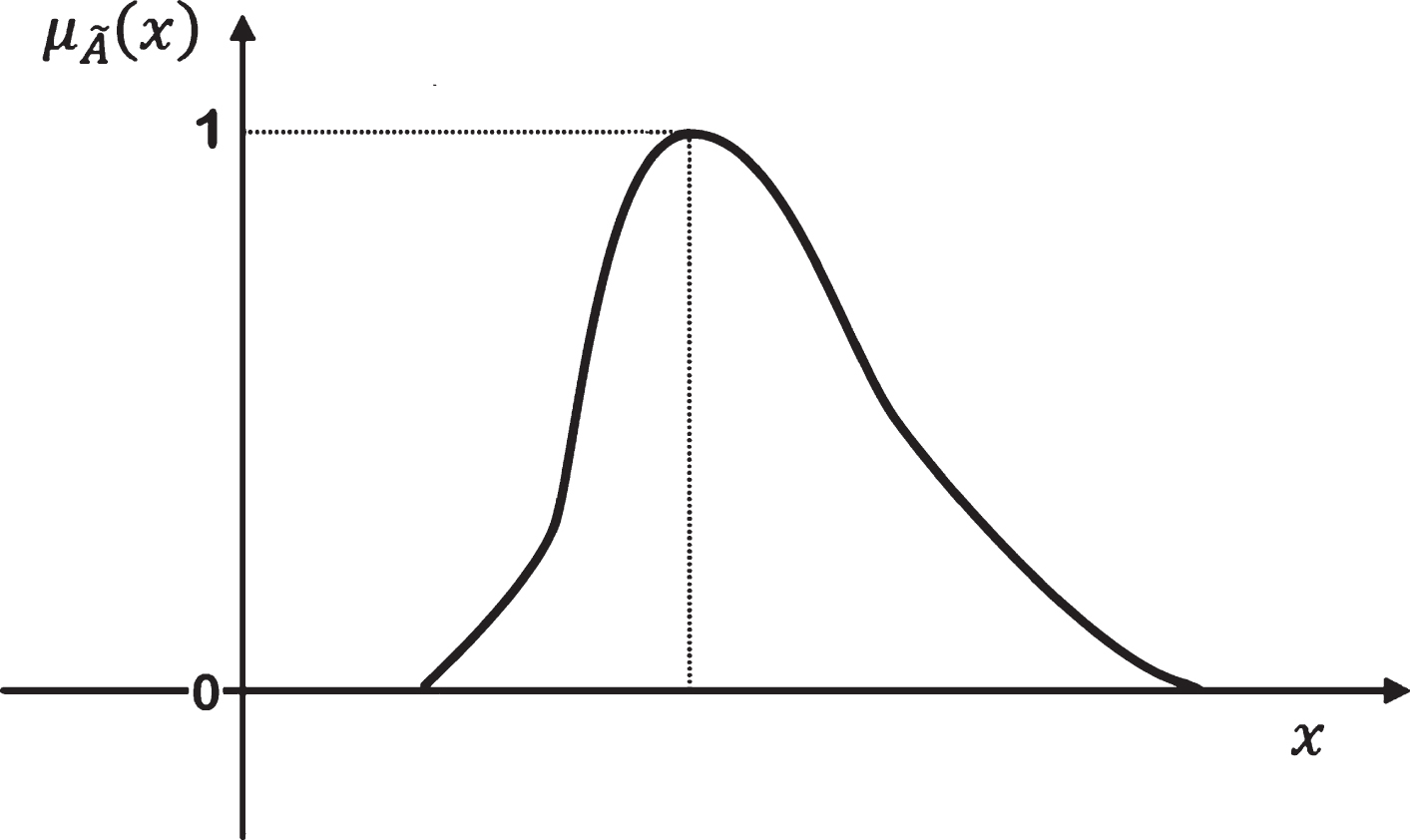
(Example of Fuzzy number).
The fuzzy number
In the study of economic models where we do a modelling using fuzzy set theory, the data that we will have will generally be expressed through positive fuzzy numbers, even if the results obtained through the operations will not always be. Note that a fuzzy number
As a fuzzy number is a particular case of fuzzy subset, by virtue of the representation theorem of fuzzy subsets, every fuzzy number
It is important to note that, by virtue of convexity, A
α
is reduced to a closed interval of R, which we will represent as follows:
We must also take into account that
Thus, through the intervals (2) that define the α-cuts, we have a practical alternative to represent a fuzzy number
Note that an ordinary real number (also called a crisp number) can be considered as a particular case of fuzzy number. However, in the same way that algebraic operations can be performed with real numbers, we are interested in analyzing how common operations with real numbers can be extended to fuzzy numbers.
The solution derives from applying the extension principle of operations or composition laws, initially introduced by Zadeh in 1973 [30], and subsequently modified by other authors [8, 33]. This principle, which is defined below, considers a general method for extending the usual operations of arithmetic to the case in which uncertain amounts are represented through fuzzy subsets or fuzzy numbers.
Let us consider
Then, the operation f can be extended to the fuzzy subsets
defined by:
The support of
1. In the case where n = 1, it follows that if
2. In the most common case, in which we have a binary operation or internal composition law between the elements of E defined by:
More symbolically, if it is being understood that if f-1 (z) =∅ then
When we write
With the same hypotheses as the extension principle, Nyugen [23] states that if the supremum of expression (3) is achieved by an (x1,x2,...,x n ), then the supremum coincides with the maximum, and in this situation the following property is fulfilled:
This property is very important, because in many cases it allows to realise in an easy way the operations with fuzzy numbers through their α-cuts, making the operation in a more operative way.
Since fuzzy numbers are a particular case of fuzzy subsets of R, all operations related to fuzzy subsets can be performed with them, and in addition, we can define new arithmetic operations from the extension of the usual operations in the set of real numbers. To do this, we adapt the extension principle from definition 4 to the cases that concern us. Let us also take into account that when the function f that defines the binary operation f(x,y) in the set of real numbers is continuous, and if we consider the membership functions of the fuzzy numbers are also continuous, the condition for the compatibility of the extension principle with the α-cuts is fulfilled, and we can therefore perform the arithmetic operations with the fuzzy numbers through the expression of their α-cuts.
As a necessary prior step, by defining the fuzzy number and adapting the extension principle to the fuzzy numbers, the theorems indicated below are directly deduced.
Note that when
Remember that a * binary operation is increasing (decreasing) if x ⩽ x, y ⩽ y′ ⇒ x * y ⩽ x′ * y′ (x * y ⩾ x′ * y′)
If the function f(x,y)=x*y which defines the binary operation is continuous, ∨ represents the maximum and ∧ the minimum. Therefore, the adaptation of the extension principle to the expression (8) is also known as max-min convolution operation.
If * is a commutative operation in R, the extended operation (*) in the set of fuzzy numbers is commutative too.
If * is an associative operation in R, the extended operation (*) in the set of fuzzy numbers is associative too.
Finally, when we need to operate using the α-cuts, we will use the following theorems, which are a consequence of the compatibility of the extension principle with the α-cuts.
If * is a binary operation in R defined byx * y = f (x, y), where f is a continuous function, and
Given the same conditions as the previous theorem, if f is a rational function where each variable appears as a maximum just once and elevated to the first power, it results that:
Due these theorems, the known arithmetic operations with fuzzy numbers (sum, pseudo-opposed, difference, product, pseudo-inverse, quotient, product for an scalar number, minimum and maximum) are justified through the corresponding operations with intervals confidence. We will use some of these operations in the next section where we will apply fuzzy logic to the economic model analyzed.
As is well-known, macroeconomics studies the functioning of the economic system as a whole, aiming to explain the relationships between the components of an economy taking into account the overall nature of economic events.
Based on the above, we can establish that two of the aims or purposes of this branch of science are:
a) To analyze and explain situations that have happened and study their causes. These previous experiences allow us to establish the possible models that can partially explain economic reality.
b) To attempt to make predictions, generally in the short and medium term, regarding the evolution of certain economic variables such as national income, investment, consumption, etc.
To achieve the first aim, fuzzy systems do not seem to be an appropriate tool. However, for the second aim of carrying out predictions, it may be appropriate to consider the uncertain parameters in the chosen models so as to achieve a better adaptation to reality. It is not a matter of creating inaccuracy, but of admitting the variability of the parameters in the models to gain information, and with that more accuracy in future predictions.
Thus, the incorporation of fuzzy systems and the use of fuzzy logic can allow scholars of economic theory to address growth models from this perspective, using fuzzy numbers for their calculations, along with the various methods for resolving fuzzy equations. Works have been published in line with this [3, 27], which provide some bases for and justify the incorporation of fuzzy logic in the formulation of economic models. Uncertainty is without doubt an inherent part of economic reality and has been analyzed by many different authors [5, 28].
Without wishing to be excessively pessimistic, the truth is that it is almost impossible to know the precise values of macroeconomic magnitudes, and if they are to be used to make predictions, we believe it is important to perform the calculations by incorporating the entire amount of uncertainty they may represent. For this reason, we will perform an in-depth analysis of the behavior of an economic model under uncertainty in order to show how we can apply the operative techniques analyzed for the uncertain problems in these models and determine the membership function for the desired variable if this is considered a fuzzy variable, thus paving the way for subsequent applications.
A simplified model for determining the equilibrium level of income is composed of both consump-tion and investment. To obtain more extensive information than that resulting from the application of classical models, we assume the parameters that establish the degree of dependence between variables are fuzzy numbers with a known membership function. Depending on the form of these functions, we will determine the respective membership function for national income.
The model we analyze incorporates the different factors that influence the level of economic activity. In this model, we will consider an economy solely comprising consumers (families) and companies, without taking into account the impact of the Public Administration Sector or the External Sector.
As we shall see, in this model the equilibrium level of income depends on the magnitude of consumption and investment, since the equilibrium level of national income is determined by establishing equality between savings and investment.
Therefore, if we consider the macroeconomic variables National Income (Y), Consumption (C), Savings (S), Investment (I), and Aggregate Demand (DA), according with the relationships given by the circular flow of income, we have:
Furthermore, in this classical model we consider the Keynesian condition that consumption and savings are function of available income, and that, in the case that we analyze here, due to not having included the Public Sector, the terms income and available income coincide. According to this condition, we write the aforementioned relationship using the simplest expression, which is the linear one:
Generally speaking, for prediction studies certain values are taken for these variables based on statistical estimations. However, in this paper we consider it is interesting to study the behavior of the model and calculate the income value in a fuzzy environment, which occurs when the values of parameters are determined based on more subjective criteria, fruit of the increasing uncertainty that is often inescapable when determining these values. In this sense, as already mentioned, fuzzy logic methods represent another useful tool in the problem of economic prediction.
Thus, in this study we consider that the marginal propensity to consume
Furthermore, although available income influences consumption decisions, as we have stated, this behavior cannot be extended to decisions related to Investment in the Companies Sector, since the investment plans they create are influenced by a number of factors, often unpredictable and in many cases outside the economic system itself. These include, among many other factors, the current state of technology, the capacity for innovation, the investors’ political, sociological and psychological views and expectations regarding the state of the economy, etc.
It should also be noted that many economic models take the interest rate as the principal variable that influences investment, although this idea is also widely debated.
For the above reason, due to the great uncertainty involved in determining investment, in our case we will consider this to be a fuzzy positive number
In the sphere of certainty, the value for the equilibrium level of income is determined from the certain relationship:
If we then express the marginal propensity to consume and investment through fuzzy numbers, although this may make later calculations difficult, we open up the possibility of applying the model with uncertain values, thus obtaining more of the same type of information and achieving the aim of having a more real application of the model in the field of prediction.
Let us consider, then, the marginal propensity to consume
We will determine the value of income under conditions of uncertainty, which will logically be a fuzzy number and will express through its α-cuts and its theoretical function membership based on the approach and resolution of the equation given by the model in the fuzzy context.
To do this, we must solve the fuzzy equation:
Therefore, if we consider the binary operation f(c,I)=I/(1-c), and assume the membership functions
By developing this expression, it follows that, given
As
Note that, in the particular case that we consider investment as a constant represented by the crisp number I, it would follow in this case that
Furthermore, since the function f is continuous, it follows that the α-cuts of
Since f is a continuous function in their domain c
α
x I
α
, which is a compact set of R2, the existence of
Due to the function f is increasing in respect to c and I, it follows that:
Next, we will specify the results for the particular case in which the
From
Finally, we note that, for the particular case in which investment is a constant value expressed through a crisp number, we will have the following as a membership function for income, as shown in the formula (22):
In order to illustrate the process for obtaining fuzzy income, let us consider the marginal propensity to consume and investment are expressed respectively through next triangular fuzzy numbers:
If we apply the general expression that results in (28), we obtain the expression of the membership function for the equilibrium level of income, which we represent graphically in Fig. 2, and which has the following analytical expression:

(Membership function for national income).
Furthermore, considering that the marginal propensity to save is represented, in this case, through the triangular fuzzy number

(Fuzzy zone for equilibrium values).
Economic models for determining income can be analyzed from the point of view of fuzzy logic in order to obtain a better predictive result. In this sense, applying the methodology of fuzzy subsets provides a way of dealing with more complex models and achieving a greater degree of adjustment to a specific economic reality. Furthermore, it is not contrary to classical statistical methods, but rather a complementary method, applicable when the parameters that relate some economic variables cannot be accurately established from past observations, but rather have to be considered subjectively through the opinion of experts to achieve a better degree of adjustment in the predictions of future values. It should be noted that in the model analyzed, if the parameters we have taken as fuzzy numbers take a certain value, the results obtained coincide with those obtained with the classical application.
In the static model of income determination that we have analyzed, if we know the membership functions for marginal propensity to consume and for investment, we can determine the membership function for the equilibrium level of income, which presents a simple and perfectly defined operational expression if
The expression of income as a fuzzy number can also be determined correctly through α-cuts using the arithmetic of the intervals, since Moore’s theorem is applicable in the fuzzy equation it determines, because the income is determined by a rational expression where the fuzzy numbers
Although economic models always suppose a simplification of complex economic reality, the purpose of the application presented here is to see how the behavior of models is operationalized and analyzed when the parameters that link the variables are fuzzy numbers and we are operating with the arithmetic of uncertainty. In subsequent studies it would be interesting to study and analyze the operational techniques of uncertainty in order to apply the method to more adjusted models in the study of income behavior, and following this methodology, we will can establish new models based on uncertainty.