



Abstract
As one kind of highest hierarchy node on the network, the transfer scheme of high-speed railway hub timetable should be studied at priority. After defining the problem that optimizing transfer scheme of timetable at high-speed railway hub, this paper proposes time adjusting strategy and platform adjusting strategy to optimize the problem, of which the first strategy introduces a FUZZY set of reasonable time range to reduce the possible train conflicts at adjacent stations on the network, and the second strategy helps to use different transfer time to match the arrival and departure of trains. Then, an optimization model of timetable based on passenger transfer is established with the minimized invalid transfer waiting time for passenger and train conflicts at adjacent stations as the objective function. The model is solved by the above two strategies in MATLAB software. Finally, the rationality and effectiveness of this model are verified, taking Shanghai Hongqiao Station as an example.
Introduction
Since it is impossible to provide a fast and direct connection between all OD pairs on the interconnected railway network, passenger transfer must be carried out in the transfer stations. Excellent transfer schemes help increase the competitiveness of high-speed rail in passenger travel choices [1]. Hence, this prompted railway companies to consider the optimization of the transfer in timetable design. However, we notice that all transfer stations are considered to be identical on the network by lots of studies. The transfer scheme of timetable is taken into account, while possible different features and strategy is seldom concerned. It’s of great significance to consider scale and node importance of transfer stations, especially large-scale complex railway network on which transfer stations vary a lot [2]. In this paper, we focus on the high-speed railway hub, which is one of the highest-hierarchy nodes on the network, for example, Beijing, Shijiazhuang, Wuhan high-speed railway station, etc. in China, and try to optimize its timetable.
High-speed railway hub refers to the stations where there are two or more high-speed railroads connected and a large number of high-speed trains arriving and departing. As the joint node of the railway network with large passenger flow, a high-speed railway hub is often designated as a very important transfer station in timetable plan. Train timetabling means determining the arrival and departure time at each station and block, with several constraints [3] such as train capacity, train speed, etc. As lots of passengers can only transfer in the station, the timetable of high-speed railway hub should offer a feasible transfer scheme to ensure passenger smooth trips. With the maturity of data mining technology, many scholars have studied similar problems in other fields [4].
We suggest that the transfer scheme of high-speed railway hub timetable should be studied separately based on three points: firstly, as the high-speed railway hub is always built to benefit major metropolitan areas, which economy and politics are of great importance in whole country [5], its transfer scheme of timetable has also more influence than those lower hierarchy and should be more optimized; secondly, as a pattern of hubs and spokes, high-speed railway hub is an important transfer station on network [5], and offers much more frequent train service than lower hierarchy transfer station, so the transfer scheme is much more complex and should be solved more effectively [1]; thirdly, to mitigate the complexity of train schedule planning on network, high-speed railway hub has always the priority to optimize train schedule according to the node importance theory [6], and as a part of timetable [7], the transfer scheme should be prioritized, especially for radial network [8].
Transfer scheme optimization of timetable is a hard problem, because the adjustment of arrival and departure times of trains at one transfer station will influence the arrival and departure times of these train at adjacent transfer stations, and may lead to the unfeasible timetable at adjacent transfer stations [1]. In this paper, the contribution is twofold. One is time adjustment strategy and platform adjustment strategy for transfer scheme at high-speed railway hub are proposed, aiming at reducing the influence between transfer stations. Another is the optimization model and algorithm of transfer scheme of hub timetable are established based on the above strategies.
The remainder of this paper is organized as follows. Section 2 presents the literature review referring to the transfer scheme of station timetable. Section 3 presents time adjusting strategy and platform adjusting strategy for transfer scheme, with the model hypothesis and parameter variable design. Section 4 illustrates the algorithm design and model solution. Section 6 validates the model and method proposed in Sections 4 and 5, with Shanghai Hongqiao high-speed railway hub as an example.
Literature review
At present, there are plenty of studies on the transfer scheme of station timetable relatively, most of which are about urban bus and urban public transit rail rather than railway, as passenger transfer is more common and essential in urban transportation for daily commuters. Minimizing waiting times for transfers between trips [9] can improve customer satisfaction, which in turn leads to increases in ridership and revenues.
Urban bus and urban rail transit
In urban bus and urban rail transit, the transfer scheme of station timetable is mainly a part of Optimizing Timetable Synchronization (OTS), as arrival and departure times of stations are restricted to each other on the network [10]. As the high uncertainty of travel time, the strong randomness of passenger flow and the mutual dependence of dwell time of each station, timetable synchronization of urban bus largely depends on real-time control, for the fact that metro lines have such high frequency that one small delay [11] can easily cause a chain reaction of multiple delays. However, in urban rapid rail transit, as train operation environment is closed and less easy to be interfered, timetable synchronization of transfer station is always achieved by adjusting the dispatch time, run times and station dwell times of each train on timetable plan in advance. Minimizing the total passenger transfer travel time and maximizing the total transfer persons are always optimization targets and multiple optimization algorithms are used for solving problems.
In the early stage of research in this field, Rapp and Gehner [12] described a coordinated four-stage interactive graphic process for operational transit planning, in which stage 2 attempts to optimize transfer delays. The expected waiting times for transfers between transit lines with different headways are considered in the transfer optimization tool. Noteworthily, Ceder et al. [13] used the transfer cohesion variable 0,1 to describe the synchronization degree among buses. Wong et al. [14] used also 0,1 cohesion variable to describe the interchange of transfer waiting time, so as to minimize the total multiplication. Fleurent and Lessard et al. [9] described a set of tools to measure and optimize synchronization of a timetable that balance the need for efficient use of resources and high quality passenger services. Christian Liebchen [15] took the 2005 timetable of Berlin Underground as an example, and described the optimization technique to improve both on the passenger travel times and operating efficiency of the company. The optimized timetable reduced the maximum dwell time and increased the number of transfers at the same time. However, the waiting time of transfer passengers is not mentioned in that article. Wu, Tang et al. [16] designed a genetic algorithm with local search to solve a bus timetabling problem with stochastic travel times. They added slack time into timetable to reduce transfer failure greatly, as the total waiting time cost was reduced by 9.5%, in which waiting time for transfer passengers by 11.8%. Guo, Sun et al. [17] proposed a mixed integer nonlinear programming model to enhance the performance of transfer synchronization in metro transit networks. Though he mainly focused on the transitional period between peak hours and off-peak hours. Sun et al. [18] revealed how an uncertain travel demand can affect the process of feeder-bus route design. Parbo et al. [19] explicitly derive passengers’ transfer patterns to obtain accurate passenger weights in the timetable optimization, and reduce passengers’ transfer waiting time by changing the departure time of buses.
Railway transfer scheme
Although above is not related to railway, many ideas, models and algorithms can be used as references.
Since railway transport is a long-journey and have less transfer frequency than urban public transport, the research on the transfer scheme of hub station timetable is mainly part of the passenger train schedule, and concentrates on: Train schedule to reduce transfer per tour. Train schedule to reduce both the estimation and the minimum of transfer waiting time.
Scholl [20] studied the line planning based on the minimization number of transfers, and solved the problem in Dantzig Wolfe method and branch-bound method after building a network reflecting travel cost of passenger. Sone [21] suggested to cancel some stop of each station to shorten the train trip for saving operating costs in the periodic schedule, which would increase the transfer waiting time for passengers. Thus, the disadvantage could be resolved by reducing the largest departure interval of trains. Nachtigall et al. [22] pointed that radial network are easier to guarantees no transfer waiting time than grid network, and a modification of the running times can be achieved by reforming the actual state of certain track segments. Shi Feng et al. [23] established a transfer scheme model and algorithm minimizing transfer times and transfer route length between two OD. Knoppers et al. [24] investigated the possibilities and limitations of coordinated transfers and optimal transfer buffer times for a single connection. Vansteenwegen [25, 26] have done lots of work on transfer. He analyzed the robust of timetable and pointed out transfer time should consist of two components: a minimum transfer time and a transfer buffer time due to train delay, and calculate transfer buffer time by simulation. Then, as timetable synchronization would affect the transfer waiting time, he developed a systematic mathematical model to compute all affected waiting times of initial train departure delays, which could evaluate the synchronization control policy yet. Besides, he established the Linear Programming Model of train schedule aimed at minimizing transfer waiting time of passengers, and from the case for the Belgian intercity network, concluded that a timetable with suitable transfer times could save 40% waiting cost compared to the current timetable. Chen et al. [27] analyzed the specific manifestation of passenger travel convenience and put forward a multitarget optimization model for stop-schedule planning with the objectives of minimizing train stop cost and maximizing passenger travel convenience. The optimized stop-schedule plan saved both the operation costs of railway transportation cooperation and stops on the routes of passengers. They then [7] proposed a heuristic optimization algorithm based on the node importance to calculate the optimal train arrival and departure times at each arrival/departure station. The heuristic optimization algorithm they proposed improved the equilibrium among passenger trains by approximately 20%. Fan, Roberts et al. [28] compares eight different algorithms that are used, or have been proposed, for the optimization of train ordering through railway junctions when a timetable becomes disturbed. The ant colony optimization algorithm outperforms other methods with a comparably faster and closer result. The idea could be used to consider a transfer-time-related problem. Goverde [29] derives a smooth convex function of transfer buffer time based on a modified version of the approach by Knoppers and Muller [24], to investigate the effect of arrival delays on transfer time. With early arrivals treated as on-time arrivals, an expression for the expected transfer waiting time the distribution of the arrival delays was obtained. These literatures seldom concern the transfer stations according to their node importance.
Based on the research above, this paper will study the characteristics of the high-speed railway hub timetable based on passenger transfer, establish an optimization model, optimize the existing timetable of the high-speed railway hub and propose adjustment plans, to help the railway-related enterprises provide better transfer for passengers by programming and adjusting train diagram.
Problem analysis
The transfer scheme of a timetable includes mainly several factors: Necessary transfer time, including minimum transfer time (transfer walking time, boarding or alighting time, etc.) and transfer buffer time(compensate arrival trains’ delays and the time fluctuation of passenger transfer). Transfer waiting time (the time that transfer passenger spends waiting for connecting train). Transfer time, meaning the interval between the arrival time of feeder train and the departure time of the connecting train. Passenger transfer flow, meaning the number of transfer passenger. Transfer relationship between trains, meaning there is transfer passenger flow between two trains.
As for the passenger, minimizing invalid transfer waiting time is expected in optimizing transfer scheme of timetable. However, for railway company, reducing the possible conflicts to other adjacent stations is necessary also. On the basis of existing timetable, we offer two strategies to optimize timetable of hub.
Time adjusting strategy for transfer scheme
To reduce the conflict at other adjacent stations, a reasonable time range for every train at hub should be calculated firstly, then the arrival or departure time of the train shall be adjusted, following the principle: trains with a large number of transfer passengers have the adjusting priority. In this paper, the reasonable time range is expressed in a fuzzy set F. μ (x) is the function of fuzzy reasonable time range, defined as:
Where [t1, t4] represents an acceptable time range, which may lead to train conflicts at adjacent stations, while the conflicts are easy to resolve, which can be achieved by train service frequency, train running buffer time, interval, etc. [t2, t3] represents that time range does not lead to train conflicts at adjacent stations, which can be achieved by interval buffer time between the adjusted trains and adjacent trains at adjacent stations. x represents the departure or arrival time of trains adjusted for transfer. Comparatively, at hubs, trains connecting adjacent stations at lower hierarchy have wider time range to adjust than those at the same or higher hierarchy, as Fig. 1 shows.

Fuzzy reasonable time range.
Fuzzy reasonable time range.
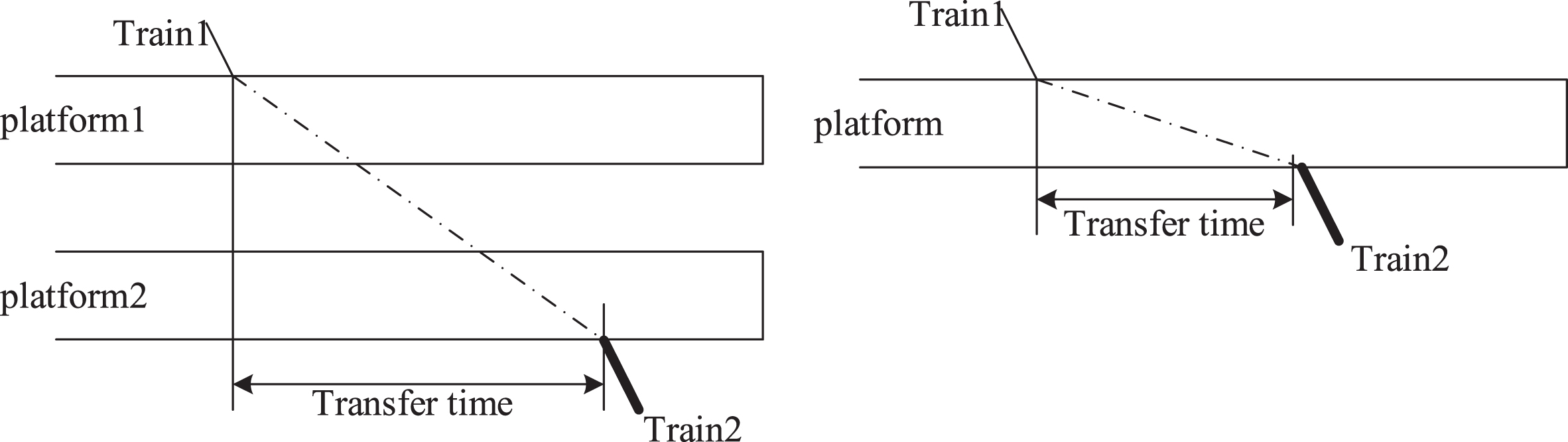
There are mainly three types of transfer routes in one station: transfer at the same platform, transfer at different platforms in the same yard, transfer between different yards. The necessary transfer time of each type of transfer route is different, among which transfer at the same platform spends the lest time, as Fig. 2 shows. Adjusting the platform plan for trains can make the transfer time match well with the arrival and departure time of two trains with a transfer relationship. However, in order to improve the station capacity, trains from different directions at the hub are usually allocated in the fixed station yard. Therefore, trains can only be adjusted in its fixed yard and should observe the principle of track allocation.
In addition, to reduce the scale of problem, we assume there is a transfer relationship between two trains, when passenger transfer flow reaches a certain amount between them. The function f (C) is introduced here. When passenger transfer flow between two trains is larger than constant value C0, the two trains have a prior transfer relationship. Otherwise, transfer relationship is optional.
Other than transfer relationship, there is connecting relationship between trains, which means that two trains at hub are allocated to the same rolling stock. These trains with connecting relationship should be assigned to the same track and enough stop time.
The timetable optimization of high-speed railway hub based on passenger transfer can be summarized as: in order to minimize total transfer waiting time, optimize the transfer scheme of existed hub timetable in use of time adjusting strategy and platform adjusting strategy.
Model hypothesis
In this paper, some hypothesis is given as follows: This paper only focuses on the optimization of the timetable of a single hub station, and does not solve the possible train conflicts at adjacent stations, which will be solved in next step. As high-speed hub is an station in important hierarchy, all the trains should stop. As the high-speed railway operates always in cycle-timetable, in order to simplify the model, this paper selects one cycle to research.
Parameter variable design
The variables and parameters involved in the model of this paper are shown in Table 1.
Variables and Parameters in the Model
Variables and Parameters in the Model
In order to minimize overall transfer waiting time, an objective function is defined as:
In the function,
In order to reduce train conflicts at other adjacent stations, the arrival and the departure time of transfer trains should be adjusted in the fuzzy time range as far as possible, so another objective function is defined as:
In the function,
The constraint analysis of the model is shown below:
1) Track occupation uniqueness
Equations (6) and (7) ensure that a train can only occupy one track at hub. Equation (8) ensures that the trains with connecting relationship arrives and departs on the same track. Equation (9) ensures no trains at the same track conflict with each other. Equations (10) and (11) ensure that a train can only route at hub.
2) Reasonable time range for adjusting
Equations (12) and (13) ensure that the departure time and the arrival time of the trains adjusted fall within the reasonable time range respectively. Equations (14-17) ensure that reasonable time range cannot lead to train conflicts at adjacent stations. Equations (18) and (19) ensure that the departure time and the arrival time of the trains adjusted belongs to one optimized period time respectively.
3) Necessary transfer time
Equation (20) ensures that the difference of the departure and the arrival time between two trains with transfer relationship is larger than necessary transfer time.
4) Train stop time
Equation (21) ensures that the difference of the departure and the arrival time of trains with connecting relationship is larger than train stop time standard.
5) Safety time interval between adjacent trains
Equation (22) ensures that there is enough safety time interval between two adjacent trains.
The optimization model of timetable on passenger transfer at high-speed railway hub established in this paper belongs to the nonlinear hybrid integer programming model with a 0-1 variable. However, considering this paper only selects a specific high-speed railway hub to analyze the feasibility of the transfer schedule optimization model and the overall scale of the model is limited, MATLAB software is used to develop integer programming algorithm to solve the model.
This paper selects Shanghai Hongqiao hub for the case study. As one of the largest high-speed railway hubs in China, Shanghai Hongqiao hub is connected to the Beijing-Shanghai High-speed Railway, Huhanrong fast railway, Shanghai-Kunming High-speed Railway, and Shanghai-Hangzhou-Ningbo High-speed Railway. There are two yards at Shanghai Hongqiao hub: one is called the high-speed railway yard and the other is called the mixed yard, and there are altogether 30 tracks and 16 platforms.
The timetable at Shanghai Hongqiao hub between 11:00 and 12:00 is obtained from the Internet, as shown in Table 2, the trains with connecting relationships too. Trains in Table 2, the IDs of which start with 0, are empty EMU coming and going to EMU depot for maintenance.
High-speed rail timetable of Shanghai Hongqiao Hub from 11:00 to 12:00
High-speed rail timetable of Shanghai Hongqiao Hub from 11:00 to 12:00
The relevant parameter values for the model calculation are shown in Table 3 below. In China, the buffer time is always set in the running time of trains between adjacent stations, so the reasonable time range [t2, t3] for every trains should be calculated one by one, while [t1, t4] is [11:00, 12:00].
Model parameter value
Firstly, according to (a) the arrival and departure order of trains, (b) the possible transfer direction of passenger flow at the hub, and (c) the principle that passengers only transfer to the earliest train in the same direction, the possible transfer relationship between trains of above timetable can be established. Then the transfer relationship between trains should be corrected by Equation (2) with actual transfer passenger flow. For example, the transfer flow from G1225 to G1375 is less than 20 persons, so the connection should be canceled. Table 4 shows the transfer relationship between trains at the hub, however, due to space limitations, only part of it is shown here. There are 48 reasonable transfer relationships between trains.
Transfer relationship between the departure and arrival trains at Shanghai Hongqiao Hub
According to the MATLAB solution results, some trains’ arrival time, departure time or track are adjusted to optimize the timetable of Shanghai Hongqiao hub between 11:00 and 12:00, as shown in Table 5.
The timetable of the trains adjusted after optimization
The model optimization results are now analyzed. The invalid transfer waiting time of passenger before and after optimization is shown in Table 6. The total reasonable transfer relationship between trains is 48, and the realizable is 37 (77.08%) before optimization as some trains cannot meet with necessary transfer time, while 48(100%) after optimization. The total invalid waiting time for transfer passengers before optimization is 541 min. After optimization, the total invalid waiting time for transfer passengers is 484 min, which is 10.53% optimized. The average invalid waiting time for every transfer before adjustment is 14.62 min. After optimization, the average invalid waiting time for transfer passengers is 10.08 min, which is 31.05% optimized.
Invalid transfer waiting time before and after optimization
The above analysis shows that the transfer timetable optimization model established in this paper can optimize the transfer scheme of timetable at high-speed railway hub to a certain extent, effectively reduce the passenger’s invalid waiting time during the transfer process, and improve the transfer efficiency.
The complex railway network makes the transfer an indispensable part of passenger travel. In order to increase the competitiveness of railway transportation, the railway enterprises can improve the transfer efficiency by optimizing the passenger transfer time. To reduce the complexity of problem, the transfer scheme of timetable at high-speed railway hub, as the most important node on network, is worth of research firstly.
This paper proposes time adjusting strategy and platform adjusting strategy to optimize the transfer scheme of timetable at hub, and in the first strategy, a fuzzy set of reasonable time range are introduced to reduce the possible train conflicts at adjacent stations on the network, and in the second strategy, different transfer time can be used to match the arrival and departure of trains. Then, an optimization model of timetable based on passenger transfer is established and be solved in use of the two strategies in MATLAB. Shanghai Hongqiao railway hub are used to verify the effectiveness. However, how to solve the possible train conflicts at adjacent stations on the network, and to optimize the transfer scheme of timetable at adjacent stations in lower hierarchy will be the next research direction.
Footnotes
Acknowledgments
This research was supported by the National Key R&D Program of China (2017YFB1200702), Service Science and Innovation Key Laboratory of Sichuan Province(KL1701), National Natural Science Foundation of China (Project No. 61703351, 71971182)), Sichuan Science and Technology Program (Project NO. 2018RZ0078, 2019JDR0211, 2018123), Science and Technology Plan of China Railway Corporation (Project No.: P2018T001, K2018X012, N2018X006-01), Chengdu Soft Science Research Project (2017-RK00-00369-ZF) and the Fundamental Research Funds for the Central Universities (2682017CX022, 2682017CX018).