



Abstract
Reversible Data Hiding (RDH) is a technique that is used to protect the secret by using digital cover media to hide it and to retrieve the cover after extracting the secret. The Reversible Data Hiding In an Encrypted Image (RDHIEI) protects the privacy of secret information and also the cover by hiding confidential information in a cipher image. Some of the algorithms in RDHIEI can extract the information if and only if the cipher image is already decrypted and some algorithms can decrypt the image if only if the data has already been extracted from the cipher image. In those algorithms, the extraction and decryption cannot be separated. But some applications like healthcare and army image processing require that image recovery and information extraction to be separate processes; this new technique is called Separable Reversible Data Hiding In an Encrypted Image (SRDHIEI). In this paper, a novel SRDHIEI is suggested with high payload and good quality decipher image by embedding information in a cipher image on two levels. In the first level data is embedded by the Least Significant Bit(LSB) substitution method and in the second level data is embedded by using Pixel Expansion (PE) method. For image confidentiality, the cover image is encrypted by using an additive homomorphism technique. The benefits of the proposed method is to transfer the cover image in an extremely secure manner with PSNR of 8.6813 dB, – 0.0077 correlation and 7.998 entropy. The average embedding capacity of the proposed method is 217579 bits, and the decrypted image PSNR is 29.5 dB. 100% restoration of the host image and 100% lossless secret information extraction can be achieved.
Introduction
With the fast growth and development of technological innovation in computer networks, the transmitting and exchange of data have become less complicated than before, which raise security issues. When information is transferred over the internet, it may be quickly exploited, illegitimately used or maliciously altered. Safeguarding that information has become a major issue now. Recently, in order to deal with these protection issues, many research studies have been performed. These studies are done in two aspects, i.e., cryptography and steganography.
In cryptography, a person can watch the information that is being transferred but cannot read it [1–6]. But in steganography, the information is hidden into an image, which cannot be noticed by a person [7–9].
In steganography after extracting the secret, the cover becomes useless due to the damage caused by data embedding. To overcome this problem, the Reversible Data Hiding (RDH) method is introduced. Reversible data hiding protects the secret, by hiding it into a digital media in a reversible manner. Being reversible, the secret information and digital cover media both can be renewed completely. Hence the RDH methods can be used in many applications, which need reversibility when actual consistency is required, e.g., for healthcare and army image processing. The various conventional RDH methods have been recommended for more than fifteen years.
Initially, RDH was developed for authentication purposes. The first RDH method has been proposed in the spatial domain [10], by using modulo addition. In [11] lossless compression is used, to create free space for data embedding. Both these methods [10, 11] can embed a small amount of data for authentication; thus, these methods are not suitable for many applications. Therefore the first high embedding capacity RDH method was introduced as explained in [12]. After that, there are various RDH methods which were developed for high embedding capacity. One of the most popular methods is Difference Expansion(DE) [13] in which the difference between adjacent pixels is doubled for data embedding.
Another attractive method is histogram shifting [14] in which the highest bin in the histogram is used for information hiding. In [15], to increase the embedding capacity of [14], the pixel difference histogram is used instead of pixel value histogram. In [16, 17] the information is embedded by splitting the image into several small non-overlapped blocks. In each block after information embedding, reversibility can be achieved by maintaining the order of the pixel value. All the above mentioned RDH methods can give security for the secret but not for cover because; the secrets are embedded in the plain image. But in some applications, the cloud service provider performs the embedding operation, in that circumstance giving plain cover to the third party makes it vulnerable.
The RDHIEI gives security for both cover and secrets. The first RDH in an encrypted image was introduced by Zhang [18], in which the three LSB of the encrypted pixels are flipped for information hiding. Finally, the image is recovered by the special correlation between the pixels. By using block smoothness and the spatial relationship of the adjacency block boundary the method introduced in [18] is improved in [19]. In both methods, the extracting bit error rate is high, and in order to reduce that error rate, the absolute mean difference of pixels and their neighbouring pixels are calculated for reversibility in [20]. The partially encrypted pixels are compressed by low-density parity-check code for secret embedding and partially encrypted pixels are unchanged to recover the cover image in [21]. In [18–21] the decryption and data extraction can be performed in the same place, but some applications may need the decryption and extraction process to be done separately, hence SRDHIEI is introduced.
The SRDHIEI is introduced in [22] by reserving room in an encrypted image. In which the LSB of the cipher image is compressed to make free space for information embedding. This means that information extraction and image decryption can be achieved separately without affecting each other. This reserving of the room after encryption reduces the deciphered image’s PSNR value. Hence to significantly improve the PSNR value, the room for embedding is reserved before encryption in [23].
The innovative methods [24, 25] for separable RDH in an encrypted domain are discovered by using additive homomorphism. Along with this additive homomorphism, the difference expansion method is used in [24] and pixel value ordering is used in [25]. The combination of integer wavelet transforms, histogram shifting and orthogonal decomposition are used in [26] for data hiding to increase the PSNR value of the decrypted image. However, the methods [22–26] are separable, the embedding capacity of those methods are very low, and image security is very less. Hence the novel separable RDH in an encrypted domain with two-level embedding is proposed by using additive homomorphism, and its significant contributions are given below The proposed method provides high security for an encrypted image with 8.6813 dB PSNR, – 0.0077 correlation and 7.998 entropy The average payload of the proposed method is 217579 bits, and the decrypted image average PSNR is 29.5 dB The secret data is retrieved without any error, and the cover image is recovered without any loss The proposed method achieves the real payload of 0.83 bpp where other existing schemes have only 0.5 bpp
This paper is arranged as follows. Section 2 presents the related works. Section 3 explains the proposed process, and section 4 describes the experimental results. Finally, this article concluded in section 5.
Related work
The image is encrypted by the image owner then the data hider compresses the LSB of the encrypted image to create the space for data embedding. At receiver side the secret can be easily extracted from the compressed image. Then image can be easily recovered by decompressing and decrypting the image.
In this method the space for data hiding is created before image encryption. Then the image is encrypted without affecting that free space. The data hider embeds the secret in the free space without affecting the cover image. Finally, the cover image and secret are recovered without affecting each other.
The image is encryted by the paillier encryption algorithm, then the secret data is embedded in an encryted image by using difference expansion method[13]. Paillier algorithm have addditve homomorphic property. The additive homomorphic encrytion allows the data hider to perform addition operation on encryted data(secret embedding). when decryting this encrypted data the result becomes the addition of plain data. Hence the image and secret can be recvored easily
Each pixel value in an image is encrypted by using additive homomorphism, then secret data is embedded by using Pixel Value Ordering(PVO). In PVO method the image is divided as several non-overlapping blocks for data embedding, If each block size is 2×2 then each block contains four pixels (C1, C2, C3, C4) and these four pixel values (Cσ(1), Cσ(2), Cσ(3), Cσ(4)) are sorted in ascending order (Cσ(1) ≤Cσ(2) ≤Cσ(3) ≤Cσ(4)). Then difference between first maximum and second maximum is calculated. This difference is used to embed the secret data. In [25] the same PVO is applied on encrypted image, because the image is encrypted by using additive homomorphism. Hence the addition operation on encrypted pixel (adding secret) is also reflected on plain image. So, the image can be recovered easily and secret can be retrieved separately.
Proposed – SRDHIEI method
The overview of the proposed method is shown in Fig. 1; it contains three phases in which the first and second phases are image encryption, data embedding respectively. The last step is data extraction and image recovery. The first phase preserves the confidentiality of an image by converting the original image into unreadable cipher image. The second phase maintains the secrecy of the secret by hiding the secret data into a cipher image. The last step restores the cipher image by extracting the confidential data from it and recovers the original image by decrypting the cipher image.
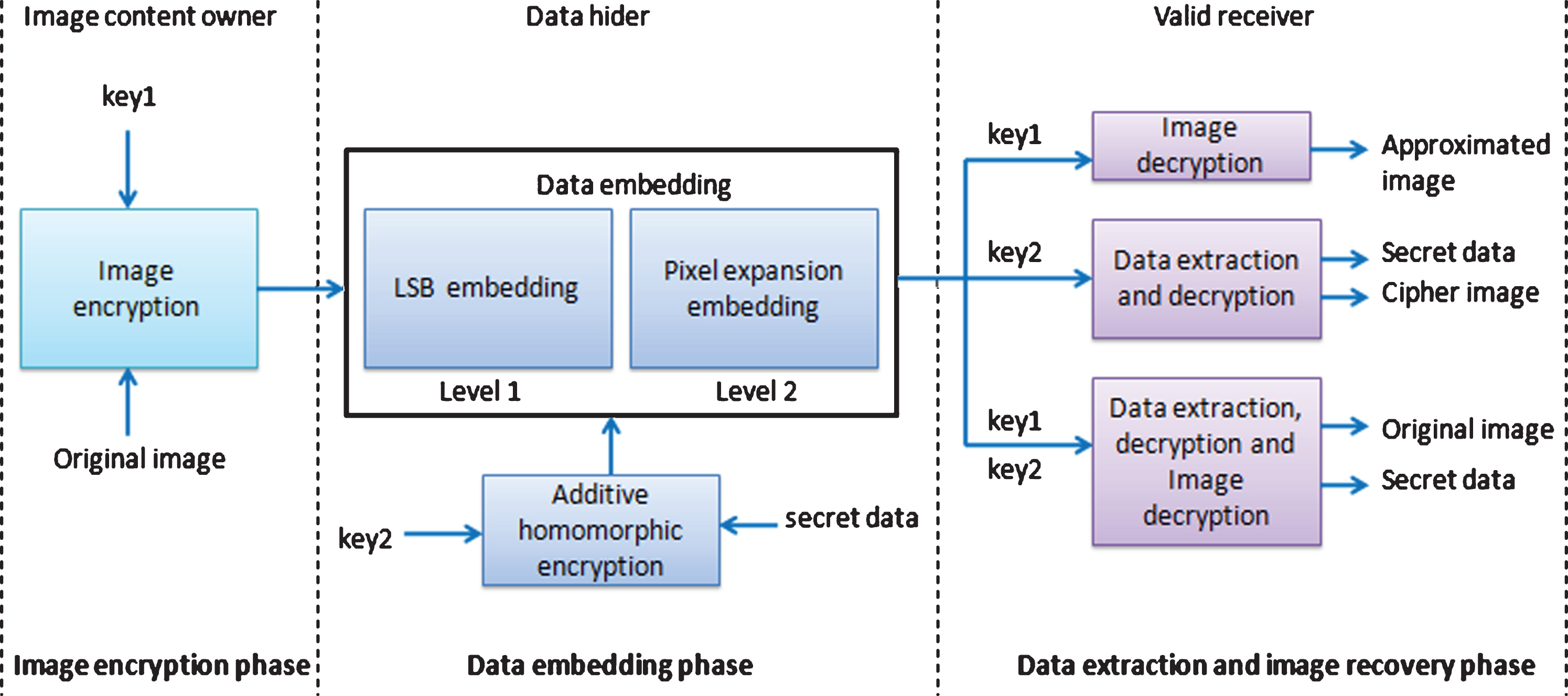
The overview of the proposed method.
Image encryption is implemented on two levels. In the first level, the image is divided into several non-overlapping 3×3 blocks. In each block, the pixel positions are numbered as the following manner.
For first level encryption, the sender and receiver will randomly choose their private key ‘r’ and ‘d’ respectively, and they are computing their public key by using the random key ‘e1’ as shown in Equations (1) and (2). The pixels in each block are encrypted by using Equation (3), and then the random number(R) is generated for each block, it is encrypted by using Equation (4), then these encrypted pixels and the encrypted random number are added to get additive homomorphic cipher image(C1). The additive homomorphic encryption for a single block is shown in Fig. 2.
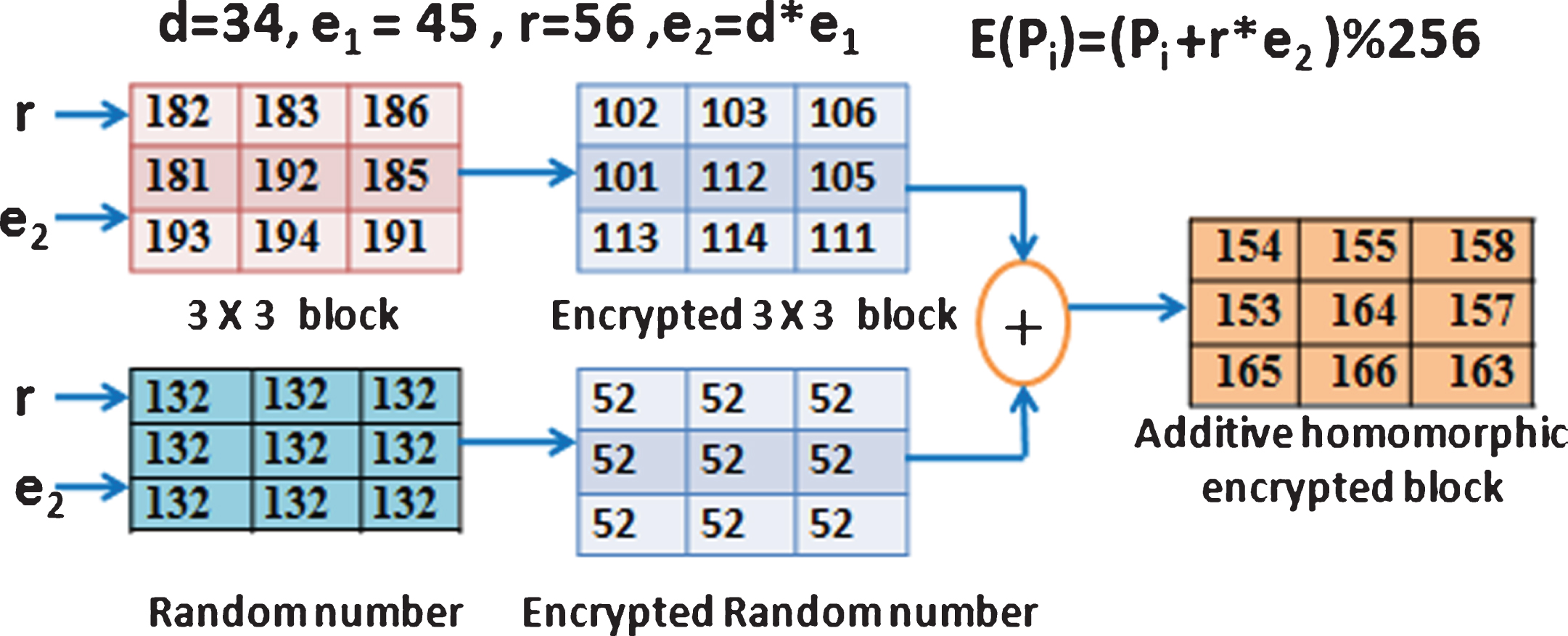
Additive homomorphic encryption.
In Fig. 2. the pixels in a block are encrypted by using Equation (3). For example the pixel value 182 is encrypted as (182 + 56*1530)% 256 and resultant encrypted pixel value is 102. For each block one random number is gerated and that random number is encryted in the same way. Finally the encrypted pixel and encrypted random number are added to get the final encryted pixel. The 8-bit random number is vary for each block, hence brute force attack will be complex for intruders.
For the second level encryption, the first level encrypted pixels (C1i) of each block is subtracted from the centre pixel as shown in Equation (6). Except for centre pixel, the other pixels are paired as (1, 2) (3, 6) (9, 8) (7, 4) as shown in Fig. 3.
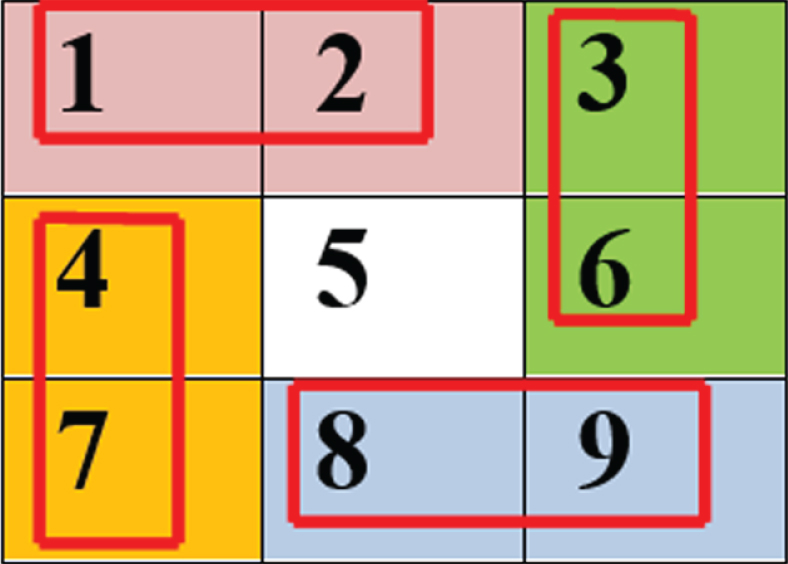
Pixel pair.
Then the second level cipher image C2 is created by using Equations (7)), (8) and (9) and it is shown in Fig. 4.

Second level encryption.
The Data embedding phase embeds the 12 bits (b1b2b3 ... b12) in each block by embedding the secrets on two levels. The first level is simple LSB substitution. In which secret bit is added with the second pixel of every pair in a block, as shown in Equation (11). In the second level embedding, the remaining 8 bits are embedded by expanding the pixel values in a block by using Equation (12). The embedding the secret bits on an image is shown in Fig. 5 and the overall image encryption and secret embedding is shown in Fig. 6.
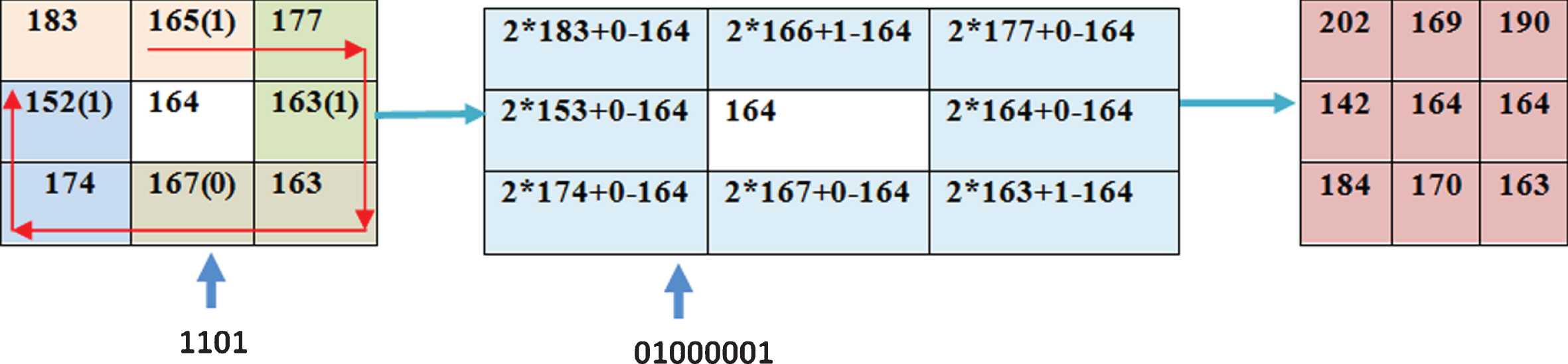
Secret embedding.
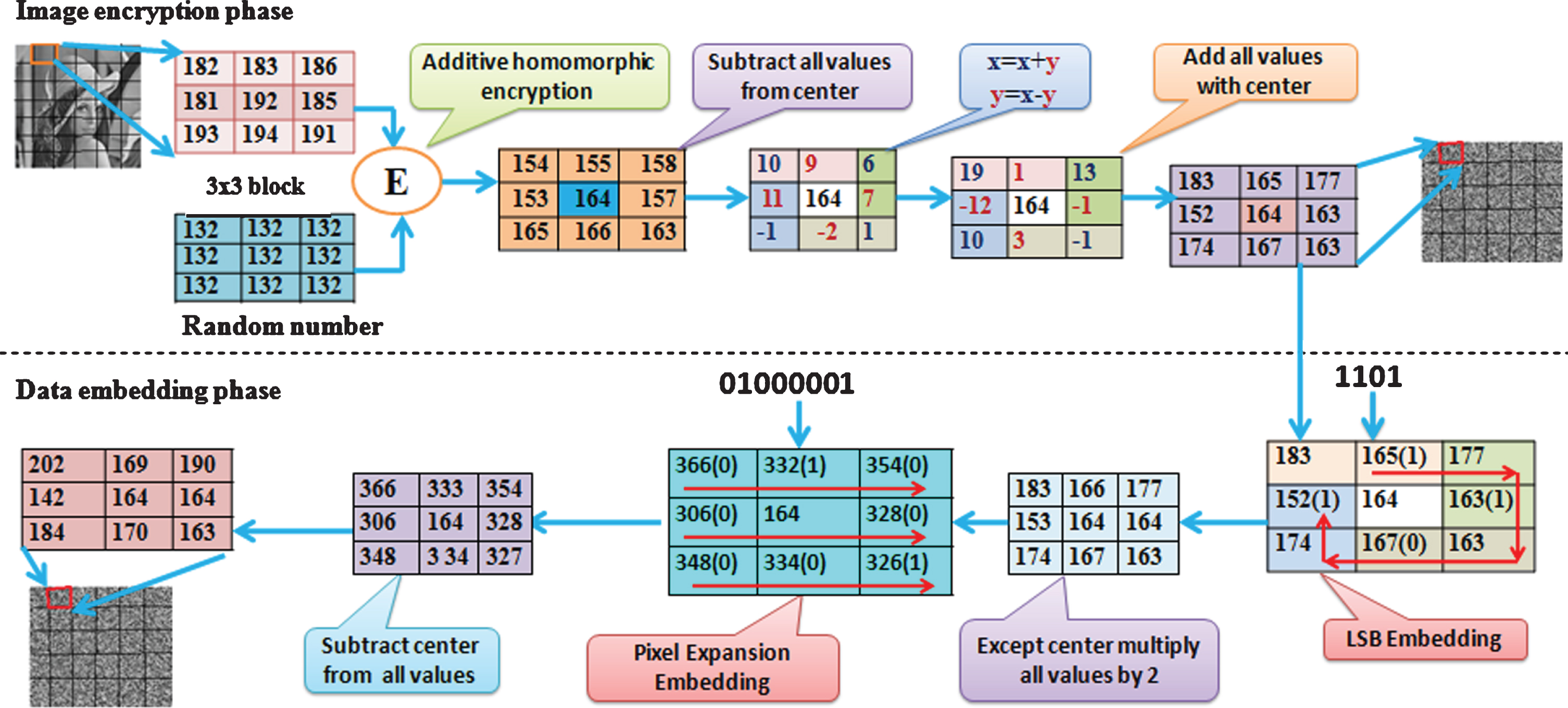
Image encryption and data embedding phase.
In each block, the secret bits b5 to b12 are extracted first. For extracting those bits, the center pixel value is added with all the pixel value of a block as shown in Equation (13), then these bits are extracted by using Equation (14). After obtaining the secret bits, b5 to b12 the pixel value is changed by using Equation (15). Then the secret bits b1 to b4 are extracted, and level2 cipher image is generated by Equations (16) and (17) respectively. The secret bits extaction process is shown in Figs. 7 and 8 then the reultant secret extracted image is shown in Fig. 9.
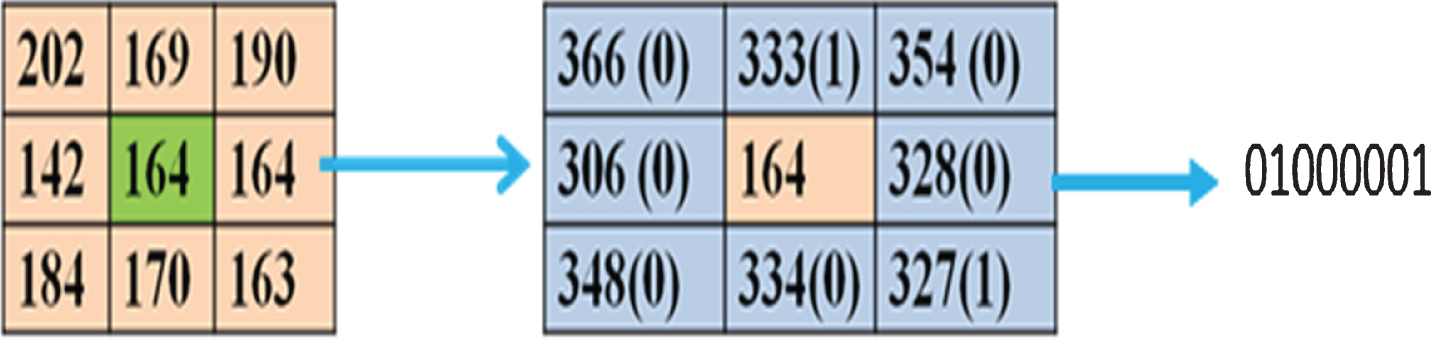
Bits b5 to b12 extraction.
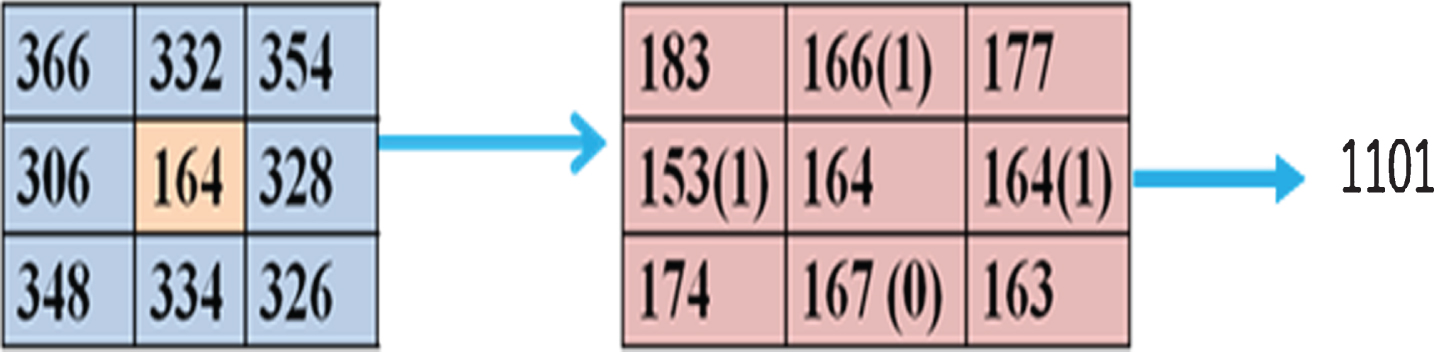
Bits b1 to b4 extraction.
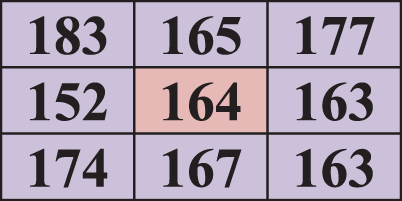
Secret extracted image.
In the decryption phase, each block is decrypted by using Equations (18) (19) and (20) to get the first level cipher block, it shown in Fig. 10. Each pixel value of the first level cipher block is decrypted by using additive homomorphism and it is shown in Equation (21), (22). The additive homomorphic decryption for a single block is shown in Fig. 11; the overall secret extraction and image recovery phase is shown in Fig. 12.

First level decryption.

Additive homomorphic decryption.

Secret extraction and image recovery.
The encryption strength, embedding capacity and image quality of the proposed method are tested with several standard grayscale images. The results are discussed here for six grayscale images with size 512×512 as shown in Fig. 13.

Tested images.
After encryption the encrypted images are entirely unreadable form as shown in Fig. 14, getting the original image from this unreadable one is very difficult. The proposed method’s PSNR, SSIM correlation and entropy values of the encrypted image are shown in Table 1. The PSNR, SSIM and correlation values are very less, and the entropy values are very high, these values show that retrieving original image from an encrypted image is very hard.

Encrypted images.
The PSNR, SSIM, correlation coefficient and entropy of the encrypted images
Figs. 15 and 16 show the histogram of the cover images and encrypted images respectively. The histograms of the encrypted images are uniformly distributed. Hence the proposed method can resist statistical attacks.

Histograms of the test images.

Histograms of the encrypted images.
In the proposed method, the embedding process is done in two levels in each block. In the first level, 4 bits are embedded, and in the second level, 8 bits are embedded which means a total of 12 bits can be embedded in each block. Therefore the actual embedding capacity is 1.3 bpp, but some blocks are not used for embedding, because after embedding some pixels may go out of bound, if we subtract those pixels, the average payload of the proposed method is 1.03 bpp. The unused pixels are identified by the location map, and the average location map size of the proposed method is 0.2 bpp. Finally, the real payload of the proposed method is 0.83 bpp. The embedding capacity of the six tested images is shown in Table 2.
PSNR SSIM and correlation coefficient of the encrypted images, embedding capacity of the proposed method
PSNR SSIM and correlation coefficient of the encrypted images, embedding capacity of the proposed method
Decrypting the cipher image with the secret gives the approximated original image. For the six tested images, the corresponding decrypted images PSNR, SSIM and correlation coefficient are shown in Table 2. For the maximum payload 0.83 bpp, the average PNSR, SSIM and correlation coefficient are 29.5 dB, 0.90, and 0.986 respectively. These values reveal that the decrypted image quality is very high.
Discussion about the results and its performance comparison with existing schemes
The decrypted image PSNR value of the proposed and three existing methods are shown in Fig. 17. The proposed method’s PSNR value is high when compared to all the other three methods. It reveals the proposed method’s decrypted image quality is better than those methods. The maximum payload of all those methods is by average 0.5 bpp, but for the proposed method it is 0.83 bpp. The proposed method has an average PSNR value of the encrypted image as 8.6813 dB, correlation as – 0.0077 and entropy as 7.998. PSNR, the Correlation coefficient is very less, and the entropy value is very high when compared to the existing methods. These values show that getting the original image information from an encrypted image is very tough.

PSNR value of the decrypted images for various payload.
The reversible data hiding in an encrypted image (RDHEI) method is proposed in this paper by using additive homomorphic encryption. It contains three phases, the first phase is image encryption, the second phase is data hiding, and the third phase is image recovery and data extraction. These three phases have been implemented in different places. In this method, the information hider embeds the secret in cipher image with zero knowledge of the cover image. The mean PSNR value of the encrypted image is 8.6813 dB, the correlation value of the encrypted image is – 0.0077 which is very closer to zero, the entropy value is 7.998 which is very closer to 8, and the histogram of the encrypted images are uniformly distributed. These results prove that the statistical attack on the encrypted image is challenging. Hence this proposed method can give good security for the original image. The proposed method can restore the cover image without any loss and this method can also retrieve the secret data with zero error. This method yields a high embedding capacity of 217579 bits as well.