



Abstract
The computer system represents data in various format viz (i) Audio, (ii) Video, (iii) Text, (iv) Message, and (v) Image format. There are many ways through which, data can be easily transferred. The process of transferring digital bank cheque image is done with the help of cheque truncation system. It transfers cheque from home branch to clearing bank branch for faster clearance of customer cheque. This helps the banking system to keep transparency of transaction. During the flow of digital bank cheque image, there may be possibility of various attacks like, Cropping, JPEG compression, Median filtering, Gaussian Blur noise, Rotation, Salt & Pepper noise, etc. This arise the issues of copyright protection and security for digital bank cheque image. In this research work, The Combination of Digital Image Watermarking Using Neural Network and Advanced Encryption and Decryption Technique is Used for Providing Copyright Protection & Security Technique to Digital Bank Cheque Image.
Introduction
This Digital technology services are classified on the basis of various types of circuits. Such as dedicated & switched circuits [1–3]. There are many types’ digital data which are transfer from source to destination based on these circuits. Digital signal has to maintain constant frequency transferring the data. There are different formats used to represent data viz. (i) image, (ii), text, (iii) audio, (iv) video, (v) numbers, (vi) different special case characters, etc. During transmission of these data, the encoding procedure is carried out to transfer over a channel. There are many users who are connected to channel for accessing the data and transferring data. To maintain the security for data, there is need of encryption and decryption techniques.
Recently, many banks are providing online services to the customer at minimum charges. However, the payments through cheques provided by bank don’t apply any charges to the bank customer. The bank cheques are cleared using cheque truncation of the system, which avoids the physical work of the employee [4]. This raised the issue of digital security of bank cheque. The security and safe transmission of digital of bank cheque can be done by proving service like encryption and decryption techniques. Similarly, the authentication and copyright protection service to bank cheque can be provided by using digital image watermarking. In this research, 256 bits key AES technique is used for encryption and decryption and neural network is used for digital bank cheque image watermarking. By using these two techniques, one can provide strong security, copyright protection and authorization to digital bank cheque image. The performance and analysis of this research can be done by implementing attack like salt & pepper noise, rotation by 45°, Gaussian blur, median filter, cropping, JPEG compression and normal mode attack [5–12].
Literature survey
The digital image watermarking technique was proposed and invented in December 1992 by “Andrew Tirkel and Charles Osborne”. The first successful experiment was carried out in 1993 by demonstrating the working principle of watermark insertion and extraction. The first watermark used by “Andrew Tirkel, Gerad Rankin and Charles Osborne” was Steganogrphic spread spectrum watermark. The spatial domain digital watermarking technique is found to be incompetent to common image processing attacks. The digital watermark can be easily destroyed by applying attacks on spatial domain digital watermarked image, as it is not found to be robust against various attacks and noise [1]. Due to above reasons, many researchers have focused on transform domain digital image watermarking techniques. B. Surekha et al. [2], proposed image watermarking technique in spatial domain using public watermark scheme. I. Pitas et al. [3] proposed DCT image watermarking is carried out on gray scale image using the properties of DCT and it embeds the watermark bits in selected block of DCT transform image. Emjima M. et al. [4] proposed frequency domain watermarking technique and its evaluation and performance was carried out by using various parameter like PSNR, MSE, robustness of watermark and processing time required for the Saeid Saryazdi et al. [5], explained invisible DCT image watermarking scheme, in which gray scale watermark bits were used for embedding and extraction using AC coefficient and DC coefficient of DCT image. Ingemar J.Cox et al. [6], explains the working principle of the digital image watermarking technique. Ingemar J.Cox et al. [7], proposed a robust and secured digital image watermarking scheme is proposed for gray scale image using DCT and DFT with help of spread spectrum technique. gray scale image watermarking. W.Lu et al. [8], proposed watermarking scheme based on the features of host image and watermark template used for matching techniques. Tsai M. and H. Hung et al. [9], the sub sampling technique is applied on host image and further watermark is embedded using DCT and DWT technique. Jiansheng et al. [10], proposed the robust image watermarking scheme based on HVS by implementing using DCT and DWT techniques. The methods proposed by Mei Jiansheng and A.V. Subramanayam et al. [10, 11], is found robust against the non-malicious attacks, but fails against rotation attack. Navnidhi Chaturvedi et al. [11], proposed the control of watermark bits during embedding and extraction process and its payload. It also explains the combined DWT-SVD provides better robustness as compared to that of the DCT-SVD, DFT-SVD and DWT-Arnold schemes [12].
Many researchers also worked on the simple encryption of image for providing security using various encryption algorithms. Due to large data, sharing and presentation of information can be easily done through images. Kai-Hui Lee et al. [13], explained the secure sharing of digital image through media. Rinaldi Munir et al. [14], proposed an asymmetric digital image watermarking along with RC4- permutation and chaotic maps is proposed for the security of digital image and robustness of digital watermark against non-malicious attacks. Darshana Mistry et al. [15], proposed the comparative study of digital image watermarking techniques using Least Significant bits and frequency domain technique using DCT, and DWT image watermarking for still image. Shilpa P.Metkar et al. in [16], proposed novel technique using the combination of watermarking using rational dither modulation technique along with AES technique using 128 bits. However, it is seen that many researcher has also worked on the combination of watermarking and encryption along with Soft computing techniques viz. (i) Neural Network, (ii) Fuzzy Logic, and (iii) Artificial intelligence techniques [17–23]. F.Prez-Gonzalez et al. [24], proposed data hiding technique against scaling attack using rational dither modulation technique. To enhance the security and copyright protection, the visual cryptography algorithms were used along with digital image watermarking.
Process of digital image watermarking
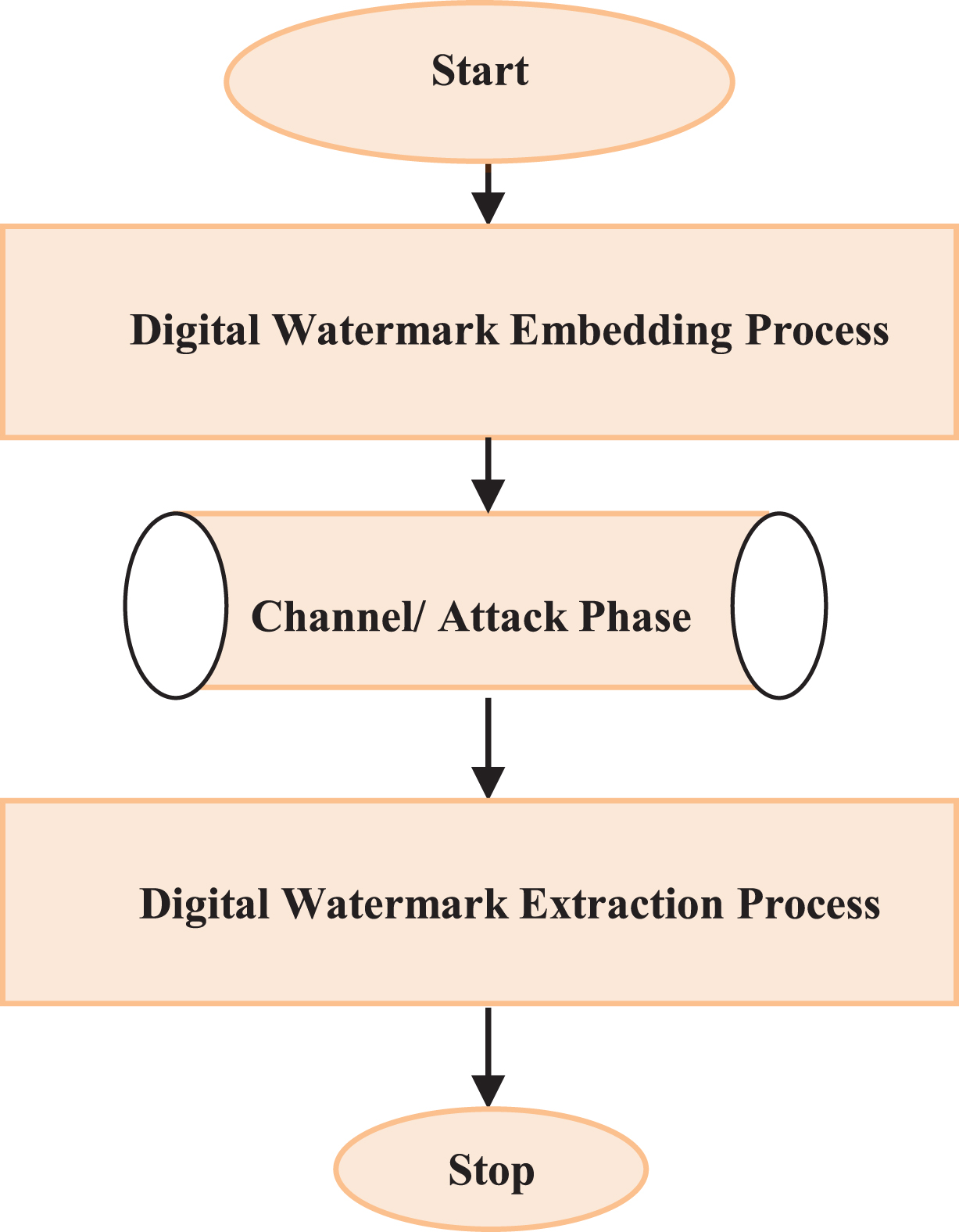
The digital image watermarking process is classified on the basis of data. For this process there are different types of watermark used viz. (i) Visible watermark, (ii) Fragile watermark, (iii) Invisible watermark, (iv) Private watermark, (v)Public watermark, etc. Following Fig. 1 shows the flow and working of Digital watermarking process. The watermarking process can be carried out, based on spatial domain techniques, frequency domain techniques, and various computational intelligence techniques. There are different types of transforms used by many researchers viz. (i) DCT, (ii) DWT, (iii) SVD, and their combination [3–13]. In this research work, one technique from computational intelligence i.e. neural network is used for digital image watermarking of bank cheque. There are different types of neural network. Such as, feedback neural network, back-propagation neural network, feed forward neural network, adaptive neural network, etc. In this work, Back-propagation neural network using Levenberg-Marquardt function implemented [14–17].
Digital image watermarking process.
The model of learning process of multi-layer neural network employing back propagation algorithm using Levenberg Marquardt function is shown in Fig. 2 (a) and (b). To explain the working of this process, the three layer neural network with two inputs and one output, is used. To train the neural network, it requires training data set. The training data set consists of input signals (x1 and x2) assigned with corresponding target (desired output) z. The network training is an iterative process. In each iteration weights coefficients of nodes are modified using new data from training data set [3–20]. Each training step starts with forcing both input signals from training set. After this stage, the output signals values for each neuron in each network layer can be determined. In the next step the output signal of the network y is compared with the desired output value (the target), which is found in training data set. The difference is called error signal d of output layer neuron shown in Fig. 3.
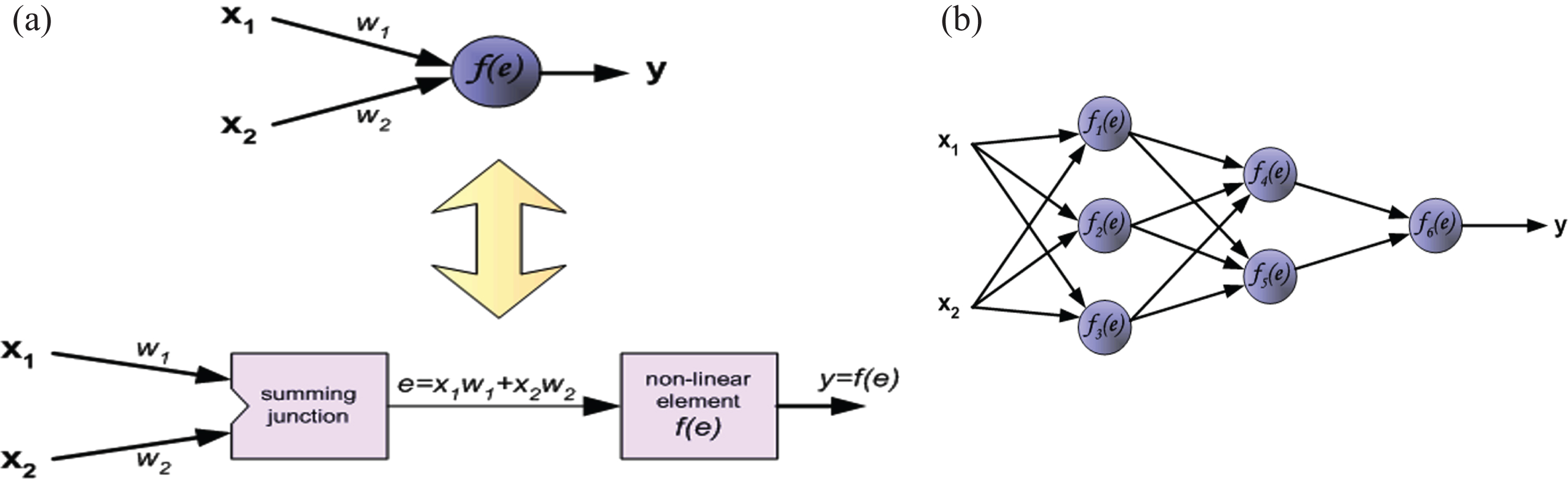
Learning process of multi-layer BPNN Levenberg Marquardt function. (b) Learning process of multi-layer BPNN Levenberg Marquardt function.
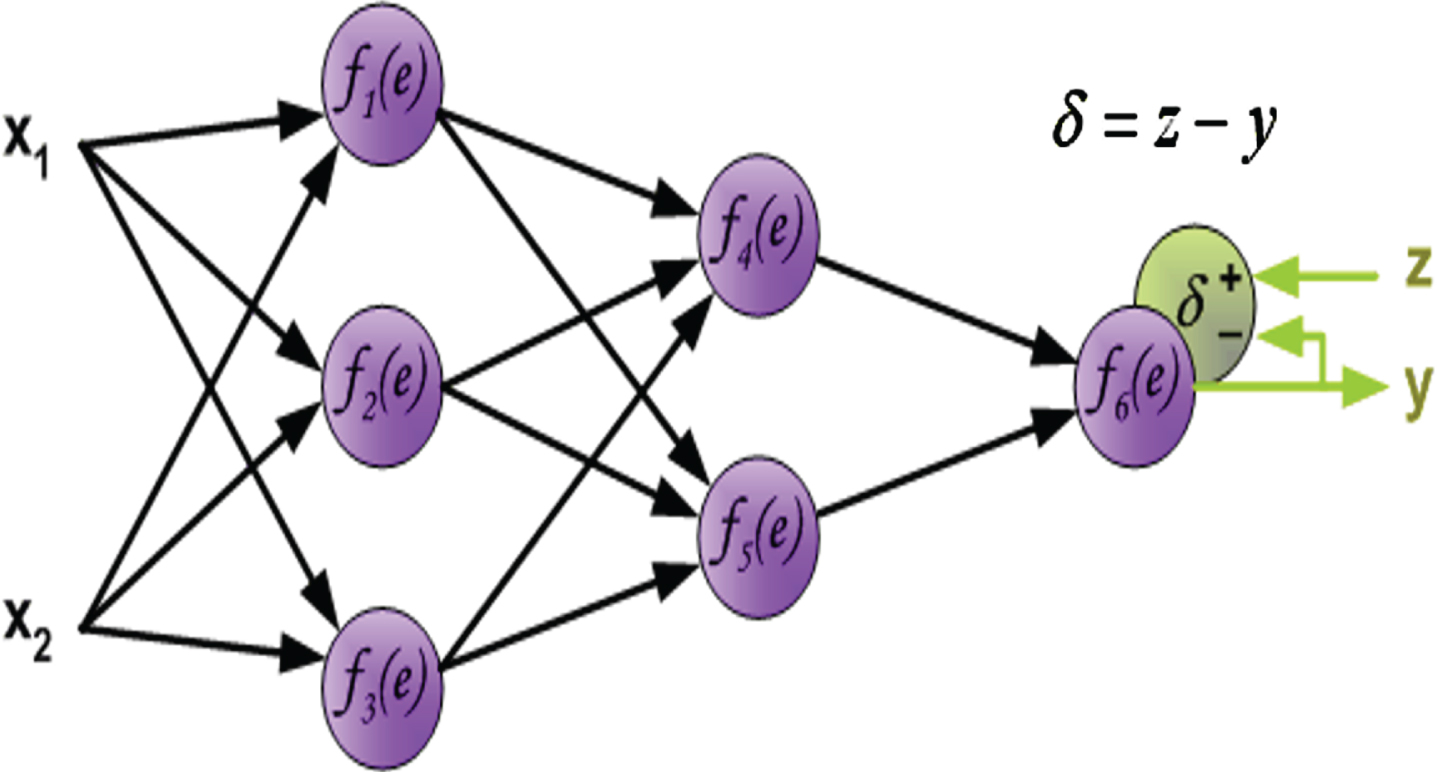
Signals propagated from output to inputs.
Encryption and decryption techniques faciliates services viz. (i) Integrity, (ii) Security, (iii) Authenticity, (iv) Confidentiality, (v) Message verification and safety, etc., against various active and passive attacks occurs on data intentionally and non-intentionally[5–20]. There are many encryption and decryption algorithms used by researcher in their experiment. Such as, DES, AES, MD5, MD6, Blowfish, Triple DES, Elliptical curve, etc. However, in this research work, an AES technique is used for encryption of digital watermarked image. These combinations of Neural network image watermarking and AES technique using 256 bits key is discussed in this research work. This research is divided into two main algorithms as explained in Section 3 and 4.
Watermark embedding algorithm
The flowchart shown in Fig. 4 explains combined neural network image watermark embedding and 256 bits key AES encryption algorithm. The steps of executions are:- Read bank cheque image. The blue color plane of bank cheque image is extracted. After extraction process, image is divided into 8×8 blocks for performing Haar DWT on it. The watermark logo image is read for creating its formation in vector form of zero’s & one’s. The two different PN_Sequence of 0’s & 1’s are created using gain factor. These PN_Sequence is trained using multi-layer BPNN Levenberg Marquardt function. The watermark embedding process is carried out using neural network on Haar DWT bank cheque image to obtained watermarked cheque image. AES technique is applied on watermarked cheque image using 256 bit key. Finally, combined neural network watermarked and encrypted cheque image is obtained.
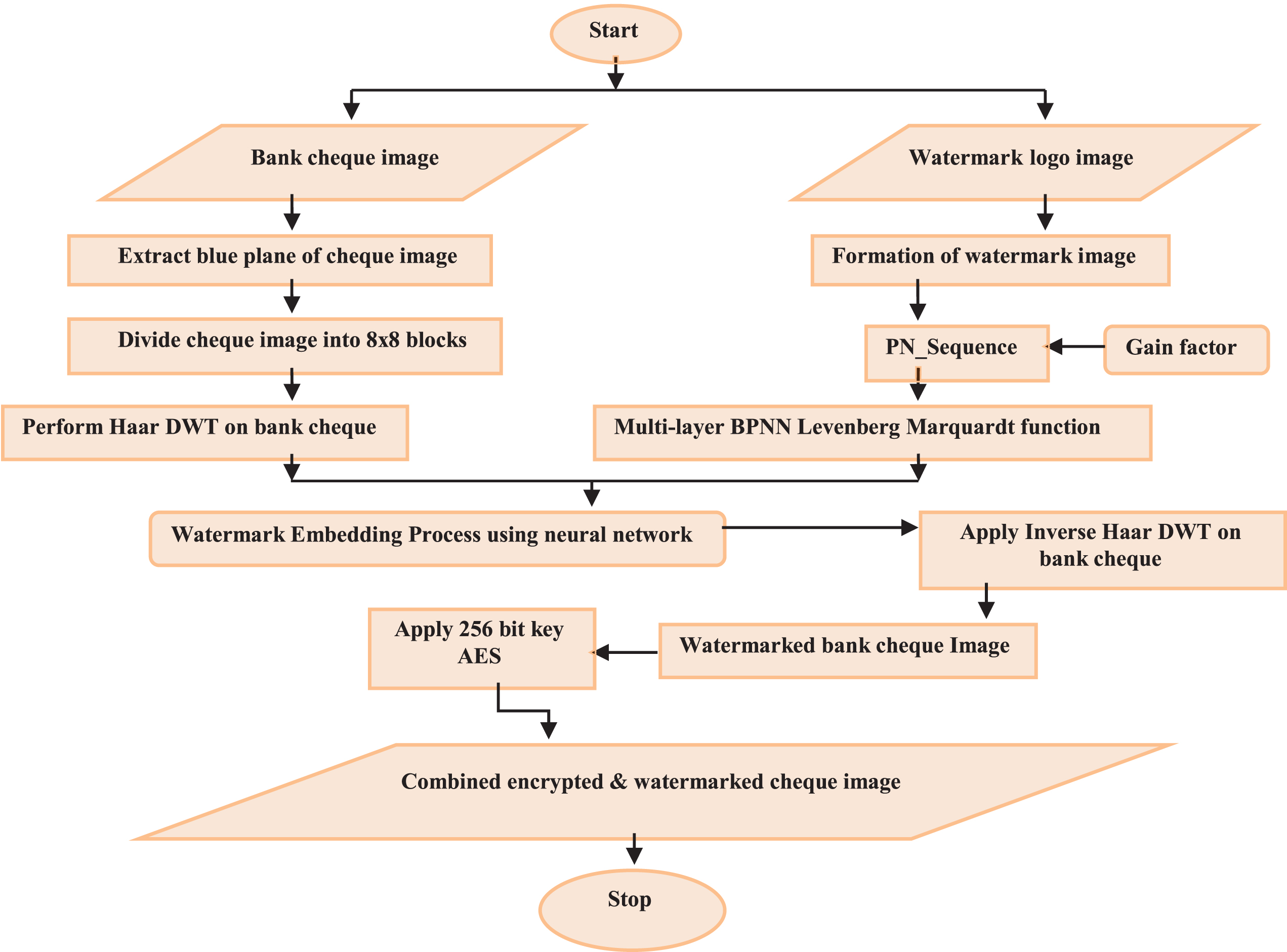
Neural network watermarking embedding & encryption process.
The flowchart shown in Fig. 5 explains combined neural network image watermark extraction and 256 bits key AES decryption algorithm. The steps of executions are:- Read, received combined watermarked and encrypted cheque image. Perform 256 bit key AES decryption process on received cheque image. Apply Haar DWT on it. Generate two different PN_Sequence PN_0 & PN_1, from same pixel seed of watermark image used for embedding. Training task is performed on both PN_ sequence, as an input to back propagation neural network, using Multi-layer BPNN Levenberg Marquardt function for comparison of coefficient task is perform. Inverse Haar DWT is applied. The watermark extraction process is carried out using Multi-layer BPNN Levenberg Marquardt function on Inverse Haar DWT bank cheque image. Thus, extracted watermark & cheque image is obtained.
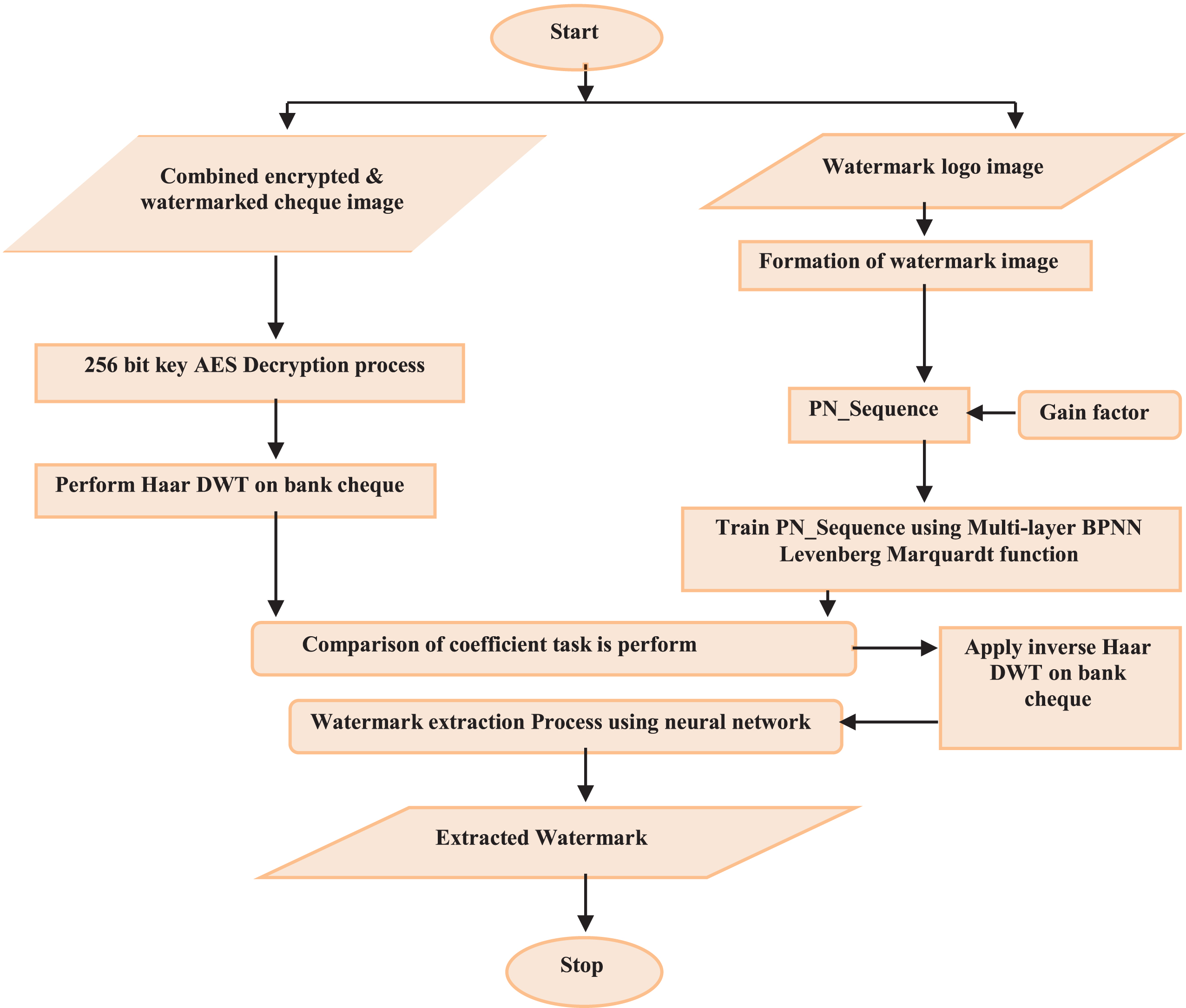
Neural network watermark extraction & decryption process.
There are different parameters are being consider to evaluate the performance of research viz. (i) Time, (ii) PSNR values, (iii) MSE and, (iv) NCC values. The Table 1 shows the time taken for embedding process of digital watermark in bank cheque, time required for encryption and decryption process of digital bank using 256 bits key AES technique. It also explains the time complexity required for complete process by calculating elapsed time in seconds.
Time taken by embedding, encryption, decryption, and extraction process against various attacks
Time taken by embedding, encryption, decryption, and extraction process against various attacks
From the graph shown in Fig. 6, it is observed that the time taken for watermark embedding is very high as compared to that of extraction time. It also explains the encryption time is high as that of decryption time.
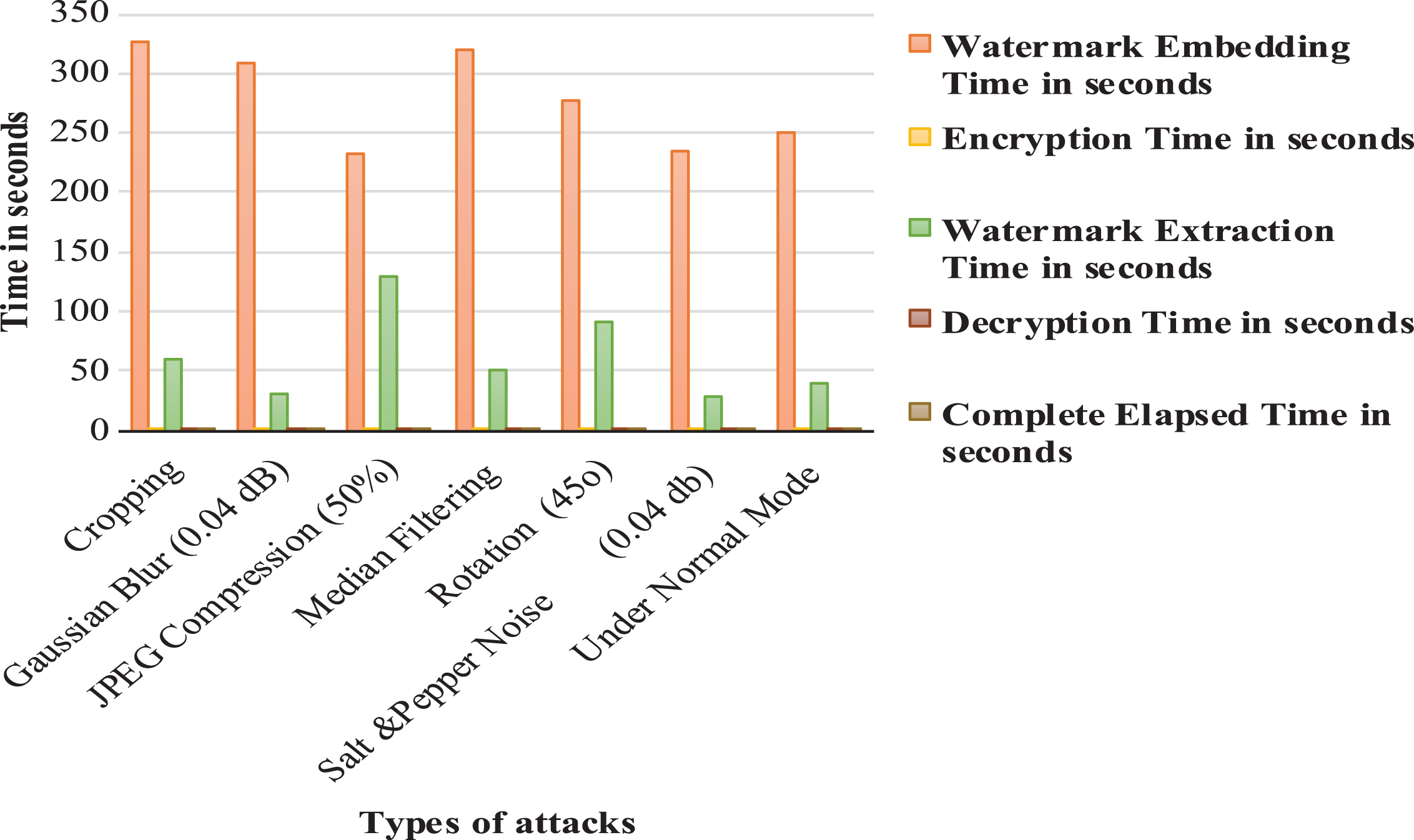
Graphical representation for time taken against different attacks.
Table 2. Shows the PSNR, MSE, and NCC i.e. normalized cross correlation coefficient value calculated against various attacks considered in this research work.
PSNR value, MSE values and NCC values images against various attacks
From Fig. 7 it is observed that the MSE value is very low after decryption and extraction of watermark as compared to that of MSE value of watermarked image. The graph also explains PSNR values are found around 63 dB to 63.50 dB against attacks except cropping attack. The MSE value is found 0.307 dB same against all attacks except cropping & Gaussian attack.
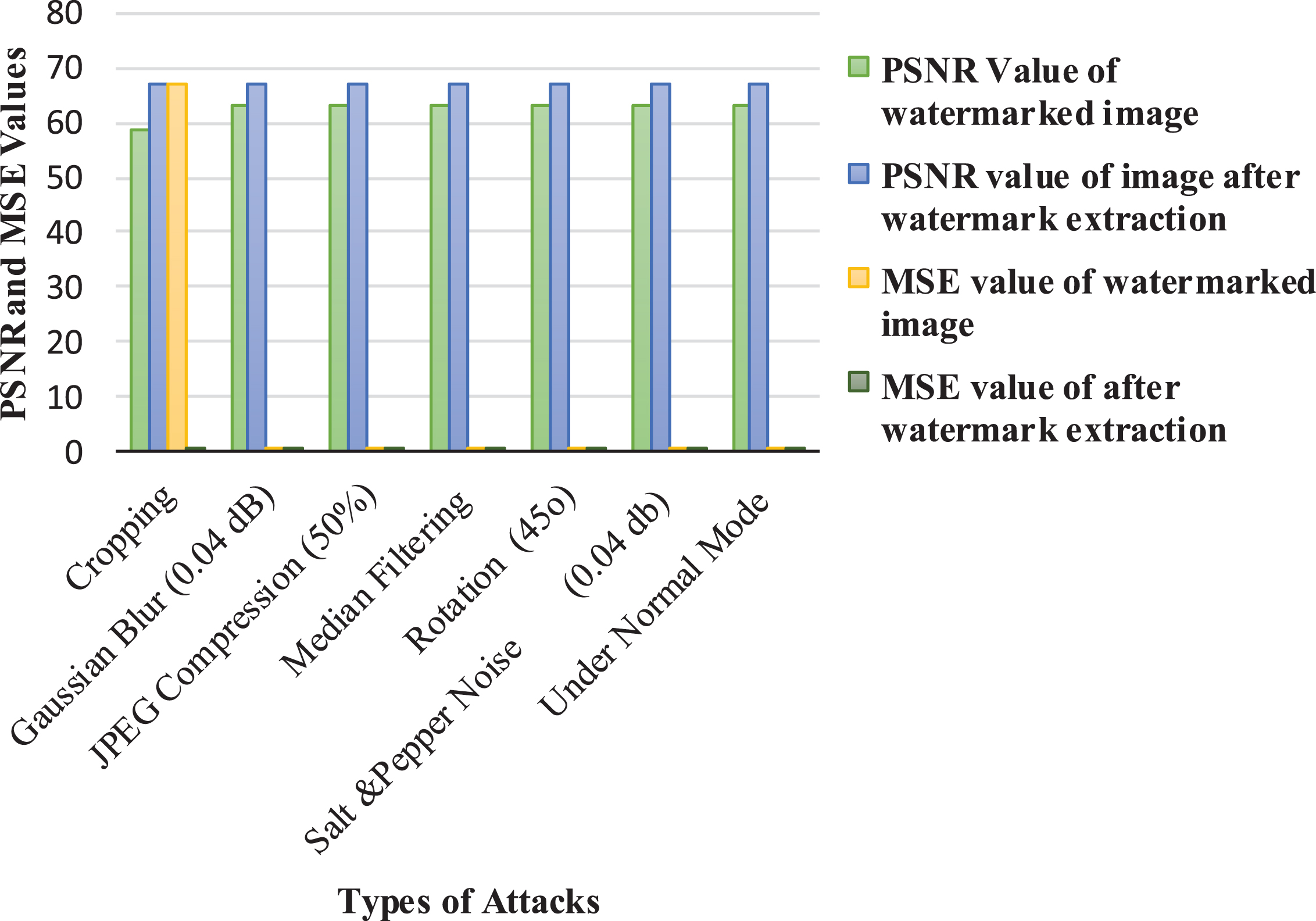
Graphical representation for PSNR & MSE values against different attacks.
The PSNR value of watermarked bank cheque image is low as compared to the PSNR value of after watermark extraction. However, it is also found that the MSE of image is same after decryption & extraction of digital watermark. The robustness of the watermark after watermarking and AES encryption is found better against cropping, JPEG and under normal mode attack.
However, the robustness is degraded against the rotation attack applied for 45°. The quality of watermark after digital watermarking and AES encryption and decryption is maintained around 96% to 99% except against rotation attack.
The NCC value of the watermark after decryption of digital bank image and extraction process is found around 96% against all attacks considered in this research work. The Fig. 8 shows the graphical representation of robustness value of digital watermark after watermarking and encryption as well as after decryption and extraction of watermark.
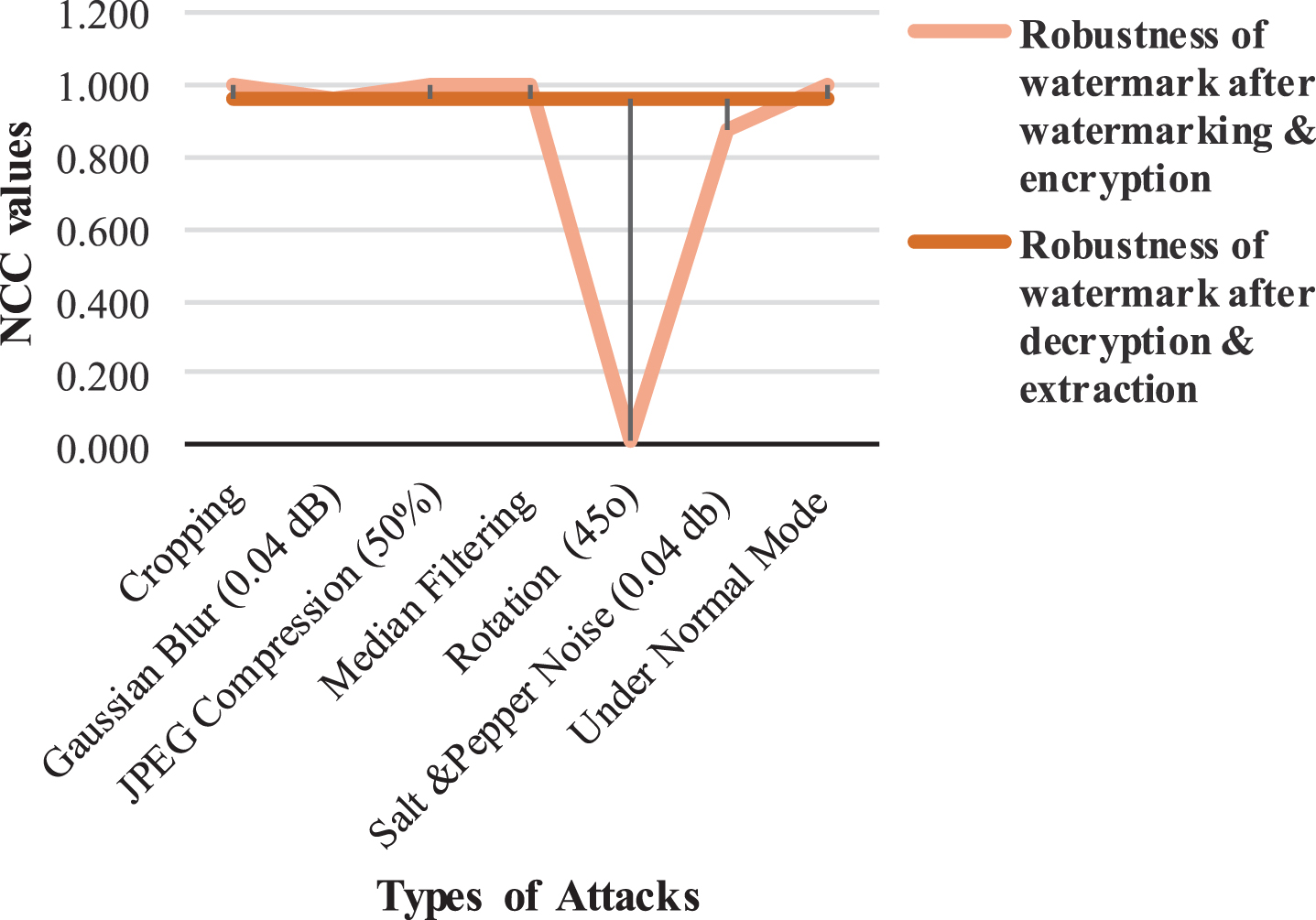
Graphical representation for Robustness i.e. NCC values against different attacks.
The resultant image on which operation were carried out are shown below:-
The Fig. 9. Shows the original image having dimension of 512×512 consist of 96dpi resolution for vertical and horizontal axis. The digital bank cheque image have 24 bit depth.

Original Bank Image.
Figure 10 shows the watermark image used for embedding the watermark in digital bank image. The size of image is 12.3 kb having 512×512 dimension with 96dpi resolution for vertical and horizontal axis with 24 bit depth. The digital watermarking embedding process with the help of Back-propagation neural network using Levenberg-Marquardt function is implemented on Fig. 9 by using watermark image shown in Fig. 10. The resultant watermarked image is shown in Fig. 11.

Original watermark image.

BPNN watermarked bank cheque image.
From Figure shown in Fig. 11, it is observed that the color quality is totally degraded as compared to original image shown in Fig. 9. But, the content present on the cheque image is visible like signature, amount in figure & words, etc.
Figure 12 shows combined BPNN watermarked and encrypted bank cheque image obtained after performing watermarking and AES encryption algorithm using 256 bits. Different types of attacks viz. (i) Cropping attack, (ii)Gaussian attack, (iii) JPEG compression attack, (iv) Median filtering attack, (v) Rotation attack with 45°, (vi) Salt & Pepper noise attack and (vii) Under normal mode attack are applied on Fig. 12 and AES decryption process and extraction of watermark process is carried out to obtain extracted watermark against these attack. The extracted watermark images against these attacks are shown in Fig. 13.

Combined BPNN watermarked and Encrypted bank cheque image.

(a) Extracted watermarks obtained against cropping attack.

(b) Extracted watermarks obtained against Gaussian blur attack.

(c) Extracted watermarks obtained against JPEG compression attack.

(d) Extracted watermarks obtained against Median filtering attack.

(e) Extracted watermarks obtained against Rotation 45° attack.

(f) Extracted watermarks obtained against Salt & Pepper noise attack.

(g) Extracted watermarks obtained against under normal mode attack.
In this research work, the combined digital image watermarking and AES encryption & decryption is explained. The BPNN using Levenberg Marquardt function is used for digital bank cheque image watermarking and 256 bits key AES technique is applied for encryption and decryption of bank watermarked image. From this research, it is observed that the rotation attack degrades the quality of watermarked & encrypted bank cheque image. However, the results shows that the watermark reconstructed up to 96% after extraction against rotation attack. The quality of watermarked bank cheque image is degraded using BPNN and AES technique. The MSE value is very less after extraction of watermark as compared to MSE value of watermarked image. This method provides the copyright protection, robustness and security to watermark and digital bank cheque image.