



Abstract
Moth-Flame optimization is a meta-heuristic algorithm based on the navigation behaviour of moths. Generally, moth’s poses a very effective mechanism called transverse orientation while moving a long distance in night and maintain of fixed angle with respect to the moon. MFO suffers with local optima and stagnation problem, in order to improve the performance and exploration rate of the existing algorithm and for solving the complex real world problems, a new version of MFO algorithms is proposed by adding the concept of orthogonality feature. The modified algorithm is termed as orthogonal Moth-Flame optimization (OMFO) algorithm. The main objective of this OMFO is going to solve the convergence problem to minimization of the search space and avoid the local optima. The proposed method can also be used to maintain the balance between exploration and exploitation. In this work, a set of 28 standard IEEE CEC 2017 benchmark test functions with 10 and 30 dimensions are used to evaluate and compare between the obtained results which prove that the proposed OMFO gives very promising and competitive performance as well as achieve better performance over original MFO algorithm with high stability over searching method. The efficiency of the proposed method is verified by applying in model order reduction problem. The performed analysis such as statistical measure, convergence analysis and complexity measure reveal that the proposed method is reliable and efficient in solving practical optimization problems.
Introduction
The No-Free-Lunch (NFL) hypothesis [1] says, no such algorithms exist to solve the entire optimization problems but able to solve some specific set of problems. This has been always a challenging task to develop efficient algorithm for solving optimization problem effectively. It has been found that Meta-heuristic techniques have become so popular in solving complex optimization problems in recent times [2]. They have been proved to be effective both in term of time and space complexity. They are concerned with obtaining global optimal solutions and make use of random operations during this process [3]. Usually Metaheuristic approaches are inspired from various process that are carried out in nature. One of the major features of meta-heuristic algorithms is that, they are not affected with the complexity which makes them suitable for applied in larger size dataset [4]. Other characteristics of meta-heuristic approaches include speed, reliability, and elegant problem handling ability. Meta-heuristic approach combines rules of randomness behaviour to implement the process that comes under stochastic optimization [5]. Stochastic optimization is broadly categorized in two types, single and population type. In individual based algorithm, individual solution is taken randomly over the set of solutions and that solution undergoes simultaneous evaluation until the optimization is achieved [6]. These algorithms rely on their search space area as they don’t succeed in generating global optimum solution. Some of popular algorithm includes Simulated Annealing [7], Iterated local search [8], Hill climbing [9], Tabu Search [10]. Another algorithm that is population based algorithm as the name suggest begins with an initial population of size ‘n’. In population based algorithm, each solution of the solution set namely candidate solutions is evaluated against the fitness function, Fitness function is a mathematical formulation which is used in the problem in current population in current problem dimension that helps to obtain the optimal solution. Some of the latest population-based algorithms are, Swarm-based, Evolutionary algorithms [11], Genetic Algorithms [12], Particle Swarm Optimization (PSO) [13, 16], Cuckoo Search (CS) [14], Gravitational Search Algorithm (GSA) [15] and firefly [17]. In presented work we have consider the bio-inspired population based metaheuristic algorithm that is Moth-Flame optimization [2]; this algorithm present the practical application in different fields that gives best possible solution. Basically, the number of search agents scatters the solution equally and collaborate each other to optimize problem. Further, to improve the performance of MFO in terms of exploration and exploitation, the concept of orthogonality is combined with the existing MFO. In this paper, our goal is to establish an efficient optimization technique termed as orthogonal moth flame optimization (OMFO) for finding global optimum.
The rest of the paper is divided as follows: Section 2 focuses on background study of moth flame optimization algorithm. Section 3 elaborates the proposed orthogonal moth flame optimization techniques. Section 4 shows the result and discussion of the proposed technique considering IEEE CEC 2017 benchmark problems. Section 5 describes the applications in model order reduction problems. Finally, concluding remarks with future scope is being presented in Section 6.
Background
In this section, an outline of MFO, its mathematical model and lastly its pseudo code with flowchart has been represented.
Overview of MFO
Moth-flame optimization algorithm is a recently developed new meta-heuristic algorithm that follows the behaviour of moth in nature. Generally, moths follows a very effective mechanism while moving a long distance in night because they maintain of fixed angle with the moon. Basically Moths are fancy insects, and they have two important phase in their life-process: larvae and adult. In this method, it is presume that the moth are taken as candidate solutions which is initialize the population and position [2]. A conceptual model of transverse orientation is followed that helps mathematically to solve the optimization problem.
Mathematical formulation
The main key components are moths and flames which illustrated as follows.
2.1.1.1 Moths key components
This algorithm consist of three main function which determine the global optimum
Where as, I- function is used to generate the initial population and receive corresponding fitness value and
M: is a position matrix used to represent the moths with their positions.
The number of moths is determine by n and d is the position of the variable OM defines the array for storing the value.
The fitness value can be calculated by using the fitness function and return the updated value and again stored in matrix form. Function P is the main function that explain the moving behaviour of moths.
T stands for Termination function
M = I ();
While T (M) is equal to false
M = P (M)
End
Flames key components
F: is a matrix used to represent their flames with their positions that include best solution that recently updated.
Here n, d, OF are number of moths, dimensional space and array to store the value
The functions are corresponding for generation of initial solutions and calculate the optimal values.
upper bound of the variables is ub
fori = 1:n
forj = 1 : d
M(i, j) = (ub(i). lb(i) * rand ()+lb(i));
end
end
Fitness Function (OM);
lb: is the lower bound of the variables
Procedure of the transverse orientation of moths is updated, so the position of moths is updated with respect to a flame using Equation (11) as follows:
Where, i-th moth indicates by Mi, Fj indicates the j-th flame, and The spiral function (movement) can be defined by S, which is important part of the algorithm moths fly by using the spiral function around a flame and not required the space. A logarithmic spiral is chosen for the original MFO algorithm defined as follows:
Where,
The distance of the ith moth for the jth flame: Di
A constant for defining the shape of the logarithmic spiral: b
t: A random number in [–1, 1]
D is calculated as,
By this method the moths tend to exploit their corresponding flames more accurately proportional to the number of moths.
To further improve the process of optimization an “Orthogonal Experimental Design” provides a systematic and efficient approach to determine the near optimal solution and provide a better search space [17]. Orthogonality is a special feature where the operations are aimed at changing just a single thing without affecting the other parameter. The feature of orthogonality makes the data and controls the structures relatively easy to understand and execute [18–22]. In the proposed work, we design an approach based on the concept of Orthogonality called Orthogonal Moth Flame optimization Algorithm (OMFO) for solving the optimization problem and to generate good optimal solution under some constraints. Our primary aim is to apply methods of orthogonal experimental design to enhance the MFO. We appeal the proposed strategy to construct an initial population that are dissipated consistently over the spot, so that the proposed algorithm can uniformly check the search space to locate the area for further investigation following iteration. At the stage of exploration process, the moth’s size is initialized with random values and updates the position of the moths that is flame position in a matrix form respectively. After this, fitness of each search agents or candidate solution is calculated and constructs a set of combination space where the algorithm runs and obtains the optimal solution. As the algorithm moves and increase the size of population & position of the problem variables according to their upper and lower bounds again, so that the moth’s size may move closure to the global minimum search space and found the good optimal solution. This features gives safe results in terms of flexibility, simplicity and efficiency.
Proposed method
Solving the optimization problem using the process ‘Orthogonal Experimental Design’ plays a very important role as it break the solutions equally. This method includes two process 1) Orthogonal array & 2) Factor analysis [22].
OA (orthogonal array)
Basically orthogonal array is a numbers of array that arrange in factors (rows) & levels (columns).where rows are levels of factors & columns are set of combination. [22] & Factor analysis or statistical optimal process to developed the set of good combination to obtain optimal solutions.
Design
LR (QC) is used to design the orthogonal array (OA), with level Q, where Q is odd and R = QJ is used to denote the number of the rows of OA, where in term J is a positive integer fulfilling C = OJ-1/Q-1.
OA needs to find an accurate value of J and Q to satisfy by minimizing the: R = QJ subject to: C (number of columns) = QJ-1/Q-1≥ n, R ≥ NP [22]
Properties of orthogonal array
In general, the orthogonal array LM (QN) where N stands for factor or variable, Q stand for levels and LM stands for Latin square which defines the combination level [22]. It has the following properties. To calculate the factors in any combinational levels it takes equivalent time. It also takes the equal times for every combination. If an orthogonal array is swapped, it doesn’t influence the outcomes. It is seen that the accuracy of the optimization is very effective when we used the concept of orthogonal array, because if some columns are eliminate from the setup, it does not affect the overall construction.
In this paper, the orthogonality feature is combined with the MFO algorithm for faster convergence and better exploitation and exploration. The pseudocode for the proposed Orthogonal MFO is presented in Fig. 1.
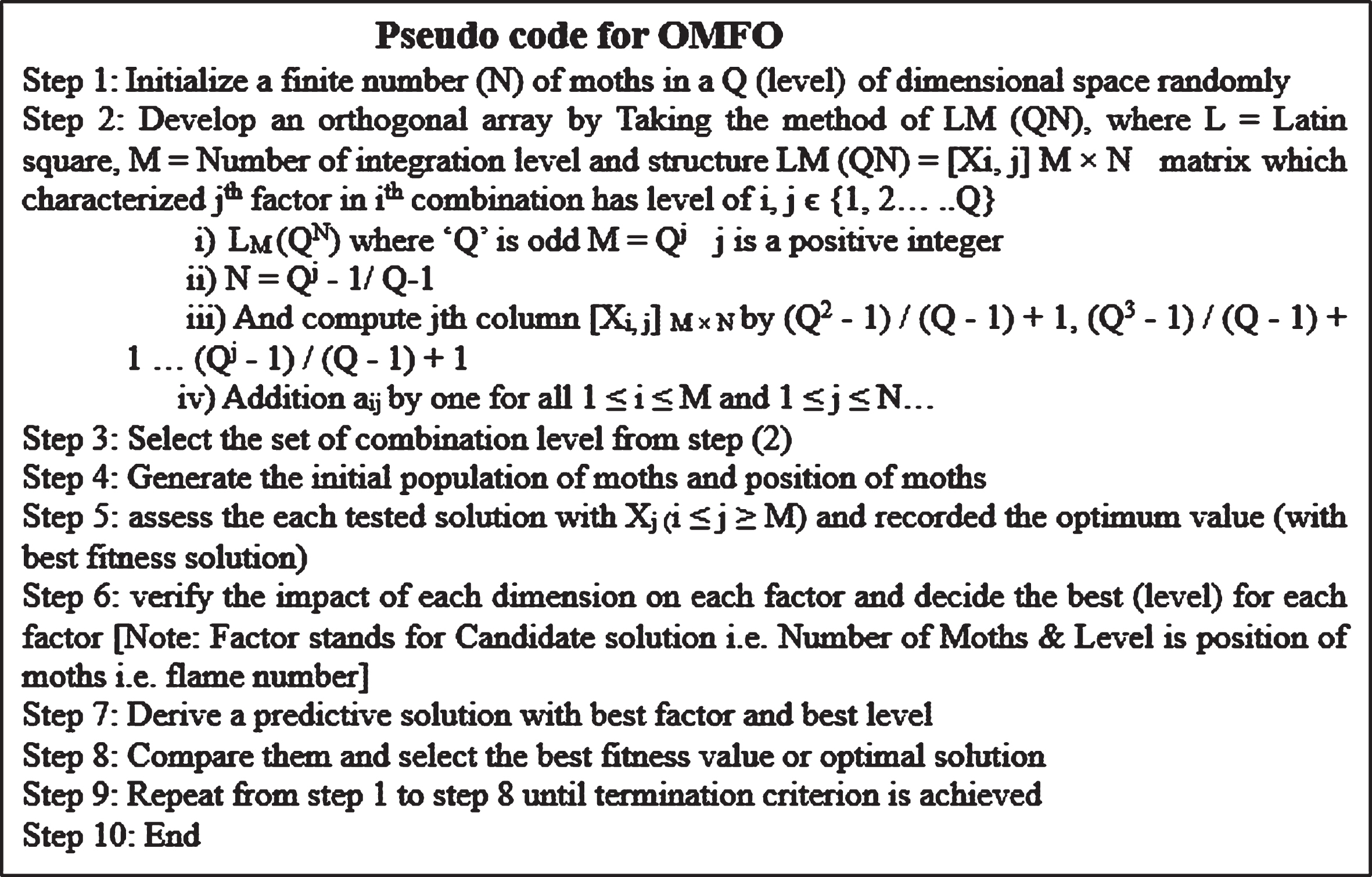
Proposed orthogonal OMFO.
The performance of the proposed algorithm i.e., OMFO is compared with the classical MFO considering the IEEE CEC 2017 standard benchmark functions [23]. Different types of functions such as unimodal, multimodal, hybrid and composite are considered in the benchmark data sets. Matlab 2016a on Intel(R) Core(TM) i7–7700K CPU @ 4.20 GHz with installed memory (RAM) 8.00 GB is used in conducting all numerical experiment. The performance of OMFO and MFO are evaluated for each of the benchmark functions. As per the criteria mentioned in CEC 2017, number of trials for each function is 25. The performance is measured for both the 10 and 30 dimensions. The range of the search space for variable vary among [–10,10], [–20,20], [–50,50], [–100,100]. Random number generator is used to set the initial population. Maximum function evaluation is considered as the termination condition.
For comparison purpose we have chosen five standard nature-inspired meta-heuristic algorithm namely, ALO [24], GWO [25], SSA [26], WOA [27], DA [28]. The parameters setting for the proposed methods are specified in the Tables 1–3. The experiments can be divided into two broad categories first we analyse the performances criteria of all 28 benchmark functions by MFO & OMFO algorithms, secondly we have done statistical analysis of the proposed algorithm. Here, F1–F3 belongs to the Unimodal type of test functions, multimodal test function includes from F4–F10 and hybrid types are F11–F20 and composite test functions are range from F21–F28. In Table 1, we have taken the parameter value such that D = 10 with Iteration = 500, clearly it is shown that OMFO performs better result rather than MFO in all F1 to F28 in terms of minimum, maximum & average fitness value MFO gives better result than proposed one. In F13 & F27 performance of OMFO is equivalent with MFO. For the dimension 30 with 1000 Iteration value, execution of objective function in OMFO is less than MFO in all the functions, almost all the cases it presumes that OMFO gives best optimal value than MFO except for F16 & F18, in F26 performance of OMFO is equivalent with MFO. It concludes that by adding the concept of orthogonality to the MFO algorithm, OMFO gives better results as described in Table 2, and comparison results shown in Table 3. The convergence graph of some functions such as F1, F4, F16 and F26 are drawn with respect to the best case performances obtained from the function are shown in Figs. 2–5. It can be clearly seen that OMFO has outperformed all other algorithms in most of the benchmark functions and it can be assume that this OMFO algorithms enhanced the balance between exploration and exploitation ratio.
Standard Deviation, Mean, Minimum, Maximum value of objective function value obtained by MFO and OMFO for 10-dimentional with 500 Iteration value of IEEE CEC2017 dataset. Good results are indicated in bold
Standard Deviation, Mean, Minimum, Maximum value of objective function value obtained by MFO and OMFO for 10-dimentional with 500 Iteration value of IEEE CEC2017 dataset. Good results are indicated in bold
Standard Deviation, Mean, Minimum, Maximum value of the objective function value obtained by MFO and OMFO for 30–dimensional with 1000 Iteration value of IEEE CEC2017 functions, better results are highlighted in bold
Comparison table of different meta-heuristic algorithm with respect to the Proposed OMFO algorithm based on 30 dimension of CEC 2017 test problems with 1000 iteration, Better results are highlighted in BOLD
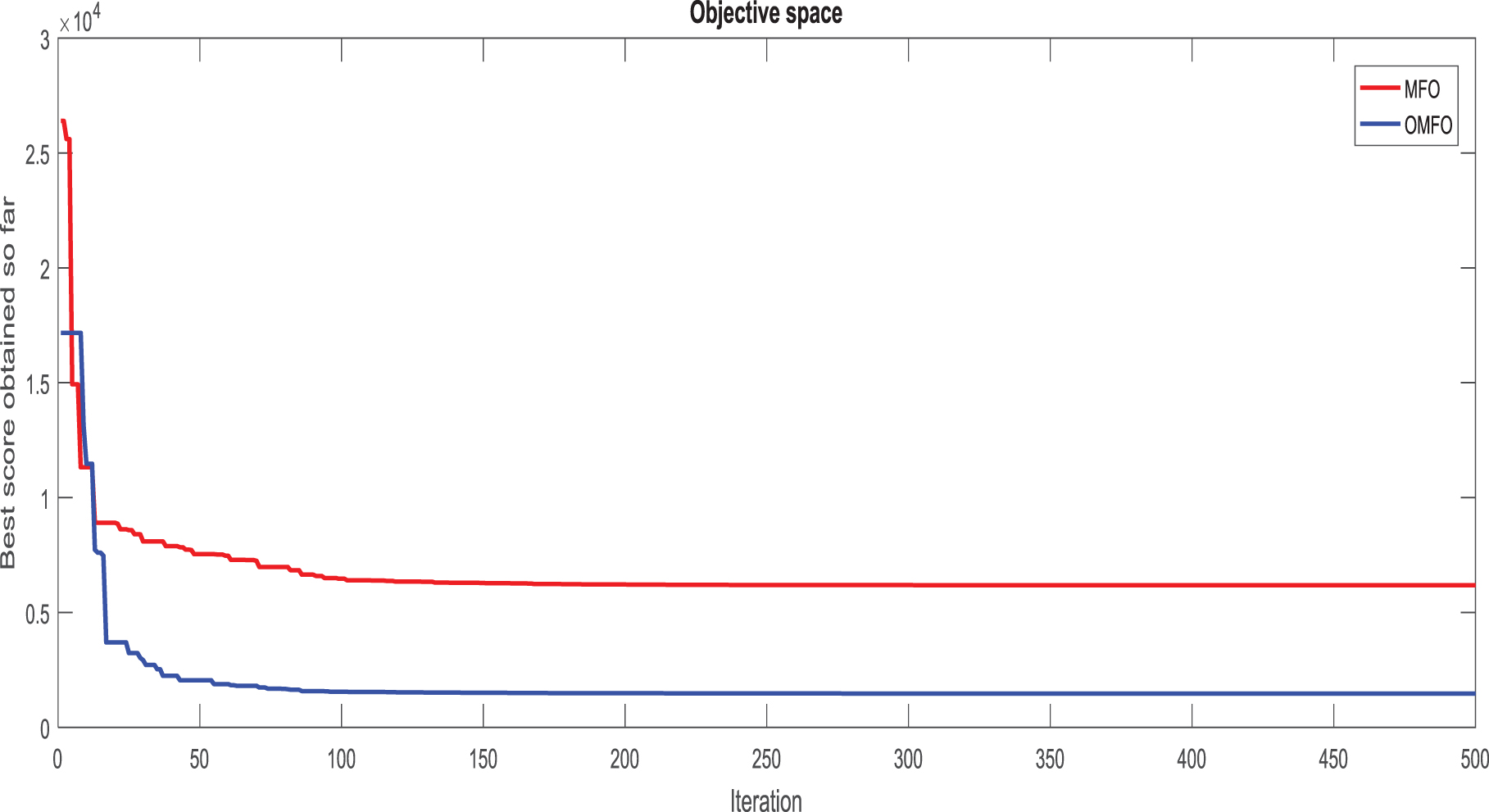
Convergence graph for F1.
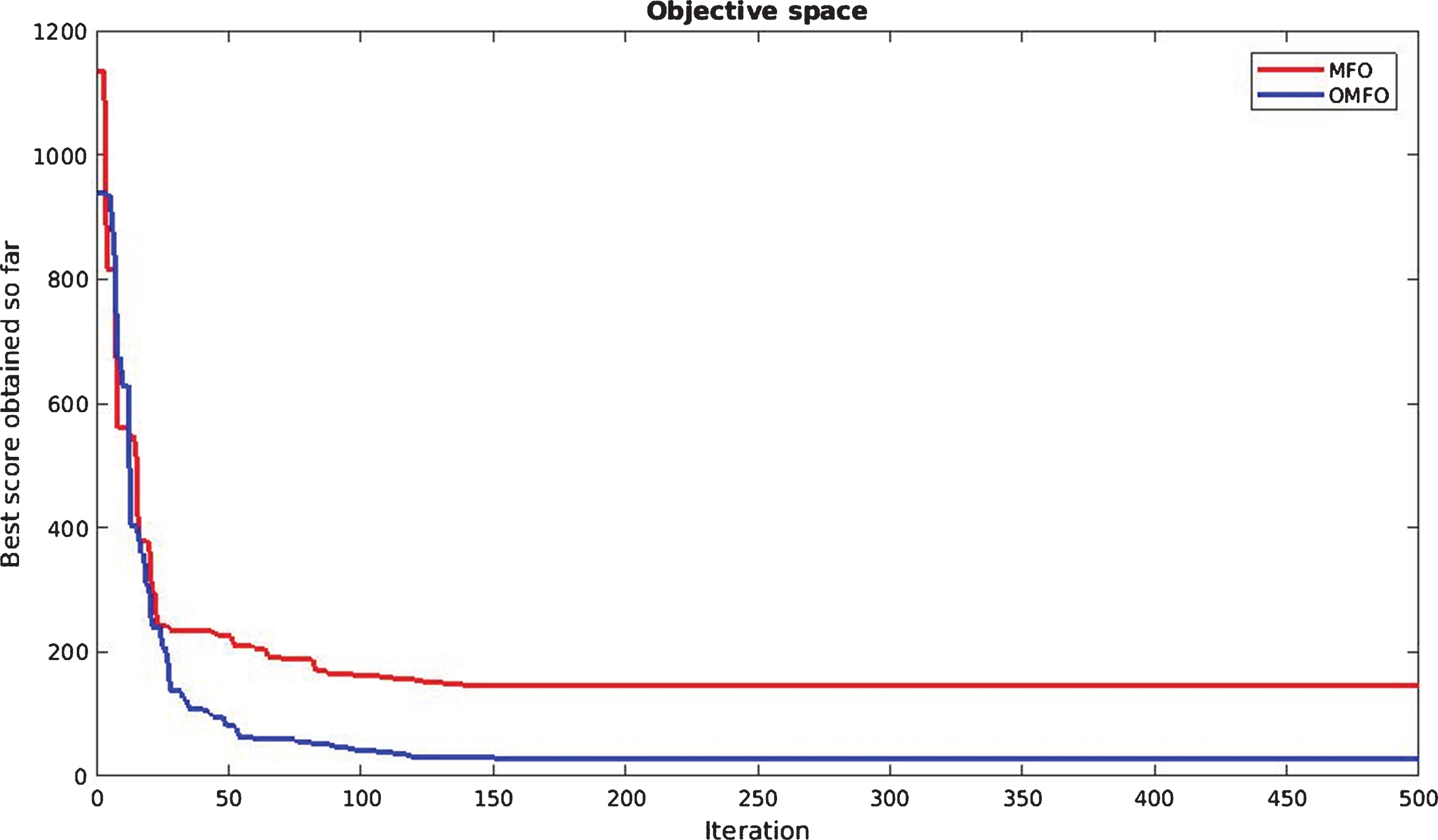
Convergence graph for F4.
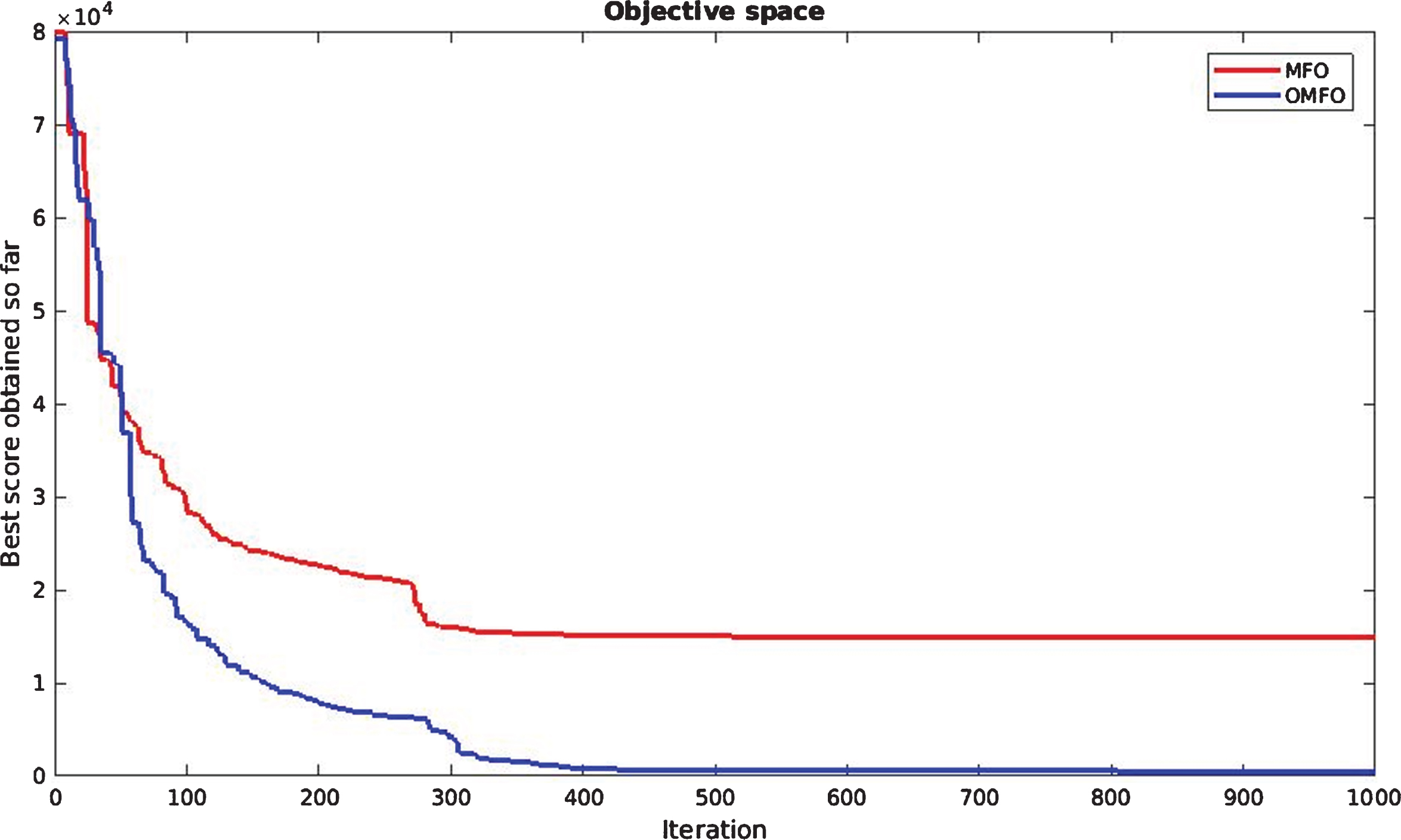
Convergence graph for F16.
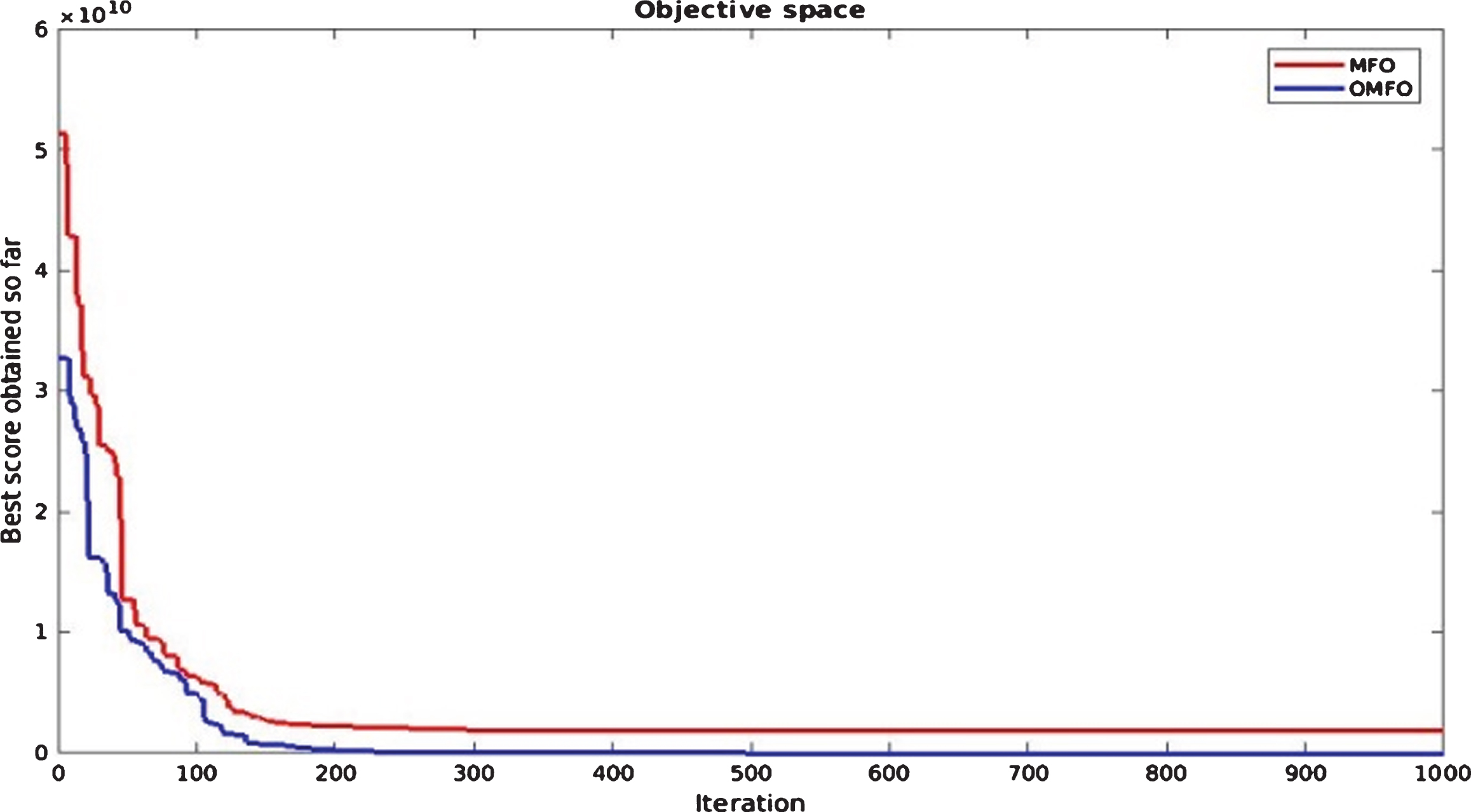
Convergence graph for F26.
Complexity of the proposed OMFO algorithm is formulated by using of IEE CEC2017 criteria [23]. The three parameters T0, T1 and T2 are used to determine the complexity. T0 represents the running time of a given mathematical functions under CEC 2017. T1 represents the access time of 2×10⁵ for evaluating the given functions, and T2 represents running time taken by an algorithm to run 2×10⁵ of F18 test function only. Table 4 represents the complexity of the algorithms for dimension 10 and 30.
Algorithm complexity (in seconds)
Algorithm complexity (in seconds)
To improve the rate of change of the convergences and to sustain the proper stability between exploration & exploitation at different stages, this statistical analysis are used to validate the different types of meta-heuristic optimization procedure in terms of their global optimum values and determined which algorithms gives better results and ranked them. Basically this statistical analysis is a non-parametric test, there are two test Friedman and Holm’s test [29] has been used to analyze the results.
Friedman test
Friedman test is a recognizable non-parametric evaluation technique, which is used to validate the
group of algorithms with their optimum value and ranks the algorithm for each dataset separately. This non parametric test preliminary rejects the content of Null hypothesis whereas the hypothesis state that all the meta-heuristic approach possesses the same reactions so their ranks Rj should be equal in nature.
H0: initially considers all methods are identical.
First, we have considered the confidence level α is 0.05, and Ranks are allotted to the algorithms depending upon the mean value obtained by the benchmark function. In this work we considered 7 algorithms
(OMFO, MFO, ALO, GWO, SSA, WOA, and DA) for non-parametric test and ranks are assigned from 1 to 7 according to their best score. The average rank is calculated using Equation (14).
Holm’s test is carried out once the null hypothesis is rejected, it helps to calculate the performance of OMFO with other approach. H0: The pair of algorithms are being compared with the different z-value that computed as per Equation (17).
Representation of Friedman Test
Results of Holm’s test
The concept of reducing a higher order linear time in-varying system into a lower order system is very common in the field of control engineering as well as in process control system. In the above process, the dynamics properties of the higher order system are studied by reducing the order of the system without affecting the input and output behaviour of system. This technique, inspired many researcher to reduce the complex, higher order and dynamic control system transfer function into its corresponding lower order transfer function because of that the above higher order system are more tends to those characteristics which define the system more prominently.
In literature, there are various methods which help the researchers to reduce the order of the system. Some of them are Pade’s approximation [30], Routh approximation [31], aggregation approximation [32], moment matching technique [33], Routh stability methods [34] etc. Above mentioned methods are successfully implemented to reduce the higher order system to their respective lower order. However in some cases, implementation of these methods leads the system to non-minimal phase, which can be avoided by applying the optimization method in the order reduction of higher order system. In literature some papers [35] proves that the implementation of nature inspired algorithm in higher order reduction is a sufficient alternative than the traditional methods. Error minimization is one method to reduce the order of higher order transfer function of linear time invariant system. Various error minimization indexes are considered in the optimization techniques, among them integral square error (ISE) is considered for order reduction of higher order system. Minimization of integral square error (ISE) will leads to quick elimination of large error as well as provide the toleration of small error for long time. As a result, it provides fast response with permissible label of amplitude and oscillation.
A new natured inspired algorithm is applied for the minimization of integral square error (ISE) to obtain a lower order transfer function of system. The reduction of higher order transfer function is consider as a unconstraint problem with assuming lower and upper bound limit 0.005 to 4 respectively. The number of search agent and iteration are taken as 30 and 200 respectively for the minimization of integral square error (ISE).
Mathematical description of model order reduction
Let’s consider a stable higher order single input and single output linear time invariant system P(s) with the transfer function of order n. After reduction of the higher order system, let the transfer of P(s) will converted to
Here, m≤n and m,n∈I. Where m, n, a z and b p represent the order of numerator, order of denominator, coefficient of numerator and denominator of original transfer function P(s) respectively.
Here,
The difference between the output of higher order system and lower order system acts as an optimization problem for the model order reduction scheme. For minimization of the error, Integral Square Error (ISE) is considered for above optimization problem. Equation (21) represent the objective function of model order reduction scheme.
Where, y(t) and
The proposed optimization technique is applied for the minimization of objective function which determined the coefficient of lower order system. The coefficient of lower order transfer function defined the system in such a manner that it approximately carries transient as well as steady state behaviour of higher order system.
Example of Model Order Reduction problem
Assume a fourth order single input single output system whose transfer function is as follow
The coefficient of respective lower order system of Equation (22) are determined by using proposed methods which are
The obtained result is compared with the original system as well as other existing model order reduction method present in literature. Table 7 shows the comparison of proposed method with other model order reduction method and their respective ISE values. From Table 7, it is clear that the proposed method gives the better ISE value as compare to the recent published method. From the step response, it observed that the proposed method show better performance as compare to the original system and other model order reduction method. Table 8 describes the various transient performance criteria of proposed method based lower order system. The above table contains rise time (t r ), settling time (t s ) and peak overshoot (M p ). From the Table 8, it evident that the proposed orthogonal MFO method shows quick settling and rise time than the original system and existing methods. From obtained result, it clear that the step response of lower order system give approximately better transient and steady state behaviour.
Comparison table of model order reduction method
Comparison table of transient response of various reduction methods
Due to the limited performance of MFO the special feature of orthogonal strategy has been introduced into the standard MFO to develop a novel orthogonal Moth-Flame optimization algorithm. OMFO is very efficient with an almost exponential convergence rate and the results were compared to a wide range of algorithms for verification. It is observed that adding orthogonal array enhance the accuracy and optimize the problems with good optimal solution. Different test has been performed to highlight the performance evaluation criteria of proposed algorithms. In the first phase, IEEE CEC 28 benchmark test functions were employed to analyse the performances of both MFO and OMFO from different perspective. It is observed that OMFO is able to show the high and competitive exploration in multimodal functions and exploitation in unimodal functions, moreover the results of composite test functions prove that OMFO gives better solution than classical MFO. OMFO gives superior performances in terms of convergence speed and avoidance of local optima. In the 2nd test proposed algorithms performed the statistical nonparametric test such as Friedman and Holm’s test to present that OMFO performance better that other meta-heuristic algorithm. Here, high levels of exploration and exploitation capability of the proposed algorithm were the motivation for this study. The proposed algorithm is then applied to a practical engineering problems i.e., model order reduction and observed in order to possess a better result than that of other algorithms.