



Abstract
Bibliometric analysis and information visualization software (Cite Space) were used to analyze and organize related research on whether people with the surname Yu descended from Temujin (Genghis Khan) of the Mongol nationality since 1981. Data were collected from the Chinese National Knowledge Infrastructure database, and analytic dimensionalities included basic knowledge of researcher, research institute, sampling of subjects, release time of research results, keywords and hotspot issues, critical cultural symbols, so on. Colleges, universities, and professors in Guizhou Province, China participated in the research, and few journalists also participated in many related surveys. The kernel keywords and critical symbols embodied in the research were “Mongol Nationality,” “Genghis Khan,” “Tiegaiyu,” “Nine Sons, Ten Jinshi (successful candidates in imperial examinations),” among others. Related studies since 1981 are divided into four development phases and continue to present an expanding trend. Related mainstream viewpoints are divided into three types, namely, the Mongol nationality, Tangut people in the Western Xia Dynasty, and the Han nationality. Research arguments focus on whether people with surname Yu in southwestern China are descendants of Genghis Khan in Mongolia. Future research emphasis and difficulty lies in identifying if people with surname Yu in southwestern China are descendants of Genghis Khan in Mongolia, combining historical truths by processing and analyzing the enormous family trees with the surname Yu. Future research should focus on the emic approach. In the current study, paternal Y chromogene detection and related articles on migrants into Sichuan are predicted to facilitate further research development.
Keywords
Introduction
The long history of mankind and human wars proves that Genghis Khan’s discovery of Mongolia Empire is hard to ignore. The Maritime Silk Road, whose influence extends the contemporary era, was opened in the Yuan Dynasty (1271–1368) and initiated by Kublai Khan, descendant of Genghis Khan. The Maritime Silk Road promoted the progress of world integration and tremendously advanced national fusion worldwide. The foundation of the Yuan Dynasty in China facilitated fusion and exchange among different nationalities in China, generating another national fusion peak throughout the Chinese history. National minorities blended in the Han Dynasty with intermarry and integration. For instance, the Qidan Nationality, Nuzhen Nationality, and Sa Dula Nationality, which entered Central Plain, were gradually combined with the Han Dynasty. The Mongol Nationality from grassland slowly experienced chinesization. Unfortunately, in view of extreme scarcity of written records left by nomadic politics and culture in deep parts of Mobei Grassland, the culture of the Mongol Nationality was recorded mostly by “word-of-mouth” or “phonetic annotation of Chinese characters.” Thus, most researchers and inheritors of folk culture had to focus their own academic exploration or “quip” on numerous differentiated narrow and dedicated fields according to their own interests and strong points [1]. In south China, a far-reaching line currently spreads among the people, that is, “the Yu family is a family of prime minister in the Yuan Dynasty and then dispelled to western region.” This line resulted in “seeking roots and ancestors” movement, by which numerous populations in southwest China participated in. From the academic level, this trend in southwest China can be generalized as “national identity” or “race identity.”
Race identity refers to a sense of social identity generated after mutual contact between members of different groups. It stresses membership and intimate connection among members in the same group [2], for instance, “I am from the Tibetan Nationality, so are you!” Under normal circumstances, race identity is the result of national population classification, and it is obtained after being identified and confirmed by a certain nationality. The identification result of one “nationality” in the same country indicates that different surnames may exist in the same race, and different races may exist with the same surname due to the existence of subjective and objective factors, such as history, politics, surviving environment, and migration. Race identity in the same surname entails “seeking roots and ancestors” or “where am I from.” Thus, race identity in the same surname is a practical activity or psychological appeal of seeking for “the same ancestor.”
Among the people in southwest China, cultural identity activities triggered by “the Yu family is a family of prime minister in the Yuan Dynasty and then dispelled to western region” become extremely prominent. In the “surname Yu” group in southwest China, the sizeable amount of members call themselves “Yu” in “Tiegaiyu” according to “the Yu family is a family of prime minister in the Yuan Dynasty.” The so-called “Tiegaiyu” signifies that people who had the surname “Tie” at the earliest changed their surname to “Yu” to escape calamities in one historical period. The cultural identity of “Tiegaiyu” also traced the sources of “Tie” such as “Tie Shiyi” in folklore and “Temujin (Genghis Khan)” who established the Mongolia Empire. Those who identify as “descendants of Genghis Khan” were the largest population (90%) with the surname Yu. By reading written records and folklores related to Yu family trees, the race cultural identity of “descendants of Temujin (Genghis Khan)” triggered by the claim that “Yu family is a family of prime minister in the Yuan Dynasty” originated from the Kangxi Period in the Qing Dynasty (1661–1722) and thrived during the reign of Emperor Daoguang (1782–1850). This folk race identity activity reached a historical peak up to the 1980 s and 1990 s. Many folks or academic members performed multibatch and multilevel textual research and investigation in the folk or academic circles, and a programmatic document regarding Yu race identity was enacted among the people in southwest China in 2008, namely, National Tiegaiyu Family Tree. This document was the first to claim that members with surname Yu in southwest China are descendants of Temujin (Genghis Khan) in the Mongol Nationality.
However, the dispute and doubt over “Yu Surnamed People Are Descendants of Temujin (Genghis Khan) of the Mongol Nationality” merely began in the 19th century. Along with the continuous textual research among the people with surname Yu other academic researchers also cultivated their research interests in this historical knowledge. As a result, an increasing number of people are gaining interest in the historical truth of the claim “Yu Surnamed People Are Descendants of Temujin (Genghis Khan) of the Mongol Nationality.”
On this basis, researchers must extensively collect data to strengthen studies on the national cultural identity of Yu -surnamed people in southwest China. They must explore its basic development laws and help or satisfy the psychological aspiration of Yu family members in southwest region to seek for roots from existing works. Hence, the present study plans to organize the research trends of “cultural identity of the Mongol Nationality” carefully, with “Yu race identity in southwest China” being the kernel keyword, thus laying the theoretical foundation for further studies on cultural identity of the Mongol Nationality.
Research method and data collection
Bibliometric analysis method
Bibliometric analysis method, also called “meta-analysis method” is a basic method of mathematical statistics and quantitative analysis of the overall situation of the existing research results. Relative to previous qualitative, inductive, and deductive traditional literature reviews, bibliometric analysis is an effective method of generalization and literature review based on statistics, including a large quantity of statistical methods and quantitative technologies and a common literature processing means. In general, bibliometric analysis method comprises the following processes: collection of descriptive statistics reflecting research features, classification and encoding of research results, and comprehensive statistical analysis of encoded research results [3]. The current research mainly involves statistics and analysis of basic information, such as author information, study objects, research contents, research methods, research conclusions, main viewpoints, publication, and publication date time.
Mapping knowledge domain and visualization software (Cite Space)
Cite Space is known as “mapping information domain and visualization technology.” This software is a tool developed by Chaomei Chen et al. from College of Information Sciences and Technology in Drexel University to realize visual display of scientific knowledge, information, and intelligence via graphical means and methods of relation construction. Within 20 years since 2004, Cite Space has become one of the essential tools for scientific policy analysis agencies, investment institutions, managerial staff of consulting companies, technicians, and researchers from colleges and universities [4]. The goals of “mapping of scientific knowledge” and “visualization of scientific literatures” can be realized by Cite Space, and can help related personnel analyze, judge, and predict the development trends in several professional fields and academic frontier trends. The version used in this research was “Cite Space-5.3. R4.8.31.2018” to analyze basic information in many existing studies, such as kernel keywords and research institutions.
Data acquisition
Studies related to the cultural identity of Yu -surnamed people in southwest China are mainly in Chinese and with relatively few English studies. Therefore, CNKI was used as the main literature retrieval platform to collect the existing research data. To gather enough samples, multibatch and multilevel retrieval mode was adopted. The retrieval conditions were as follows: “subject,” “title,” and “abstract” contained “surname Yu” or “Yu family,” including “southwest,” “Guizhou,” “Sichuan,” “Chongqing,” and “Yunnan.” The time range of retrieval was 1 January 1978 to 31 December 2018. The retrieval mode was “accurate matching,” and the retrieval range was “all journals” or “all data.” Ultimately, the time range of the retrieved scientific studies related to “Yu Surnamed People Are Descendants of Temujin (Genghis Khan) of the Mongol Nationality in southwest China” was 1981–2016. All retrieved literature were screened out, and the screening criterion was as follows: all studies containing contents related to cultural identity of Yu surnamed people in southwest China were included into the category of analysis, and 31 valid scientific research documents were obtained.
Results and analysis
Basic information of research institutions and researchers
Frequency analysis (number of times of publishing research results of cultural identity of Yu -surnamed people) of research institutions of the existing studies was performed through highlight drawing function of Cite Space. The statistical frequency analysis of regional distribution of researchers was implemented and the results are presented in Fig. 1.
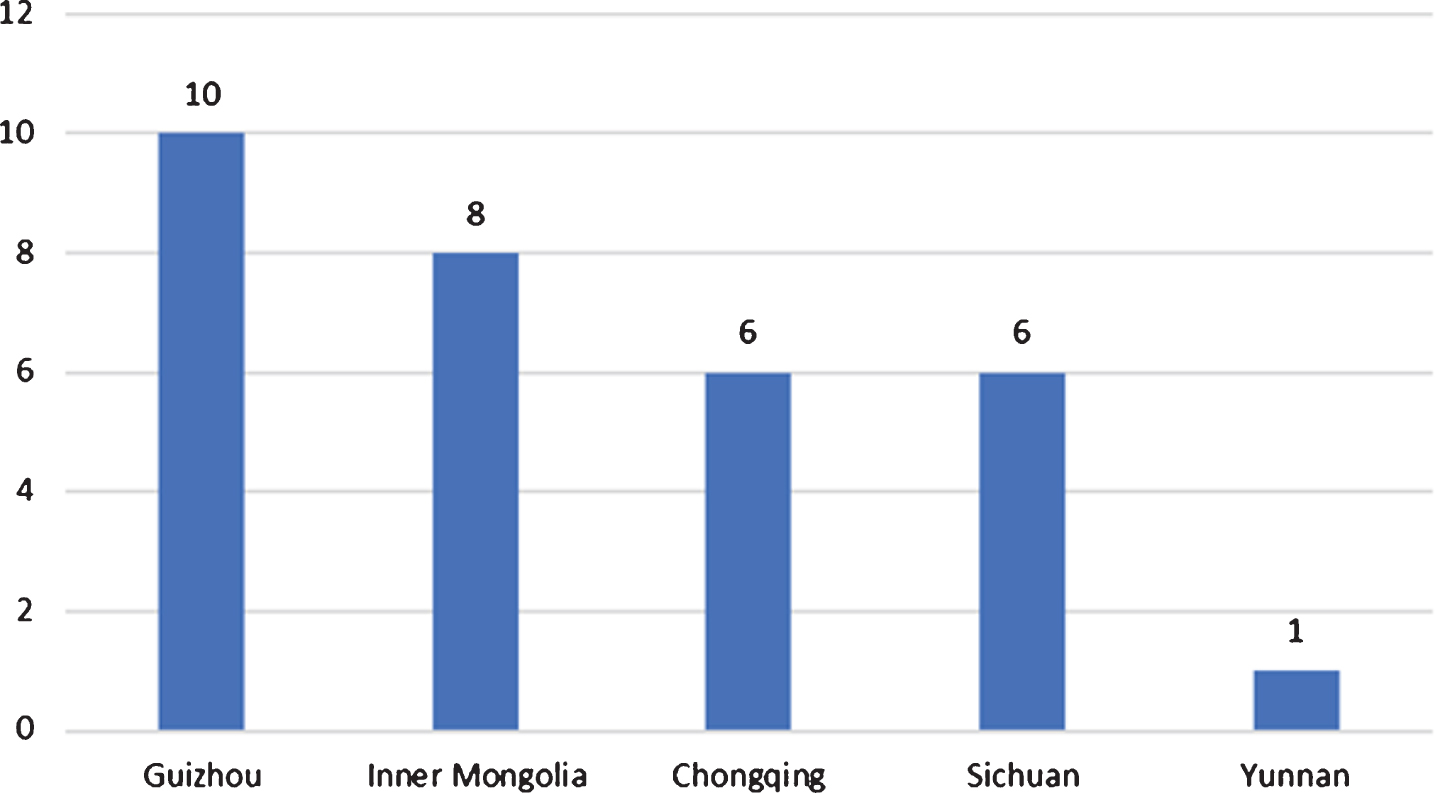
Regional researcher distribution.
Fig. 1 also displays similar results of regional researcher distribution. The number of researchers in Guizhou Province was the largest (32.25%), followed by that in Inner Mongolia (25.80%), Chongqing and Sichuan (both being 19.35%), and Yunnan (3.25%). The results manifested that from the regional researcher distribution, scholars investigating cultural identity of Yu surnamed people in southwest China mainly came from Guizhou, followed by Inner Mongolia, then Chongqing and Sichuan.
The identity information of the researchers was also investigated. According to their actual identities, the researchers could be divided into teachers in universities and colleges (master or doctoral candidates included), journalists, all types of researchers, and secondary school teachers accounting to 67.74%, 19.35%, 9.6%, and 3.315%, respectively, as shown in Fig. 2. The results indicated that the problem of cultural identity of Yu-surnamed people attracted high attention among teachers in colleges and universities who performed related studies. Cultural identity problem of Yu surnamed people in southwest China also attracted attention from journalists and related surveys and investigations. Scientific researchers from regional State Ethnic Affairs Commissions and Chinese Academy of Social Sciences also participated in studying this subject.

Statistical graph of researcher identity information.
The above results validated that colleges, universities, and related research institutions paid considerable attention to the cultural identity problem of Yu-surnamed people and that corresponding researches were performed. The studies by colleges, universities, and researchers in Guizhou Province led in terms of the cultural identity of Yu-surnamed people in southwest China, enjoying far more prominent status than those in other provinces and cities in southwest China. Evidently, this finding reflected regional limitations of cultural identity research among the people with surname Yu in southwest China, and related studies among various regions seemed disperse with a lack of necessary cooperative. Along with colleges, universities, and teachers in Guizhou Province, teachers from colleges and universities or researchers in Sichuan, Chongqing, Yunnan, and Beijing, including researchers from related institutions of State Ethnic Affairs Commissions in Sichuan and Inner Mongolia, also participated in the studies within this field. Thus, transregional combined or integrative studies will be a future development trend.
To deeply master the research status of cultural identity of Yu surnamed people in southwest China, sampling results of studies or surveys were analyzed and calculated, as shown in Fig. 3. The results showed that since 1981, sampled objects in studies related to the cultural identity of Yu surnamed people in southwest China were mainly from Guizhou (35.48%), followed by Sichuan (32.25%), entire southwest region (16.13%), Chongqing, and Yunnan.

Regional distribution of research objects (sample sources). Note: YGSC means Yunnan-Guizhou-Sichuan-Chongqing; GCHH means Guizhou-Chongqing-Hunan-Hubei.
Regions with samples accounting for 67.73% were Dafang County in Guizhou Province and Ganzi Prefecture in Sichuan Province. Yu families in the two regions shared a common feature, namely, sticking to the “Tiegaiyu” legend verbally imparted by forefathers. Certain Yu family members changed their national identity into the Mongol Nationality through ethnic identification work from 1987–1995, and some changed their surname to “Borjigin · Yu XX” and so on. Dafang County founded “village of the Yi nationality and Mongol nationality in Fengshan” during “district revocation, village merging, and town construction” in the 1990 s. This region included 11 nationalities, such as the Yi, Mongol, Miao, and Bouyei nationality, where national minorities accounted for 39.9% of total population. Simultaneously, most people of the Mongol nationality in Fengshan Village were surnamed Yu and were changed into the Mongol nationality through ethnic identification policies. Naturally, studies involving the cultural identity of Yu surnamed people in southwest China would take Dafang County as the main study object. The situation was similar to that in Ganzi Prefecture in Sichuan. As a prefecture with many national minorities, Ganzi Prefecture also contains the Mongol Nationality, which is an important reason why it becomes a sampling emphasis in the current research. Fengdu in Chongqing is also the main region intensively distributed with research objects because of the attention induced by the report “Jin and Yu Surnamed Descendants of Genghis Khan Were Found in Fengdu, Chongqing” published on Chongqing Times on 19 July 2006 [5].
The journals were divided as follows: college journals, professional ethnological journals, general journals of social sciences, literature and history, and local newspapers. The statistical results are displayed in Fig. 4, where those publishing research results of cultural identity of Yu -surnamed people in southwest China were journals of social sciences, literature, and history (38.70%), such as Social Science in a province, Lantai World, History of World, Zhongzhougujin, China Three Gorges Tribune; Bridge of Century; college journals (25.80%), namely, Journal of Southwest University for Nationalities, Journal of Inner Mongolia University; Journal of Yunnan Minzu University; professional ethnological journals (22.58%), such as Guizhou Ethnic Studies, Qinghai Journal of Ethnology, Ethnic History Studies, and Northwestern Journal of Ethnology; and local newspapers (12.92%), namely, Ganzi Daily, Guizhou Daily, and Guizhou Ethnic News. From publishing journals, most research results were published on strong academic college journals or professional ethnological journals. Thus, related studies on the cultural identity of Yu surnamed people in southwest China were also of certain academic property with high academic research level.
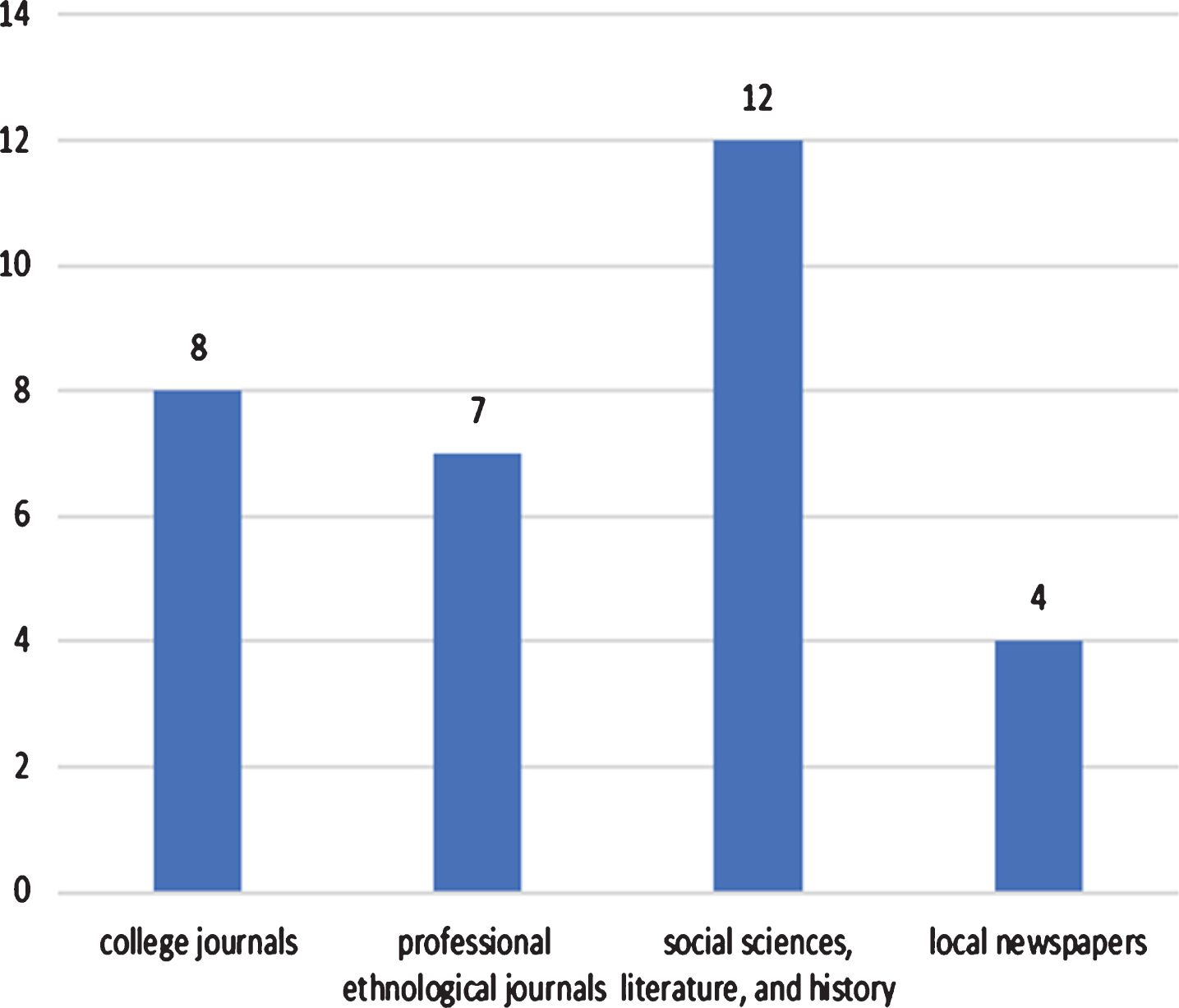
Types of journals publishing scientific research papers.
According to literature publishing time, the studies were organized and analyzed using every 10 years as a stage, and the results are shown in Fig. 5. The results showed that few studies were conducted on the cultural identity of Yu surnamed people in southwest China in the 1980 s and 1990 s. Related studies began increasing in 2000–2009, and the research work peaked in 2010–2018. Following this development trend, these studies may continuously increase and expand because ethnic identification work was vigorously performed in the 1980s–1990 s, and folk awareness of race and ancestor origins were enhanced. Therefore, in 2002 and 2008, Yu families in southwest China implemented different levels of “clan and family tree combination fusion” activities with different scales and organizers in various regions, and various versions of “genealogy” were internally released. On the one hand, a series of such activities motivated awareness of cultural identity among Yu surnamed people in southwest China. On the other hand, they induced severe divergences over different ancestor or ethnic origins. Naturally, this kind of divergences over cultural identity would result in high attention paid by the enthusiastic studies, thus leading to obvious increasing trend of studies on the cultural identity of Yu surnamed people in southwest China over the past 20 years.
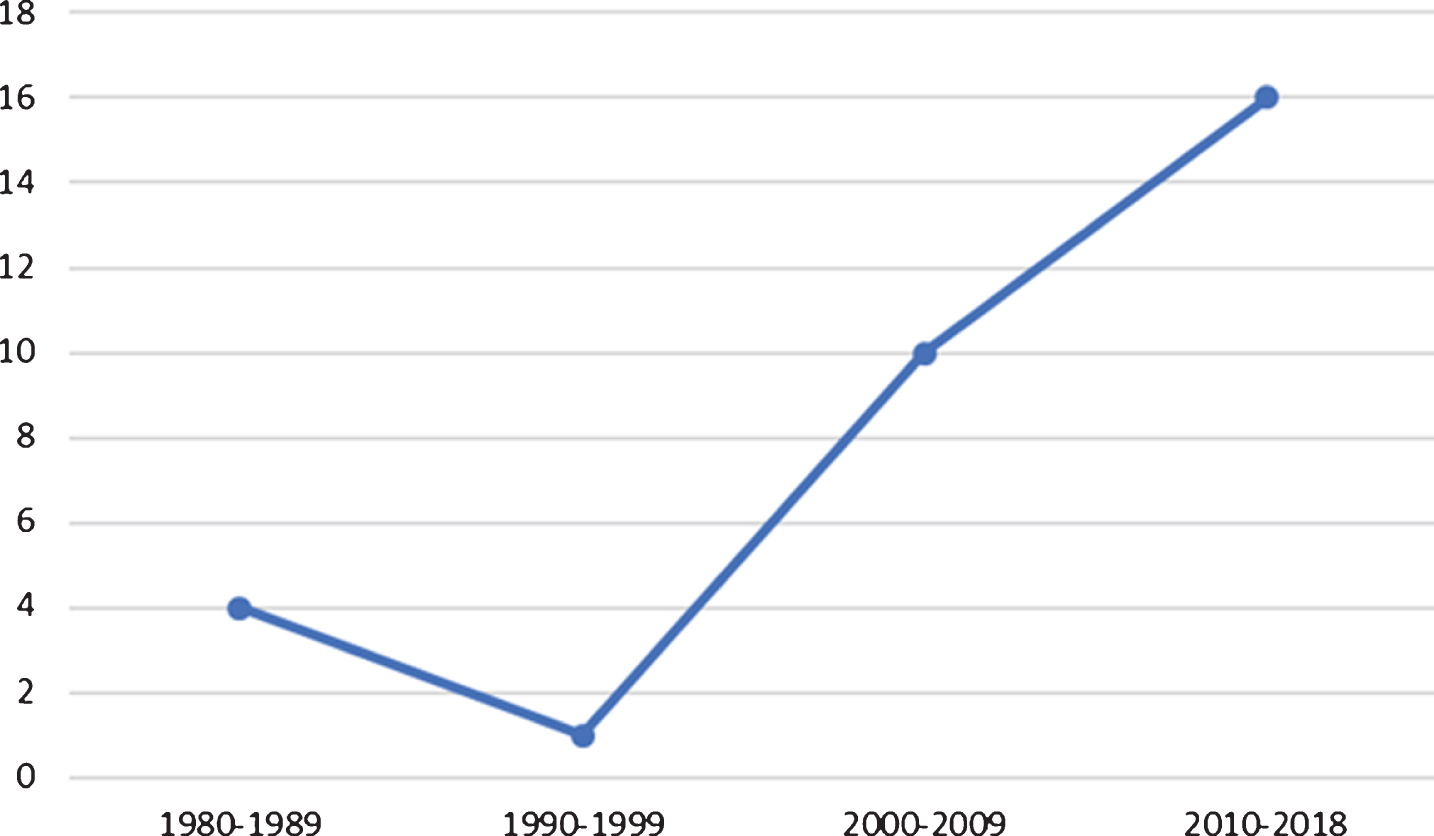
Quantitative development trend of published scientific research papers.
Based on the above analysis, the development process of studies on the cultural identity of Yu surnamed clans in southwest China was divided into four phases. Phase I (1981–1989), an initial phase of the studies with the main research emphasis laid on celebrities or ethnic origin problems of surname Yu in southwest region, for instance, Shisong Chen’s [6] research on “Economic Remedial Measures of Jie Yu in the Song Dynasty for Sichuan Province and Their Effect”, Shaoming Li’s [7] research on “Textual Research on Yu Genealogy of the Mongol Nationality in Xichang,” Sheng Rong’s [8] research on “Trial Research on Yu Genealogy of the Mongol Nationality in Guizhou Province,” and so on. Phase II (1990–1999) was a low-tide period of studies on the cultural identity of Yu clans in southwest China, and only few studies sought for the origin of the surname Yu in Sichuan from the angle of surname symbol, hsuch as Hehui Qi’s [9] research on “Contents of Nationality Culturology in Surname Symbols in China.” Phase III (2000–2009) was a high-speed development phase of studies on the cultural identity of southwestern races. During this period, heavy interests were generated in the cultural identity of Yu clans in southwest region among nongovernmental organizations and theoretical academic circles. Numerous studies and textual criticism were conducted and enormous achievements were acquired. In this period, besides the remarkably increasing quantity of studies, all kinds of Yu Family Tree spontaneously compiled by non-governmental organizations and local ancestor worships with clan fusion emerged in quantity, where the most significant was release of Qiwowen Tiegaiyu Family Tree of the Mongol Nationality (national uniform volume) [10] (2003) and Tiegaiyu Genealogy of Imperial Descendants of the Mongol Nationality [11] (2008) (internal release). Phase IV (2010–2018) was a critical development period of studies on the cultural identity of Yu clans in southwest region. During this period, research achieved enormous quantitative and qualitative breakthroughs. However, theoretical academic circles and nongovernmental organizations had increasingly intense disputes and divergences over the proposition “ancestor origin or ethnic origin” with contradictory viewpoints. For instance, Li [12] believed that, “As the Mongol Nationality was discriminated under low status in the Ming Dynasty, Zijun Yu still called his ancestor the Mongol Nationality when depicting his genealogy, and so he was a Mongolian.” By contrast, Yan [13] deemed that, “the proposition that Yu was a Mongolian was doubtful and unbelievable. He might belong to the Han Nationality.”
Cite Space was employed to perform a visualization analysis of the existing research results, expecting to discover hotspot issues and leading-edge keywords in studies on the cultural identity of Yu clans in southwest region. The analysis basis derived from keywords listed on CNKI platform. The parameters of Cite Space were set as follows: node strength: default Cosine function and within slices; threshold: TOP-50; parameter selection for the network clipping functional zone: minimum Spanning Tree.
To further validate the hotspot degrees of the above keywords, bibliometric analysis method was continuously used to conduct in-depth statistics and analysis of the existing studies, where the main analytical approach was follows: the retrieving frequency of each keyword listed on CNKI platform was calculated and they were sorted in order, and the first six hotspot keywords in different phases were obtained as shown in Table 1. This result accorded with the mapping knowledge domains of keywords analyzed through Cite Space software.
Statistical table of kernel keywords in researches on cultural identity of Yu clans in southwest China
Statistical table of kernel keywords in researches on cultural identity of Yu clans in southwest China
Both mapping knowledge domains of keywords and bibliometric statistical table showed that keywords, such as “the Mongol Nationality,” “Genghis Khan,” and “Sichuan,” were hotspot keywords and played leading roles in studies on the cultural identity of Yu clans in southwest region. Thus, the Mongol nationality and Genghis Khan will be unavoidable subjects in the studies and they constituted the ethnic origin problem of Yu surnamed ancestors in essence. The reason why Sichuan and Guizhou became hotspot keywords was that Yu surnamed Mongolian people existed in Dafang County in Guizhou Province and Ganzi Prefecture in Sichuan Province. The appearance of hotspot keywords rightly conformed to the basic features of the four development phases of studies on the cultural identity of Yu clans in southwest China as mentioned previously, namely, “whether they were descendants of Genghis Khan” run through all research phases.
To master mainstream ideas over cultural identity of Yu clans in southwest China, main ideas over race identity in the research results were classified and compared, namely, Yu “clans” can be divided into three types as seen in Fig. 6. From the classification and statistical results in Fig. 6, 81% of the studies used “Tiegaiyu” as Yu clan culture in southwest China or considered it as the ethnic origin of Yu clans in southwest China by default, namely, surname Yu in southwest region was “Tiegaiyu” of the Mongol nationality. Another 13% of the studies identified “traditional Yu,” namely, surname Yu in southwest region originated from the first ancestor “Youyu” during Qin and Han Dynasties. They belonged to the Han Nationality but not the Mongol nationality, and 6% of the studies identified another type “Shegaiyu”, namely, descendants in Shuixitusi(now Guiyang) in Dafang County, who changed their surnames from “She” to “Yu.”

Cultural identities of Yu clans in southwest China indicated in the researches.
Therefore, the main ideas in existing studies can be divided into following:
Type I ideas: The ancestor of Yu surnamed people was Temujin (Genghis Khan), a Mongolian. The bases for studies identifying this idea included verbal imparting by forefathers, records in genealogy, transliteration mistake of “Temujan,” name of first ancestor, and so on. Most studies of this type focused on cultural identity of southwest Yu clans based on the viewpoint that the ancestor of southwest Yu clans was Mongolian “Genghis Khan” or “Temujin.” The main attention was paid to southern Mongolian culture embodied in southwest Yu clans and cause analysis for missing of partial northern grassland culture of the Mongol Nationality. The criteria adopted for identity of Yu surnamed Mongolians in southwest region in the studies included “call oneself,” “could be,” “should be,” and “according to legend.” Some researchers also examined historical records, namely, History of the Yuan Dynasty, The Secrete History of the Mongols and Emperors of the Yuan Dynasty, and so on, attempting to prove that southwest Yu surnamed people were of Mongol nationality. Some reports drew from the angle of “national identification” work in the 1980s–1990 s, conducted investigation and examination work by various means, such as looking up genealogy, tombstone survey, individual interview, and symposium holding. They finally certified that the race of southwest Yu surnamed people was the Mongol nationality.
Type II ideas: The ancestors of southwest Yu surnamed people might be the Tangut people in the West Xia Regime, Que Yu in the Yuan Dynasty, or might be descendants of Kipchak Yuliboyawu family. Studies on this type mainly derived from a viewpoint in the historian circles, namely, “Tiegaiyu” were descendants of a noble family in the Yuan Dynasty, but they might not be descendants of royal family of Genghis Khan. The main bases were related figure events and historical events recorded in Yu family tree and those recorded in history books written in biographical style, and so on. For example, Shaoming Li [14] deemed that, “the origin of Xichang Yu surnamed people in Sichuan might be related to Fa Yu, living in the Yuan Dynasty, but not to the royal family in that period. Of course, Que Yu was Tangut Qiang person in the Western Xia Regime, but the objective fact that some of the descendants have already become Mongolians is undeniable.” Another reason for doubting over “southwest Yu-surnamed people were royal Mongolians” was that the genealogy table of southwest Yu-surnamed people cannot be totally connected up to that of Genghis Khan.
Type III ideas: The ancestors of southwest Yu-surnamed people were not Mongolian, Genghis Khan, or Temujin but southern Han Nationality. Studies on this carried out historical examinations of “nine sons, ten Jinshi” and “four prefecture chiefs, five ministers and one assistant minister” in Yu family trees. Local chronicles and county annals were investigated, and the final conclusions were formed in full consideration of all kinds of influence factors. For instance, related studies regarding a famous figure in the Ming Dynasty—“Zijun Yu” [13] — deemed that reliable information of historical Zijun Yu, such as birthtime and name of his grandfather were compared with Zijun Yu-related information recorded in Yu family trees. Thereafter, “the proposition that Zijun Yu was a Mongolian was doubtful and unbelievable. He might belong to the Han Dynasty.”
To clearly master the overall perspective of cultural identity of southwest Yu clans, “symbol labeling method” commonly used in the ethnology was used to analyze various critical points appearing in existing research. Critical points mentioned in the literatures to describe or demarcate Yu clan culture in southwest China were calculated and analyzed after being classified (different from the analysis of keywords in CNKI in preceding part), and then labeled with “letter symbols.” The analysis results are shown in Table 2.
Table of cultural identity symbols of southwest Yu clans (arranged by proportions)
Table of cultural identity symbols of southwest Yu clans (arranged by proportions)
Note: *** denotes importance degree of Tiegaiyu symbols in the cultural demarcation process of southwest Yu clans.
As shown in Table 2, important symbols included “descendants of Genghis Khan,” “Temujan,” “nine sons, ten Jinshi,” “separated on Fengjin Bridge in Luzhou,” “separation with a willow twig,” “Mongolian culture already lost,” and “Nanping King.” These critical symbols, once connected, can form a complete sentence: southwest Yu-surnamed people were descendants of Genghis Khan, the first ancestor Temujan once cultivated nine sons and one daughter, all of whom became Jinshi, namely, “nine sons, ten Jinshi”; (afterwards) he carried his family members to Sichuan to avoid the calamity, they were separated by inserting a willow twig and then migrated to different places, hence the original northern grassland culture of the Mongol nationality was lost. The specific contents expressed by this sentence were mostly directly recorded in numerous family trees of southwest Yu clan, and these family trees were the main basis for cultural identity activities among the folks.
The second noteworthy symbol was the process of “Tiegaiyu.” The first cause for surname change was that Shun Emperor of the Yuan Dynasty dreamed of nine iron spears inserted in the throne room, and the next day, a chancellor explained the dream, such as “nine sons, ten Jinshi in Tie family” would conspire against the imperial court, so the emperor sent forces to kill them. When the pursing forces were approaching, the Tie family changed their surname on Fengjin Bridge for the convenience of flying for their lives. The change method was to remove the right side of “Tie” and replace it with “Jin”, they worried that “Jin” and “Tie” were so similar that it might not be convenient for them to escape, hence they changed “Jin” into “Yu”. The second cause: When the army forces sent by the Shun Emperor were approaching, not knowing how to explain and seeing fish breaking out of the water surface, they suddenly thought of changing “Tie” into “Yu”. The fourth cause: As Zhu Yuanzhang in the Ming Dynasty chased after imperial family of the Yuan Dynasty or red scarf army chased after nobles of the Yuan Dynasty, “they could not be totally destroyed and there were always the rest of them”, so “Tie” was changed into “Yu”. The fifth cause: “second son of Zilin Tie, namely, Muer Tie, occasionally gained a unique jade Ruyi-shaped claw” [15], he intended to contribute to the emperor, but he was chased because “the claw was hided with book on the art of war and weapons”, and he changed his surname in the escaping process. No matter which cause was true or why they were different, our emphasis was laid on finding their common ground: changing “Tie” into “Yu”. This was one of the primary reasons why “the Mongol Nationality” was taken as the mainstream identity in the cultural identity process of southwest Yu clans, which took “Tie” in “Temujin” as the origin of their original surname Tie.
The explanation for the symbol “Mid-Autumn Festival not celebrated” among the southwest Yu surnamed people: As officials and soldiers in the Ming Dynasty wiped out the people of Temujan everywhere in way of carrying information in mooncakes, in memory of this miserable history, the people did not celebrate mid-autumn festival any longer. Nevertheless, today with well-developed network, the cultural symbol “Mid-Autumn Festival not celebrated” is gradually fading. The symbol “Shiyi Tie” was a popular symbol in the Yu family tree in southwest region, and it is said that he was the grandfather of Temujan.
Besides the symbols listed in Table 2, another symbol widely circulated among Yu family members in the broad southwest region is “spreading from mouth to mouth” or “oral imparting”, namely: old forefathers taught the descendants orally, “we are Mongolians, descendants of Genghis Khan,” and they all believed that their surname originated from “Tie” in “Temujan”.
The abovementioned cultural symbols or legends specific to Yu families in southwest region have truly embodied the folks’ specific sense of pride for the honorary past of their forefathers, and meanwhile, they have become a kind of significant cultural symbols enhancing the cohesion of their ethnic group. However, offences and contradictions of all kinds existing among such symbols have triggered divergences over cultural identity of their clans in the folks and a research boom in the academic circles. The divergences and researches regarding this cultural identity focus on the ethnic group of “Tiegaiyu” in southwest China.
Research conclusions
Existing studies have achieved outstanding performances in the field of “Yu Surnamed People in southwest China Are Descendants of Temujin (Genghis Khan) of the Mongol Nationality” (cultural identity of southwest Yu clans), but after making a general survey of all the studies, it is unavoidable to find some common deficiencies in the studies. These deficiencies are first embodied by unicity of research method, namely, textual analysis method and narrative research method are mainly used with a lack of necessary empirical studies. Second, studies hold different opinions over the recognition “Yu Surnamed People in southwest China Are Descendants of Temujin (Genghis Khan) of the Mongol Nationality,” and they are under mutual contradiction. Third, the research objects are not representative enough, and most samples are distant Yu family members with partially low educational level, thus failing to guarantee effectiveness of collected information. In the end, most researchers have investigated the race culture of southwest Yu families only as “observers” through “identity acquisition” and “guest cultural research method”, lacking the implementation of the “host cultural research method” [16]. In other words, related researches on “Yu Surnamed People in southwest China Are Descendants of Temujin (Genghis Khan) of the Mongol Nationality” (cultural identity of southwest Yu clans) need to seek for social and cultural interpretations of the behaviors of the research objects from their own experience, thought and surviving natural and social environments [1].
Research expectations
It is foreseeable that “Yu Surnamed People in southwest China Are Descendants of Temujin (Genghis Khan) of the Mongol Nationality” will keep being a hotspot research field in the academic circles within a long time in the future. However, the difficulty and emphasis in this research field will be the relations of Yu families in southwest China with the Mongol Nationality and Genghis Khan. Moreover, the analysis of enormous family trees of various versions in southwest China will be another research emphasis. Future studies will concentrate on cultural identity of the clans and mutual game between consanguinity identities. Genetic detection technique, namely, male chromosome Y-STR (parental Y chromogene), which has become a hot topic in recent two years, may bring about new progress to studies on “Yu Surnamed People in southwest China Are Descendants of Temujin (Genghis Khan) of the Mongol Nationality”. In addition, related studies on “a large number of migrants into Sichuan” [17] will probably influence the progress and development of the studies of this type.
Footnotes
Acknowledgments
The work is supported by Fund program: 2018 National Social Science Project “A Psychological and Behavioral Study of Cultural Identity of the Same Surname in Southwest Region” (project number: 18XMZ058).