



Abstract
In this research study, an advance computational intelligence paradigm is used for solving second order Emden-Fowler system (EFS) based on artificial neural network, genetic algorithm (GA) which is a famous global search method, sequential quadratic programming (SQP) known as rapid local refinement and the hybrid of GA-SQP. The proficiency of the designed scheme is inspected by solving the three examples of EFS to check the efficiency, consistency, precision and exactness of the technique. The numerical outcomes of the purposed scheme are compared with the exact solution that shows the significance of the scheme based on accuracy, correctness and convergence. Moreover, statistical explorations have been executed to verify the precision and accuracy of the outcomes based on performance measures of mean absolute deviation, root mean squared error and variance account for.
Keywords
Introduction
The Lane-Emden model (LEM) is the fundamental model introduced by Lane and further explored by Emden has many applications and widely use to study the stellar structure. This model has a great history and broad applications in the density profile of gaseous star [1], mathematical physics and geometry [2], catalytic diffusion reactions [3], polytrophic and isothermal gas spheres [4], electromagnetic theory [5], oscillating magnetic fields [6], classical and quantum mechanics [7], isotropic continuous media [8], dusty fluid models [9] and morphogenesis [10]. Many techniques have been implemented to solve this challenging and famous singular LEM. To mention the few of them, Bender et al [11] applied perturbative method, Shawagfeh [12] proposed Adomian decomposition method, Liao [13] suggested an analysis algorithm, Nouh [14] applied power series by using an Euler-Abel and Pade approximation, Mandelzweigand and Tabakin [15] developed Bellman and Kalabas quasi linearization method for solving these type of singular problems. The Emden–Fowler system (EFS) is used to model the several phenomena, like as population evolution, pattern formation and chemical reactions. The general form of EFS can be expressed as [16, 17].
Where μ1 and μ2 are positive constants. All the above-mentioned techniques have their own performance, accuracy and efficiency, as well as imperfections over one another. The heuristic techniques based on the stochastic type of solvers optimize with linear/nonlinear models by manipulating the neural network’s strength and practical adaptation of the applications of evolutionary computing [18, 19]. Some possible recent applications are Thomas-Fermi atom’s model [20], singular Lane-Emden model [21], nonlinear singular functional differential model [22], conduction of heat in human head model [23], heartbeat model [24], control systems [25], cell biology [26], power [27] and energy [28].
The intention of the recent study is to present numerical solutions of EFS (1) using intelligent computing technique based on the strength of artificial neural networks (ANNs) optimized with genetic algorithm (GA) supported by sequential quadratic programming (SQP). The salient features of the scheme are summarized as: ANNs applied successfully and effectively for solving the three variants of nonlinear singular system of Emden-Fowler equations. Investigation and manipulation via neural networks based stochastic solvers are applied to find the accurate and consistent numerical outcomes for the nonlinear EFS. The consistent overlapping with the present outcomes and the exact solutions established the stability and correctness of the designed scheme. The performance measures through statistics based operators is checked using 100 independent runs give more satisfaction of the designed scheme EFS is not easy to solve due to the nonlinear behavior and singularity. ANN is a good selection to handle such kind of complicated problems where the other conventional/traditional techniques fail.
For the solution of Emden-Fowler system (EFS), the designed proposed methodology based on two phases: first phase is to use an error based fitness function based on the differential equation of the EFS. While the second phase is to provide the detailed discussions using the hybrid of GA-SQP.
Modeling
The mathematical description of the EFS (1) is formulated to feed-forward ANNs in the form of u(t) and v(t), as well as, their respective n th order derivatives are given as:
Where the number of neurons are denoted by m, while the n represents derivative order. The terms φ, w and b are the unknown weight vector
Using h(t) = 1/(1 + e-t) i.e., log-sigmoid activation function, the network (2) is updated using the approximate values of
Using the network (3), the fitness function in the sense of mean squared error is written as:
Where, ∈1 and ∈2 are error functions related to the EMS, the approximate solutions are denoted as
The solution of the EFS (1) can be achieved to the available appropriate weights, the fitness function ∈ tends to zero, i.e., ∈→0, then, the approximate solutions i.e.,
A vital explanation of the optimization to get the design parameter values of ANNs on the basis of GAs combined with SQP given as:
Genetic Algorithm: population of candidate solution in genetic algorithm known as creatures or phenotypes, individuals to an optimization problem, which is progressing toward improved solutions. Each applicant solution has a property set (chromosomes) that can be transformed or improved. Usually, results are signified in binary form as strings of zeros and ones. The evolution normally starts from a population of randomly made individuals, which is an iterative process and it became generation with the population. The fitness values of each individual in the population are calculated on each iteration. GA has a variety of applications in many fields of technologies, engineering and applied sciences. Recently, GAs used to optimize heterogeneous bin packing [29], emergency humanitarian logistics scheduling [30], cost optimized for a multi-energy source building [31], traveling salesman problem [32], the optimal set of overlapping clusters [33], design of buildings for residential buildings [34], new encoding on the basis of least spanning tree for the reconfiguration of feeder distribution [35], wind power system [36], an implementation of intrusion detection system [37], determination of glass transitions in boiling candies [38] and in the design of military surveillance networks [39]. The GA becomes faster through the hybridization procedure with the appropriate local search method.
Sequential Quadratic Programming: It is implemented for solving the optimization sub-problems sequence. In this regards, an objective function is optimized due to linearization of the constraints. For unconstrained problem, the method diminishes to Newton method for finding a point, where the gradient of the objective vanishes. For equality constraints, the method is equivalent to apply the Newton’s method to the first-order optimality conditions, or Karush–Kuhn–Tucker conditions, of the problem. Some recent application of SQP is multiproduct economic production [40], economic load dispatch problem [41], optimal attitude and flight vector recovery for large transport aircraft [42], bipedal dynamic walking robot [43] and short-term hydrothermal coordination.
In this study, the hybrid strength of GA-SQP is oppressed for design variability of the networks to solve the EFS. GA-SQP steps in the workflow diagram are provided in Fig. 1, whereas the detail of GA-SQP pseudocode is given in Table 1.
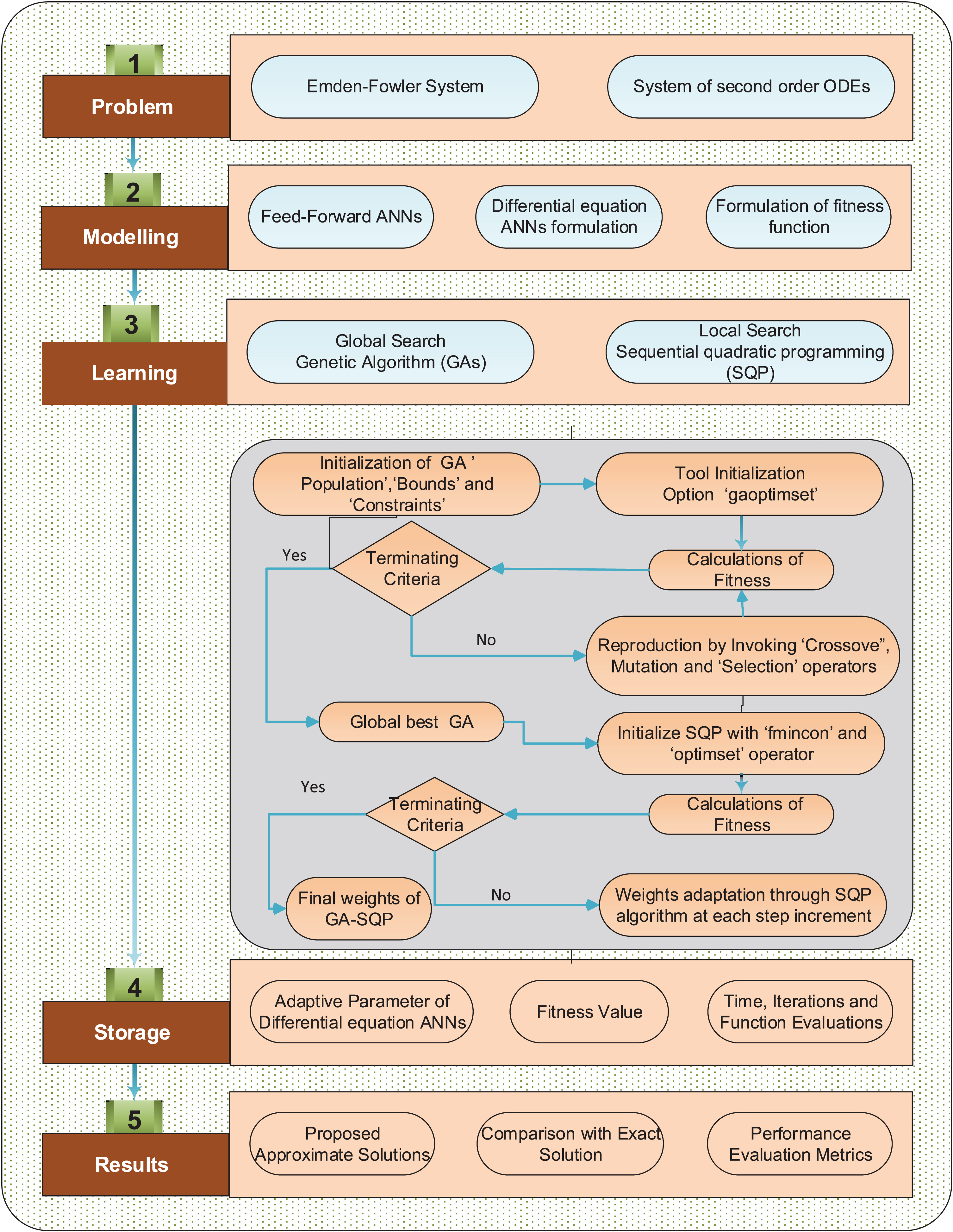
Workflow diagram of the proposed methodology.
Pseudo code for GA-SQP to optimize the systems
The performance measures based on the mean absolute deviation (MAD), root mean squared error (RMSE), and variance account for (VAF) are investigated on the functioning of the designed method. Mathematical form for both u(t) and v(t) of EFS in the form of MAD, RMSE and VAF are given, respectively, as:
The error function EVAF related to VAF mathematically given as:
Where, m represents the grid points. Global description of MAD, RMSE and VAF are formulated on the mean values of these operators over numerous independent runs. Mathematically, global variations of performance indices are indicated as, Global MAD (GMAD), Global RMSD (GRMSD) and Global VAF (GVAF) are used to scrutinize the designed methodology for solving the EFS.
The numerical study of the proposed methodology is narrated to investigate the EFS. Comparison of results are made with the exact solutions for three examples
The exact solution of the above system is [e t 2 , e-t2] and the fitness function is given as:
The exact solution of the above system is [t2 + e t 2 , t2-e t 2 ] and the fitness function is given as:
The exact solution of the above system is [
Optimization of all three examples of EFS is supported with the hybrid of GA-SQP for 100 multiple runs to achieve the modifiable networks parameters. Set of weights is also plotted in Fig. 3 for u(t) and v(t). These weights are used to find the approximate solution for all three examples. The mathematical form is given as:
The approximate values
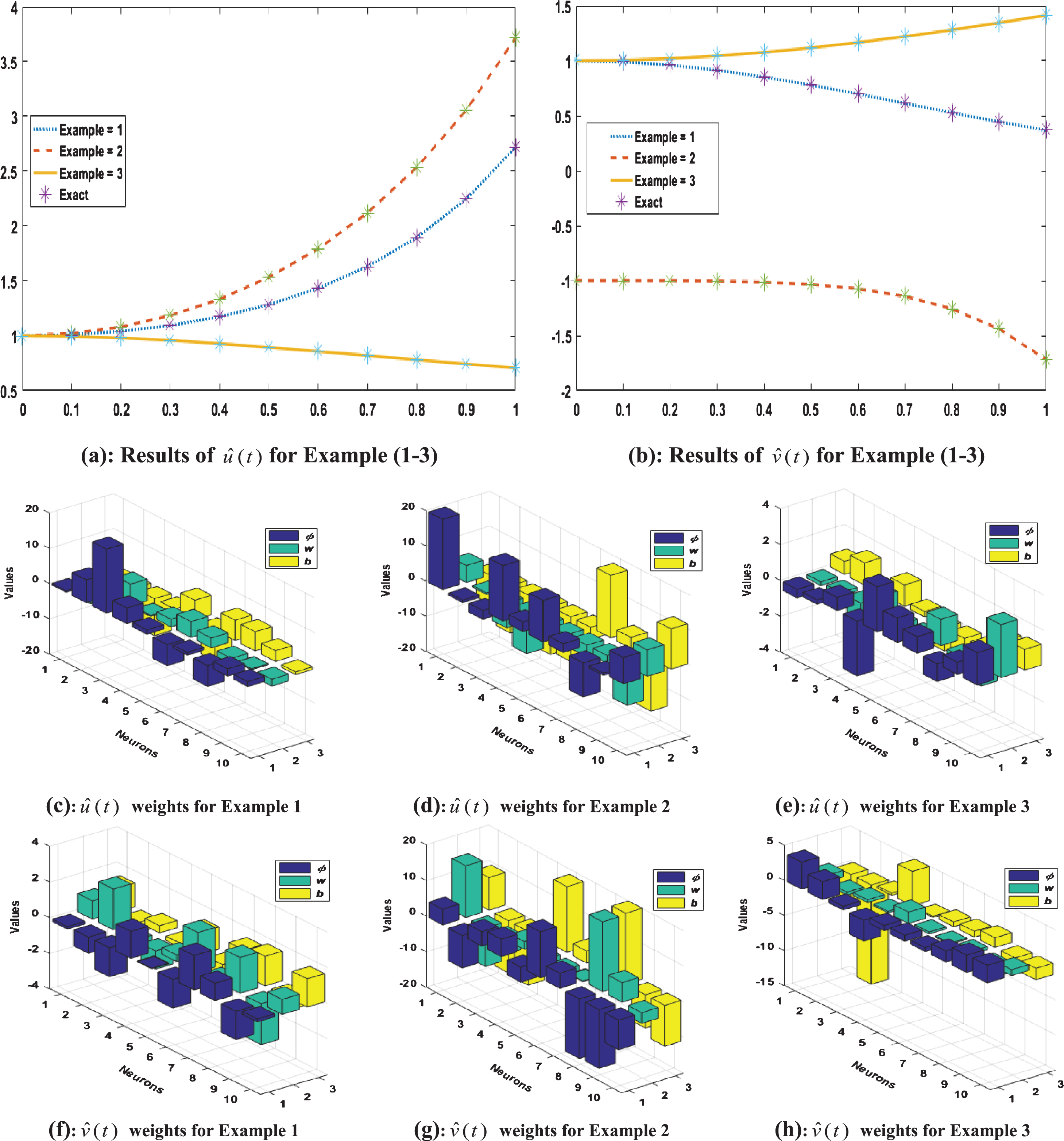
Set of weights and comparison of outcomes for Example (1–3).
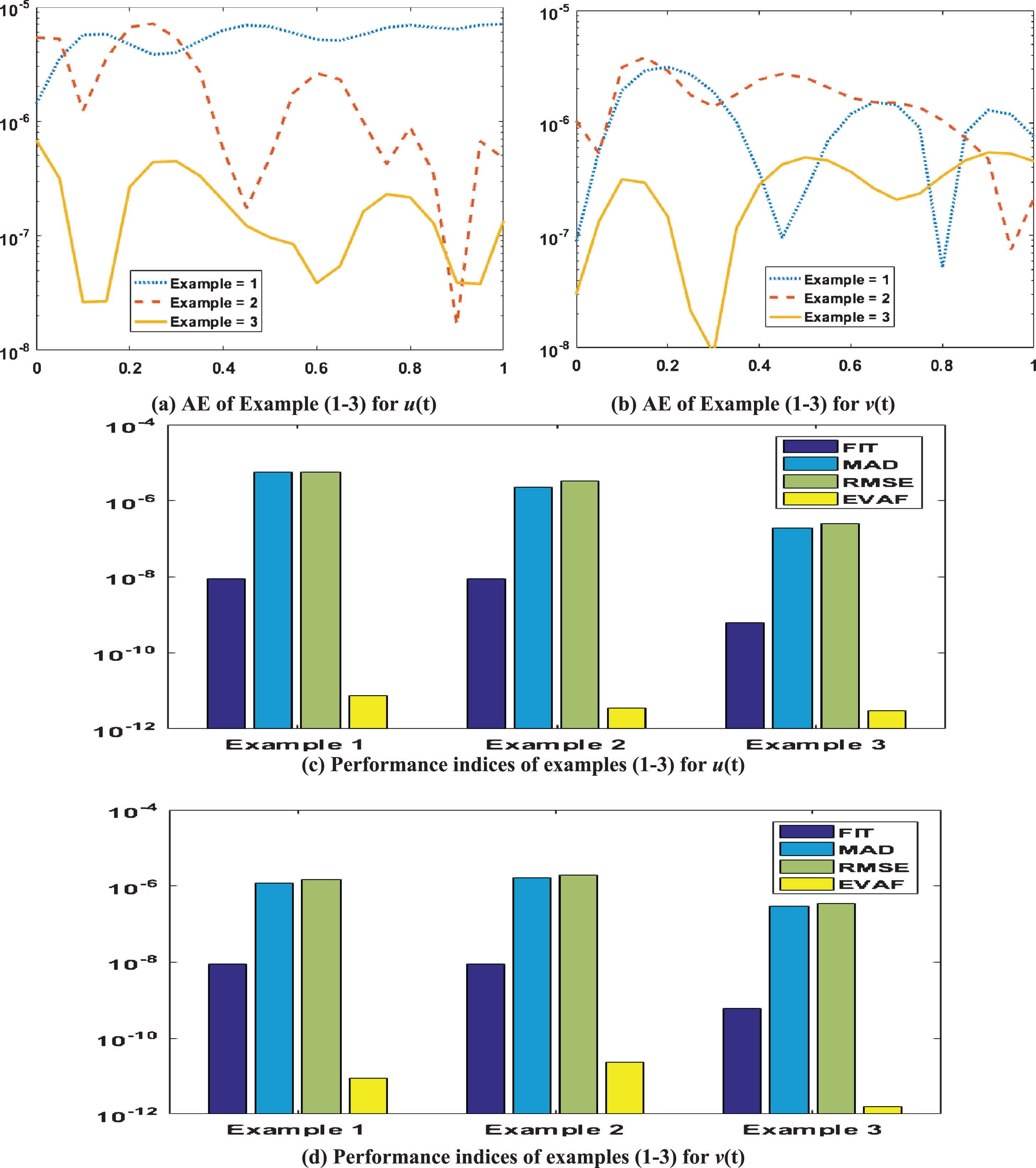
Absolute Error and Performance measures for Example (1–3).
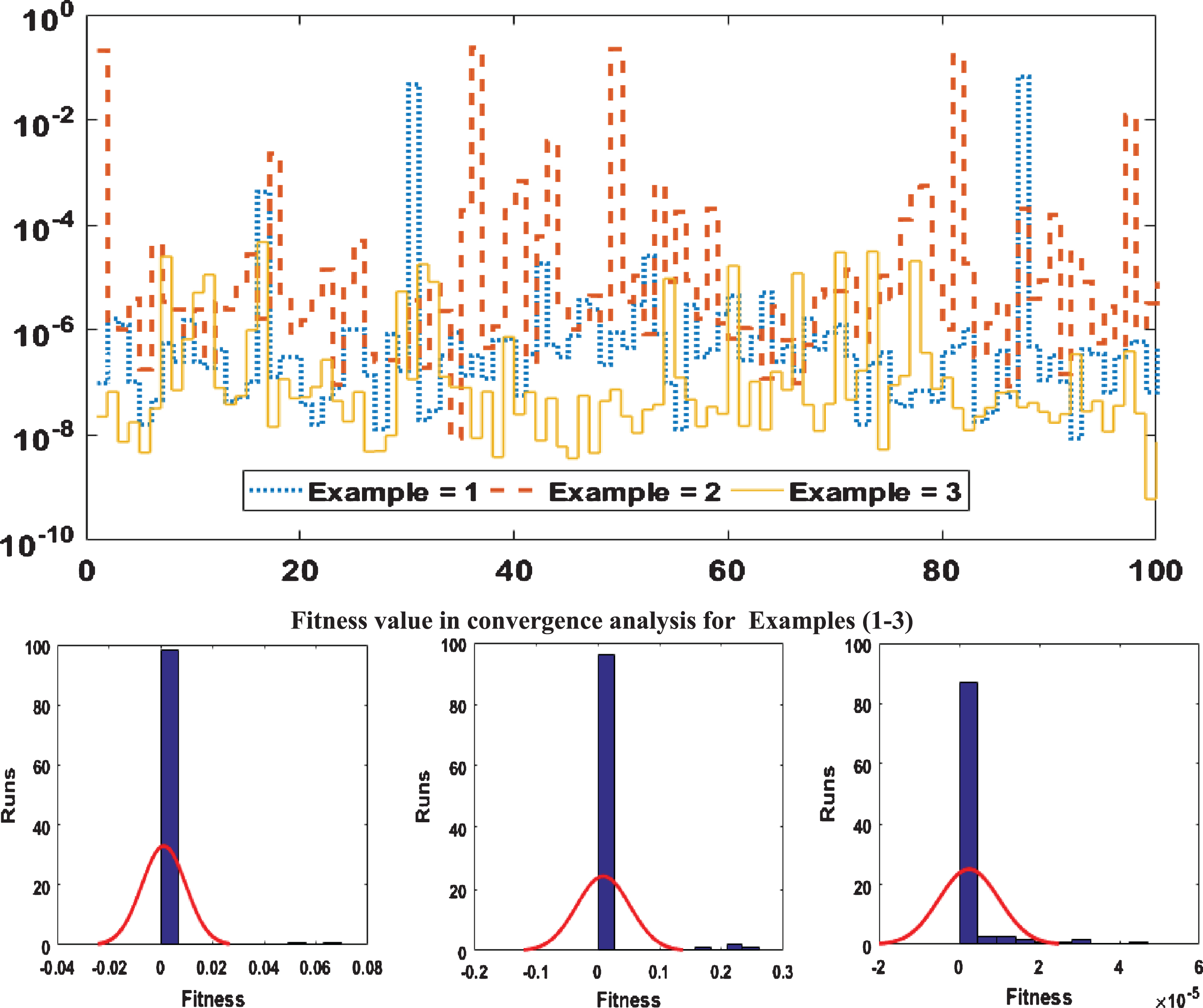
Fitness value and histogram of GA-SQP for Example (1–3).

MAD value and histogram of GA-SQP for Example (1–3).

RMSE value and histogram of GA-SQP for Example (1–3).
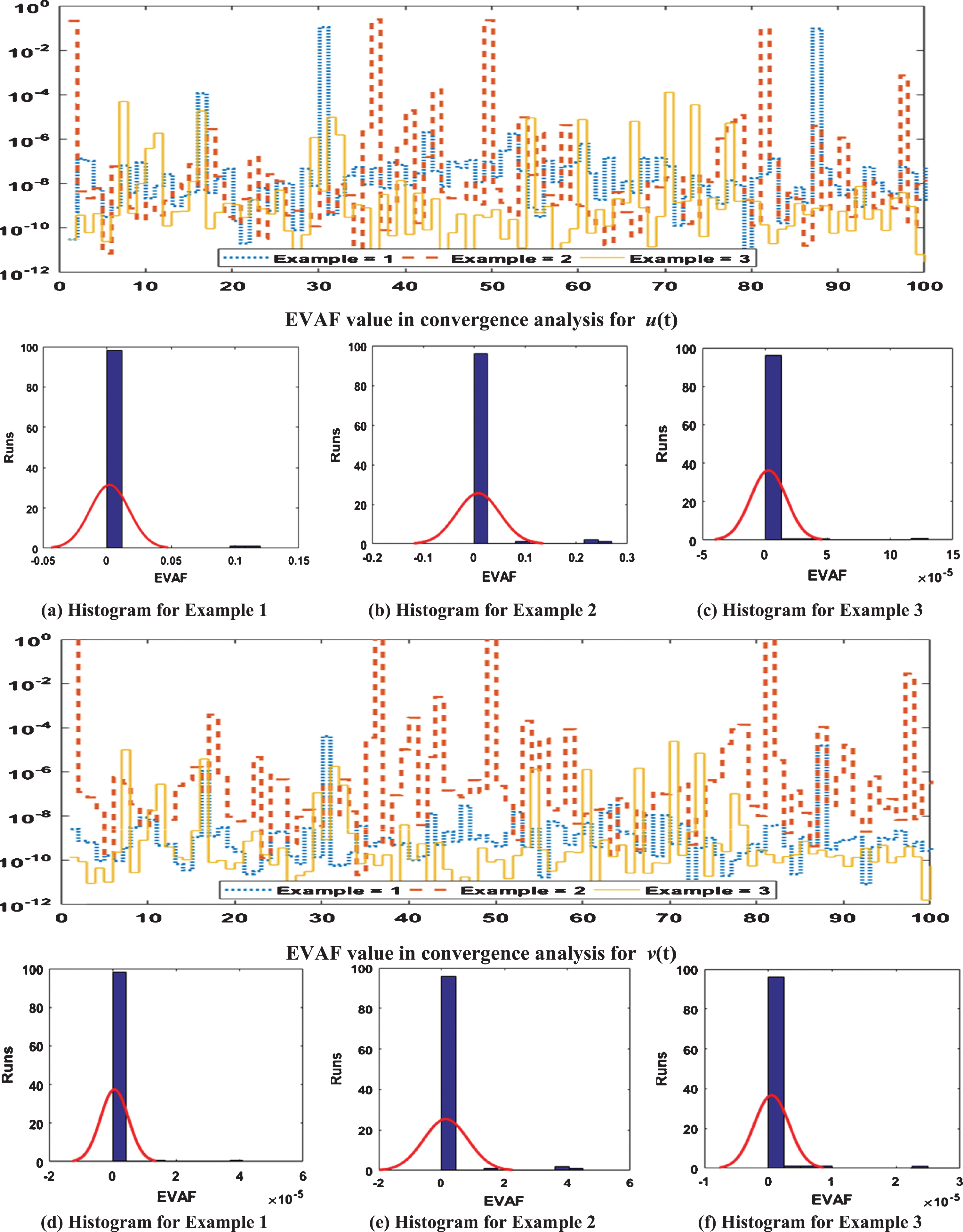
EVAF value and histogram of GA-SQP for Example (1–3).
For the precision of the proposed scheme, statistical analysis is established on the basis of minimum (Min), mean (Mean) and standard deviation (SD). The results of these operators for examples (1–3) are tabulated in Tables 2 (a-b) for
(a): Statistics outcomes of
(b): Statistics outcomes of
Global performance results of
Convergence analysis for problems (1–3)
Complexity analysis for problems (1–3)
The motivation behind this study is to solve singular system of Emden-Fowler model using ANNs optimized with GA, SQP and the hybrid of GA-SQP. Some key findings of the present study are summarized as: ANN applied effectively for solving the singular system of Emden-Fowler equation. By using the ANNs, the achieved outcomes using the proposed mythology are very accurate and reliable. To analyze the accuracy and convergence of the present method, statistical analysis is made for 100 independent runs to solve the model equation. The best AE values lie up to 10–05 to 10–09. However, the worst outcomes of AE lie up to 10–01 to 10–05. The statistical operators MAD, RMSE and VAF and their global forms are presented effectively with good agreements.
Funding statement
This work has been partially supported by Ministerio de Ciencia, Innovación y Universidades grant number PGC2018-097198-B-I00 and Fundación Séneca de la Región de Murcia grant number 20783/PI/18.