



Abstract
In order to further improve the students’ learning ability, discrete analysis of linguistic pseudo-parallel constructions and symbols under the activation diffusion model is performed. Taking English as an example, this paper analyzes the usage of false paratactic construction from the perspectives of violating the restriction rules of paratactic structure and the irreplaceable nature of “and”; briefly introduces the discreteness of English vocabulary and analyzes the metaphorical function of the cognitive mode of lexical discreteness. Based on the improved activation diffusion model, the experiment class uses the activation diffusion model to implement the false parallel construction and vocabulary discrete teaching, while the control class uses the traditional method to implement the false parallel construction and vocabulary discrete teaching. The final results show that the average English score of the experiment class is improved by 14.5%, while the control class is only improved by 3.2%. The results show that the activation diffusion model is helpful to grasp the pseudo paratactic construction and analyze the discreteness of English vocabulary.
Keywords
Introduction
Collins and Quillian proposed the activation diffusion model in 1975. This model is considered to be the most ideal model that can reflect the essence of mental lexicon. In this model, the concept of word meaning is represented by nodes, and the distance between nodes represents the degree of closeness between the two word concepts. We can see that if the distance between nodes is closer, the connection between concepts is closer. Conversely, if the connection distance between nodes is far away, the degree of cohesion between concepts is not good. Since 1975, the concept of activating diffusion teaching model has been used to combine vocabulary teaching. Foreign researches on this model have been in-depth, which provides a basis for domestic research. Domestic researches are mainly focused on cognitive psychology and second language acquisition [2]. From the perspective of the concept and characteristics of the activation diffusion model, Zhang Xiaodong explains that this model can effectively help students improve their vocabulary memory efficiency, improve their vocabulary quickly and effectively diverge students’ thinking. Zhang Yan discusses the activation diffusion model, semantics in vocabulary knowledge and deep vocabulary acquisition. He pointed out that the activation diffusion model can promote deep vocabulary acquisition and tries to find an effective vocabulary learning method. Yang Jienian explored the influence of activation diffusion model on students’ memory of vocabulary. In “activation diffusion model and English Vocabulary Teaching”, Zhang Baicheng pointed out that the teaching of English vocabulary should be carried out in the associative network of vocabulary. The methods of classification, contrast, association and so on make them connect with the existing words. Vocabulary teaching should be carried out from the concept knowledge, phonetic knowledge and syntactic knowledge of vocabulary. The lack of any aspect will lead to the difficulty of activating and extracting vocabulary from long-term memory, and reduce the probability. He also pointed out that the role of activating diffusion model in vocabulary review teaching cannot be ignored. However, he did not give specific methods of classroom teaching. Knowledge theoretically expounds the relationship between activation diffusion model and vocabulary teaching.
In this study, the activation diffusion model is used to analyze the discreteness of language vocabulary and the pseudo paratactic construction of language usage [13]. In the context of linguistics and semiotics, discreteness refers to the fact that linguistic symbols or components of symbols can be divided into definite boundaries and no continuous or gradual transition relationship between them, which is the premise of the analysis of linguistic structure. The language units with clear boundaries and discreteness can be either semantic (for example, phonemes) or semantic (for example, morphemes). There are discrete language units at both levels of language structure. Human beings strive to understand and describe the world accurately, which depends on the discrete language used by human beings to a great extent. Discreteness is a concept often used in language research, which reflects a way of observing and understanding the world [4]. As one of the attributes of language, discreteness, together with other attributes of language, makes language different from some non-verbal communication systems (such as the howling of animals), thus showing its unique flexibility, efficiency and accuracy. Because of this, language (symbol) is regarded as digital in the classification of analog and digital symbols in semiotics. Symbols that are not discrete are considered analog. “Digital” is the opposite of “analog”, which means clearer and more accurate [8, 19]. If language does not have discreteness, there will be no distinct, different or opposite phonemes, and there will be no meaning units such as morphemes or words formed by the combination of phonemes, which will inevitably present a chaotic state and lose the function of accurately expressing meaning. If there is no discreteness in language, there is no difference or opposition in language organization [9, 17]. The difference implies the same sex, that is, the relatively stable and recognizable features of language units, which complement each other. However, both difference and identity mean that language symbols are not continuous and fuzzy, but can be clearly distinguished or defined.
Taking English as an example, this paper analyzes the application of English vocabulary discreteness and pseudo paratactic construction. Taking senior students in a middle school as the object, the paper conducts the teaching experiment of English pseudo paratactic construction and vocabulary discreteness under the activation diffusion model, and verifies whether the activation diffusion model is helpful to master English pseudo paratactic construction clearly and analyze English vocabulary discreteness.
Algorithm definitions
Activation diffusion model
Collins and Quillian proposed a semantic memory model called activation extension model in 1975. In this model, words are not organized hierarchically, but a net composed of closely related nodes. Nodes represent the concept of words. The distance between words, i.e. the distance between nodes, represents the closeness between two nodes. The farther the distance is, the less the relationship between nodes is, and the closer the distance between nodes is, which indicates that the two nodes are closely related to each other. The more common the concepts are, the closer the connections are. The process of activating diffusion is like the diffusion process of sound. Far away from the speaker, the received sound is not as loud as the received sound near the speaker, which is related to the sound size of the speaker itself, and also related to the factors of sound propagation. However, the larger the sound diffusion ranges, the lower the sound volume. Although Collins and Quillian’s activation diffusion model has strong explanatory power, they also have their own defects, that is, they only focus on the semantic (conceptual) features of psychological vocabulary, but ignore the phonemic, syntactic, morphological features of vocabulary.
To solve this problem, bock and Levelt improved the activation diffusion model proposed by Collins and Quillian. They think that people’s vocabulary knowledge has three different levels: the concept level, the lemma level and the lexeme level. The content and organization of the concept layer is similar to the network model of Collins and Quillian, and it is also composed of nodes representing concepts, which are connected with other nodes through various semantic relationships [18]. The item level represents the syntactic properties of words (such as part of speech, basic collocation requirements, etc.). Although Bock and Levelt’s theories best reflect the nature of mental lexicon, the lexical level represents the phonological properties of lexicon, including the phonemic characteristics and pronunciation of lexicon. The specific example is as shown in Fig. 1:
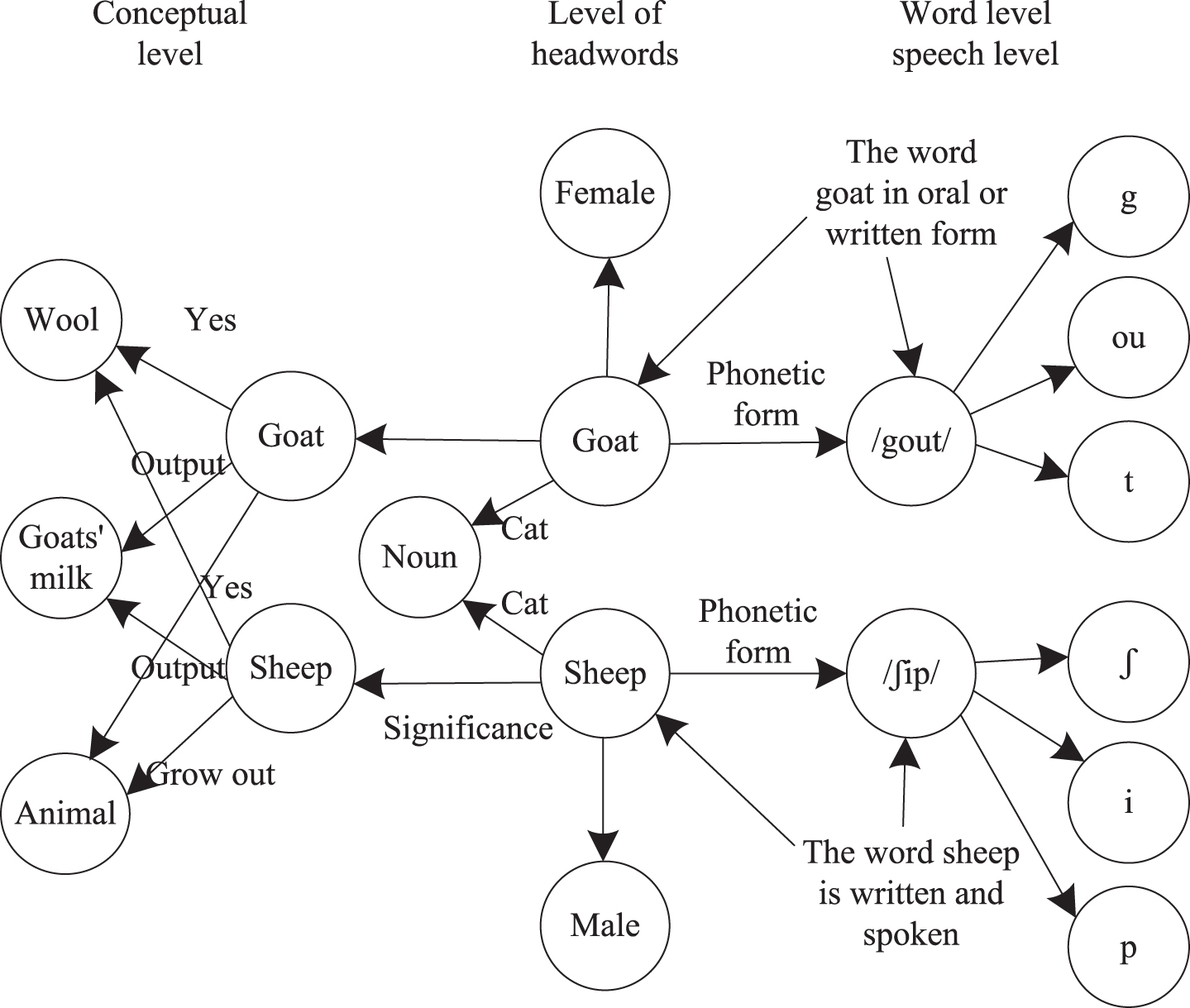
Example of improved activation diffusion model.
Bock and Levelt think that the communication activation model may be the best model to present the mental lexicon. Refer to the foreign research review, summarize the characteristics of the activation diffusion model:
One, the activation diffusion model is complex, which can be expanded and extended many times [10], and the nodes and the nodes can form a complex semantic network through the degree of semantic association.
Two, diffusion can be activated between nodes. When a node is activated, the node with the highest degree of association will be activated accordingly.
Three, Du Shichun thinks that the connection between nodes is reasonable and the activation diffusion model is flexible. It is impossible for the central word in the activation diffusion to spread indefinitely [21], and to a certain extent, it will stop.
In English, false paratactic construction refers to the use of “and” to connect two words to express a complete meaning. Quirk et al. formally put forward the word “pseudo coordination”, which regards false juxtaposition as an unconventional usage of juxtaposition structure. Rhetorically, the false paratactic construction is often called “Hendiadys”, which appears in literary works, especially in Shakespeare’s plays. Hendiadys comes from Greek, in Oxford English dictionary, Hendiadys is defined as “A figure of speech in which a single complex idea is expressed by two words connected by a conjunction; e.g. by two substantives with and instead of an adjective and substantive”. “Two words and one meaning”: the conjunction “and” connects two independent words to express a complete meaning. For example, “nice and warm” means “nicely warm”; and “try and get” is similar to “try to”. Different from common juxtaposition, false juxtaposition has its special form and significance. By combing the research of the false parallel construction at home and abroad, we hope to form a more systematic understanding of the construction and put forward the prospect for the future.
The universality and particularity of false juxtaposition have been paid more and more attention by scholars. In this paper, the research of false juxtaposition will be summarized with the research development stage as “Jing” and different theoretical perspectives as “Wei”.
Traditional grammar
From the perspective of traditional grammar, the study of pseudo paratactic construction mainly describes its classification and significance. Poutsma first analyzed several structural types and semantics of tautology in 1917: “noun and noun”, “adjective and adjective”, “verb and verb”, etc. For example, “gold and cups” refers to “gold cups” and “nice and warm” refers to “nicely warm”. Wright has made statistics on the tautology in Shakespeare’s plays, among which the nominal tautology structure is the most, accounting for 78%. This shows that tautology, as a rhetorical device, especially the nominal structure, plays an important role in text modification.
Transformation generation syntax
The formal research on the false juxtaposition began in the 1960 s. Chomsky established transformational generative grammar in the 1950s-1960 s, marked by the syntactic structure published in 1957. Generative grammar provides a more objective and rational method for language description and overcomes the subjectivity of traditional grammar [5]. From the perspective of generative grammar, the study of pseudo paratactic constructions starts from Ross’s constraints on variables in syntax. In foreign studies, pseudo collocation is generally regarded as a verb false paratactic construction by default and syntactically analyzed. Through reading the relevant literature, this paper summarizes the syntactic features of the false paratactic construction as follows:
Violating the restriction rules of parallel structure
False juxtaposition is an “exception” of common juxtaposition, which violates the coordination structure constraint (CSC) formulated by Ross.
CSC: In a coordinate structure, no conjunct may be moved, nor may any element contained in a conjunct be moved out of that conjunct.
For example: One, “Ralf admired Kgomotso and Peter had the hots for Tjitske”.
When the first juxtaposition in a sentence is extracted, a question will be obtained:
Two, *who did Ralf admire and Peter have the hots for Tjitske?
Obviously the sentence is illogical. Ross added two exceptions, one is the ATB (across the board) model, and the other is the pseudo coordination (not called “pseudo coordination” at that time). In contrast to CSC, the argument of each juxtaposition can be extracted separately. As follows:
Three, what did you go and get?
In the three, get arguments are extracted separately, which is also consistent with the expression habit.
The same morphological inflection
Carden & Pesetsky pointed out that in the verb false paratactic construction, the inflectional changes of two paratactic verbs must be consistent. Ross, D. further pointed out that in the false juxtaposition try and V construction, “try” not only follows the inflection change of the main verb “V”, but also follows the bare form condition of Carden & Pesetsky, that is, try and V are generally inflectionless.
Avoid non agent subjects
In the research of Pullum et al, it is proposed that although the subject of the false juxtaposition construction such as and-V construction can be agent subject or non-agent subject, the construction tends to avoid the use of non-agent subject [6], and the subject is mostly human.
Distribution
De Vos points out that in common juxtaposition, “both” can be used to modify two separate events, but in false juxtaposition, two verb juxtaposition items cannot be modified by “both”. The reason is that the false paratactic construction expresses the meaning of “a complete event”. Such as:
Four, John both ate some cake and drank some tea(juxtaposition)
Five, *what did John both go and read (false juxtaposition)
In the five, both failed to decorate “go and read”.
The irreplaceable nature of “and”
In the construction of false juxtaposition, the conjunctions are only “and”, which cannot be replaced by conjunctions such as “or”.
For example: six* What did John go or read?
This paper summarizes the characteristics of false paratactic construction from the perspective of generative grammar as follows: violating the restriction rules of paratactic structure, inflectional changes of the same form, avoiding non agent subjects, distribution characteristics and the irreplaceable of and. The analysis of these formal levels is helpful to form a more systematic and in-depth understanding of the formation of false juxtaposition.
Sperber & Wilson’s relevance theory is a cognitive theory about human communication and discourse understanding. Relevance is the basic factor that always restricts human communication. The core idea of relevance theory is to pursue the best cognitive effect with the least effort [14]. In relevance theory, relevance is regarded as a characteristic of utterance, thought, memory, behavior, voice, scene, smell, etc. When the input content is worth processing, it has relevance [23]. So, what makes input worth processing can be explained according to cognitive effect and processing effort. Relevance theory distinguishes three kinds of cognitive effects or contextual effects: (1) the combination of new information and existing contextual assumptions produces new contextual implications; (2) new information strengthens or weakens existing contextual assumptions; (3) the contradiction between new information and existing contextual assumptions negates or excludes existing contextual assumptions [3]. Relevance theory puts forward two basic principles: cognitive principle and communicative principle.
The cognitive principle of Relevance: human cognition tends to be consistent with the maximum relevance.
Communicative principle of Relevance: every ostensible communicative act should be supposed to have the best relevance.
Relevance theory points out that discourse understanding includes modular decoding process and non-modular reasoning process. The former forms the logical form of discourse, while the latter forms the explicit content (explicit meaning) and implicit information (implicit meaning). Explicit content is an explicit hypothesis derived from direct reasoning of the logical form encoded by discourse. Incomplete logical forms are enriched into explicit contents of discourse through reasoning [15]. There are two aspects to the logical form of reasoning enrichment: on the one hand, the process that the listener obtains the complete proposition content from the incomplete logical form; on the other hand, it involves embedding the proposition into the corresponding speech act or proposition attitude description. That is to say, every explicit content has to go through the process of language decoding and pragmatic reasoning [24]. Explicit meaning includes not only the propositional content of utterance, but also a series of high level explicit expressions of speech acts and propositional attitudes. The implied information in relevance theory is relative to the explicit content. It is not an extension of the logical form of discourse, but an explicit hypothesis derived entirely from pragmatic reasoning [12]. Some of the implied information is the contextual hypothesis that the speaker intends to express, or the contextual premise of the reasoning process, or the contextual conclusion.
The difference between “saying” and “implication” by Griac (1975/1989) is different from that of “explicit” and “implicit” by Sperber and Wilson. According to Griac, explicitness means that utterances express certain propositions directly. In order to make clear what utterances say, i.e. what propositions are expressed explicitly, the hearer must decode the utterances to obtain the semantics [11]; and implicature is related to the violation of the principles of cooperation, which needs to be understood through pragmatic reasoning. What Grice’s theory of conversational implicature is concerned about is mainly darkness Communication. However, Sperber’s and Wilson’s relevance theories attach the same importance to explicit communication and implicit communication. In their opinion, there are two steps to draw implicit meaning from explicit theory: first, draw implicit premise, and then derive implicit conclusion. Grice’s theory of conversational implicature is not perfect for the interpretation of explicitness and implicature. For example, B’s answer in [10] suggests that they should not wait for Jane any longer. There are two implicit premises: she said that if she is late, we can wait for her, and we have waited for half an hour. Moreover, the two premises are parallel in function, and they jointly deduce the implied conclusion, that is, the implicit meaning of the sentence. The cognitive effect of and paratactic sentence is obtained by two clauses participating in the reasoning process as contextual premise. We simply express the reasoning process as seven.
Seven, A: Shall we start without Jane?
B: Well, she did say to start if she was late, and we have been waiting for half an hour now.
Eight, a. Jane said to start without her if she was late. Explicit / premise
b. We have been waiting for Jane for half an hour now. Explicit / premise
c. If someone says to start without her under such and such conditions, it is reasonable to start without her if those conditions pertain. Highly accessible contextual hypothesis / implied premise
d. We should start without Jane if she was late. Implied conclusions from a and c.
e. If we have been waiting for half an hour for Jane, she is late. Highly accessible contextual hypothesis / implied premise
f. Jane is late. Implied conclusions from b and e.
g. We should start without Jane. Implied conclusion from d and f (implicit meaning).
The purpose of speech communication is to change the cognitive context hypothesis of the hearer. Therefore, the speaker must make pragmatic constraints on the hearer’s discourse understanding when generating the discourse [1]. The process of speech communication is a process in which both sides of communication take part in the assumption of cognitive context. In such an ostensive inferential communication mode, in order to guide the hearer’s discourse understanding and provide cognitive direction for information processing, so as to realize the pragmatic restriction of discourse understanding, the speaker will use some ostensive language means, such as the use of discourse connectors or discourse markers, to reduce the efforts of the hearer in understanding the utterance, it is easier to find the relevance of the utterance. The successful hearer who has achieved verbal communication also has reason to believe that the speaker will not make him pay unnecessary cognitive efforts.
Analysis of the discreteness of linguistic signs – Taking English as an example
General explanation of English vocabulary discreteness
Linguists usually pay attention to the discreteness of low level or secondary level of language structure. For example, from the perspective of phonetics, the difference between [p] and [b] in English is not absolute, there is a continuous or non-discrete change between them; any of them is a sound series, and there is no clear boundary between them. But from the perspective of phonology, /p/ and /b/ have different functions in English, which can be proved by the minimal pair composed of pet and bet. In this case, there is a clear boundary between the two. Any sound like /p/ and /b/ cannot be accepted, either as /p/, or as /b/. The relationship between the two can be expressed as follows: p Ve q. In other words, they are distinct and discrete. From this exegesis, we can also find that when /p/ and /b/ are considered to be discrete - in a discontinuous relationship, meaning has become a factor to be considered, although they do not carry meaning themselves.
In addition, by the way, in the view of some linguists, phonemes are just a collection of several distinctive features, so whether the distinctive features also reflect the discreteness? For example, /p/ can be regarded as composed of “bilability”, “voiceless”, “plosiveness” and other features. Are these distinctive features discrete? The answer is yes. However, unlike phonemes, distinctive features are not presented in a linear way one by one, but in a certain phoneme at the same time. Although there is no need to consider the meaning of distinguishing features, the phonemes they distinguish have the function of distinguishing meaning.
The process of defining something as a symbol itself involves changing continuity into discreteness. Here “symbol” is generalized, not only referring to language symbols. The process of things being classified or normalized implies discreteness. In other words, the distinction between things and the discreteness of things complement each other. Discreteness exists not only in the low level of language structure (i.e. the phonetic level), but also in the high level of language (i.e. the expressive level). This level is composed of detached or discontinuous language units, such as morphemes or words. For them, discreteness also has explanatory power [22]. Compared with the phoneme which does not carry meaning, the word or morpheme which carries meaning in language should be discrete in two aspects: form and meaning (including grammatical meaning). The meaning of each word can be clearly defined, forming differences and opposites between them. Even two homonyms with the same pronunciation and writing form, such as bear and bear, have obvious differences or boundaries in their meanings and are still in a discrete relationship. Synonyms with almost the same meaning (commonly known as “synonyms”) are also clearly demarcated, that is to say, they are still different from each other in some aspects of meaning.
In some other symbol systems, such as traffic signals, discreteness also exists, but in such a complex and mature symbol system, discreteness is more significant. In a language, there are few phonemes which are meaningless but used to express meaning, but there are countless morphemes or words which are composed of these phonemes to carry meaning [7, 20]. As Bloomfield said, things referred to by language symbols, which is, the whole content of the real world, are changeable. Therefore, it is necessary to combine these limited phonemes continuously to form a large number of morphemes and words with meaning; the continuous combination of words can form more sentences. So, obviously, one of the preconditions for the realization of this combination is discreteness, which includes both the discreteness of phonemes and morphemes and words.
The analysis of metaphor by discrete cognitive model
Language is the expression of human thoughts, but no matter how complex the world we see or the inner world is, we can’t express the world without deviation. The imprecision of language makes people more inclined to use rhetoric to express emotion, and the polysemy of a word (i.e. belonging to multiple sets) makes metaphor more popular. Lakoff points out in the contemporary theory of metaphor that metaphor is a systematic mapping from a concrete conceptual domain to an abstract conceptual domain: metaphor is a problem at the level of thinking, not at the level of language expression. Therefore, metaphor is a way of thinking and cognitive means. Human beings tend to connect with similar things, which provide multiple possibilities for metaphor.
Lakoff and other cognitive psychology think that human beings have three cognitive styles: convergent cognition, divergent cognition and connected cognition. In this paper, we use convergent cognition to make a brief analysis: language is human thinking. When people recognize or express strange things, they first start convergent cognition, that is, they think of their similarity with known things, so as to eliminate strangeness as much as possible. It is convergent cognition that makes people quickly discover the similarity and relevance of things, and classify new names into some set according to their main features, and form intersection with other sets according to other features. These continuous sets, intricate intersections and discrete elements in each set constitute a metaphor with great charm and beyond imagination.
Lakoff and Johnson “wrote that” the essence of metaphor is to understand and experience one thing or experience through another thing and experience.” As a figure of speech that directly uses the metaphor to replace the ontology, metaphor is based on the similarity between the original and the vehicle, which is based on intersection from the perspective of set.
Nine, her sorrow flooded, once recalled her husband′s death.
In cognitive sentences, people come across the unrelated words “borrow” and “flood”. How does “sorrow” relate to “flood” and how to complete this cognitive process are as shown in Fig. 2.
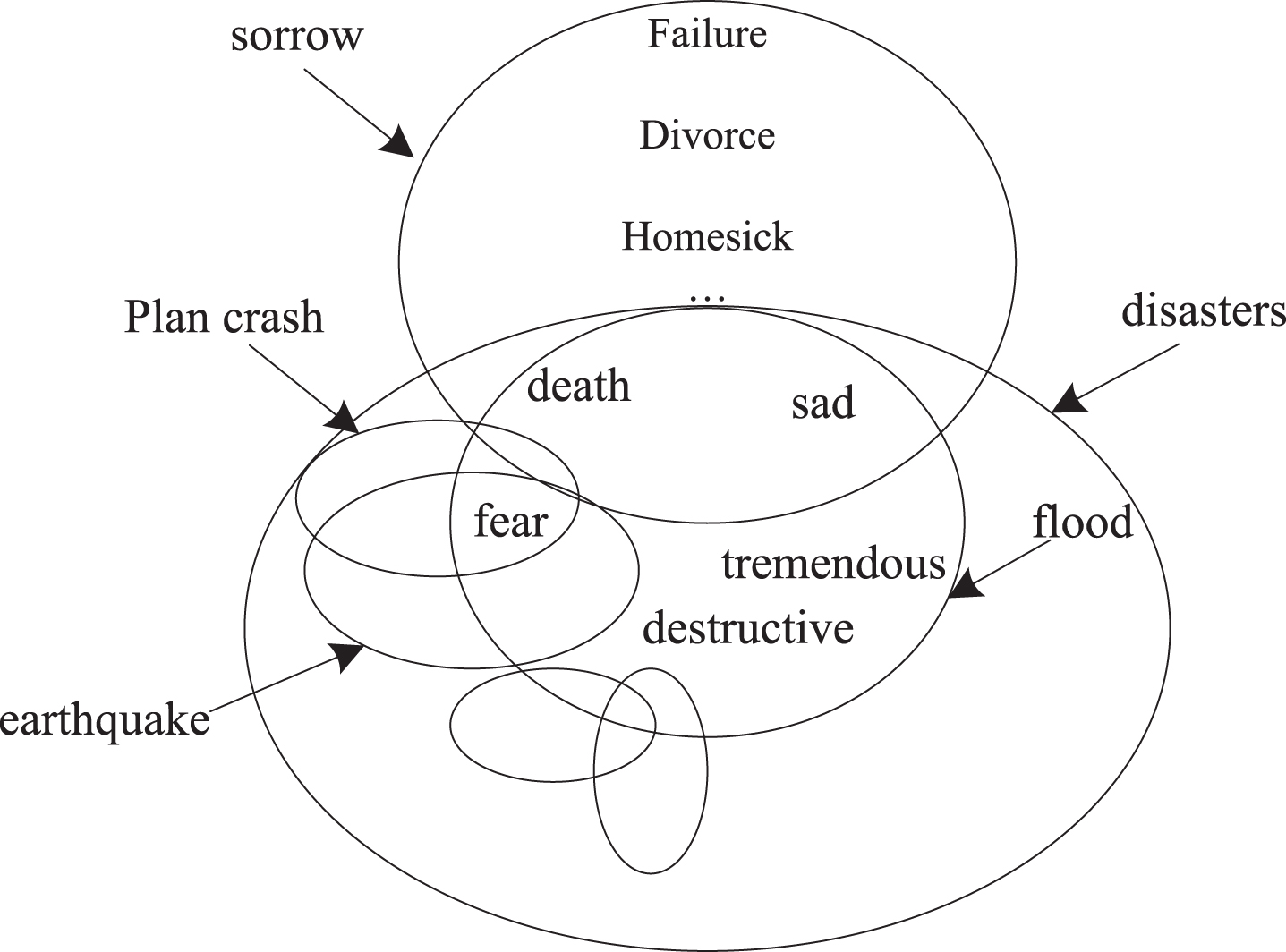
“Sorrow” and “flood” correlation process.
First of all, as two separate elements, “borrow” and “flood” have their own characteristics. They belong to their own discrete sets. For example, “flood” belongs to the “plan crash, earthquake, tsunami” included in “disaster” to represent the set of disasters. In this large set, various disasters have their own characteristics and intersect with each other. Even in the example “what a disaster book I’ve brought!”, the intersection of “book” and “disaster” can be formed.
Second, the elements contained in each of our two collections. For example, the discrete quantity of “sorrow” may contain many elements: failure, sad, death, homesick, etc.; while the characteristics of “flood” include huge, destructive, death, panic, etc. The two sets form a similar intersection: sad and death. The characteristics of human convergent cognition make us connect the two and form a wonderful metaphor.
Subjects
Taking one or two high school students in a parallel class with similar average English scores as the research object, one class was randomly selected as the experimental class, and the improved activation diffusion model was adopted to complete the teaching of English false juxtaposition and vocabulary discreteness. The other class was the control class, which adopted the traditional teaching mode. The reason why the senior students are chosen as the subjects of this experiment is that they have a certain English foundation after the English learning of the senior high school entrance examination. The number of subjects in this experiment is 106, and the average time for the subjects to learn English is at least 5 years, which fully meets the requirements of using activation diffusion model to learn English pseudo juxtaposition and vocabulary discreteness in the experiment, which can better guarantee the accuracy and validity of the data.
Questionnaire, literature, comparative research and interview were used to ensure the validity and authenticity of the experimental data.
Questionnaire design
In this experiment, 203 questionnaires were sent out and 200 were recovered. The subjects were freshmen in senior high school. The questionnaire was set up to investigate the current situation of English vocabulary learning, and the factors that affect the learning of English vocabulary, such as the common methods of English vocabulary learning, the degree of forgetting and the frequency of reciting words. The investigation of these factors can provide the factual basis and preconditions for English teachers to implement the new vocabulary teaching mode in class. Before the experiment, it is helpful for the implementation of the experiment to know the current situation of the subjects’ English vocabulary learning before the experiment. It also provides reference and factual basis for the following teaching suggestions to ensure the accuracy of the experiment. The questionnaire can be divided into the following categories: factors that affect high school students’ English vocabulary learning, self-learning of English vocabulary, methods to improve English vocabulary and self-assessment of high school students’ English vocabulary. The questionnaire is shown in Table 1:
Questionnaire
Questionnaire
The pre-test and post-test papers used in this experiment are all composed of exercises related to the textbooks of the people’s education publishing house, without any super outline questions, which are fully in line with the students’ psychological development and actual knowledge level.
The experiment was carried out in the second half of 2018 and lasted for one semester. The purpose of this experiment is to test whether the combination of activation and diffusion teaching mode can promote students’ learning of false juxtaposition and vocabulary discreteness, and whether it can help students memorize English vocabulary quickly and effectively.
In the English class of the experimental class, the teaching mode of activating diffusion is adopted, because the teaching method is only for vocabulary teaching. According to the syllabus and class schedule of English, it is adjusted to two classes a week for vocabulary teaching under the mode of activating diffusion, including new words explanation, vocabulary review and solving vocabulary related exercises in the classroom of the experimental class, which are mainly introduced and explained how to use the activation diffusion model to memorize words to explore the depth and breadth of words and deepen the memory. For example, the word “dispute” has the concept of noun debate and argument, and it also has the meaning of verbs, transitive verbs: and an intransitive verb: debate, controversy, debate, etc. The synonyms with the same meaning as debute are argue, dispute, converse, arguent, etc. When debate is a noun, the related phrases are under debate and open to a debate. As a verb, the related phrase is hotly debute. At the same time, the commonly used synonyms of debute, such as the usage of argue, as a verb, have the following phrases: argue with sb./argue aboutsth/argue for sth/argue for doing sth /argue against sth/argue against doing sth. Arguable and argumentative are the related new words. The activation diffusion model of debate is as shown in Fig. 3:

Activation diffusion models of vocabulary “argue”.
As can be seen from the figure, the closer the arrow is to the debate, the closer the relationship between the word and debate is, that is, the knowledge points that are often used in sentences, reading and conversation. The farther the word is from debase, for example, the less close it is to debate. Here, the argue is listed and in terms of vocabulary depth, the more activation and diffusion of argue is. The big reason is that argue is more interchangeable in terms of vocabulary usage and is often used for comparison or exchange, so teachers should adjust the diffusion model appropriately to help students learn the model with pertinence and some misplacement, better help students learn key and difficult vocabulary, which is also helpful for students to better use words.
Experimental test results and comparative analysis
At the beginning of September 2018, the author tested the students’ learning level in the aspects of false juxtaposition and vocabulary discreteness, and at the end of December 2018, all the students took the post-test. A total of 106 students from the experimental class and the control class took the two tests. The content of the test paper is mainly vocabulary test, 100 point system, 70 points and above pass, 80 points and above good, 90 points and above Excellent. Before the experiment, the experimental class and the control class were tested on the same test paper at the same time. The full score of the test paper was 100 points. The average score of the test in the experimental class is 74, while the average score of the pre-test in the control class is 72, which shows that the vocabulary level of the two classes is basically the same. In addition, it can be seen from the data that the test scores of the two classes are low, which indicates that the subjects’ vocabulary is not mastered properly.
According to the comparative analysis of students’ English test scores before and after the experiment in Table 2, we can draw the following conclusions: the vocabulary activation diffusion teaching mode improves the English scores of the experimental class, the average score of the experimental class before the experiment is 76, the average score after the experiment is 87, and the average score before and after the experiment increases by 14.5%. At the same time, for the control class without activating diffusion teaching mode, the average English score in the pre-test and post test results has slightly improved, from 74.5 points in the front test to 77 points in the post test, but compared with the experimental class, the performance of the control class has only increased by 3.2%. It can be seen that the teaching mode of activating diffusion is better than the traditional teaching mode in the teaching of false juxtaposition and vocabulary dispersion.
Comparison and analysis of students’ before and after tests
Comparison and analysis of students’ before and after tests
Activating the teaching mode of diffusion can also promote students’ overall English average score. It can be seen from Table 2 above that the standard deviation of the experimental class before the experiment is 19.65, the standard deviation of the experimental class after the experiment is 13.17, and the standard deviation before and after the experiment is reduced by 6.48. In contrast, the standard deviation of the pre-test and the post test of the control class was 19.07 and 17.43 respectively. After the pre-test and the post test, the standard deviation of the control class decreased by 1.64. It can be seen that the ratio of the reduction of the standard deviation of the average performance of the experimental class implementing the activated diffusion teaching mode was lower than that of the control class. There are 4.84 more examples, which shows that the teaching method of the experimental class can effectively reduce the problem of polarization of English scores in the class, reduce the gap between the students with excellent English scores and the students with poor English scores, and improve the overall scores of students. Therefore, we can draw a conclusion that in senior high school English classroom activities, using the teaching mode of activation and diffusion to guide the design of false juxtaposition and vocabulary discrete teaching is more effective than the traditional teaching method, and more conducive to improving students’ performance.
Before and after the experiment of activating diffusion teaching mode, it is found that teachers lack the teaching skills of activating diffusion teaching mode. In the experiment of false juxtaposition and vocabulary discreteness, teachers should guide students to learn words according to certain context, find a suitable activation point according to the characteristics of students’ knowledge and mental age, and help students to stimulate and establish semantic network model enables students to better understand the words they have learned. However, in the actual use of the teaching mode in the classroom, students often pay too much attention to the context situations put forward by the teachers, which leads to the excessive divergence of students’ thinking in the classroom. Over time, it challenges the ability of teachers to guide and control the classroom, and students cannot grasp the key points of the classroom. Secondly, due to the limited class hours of English teaching, the limited class time given to vocabulary teaching, students are more unfamiliar with the activation of teaching mode, so it is more necessary for teachers to master certain teaching skills to deal with and control the possible problems in classroom teaching. Teachers should not only stimulate students’ semantic network, but also take into account the teaching of some lexical methods in traditional vocabulary teaching. They should not only select effective activation points, but also pay attention to the scope of the situation to guide students’ thinking direction. Teachers should also take into account the level of vocabulary, word position and concept, so the challenge to teachers’ teaching skills should not be underestimated.
The teaching age of English teachers interviewed in this interview is basically 8 years, 10 years and 12 years, with rich teaching experience.
Question 1: compared with the traditional English teaching method, what changes will be brought to your teaching based on the activation diffusion model in the implementation of English false juxtaposition and vocabulary discrete teaching? The three teachers interviewed think that the activation diffusion model teaching method will bring the following changes:
First of all, from the perspective of teacher-student relationship, the interviewed teachers think that there are more exchanges and contacts with students, and students are more active in the classroom, and the relationship between teachers and students is more harmonious. Secondly, in terms of teaching methods, the former teaching method of English vocabulary and pseudo paratactic construction was mainly based on traditional teaching methods, supplemented by other teaching methods. Among them, the auxiliary teaching methods are situational teaching method, task-based teaching method and teaching mode are relatively rigid, and the teaching enthusiasm also drops. Now, based on the three links of driving, facilitating and evaluating of output oriented method, schema is used. Associating the relationship between words with diagrams greatly supports the classroom practice in theory, enables teachers to effectively organize the classroom activities of vocabulary teaching, integrates vocabulary teaching into the context of the text, instead of learning words and reciting sentences in isolation, closely integrates reading teaching and vocabulary teaching, and truly achieves the goal of reading by reading Promote writing.
Question 2: what difficulties do you think will be encountered in the implementation of activated diffusion model teaching?
In the interview with three teachers, one teacher thought that the implementation of teaching students to learn vocabulary can greatly stimulate students’ thinking and divergent thinking ability, but sometimes students’ thinking is too divergent to grasp the extent of vocabulary diffusion. A teacher thinks that high school students have a lot of tasks and subjects, especially in English teaching, the proportion of single learning sentence false juxtaposition and vocabulary discrete course is not very large, especially the model takes more time in these two kinds of teaching, so there may be the possibility of insufficient time. Another teacher thinks that when choosing the activated words, he needs to teach the students some activation methods. Excellent words are suitable for activation, while some words are not suitable for activation. So when activating, he needs to teach the students some methods and skills of processing and activating words.
Through the interview and analysis of teachers, we can see that English teachers hold a positive attitude towards the application of this model to the teaching of sentence false juxtaposition and vocabulary discreteness. Teachers accept this new teaching method, and think that this teaching method stimulates students’ enthusiasm and participation in the classroom, and is also conducive to creating a student-centered classroom. Teachers can see the improvement of students’ academic performance, and also greatly mobilize the enthusiasm of teachers.
Conclusions
Under the guidance of the activation diffusion model, this paper combines the activation diffusion model with the false juxtaposition structure and the vocabulary discrete teaching, and conducts a one semester empirical study in a senior high school. The purpose of this survey is to understand the effect of the activation diffusion model on students’ learning English false juxtaposition structure and vocabulary discrete. The results show that the activation diffusion model significantly promotes the false juxtaposition. The study of column construction has a positive effect on the analysis of English vocabulary discreteness.
In view of the current situation of the study of English false paratactic constructions, the following tentative ideas are put forward:
One, the theoretical perspective and research content can be explored from the perspective of cognitive linguistics. For example, we can discuss the characteristics of false paratactic constructions from the perspective of construction grammar. From the perspective of construction grammar, the study regards the false paratactic structure as a construction, and pays attention to the role played by the construction. The construction is the prescriptive pairing of form and meaning. It emphasizes the interaction between form and meaning, which makes up for the problem of focusing only on form or meaning in the past. Analyzing the cognitive mechanism of this construction from the perspective of cognitive semantics is a deep exploration of the previous semantic research.
Two, in terms of research methods, quantitative research and qualitative analysis can be combined to conduct quantitative research on the pseudo paratactic constructions such as V1 and V2 or A1 and A2 based on the real data of corpus, so as to overcome subjectivity.
Three, in research dimension, we can combine diachrony with synchrony. Language is developing constantly. Studying the diachronic evolution of language is helpful to grasp its development track and direction. Some scholars, such as Wulff, have noticed the grammaticalization characteristics of the existence of false paratactic constructions and the inheritance relationship with other constructions. The mysterious evolution track of false paratactic constructions needs to be revealed.
Four, in the practical sense, the contribution to the interdisciplinary field can be considered. For example, the study of the false paratactic construction is applied to the second language teaching to inspire the second language learners how to make the oral and written expressions more authentic; the study of the false paratactic construction is applied to the translation practice to make the translators pay attention to the particularity of the construction and improve the quality of translation. Through the review of the previous studies on false juxtaposition, we hope to have a more systematic understanding of the formation of false juxtaposition, and provide feasible suggestions for the future development direction of the study on false juxtaposition according to the current research situation.
Footnotes
Acknowledgments
The research is supported by Soft Science Research Project of Henan Province (192400410282) and Foundation Project in Henan polytechnic (2018-HZR-06).