




Abstract
Quality is of great significance in enterprises, strengthening and identifying enabling factors of quality defect management are one of core goals of organizational operation management. In this study, sense-making theory is adopted to identify organizational quality defect management enabling factors, and interval-valued hesitant fuzzy set ELECTRE for multi-attribute decision-making method and quantile regression analysis method are used to empirically identify and verify organizational quality defect management enabling factors, revealing influence size and scale, influence degree and influence significance level of enabling factors on organizational quality defect management. Empirical analysis results indicate that combination methods of sense-making theory, interval-valued hesitant fuzzy set ELECTRE for multi-attribute decision-making method and quantile regression analysis method can effectively identify organizational quality defect management enabling factors, which will have great promise in the field of organizational quality management and operation management based on the rationality, feasibility and applicability.
Keywords
Introduction
American famous quality management master Dr Juran had said that 21st century was the century of quality. Maintaining product quality, work quality, process quality and quality performance are of great significance in enterprise operation management. Facts and practical experiences have proved that enhancing organizational quality defect management ability and effectively identifying quality defect management enabling factors are effective ways to improve quality performance. Numerous domestic and international theory and empirical research results show that the main constituent elements of quality defect management include organizational quality monitoring (OQMM) (organizational quality internal monitoring (OQIM) and organizational quality external monitoring (OQEM), organizational quality defense (organizational quality defense hard elements (HE) and organizational quality defense soft elements (SE), organizational quality memory (OQM) [9–11, 26]. However, the literatures of mining organizational quality defect management enabling factors by theoretical analysis methods and qualitative research methods are relatively few. Furthermore, the literatures of empirically researching into organizational quality defect management enabling factors by combining with empirical research methods are also very few. Under the above background, this study puts emphasis on identifying and empirically demonstrating organizational quality defect management enabling factors on the basis of referring to related literatures and theories home and abroad. This study mainly discusses about three propositions: firstly, we use qualitative research method of sense-making theory (SMT) to identify organizational quality defect management enabling factors. Secondly, interval-valued hesitant fuzzy set ELECTRE for multi-attribute decision-making method (also named interval-valued hesitant fuzzy set ELECTRE or IVHFS for short) was applied to preliminary carry out empirical test of enabling factors identified by sense-making theory, set multi-attribute as multiple enabling factors, set plans (schemes) as target variables (dependent variables, namely organizational quality defect management), empirically identify enabling factors corresponding to target variables, determine precedence relationships among target variables in the role of enabling factors. IVHFS method integrates and fuses interval-valued, fuzzy set, interval hesitate fuzzy set and ELECTRE advantages, effectively deals with multi-attribute and multiple influence factors, judges and sorts out influence factors corresponding to target variables (dependent variables, schemes) and precedence relationships among target variables according to multi-attribute and influence factors, reasonably positions and identifies target variables corresponding to multi-attribute and influence factors, makes decision and determines corresponding relationships among target variables, multiple influence factors and attribute. Thirdly, we adopt quantile regression analysis (QRA) method to empirically verify the preliminary identification results of organizational quality defect management enabling factors by IVHFS, reveal influence size and scale, influence degree and influence significance level of enabling factors on organizational quality defect management. Research results are not only good complementation for organizational quality defect management enabling factors on the organizational level, but also empirical demonstration and extension for SMT, IVHFS and QRA in the field of quality management and operation management. The satisfactory results will provide references and applications guide for identifying and selecting organizational quality defect management enabling factors in the practical process and operation.
Organizational quality defect management enabling factors identification based on SMT
Sense-making theory (SMT) has become one of important influence factors identification methods, which mainly deals with complex, fuzzy and uncertainty, pressure situation. SMT theory finally makes out specific structure, significance and process by ways of deduction, reasoning, and inference based on individual experience [1, 20]. The main components of SMT include individual role identity, context (internal and external context), interpretation passage, action and commitment interpretation. The core analysis points of using SMT to identify influence factors include unique interpretation process category and subject analysis based on single participant, field types analysis based on common ground convergence, common element and generalization operation rules, gestalt analysis that mainly draw figures to depict relationships among constitution elements of interpretation, finally determine spindle identification results [1, 20]. The main steps of using SMT to identify influence factors are shown as follows: (1) providing type and type attribute of original presentation [1, 20]. (2) determining spindle identification results according to the gestalt analysis figure results [1, 20]. (3) using Kappa consistency test, Delphi method and brain storming method to determine influence factors, function goals (dependent variables) and function paths of influence factors, unitary and diverse relationships among influence factors and dependent variables [1, 20]. Middle and top level managers who are familiar with organizational operation situation and quality management circumstance and have rich quality management experiences for many years of large and medium-sized manufacturing industry enterprises were selected as research objects.
This study conforms to identification logic of SMT [1, 20], uses collection types of structured interview, semi-structured interviews, referring to relevant documents of enterprises, field text record, field explaining specific meaning and applicability in quality management of particular academic languages and variables, EMAIL inquiry to collect and identify relevant information, integrates similar semantic information and variables, fuses academic languages, adopts academic languages in the existing relevant literatures and theoretical foundation, and relevant variables in the quality management field to summarize and identify interview comments, feedback information and influence factors as much as possible, but does not change the information through practice, safeguards matching degrees between theory and practice [7], and achieves the purposes of comparing and deliberating relationships among practice, data and theory. On the basis of enabling factors identification results figure on the starting points of gestalt analysis, the spindle identification results of enabling factors based on SMT are shown in Tables 1 and 2.
Spindle identification results of enabling factors based on sense-making theory
Spindle identification results of enabling factors based on sense-making theory
Note: ⊕ stands for highlighted and key target variables, the variables with a brace in the table are not only the enabling influence factors, but also may have moderating function to some extent.
Summary results of enabling factors on the organizational level
According to SMT, identification results on the organizational levels (removing factors and elements in the external context on the non-organizational levels) are obtained, which combine with interview results and verify existence and rationality of highlighted faith (key factors) through KAPPA consistency test. Table 2 shows that internal context of enabling factors that affect quality defect management includes OMC, RE and CF (RE and CF also have moderation function to some extent, mainly moderate relationships among quality defect management and quality performance). And external context of enabling factors that affect quality defect management includes OS, OV, OM and AEB (also have moderation function to some extent), action OQMM, OQD and OQM are highlighted target variables of external context. Internal and external context mainly affect action OQMM, OQD and OQM. Interpretation passage of affecting action OQMM, OQD and OQM are seven variables of OST, AT, ET, SET, OQSE, HPWPS and OAG. The final commitment interpretation is quality performance. Therefore, the final enabling factors that affect OQMM, OQD and OQM are OST, AT, ET, SET, OQSE, HPWPS, OAG and OMC.
(1) IVHFS (interval-valued hesitant fuzzy set ELECTRE for multi-attribute decision-making method, also named interval-valued hesitant fuzzy set ELECTRE or IVHFS for short) is used to preliminarily empirically verify enabling factors identified by SMT. We set multi-attribute as eight enabling factors, set multiple schemes as OQMM, OQD and OQM, empirically identify enabling factors corresponding to OQMM, OQD and OQM, determine precedence relationships among target variables in the role of enabling factors. IVHFS refers to empirical analysis methods of qualitative and quantitative combinations and fusions. It is joint method that combines with the advantages, characteristics and attributes of four methods of fuzzy sets [8], hesitant fuzzy sets [16, 22], ELECTRE multi-attribute decision-making method [14], interval-valued hesitant fuzzy set for multi-attribute decision-making model [3, 29], which makes up for the shortcomings and disadvantages of each single method and independent method, which can make the research methods and results more targeted, operable, complete, abundant and well-performing, the research methods and results also possess verifiability, validity and adequacy. IVHFS can effectively integrate advantages of fuzzy sets [8], hesitant fuzzy sets [16, 22], ELECTRE multi-attribute decision-making method [14], interval-valued hesitant fuzzy set for multi-attribute decision-making model [3, 29], which sorts out precedence relationships among attribute (influence factors), compares and orders precedence relationships of target variables on multi-attribute evaluation information, selects and determines optimal schemes according to level precedence relationships [3, 29]. The above four methods are widely used home and abroad. ELECTRE method has been successfully extended to the field of interval-valued and fuzzy set, which has become one of the representative multi-attribute decision-making and influence factors identification methods [3, 29]. Fuzzy set can deal with fuzzy factors, uncertainty information and complexity decision, which can identify influence factors and solve multi-attribute decision-making problems [3, 29]. Hesitant fuzzy set which are based on fuzzy set deals with uncertainty fuzzy factors and inaccuracy hesitate evaluation information according to membership degree, interval-valued and multiple collection forms within the scope of [0, 1], which can respond to complex change evaluation information environment and complexity decision-making, preserve important decision-making information and accurate evaluation information, avoid negative impacts of internal and external factors of knowledge level and professional structure by policymakers on decision-making and evaluation results [3, 29]. Interval-valued hesitant fuzzy set integrates fuzzy set and hesitant fuzzy set principles based on interval-valued and collection scope, which can also effectively identify influence factors and processing multi-attribute decision-making problems [3, 29].
Referring to related literatures [3, 29], main steps and principles of IVHFS are as follows [18]:
Set X which is called interval-valued hesitant fuzzy set (IHFS)
Step 1. Giving out interval-valued hesitant fuzzy elements, determine interval-valued hesitant fuzzy decision-making matrix.
Assuming that scheme sets are A = { A1 , A2 ⋯ A
m
} (i = 1, 2, 3 ⋯ m), attribute sets are G = { G1 , G2 ⋯ G
n
} (j = 1, 2, 3 ⋯ n) , w = (w1, w2 ⋯ w
n
)
T
is attribute weights by experts. Experts give out interval evaluation values of multiple schemes on attribute G
j
, interval-valued hesitant fuzzy elements are evaluation information of scheme A
i
on attribute G
j
and hesitant fuzzy matrix of
Step 2. Referring to related literatures, determining attribute advantages set
In general, setting
Possibility degree of
In general, setting interval-valued hesitant fuzzy elements
In general, setting X ={ x1, x2, ⋯ x
n
} as a domain,
The normalized Euclidean distances between
Where
Under the circumstances of IVHFS and interval-valued hesitant fuzzy set, calculating score function of
Calculating possibility of
Obtaining possibility matrix P
j
(j = 1, 2, ⋯ n, k, l = , 2, ⋯ m) is as follows:
Where
Summing up each row of matrix
Compared with
As for schemes A
k
and A
l
, decision-making attributes are divided into attribute advantages set and attribute disadvantages set [24, 25]. Definition of attribute advantages set
Definition of attribute disadvantages set
Step 3. Constructing advantages matrix E = (e kl ) m×n and disadvantages matrix F = (f kl ) m×n.
Calculating advantages index e
kl
according to attribute advantages set
Calculating e
kl
(k ≠ l, j = 1, 2, ⋯ , n) of advantages index of all schemes, construct advantages matrix E = (e
kl
) m×n.
As for attribute disadvantages set, calculating the disadvantages degrees of A k to A l , f kl is given by Equation (8).
Where
Calculate all disadvantages index f
kl
(l ≠ k), obtain disadvantages matrix F = (f
kl
) m×n.
Step 4. Calculating advantages and disadvantages index threshold values, construct advantages 0-1 Boolean matrix U = (μ kl ) m×n and disadvantages matrix 0-1 Boolean matrix Y = (y kl ) m×n.
Given advantages index threshold value
According to threshold value
When elements of matrix U are 1, they mean that they have advantages.
Further, setting disadvantages index threshold values
According to
Step 5. Integrating advantages of TOPSIS method, constructing advantages comparison matrix X = (x kl ) m×n and disadvantages comparison matrix Y = (y kl ) m×n.
Step 6. According to multiply integration of advantages and disadvantages Boolean matrix, generating comprehensive advantages and disadvantages judgment matrix Z = (z kl ) m×n.
Step 7. Calculating relative closeness degrees of multiple schemes on positive and negative ideal points, constructing comprehensive precedence matrix R = (r kl ) m×n.
Step 8. As for multi-attribute, calculating comprehensive evaluate values of multiple schemes.
Step 9. Removing relative disadvantages schemes, maintain relative advantages schemes, sorting out partial precedence relationships among multiple schemes.
Step 10. Comparing comprehensive evaluation values of multiple schemes, ordering overall precedence relationships among multiple schemes, identifying function paths and influence effects of multiple influence factors on target variables(dependent variables), determining multiple influence factors corresponding to target variables(dependent variables), selecting and ordering schemes, determining optimal schemes [3, 29].
Relevant formulas from step 5 to step 10 are as follows [3, 29]:
Carrying out multiply results of elements in U and V, constructing elements z kl of comprehensive advantages judgment matrix Z = (z kl ) m×n, namely z kl is given by Equation (13).
According to matrix Z, if zkl = 1, then A k is overall superior to A l , but there is possibility of priority among other schemes and A k . Therefore, as for A k , if A k meets the demand of the following formula, then it will not be removed. The operation principles are illustrated by Equation (14).
In Z, if there exists that one element is 1 in any column, then the column corresponding to the schemes will be removed in the optimal schemes [3, 29].
According to above method, non-ideal schemes can only be removed and partial precedence relationships among multiple schemes can be obtained. TOPSIS method is introduced to construct advantages comparison judgment matrix X = (xkl) m×n, obtaining overall orders of multiple schemes [3, 29], x kl is illustrated by Equation (15).
Constructing disadvantages comparison judgment matrix Y = (y kl ) m×n based on TOPSIS method, y kl is illustrated by Equation (16).
Calculating relative closeness degrees of multiple schemes on positive and negative ideal points, obtaining comprehensive matrix R = (r kl ) m×n, of which r kl is illustrated by Equation (17). r kl stands for relative closeness degrees of scheme A k relative to scheme A l on positive and negative ideal points.
Calculating comprehensive evaluation values of multiple schemes, which is illustrated by Equation (18).
According to
This study sets multi-attribute as multiple enabling factors, sets multiple plans and schemes as organizational quality defect management, combines with opinions and results of twenty-five experts and thirty mid-top level managers of large-scale manufacturing enterprises, deals with the data by average and central processing, gives out the evaluation values under multi-attributes Gj(j = 1,2,3,4,5,6,7,8) (eight enabling factors, namely G1(OST), G2(HPWPS), G3(OAG), G4(AT), G5(OQSE), G6(ET), G7(SET), G8(OMC)) of multiple plans and schemes Ai(i = 1,2,3,4,5) (eight enabling factors corresponding to target variables of OQMM (OQIM and OQEM), OQD (SE and HE), OQM), evaluation values are expressed by interval-valued hesitant fuzzy elements and set, further constructs interval-valued hesitant decision-making fuzzy matrix and evaluation values and scores of interval-valued hesitant fuzzy (evaluation information of multiple schemes and plans on multi-attributes), weights of multi-attributes are w = (0.1,0.1,0.1,0.1,0.2,0.1,0.2,0.1) determined by twenty-five experts and thirty mid-top level managers of large-scale manufacturing industry enterprises, interval-valued hesitant decision-making fuzzy matrix
The final comprehensive evaluation values of multiple schemes and plans are:
Interval-valued hesitant fuzzy decision-making matrix
Evaluation values and scores of interval-valued hesitant fuzzy
This study sorts out partial precedence relationships among multiple plans and schemes, the results are shown in Fig. 1. Integrate Equation (1) to Equation (19), overall orders of precedence relationships among multiple plans and schemes were summed up. Empirical analysis results indicate that as for eight enabling factors, order of enabling factors corresponding to target variables is SE, HE, OQIM, OQEM, OQM respectively. Eight enabling factors are all contributive to target variables of OQMM, OQD and OQM, the enabling factors that affect target variables of OQMM, OQD and OQM are OST, HPWPS, OAG, AT, OQSE, ET, SET, OMC. B5 represents for SE. B2 represents for HE. B4 represents for OQIM. B1 represents for OQEM. B3 represents for OQM. Partial precedence relationships order results are: B2 > B1, B2 > B3, B2 > B4, B5 > B1, B5 > B2, B5 > B3, B5 > B4. Overall precedence relationships order results are: B5 > B2 > B4 > B1 > B3.
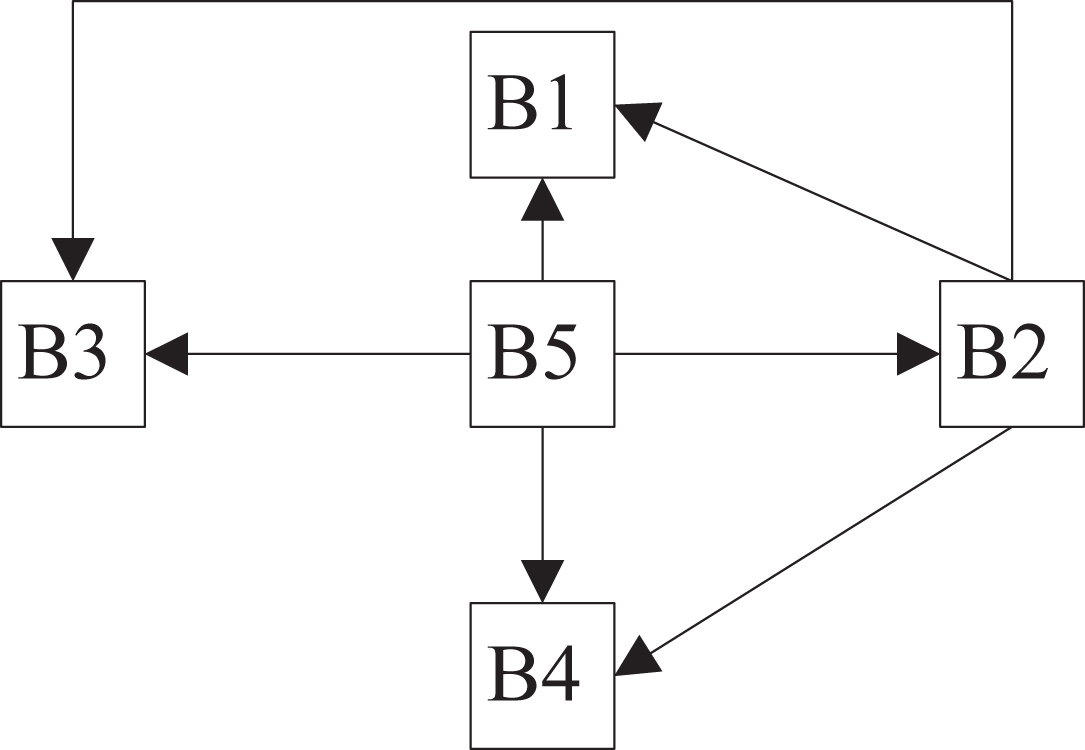
Precedence relationships among target variables as for enabling factors.
(2) This study uses IVHFS method to carry out enabling factors of preliminary identification that affect OQMM, OQD and OQM, however, the method can not determine the influence of size, scale, degree and significance level of enabling factors on OQMM, OQD and OQM. On the basis of enabling factors of preliminary identification results of OQMM, OQD and OQM by IVHFS, quantile regression method (QRA) is used to empirically analyze the influence of size, scale, degree and significance level of enabling factors on OQMM, OQD and OQM, which will improve enabling factors results of preliminary identification on OQMM, OQD.and OQM, and relationships among enabling factors of OQMM, OQD and OQM by IVHFS. Through five kinds of questionnaires issuing ways of Email, network, phone track and investigation, field issuing questionnaires, field survey and interview, this study carries out data investigation of enabling factors and main constitution elements of organizational quality defect management, the total amount of issuing questionnaires is 360, the total amount of recycling questionnaires is 253, the amount of invalid questionnaires is 104, the amount of valid questionnaires is 149, the effective rate of questionnaires is 41.4%. Questionnaire respondents must be fundamental, middle and top level managers of manufacturing industry enterprises, who must be familiar with enterprise production operation and quality management. Sample data characteristics and data proportion are shown in Table 5. Corresponding scale variables, dimensions and evaluation indexes of questionnaire all refer to related literatures and scholars home and abroad, consider cultural differences impacts between China and foreign countries, ensure content validity of scales. Reliability coefficient test, exploratory factor analysis and confirmatory factor analysis, common method biases test results reveal that all the scales have good reliability and validity.
Sample data characteristics and data proportion
In order to avoid the instability and absoluteness of regression results brought about by independent variables in the single digits (0.5 digits) and to reduce median results error and absolute perturbation to dependent variables, this study focuses on the impacts of independent variables on dependent variables under the 0-1 effective quantile, reasonably mines and empirically verifies enabling factors that affect OQMM, OQD and OQM. Koenker and Bassett firstly put forward quantile regression model, QRA has good resistance to non-normal distribution and abnormal value, which does not need to make out any specific and restrictive assumptions for error term, and can effectively solve heteroscedastic model, systematically and fully reflect the influences of independent variables on dependent variables, maintain important information [4–6, 21, 27]. Correlation principles and steps of quantile regression analysis are derived as follows [4–6, 21, 27]:
The probability distribution of random variable YF (y) = prob (Y ≤ y), τ quantile of Y meets the minimum y value of F (y) ≥ τ, q (τ) = inf{ y : F (y) ≥ τ, 0 < τ < 1 }. When τ = 0.5, it is the median.
As for a set of random sample y1,y2, y3, ⋯ , y
n
of Y,
When
Sample median is optimal solution of minimizing absolute value of residual error:
Extend the median to quantile:
Where
To avoid fluctuation and instability data, average up processing of variables and corresponding evaluation index (compute all evaluation index means of the corresponding variables), integrate relevant operation steps of transforming, computing variable, target variable, type & label, numeric expression and function group, etc, on this basis, take logarithm dealt for related variables to regression. Set LOG (Y1) to LOG (Y3) as dependent variables respectively, at the same time, make enabling factors LOG (X1) to LOG (X8) as independent variables, relevant indicators of QRA results are very unstable and extremely not ideal. Therefore, set LOG (Y1) to LOG (Y3) as dependent variables respectively, set LOG (X1) to LOG (X8) in turn respectively as independent variables (namely a dependent variable corresponds to only one independent variable), carry out QRA of relationships among OQMM, OQD, OQM and enabling factors respectively, the results are shown from Tables 6–9 and Fig. 2 (Due to too much data, this study sets a certain variable as examples, only parts of QRA results are given). Eventually the overall QRA results are shown in Table 10, general QRA results show that in each quantile (0.1, 0.2, 0.3, 0.4, 0.5, 0.6, 0.7, 0.8 and 0.9), most quantile regression coefficients of impacts of enabling factors (OSI, HPWPS, OAG OQSE,AT, ET, SET and OMC) on OQMM, OQD and OQM reach significant level (p < 0.05), OSI, HPWPS, OAG OQSE,AT, ET, SET and OMC are enabling influence factors that affect OQMM, OQD and OQM. Target variables of OQMM, OQD, OQM and enabling factors construct and form reasonable causality relationships network, which correspond to logic and reasonable causality relationships.
The results of overall regression analysis
Note: In the table, Y1-Y3 stands for OQMM, OQD and OQM respectively. X1-X8 stands for OSI, HPWPS, OAG, OQSE, AT, ET, SET and OMC respectively. Software is EVIEWS7.0.
The results of multiple quantile regression analysis
The results of quantile slope equality test
The results of symmetric quantiles test

The figure results of quantile regression analysis.
The overall results of quantile regression analysis
This study uses sense-making theory to identify organizational quality defect management enabling factors, adopts IVHFS and QRA to empirically demonstrating organizational quality defect management enabling factors, reveals influence size, degree and significance level of enabling factors on organizational quality defect management. Firstly, we use qualitative research method of sense-making theory (SMT) to identify organizational quality defect management enabling factors. Secondly, interval-valued hesitant fuzzy set ELECTRE for multi-attribute decision-making method was applied to preliminary carry out empirical test of enabling factors identified by sense-making theory, set multi-attribute as multiple enabling factors, set plans (schemes) as target variables (dependent variables, namely organizational quality defect management), empirically identify enabling factors corresponding to target variables, determine precedence relationships among target variables in the role of enabling factors. Thirdly, we adopt quantile regression analysis (QRA) method to empirically verify the preliminary identification results of organizational quality defect management enabling factors by IVHFS, reveal influence size and scale, influence degree and influence significance level of enabling factors on organizational quality defect management. Empirical analysis results indicate that enabling factors affecting OQMM, OQD and OQM, including OST, AT, ET, SET, OQSE, HPWPS, OMC and OAG. Under the circumstances of quantile scope from 0.1 to 0.9, most of quantile regression coefficients of enabling factors on OQMM, OQD and OQM reach significant level (p < 0.05). Target variables of OQMM, OQD, OQM and enabling factors construct and form reasonable causality relationships network, which correspond to logic and reasonable causality relationships. Combination methods of SMT, IVHFS and QRA engaged in effectively identifying organizational quality defect management enabling factors, which have feasibility, rationality and feasibility, maneuverability and operability practicability, applicability, integration and combination attributes, wholeness, the combination methods are clear and easy to understand, concise, convenient in identifying enabling factors, which also expand application scope of IVHFS in the field of quality management and operational management, enrich the principles, contents and application scope of interval-valued, fuzzy set, interval-valued hesitant fuzzy set for multiple attribute decision-making model, fuse typical multiple attribute decision-making method of ELECTRE into interval-valued hesitant fuzzy set context. Empirical analysis results will also provide supporting decision and mathematical statistics evidence for identifying organizational quality defect management enabling factors.
Footnotes
Acknowledgment
This research is funded by national social science fund project (17CGL020).