



Abstract
At present, manufacturing industry is obviously experiencing the rapid development of intelligent manufacturing on a global scale. To meet the needs in the new era, China has continuously been introducing new measures to develop smart manufacturing, and remarkable results have been achieved for the development of smart manufacturing. This paper first summarizes the diffusion model for applying intelligent manufacturing in manufacturing enterprises in Hangzhou. Secondly, the improved SIR model and Matlab software are used to analyze the impact of industrial policy accuracy on the proliferation of intelligent manufacturing applications. Finally based on the simulation results, it is found that the policies play an important role in the diffusion of intelligent manufacturing applications. The good top-down design of the government is the prerequisite for the sound promotion of intelligent manufacturing technology application, but the accuracy of policies needs to be further strengthened to better promote the proliferation of smart manufacturing applications.
Introduction
The diffusion of technological innovation is the process by which innovation results are transmitted from the providers to the recipients through a certain channel during a certain period of time [4]. Instead of being a process of imitation, the diffusion of technology is an independent innovation process during the process of imitation. It requires the recipients for new technologies to consider the ratio between the benefits and costs for adopting new technologies in all aspects [9].
Regarding the factors underlying the diffusion of technological innovation, Hall [2] believes that it can be classified as the cost of new technologies, the benefits of new technologies, information and uncertainty, and the culture in the whole industry. Hall pointed out that the cost and benefit factors include the comparative advantage factors, the revenue factors of new technologies include network effects, and the technical compatibility factors are the key to network effects. Zhang & Sun [11] believes that the diffusion of technological innovation must be considered from the following three aspects: the source of innovation technology diffusion, the recipients of proliferation and diffusion field. Choi [5] studied the role of network structure and network effects in the diffusion of innovation. The small world map through simulation calculations found that innovation diffusion is more likely to fail in random networks than in highly consumer-intensive networks. Desiraju R, Nair H & Chintagunta P [10], when studying the diffusion of technological innovation in the medical field, concluded that the cost would have an impact on the rate of diffusion, and higher costs would reduce the rate of diffusion.
Meyer [1] believes that the attitude of the enterprises’ management toward innovation directly affects the attitude toward technology diffusion. The more the management supports innovation, the faster the new technology spreads in the enterprise. Wiener [6] believes that government policies play an important role in the diffusion of technological innovation, which will affect the direction and speed of technological innovation diffusion. Arrow [8] argues that as the proliferation of technological innovation is the public goods in nature, it provides the possibility for governments to conduct interference through policies. Evanisko [7] believes that macro-political factors have a great impact on technology diffusion. Macroeconomic factors greatly influence the micro-activities and processes of organizations, so it will largely determine how and whether people will accept and help spread innovation results. Political factors have an impact on the behavior of enterprises. Such influence largely determines whether the acceptance and diffusion of innovation results can be achieved.
In summary, among all the factors, scholars pay the most attention to the advantages of technology, the characteristics of technology recipients and the influence of diffusion channels. This paper studies the cases for the diffusions of intelligent manufacturing technology in China, and selects industrial policies as the factor. On the one hand, it is believed that a large amount of uncertain factors affect the early stage of technological innovation diffusion, which restricts the enthusiasm of enterprises from participation, and can be eliminated under the guidance of industrial policies. The information asymmetry promotes the diffusion of technological innovation among enterprises. On the other hand, for adopting technological innovation, enterprises need to invest a large amount of funds, but as there is great uncertainty for future income, the enterprises have to adopt a “wait and see” attitude. Such phenomenon will greatly reduce the speed of technological innovation diffusion. They believe that through the policies’ guidance, reducing the financial pressure of enterprises and the initial investment, it will mobilize enterprises that adopt a “wait and see” attitude.
The establishment of diffusion model of intelligent manufacturing technology
Classic SIR model elements
In the classic SIR model, the individual states of a population Ω are divided into the following three categories: unaffected but in a susceptible state (Susceptible, S); ailing and can infect other individuals, i.e., infected state (Infected, I) and uninfected immune status (Recovered, R). When an individual in the S state touches an individual in the I state, there is a possibility that the probability α changes to the I state. Similarly, even after the I state has been changed, the state can be changed to the R state with a certain probability β, that is, cure. The differential dynamic equation is expressed as:
Where S(t), I(t) and R(t) represent the proportions of the three state individuals in the population at time t, respectively, and there is a certain quantitative relationship among the proportions: In the initial state, the individuals in the S state account for the majority, and the I state only takes a small proportion. As the individuals in the S state continuously contact with the individuals in the I state, the S state eventually changes to the I state, and the number of infected individuals in the population reaches the maximum amount. After a certain long period of time, as the there is a certain probability for I state to change into an immune state, all the infected individuals in the population will turn into an immune state, and the propagation will be terminated. The propagation process is shown in Fig. 1:

SIR model.
Fully given the early stage’s development of intelligent manufacturing, along with the traditional SIR model, the idea of diffusing the smart manufacturing application model supported by the government is put forward.
(1) On the basis of the traditional SIR model, the latent state E is introduced, which indicates that the enterprise is in the decision-making state of whether to carry out intelligent manufacturing construction based on the reasons of “interesting” and “questioning the authenticity of the information” after receiving the relevant information.
(2) Introduce a government incentive mechanism to study the impact of government intervention on the initial stage of intelligent manufacturing development.
(3) Introduce the competence factors of the employees (such as educational background, personal resume and experience level), to study the response of enterprises to the development of intelligent manufacturing, and the probability of changes in the state of the enterprise.
(4) Consider the model enterprise itself, such as management mode and production mode, to study the impact on the speed and scale of smart manufacturing development.
In the early stage of intelligent manufacturing development, the government joined as initiators, guides and propagators, vigorously promoted the prospects and advantages of smart manufacturing, and actively guided related companies [13, 14]. Attention is paid to mainly explaining the questions that are likely to arouse doubts form the enterprise, describing intelligent manufacturing in an appropriate way, guiding enterprises to actively participate and providing certain policy supports, and promoting the diffusion of intelligent manufacturing applications [15]. In the process of diffusion, the interaction between government and enterprises will also have an impact. In order to facilitate the processing in mathematical analysis, we assume that under the government policies, the conscious enterprises are increased at the rate λ. The superposition effect of the conscious activity is represented by a cumulative proportional function M(t) with respect to time t. The derivative of the function M(t) with respect to time is proportional to the number of intelligent manufacturing ranks in the enterprise, and it is assumed that the accumulation of consciousness will dissipate at a certain rate θ. Then use the differential equation and it is expressed as:
Under the influence of the government, vulnerable enterprises that are not involved can be divided into two categories: S N (t) (unconscious enterprises that are not involved in technology diffusion) and S Y (t) (conscious enterprises that are not involved in technology diffusion). Therefore, the companies in our model can be divided into five different status types: unconscious non-participating companies (S N ), conscious non-participating companies (S Y ), companies in the “latent” enterprise (E), and participating enterprise (I), enterprise (R) in an “immune” state. Let S N (t), S Y (t), E(t), I(t), and R(t) represent the proportion of enterprises from different state types, respectively, and assume S N (t), S Y (t), E(t), I(t), R(t) are all continuous differentiable functions with respect to time t.
The “growth system”, which is composed of S N (t), S Y (t) and E(t) elements in the model, is key to the whole model. The mutual conversion process of the three elements reflects the intelligent manufacturing’s situation in the early stage of development. The transformation relationship of the three is shown in Fig. 2. S N (t) is transformed into S Y (t) with a change rate of λM(t), and S Y (t) loses consciousness at a rate η. When they encounter I, they are converted to E with the probability of α 1 , α 2 , respectively. The enterprise in the state E returns to the non-participating state at a constant rate ν, where the correspondingly returned probability of S N (t) is p, the correspondingly returned probability of S Y (t) is q, and p + q = 1. The model parameters are described in the Table 1.
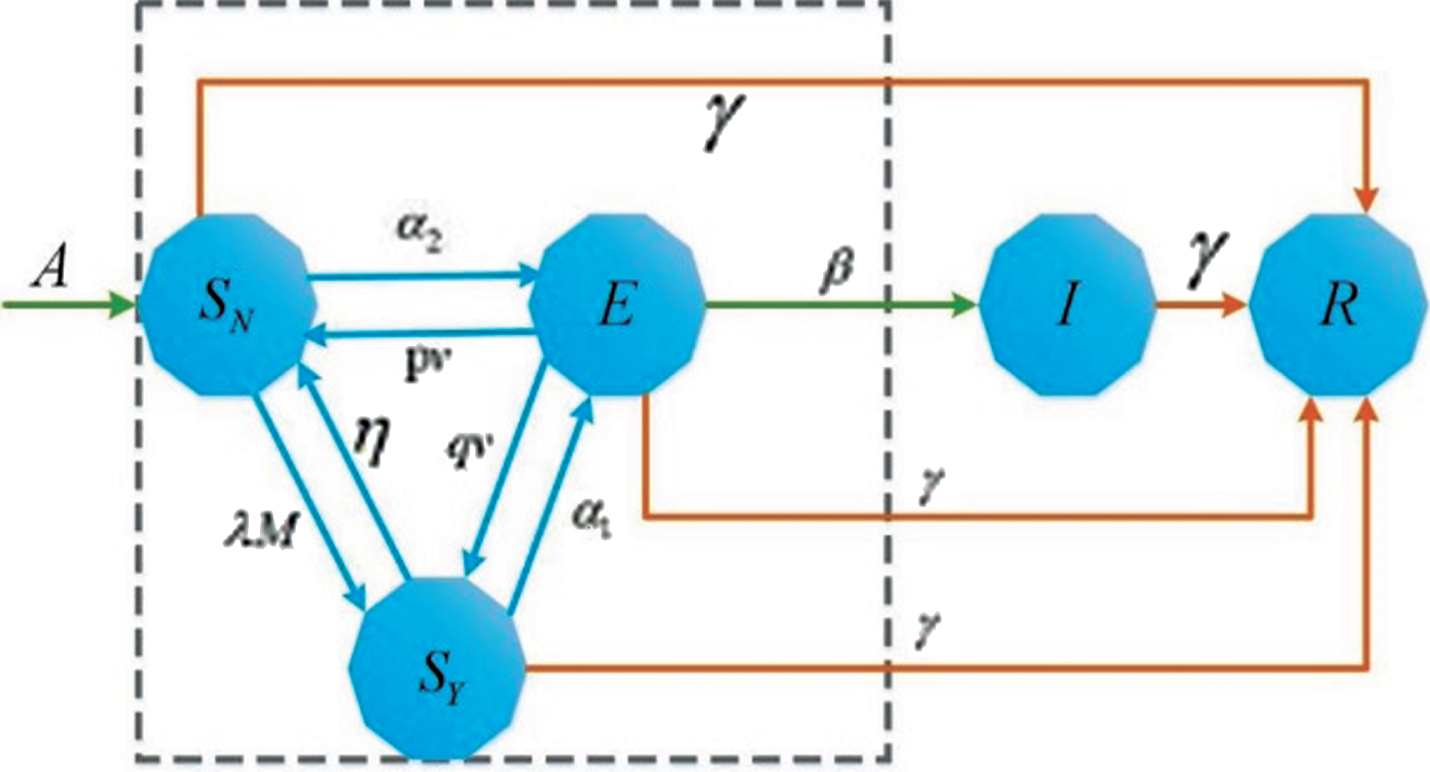
Diagram of enterprises’ transformation.
Table for the parameter description
Based on the enterprise’s decision-making process and related literature, the following assumptions are made about the model:
Hypothesis 1: Assume that I can only be converted to R, and E can be converted to I or restored to S N , S Y .
Hypothesis 2: I has a certain degree of “infectivity”, and there is a certain probability of participation in the non-participated enterprises S after contacting with I. Assume that the non-participated enterprise does not participate immediately after obtaining relevant information. Such enterprise needs a subjective decision-making before identifying the authenticity of the information and the status quo of the enterprise. Therefore, the non-participated enterprise first turns into E after obtaining the information, and then it can be converted into I.
Hypothesis 3: E will return to S at a constant rate ν. On the basis of Hypothesis 3, it is assumed that the probability of recovery to S Y is greater than that to S N , that is q > p, and p + q = 1.
Hypothesis 4: The government’s policy will have an impact on the transition. If the policy is in line with the needs of development, the policy intensity μ becomes relatively large.
According to the system dynamics, a smart manufacturing development model is established under the government’s role:
Since none of the first five equations in the model (3) include S, only the system consisting of the first five equations is considered. Note that S N (t) + S Y (t) + E (t) = 1 and p + q = 1, the model (3) can be rewritten as:
Since the model (4) can be regarded as a single-input multiple-output system, the basic regeneration function
The propagation equilibrium point P can be solved. The characteristic equation of P is:
Among them:
It is easy to know that, a1 > 0, a2 > 0, a3 > 0, a1a2-a3 > 0. Based on the Routh-Hurwitz discriminant method [11], P1 is locally asymptotically stable.
Initial parameter setting
The initial parameters are set as in Table 2. The values in this parameter table refer to those of the parameters in the system, assuming that the factors listed in Chapter 2 are not added.
Parameter Initial Value Tablermbox1
Parameter Initial Value Tablermbox1
rmbox1 The value here is chosen only to illustrate the problem, not the actual data obtained according to the actual situation. When the parameter value approaches 1, the transition probability (consciousness loss rate, policy intensity, etc.) represented by these parameters is larger, and vice versa. The values appearing below also have the same meaning.
Policies play pivotal roles on the rise and development of the industry. This article also takes into consideration that the accuracy of the policy will have an impact on the construction of intelligent manufacturing [12]. This paper believes that there are two types of policies, namely: precise policies and inaccurate policies. Since smart manufacturing is still in the early stage of development, the government has introduced relevant policies to promote the proliferation of smart manufacturing applications. However, only the positive policies for development are discussed here. The positive policies are those that promote the proliferation of smart manufacturing applications, so bad policies during the recession are not concerned here.
It is believed that if the accuracy of the introduction policy is high and conforms to the actual situation of the enterprise, and such policies can help solve the main problems faced by enterprises in the intelligent manufacturing construction, the enterprises will be impressed by the support intensity of the government and vice versa. In this paper, the impact of the number of policies is intentionally reduced. The concept of policy intensity is introduced by using μ to represent the intensity of policy. μ= 0.1 means the poor government’s policy accuracy and weak policy intensity. μ= 0.8 means that the policies are more precise and allows the enterprise to be impressed by the policy support. The effect of policy intensity on the final steady state is observed by changing the value of μ. The simulation results are shown in Fig. 3.
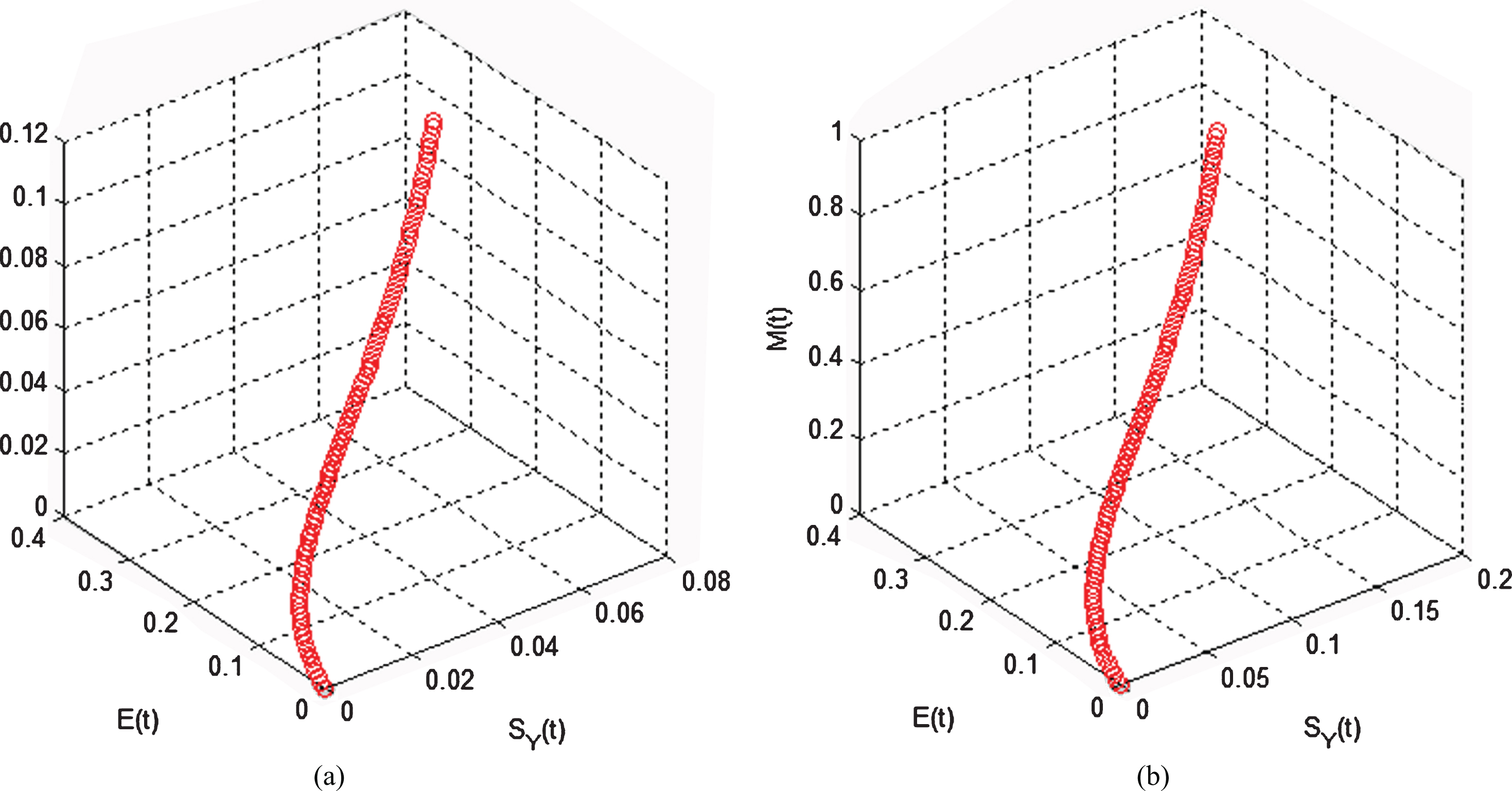
The impact of policy intensity on smart manufacturing construction.
Comparing (a) and (b) in Fig. 3, it is found that when the steady state is reached, SY(t) and M(t) in (b) are about 0.2 and 0.7 respectively, and SY(t)and M(t) in (b) are 0.08 and 0.09 respectively. SY(t) is increased by more than 20 times, and M(t), by nearly 10 times. It shows that with the increase of the “precision” of the government’s policy, the accumulated awareness of conscious unparticipated enterprises and all enterprises that have not established intelligent manufacturing has improved, but it has not shown a strong impact on E(t).
Further analysis on how the change of μ affects the changes of SY(t) and M(t), and studying the trend of change will help to reap large benefits at small expenses. 4 different sets of values are set up respectively. μ= 0.01 means that the low accuracy of the policy indicates that the policy to promote the proliferation of smart manufacturing applications introduced at this time is totally inconsistent with the policy needs of enterprises for building intelligent manufacturing. Although there are certain links, there is no availability for operation. μ= 0.95 means that the policy is particularly precise, and the policies introduced are what the enterprise needs and is operable. The results of the simulation are shown in Figs. 4 and 5.
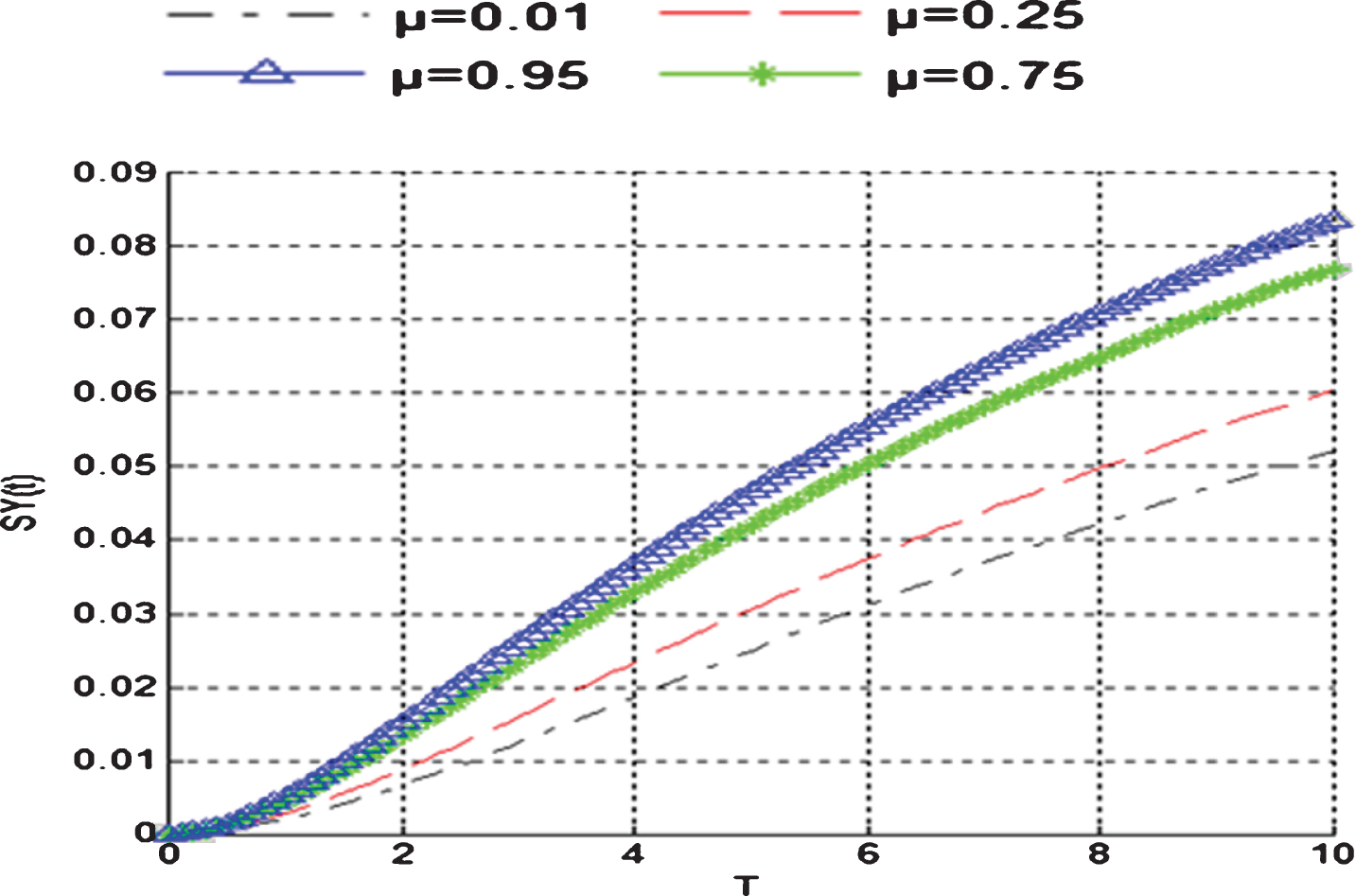
Effect of μ change on SY(t).
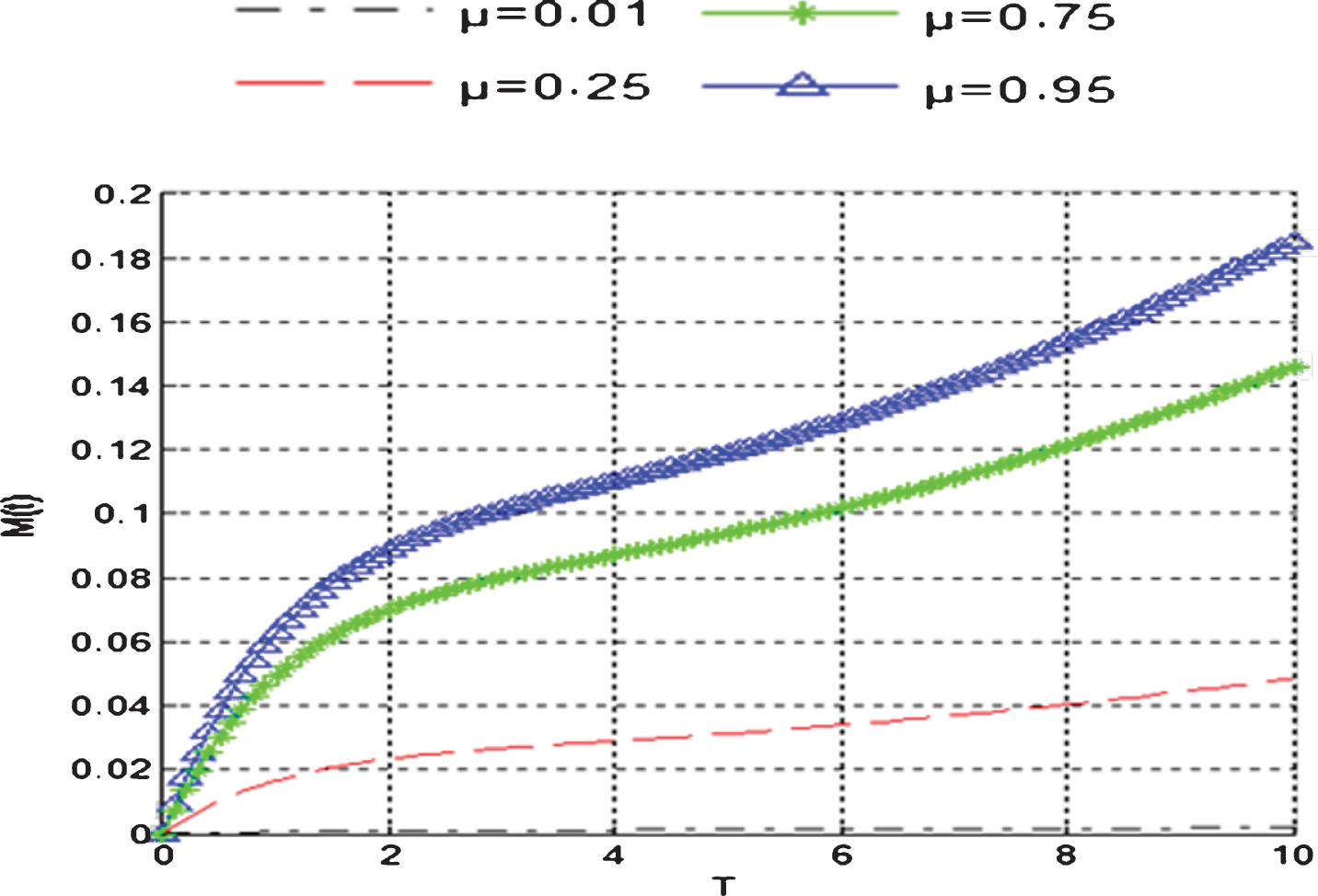
Effect of μ change on M(t).
Through the analysis of the two figures, it is found that although the increase of μ promotes the increase of SY(t) and M(t), the effect is different. With the increase of μ, the variation of SY(t) is relatively small, but M(t) shows a significant increase, indicating that μ is more conducive to the accumulation of consciousness.
The “precision” policy will have the most cumulative impact on the ultimate awareness of intelligent manufacturing construction. By improving the “precision” of the policy, it will help to promote the diffusion of the Hangzhou model.
(1) The stronger the supportive policies issued by the government, the greater the impact of policies on the diffusion of technological innovation and industrial development. Through simulation, it can be found that with the improvement of the “precision” of policies, the policy intensity that enterprises is impressed by becomes greater. As a result as the model reaches ultimately stable status, the proportion of companies, which are interested in building the plant’s Internet of Things, is greater. Among those influencing factors, policy accuracy has the greatest impact. Further analysis found that in addition to planning the direction of technological innovation diffusion and industrial development, it is more important to provide talent and capital policies.
(2) The current policy is that enterprises can obtain hundreds of thousands of yuan from the competent authorities after the acceptance of the intelligent manufacturing project. However, the financial problems of the enterprises in the initial stage of implementation have not been effectively solved, hence reducing the enthusiasm of enterprises. It is recommended that the competent authorities, according to relevant regulations, allocate part of the industrial support funds to be used for building the Internet of Things. At the same time, it is concluded that the funds for intelligent manufacturing construction are separately established, and the pre-assessment of the enterprise project declaration should be strengthened, allowing for practical projects. For practical projects, it is allowed to apply for loans from the fund for intelligent manufacturing construction (interest-free or low-interest, without the need for enterprises to mortgage real things), to implement special funds, to prohibit enterprises from misappropriating, and to establish a punishment mechanism.
(3) At present, in Hangzhou’s policy on the Internet of Things, there is a lack of relevant implementation measures to introduce social capital participation. Because of its special nature, social capital has been widely involved in all aspects of urban construction, such as the introduction of social capital in the construction of subway. Introducing social capital into the construction of intelligent manufacturing can solve the shortage of capital for enterprise construction.
Summary
China’s industrial policies are propelling the proliferation of smart manufacturing technology applications. The government has introduced financial support policies and subsidized the enterprise’s intelligent transformation, which can reduce the concerns of enterprises to a certain extent; promote the accumulation of intelligent manufacturing-related industries, develop characteristic towns, and improve the competitiveness of the industry. However, the existing policies are considered from a global perspective and hence lack “accuracy”. In the different stages of development, the government should make timely adjustments tailored for the policies introduced, which will certainly promote the spread of smart manufacturing in a wider scope, improve the traditional manufacturing model of intelligent manufacturing and improve the competitiveness of manufacturing.
Footnotes
Acknowledgments
This research is funded by Nature Science Foundation of China (U1509220), “Research on E-commerce-driven Industrial Cluster Transformation and Competitiveness Improvement”.