



Abstract
In order to improve the evaluation score and accuracy of ceramic 3D printing sample data, a fuzzy algorithm based evaluation method of ceramic 3D printing sample data is proposed. The data of ceramic 3D printing samples were collected and preprocessed by fuzzy algorithm. The specific content of the evaluation index of 3D printing sample data is determined, and the evaluation system of 3D printing sample data is established. Fuzzy algorithm is used to determine the weight of data quality evaluation index of ceramic 3D printing samples. According to the steps of setting up the weight matrix of the evaluation index of 3D printed ceramic sample data, the weight matrix of the evaluation index is established. Because there are many data sources of ceramic 3D printing samples, there may be data conflicting with the description of the same object. Under the background of fuzzy algorithm, the effective dimension of ceramic 3D printing sample data is established. According to the membership function of each evaluation index, the fuzzy set of 3D printing sample data of ceramics is established. Finally, the data evaluation process is designed to realize the data evaluation of ceramic 3D printing samples based on fuzzy algorithm. The experimental results show that the evaluation accuracy of the method is higher than 96%, and the scores of users and experts on the interior design scheme are above 80 points.
Introduction
China’s ceramics has a long history and has long been known in various countries around the world. The president of Germany’s Hendry Group once said that China is not only the place with the oldest ceramics, but also the place with the richest ceramic traditions [18]. China is known as a ceramic power, but it cannot be called a ceramic power. This situation can be attributed to a variety of reasons, one of the important reasons is from data evaluation for ceramic 3D printing samples.
Ceramic products have the advantages of high temperature resistance, corrosion resistance, high hardness and high strength, which are widely used in aerospace, machinery, electronics and other fields. The research shows that 3D printing sample data evaluation is the key factor to reduce the production cost of ceramic products and improve the molding performance of ceramic parts. The production process of traditional ceramic products includes three steps of raw material process, forming process and firing process [19], the most complicated process is forming process, and the data evaluation of this process is also the most difficult. As the ceramic products are produced by molds, the surface quality of the products will be reduced, and subsequent operations such as 3D sample data evaluation are required. From this, we can see that the traditional evaluation has the following shortcomings: low efficiency, easy to cause data loss, high cost, long evaluation time, etc., which cannot meet the needs of the market and the development of science and technology.
Evaluation method is also called “additive manufacturing data evaluation method”. Because of its influence on ceramic industry, it is also called “the third industrial revolution”. It is totally different from the traditional evaluation method. This method uses computer 3D modeling and fuzzy algorithm to evaluate 3D sample data, so it can speed up the efficiency of data evaluation. Fuzzy algorithm is a kind of intelligent algorithm which was proposed by American scientists in 1960 s. Classification evaluation is an important part of fuzzy algorithm research. Its corresponding classification system includes parallel generation subsystem based on string rules, fuzzy algorithm subsystem and data evaluation subsystem. It has been widely used in economy, science and engineering. Common fuzzy algorithms, such as mean blur, Gaussian blur and so on, the basic process is to calculate the sum of some eigenvalues and their corresponding weights in a certain field around a pixel, and then get the result value. From the operation process of the fuzzy algorithm, this method belongs to the intelligent algorithm, but strictly speaking, it is not a simple intelligent fuzzy. The algorithm can optimize the algorithm results by effectively using the existing relevant information to improve the adaptability of the data. Similar to the principle of survival of the fittest in nature, fuzzy algorithm cannot know the problem solving process in advance. The information that the algorithm relies on mainly comes from the evaluation results of each 3D ceramic sample data. The weight of 3D ceramic sample data is determined by the corresponding fitness value, so that the information of 3D ceramic sample data with good fitness value can be better saved [21]. Through ingenious use of coding technology and fuzzy algorithm theory, we can effectively solve some complex phenomena and difficult problems in the evaluation of 3D ceramic sample data.
With the development of science and technology, many domestic and foreign enterprises are actively exploring how to make good use of 3D sample data to keep the ceramic industry in an invincible position in the fierce social competition, and even to find and open up new high added value fields. However, due to the unbalanced development of economic system or society, some domestic ceramic enterprises are aware of the importance of 3D sample data to the production and operation management of enterprises, but they do not know how to use 3D sample data or cannot effectively use 3D sample data. The definition of 3D sample data usually exists in a narrow sense and a broad sense. The 3D sample data in this paper refers to the sample data generated in the production process of ceramic enterprises. These sample data include not only the basic information of enterprises, but also the operation performance of enterprises. Various problems found in the investigation of some enterprises. Considering the problems of too high dimension and too large data of 3D sample data, this paper first eliminates the incompleteness of 3D sample data and the correlation between dimensions, so that the data can meet the use requirements for the subsequent data processing and data application. Secondly, in view of the specific problems of ceramic enterprises, this paper studies the corresponding data evaluation system, and compares the advantages and disadvantages of the evaluation indexes. From the full text, this paper focuses on how to deal with 3D sample data and how to apply 3D sample data. Through the processing and application of 3D sample data, it provides corresponding support for the operation management and decision-making of ceramic enterprises [1].
3D sample data is the basis of analysis and decision-making of ceramic enterprises, and data quality is related to the use of data, so data quality plays an irreplaceable key role in the effectiveness and scientificity of management. Evaluation is one of the most important methods to solve data quality problems. Although the concept of data quality is different, it is generally believed that data quality can be divided into different categories and different evaluation dimensions according to different applications [17]. The core of data quality evaluation is how to evaluate each dimension concretely. For a long time, many scholars dimensions to the evaluation of data, carried on the thorough research, but most of the effect is not ideal, therefore low evaluation score and evaluation the problem of poor accuracy, in order to solve the traditional methods evaluation score is low, and evaluate the problem of low accuracy, so this article will solve the problem, as the key to 3D printing ceramic sample data to evaluate the goal of high grade and high accuracy, is proposed based on fuzzy algorithm of ceramic samples of 3D printing data evaluation method. This article study, usually adopt the data accuracy, timeliness, integrity, objectivity, availability, dimensions such as useful to measure the quality of the data, can effectively promote the ceramic and accuracy evaluation score, 3D printing sample data for the sample data evaluation method lays the foundation for the further development, and promote the further development in the field of ceramic 3D printing.
Materials and methods
This paper takes data for ceramic 3D printing samples as the research object, introduces the commonly used ceramic 3D printing technology, and analyzes the temporal and spatial characteristics and internal correlation of data for ceramic 3D printing samples. According to the theory and characteristics of 3D printing, the quality of data for ceramic 3D printing samples was analyzed. According to the logical order of normative detection, missing data detection, wrong data and inaccurate data detection [9], this paper puts forward the evaluation method of data for ceramic 3D printing samples. Based on the quality analysis of data for ceramic 3D printing samples, the quality evaluation index system of data for ceramic 3D printing samples is proposed from micro, meso and macro levels. Fuzzy algorithm is used to evaluate the quality of data for ceramic 3D printing samples. Finally, on the basis of quality problem identification and evaluation of data for ceramic 3D printing samples, the fuzzy set of data for ceramic 3D printing samples is built to improve the quality of data for ceramic 3D printing samples. The technical roadmap of this paper is shown in Fig. 1.

Technology roadmap.
Data for ceramic 3D printing samples mainly comes from some data in a ceramic enterprise database, involving 84 data tables, including customer information table, business code table, detailed business table, user status table, upload file record table, evaluation dimension table, evaluation data table, rule table, etc. The data contained in the corresponding data table is shown in Table 1.
Corresponding table of ceramic 3D printing sample data
Corresponding table of ceramic 3D printing sample data
These 3D printing sample data tables have a lot of noise information without preprocessing. In addition, different application targets need different 3D printing sample data to support [20]. Therefore, this section first deals with and filters the 3D printing sample data. First of all, in order to analyze the effectiveness, starting from the basic information of 3D printing sample data, 3D printing sample data with incomplete information and wrong information are screened, so that the 3D printing sample data used in this section has complete information. Then the basic information of 3D printing sample data is used to add the format information of 3D printing sample data. Thirdly, according to the network access time of 3D printing sample data, the corresponding network time of 3D printing sample data is calculated. Fourth, according to the status information of 3D printing sample data and the 3D printing sample data information used, the relevant data are screened. Fifth, according to the business code of 3D printing sample data, all kinds of business information of 3D printing sample data are separated and summarized, and the evaluation trend data of 3D printing sample data is calculated [7]. According to the above data preprocessing and other statistical work, a data set containing basic information and various evaluation information of 3D printing sample data is finally obtained. From this data set, 8000 pieces of data are randomly selected as the training set of 3D printing sample data evaluation, and 20000 pieces of data are selected as the evaluation test set.
The preprocessing process of ceramic 3D printing sample data is shown in Fig. 2.
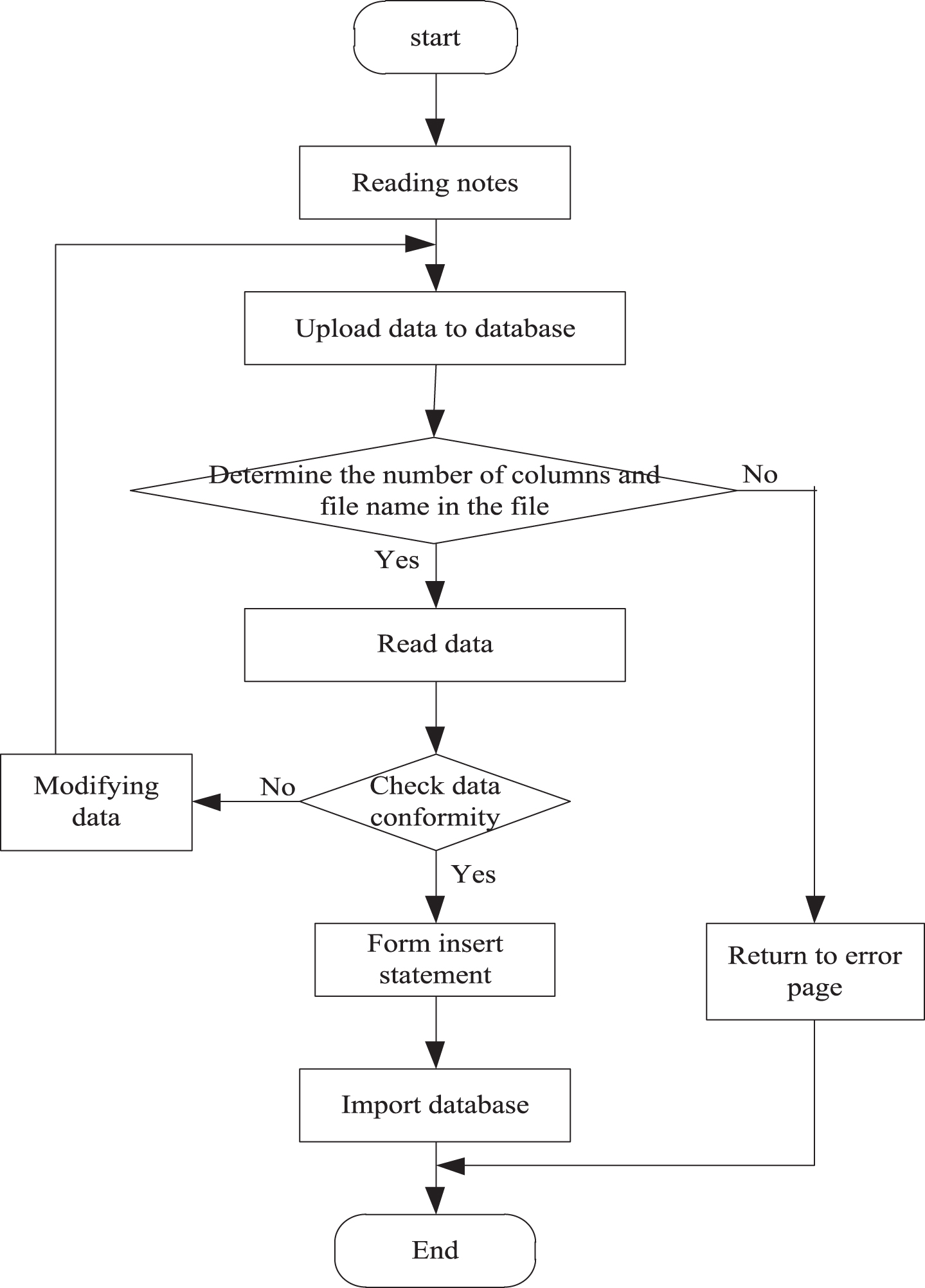
Preprocessing flowchart of ceramic 3D printing sample data.
Data preprocessing can exist in all aspects of data evaluation. By predicting the trend of the market, the needs of customers, and controlling the cost of enterprises, ceramic enterprises can optimize their business management activities [10]. The effect of preprocessing depends partly on data selection and corresponding data collection, while the greater part is affected by preprocessing methods. In this paper, through the analysis of different problems, the corresponding data set is selected and the corresponding evaluation system is constructed. Through the study of different problems, the common purpose of cost control and management optimization of ceramic enterprises is finally achieved.
At present, there is no uniform specification or standard for the evaluation of data for ceramic 3D printing samples at home and abroad, and different types of data for ceramic 3D printing samples will have different data evaluation systems [24]. According to the preprocessing principle of data for ceramic 3D printing samples, the evaluation system of data for ceramic 3D printing samples is established as shown in Fig. 3.
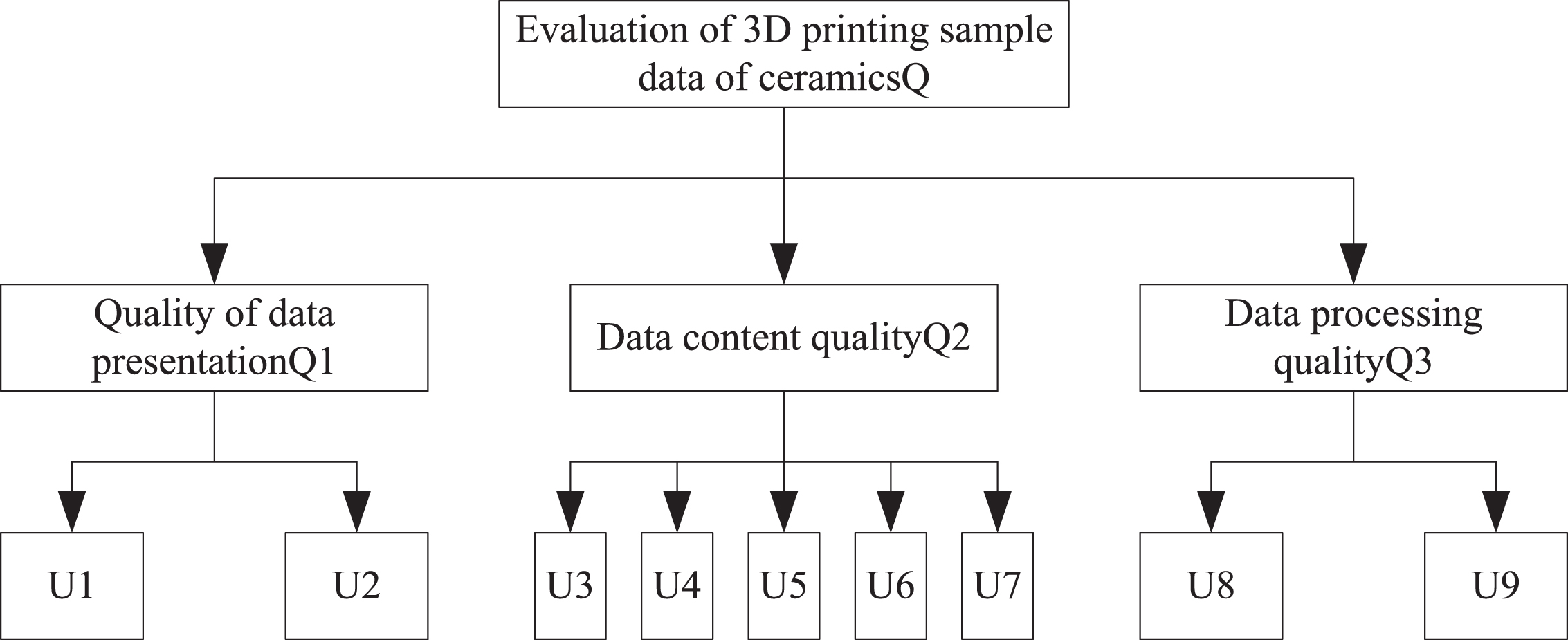
Evaluation systems of data for ceramic 3D printing samples.
where U1, U2, ⋯ U9 respectively represent the evaluation index sets of different types of data for ceramic 3D printing samples. The specific meanings are as follows:
The specific contents of the evaluation indexes of data for ceramic 3D printing samples are shown in Table 2.
Specific contents of evaluation indexes of data for ceramic 3D printing samples
Expression quality
Normative
Definition: whether the data format and presentation method conform to the unified field specification standard. If they conform to the unified standard, they are qualified, otherwise they are unqualified.
The normalization degree f
norm
of data is usually expressed as a percentage, and its calculation formula is as follows:
Property integrity
Definition: whether property information of the described object is missing:
When evaluating the accuracy of data for ceramic 3D printing samples, you can select any of the above indicators to evaluate the quality of data for ceramic 3D printing samples.
In this paper, the fuzzy algorithm is used to determine the weight of data for ceramic 3D printing samples. In the 1970 s, American operational research scientists put forward a decision-making analysis method that combines qualitative and quantitative analysis, i.e. fuzzy algorithm [16]. It quantifies and models the decision-making thinking process of managers for complex events. The feature of fuzzy algorithm is to divide the complex problems into several levels and factors, and form the multi-level analysis structure model. Through the comparison and calculation of each factor in a certain level, the weight of different factors can be obtained, which provides the basis for data for ceramic 3D printing samples to evaluate the selection of the optimal scheme.
When using the fuzzy algorithm to establish the weight matrix of data for ceramic 3D printing samples, it is usually divided into the following four steps:
–Establish the ladder type fuzzy evaluation index system
For the more complex problem, based on the main factors affecting the quality evaluation of data for ceramic 3D printing samples, the problem is divided into several simple problems. The complex target is divided into several sub element indicators. If the sub element indexes are still complex, the fuzzy decomposition is continued until the element indexes of the last layer are all simple indexes. Thus, a fuzzy index evaluation system is established [2–4]. The process of establishing evaluation index system is actually the process of decomposing complex problems. In this paper, the target layer of the quality evaluation system of micro data for ceramic 3D printing samples is the quality level of micro data for ceramic 3D printing samples. Due to the complexity of data for ceramic 3D printing samples quality evaluation, the three-tier structure index evaluation system is established as shown in Fig. 1.
–Construct the judgment matrix of pairwise comparison
After establishing the ladder type fuzzy evaluation index system, the judgment matrix is constructed based on the subordinate relationship between the upper and lower layers [12]. That is to say, the element index of the above layer is the fixed criterion, and the relative importance of the factor index of the next layer to the layer is compared by two pairs, and the quantity scale is given. Generally, 1-9 scale method is used to scale the judgment matrix, as shown in Table 3.
1–9 scale method
1–9 scale method
According to the 1–9 scale method, the relative importance of n elements in the same layer can be obtained, and the judgment matrix can be established.
–Calculate the weight coefficient
Based on the above judgment matrix, the maximum eigenvector, which is the weight of each factor, is obtained by normalization, and w = [w1, w2, L, w n ]. For the multi-level evaluation system, the weight of each factor index to the previous factor index can be determined from top to bottom, and finally the weight of each factor relative to the target layer can be obtained.
–Check the consistency of judgment matrix
Since the judgment matrix is based on the experience of different individuals, it is inevitable that there are different opinions and judgment errors, so it is necessary to check the consistency of the judgment matrix to ensure the rationality of the judgment matrix [14]. Generally, consistency test includes consistency index, evaluation random consistency index and random consistency ratio.
* The consistency indicators
where λmax represents the maximum feature root of the feature matrix; n indicates the number of indicators.
The maximum feature root of the feature matrix is defined as follows:
where A represents the judgment matrix; W indicates the indicator weight.
The greater the value of the consistency index is, the closer the judgment matrix is to the complete consistency; the greater the value of the consistency index is, the greater the deviation of the judgment matrix from the complete consistency is. Generally, with the increase of the order of the judgment matrix, the value of the deviation from the completely consistent index caused by human is larger.
* Random consistency index:
For multi order judgment matrix, the average random consistency index is introduced.
* Random consistency ratio:
The ratio between the consistency index C . I . of judgment matrix and the random consistency index R . I . of the same order is called random consistency ratio. When C . R . is less than 0.10, the judgment matrix has acceptable consistency; otherwise, the judgment matrix needs to be adjusted and modified until it has satisfactory consistency.
There are many dimensions that affect data validity. Assuming the validity rating dimension is f, each dimension is defined as f1, f2, f3, ⋯ , f p , and meets the following requirements:
Under the background of fuzzy algorithm, because of the 3 V characteristics of data for ceramic 3D printing samples, the possibility of data quality problems becomes higher [15]. Due to the scale and high speed of fuzzy algorithm, there are many sources of data for ceramic 3D printing samples, which may produce conflicting data and incompatible data for the description of the same object. There are also many problems in the generation, transmission and processing of data for ceramic 3D printing samples, such as incorrect and incomplete data for ceramic 3D printing samples. These problems are the main factors that affect the effective use of data [11]. Therefore, in order to evaluate the validity of data for ceramic 3D printing samples scientifically and reasonably, the integrity, correctness and compatibility of data for ceramic 3D printing samples are selected as the evaluation dimensions of data validity.
For different applications, each attribute in data for ceramic 3D printing samples has different influence, so the weight of each attribute is different [22]. For a part of data in the data for ceramic 3D printing samples set, suppose that the data has m attributes, and the weight of each attribute is w j , that is w1, w2, w3, ⋯ , w m . w j satisfies the following requirements:
At present, there is no definition for the integrity of data for ceramic 3D printing samples. From the specific application, the integrity of data for ceramic 3D printing samples under the background of fuzzy algorithm is defined as follows:
Definition 1: if a data for ceramic 3D printing samples has n attributes, and each attribute keeps its own part, then the data for ceramic 3D printing samples is complete for these n attributes, otherwise it is incomplete.
Definition 2: integrity is used to indicate the integrity of data for ceramic 3D printing samples. For some data for ceramic 3D printing samples, R i can be used. The attributes in this part of data for ceramic 3D printing samples are represented by R ij . t [R ij ] is the value of R ij , and V [R ij ] is the integrity of R ij . According to different applications, V [R ij ] can have different forms.
In this paper, fuzzy algorithm is used to evaluate the quality of traffic flow data. Through the establishment of index set, evaluation set, weight set and membership function determined by AHP, the comprehensive evaluation of data for ceramic 3D printing samples quality level is realized. Fuzzy algorithm is proposed by American controller. The evaluation method based on fuzzy algorithm theory is called fuzzy comprehensive evaluation method. At present, this method has formed the relatively complete set of bodies [8].
The basic idea of fuzzy evaluation is to quantify the factors with unclear boundary and not easy to quantify. With the help of the membership degree theory in fuzzy mathematics, the qualitative evaluation is transformed into the quantitative evaluation method. This method can quantify things that are not easy to quantify, such as “excellent, good, medium, poor”, “qualified, unqualified” and other similar fuzzy language scores [23]. Fuzzy evaluation method is mainly used to judge the ceramic process flow in the field of intelligent ceramic 3D printing, but it is still blank in the quality evaluation of data for ceramic 3D printing samples.
There are four steps to build the fuzzy set of data for ceramic 3D printing samples:
–Determine the indicator set of evaluation factors
Determine the indicator set of quality factors of data for ceramic 3D printing samples (Q ={ Q1, Q2, L, Q n }), that is, there are n evaluation indicators.
Data evaluation set is a set of evaluation grades composed of evaluation results made by evaluators for the evaluated objects. In this paper, the quality evaluation set of data for ceramic 3D printing samples is V ={ v1, v2, v3, v4 }.
–Carry out single factor fuzzy evaluation and establish fuzzy relation matrix
From a single factor, the membership degree of evaluation index U to evaluation set V is determined, and then the fuzzy matrix of the whole evaluation system is obtained, as
–Determine membership function
The key to determine the fuzzy relation matrix is to determine the membership function of each evaluation index. Membership function is used to describe the membership degree of index to evaluation set, which is usually expressed as u I (X). When u I (X) = 1, it means that the indicator is totally subordinate to I; when u I (X) = 0, it means that a part of the indicator is totally not subordinate to I; when 0 < u I (X) < 1, it means that a part of the indicator is subordinate to I.
There are many methods to construct membership function, including matrix function, normal function, Cauchy function, trigonometric function, trapezoid function and so on. Because the relationship between accuracy, integrity, effectiveness and data for ceramic 3D printing samples is more in line with trapezoid function, and trapezoid function calculation is simple, so trapezoid function is selected to construct membership function in this paper [6]. Generally, the construction method of membership function is based on the characteristics of various factors, such as the distribution law based on a large number of historical data or the widely recognized and conventional division standards in the industry. At present, there is no unified standard document for traffic data quality evaluation or the classification of related indicators. In addition, the selection of each evaluation indicator also has its own emphasis. Therefore, this paper mainly based on the frequency statistics of a large number of historical data to determine the membership function of each evaluation index.
Realize the data evaluation of 3D printing ceramic samples
In the evaluation of data for ceramic 3D printing samples, the determination of the weight mainly depends on the expert scoring method, which can make full use of the knowledge and experience of experts in the field to evaluate the relative importance of indicators, so as to obtain the weight. The weight obtained by this method has strong authority and practicability. However, data for ceramic 3D printing samples is dynamic, and the contribution of each index to the importance of the evaluation results may change in different devices and periods. Therefore, a reasonable weight should be a combination of subjective and objective factors.
In this paper, the fuzzy algorithm is used to calculate the index weight, and the influence of dynamic data is considered in the original method, and the dynamic linear correction is made to the weight. In this paper, the fuzzy comprehensive evaluation method is improved by using the data difference driving principle and the linear compensation method of weight. In this paper, the improved method is called dynamic fuzzy comprehensive evaluation method [5], which can not only save the suggestions of experts in the field, but also grasp the dynamic changes of data and the impact of data on indicators in time. When the data is abnormal, it can reduce the impact on the evaluation results; when the data is correct, it can obtain the dynamic development of the traffic state through reasonable.
The evaluation method of data for ceramic 3D printing samples based on fuzzy algorithm is mainly composed of three stages: data preparation stage, comprehensive weight calculation stage and fuzzy decision-making stage, as shown in Fig. 4.
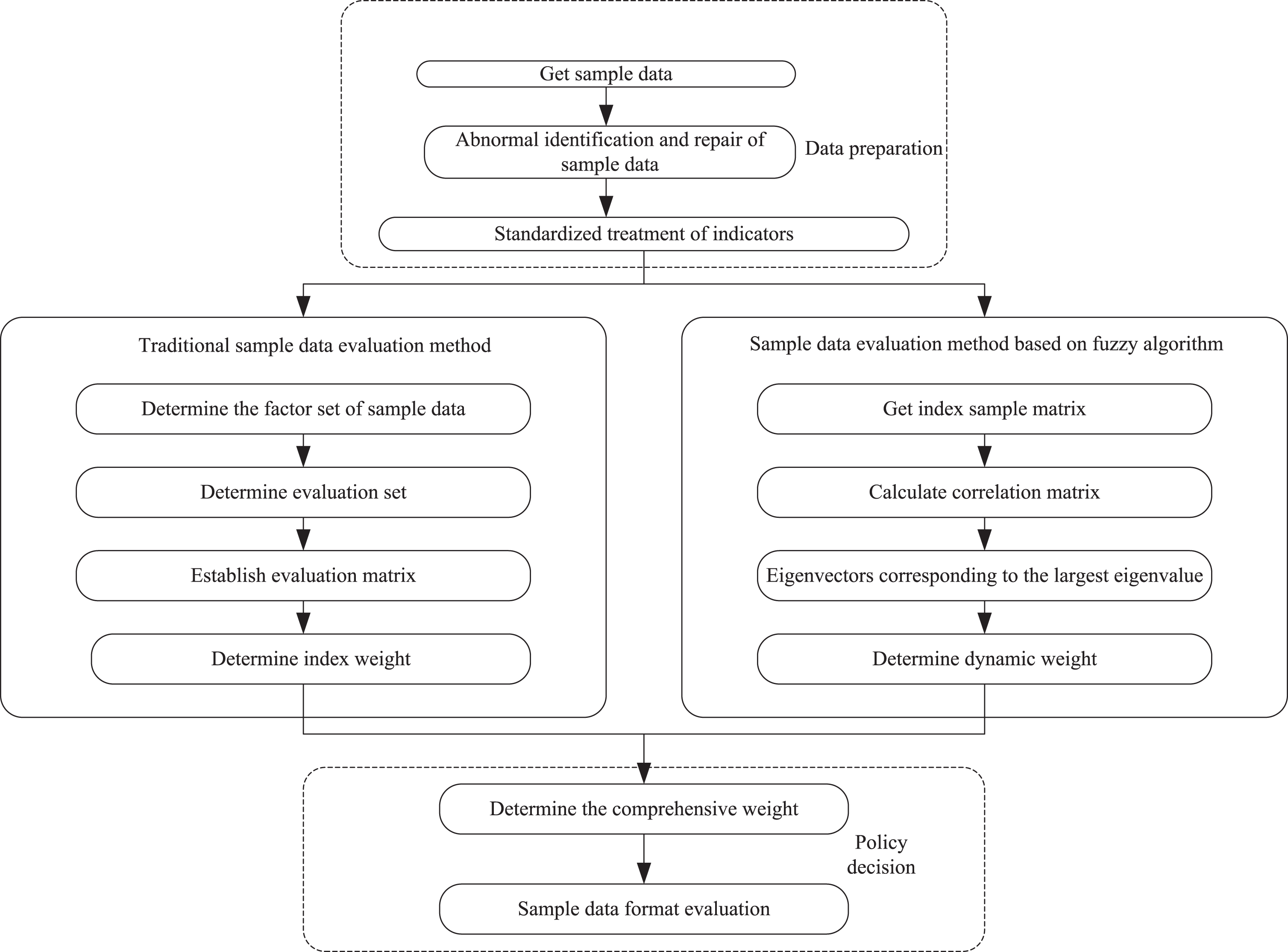
Evaluation flow chart of data for ceramic 3D printing samples.
In the context of the fuzzy algorithm, data for ceramic 3D printing samples were first collected in the data set for ceramic 3D printing samples. Because the collected data contains a lot of noise information, the fuzzy algorithm was used to preprocess the data for ceramic 3D printing samples. According to the preprocessing principle of ceramic 3D printing samples data, the specific content of the evaluation index of data for ceramic 3D printing samples was determined, and the evaluation system of data for ceramic 3D printing samples was established. The weight of the quality evaluation index of the data for ceramic 3D printing samples is determined by using the fuzzy algorithm. According to the weight matrix establishment step of the evaluation index of the data for ceramic 3D printing samples, the evaluation index weight matrix is established. Because there are many sources of data for ceramic 3D printing samples, there may be data that conflicts with the description of the same object. Under the background of fuzzy algorithm, the validity dimension of data for ceramic 3D printing samples was established. In order to prevent data for ceramic 3D printing samples from being lost during the evaluation process, a fuzzy set of data for ceramic 3D printing samples was built according to the membership function of each evaluation index. Finally, the data evaluation process is designed to realize the evaluation of data for ceramic 3D printing samples based on fuzzy algorithm [13].
Evaluation index weight
Since different ceramic 3D printing sample data evaluation experiments have different indexes, different weights were given to the ceramic 3D printing sample data evaluation indexes, and the evaluation index weights were selected. The selection criteria of evaluation index weights are shown in Table 4.
Selection criteria of evaluation index weights
Selection criteria of evaluation index weights
Figure 5 shows the experimental process of ceramic 3D printing sample data evaluation.
According to the experimental process, the specific implementation steps of the experiment are determined.
Step 1: set up the experimental environment and get the sample data. Matlab 7.0 software and window 10 operating system were used in the experiment. The experimental data comes from a large-scale ceramic 3D printing product manufacturer, whose product parameters and background data are taken as the experimental sample data.
Step 2: determine the type of data for ceramic 3D printing samples evaluation experiment. According to the evaluation requirements of different types of data for ceramic 3D printing samples, the experimental model is made. The experimental model is saved as a source file format, which is convenient for editing the evaluation results of data for ceramic 3D printing samples.
Step 3: before making the model, each type of data for ceramic 3D printing samples evaluation scheme is divided reasonably to meet the overall needs of the experiment.
Step 4: establish a fuzzy algorithm evaluation platform. Edit the running script of the evaluation system in the computer, associate the experimental equipment with the model, and ensure the normal operation of the whole experiment.
Step 5: Evaluation indexes from ceramic 3D printing sample data were imported into the model, and the weight values of different evaluation indexes were used to calculate the scores and evaluation accuracy of each evaluation index.
Analysis of experimental results
Using the above experimental process, statistical tables of user ratings and expert ratings of the two evaluation methods were obtained, as shown in Table 5.
Statistics of experimental results
Statistics of experimental results
From the statistical table of experimental results, it can be seen that when using the traditional evaluation method of data for ceramic 3D printing samples, users and experts have relatively low scores on data for ceramic 3D printing samples, and the expert scores are lower than users’ scores. The average score of traditional data evaluation method for ceramic 3D printing samples is 53.7 points, while when using data evaluation method for ceramic 3D printing samples based on fuzzy algorithm, users and experts have scored more than 80 points for interior design scheme. The evaluation method of data for ceramic 3D printing samples based on fuzzy algorithm gets 88.8 points. Therefore, it can be concluded that the evaluation method of data for ceramic 3D printing samples based on fuzzy algorithm has a high evaluation score for data for ceramic 3D printing samples.
On the basis of the above experiments, a comparison experiment of evaluation accuracy was conducted, and the experimental results are shown in Fig. 5.
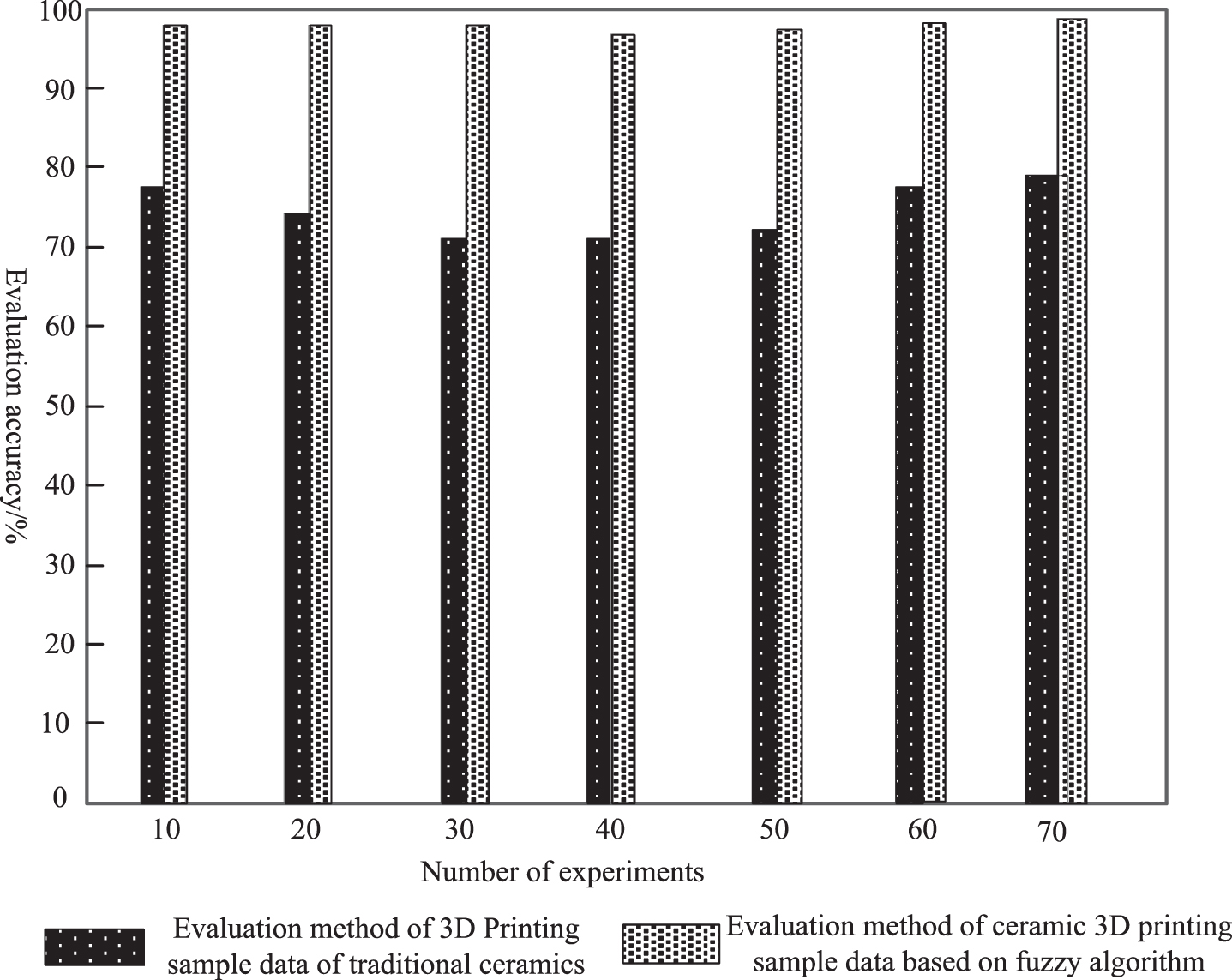
Comparison of evaluation accuracy of different methods.
According to the above figure, the evaluation accuracy of the traditional ceramic 3D printing sample data evaluation method is between 73% and 79%, while the evaluation accuracy of the ceramic 3D printing sample data evaluation method based on the fuzzy algorithm is above 96%, far higher than the traditional method, indicating that the method has good evaluation accuracy, reliability and practicability.
In order to solve the problem of low evaluation score and accuracy of traditional methods, a ceramic 3D printing sample data evaluation method based on fuzzy algorithm was proposed. Experimental results show that the method on the users and experts in the indoor design scored in more than 80 points, the evaluation accuracy is above 96%, has the high accuracy evaluation scores and evaluation, which fully shows the fuzzy algorithm is applied to the ceramic 3D printing sample data evaluation has the very good effect, for the further development of ceramic 3D printing technology to provide technical support, can also provide new way for the design of the sample data evaluation methods, to promote further development in the field of 3D printing ceramic, but 3D printing ceramic sample data evaluation method still has a lot of space, In the future, with the development of science and technology, further research on this issue is needed to maximize the evaluation effect of ceramic 3D printing sample data.