



Abstract
This paper proposes the concept of an intelligent logistics system (ILS) in the context of the Internet of Things (IoT), expounds the characteristics of the ILS, and constructs a logical framework of the ILS based on the IoT. In the dynamic IoT environment, in order to obtain a highly satisfied logistics service, a locally optimal choice of logistics service selection scheme is proposed. This scheme uses the traditional web service combination idea to solve the intelligent logistics service problem. First, model and calculate the Quality of Service (QoS) attributes in logistics, and then select an atomic solution with the best utility value from each logistics sub-process, perform service composition and execute. The feasibility and effectiveness of the model and algorithm under this scheme are verified by experiments.
Introduction
The 21st century is a century of intelligence. With the development of intelligent technology, logistics is also developing in the direction of intelligence. The concept of intelligent logistics has emerged and has attracted widespread attention from scholars at home and abroad [2, 17]. In 2001, Shen et al. [12] first proposed the intelligent logistics system (ILS) concept, which is based on the intelligent transportation system (ITS) and electronic commerce (EC). It uses the ITS to solve the real-time information collection of logistics operations and analyze and process the collected information. The information transmission in the link provides detailed information and consultation for the cargo owner. Under the operating environment of EC, it provides customers with value-added logistics services.
Recently, many logistics companies apply the Internet of Things (IoT) technology to improve overall management and improve the speed and accuracy of logistics services. This paper proposes to use service computing-related technologies to solve problems in logistics [1, 16]. A logistics service has to go through a series of business intermediate processes. Each core business process in the middle is abstracted into a service component. The entire logistics service is a composite service. This article focuses on how to configure all aspects of logistics so that you can get a more efficient logistics service with the best user satisfaction.
Intelligent logistics system
Concepts and characteristics of the intelligent logistics system
The IoT is based on the electronic product code Electronic-Product-Code (EPC) and electronic tags based on radio frequency technology. It is based on the IoT and interworking. The development of IoT technology has given new meaning to intelligent logistics, making it easier and faster to collect and share information in ILSs. Intelligent logistics is based on the widespread application of the IoT. It uses advanced information collection, information transmission, information processing, and information management technologies to achieve the optimization of the entire logistics process and resource optimization through the integration of information integration, technology integration and logistics business management systems. Complete a variety of logistics activities including transportation, warehousing, distribution, packaging, loading and unloading, and optimize the efficient and efficient operation of various logistics activities to provide the maximum profit for the supplier, provide the best service to the demand side, and consume the least natural resources and social resources, the overall intelligent social logistics management system that maximizes the protection of the ecological environment.
According to the concept and connotation of intelligent logistics, the ILS has the following characteristics: Logistics informatization. Logistics informatization is manifested in the informatization of logistics commodities, database nation and coding of logistics information collection, electronification of logistics information processing, networking, standardization and real-time logistics information delivery, and digitization of logistics information storage [3, 6]. Intelligent logistics. Intelligence is the core feature of ILS and the main symbol that distinguishes it from other logistics systems. The intelligence of ILS is mainly reflected in the intelligentization of logistics operations and the intelligentization of logistics management. In logistics operations, intelligent technology is used to effectively improve the efficiency and safety of logistics operations and reduce errors in logistics operations. The intelligence of logistics management is mainly reflected in the intelligent acquisition, transfer, processing, and utilization of information and knowledge to serve logistics decision-making [4, 10]. Logistics automation. Logistics automation refers to the automation of equipment and facilities in logistics operations, including the automation of operations such as transportation, packaging, sorting, and identification [14, 15]. The basis is logistics informatization, and the core is mechatronics. Logistics automation relies on technologies such as automatic identification system, automatic detection system, automatic sorting system, automatic access system, automatic cargo tracking system and information guidance system to achieve real-time collection and tracking of logistics information, thereby improving the management of the entire logistics system and monitoring level, expand logistics operation capabilities, improve logistics production efficiency and reduce errors in logistics operations. Integrated logistics. The integration of ILS is mainly reflected in three aspects: technology integration, logistics link integration, and logistics management system integration. Integrate advanced information technology, intelligent technology, and logistics management technology through technology integration. Integrate transportation, storage, packaging, loading, unloading, and distribution in the logistics management process into an integrated system by relying on information sharing and integration. By integrating various business systems of logistics, such as transportation management systems, warehouse management systems, logistics distribution systems, etc., to build an integrated management system. The integration of ILS can effectively realize the information sharing and integration of logistics resources in various links of logistics, effectively shorten the delivery time, reduce costs, and improve the competitiveness of enterprises and even the entire supply chain [5, 20]. Logistics network. Logistics networkization includes two aspects of logistics facilities, business networking, and logistics information networking. Logistics information networking is a logistics information network established using computer communication networks and IoT according to the development of logistics facilities and business networks [7, 11]. The modern logistics network emphasizes the networkization of logistics information, and its foundation is logistics informatization. On the one hand, modern logistics and distribution systems have established organic links between logistics distribution centers and their upstream suppliers and downstream customers through computer network communications, the Internet of Things and other technologies to ensure the smooth flow of logistics information; On the one hand, various departments within the enterprise complete their organization’s network through the local area network to achieve information exchange within the company.
The logic framework of the intelligent logistics system
The goal of ILS is to comprehensively use modern logistics technology, information technology, automation technology, system integration technology, especially artificial intelligence technology, to better solve logistics problems, improve logistics service levels and logistics efficiency. In order to build a comprehensive intelligent decision service system that integrates logistics operation management and logistics intelligent decision. The ILS should include multiple intelligent subsystems. Generally speaking, an ILS should include nine subsystems: intelligent logistics information subsystem, intelligent transportation subsystem, intelligent product traceability subsystem, intelligent warehouse management subsystem, intelligent logistics distribution subsystem, intelligent circulation processing subsystem, and intelligent Packaging subsystem, intelligent loading and unloading subsystem. The composition of the ILS and the main technologies required are shown in Fig. 1.
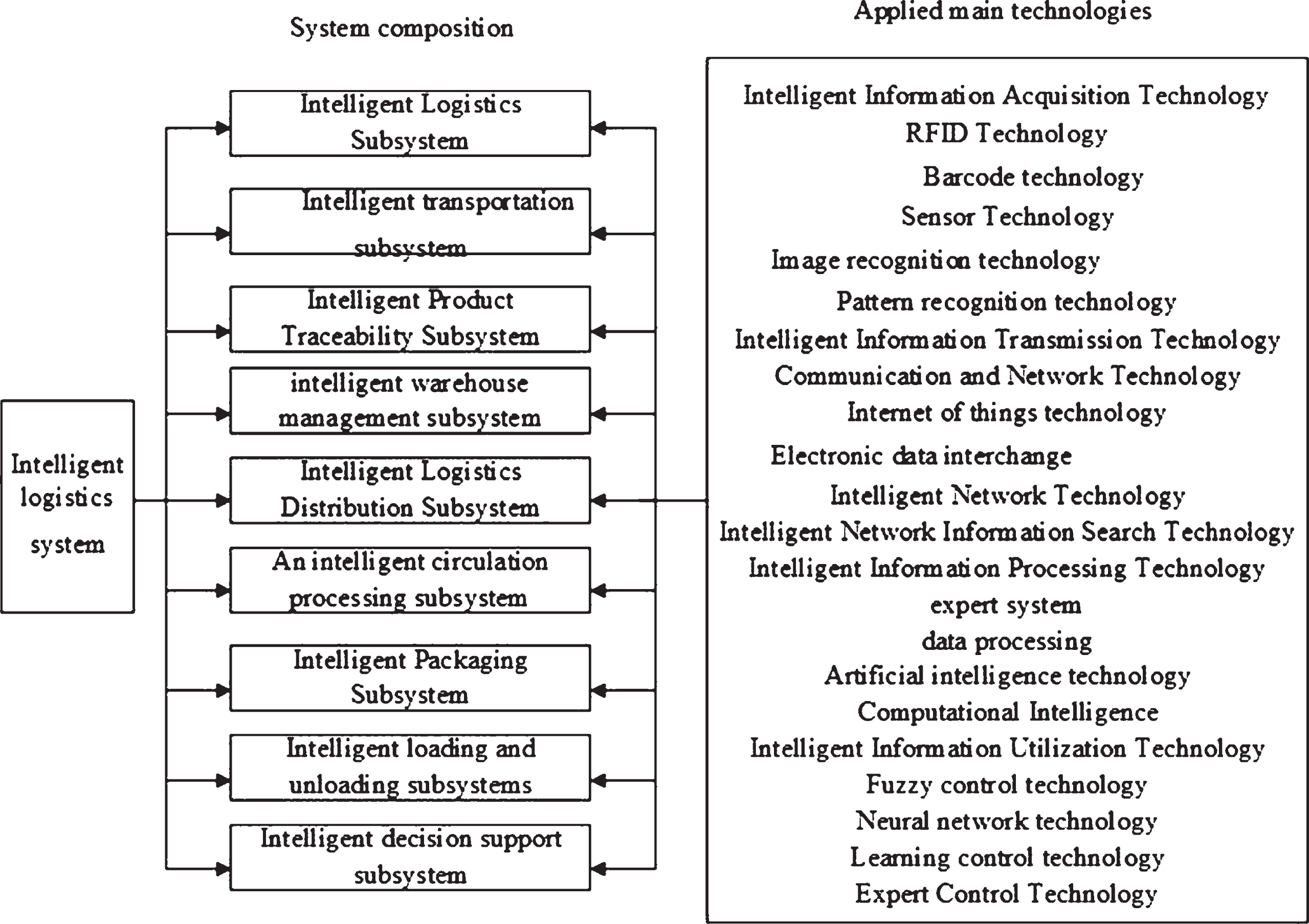
Composition and application of intelligent logistics system.
Logistics system structure
A complete and standard logistics business process mainly includes the following business activities: business acceptance, goods storage, loading of goods, transportation, operation monitoring and unloading of goods. Only the core business activities of logistics are listed here, and other details are omitted. The overall block diagram of intelligent logistics is shown in Fig. 2.
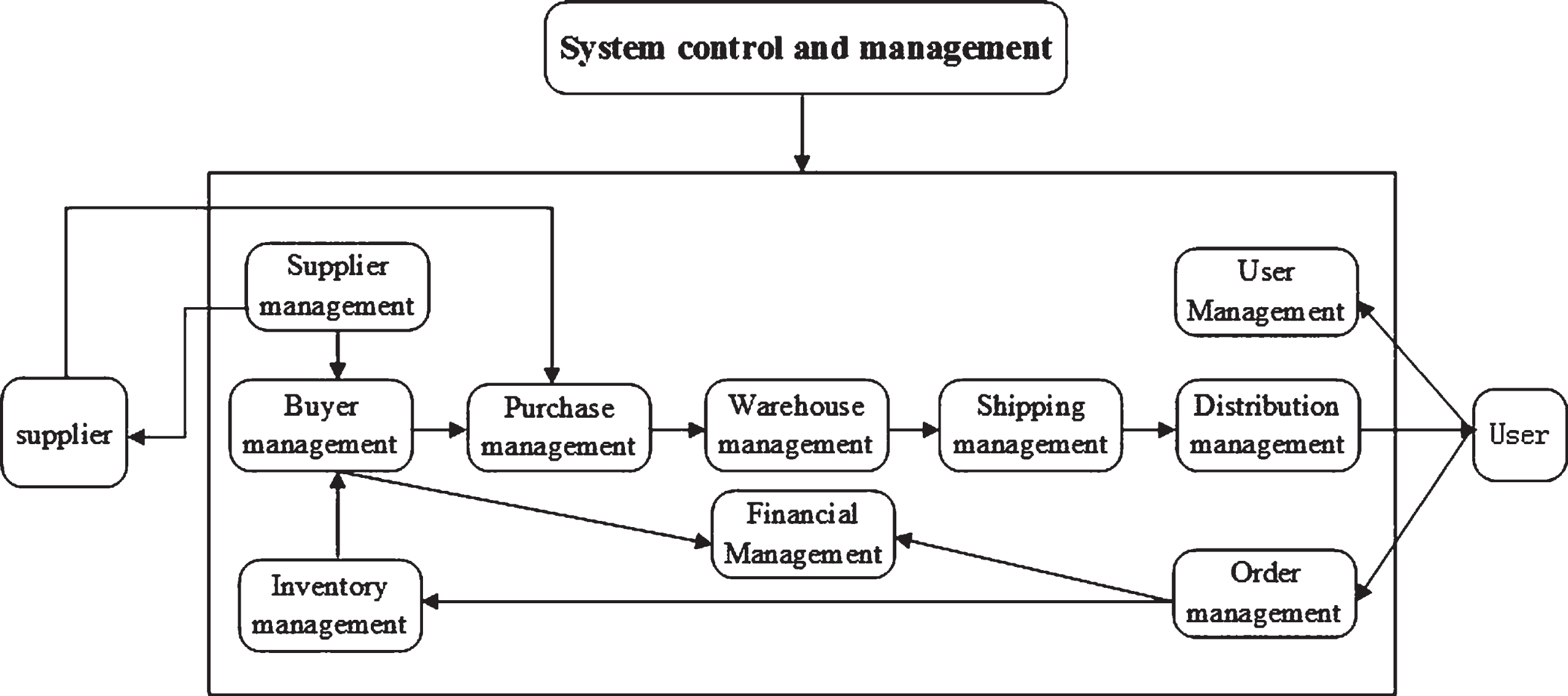
General block diagram of logistics.
According to the actual situation of intelligent logistics services in the IoT environment, the following Quality of Service (QoS) attributes are considered: Service Price, that is, the fee that the service requester must pay to use the service; Service Time, that is, the time that must pass to complete the service; Reliability is the success rate of service execution; the Degree of Reliability (Reputation Degree), which reflects the service user’s recognition of the service provided; Availability (Availability), which is the percentage of time, indicates when the service is operational, can be visited by the service requester.
Under the sequential structure, it is assumed that the composite service CS is composed of n component services, that is, CS ={ S1, S2, …, S n }. For each component service S i , there are multiple candidate services that can complete the component. The required function can be expressed as: S i = {Si1, Si2, ⋯ , S im } (m is the number of candidate services included in the component service). The aggregation functions of the above five QoS attributes in the order relationship are shown in Table 1. In an article, it is unnecessary to have an arrangement statement at the beginning (or end) of every (sub-) section. Rather, a single overall arrangement statement about the whole paper can be made at the end of the introduction section.
Aggregate function
Aggregate function
The logistics service combination is a specific implementation method selected from each sub-process and combined together. In the actual logistics environment, the implementation methods of each sub-business process are limited. For example, in the transportation link, there are a certain number of transportation methods adopted by logistics companies. The atomic services and representations of the six sub-process services in this study are shown in Table 2.
Atomic services and representations
Atomic services and representations
Assume that the logistics service CS is composed of n component services. For each component service S i , there are multiple candidate services, which can be expressed as: S i = {Si1, Si2, ⋯ , S im } (m is the number of candidate services included in this component service). For each S ij , it has the QoS attributes described above. In different application environments, users have different degrees of preference for non-functional attributes, denoted as ω, (0 < ω < 1), which is set by the method in Equation (1), that is, their weights are set according to the priority order of attributes Set, among the n attributes, the weight value ω j of the j-th attribute can be expressed as:
The QoS attributes of a composite service can be represented by a matrix
The row represents a candidate service in component service S i ; the column represents a QoS dimension and Q ij represents a corresponding QoS attribute value, where p is the number of QoS attributes.
There are two types of QoS attributes: For positive QoS attributes, the higher the value, the better the service performance or quality; For negative QoS attributes, the lower the value, the performance of the service or worse quality [18, 19]. Among the above five QoS attributes, reliability, reliability, and availability are positive attributes, while service price and service time are negative attributes. Use the Equations (2) and (3) to normalize the properties of the anode and cathode, respectively.
After normalization, the matrix
Using the matrix
Logistics service is composed of n key sub-services. Utility value calculation is performed on the candidate services in each sub-service using formula (4). The logistics combination service includes one candidate service in each sub-service. total_uf indicates the logistics combination service. Utility value, that is:
Problem statement
A highly rated logistics service must come from a more perfect business process, and each sub-process in the process must be well regulated. Using the concept of service computing, a logistics service is a service composition problem, and each sub-business process is a service component. Each component has multiple candidates’ specific services (atomic services), that is, specific operation implementations. Today, intelligent logistics in the context of the IoT is dynamic, providing opportunities and challenges for people. To strive to find an optimal combination of logistics services to meet user requirements, it can be formalized as the following description: Logistics service CS is composed of n component services, i.e., CS = {S1, S2, ⋯ , S
n
}; Each component service S
i
has multiple candidate services, i.e., S
i
= {Si1, Si2, ⋯ , S
im
} (m is the number of candidate services included in this component service); An optimal combination
Optimal logistics service combination algorithm
According to the description in Section 3.1, the following introduces an optimal logistics service combination algorithm (LSC). Through this algorithm, it helps to find the optimal atomic service combination in the logistics business. The algorithm first calculates the weight of each QoS attribute dimension, then normalizes all the attribute values of each atomic service, then calculates the utility value of each atomic service, and finally selects the largest utility value from each component service according to the utility value atomic services.
The LSC algorithm process is as follows:
Experimental analysis
Figures 3 and 4 are used as prototypes, QWSDataset (2.0) is used as the data source, and the model and algorithm in this paper are verified through two sets of experiments. LSC is compared with the other two algorithms, that is, fixed path combination FSC (select csl = bal, sg1, 1g1, tpl, oml, ugl as the fixed path) and random path combination RSC (that is, each sub-business process randomly selects a candidate operation). The first set of experiments fixed total_uf to 4.3 and compared the user satisfaction rates obtained by the three algorithms; the second set of experiments measured the performance of the three algorithms when the total_uf changes uniformly. The user satisfaction rate is defined as the ratio of the number of times that the user total_uf expectation is satisfied to the total number of calls.
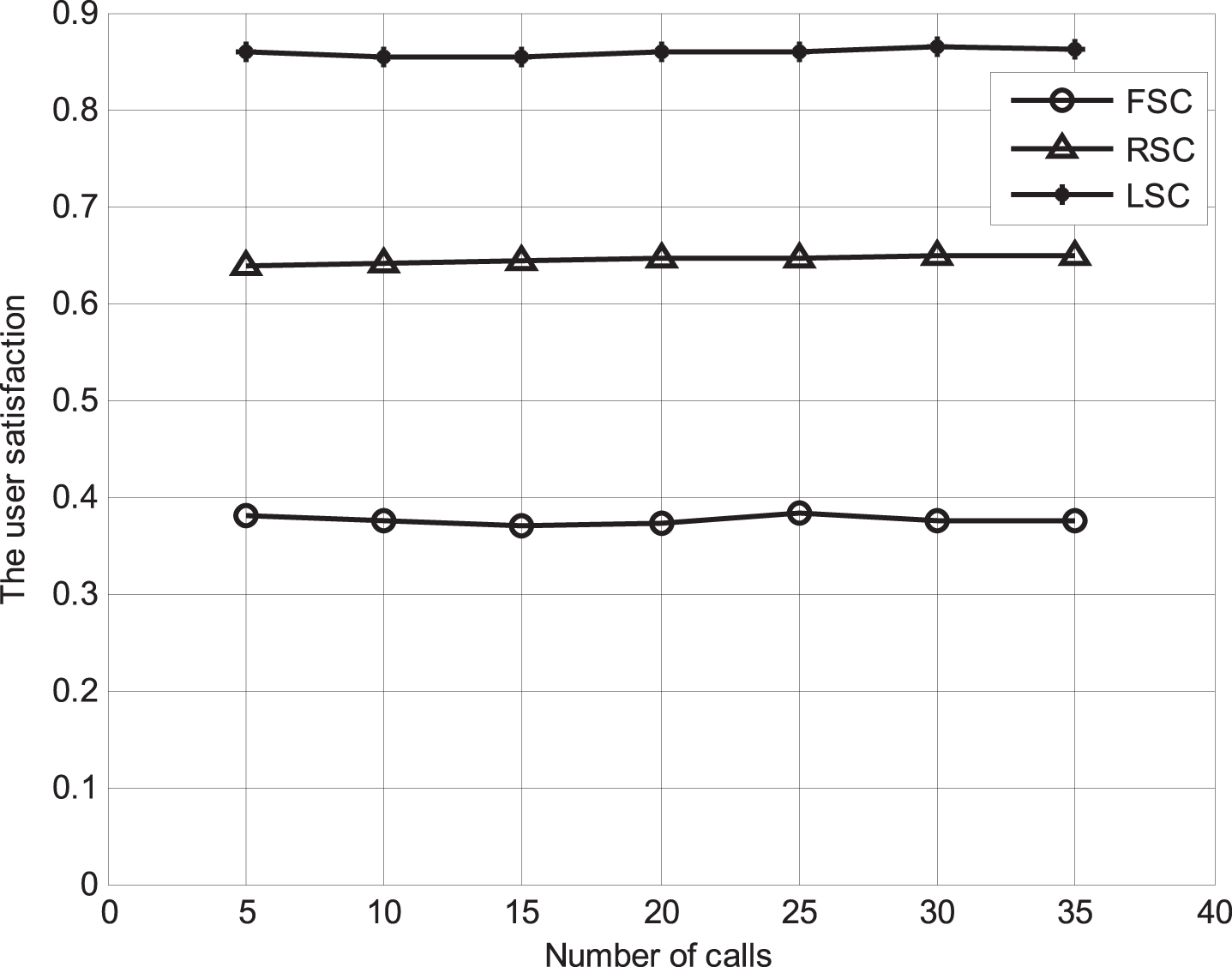
Total_uf = 4.3.

Total_uf dynamic changes.
In this study, a processor Intel @ CoreN i5 CPU (2.80 GHz), 4 GB of memory, and a 64-bit win7 operating system were used as the experimental environment. All experiments were performed in MyEclipse. The QoS dimension service price, service time, reliability, reliability, and availability are assumed to correspond to the 8, 1, 5, 4, and 2 attribute fields in the QWS Dataset, respectively. In Table 2, there are a total of 18 atomic services, and the records in the QWSDataset are averaged in turn.
Analysis of experimental results
Figure 3 shows the results of the first set of experiments. The horizontal axis is the number of calls to the logistics service, ranging from 5 to 35, with an interval of 5 each time, and the vertical axis is the user satisfaction rate. It can be seen from the figure that the user satisfaction rate obtained by the LSC algorithm is the highest, which is almost 85%. This is because each sub-business process of the logistics service is carefully selected, so the performance of the entire combined service of the final combination Also the best. The second best is the RSC algorithm. Each sub-process randomly chooses one of several schemes, so the combined scheme may also achieve relatively ideal performance, and its user satisfaction rate can reach more than 60%. The worst performance of the three algorithms is FSC. In the experiment, the csl path listed above was selected as the fixed path, and its user satisfaction rate was below 40%. Through the experimental comparison, the analysis shows that intelligent logistics service is now in a dynamic service environment. In each business process link, configuration selection must be made dynamically so that users can obtain a more satisfactory service.
Conclusion
Through two sets of experiments, the feasibility and efficiency of the optimal logistics service selection scheme based on the LSC algorithm were verified, and it also explained that in the dynamic intelligent logistics service, due to factors such as environment, it is necessary to perform dynamic optimization in each process link Configuration selection. In the future, the logistics service selection plan will be further improved, more detailed attributes will be considered, and it will be used in specific logistics service systems.