



Abstract
This paper applies uncertain theory to establish an uncertain differential equation (UDS) SIS epidemic model, comparing with deterministic and stochastic SIS models. Solution of the UDE model is obtained. Threshold conditions are derived for permanence and extinction of disease by the corresponding α-paths, which reveal relationships of three models. Numerical simulations are given to illustrate these results.
Introduction
An epidemic is the rapid spread of infectious disease to a large number of people in a given population within a short period of time. There is a wide range of deterministic and stochastic models to investigate spread of an epidemic, such as SIS, SIR, SEIR, SEIRS models and so on, see Kermack and Makendrick [1], Capasso and Serio [2], Liu et al. [3], Hethcote [4], Allen and Burgin [5], Li et al. [6], Yang and Mao [7], Artalejo and Lopez-Herrero [8].
Deterministic models are usually described by ordinary differential equations (ODEs) and provide local or global stability for persistence and extinction of disease by a basic reproduction number. For example, Korobeinikov and Wake [9] obtained global stability properties of SIS, SIR and SIRS epidemiological models by Lyapunov functions. Li and Jin [11] provided global stability of an SEIR epidemic model with infectious force. Bai and Mu [10] proved global asymptotic stability of a generalized SIRS epidemic model.
In order to explore the effect of environmental fluctuation on deterministic model, many scholars introduced different noises into deterministic model and established stochastic versions, which are generally formed by stochastic differential equations (SDEs). Stochastic model mainly deals with asymptotic behavior around equilibria of the deterministic case by a threshold value. Yang et al. [12] showed ergodicty and extinction of stochastic SIR and SEIR epidemic models with saturated incidence. Chen and Kang [13] proved asymptotic behavior of a stochastic SIR model.
Suppose the total population size at time t is given by N t , which is divided into two sub-groups: the susceptible (S) and infected (I) classes. Let S t and I t be the numbers of susceptible and infectious individuals at time t, respectively. Consider a deterministic SIS epidemic model formed by the following ODEs
Denote N
t
= S
t
+ I
t
and N
0 = S
0 + I
0. For model (1), it is easy to get
Then, N t = N - (N - N 0) e -μt . If t→ + ∞, then N t → N; that is, S t + I t → N. Without loss of generality, suppose S t + I t ≡ N. Define a basic reproduction number as
Thus, solution of the model (1) is obtained as follows
Based on the above solutions, the following results hold.
(A1) If
(A2) If
Consider random effects of environment make transmission coefficient β of disease, Gray et al. [14] established an Itô stochastic differential equation (SDE) SIS model by replacing βdt in model (1) by
For model (3), define a threshold value as
For a given initial value I 0 and all t ≥ 0, Theorem 3.1 of Gray et al. [14] showed model (3) has a unique global positive solution I t ∈ (0, N) with probability one. Moreover, the following results hold.
(B1) If
(B2) If
In practices, the number of infectious individuals perhaps continues to increase or decrease at the beginning or the end of an epidemic. Thus, the total number of compartments may not behave like Ito’s SDE. On the other hand, in order to investigate transmission mechanism of disease, it need to collect a set of the available samples and provide numerical simulations. However, for such kinds of epidemics with few data in short time or missing data in long time, we have to invite some domain experts to evaluate belief degree that each event will happen. Liu [15] first introduced the concept of belief degree to solve the above questions, which represents strength with which we believe the event will happen. Based on belief degree, an uncertain theory is established to reflect uncertain phenomena according to normality, duality, subadditivity and product axioms, different from probability theory. In order to indicate belief degree, an uncertain measure is defined as a set function on a σ-algebra, which is interpreted as personal belief degree. Thus, an uncertain variable is used to represent quantities with uncertainty and uncertainty distribution is used to describe an uncertain variable.
In 2008, Liu introduced uncertain process and proposed a type of differential equations driven by Liu process, called uncertain differential equation (UDE). So far, uncertain differential equation has become a main tool to deal with dynamic uncertain system such as finance and control fields. Liu [18] supposed stock price followed an uncertain differential equation and produced a new topic of uncertain finance. Chen and Gao [19] analyzed an uncertain interest rate model with uncertain short rate. Yao [20] studied a stock model with uncertain interest rate. Liu [21] proposed an uncertain insurance risk process, and Yao and Qin [22] modified the uncertain risk model.
Recently, Li et al. [23] firstly applied uncertain differential equation to the domain of infectious diseases and established an uncertain SIS epidemic model with uncertain recovered rate γ. Replace γdt in the model (1) by
Consider the infection coefficient rate β of model (1) is a main way that people infected with disease. Similar to the above UDE model of Li et al. [23], this paper tries to establish an UDE SIS model with uncertain transmission rate and reveals relationships of deterministic, stochastic and uncertain models. The rest is organized as follows. In Section 2, we first review some basic concepts of uncertain theory. Then, an UDE SIS epidemic model with uncertain transmission rate is established. We provide analytic solution of the model and obtain threshold conditions by α-paths. Further, uncertain distributions of solution can be obtained by α-paths, too. In Section 3, we provide comparison of ODE, SDE and UDE SIS models and reveal relationship of them. In order to illustrate these results, numerical simulations are shown in Section 4 and a brief conclusion is in Section 5.
Uncertain theory
Some definitions about uncertain measure, uncertain variable, uncertain process, uncertain calculus and uncertain differential equation refer to Liu [15], Liu [24] and Yao [25].
In this case, the triple
An uncertain variable ξ is a measurable function from uncertainty space
Let T be an index set and
C
0 = 0 and almost all sample paths are Lipschitz continuous.
C
t
has stationary and independent increments. Every increment C
t+s
- C
s
is a normal uncertain variable with an uncertainty distribution
Let X
t
be an uncertain process and C
t
be a Liu process. For any partition of a closed interval [a, b] with a = t
1 < t
2 < ⋯ < t
k+1 = b, the mesh is written as
Let X
t
be an uncertain process. For each α ∈ (0, 1), there exists a real function
For the model (1), suppose uncertain fluctuations in the environment will manifest themselves mainly as fluctuations in the infection coefficient β, so that βdt is replaced by βdt + σ t dC t , where C t is Liu process with intensity σ t > 0, instead of Wiener process B t . Thus, an UDE SIS epidemic model with uncertain infection coefficient is established as follows
In order to get solution of model (7), we will solve a special type of nonlinear uncertain differential equation and obtain the corresponding analytic solution.
Denote
Further,
By Theorem 1 of Liu (2012), a solution of the above equation is
Based on Lemma 1, we obtain the solution of the uncertain model (7).
Denote u
1t
= βN - μ - γ, u
2t
= - β, v
1t
= σ
t
N and v
2t
= - σ
t
. Then, for the UDE (8) we obtain
Based on Lemma 1 and S t = N - I t , solution of the model (7) follows. □
Yao [25] proved that solution of an UDE is a contour process. Thus, solutions S
t
and I
t
of UDE SIS model (7) are two contour processes. In order to obtain an uncertainty distribution of an UDE, we need to discuss α-path. For model (7), α-paths are denoted by
Since I
t
is a contour process, it is to get
Thus,
(1) If
(2) If
where
Evidently,
Moreover, by Theorem 2,
(2) If
Let Φ
X
t
(x) and
(1) If
(2) If
(1) By Theorem 3, if
If
(2) If
In this section, we compare dynamic properties of deterministic, stochastic and uncertain SIS epidemic models and reveal relationship among three models. In ODE SIS model, the basic reproductive number
The relationship of ODE and UDE SIS models
By the definition of Φ
-1 (α) in (6), we have
Thus, there only exists a unique value α * such that Φ -1 (α *) =0. Obviously, α * = 0.5. Further, if 0 < α < 0.5, then Φ -1 (α) <0; if 0.5 < α < 1, then Φ -1 (α) >0.
Since solution I
t
of UDE model (7) is a contour process, it is easy to get
Next consider three cases of uncertain measure α:
(i) If α = 0.5, then
(ii) If 0 < α < 0.5, then
(iii) If 0.5 < α < 1, then
The relationship of SDE and UDE SIS models
By the definitions of
Since
(I) If α = α
*, one has
(II) If 0 < α < α
*, one has
(III) If α
* < α < 1, one has
Numerical simulation
In order to reveal the same and different properties of ODE model (1), SDE model (3) and UDE model (7), we provide three cases according to threshold values
The discrete equations of the model (3) is shown by
Take N = 100, β = 0.00005, μ = 0.02, γ = 0.2, σ = 10-3 and S 0 = 80, I 0=20. The trajectories of S t and I t in three models are shown in Fig. 1 by the discrete equations (11), (12) and (13).
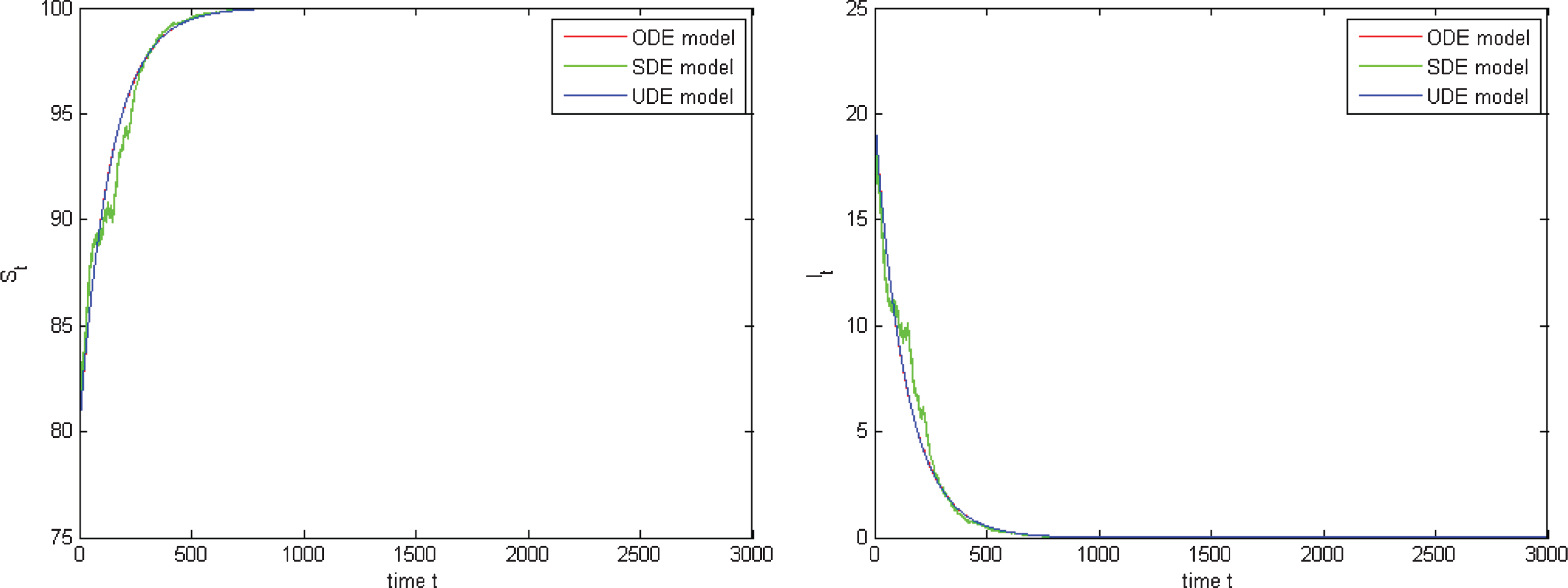
Trajectories of the solutions S t and I t with β = 0.00005 and σ = 10-3.
Taking the above parameters into the equation (2), it has
On the other hand, by (10), values of
The values of
Take N = 100, β = 0.005, μ = 0.02, γ = 0.2, σ = 10-1.8 and S 0 = 80, I 0=20. Based on the discrete Equations (11), (12), (13) and all given parameters, Fig. 2 reflects trajectories of S t and I t in these models.
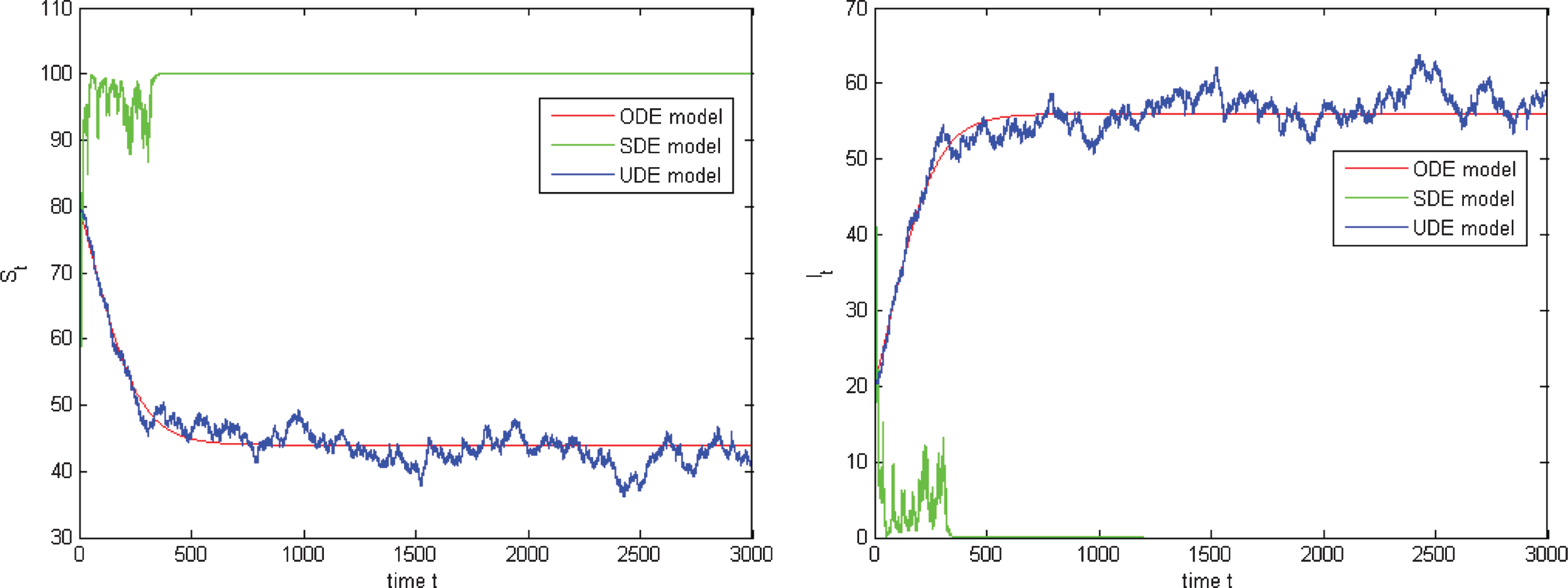
Trajectories of the solutions S t and I t with β = 0.005 and σ = 10-1.8.
Similar to Case 1, we have
It reflects the disease will be persistent.
For model (3),
Table 2 provides the values of
The values of
If
Take N = 100, β = 0.006, μ = 0.02, γ = 0.2, σ = 10-3 and S 0 = 80, I 0=20. Similar to Case 1 or Case 2, Fig. 3 reflects the trajectories fluctuation of models (1), (3) and (7).
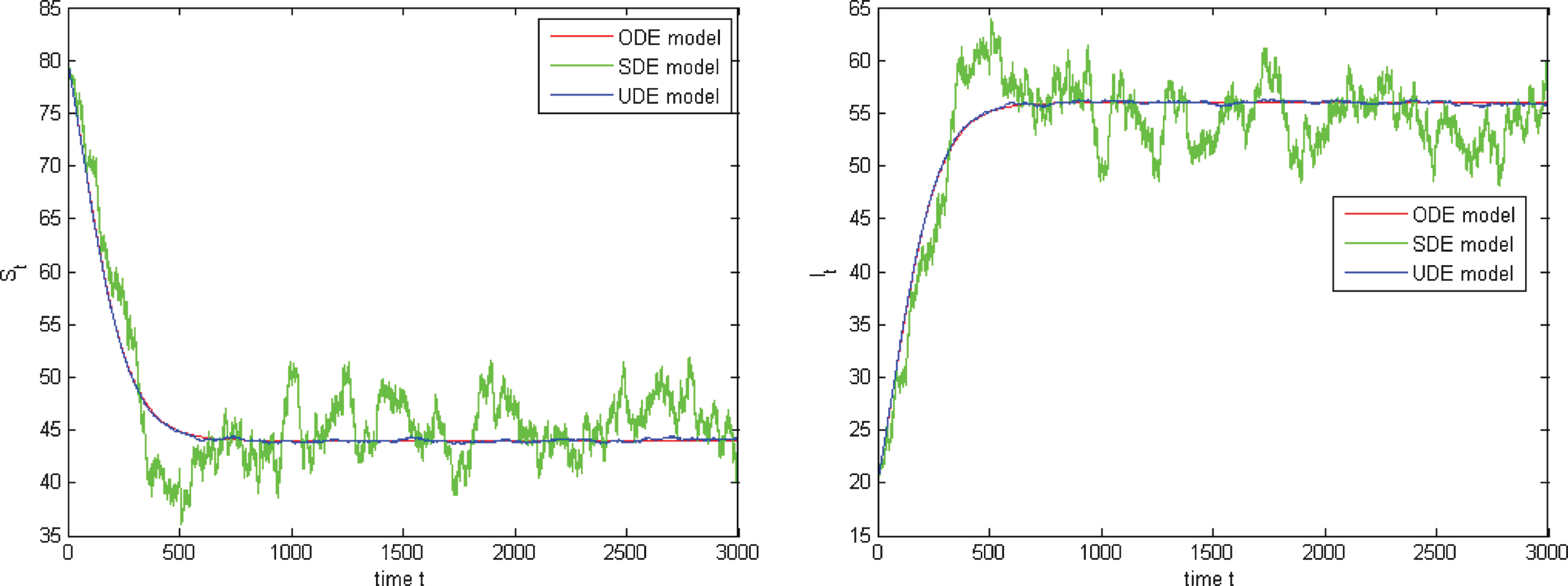
Trajectories of the solutions S t and I t with β = 0.005 and σ = 10-3.
For model (1),
It reflects the disease is persistent. Comparing with model (1), trajectories fluctuation of model (3) is greater than that of (7), see Fig. 3.
For α = 0.1, 0.2, …, 0.9, Table 3 provides the values of
The values of
This paper applies uncertain differential equation to study SIS epidemic model. By relationship of S t and I t , solution of UDE SIS model and the corresponding α-paths are obtained, respectively. Based on α-paths, we obtain threshold conditions to reflect permanence and extinction of disease.
In order to reveal the relationships of deterministic, stochastic and uncertain model, we study the dynamic properties of these models by their threshold values
Besides the deterministic, stochastic and uncertain differential equations, there exist other differential equations such as fuzzy differential equations and fractional differential equations, see Nieto et al. [26], Guo (2009), Khastan et al. [27, 28], Cecconello [29] and Zhang et al. [30 –32]. How to apply these differential equations to investigate spread of an epidemic and reveal the relationships of epidemic models defined by these equations. This is an interesting, new and opening topic.
Footnotes
Acknowledgments
We thank the reviewers for their insightful comments which led to a significant improvement of the paper. This research was funded by the National Natural Science Foundation of China (Grant Nos. 11661076, 61563050) and the Science and Technology Project Foundation of Xinjiang Uygur Autonomous Region (Grant No. 2016D01C043).