



Abstract
Reliability-based dome optimization (RBDO) is one of the most robust methods nowadays, which has made it possible to achieve a high degree of safety and optimum structural design at the same time. The purpose of optimization, based on the reliability of space domes, is to find the best set of sections of the structural members, which leads to the minimum structural weight, incorporating the probabilistic constrains. In the contest of reliability or probabilistic constrain, the applied loads, the module of elasticity, and the cross-sections of the members are considered as random variables with the specified probability distributions. The particle swarm method (PSO) is used as optimization algorithm because it is a simple and robust method in the case of nonlinear objective functions. In order to investigate the effect of probabilistic constraints selections based on three displacement, stress, and combination of displacement and stress, three space domes with different height to span ratios are considered in this research. The results indicate the optimal structural weight of space domes vary with changes the height-to-span ratio and type of the constraint model selections. Therefore, in order to obtain the optimum space domes in regards to the structural weight, incorporation of both probabilistic constraints of combined stress and displacement is essential in design step.
Keywords
Introduction
Space structures are rapidly becoming accepted by designers and structural engineers around the world today. This is not only because of the attractiveness and beauty of these structures, but also because of their structural characteristics, the economics of these systems, and the possibility of their rapid implementation. Also, with these types of structures are possible to cover roofs with large spans, including sports stadiums, trade shows, recreation centers, etc. [6]. Owing to their beauty, the proper handling of loads, low structural weight, and cost effectiveness, the use of domes has now increased in comparison with other structural forms. Also, these structures are widely used to cover in area where intermediate columns are undesirable. On the other hand, because of the fact that these structures are designed and constructed on a large scale, their traditional design leads to non-optimal, heavy, insecure, and very costly structural forms [5]. For this reason, in recent years, the optimization of these structures has attracted many researchers. Yang et al. [17] examined the 120-member dome in which the height of the rings of the dome was optimized as a design variable. Salajegheh et al. [16] investigated the optimization of the geometry of single-layer space domes with fixed span and height to find the minimum weight, where the degree of meridian equation and the radius of circuits have been considered as a variable design. Saka [25] used a genetic algorithm to optimize the geodesic dome in which the height of the dome crown and the cross-section of members are considered as random variables. In another research, Hasançebi et al. [26] presented an algorithm for optimizing the topology of geodesic domes where the number of rings, crown height, and dome members were optimized. A comparative study was conducted by Kaveh et al. for the optimal design of single-layer dome types [1]. In this study, a number of metaheuristic algorithms, such as Particle Swarm Optimization (PSO), Ant Colony (ACO), Harmonic Search (HS), and Big Bang (BB), are incorporated to obtain the performances of these algorithms for single-layer space domes. Other works, such as those of Hasançebi [27], Balling and Briggs [28], Babaei [21], and Tang et al. [31], can be mentioned in the optimization of space structures using metaheuristic algorithms. In recent years, a number of space structures has been damaged or broken over the world, in general, thanks to snow load, wind load, seismic load, and traditional designs. One of the reasons for this event can be attributed to the uncertainties in the materials and loads applied on the structures [13]. Given the uncertainty in engineering problems, first, the optimal design of the structure should be such as to provide the appropriate structural reliability. In addition, because of these uncertainties in structural parameters and applied loads, no structure can be considered completely safe, but each structure has a probability of failure, although small [14]. Therefore, in the design of structures, in addition to the fact that the uncertainties should be included, we need to design them in such a way that their probability of failure will not be greater than the amount specified by the regulations. Increasing the safety or reducing the probability of failure is always important for an engineer, but it can increase the economic costs of construction [7]. One of the main methods used to determine the uncertainty in optimization problems is the reliability-based optimization method (RBDO). The ultimate goal is to design a structure which achieves safety at the lowest cost with the conditions required for performance [29]. Hence, reliability-based optimization concepts seem to be a more logical design philosophy. It has been observed that the cost of computing from a reliability analysis is one of the main issues in using RBDO for real-world problems [15]. One of the main methods for assessing the reliability of structures is the Monte Carlo simulation method to evaluate the probability of failure. But the Monte Carlo method requires a large number of structural analyses for each of the set of random variables. In complex structures, and in structures likely to have small failure probability, a lot of time is needed. Therefore, the First-Order Reliability Method (FORM) is alternative method for determining the reliability index, which is able to solve most practical problems that have several limit state functions [9]. Mashayekhi and Salajeghet presented the optimal design of the two-layer flat-panel network with random variables with the probability of failure [22]. They used the Monte Carlo method of the combined ant algorithm and reliability with Monte Carlo.
Y. Aoues and A. Chateauneuf presented a series of basic methods for numerical solution of RBDOs, the purpose of which was to compare numerical methods of problem solving [32]. V.Togan and A.Daloglu analyzed a two-dimensional structure with various reliability optimization methods. On comparing the results, it was found that the genotype algorithm method provides better results than other methods [30]. C. K. Dimou and V. K. Koumousis used a particle swarm optimization method for optimal design based on the reliability of the truss structure; the results of the optimization for a 25-member truss and a 30-member arc indicate the ability of this method in comparison with other optimization methods [4]. In another study, L.C. Leandro and H. M.Gomes used a comparison between the metaheuristic methods of the genetic algorithm and the annealing method with the traditional mathematical programming (SQP) method to optimize the flat truss, such that the average results show that heuristic algorithms provide more efficiency and more precise results than SQP [20]. M.Jalalpour and J.K. Guest presented a new reliability-based method for optimizing truss shape with geometric defects [24]. In the past, in general, a type of probabilistic constraint function has been used for reliability-based optimization in space structures, most of which is a displacement constraint. Hence, in this research, we have tried to investigate the effects of different probabilistic constraint such as stress, displacement, and their combination individually on the optimal weight of space structure doms.
Reliability-based optimization
Reliability-based optimization is a method for obtaining an optimal design of a structure with a specific and low failure probability, the purpose of which is to minimize the cost function (minimum structure weight) with reliability constraints and deterministic constraints, the mathematical model of which is illustrated in Equation (1).
β i is the reliability index calculated in i-th mode failure and β Ti is the target reliability index. The reliability index has a direct correlation with the probability of structural failure, which is obtained from the relationship P i = Φ (- β i ) where Φ denote the standard Normal cumulative distribution function [24].
Performance function
A limit state is a boundary between undesired and desired performance of a structure (or part of the structure). The above boundary is usually denoted mathematically by a performance function or limit state function. Generally, the limit-state indicates the margin of safety between the resistance and the load of structures [18]. The limit state function, Z (·), is defined by Equation (3)
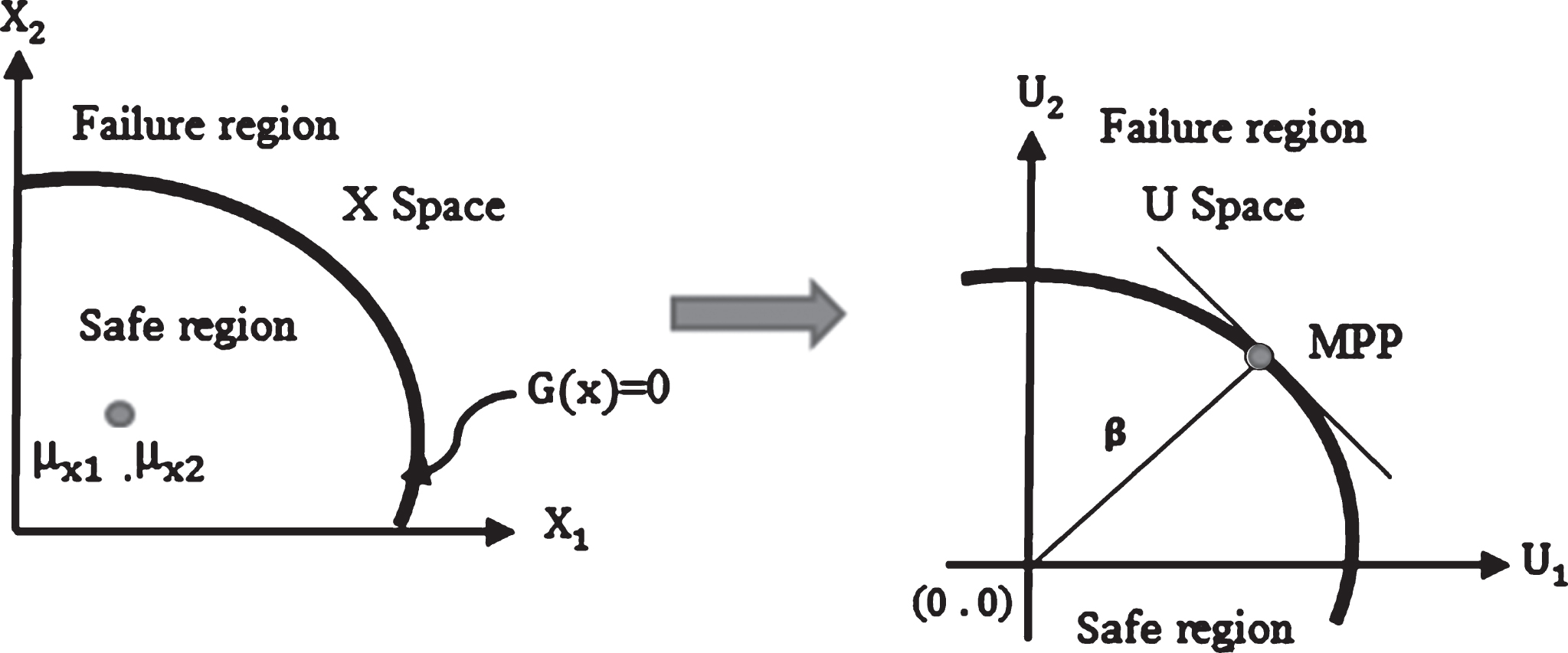
The hasofer and lind reliability index [10].
One of the easiest ways to estimate the first-order reliability has been provided by the Kernel, based on the separation of the health area (g > .0) and failure (g < .0), the linear expansion of the limit state function around the mean point and, finally, estimation of the reliability index (β) as β = μg /σg . Because of different results obtained from this expression for different probability distribution function of random variables, as well as the acquisition of different solutions in the state of change in the form of the expression of the limit state function, the Kernel method is not very effective in solving reliability problems. Hasofer and Lind [23], in 1974, defined a new reliability index as the minimum geometric distance between the source and the transferred limit state function, based on the Kernel’s idea, and using the linear form of the limit state, combined with a mapping to transfer random variables from the design space to the Normal standard space (with zero mean zero and standard deviation of the unit). In accordance with the definition given by Hasofer and Lind, the design point point is a point on the limit state function (g = 0) which has the smallest distance from the origin to limit state function in Normal standard space. This point is also known as the point with the maximum failure probability and is illustrated in Fig. 1. The distance between this point and the origin is the reliability index, which provides the structural failure probability by the relationship P
f
= Φ (- β). Therefore, a calculation of the design point requires the use of the optimization algorithm as follows:
PSO which is an evolutionary global algorithm has gained popularity recently. Similar to other existing EAs, PSO is a population-based optimization method [12]. Distinct from other EAs where knowledge is destroyed between generations, individuals in the population of PSO retain emory of known good solutions as the search for better solutions continues. Hence, PSO has higher speed of convergence than other evolutionary search algorithms [3]. The other advantage of PSO is that it’s easy to implement and there are fewer parameters to adjust. The velocity vector of each particle is calculated by Equation (5).
Particle swarm algorithm is a nature-based method that replaces mathematical relations for optimization and the advantage of this is local non-convergence, which prevents the operation from stopping before it reaches the optimal answer. To optimize the use of the particle swarm algorithm, we can limit the reliability index and consider the minimum weight as the objective function or, contrariwise, we can limit the weight and objective function of the reliability index. In this research, the reliability index is the limitation and the minimum weight is the objective function.
Objective function
In optimization problems in civil engineering, the goal is primarily to minimize the weight of the structure or the consumable material. In this research, the objective function of the weight of the structure is given by Equation (7).
In this problem of structural constraints defined by Equations (8) to (12).
The permissible compressive stress of the members is calculated on the basis of two possible modes of failure of the member, calculated from Equations (15) and (16).
A: In the case of inelastic buckling (λ
i
< c
c
):
B: and in the case of the elastic buckling (λ
i
≥ c
c
):
In the above relations, E is the modulus of elasticity, F
y
is the steel yield stress, and
In order to evaluate the effect of probabilistic constraints on the optimal weight of space structures and to compare this with the optimal results without probabilistic constrains, three space domes with a height-to-span ratio of 0.22, 0.30, and 0.50 are considered here. Given that the performance of the particle collection algorithm is dependent on the constant parameters of the algorithm and the optimal values of these parameters are largely dependent on the type of problem. Therefore, in the first step, by performing sensitivity analysis, the optimal values of these parameters for space structures are determined. Then, the effect of probabilistic constraints on optimizing the weight of the structure is investigated. Given the random nature of the algorithm (PSO) to find optimal weight values, this algorithm is performed for each problem 30 times by independent analysis; the results are based on average values of 30 runs.
A 120-bar dome space structures
The 120-bar space dome shown in Fig. 2, contain 120 members with 111 degrees of freedom. The member cross-section is divided into seven groups, as shown in Fig. 2. All members have material density ρ = 7971.81kg /m3 , Young’s modulus of 210000 MPa, tensile yield of 400 MPa. The allowed node displacement in all directions are limited to±5 mm. All loads on the structure are in the vertical direction and applied to all the nodes except the nodes on the supports. The load on node 1 is 60kN and on the nodes 2 to 13 are 30 kN. The load on the other nodes is take as -10 kN. The members cross-sections are taken in the semi-discrete interval from 5 to 129.032 cm2. Also, the loads, the module of elasticity, and members cross-sections are take as the random variable with Normal probability density function and has a coefficient of variation of 5%. The probability of exceeding the limits of the permitted value should not be less than 99.865% or target reliability index of three (β t = 3). In this research, firstly by sensitivity analysis, the optimal values of the constant parameters of the particle swarm algorithm of space structure dome are determined and then the effect of probabilistic constraints on optimizing the weight of the structure is investigated.
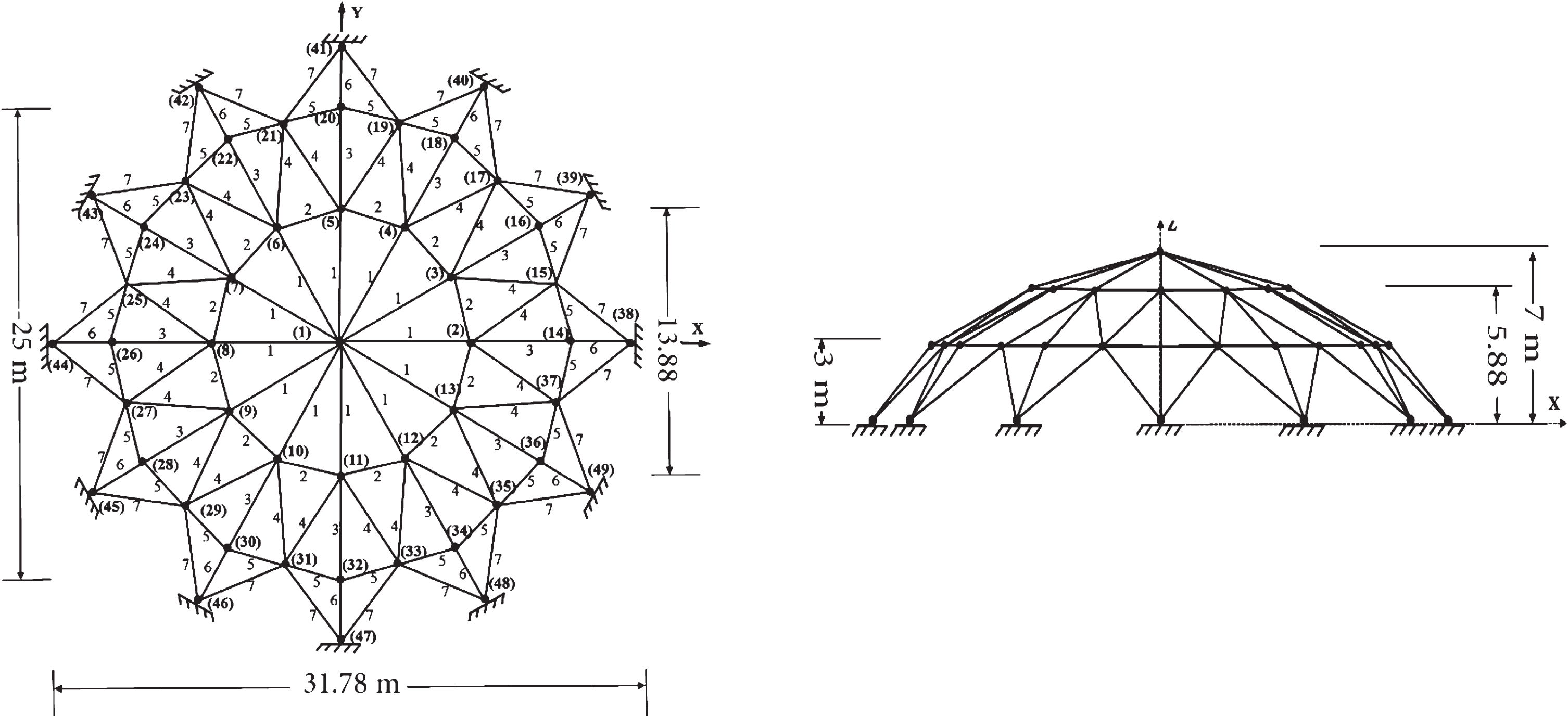
The 120-bar dome space structures [29].
The performance of the Particle Swarm Algorithm, like other metaheuristic algorithms, is mainly dependent on the constant parameters of the algorithm. The optimal values of these parameters are mainly dependent on the type of problem, the speed, and the precision of problem solving, and are different for different issues [2]. Therefore, in this paper, with the help of a sensitivity analysis, the optimal values of these parameters for space structures are determined. Given the random nature of the algorithm (PSO) to find optimal values, this algorithm has been solved for each problem 30 times and the final results are estimated based on the average values of 30 runs. To determine the optimal values of the learning coefficients c1 and c2, we first consider the inertia coefficient equal w = 0.90 and the number of particles npop = 30 and consider 30 different combinations of c1 and c2 such that the condition c1 + c2 ≤ 4 is observed. Therefore, the structure is analyzed 900 times for these states and the value of the objective function is determined. According to the results given in Table 1, the most optimal amount of learning coefficients can be obtained for a situation where the objective function is the lowest value.
Effect of learning coefficients on the optimal weight of the 120-member space dome
Effect of learning coefficients on the optimal weight of the 120-member space dome
The inertial coefficient, w has a great effect on the particle convergence in the main path, such that its amount varies from 0 to 1.20, but in most of the articles available, the interval [0.4, 1] is recommended for the range of this coefficient [19]. To calculate the optimal value of the inertial coefficient w, the value of the learning coefficients is given c1 = c2 = 1.85, and the number of particles is npop = 30. Therefore, the value of the mean objective function is calculated in this step, which can be deduced from Fig. 3, such that the lowest weight of the structure is obtained for the value w = 0.90. This is the best value for this example. In most papers, a decreasing function is used for inertial coefficient, and, so, we will consider a comparison between the constant inertial coefficient (w = 0.90) and the decreasing inertia coefficient w, which decreases from 1 to 0.4. As shown in Fig. 4, the inertial constant (w = 0.90) has a better convergence than the decreasing inertia coefficient. As we know, increasing the number of primary particles reduces the number of iterations required to converge the algorithm. But the increase in the number of particles causes the algorithm to spend more time in the particle evaluation stage and the run time of the algorithm increases to convergence. On the other hand, decreasing the number of particles may cause the function to be trapped in the middle of the local minimums and to reach the optimal solution.
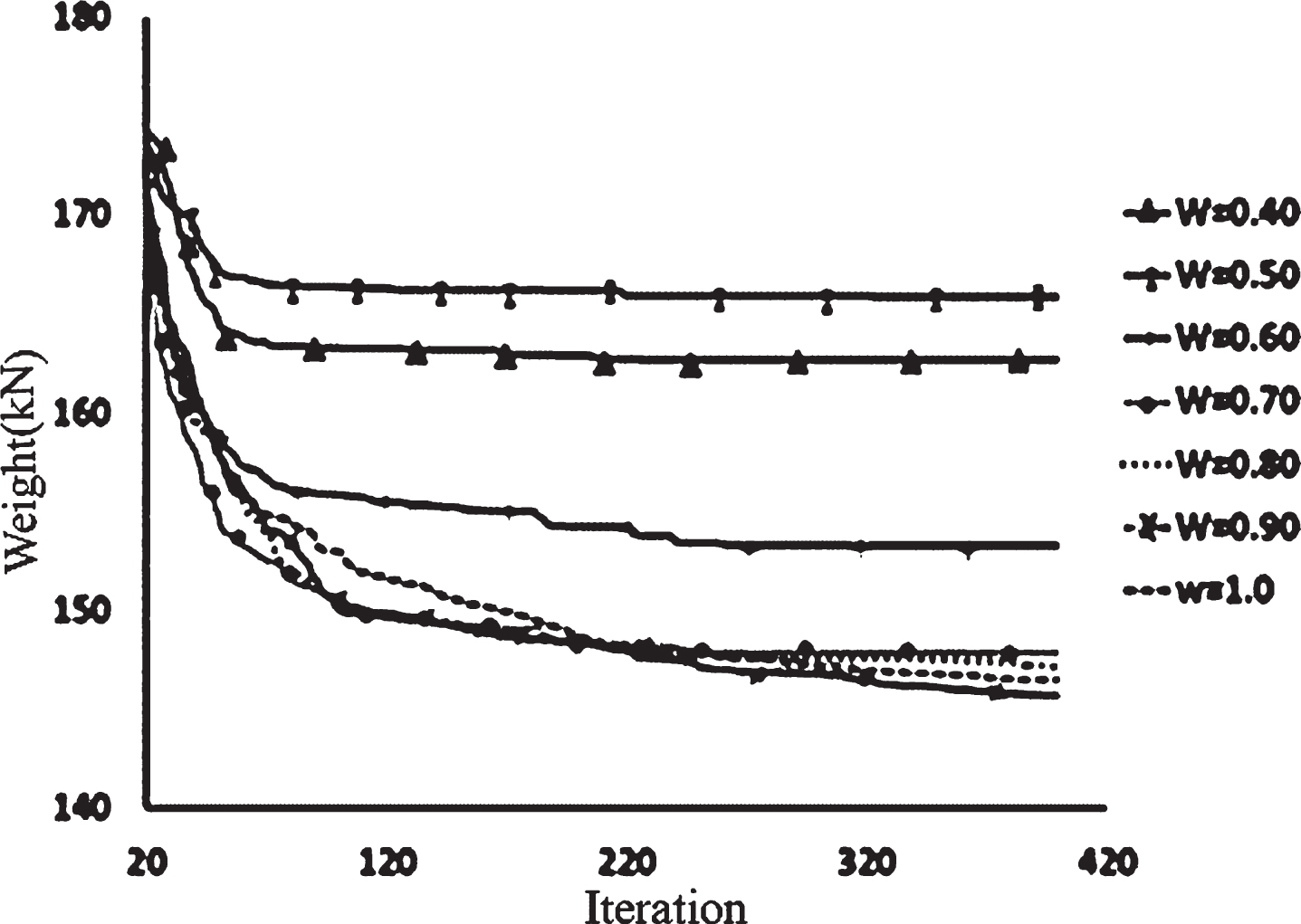
Optimal value of the inertial coefficient w structures.
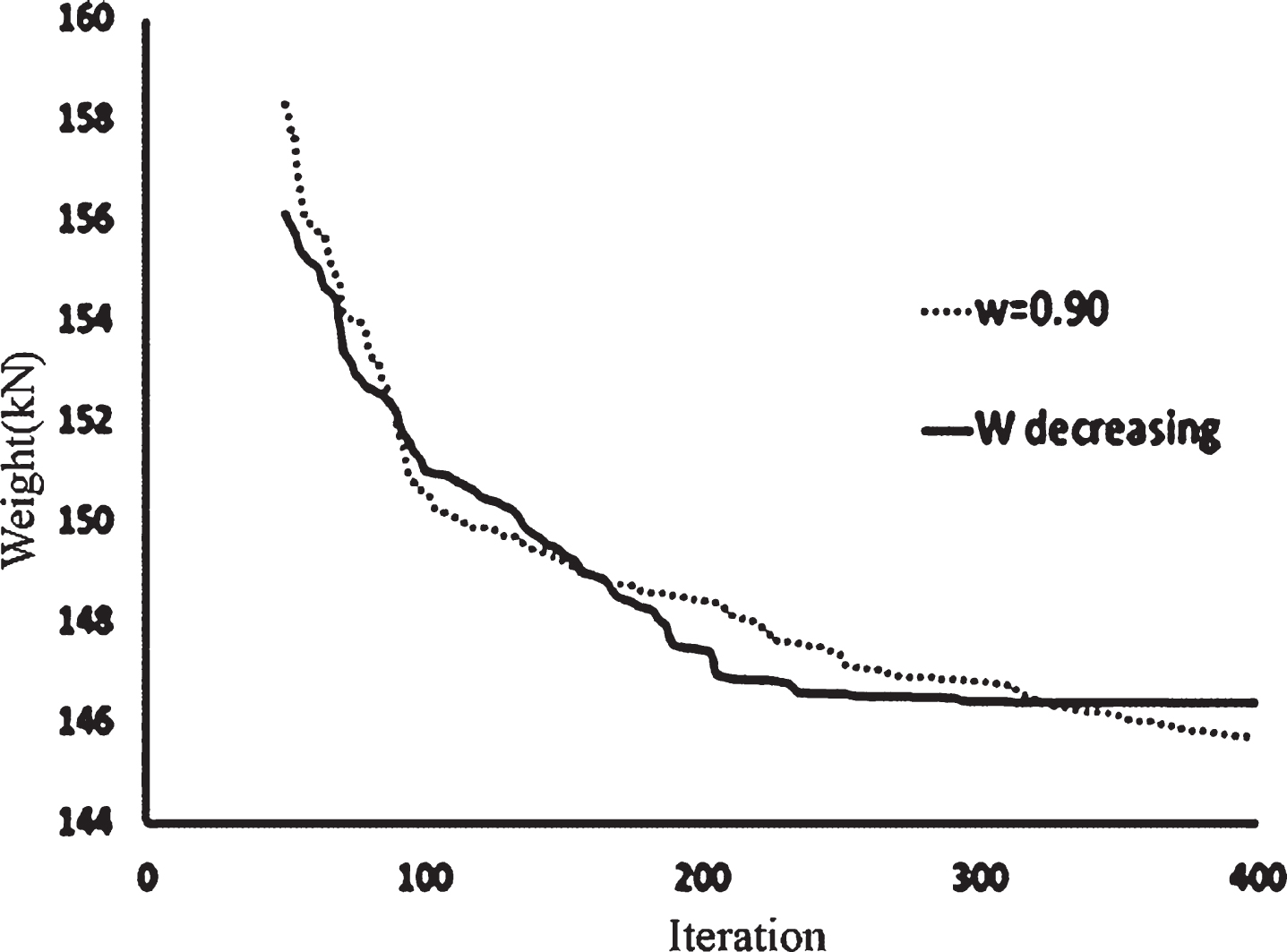
Comparison between the constant inertial coefficient and decreasing inertia coefficient structures.
Therefore, to investigate the effect of the number of particles on the optimization algorithm, the speed and precision are independently analyzed by increasing the number of particles from 20 to 100. The results are shown in Table 2 with the best results vary from 60 to 100 particles. Finally, according to the above results, the constant parameters of the particle swarm algorithm used in this research for optimization the space structures dome is shown in Table 3.
Effect particles number s on the average weight of the 120-bar dome space structures
In the previous research, in general, a type of probabilistic function has been used for reliability-based optimization in space structures, most of which are displacement constraints. Therefore, in this section, efforts have been given to assess the effects of different constraints on the final results of reliability-based design optimization. The three probabilistic constraints of given here are:
Parameters of the PSO algorithm
Parameters of the PSO algorithm
Optimum results for 120-bar dome space structures
In this section, an optimization of a 156-bar space dome with 21 meters span and 7 meters height as shown in Fig. 5 has been investigated and the optimum structural weight under three probabilistic constraints are estimated. A uniform 200 kg/m2 external load is imposed on the surface of this dome. The structure has 65 nodes and 156 members. The structural members are classified into five groups as shown in Fig. 5 Slenderness ratio and buckling stress limitations of members are obtained in accordance with ASD-AISC regulations, as described in section (2–5). The cross-section of the members are taken in a semi-discrete interval from 0.0005 to 0.012 m2, and the permitted displacement are set to 0.058m in all three directions for all structural nodes. In this case, the yield stress, applied load, module of elasticity, and cross-section of the members are taken as random variables with the Normal probability density function and a coefficient of variation of 5%. Assuming that the probability of exceeding the permitted value is not less than 99.865% or target reliability index βt=3. In this problem, three modes are considered to optimize the weight of the structure, so that in each case, by changing the type of probabilistic constraint, its effect on the weight of the structure is determined. In this case,
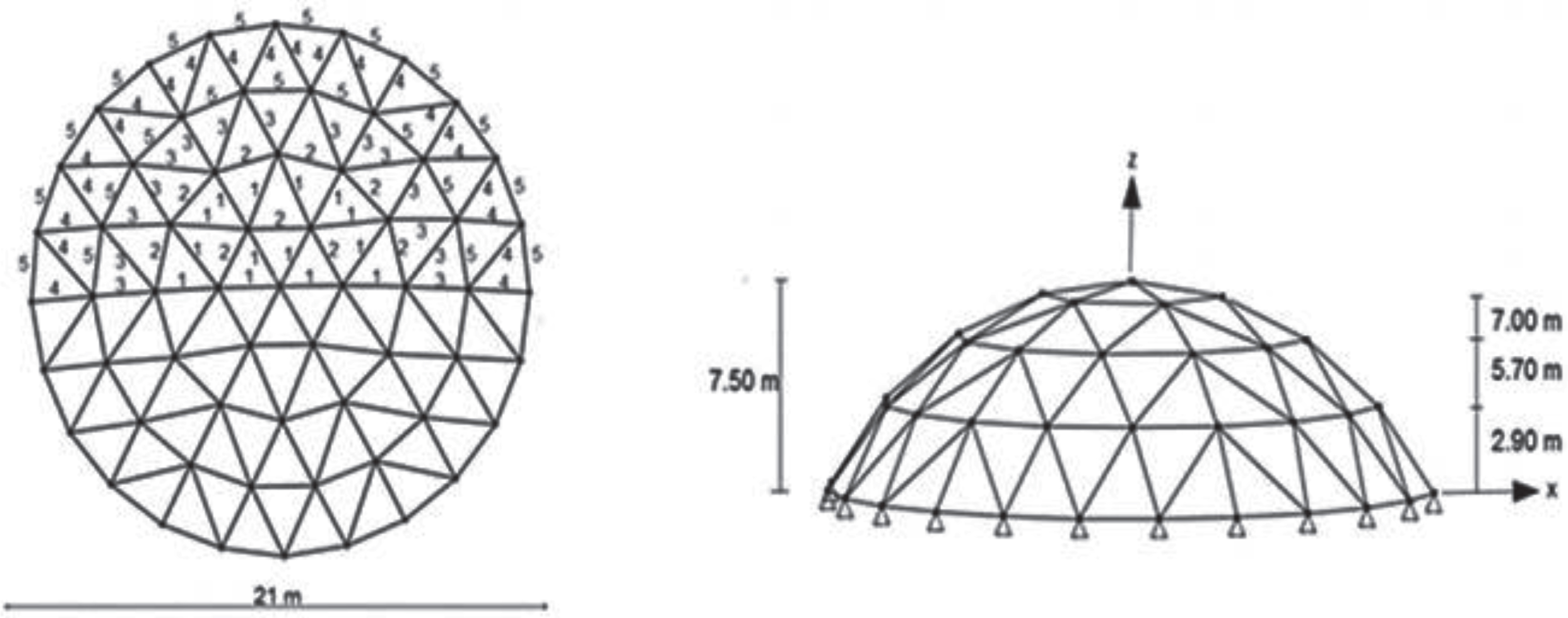
The 156-bar dome space structures.
The results presented in Table 5 show that in the case where only the reliability stress constraint is used for the optimization of the structure, the weight of the dome is approximately (19%) higher than that of the reliability constraint of displacement. As is clear from results given in Table 5, the reliability index obtained for both cases is close to each other, then it can be concluded that in this space dome, the probabilistic constraint of stress is a decisive factor, and the probabilistic constraint of displacement does not have much impact on the optimal weight. If we investigate the forces and displacement of the structure in the case where the displacement constraint is a probabilistic one, we see that the displacement computed in this case (2.5 mm) is equivalent to (4.3%) the allowed displacement (58 mm), such that it indicates the rigidity of this type of structure.
Optimum results for 156 -bar dome truss structure
In this section, the optimization of a 176-bar space dome with 10 meters span and 5 meters height as shown in Fig. 6 is investigated This space dome is under the uniform external uniform loads of 200kg/m2 . The structure consists of 65 nodes and 176 members, such that structural members are classified into five groups, and the tensile stress, slenderness ratio and buckling stress are calculated in accordance with ASD-AISC regulations.
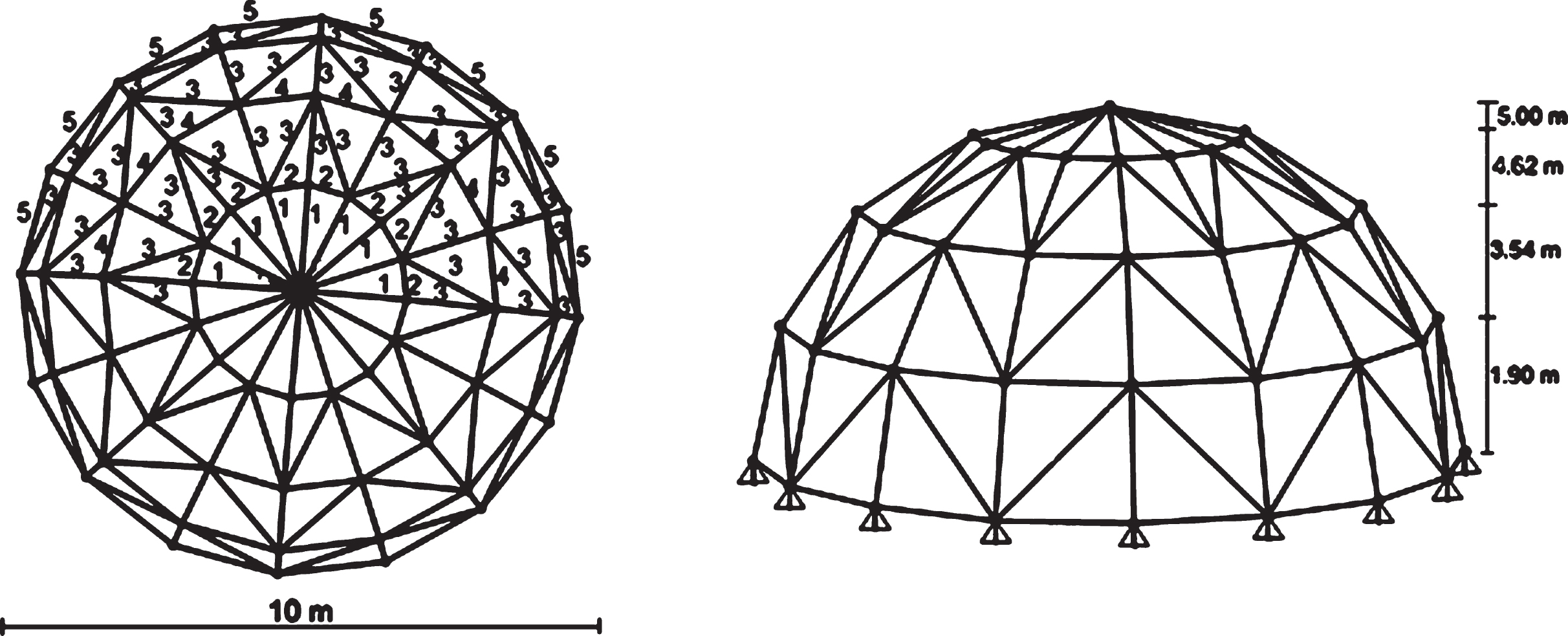
The 176 bar dome space structures.
Other parameters are taken similar to the case given in Section 6.2. The maximum permitted displacement of nodes in all directions is taken equal to 27.8mm. In this case, the effects of different probabilistic constraints on the optimal space dome weight are evaluated on the basis of reliability analysis. The three probabilistic constraints are take,
Optimum results for 176-bar dome space structures
Reliability-based optimization algorithm is used to obtain the weight of space structures doms and to choose the best combination of the structural members that have the lowest weight and the highest safety. In this method, the effect of three probabilistic constraints of stress, displacement, and their combination on the optimal weight of the structure has been investigated respectively. For the 120-member dome with a span-to-height ratio of 0.22, the results show that the effective constraint according to the lower weight is the displacement control. But in domes with 156 and 176 members, the span-to-height ratio of which is greater than 0.3, the amount of axial force increases and the amount of deflection decreases. For this reason, in these domes, the effective constraint is the stress constraint in the structure. Therefore the effective constraints to determine the optimal weight of space domes may change by changing in the span-to-height ratio, and, hence, in order to obtain the optimal logical weights, we must incorporate the effects of both probabilistic stress and displacement constraints.