In this paper, by using the fuzzy CESTAC method and the CADNA library a procedure is proposed to control the step size for solving the fuzzy differential equation with fuzzy boundary conditions based on the finite differences method under generalized H-differentiability (gH-differentiability). An algorithm is presented to implement the discrete stochastic arithmetic for solving the given fuzzy boundary value problem on the C++ code via the CADNA library. Also, a theorem is proved to show the accuracy of results based on the concept of the common proximity of two fuzzy numbers. Finally, some examples are solved by using the proposed algorithm to illustrate the effectiveness of applying the stochastic arithmetic (SA) in place of the floating-point arithmetic (FPA) to validate the results and find the optimal solution.
The study of fuzzy differential equations (FDEs) forms a suitable setting for the mathematical modeling of real world problems in which uncertainty or vagueness pervades. Hence solving FDEs in both initial and boundary conditions are important topics in fuzzy mathematics and its applications [15, 26]. In recent years, different numerical and analytical approaches were proposed to find the fuzzy solution of a given FDE such as [6, 31]. In these works, the exact solution of the FDE must be determined in order to compare with the computed results when a numerical scheme has been considered. Since the calculations are based on the FPA, a fixed number of iterations or a constant step size is assumed to implement the algorithms by a package like Matlab, Maple or Mathematica. In this case, the accuracy of the results cannot be verified and optimized. Finite precision computations may affect the stability of algorithms and the accuracy of computed solutions. In fact, the numerical result provided by an algorithm is affected by a global error, which consists of both a truncation error and a round-off error. Computation of the solution of many problems in scientific computing involves a step size h. As h decreases, the truncation error also decreases, but the round-off error in the method may increase. Here, the problem is to find the optimal step size hopt which minimizes the global error. In general, it is difficult to estimate the optimal step size in an algorithm. So, it needs to replace a new arithmetic to validate the results of numerical algorithms. Vignes and La Porte [32–34] proposed the SA to substitute for the common computer arithmetic. Vignes planned the CESTAC method [35, 36] to implement the discrete stochastic arithmetic (DSA). In the sequel, Chesneaux designated a library called CADNA [17, 25], to implement the CESTAC method automatically on a code written by ADA, Fortran or C++. This library has been applied to validate the results of different algorithms for solving various problems such as [1–5, 28]. In [21], the authors proposed a procedure to obtain the optimal step size for solving fuzzy differential equation by using fuzzy Runge-Kutta method.
In this paper, a procedure is presented to control the step size for solving fuzzy differential equations with fuzzy boundary conditions and under gH-differentiability based on the finite differences method [9]. Also, a characterization theorem presented by Bede [11] and Bede and Gal [13] is used, which describes that an FDE under the H-differentiability and gH-differentiability is equivalent to a system of ODEs under certain conditions that are appropriate for solving FDEs numerically. It is shown, by using the CESTAC method and the CADNA library, the optimal iteration of the fuzzy finite differences method can be dynamically computed and its accuracy can be estimated. By using this library, we determine the optimal step size, and we find the approximate solution of the FDE at the nodal points. Then, the CESTAC method and the SA are used to validate the results and implement the numerical examples.
Let the following fuzzy linear two-point boundary value problem (FBVP)
where g1 (t), g2 (t) and f (t) are real continuous functions and the values of g2 (t) are positive on [a, b] and and are fuzzy numbers [9].
This paper is organized as follows, in Section 2, the basic definitions of fuzzy numbers and fuzzy sets are presented briefly. In Section 3, the main idea is given, including a brief description of fuzzy finite differences method. Also, a theorem is proved to illustrate the accuracy of the proposed method. The fuzzy CESTAC method in companion with an algorithm which is implemented by the CADNA library to solve Eq. (1) are given in Section 4. In Section 5, two numerical examples are solved to illustrate the importance of using the stochastic arithmetic to validate the results based on the given algorithm.
Preliminary
The basic definitions of fuzzy mathematics are given in [8, 23]. In this section, we review some of them.
Definition 1. [23] Given the definition domain U, the mapping X: U ⟶ [0, 1], is called a fuzzy set. X (u) is denoted as the membership function, whose values locate in a closed interval [0, 1]. If only the point values 0 and 1 are suitable, the fuzzy set X degenerates into a classical one, which means that the classical set is a special form of the fuzzy sets.
Definition 2. [23] Given a fuzzy set X, for any r ∈ [0, 1], the classical set [X] r = {u: u ∈ U, X (u) ≥ r} is defined as the r-cut set, where r is the cut level. Usually, the cut sets are considered as intervals of confidence, since in the case of convex fuzzy sets, they are closed intervals associated with a gradation of confidence between [0, 1]. Also, support of X is supp (X) = {u ∈ U: X (u) >0}. The addition X ⊕ Y and the scalar multiplication are defined as having the level cuts
So, the product and division of two fuzzy numbers is
For a fuzzy interval X, its r-cuts are closed intervals in and we denote them by [X] r = [x− (r), x+ (r)]. Two widely used of fuzzy intervals are triangular and trapezoidal fuzzy intervals.
Let us denote by the set of all fuzzy numbers, however, fuzzy numbers are generalized closed intervals.
Definition 3. The generalized Hukuhara difference of two intervals, , (gH -difference) is defined as follows [23]:
Consider [Z] r = [z− (r), z+ (r)] then z− (r) = min {x− (r) - y− (r), x+ (r) - y+ (r)} and z+ (r) = max {x− (r) - y− (r), x+ (r) - y+ (r)}.
Definition 4. [23] Define by
where is Hausdorff distance between two fuzzy intervals with the properties
Definition 5. [9, 23] A function is called a fuzzy function. If for arbitrary fixed and ɛ > 0, a δ > 0 such that
exists, Y is said to be continuous.
Generalized derivative: [23, 29] Let (jth-order differential of Y) for all j = 0, 1, …, n − 1 and . Y(j) is called gH-differentiable (gH-differentiable for short) at t0, if there exists for all j = 0, 1, …, n − 1, such that
also we say that Y(j), j = 0, 1, …, n − 1 is gHi-differentiable at t0 if
and we say that Y(j), j = 0, 1, …, n − 1 is gHii-differentiable at t0 if
Fuzzy Taylor formula: [8] Let are gH-differentiable for all j = 0, 1, …, n − 1 and fuzzy continuous on T. Then for s ≥ a; s, a ∈ T
where
Here Rn (a, s) is fuzzy continuous on T and ∑* denotes the fuzzy summation.
Theorem 1. [23, 27] Let us consider y′′ = F (t, x (t), x′ (t)) where is such that
[F (t, x (t), x′ (t))] r = [f− (t, x, x′) (r), f+ (t, x, x′) (r)] for each r ∈ [0, 1].
The functions f− (t, x, x′) (r),and f+ (t, x, x′) (r) are equi-continuous, i.e. for any ɛ > 0 there exists δ > 0 such that for any we have absf− (t, y, z) (r) - f− (t1, y1, z1) (r) < ɛ and absf+ (t, y, z) (r) - f+ (t1, y1, z1) (α) < ɛ whenever norm (t, y, z) - (t1, y1, z1) < δ.
[F (t, x (t), x′ (t))] r is named uniformly bounded on any bounded set, if exist l > 0 such that
and also
Then, for the FBVP (1) and the corresponding BVPs systems are equivalent.
Main idea
In order to solve Eq. (1) by the finite differences method, the interval [a, b] is divided into N equal subintervals by the grid points ti = t0 + ih, i = 0, 1, …, N where h = (b - a)/N. At the interior mesh points, ti, for i = 1, …, N, the solution of a differential equation is
Expanding in a third fuzzy Taylor formula [9] and applying definition of standard difference and definition 2, we get
so
thus
for each i = 1, 2, …, N.
A finite differences method with truncation error of order results by using above equation together with the boundary conditions and to define the system of linear equations
g1 (ti) >0 for i = 1, …, N
g1 (ti) <0 for i = 1, …, N
where are approximation of . Also, the are approximation of for i = 1, 2, …, N with the step size h, similarly for step size . The local truncation error with step size h can be written as
where is independent of h. With step size
however, we can rewrite
Bede [11] defined the Characterization Theorem that provides certain conditions under which an FDE is equivalent to a system of ODEs with respect to H-differentiability. Thereafter, Bede and Gal [13] proposed another version of this theorem for solving FDEs under gH-differentiability. Both of these characterization theorems are employed to transfer the FDEs under fuzzy differentiability to ODEs systems. So, A. Khastan, J.J. Nieto [27] by using Characterization Theorem under gH-differentiability, present a method for translating a FBVP to a system of BVPs. Based on Definition 2, gH(i)-differentiable, gH(ii)-differentiable and the Characterization Theorem 1 [27], each of Eqs. (2) and (3), under certain conditions, we may replace by two equivalent BVPs systems.
In any case, we have system of linear equations with 2N equations as
where elements of the matrix and vector , are obtained by Eqs. (2) and (3). The solution of this system of linear equations gives the finite differences solution of Eq. (1) satisfying its fuzzy boundary conditions.
Definition 6. For two distinct fuzzy numbers and in the notation means the common proximity between and , which is defined as,
Remark 1. The defuzzification, the 1-cut of Eq. (10) is as follows
where the notation Cx,z is estimation of the number of common significant digits between two distinct real numbers x and z [1,15, 1,15]. For instance, if Cx,z = 3, the relative difference between x and z is of the order of 10−3, which means that x and z have three significant decimal digits in common.
Example 1. Assume
and are two fuzzy numbers, then based on Definition 6, we easily see that common proximity between and become actually different from the fourth position namely .
We prove the following theorem for computing of the common proximity of each corresponding components of the computed solution and the exact solution for a FBVP using finite differences method.
Theorem 2. Suppose , are the approximate values of in two successive iterations respectively obtained from the fuzzy finite differences method to solve FBVP (1). Then
Proof. By using Eq. (6), we deduce
then
Similarly, from Eq. (8), we get
From Definition 6 and Eq. (12) we have
Therefore
Similarly, by using Definition 6 and Eq. (13) the following formula can be obtained as
Finally
This theorem shows, if h is small enough, then the number of common proximity between and is almost equal to the number of the common proximity between and . It is necessary to mention that According to Eq. (11),
For k = 2:
For k = 3:
CESTAC method
In many numerical iterative and approximate recursive schemes, the absolute error is applied to show the accuracy of the method. In order to apply the absolute error, existence of the exact solution is necessary. In the iterative algorithms which are constructed based on the common FPA, the termination criterion depends on a tolerance parameter like epsilon (eps) as follows:
where ψ is the exact solution and Zm is the m-th computed result obtained from the iterative algorithm. This criterion may not be acceptable. If eps is chosen very large, the iterations are stopped before getting access to a suitable approximation. If eps is chosen very small then, unnecessary iterations are done without improving the accuracy of the results. So, it can not been determined the optimal iteration m by applying a tolerance in the stopping criterion. Also, if one applies the criterion absZm - Zm+1 < eps, in place of the condition (1), it is not any guarantee to confirm Zm is an approximation of ψ without knowing the exact solution. This is because of the nature of the FPA. Therefore, it needs to be suggested other way which is independent of this tolerance. For this purpose, we must replace the FPA by a new arithmetic so that it is able to omit the tolerance epsilon in the termination criterion. This new environment is the stochastic arithmetic. The details of this arithmetic can be found in [1–5, 32–36]. In order to use this arithmetic in discrete case, the CESTAC method should be applied [20, 36]. This method is able to validate the results and detect any instability step by step during the run of a code. The algorithm of this method is based on the concept of common significant digits. In this case, the following termination criterion is substituted which is independent of the value epsilon.
where the symbol @.0 is denoted as the informatical zero which means the corresponding value (difference between two sequential results) has not any significant digits and hence in the point of computational view we can say Zm ≅ Zm+1. Eq. (17) means when the difference between two sequential results is an informatical zero, the computations must be stopped and any calculations after m-th iteration is redundant. In order to implement the CESTAC method, the CADNA library was designated by Chesnueax [17, 25]. This library is able to perform the discrete stochastic arithmetic and the CESTAC method automatically on any C++ or Fortran code. So, in order to apply it, the main code must be written in one of this programming languages.
The CESTAC method was developed by La Porte and Vignes [34]. This method is able to detect numerical instabilities which occur during the run and estimate accuracy of the computed results. During the run, as soon as the number of the significant digits of any result becomes zero, an informatical zero is detected and the result is printed by the notation @.0.
The basic idea of the CESTAC method is to replace the usual FPA with a random arithmetic. Consequently, each result appears as a random variable. This approach leads toward two concepts: stochastic numbers and stochastic arithmetic.
The applying of the CESTAC method in a scientific program has the following advantages:
The accuracy of any numerical result is estimated, during the running of a program.
The numerical instabilities are detected and the branching are checked.
Unnecessary iterations are eliminated, which the FPA is not able to distinguish them. In some cases, the termination criterion of iterative methods is not suitable so that, the implementation of the algorithm is continued without improvement in the accuracy of the result. In the SA, instead of the termination criterion, a criterion that directly reflects the mathematical condition, is replaced, that must be satisfied by the solution.
It is able to find the optimal step of the iterative methods, which after this step, the accuracy of the result does not increases or maybe decrease, because of the rounding error accumulation.
It is an effective and powerful tool that helps to achieve the validation of scientific programs and gives them a reliable.
Let F be a set of real values which are reproduced by computer and the arbitrary value ψ is demonstrated as Ψ ∈ F. In the personal computer (PC), Ψ with the binary FPA, ρ mantissa bits and the rounding error term is shown by
where 2−θρ is the missing segment of mantissa which is obtained from round-off error, ɛ is the sign of ψ, E is the binary power of the outcome. If ρ is a random parameter on [-1, 1] which is distributed uniformly and is applied to perturb on the last mantissa bit of Ψ then, the random result of Ψ can be calculated where mean (μ) and standard deviation (σ) are applied to guarantee the precision of results [32–36].
In PC, for θ = 24, 53 the results can be obtained by single or double precisions respectively. By L times performing the process for Ψi, i = 1, …, L the distribution of them is in the quasi Gaussian form. Therefore, the mean of them is equal with the exact value of ψ and the values of μ and σ can be estimated by these L samples. The following algorithm of CESTAC method is presented where τδ is the value of T distribution with L − 1 degree of freedom and confidence interval 1 - δ.
Algorithm 1.
1- Find L samples for Ψ as Φ ={Ψ1, Ψ2, …, ΨL} by means of the perturbation of the last bit of mantissa.
2- Compute.
3- Calculate.
4- Compute as the common significant digits between Ψ and Ψave.
5- If CΨave,Ψ ≤ 0 or Ψave = 0, then write Ψ =@.0.
In the sequel, Algorithm 1 is developed in fuzzy case.
Fuzzy CESTAC method
Let be a fuzzy number in . Then, is represented as in the computer. It can be shown that:
where, ɛ is the sign of y± (r), and 2−Pz± (r) is the lost part of the mantissa due to round-off error for r ∈ [0, 1] and E is the binary exponent of the results. In the fuzzy CESTAC method, z± (r), 0 ≤ r ≤ 1 is considered as fuzzy random variable uniformly distributed on [-1, 1]. In order to find L samples for the obtained random variables, we perturb the last mantissa bit of the values v± (r), 0 ≤ r ≤ 1. The algorithm of the fuzzy CESTAC method is as follows where τβ is the value of T distribution with L − 1 degree of freedom and confidence interval 1 - β. If L = 3 and β = 0.05 then τβ = 4.303.
Algorithm 2.
Find L samples for as
Compute
Compute denotes the fuzzy product.
Compute as the common estimated proximity between the exact value and the approximate value .
If then write v± (r) = @.0, r ∈ [0, 1].
CADNA library
The CADNA library is a tool to implement the SA automatically. The first goal of this library is the estimation of the accuracy of each computed result. The CADNA detects numerical instabilities (informatical zero) during the run of the program. The CADNA works in Fortran or C++ codes on the Linux operating system [25]. When a result is a stochastic zero (i.e. is insignificant), the symbol @.0 is printed. The CADNA detects numerical instabilities during the run of the program. For more details about this library, we refer the reader to "http://www-pequan.lip6.fr/cadna".
We divide the interval [0, T] into sub-intervals, and then obtain the optimal h by increasing n when n = 1, 2, 3, … by using following algorithm. According to the previous results, by using the Fuzzy CESTAC method and the CADNA library, we consider as the stopping criterion. In order to solve FBVP (1) in the stochastic arithmetic, we use the following algorithm by applying fuzzy finite differences method. Suppose , are the approximate values of in two successive iterations obtained from the fuzzy finite differences method. For the termination criterion, we consider the Hausdorff distance to be an informatical zero (@.0).
Algorithm 3.
1- Input h = T/N and let
2- Find and by using system (9),
3- If then stop.
4- Else h: = h/k and goto step 2.
5- EndIf.
Numerical Examples
According to Algorithm 3 and Theorem 2, by using the CESTAC method and the CADNA library, we apply as a stopping criterion which allows us to estimate the optimal step size as soon as the difference between and is equal to the computational zero. In this case, by the theoretical results presented in Section 3, the common proximity between and are also the common proximity between and , up to one digit. By the proposed method, the best approximation of provided by the computer is chosen. It is necessary to mention that in all, the presented examples have been computed by the system (40). Let us now present the examples and the results which we obtain by the C++ code of the fuzzy finite differences method combined with the CADNA library on Linux in double precision. The data_st function of the CADNA library has been used to take into account the assignment error of some data of the examples which are not integer numbers and cannot be exactly coded for computer.
Example 2. Consider the fuzzy two-point boundary value problem [18]
with the boundary conditions
where in case 1-cut, the exact crisp solution is
The analytical solution according to presented method in [18] is
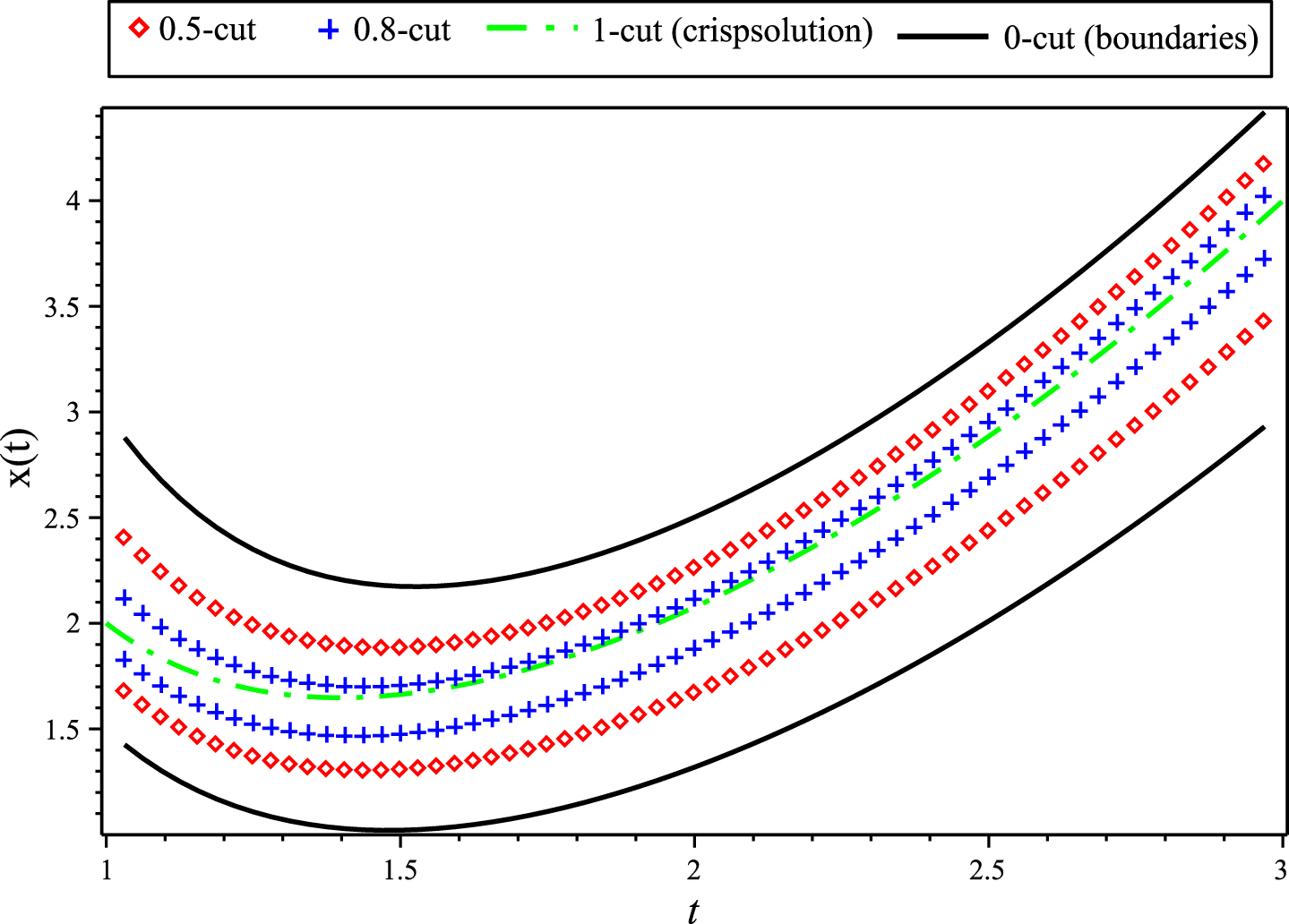
To solve Eq. (20), we use the fuzzy finite differences method. For k = 2, we divide the interval [1, 2] into N = 2n sub-intervals, and then obtain the optimal h by increasing n when n = 1, 2, 3, … based on algorithm 2. Fuzzy solution generates according to r-cuts by using fuzzy CESTAC method and CADNA library a band in tx-plane (Fig. 1).
The fuzzy solution for Example 2 and its r-cuts, h = 2-13.
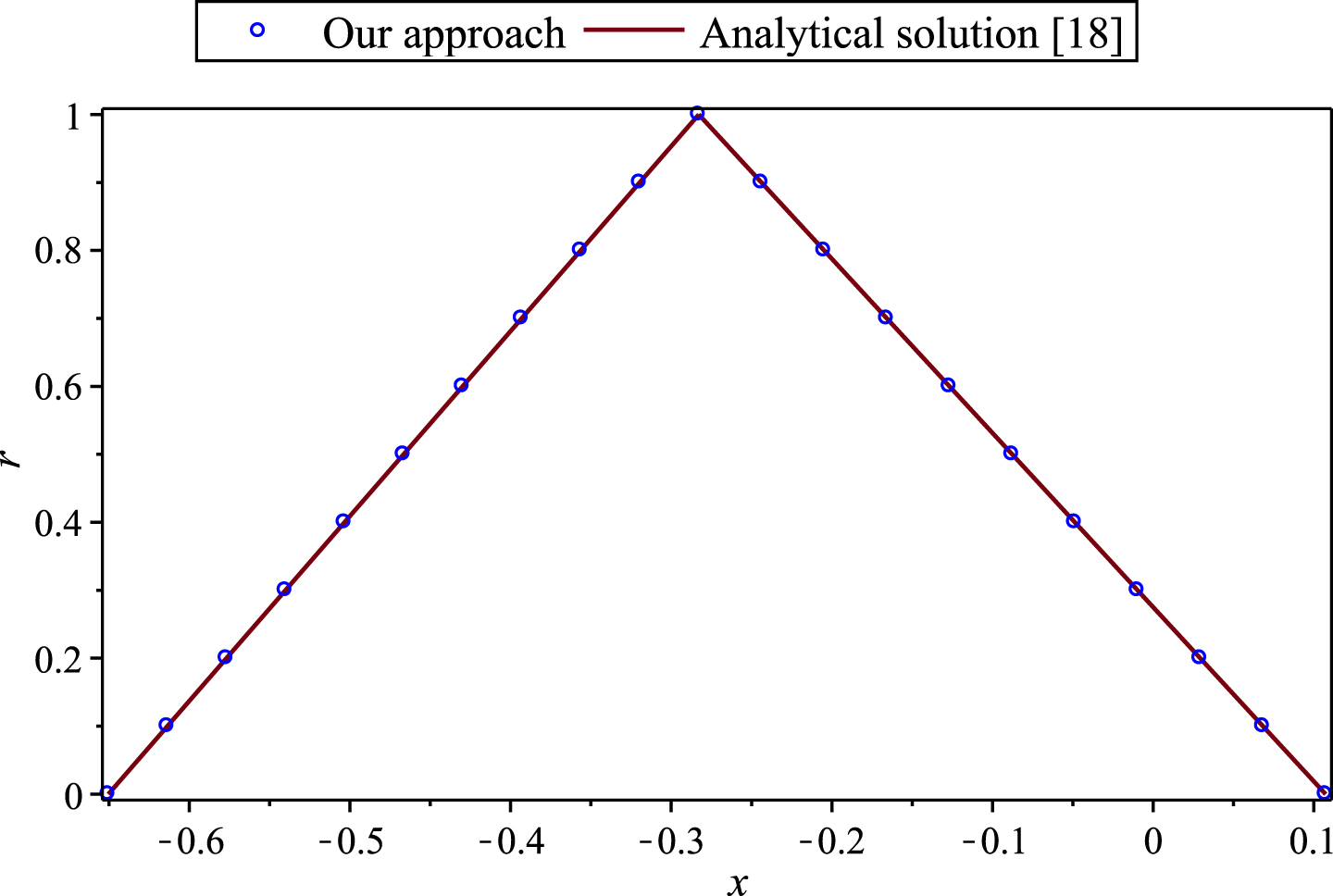
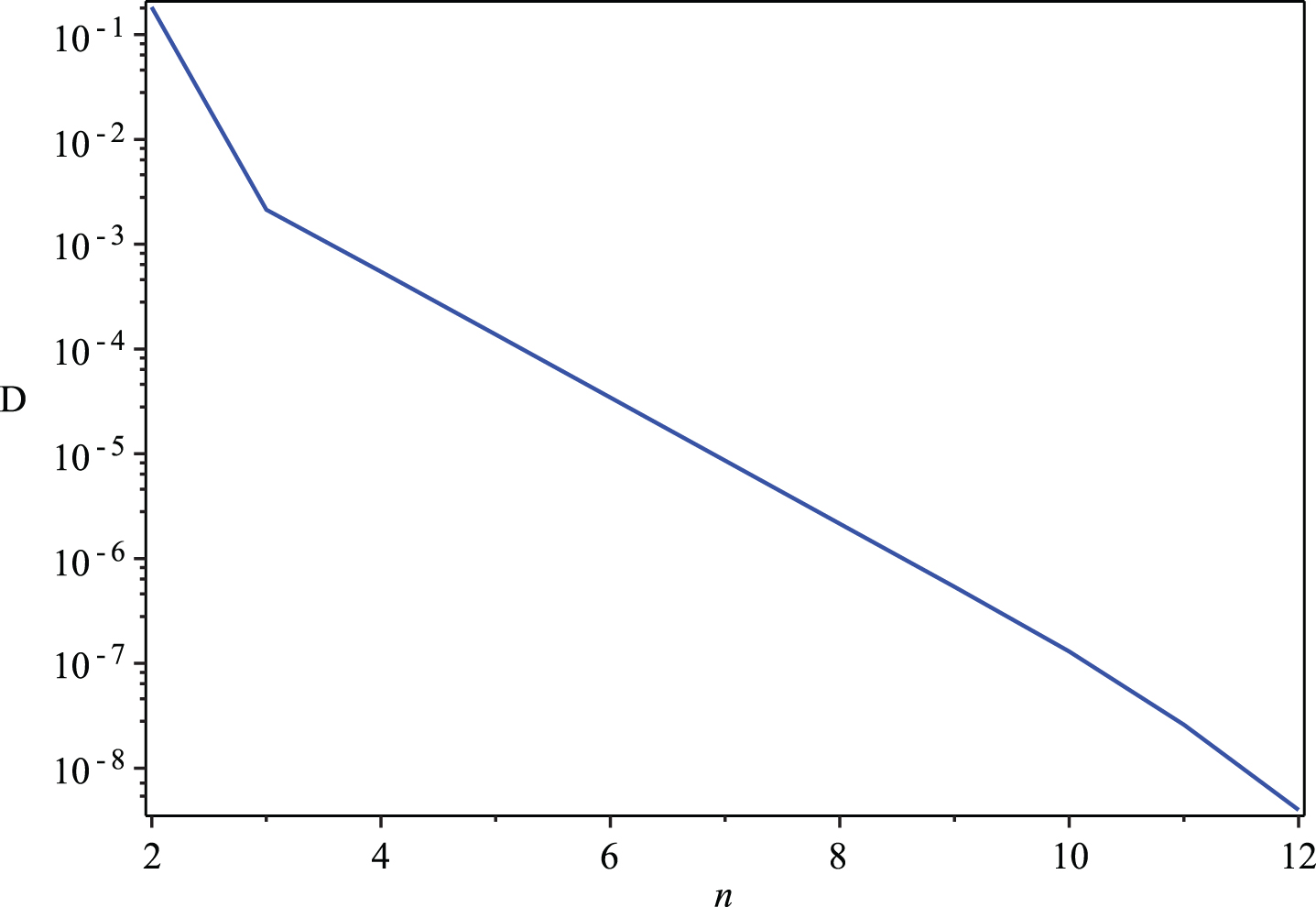
We compare the solution obtained by our method with the solution obtained by an analytical method that uses in the [18] For comparison, the results of these two methods at the point t = 2 are shown in Fig. 2. The numerical solution for different r,s are observed in columns w− (2; r) and w+ (2; r) which is optimized at n = 14, and optimal step size hopt = 2−13. In optimal step case, the Hausdorff distance between the solutions of two successive iterations equals to informatical zero (@.0). In Fig. 3 the error of iterative methods with Hausdorff distance is displayed. The results of the numerical method at the point t = 2 are shown in Table 1.
Comparison of Example 2, t = 2, h = 2-13.
Hausdorff distance of Example 2, t = 2, h = 2-n.
Numerical results of Example 2.
n
r
w− (2; r)
w+ (2; r)
2
0.5
−
−
−
−
3
0.25
0.0
0.132173767713205E+001
0.250601760745425E+001
0.1
0.13914756759707E+001
0.245732761326073E+001
0.2
0.146121367480946E+001
0.240863761906722E+001
0.100854521270E-001
⋮
⋮
⋮
1
0.201911766551909E+001
0.20191176655190E+001
4
0.125
0.0
0.13200362074344E+001
0.25031381971966E+001
0.1
0.138975457393044E+001
0.245454636471650E+001
0.2
0.14594729404264E+001
0.24059545322363E+001
0.28794102575E-002
⋮
⋮
⋮
1
0.20172198723947E+001
0.20172198723947E+001
5
0.62500E-001
0.0
0.13195936332165E+001
0.25023892254433E+001
0.1
0.13893068930870E+001
0.24538229260911E+001
0.2
0.14590201529574E+001
0.24052566267389E+001
0.7489717532E-003
⋮
⋮
⋮
1
0.20167262319210E+001
0.20167262319210E+001
⋮
⋮
⋮
⋮
⋮
⋮
12
0.48828125E-003
0.0
0.1319444453E+001
0.2502136767E+001
0.1
0.13891559921E+001
0.24535790747E+001
0.2
0.14588675307E+001
0.24050213819E+001
0.463E-007
⋮
⋮
⋮
1
0.20165598392E+001
0.20165598392E+001
13
0.244140625E-003
0.0
0.1319444446E+001
0.2502136755E+001
0.1
0.1389155985E+001
0.2453579063E+001
0.2
0.14588675236E+001
0.24050213711E+001
0.11E-007
⋮
⋮
⋮
1
0.20165598316E+001
0.20165598316E+001
14
0.1220703125E-003
0.0
0.1319444444E+001
0.2502136753E+001
0.1
0.1389155983E+001
0.2453579060E+001
0.2
0.1458867521E+001
0.2405021368E+001
@.0
⋮
⋮
⋮
1
0.201655982E+001
0.201655982E+001
Example 3. Consider the fuzzy two-point boundary value problem
with the boundary conditions
where in case 1-cut, the exact crisp solution is
The analytical solution according to presented method in [18] is
Fuzzy solution generates according to r-cuts by using fuzzy CESTAC method and CADNA library a band in tx-plane (Fig. 4).
The fuzzy solution for Example 3 and its r-cuts,
The results of finite differences method in the case k = 2 at is shown in Table 2. According to Table 3, it has been found the optimal step size hopt = 2−15π, when the Hausdoff distance equals to @.0.
Numerical results of Example 3.
n
r
w− (π/4; r)
w+ (π/4; r)
1
0.785398163397448
−
−
−
−
2
0.392699081698724
0.0
−0.65291261E+000
0.1101605E+000
0.1
−0.6159119E+000
0.7085395E-001
0.2
−0.5789112E+000
0.315473E-001
0.1829058E+000
⋮
⋮
⋮
1
−0.2829058E+000
−0.2829058E+000
3
0.196349540849362
0.0
−0.6509902E+000
0.1080245E+000
0.1
−0.61417742E+000
0.6893585E-001
0.2
−0.57736461E+000
0.298471E-001
0.21360E-002
⋮
⋮
⋮
1
−0.2828620E+000
−0.2828620E+000
4
0.981747704246810E-001
0.0
−0.65049004E+000
0.1074777E+000
0.1
−0.61372581E+000
0.6844523E-001
0.2
−0.57696159E+000
0.294126E-001
0.54672E-003
⋮
⋮
⋮
1
−0.2828477E+000
−0.2828477E+000
⋮
⋮
⋮
⋮
⋮
⋮
12
0.383495196971410E-003
0.0
−0.65032152E+000
0.1072943E+000
0.1
−0.61357364E+000
0.6828067E-001
0.2
−0.57682576E+000
0.292669E-001
0.26E-007
⋮
⋮
⋮
1
−0.2828427E+000
−0.2828427E+000
13
0.191747598485705E-003
0.0
−0.65032151E+000
0.1072943E+000
0.1
−0.61357363E+000
0.6828066E-001
0.2
−0.57682575E+000
0.292669E-001
0.4E-008
⋮
⋮
⋮
1
−0.2828427E+000
−0.2828427E+000
14
0.958737992428525E-004
0.0
−0.65032151E+000
0.1072943E+000
0.1
−0.61357363E+000
0.6828066E-001
0.2
−0.57682575E+000
0.292669E-001
@.0
⋮
⋮
⋮
1
−0.2828427E+000
−0.2828427E+000
The numerical results between presented method and analytical method [18] for are compared in Fig. 5. In Fig. 6 the error of iterative methods with Hausdorff distance is displayed.
Comparison of Example 3,
Hausdorff distance of Example 3, .
Conclusion
In this work, a novel arithmetic called discrete stochastic arithmetic was suggested to implement the numerical algorithm to control the step size in the fuzzy finite differences method for solving the linear fuzzy two-point boundary value problem under gH-differentiability. For this purpose, the CESTAC method and the CADNA library were applied to control the computations dynamically and find the optimal step size. Numerical examples showed that the proposed method is effective and is able to rely the computed results of the mentioned algorithm.
Many real world problems within fields such as information knowledge, engineering technologies, environmental sciences, social sciences andmedical sciences, contain uncertainties in various forms. It is known that these types of uncertainties cannot be modeled by the customary analytical techniques. Soft set theory and rough set theory [30, 37–40] are mathematical tools for dealing with uncertainties and are closely related. The main purpose of soft rough set is reducing the soft boundary region by increasing the lower approximation and decreasing the upper approximation. Rough set theory has attracted worldwide attention of many researchers and practitioners, who have contributed essentially to its development and applications. Rough set theory overlaps with many other theories. Despite this, rough set theory may be considered as an independent discipline in its own right. The rough set approach seems to be of fundamental importance in artificial intelligence and cognitive sciences, especially in research areas such as machine learning, intelligent systems, inductive reasoning, pattern recognition, image processing, signal analysis, knowledge discovery, decision analysis, and expert systems. As well, soft set theory can have a bearing on making decisions in many fields. Particularly important is parameter reduction of soft sets, an essential topic both for information sciences and artificial intelligence. Therefore in the future, we can investigate by using the CESTAC method and the CADNA library some algorithms of parameter reduction based on some types of soft sets.
Footnotes
1
Control et Estimation Stochastique des Arrondis de Calculs.
2
Control of Accuracy and Debugging for Numerical Application.
Acknowledgment
The authors would like to thank the anonymous reviewers for their constructive comments to improve the quality of this work.
References
1.
AbbasbandyS. and Araghi FariborziM.A., A Stochastic scheme for solving definite integrals, Appl Num Math55 (2005), 125–136.
2.
AbbasbandyS. and Araghi FariborziM.A., The use of the stochastic arithmetic to estimate the value of interpolation polynomial with optimal degree, Appl Numer Math50 (2004), 279–290.
3.
AbbasbandyS. and Araghi FariborziM.A., A reliable method to determine the ill-condition functions using stochastic arithmetic, Southwest J Pure Appl Math1 (2002), 33–38.
4.
AbbasbandyS.
and Fariborzi AraghiM.A., Numerical solution of improper integrals with valid implementation, Math Comput Appl7 (2002), 83–91.
5.
AbbasbandyS.
and Araghi FariborziM.A., The valid implementation of numerical integration methods, Far East J Appl Math8 (2002), 89–101.
6.
AbbasbandyS., AllahviranlooT., Lopez-PousoO.
and NietoJ.J., Numerical methods for fuzzy differential inclusions, Journal of Computer and Mathematics with Applications48 (2004), 1633–1641.
7.
AhmadianA., SalahshourS., ChanC.S.
and BaleanuD., Numerical solutions of fuzzy differential equations by an efficient Runge-Kutta method with generalized differentiability, Fuzzy Sets and Systems331 (2018), 47–67.
8.
AnastassiouG.A., Fuzzy Mathematics: Approximation Theory. Springer, Berlin (2010).
9.
AllahviranlooT.
and KhalilpourK., A numerical method for two-point fuzzy boundary value problems, World Appl Sci J 1310 (2011), 2137–2147.
10.
BaloochM.R.
Shahriyar, IsmailF., AghabeigiS., AhmadianA.
and SalahshourS., An eigenvalue-eigenvector method for solving a systemof fractional differential equations with uncertainty, Mathematical Problems in Engineering (2013). ID 579761.
11.
BedeB., Note on Numerical solution of fuzzy differential equations by predictor-corrector method, Inform Sci178 (2008), 1917–1922.
12.
BedeB.
and GalS.G., Generalizations of the differentiability of fuzzy-number-valued functions with applications to fuzzy differential equations, Fuzzy Sets Syst151 (2005), 581–599.
13.
BedeB.
and GalS.G., Solutions of fuzzy differential equations based on generalized differentiability, Commun Math Anal9 (2010), 22–41.
14.
Sh.BehzadiS., VahdaniB., AllahviranlooT.
and AbbasbandyS., Application of fuzzy Picard method for solving fuzzy quadratic Riccati and fuzzy Painleve I equations, AppMath Mod40 (2016), 8125–8137.
ChesneauxJ.M.
and JezéquelF., Dynamical control of computations using the trapezodial and simpsons rules, J Universal Comput Sci4 (1998), 2–10.
17.
ChesneauxJ.M., CADNA: An ADA tool for round-off errors analysis and for numerical debugging, In ADA in Aerospace, Barcelone, Spain, 1990.
18.
GasilovaN., EmrahS.
Amrahovb and FatullayevaA.G., Solution oflinear differential equations with fuzzy boundary values, Fuzzy Sets and Systems257 (2014), 169–183.
19.
Chalco-CanoY.
and Romtan-FloresH., On new solutions of fuzzy differential equations, Chaos, Solitons and Fractals38 (2008), 112–119.
20.
Fariborzi AraghiM.A., The methods of valid implementation of the numerical algorithms, Phd dissertation thesis, Science andresaerch branch, Islamic Azad University, 2002.
21.
FariborziM.A.
Araghi and Barzegar KelishamiH., Dynamical control of accuracy in the fuzzy Runge-Kutta methods to estimate the solution of a fuzzy differential equation, Journal of Fuzzy Set Valued Analysis 2016 SI1 (2016), 71–84.
22.
FariborziM.A.
Araghi and FattahiH., Solving fuzzy Linear systems in the stochastic arithmetic by applying CADNA library, In Proceedings of the International Conference on Evolutionary Computation Theory and Applications, 2011, pp. 446–450.
23.
GomesL.T., BarrosL.C.
and BedeB., Fuzzy Differential Equations in Various Approaches, Springer, ISBN: 978-3319-22574-6, 2015.
24.
JézéquelF., Contrôle dynamique de méthodes d’ approximation, Habilitation á diriger des recherches, Université Pierre et Marie Curie, Paris, 2005.
25.
JezequelF.
and ChesneauxJ.M., CADNA: A library for estimating round-off error propagation, Computer Physics Communications178 (2008), 933–955.
26.
KalevaO., A note on fuzzy differential equations, Nonlinear Analysis64 (2006), 895–900.
27.
KhastanA.
and NietoJ.J., A boundary value problem for second order fuzzy differential equations, Nonlinear Anal72 (2010), 3583–3593.
28.
Khojasteh SalkuyehD., ToutounianF.
and Shariat YazdiH., A procedure with stepsize control for solving n onedimensional IVPs, Math Comput in Simulation79 (2008), 167–176.
29.
LiuH.-K., Comparison results of two-point fuzzy boundary value problems, Int J Comput Math Sci5 (2011), 1–7.
30.
MaX., ZhanJ., AliM.I.
and MehmoodN., A survey of decision making methods based on two classes of hybrid soft set models, Artificial Intelligence Review49(4) (2018), 511–529.
31.
SeikkalaS., On the fuzzy initial value problem, Fuzzy Sets Syst24 (1987), 319–330.
32.
VignesJ., A stochastic arithmetic for reliable scientific computation, Math Comp Simul35 (1993), 233–261.
33.
VignesJ., New methods for evaluating the validity of the results of mathematical computations, Math Comp Simul20 (1978), 227–249.
34.
VignesJ.
and La PorteM., Error analysis in computing, in: Information Processing 1974, North-Holland, 1974, pp. 610–614.
35.
VignesJ., A stochastic approach to the analysis of roundoff error propagation. A survey of the CESTAC method, in: Proc 2nd Real Numbers and Computers Conference, Marseille, France, 1996, pp. 233–251.
36.
VignesJ., Discrete stochastic arithmetic for validating results of numerical software, Num Alg37 (2004), 377–390.
37.
ZhangL.
and ZhanJ., Fuzzy soft β-covering based fuzzy rough sets and corresponding decision-making applications, Int J Mach Learn Cybern (2018). DOI: 10.1007/s13042-018-0828-3
38.
ZhanJ.
and WangQ., Certain types of soft coverings based rough sets with applications, Int J Mach Learn Cybern (2018). 10.1007/s13042-018-0785-x.
39.
ZhanJ.
and J.AlcantudC.R., A novel type of soft rough covering and its application to multicriteria group decision making, Artificial Intelligence Review (2018). 10.1007/s10462-018-9617-3
40.
ZhanJ.
and J.AlcantudC.R., A survey of parameter reduction of soft sets and corresponding algorithms, Artificial Intelligence Review (2018). DOI 10.1007/s10462-017-9592-0